“The Texas educational system inundates the children with the almost mythical stories of Sam Houston, Stephen F. Austin, and other Texan heroes. This perpetuates the feeling that Texans are superior to others. Social Identity Theory claims that in-group biases are a direct need to feel superior to another group. By reinforcing such ideals of Texas history at an early age, they are indirectly making Texans feel superior to other states.”

Don’t mess with Texas, Justin R.Erenkranz, retrieved on February 18, 2021

In fact, Texans are so proud of their state, and so confident in themselves, that their power grid, run by ERCOT – Electric Reliability Council of Texas, has no connections linking it to the outside world.
Yes, your eyes are OK. Texas – most of it, anyway, cannot import electric energy. No matter what!

For those who know anything about power management, this is insane.
For the rest of the people, this sounds like gibberish.

Who cares where the power comes from?!?

Until it stops coming… exactly when you need it most!

Texas produces and consumes more electricity than any other state, but it is the only state in the continental United States that runs a stand-alone electricity grid, which was designed to keep the state’s energy system independent and isolated from other markets.

‘OK. But surely, there are also other systems which are independent. And isolated. What about Hawai’i? It’s too far away to connect itself with anybody else and it’s doing just fine.’

True enough. And I can name a few more, easily. Only most of them are independent because they are isolated, not by design.
And, exactly because they are isolated, they are run with utmost care. More precautions are taken than in ‘normal’ situations.

‘Precaution’ meaning, in this case, spare capacity.
The responsible people running those systems make sure that, when push comes to shove, somebody is there to deliver the goods. The megawatts of power.

Since 2010, ERCOT’s reserve margin – the buffer between what it can produce vs. forecasted demand – has dropped to about 10% from about 20%. This has put pressure on generators during electricity demand spikes, making the grid less flexible, NERC said.

NERC stands for North American Electric Reliability Corporation. Which corporation, in December 2020, had released “a long term reliability study” maintaining that “ERCOT’s market and system operations have been successful over the last several years even as demand has continued to rise in Texas“. It was the same study which had mentioned that the grid was becoming “less flexible“….

SEC Rule 156 requires mutual funds to tell investors not to base their expectations of future results on past performance before they invest.

Oops…

Reality is an Acquired Taste.

Past performance is not… John Brown, Forbes, 2016

Maybe we need to reconsider our infatuation with ‘just in time management’.
While ‘just in time management’ maximizes profits by streamlining inventory, it works its magic only when everything goes according to plan. And the stricter the streamlining, the harsher the consequences of anything not going according to plan!

As people in Texas have just learned.

And there’s something else which bothers me ever since I’ve started writing this post.
How much sense does it make to be able to pipe oil all the way down from Canada to the refineries lining the Gulf of Texas when you end up freezing to death because you don’t have enough electricity to operate those refineries?!?

And no, I’m not making fun of the ordinary people who suffer the consequences!
This being the moment when I feel the need to remind you that the author of this blog – that’s me, tries to asses the consequences of our limited consciousness. Of the fact that none of us knows much. And, furthermore, that very few of us admit that!
Which consequences might be – as too often are, tragic.

Specially when those who are not aware that their knowledge is limited happen to be invested with critical decision power.
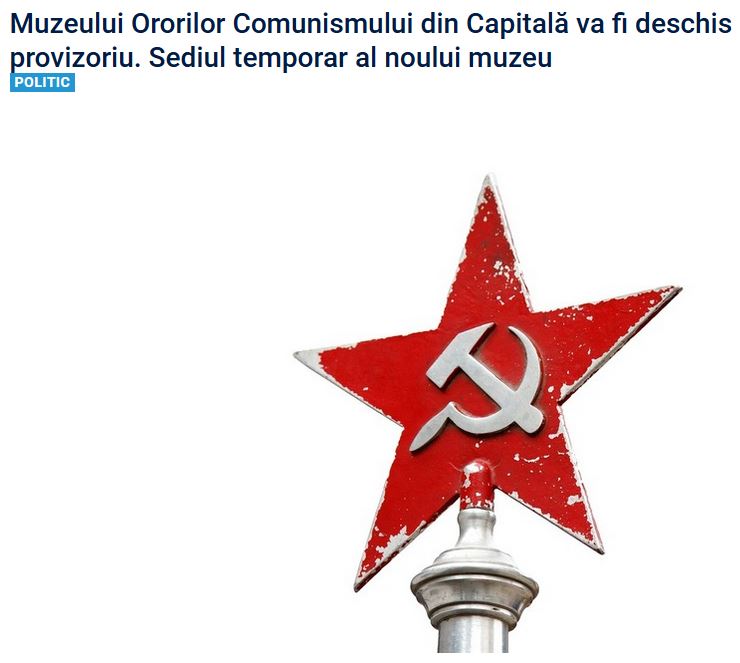
Vorbeam în postarea precedentă despre nevoia societății ca generațiile succesive să fie bine conectate între ele.
Despre nevoia societății, în ansamblul ei, ca educația să fie efectivă. Ca informațiile să circule de la o generație la alta.

Tocmai pentru ca generațiile ulterioare să nu repete, aiurea, greșelile săvârșite deja de generațiile precedente.

Muzeele sunt unele dintre locurile care facilitează transferul de informație.
Doar că efectele transferului depind în mod esențial de modul în care este ambalată înformația. Informația care urmează să fie transferată…

Așa că!

Ce urmărim?

Să ne convingem singuri că orânduirea comunistă a fost o oroare?
Mai avem nevoie de chestia asta? N-am reușit încă să transmitem singuri acest lucru generației care nu a experimentat, pe pielea ei, ororile ce urmează să fie puse în evidență?
Nu cumva asta sugerează că noi înșine nu am fost suficient de convinși?

Sau vrem să vaccinăm noile generații împotriva virusului autoritarismului?
Și atunci trebuie să transferăm și informația cu privire la circumstanțele în care:

„Timp de 68 de ani, România a avut cel mai opresiv regim totalitar dintre statele foste comuniste. La noi, cei care făceau parte din elita societății, dacă nu au fost omorâți de-a dreptul, au fost târâți în închisori, în lagărele de muncă silnică sau, în cel mai bun caz, au fost persecutați, hărțuiți, cu domiciliu! forțat, cu drepturi interzise, într-un cuvânt: anihilați.”

Profit.ro

Vrem să le transmitem copiilor noștri doar cât de slabi am fost noi?
Sau vrem să-i ajutăm să înțeleagă succesiunea de greșeli comise de generațiile care s-au succedat de la mijlocul secolului XIX și până în zilele noastre?

Pentru asta ar fi nevoie de două lucruri.

În primul rând să înțelegem noi, generația care suntem astăzi la butoane, că toată țara a fost scena „ororilor comunismului”.
Că ororile „comunismului din Capitală” au fost doar un caz special al ororilor puse la cale în fiecare colțișor al țării.

În al doilea rând, este nevoie ca Muzeul de Istorie a Comunismului din Romania să prezinte și particularitățile istorice care au dat ‘o intensitate specială’ comunismului din România.
Atât cele de origine externă: prezența trupelor sovietice și, mai ales, interesele geopolitice și istorice ale intelighenției de la Kremlin.
Cât și pe cele deja prezente.

“În martie 1949, Plenara Comitetului Central al Partidului Munctoresc Român decisese colectivizara agriculturii, dar Galațiul și Vrancea rămăsese printre ultimele județe ”libere”, pentru că aici ”oamenii locului erau îndărătnici, iar sărăcimea, puțină”.”

Cu alte cuvinte, activiștii comuniști – sprijiniți de sovietici, și-au putut face mendrele aici – mai abitir decât în restul lagărului comunist, tocmai pentru că la noi era mai multă „sărăcime”.

Înțelegem ceva din toată istoria asta?
Sau vrem să o mai aprofundăm odată?
Să mai experimentăm o tură de orori?

În toată țara, nu doar în ‘capitală’.

Anul acesta, pe caz de pandemie, ar urma ca procentul să scadă la 2.5%.

O fi bine? O fi rău?
O fi justificat ca atunci când avem nevoie de bani pentru autostrăzi să tăiem de la educație?
Sau, dacă vrem să pricepem ce se întâmplă cu adevărat, ar trebui să ne uităm și la cifrele absolute. La bani, nu doar la procente… Iar apoi și la execuția bugetară. Cât din bugetul alocat a fost cheltuit. Pe ce. Și cu ce rezultate.

Nu mi-am propus un blog de analiză economico-financiară.
Mă voi rezuma la a sădi întrebări.
Și la a trage concluzii personale.

Privesc diagrama și mă îngrozesc.
Pentru că mai am deschisă o pagină de net.

„Ultimul studiu, făcut la începutul lunii februarie, arată că peste 51% dintre români vor să se vaccineze împotriva COVID-19.”
„La acest moment avem aproape 60% dintre profesori care s-au înscris pentru a se vaccina.”
„Din rândul personalului didactic auxiliar peste 60%, 61-62% dintre persoanele din acest segment doresc să se vaccineze.”, a spus Genoveva Farcaş, inspector general şcolar ISJ Iaşi.”

Să presupunem că am căzut în cap.
Și că am uitat tot ce știam vreodată despre conceptul de vaccin.
Dar că țin minte ce înseamnă să fii profesor. Cadru didactic. Adică acel om care are menirea să învețe pe alții cum să învețe. Cum să citească și cum să caute informația de care are nevoie.

Păi dacă oamenii care trebuie să-i învețe pe conaționalii lor încă nu s-au hotărât cu privire la cum să reacționeze ‘pe caz de pandemie’… ce să ne mai mirăm de indecizia publicului larg…
Și asta la mai bine de un an de când virusul a început să ne rărească!
Să nu ne fi rărit destul?!?

Revenind la imaginea cu care am început, da, România cheltuiește mult prea puțini bani pentru educație.

Doar ca nu prea stiu cine ar trebui educati primii…

Publicul – și politicienii, cu privire la importanța sistemului de educație?
Astfel încât cei implicați în sistem să se poată bucura de toată considerația pe care ar trebui s-o merite!

Sau cei implicați deja în sistem?
Astfel încât să se ridice, cu adevărat, la înalțimea sarcinii pe care și-au asumat-o!

”Meseria de profesor nu şi-a pierdut doar “aura” prestigiului social, ci şi conţinutul. Cândva, profesorul era profesionistul unui domeniu…Acum, profesorul a ajuns un repetitor: mai înainte de toate nu are mijloacele de a se păstra în contact cu lucrurile semnificative din domeniul său, apoi nu mai are timpul, diponibilitatea (şi – de multe ori – nici formaţia necesară) pentru a le aprofunda. Cum s-a ajuns aici? Care a fost logica acestei decăderi?” 

Declasarea profesorimii române, Mihai Maci, Edupedu.ro, 2019.

Orice națiune care vrea să rămână vie are nevoie de solidaritate. Între individualitățile care constituie fiecare generație și între generații.
Generația tânără va crește sub influența celor aflate deja la maturitate.
Iar cea aflată la senectute se va bucura, sau nu, de sprijinul generațiilor pe care le-a ajutat să crească.
Iar fiecare dintre generații va avea doar atâta forță cât va fi în stare să genereze. Să genereze împreună. Ca o echipă. Ca o echipă constituită din colegi care se respectă între ei.

Înțelegem chestiile astea?
Facem în așa fel, împreună, încât cei care au chemare pentru catedră să aibe curajul să-și urmeze chemarea?
O vom duce, de la o generație la alta, din ce în ce mai bine.


Ne lăsăm în voia lui „după mine, potopul”?
Atunci vom avea surpriza să experimentăm potopul. Pe pielea noastră!

‘Are you nuts? or something?
Isn’t exactly this what the Europeans had been doing all over the world? For the last five centuries?
And you attempt to ‘nuance’ it?
Aren’t you ashamed of yourself?!?’

Ashamed of what some of my predecessors have done, yes!
Also ashamed of what some of my contemporaries are doing.
Right now, as opposed to back then.

And since there’s nothing to be done about the past, but to learn from it, and everything to be done about the future, right now, I’d rather have at least some of those statues still standing.

In public squares!
Maybe not in the same places, maybe not in the same settings. But still in public!
Hiding them in museums would mean taking them out of the limelight. Out of public scrutiny!
If we are to learn anything from past mistakes we must focus on them. Putting those statues aside because we feel too strongly about them would only serve those who don’t want to admit mistakes had been perpetrated. Who actually don’t want to own our past.

Those who had promoted Jim Crow legislation had erected the confederate statues as a symbol of their regained public influence.
Obliterating the statues won’t make anything suddenly right. The consequences of Jim Crow won’t disappear, as if by magic, along with the statues. They didn’t disappear when the legislation had been abolished and they won’t disappear now.
If we want to put the past behind us, we must accomplish what has to be accomplished. We need to make things right, not hide away the prickliest pieces of evidence.

Demolishing statues won’t help any of those living in still segregated neighborhoods. Won’t help the children going to heavily underfunded schools. And so on…
Demolishing statues will only help those who will certainly ask, in a few short years, if nothing changes in our hearts and minds:

What more do they want?!?

We’ve even dispatched those damn statues!!!

‘Handicap’ has become a dirty word…
Somewhat strange, given the breadth of its meaning. Horses get handicapped in order to even their chances to win a race. Yachts get handicapped so that different makes might participate in the same race… In these situations, its an ‘honor’ to be handicapped…

Then why has this concept, ‘political correctness’, become so ‘popular’?

You might already be familiar with the ‘upfront’ explanation.

“political correctness has reset the standards for civility and respect in people’s day-to-day interactions.”

Rethinking Political Correctness, Robin J. Ely et all, HBR Magazine, 2006

I’m convinced there was something more.
Civility and respect haven’t been invented yesterday. We’ve been polite for quite a while now.

Yeah, only politeness had been invented, and polished, when society was way more hierarchical than in is now.
In those times, when a ‘superior’ told somebody ‘you idiot’ that somebody paused to think. The ‘idiot’ could not dismiss what the ‘superior’ had just told him. The ‘idiot’ really had to make amends. He was so busy trying to correct himself that he couldn’t allow himself to feel offended. If anything, he was grateful. The ‘superior’ had made the effort to help the ‘idiot’ improve himself instead of dispatching him altogether.
In modern times, even before PC had become fashionable, calling someone’s attention about how idiotic he was behaving only made him angry. Hence dismissive and unresponsive. In an era when all people had become peers, a new ‘manner of speaking’ had to be invented in order for ‘information’ to be made ‘palatable’.

The process had been successful.
So successful that the same approach had been used when dealing with other ‘hot’ subjects. Race, gender… ‘inclusion’ in general…

In fact, the process had become too successful for its own good!

Some of the ‘enthusiasts’ have reached the conclusion that ‘everything’ is open for reconsideration.
That ‘everything’ should be closely reexamined.
According to the ideological lenses worn by the examiners, of course…

Unfortunately, the end result is rather messy.

Instead of facilitating the dialog, the stiffer and stiffer set of ‘appropriate’ ‘rules of engagement’ has almost stifled any transfer of meaningful information.

“Despite this obvious progress, the authors’ research has shown that political correctness is a double-edged sword. While it has helped many employees feel unlimited by their race, gender, or religion, the PC rule book can hinder people’s ability to develop effective relationships across race, gender, and religious lines.”

Ibid.

Not only that people find it harder and harder to understand each-other, ‘things’ themselves become blurry.

Let me give you a recent example.

In the US, many of the ex-confederated States have started to reconsider the statues commemorating ‘famous Southern figures’.
The vast majority of which had been built between 1890 and 1950, during the Jim Crow era.
Simultaneously, like minded activists have recently toppled Edward Colton’s statue in Bristol, England.

Are these two ‘developments’ similar, as PC would mandate us to understand?

Jefferson Davies – a very ‘familiar statue’ in the US, had been the President of the Confederate States of America. A slave owner himself, he was a “champion of the unrestricted expansion of slavery into the territories.” And the statues glorifying him had been erected, during the Jim Crow era, as a reminder to the fact that the Confederation may had lost the war but things hadn’t change that much.
Edward Colston, on the other side of the Atlantic, had not been a slave owner per se. In the sense that he didn’t put slaves to work for him. He was ‘only’ a purveyor of slaves. He had ‘only’ kidnapped African people and then sold them, as slaves, on the other side of the Atlantic. 10 to 20% of which had died, in horrible conditions, during the voyage. As a consequence of his ‘efforts’, Colston had become a very rich man. He had ended his involvement in the slave trading business some 30 years before his death – 1721, and used much of his wealth for charity. His statue had been built in 1895 and many of the buildings which had been raised with the money bequeathed by him bear his name. Some of those buildings are used to house schools, others as almshouses.

Now, do the statues of these two people stand for the same thing?
And no, I’m not trying to discern between two villains!

Each of them had done an immense amount of harm and had produced endless suffering. People are still smarting to this day because of what both of them had done.
Only there are some differences between them. One had also done some good in his life. While the other had been used, after his death and without his consent, as a symbol. After he had, directly, kept people in slavery he had also been used to further the sufferings of black people.

Are we capable of seeing any of these differences?
Or are we too angry to differentiate?

Do you remember why we had invented political correctness in the first place?

Despite this obvious progress, the authors’ research has shown that political correctness is a double-edged sword. While it has helped many employees feel unlimited by their race, gender, or religion, the PC rule book can hinder people’s ability to develop effective relationships across race, gender, and religious lines. Companies need to equip workers with skills—not rules—for building these relationships.


“The popularity of authors like Deutsch, Sandbrook and Foote – men of very different calibre in many different ways, but all wordsmiths who form history into desirably unchallenging packages for certain kinds of audience – is undeniable. It points to a conclusion that the wider historical profession, from schoolteachers to internationally renowned critical scholars, struggles to overcome. People, and specially people from priviledged groups, do not want historians to tell them bad things about their tresured identities. They will, indeed, forcefully react against such challenges, when given the political rallying-calls that allow them to do so. In that sense, it must be said, they do not want history. They want what they are increasingly getting: a cosy blanket of half remembering and convenient forgetting that is cushioning their slide down the slope to full-blown cultural dementia.”

Cultural Dementia, David Andress, 2018

If you have the stomach for the whole of it…

Is it enough for something to exist in order for that something to become real?

Existence = “The fact or state of living or having objective reality.”
Real = “Actually existing as a thing or occurring in fact; not imagined or supposed.”

Ooops!

Do I sense a conundrum haunting these premises?

Which came first? Reality or ‘mere’ existence?

Descartes was the first who had introduced a ‘pecking order’ into this mess.

Dubito ergo cogito.
Cogito ergo sum.

You’re free to translate this any way you want.
Mine goes like this:

My existence is certified only by my doubts.

My existence as a human being, of course.
As a conscious human!

The ‘pecking order’ being, as far as I figure it out:

I need to exist, as an animal, in order to become conscious.
And I need to gain consciousness in order to learn about my existence.

Complicated?
Let me elaborate.

Our understanding of the world is incomplete.
First of all, there are so many things we don’t know about.

For example, we have no idea what goes on between Mars and Jupiter.
We think we know that there’s no major planet hidden in between those two orbits. No object with an important enough mass to disturb either Mars or Jupiter and no object with an albedo big enough to be noticed. To be noticed by us…
Other than that… we have no clue about what’s going on there.
In fact, we don’t know much about what’s going on in the middle of our own planet… or on the floor of ‘our’ oceans…

But the fact that we don’t know about their existence doesn’t preclude the actual existence of whatever ‘objects’ and/or organisms might happen to be there.

Secondly, there are so many things we don’t fully understand. Not yet, anyway. We are aware of their existence – because we’ve been confronted with some ‘consequences’ of the aforementioned things, but we haven’t yet figured out, exactly, how those consequences have been produced.
For example, we’re still learning about viruses. About their ability to bypass our defenses. About how they infect us. About how we might improve our chances of avoiding/surviving infection.

But the fact that we don’t fully understand them doesn’t preclude us – well, some of us, from believing those viruses to be real.

My point being that ‘existence’ is far wider than ‘reality’.
There’s no need for us to know about it for something to exist.
But for something to be considered ‘real’, by us, that something needs to exist first.

‘But aren’t you contradicting yourself?
In a previous post, you argued that ‘the Flat Earth’ was real?!?’

Confusing, isn’t it?
I’m sorry if I misled you.
All I was trying to say was that ‘the Flat Earth’, as a concept, is ‘real’. In the sense that so many people discussing it – either for or against, make it real. Those very discussions, a direct consequence of the concept’s very existence – albeit only in the virtual space, give consistency to its reality.
Don’t get me wrong. The Earth – as I ‘know’ it, continues to be round. The Earth – that we live on, is not ‘Flat’. The Earth doesn’t exist as a flat object.

We are confronted with two facts here.
1. All that we’ve so far learned about it leads us to the conclusion that the Earth is, more or less, round.
2. There still are people who believe – or pretend to, that the Earth is flat.

The second fact exists.
The belief which made it possible is false. As far as we know. As far as the scientific community is convinced.
Yet the fact still remains.
Those people believing in it provide it with ‘existence’.
Those people believing in it make it ‘real’.

Sort of, anyway.

You have to give this to the guy.

You really have to give it to him.
He was absolutelly right about his supporters being loyal.
‘No matter what’ kinda loyal…

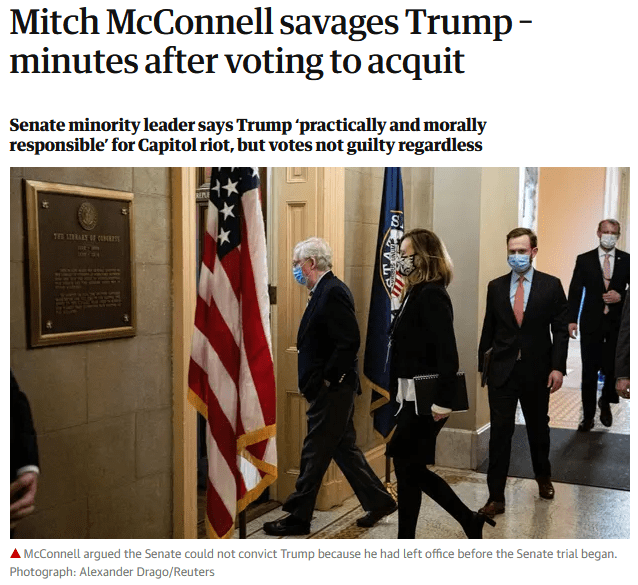
“”Most Americans want neither inaction nor retribution,” McCarthy said, despite surveys showing a majority of the country in favor of impeaching and removing Trump from office. Most Republicans do not, however.
“They want durable, bipartisan justice. That path is still available, but is not the path we are on today. That doesn’t mean the president is free from fault. The president bears responsibility for Wednesday’s attack on Congress by mob rioters. He should have immediately denounced the mob when he saw what was unfolding.
“These facts require immediate action from President Trump — accept his share of responsibility, quell the brewing unrest and ensure that President-Elect Biden is able to successfully begin his term. And the president’s immediate action also deserves congressional action, which is why I think a fact-finding commission and a censure resolution would be prudent. Unfortunately, that is not where we are today.””

““Well, Kevin, I guess these people are more upset about the election than you are,” Trump said, according to lawmakers who were briefed on the call afterward by McCarthy.”

As for the fact finding mission… I wonder!
Given the amount of loyalty extended to Trump by Kevin McCarthy, how many years might pass before the facts will be ‘found’?

5?!? And who would be fingered for ‘starting the whole thing’?

Where there’s a will there’s a way

According to the internet, this proverb is way older than the American Constitution.

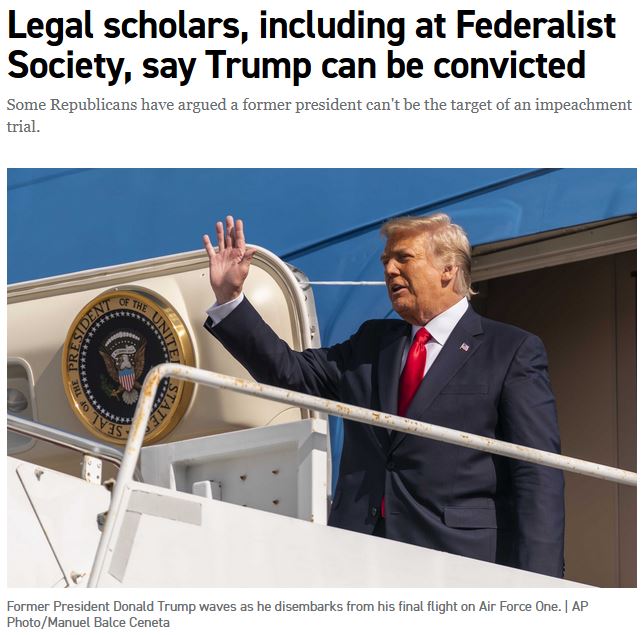
Now, will ‘they’ find a constitutional way to set a precedent?
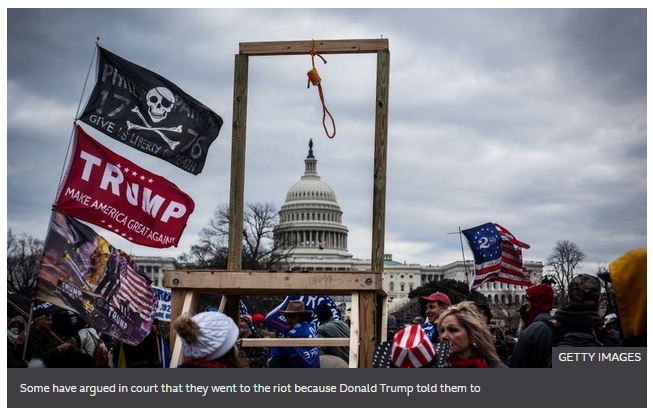
That a guy who had so horribly – and tragically, misused the sacred notion of “freedom of expression” has no place in such a powerful position?
Or, by failing to do so – for whatever reasons, will ‘they’ leave open the ‘opportunity’ for an even more callous ‘political animal’ to climb into the Oval Office?

“At what point then is the approach of danger to be expected? I answer, if it ever reach us, it must spring up amongst us. It cannot come from abroad. If destruction be our lot, we must ourselves be its author and finisher. As a nation of freemen, we must live through all time, or die by suicide.”

Abraham Lincoln, 1838

Being an engineer, I’m gonna present you with a more straight-forward version than the philosophical one.

For something to be real, it has to have consequences.

‘But…?!?’

No buts!
The only thing which classifies something as being real or not is our consciousness.
Without it, without our consciousness, the something we’re talking about now – reality itself, would cease to be ‘real’.
Without us pondering about it, ‘reality’ would continue to exist, of course! Only it would no longer bear a name… Without us being concerned enough about it, it would ‘disappear’ from our ‘radar’.

‘Yes, but … you just said that something becomes real as soon as it has consequences!
We encounter ‘real’ things in each and every moment of our existence.
We need air to breathe, water to drink… food to eat. And a solid earth to walk on…’

True enough. Only for all these things to become ‘real’, we first need to notice them!

See how ironic things are?
In retrospect, electrons are real. Despite the fact that none of us can actually see them. Or otherwise ‘feel’ them. In any way, shape or form!
But until we had gathered enough evidence about their existence…

And now, that our discussion has reached this subject – evidence, I feel the need to mention the fact that Earth is not yet round ‘enough’. That there still are some people actually believing in the notion of the Flat Earth.

‘Are you implying that the Earth might be Flat?!?’

Excellent question, thank you very much!
(If I may say something like that myself. Please excuse my boastfulness!)

You see, we are dealing here with two things. Two very different things.

The roundness of the Earth. Which seems to be real.
The ‘Flat Earth’. Which is certainly real.

‘Now you’ve outdone yourself! For sure…’

I’m almost certain that you can hear me chuckle.

The roundness of the Earth belongs to the realm of science. Which is ‘wrong by definition‘. At least according to Popper… In the sense that the Earth will continue to remain round only till somebody will prove it to be different. Which had happened already… In ‘reality’, the Earth resembles a potato more than anything else!
On the famous ‘other side’, the ‘Flat Earth Theory’ belongs to the realm of belief. Which is also real. Not in the ‘direct’ sense – a concept which describes a real ‘reality’, only in the sense that it has certain consequences.

‘The Flat Earth has consequences?!? You admit that the concept – ‘the Flat Earth’, describes something which doesn’t exist yet you pretend that it has consequences?’

Yep!

Can you deny the reality of this whole thing? Six hundred and twenty million hits? In less than point 8 seconds?
Can you pretend these are not ‘real consequences’? Can you imagine, for instance, how much energy is spent only to preserve this amount of raw information in the ‘cloud’. How much ‘space’? How much bandwidth is used to transport this ‘fake-ness’ across the ‘globe’!

‘And where does this whole thing lead us?
What about the Flat Earth?
Is it still a fake?’

Yeah.
I’m actually tempted to say ‘obviously’!
On the other hand… it’s hard to deny how ‘real’ the whole thing is…