Archives for category: man as a measure for all things

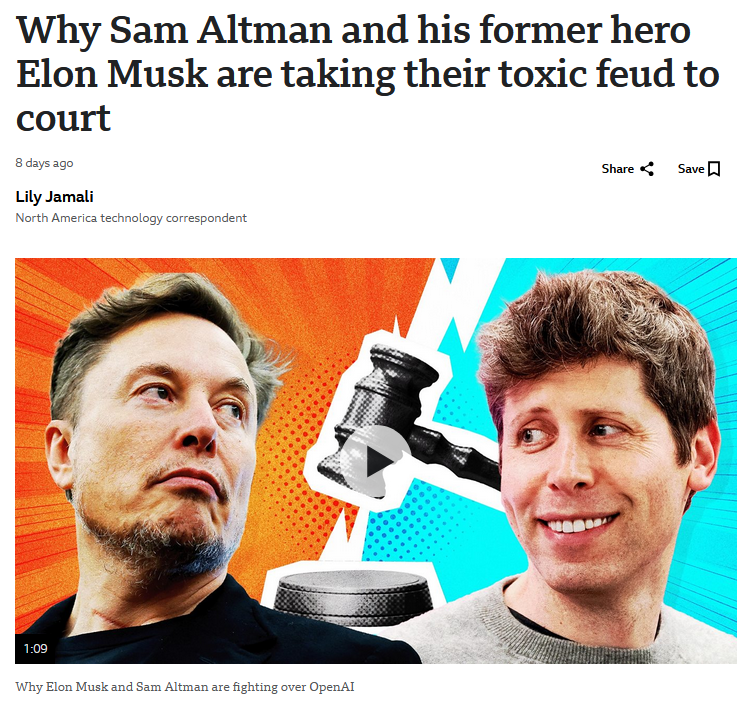
“Musk and Altman are so big, so larger than life, and so unrelatable,”
says University of San Diego professor Sarah Federman,
who specialises in conflict resolution.
“That’s what makes them so delicious to watch as they clash.”

The past is no longer here.
The future is not yet.

We learn about the past and discuss about the future.

The present, the place we live in, is a story. Information about the past mingled with professed intentions about the future.

Which future heavily depends, decisively even, on how we treat the story.
On how we tell it and on how we read it.
On how we relate to it. To what unfolds around us…

In the beginning was the Word, and the Word was with God, and the Word was God.
The same was in the beginning with God.
All things were made by him; and without him was not any thing made that was made.
In him was life; and the life was the light of men.
And the light shineth in darkness; and the darkness comprehended it not.
There was a man sent from God, whose name was John.
The same came for a witness, to bear witness of the Light, that all men through him might believe.
He was not that Light, but was sent to bear witness of that Light.
That was the true Light, which lighteth every man that cometh into the world.
He was in the world, and the world was made by him, and the world knew him not.
He came unto his own, and his own received him not.
But as many as received him, to them gave he power to become the sons of God, even to them that believe on his name:
Which were born, not of blood, nor of the will of the flesh, nor of the will of man, but of God.
And the Word was made flesh, and dwelt among us, (and we beheld his glory, the glory as of the only begotten of the Father,) full of grace and truth.

Observer effect:
the disturbance of a system by the act of observation.

A perfunctory glance down the history alley is enough to convince us.
Democratic decision making is slower than any of the alternatives.
Yet, over the longer time frame, it begets better results.

Democratically run systems are more likely to survive, as long as they manage to preserve their democratic nature.
While autocracies collapse, under their own weight, sooner rather than later. Because of their autarchic nature.
Those running an autocratic regime – a small group to start with and growing smaller and smaller as time passes because that’s how autocracies work – don’t understand the observer effect.

But what is this famous ‘democratic nature’?

Each democratic ‘event’ has three ‘stages’. Like all other decision making processes.
Information gathering, making the call, assessing the outcome.

Electoral campaign.
‘Political scientists’ use the above mentioned term to designate the democratic ‘fact finding phase’.
Leaving aside the fact that people – potential voters – actually live. In the very circumstances they are called to vote about. To evaluate at the ballot box.
Which highlights for us to the first ‘chocking point’.

Individual voters have a limited experience.
Each of us gets in touch with a limited portion of the reality, remembers only some of it and tries to figure out only what each of us is interested in.
If actual voting would take place in ‘absolute darkness’ – each of us voting based exclusively on our own, individual, experience – democracy would be demoted to ‘mob rule’. The largest group of people would run the show according to its own, specific, interest. While all the rest would be sidestepped. Not a sustainable way of running business. Specially when the business at hand is of a social nature.
Hence democracy depends upon a continuous, honest and respectful exchange of information between all the members of a democratic society. People need to know what their neighbors feel about things before voting one way or another. Furthermore, and even more important, people need to care about what other people experience in their daily lives.
‘Political scientists’ – well, some of them – are convinced that ‘efficient campaigning’ is enough to do the trick. To convince enough voters to do as they are told. This conviction has transformed democracy into a war of words. Into a conflict fought inside a space defined by language.
Fighting that war brought us where we are now. For the better and the worse of it.

‘It doesn’t matter what people vote.
The important thing is that votes are counted by the right people.’
I rephrased here a quote attributed to Stalin. The communist dictator.
Si non e vero, e ben trovato. The ‘original attribution’, “It is enough that the people know there was an election. The people who cast the votes decide nothing. The people who count the votes decide everything.” aptly describe Stalin’s attitude towards his subjects. The attitude demonstrated by the consequences produced by his actions. By his actualized decisions. His public positions on the matter? Read one of his discourses… He was lying through his teeth? Said one thing and done the very opposite? Judging by the very consequences of his reign? That’s what I meant by saying ‘the autocrats don’t care about/understand the observer effect’.
Enough about vote rigging. The second ‘chocking point’.

Casting the ballots – and counting them, one way or the other – takes us only this far. Where we are ‘now’.
‘Going forward’ we also need to ‘evaluate’.
You might think that evaluation is an integral part of the first phase. It is. The evaluation of the consequences. Before a new round of elections we need indeed to evaluate what the confirmed candidates had done.
I’m talking about another evaluation.
Very soon after the votes had been counted, the confirmed candidates ‘loose’ their masks. Relax their pretenses and start acting their truer selves. That being the moment when we need to evaluate our decisions. Our choices. What we have voted for…

Very soon after they get elected, the vast majority of the confirmed candidates start blaming their predecessors.
‘Things would be far better if the guy before me would had done that. Or refrained from doing the other that’.
‘Yes, I know. That’s why I voted for you! But you’re not delivering. Everything you promised…’
This being the moment when we, each of us, need to evaluate our own actions. Our own decisions!

Yes, ‘they’ have their share of guilt. ‘Had they done everything they promised…’
But first we need to figure out how, and why, WE have fallen for their ‘lies’.
Cause, after all, we are the ones who have put our faith in their promises!
And we are the ones experimenting the consequences.

And God said…
.
.
And God saw every thing that he had made, and, behold, it was very good.

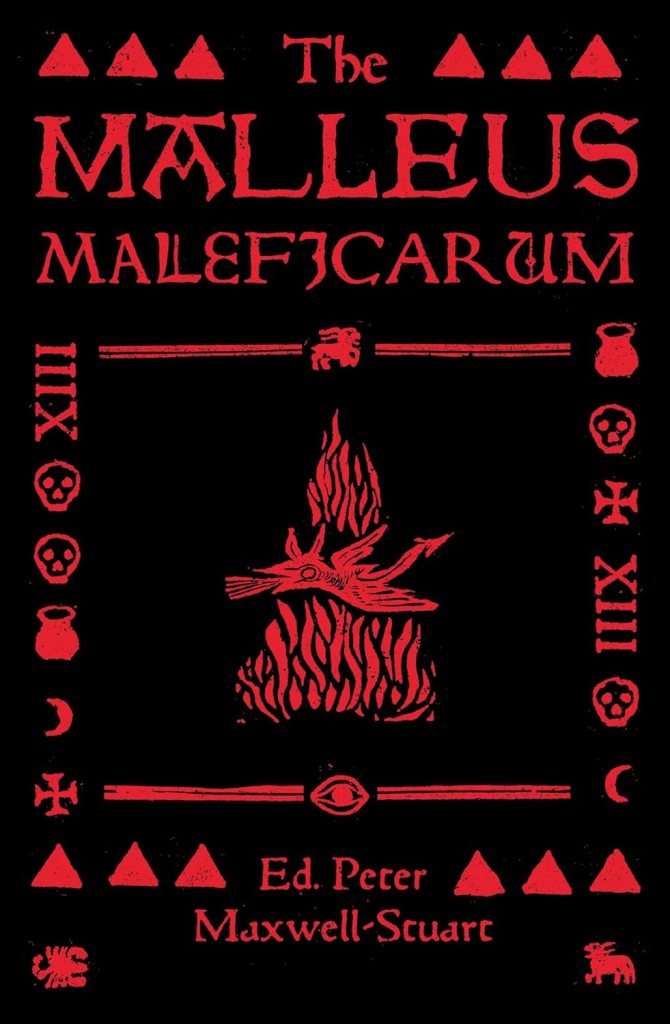
Investigating Witch Trials In 1487, the zealous inquisitor Heinrich Kramer wrote a treatise that would have a remarkable influence on European history. Blaming women for his own lust, and frustrated by official complacency before what he saw as a monstrous spiritual menace, Kramer penned a practical guide to aid law officers in the identification and prosecution of witches. Fusing theology, lurid anecdotes and advice for those engaged in combating sorcery, The Malleus Maleficarum transports the reader into the dark heart of medieval belief – where fear and the supernatural converged in a gripping struggle for understanding and control.
The book led to the burning of numerous heretics and ‘witches’ and had a lasting impact on the popular image of witchcraft.”

Remember ‘alchemy’?
According to Britannica.com, “a form of speculative thought that, among other aims, tried to transform base metals such as lead or copper into silver or gold and to discover a cure for disease and a way of extending life.
Alchemy was the name given in Latin Europe in the 12th century to an aspect of thought that corresponds to astrology, which is apparently an older tradition. Both represent attempts to discover the relationship of man to the cosmos and to exploit that relationship to his benefit. The first of these objectives may be called scientific, the second technological. Astrology is concerned with man’s relationship to “the stars” (including the members of the solar system); alchemy, with terrestrial nature.

So. In the 12th, men were free to engage in an attempt to discover and exploit in their benefit the relation between themselves and the cosmos. To make every effort they could think of to transform ‘base metals’ into precious ones.
Alchemists believed that, if their mind, body and spirit were pure, they could create the Philosophers’ Stone – a substance that could heal people from illness and turn base metals into gold.
Meanwhile, witches – predominantly female – were burned at the stake for attempting basically the same thing. Exploit to their benefit the understanding they had about how things worked in the universe.

Basically, both – the alchemists as well as the witches – attempted the same thing. To perform/accomplish tasks which seemed impossible to the lay people.
Witches were burned when caught by the ‘wrong people’ while the alchemists were feted.

Is there any sense to be made out of all this?!?

Well, let me go back. To the ‘genetic’ moment. When all ‘this’ started.
As I’ve already mentioned, in my blog, I’m an agnostic. I don’t need a god as an explanation for anything. But I don’t know, as in ‘I can’t be sure’, whether any of this has been decisively influenced by a ‘deus ex-machina’. Hence my agnosticism. Furthermore, I’m absolutely convinced that the God worshiped by people is real. Made real by their belief!
Now, anyway you look at the whole thing – believer, agnostic or even atheist – there is no denying that the Bible is choke full of information. Of sense!

‘But… but… how can you say something like that!?!
What sense can you find in a book that inspired people to burn other people?’

Spot on, my dear Watson.
That’s exactly the question I’ve been asking myself!
What happened during those fifteen centuries. Between writing the Bible, as a collective work, and Heinrich Kramer writing Malleus Maleficarum. Between Christians building a certain culture and some people, claiming to belong to the same ‘denomination’, starting to burn witches, but not alchemists, at the stake.
Stay tuned.

Kill time.
Solve problems.
Learn, understand, discover.

Gather information.
Grind it into a modicum of knowledge.
Make the call.
Implement it.
Wait for feed-back.
Evaluate and reach a ‘final conclusion’.

Formal decision making in a nut-shell…

Philosophy bothers itself with what to think. What conclusions we should be reaching…
Science bothers itself with the hows of the matter. How should we think in order to reach the right conclusions! ‘Right’ as in as close to reality as (humanly) possible.

But why?!?
Why do we think at all?

I haven’t read everything Ernst Mayr had ever written but I’m sure he would have answered ‘because we can’!
I’m no student of philosophy so I really don’t know whether a better answer has ever been offered. Or even if the question has been asked before…

So. What’s driving us to think?

Whoa! This is a different question, you know!
‘Why do we think’ is not at all similar to ‘What drives us to think’. But the second version is an easier one to answer…

As you’ve already noticed, I hope, this blog is about the ‘limited nature of our consciousness’.
Which consciousness is defined/generated by our ability to think.
Which has to be trained in order to be effective but I’ll save that for another post.

So, what drives us to think?
Sheer necessity, survival instinct… I’ll come back.
As the rest of us, I’m thinking as I go along. New paths open, left and right, but there is a place I want to reach today.
The dimensional dimension of the whole process of thinking.
I introduced the ‘driver’ to ‘open the space’. A driver needs a space to drive in…

According to the formal theory, thinking is a linear process. A narrative…
According to the day to day practice, a thought is, indeed, a linear thing. A narrative.
But the fact that a trail is linear doesn’t make driving into a linear something.

So, a thought is, indeed, a ‘linear narrative’ while thinking, like driving, is more like an exploratory process.

OK. Now that you’ve got my full attention, how about you get to the point?
Cut the crap, already…

I’d really love to oblige but I need to make a small detour…
I’m an engineer. As such, I do understand physics. Up to a point… Modern physics demand a lot of mathematics and that’s where I falter. As such, I’m aware that some specialists maintain that there are some 11 dimensions which measure the physical world… most of them being so tightly compacted that we don’t notice them in day to day life.
Same thing when it comes to thinking… There are many dimensions which may come in handy but I’ll mention only three of them.

Goal.
Individual prowess.
Environment.

Polichinelle is my witness. Each and everyone of the above dimensions can, and will, be divided in sub-dimensions.
Soon.
Here.

WHAT HAPPENS WHEN YOU PUT GOOD PEOPLE IN AN EVIL PLACE?
DOES HUMANITY WIN OVER EVIL, OR DOES EVIL TRIUMPH?
THESE ARE SOME OF THE QUESTIONS WE POSED IN THIS DRAMATIC SIMULATION
OF PRISON LIFE CONDUCTED IN 1971 AT STANFORD UNIVERSITY.

“How we went about testing these questions and what we found may astound you. Our planned two-week investigation into the psychology of prison life had to be ended after only six days because of what the situation was doing to the college students who participated. In only a few days, our guards became sadistic and our prisoners became depressed and showed signs of extreme stress. Please read the story of what happened and what it tells us about the nature of human nature.”

Professor Philip G. Zimbardo

1971

A group of California students was divided in two. Half were told to act as prison guards and the other half to obey the first. The experiment was meant to last for two weeks but was cut short after six days.
“I ended the study prematurely for two reasons. First, we had learned through videotapes that the guards were escalating their abuse of prisoners in the middle of the night when they thought no researchers were watching and the experiment was “off.” Their boredom had driven them to ever more pornographic and degrading abuse of the prisoners.” Professor Philip G. Zimbardo.

2025-2026

People living in the US have been told that some of them don’t belong there. That if and when those who do not will have been removed, the rest will resume their previously ‘great’ lives.


Nothing which is impossible may ever happen.’
Until it does…

Life happens. Because it is, after all, possible.
In certain conditions, true.

Life, individually speaking, is limited. Individual organisms live for a while. Then go away.
Species adapt themselves. Or disappear…
Evolution! That’s how we, conscious observers, call this process.
Life itself, the entire phenomenon, may happen – as I’ve already mentioned, I know – only ‘inside’ a certain ‘environmental bracket’. The kind of life we’re familiar with, anyway.

The ‘impossible’ I’ve started with is a very interesting thing.
First of all, it’s – again – us who have come up with the notion. Until we’ve started to observe, things happened. Or not… But there was nobody to tell whether something was possible. Or impossible…
Things which could happen, did – if the conditions were right for long enough, while things which could not – at least not in the then present circumstances – simply didn’t happen. Without anybody noticing any of those things.
Now, that we’ve started to observe – in a conscious, as in ‘what’s in it for us’, manner – we’ve become very much interested in whether something may happen or not. Whether something good might be ‘enticed’ to happen and whether something bad might be prevented from happening.

I need to go back to ‘life’ for a moment.
I’ve already mentioned that individual life is temporary. Finite. I’ve also mentioned that species have to adapt to changes in order to survive. And that life itself, as we know it, can happen only inside a certain environmental bracket.
The point being that individual organisms which happen to be less than perfect – less than perfectly attuned to their environment – may still survive. At least for a while.
Life, as a phenomenon and strictly inside that environmental bracket, has somehow stretched the very notion of possible/impossible. The limits of ‘impossible’ are no longer clear cut. Somehow hazy. As in ‘possible’ but not for very long…
‘In constant balance’.

And we’ve arrived to the next level.
Society. Conscious people in congress.
Just as life has stretched the limits of ‘possible/impossible’, society – us, individual people working in concert – has stretched those limits even further.

The most blatant example which crosses my mind being the academic who had decreed that ‘heavier than air flying machines are impossible’. Lord Kelvin, 1895.
So. What had happened in the short 8 years passed between Kelvin uttering his now infamous words and the Wright brothers taking off? Had physics changed? Had our understanding of physics changed?
None of the above. We, as in ‘we humans’, made it possible. Found ways.
Just as life found a way to transform inanimate matter into living organisms – on a temporary basis – people working in concert have found ways to accomplish feats which seemed impossible. To their contemporaries. And, sometimes, even to those who live in the distant future of those achievements. We still have not figured out, in detail, how the Egyptian pyramids had been built…

I’ve been speaking of ‘individual’ achievements.
Flying machines as well as pyramids are, in a sense, ‘individual’. Somebody had an idea and, based on previous human achievements and with the help of others, have put their ideas into practice.
‘Individual’ not strictly in the sense that they have been achieved by an individual but in the sense that they have been the result of a deliberately targeted effort.

Other achievements had been ‘natural’. Or social?
In the sense that they had come around without anybody coordinating the effort. As in the case of the individual ones.
Learning to speak. To write. Yes, we do know that Cyril and Methodius were the guys responsible for the Russian alphabet. And that Mesrop Mashtots had created the Armenian Script. Only these efforts had been based on previous knowledge. Humankind had already been writing for at least 3000 years. Using different manners of notation but the principle was already there. And the achievement was ‘folkloric’ in nature. No identifiable author. The feat belonged to the entire community.

Another social/natural achievement is morals. Our habit of doing ‘the right thing’.
Which is different from what is being known as ‘justice’. Formal law being upheld by the government. Which is, basically, a collection of individual achievements.
So, why do we – statistically speaking – behave in a moral manner?

Evolutionary speaking, simply because moral communities fare better than amoral ones. And even better than immoral ones.
Don’t believe me? You’re not convinced that immoral communities will, sooner rather than later, either change their ways or crumble under the weight of their undoings? You are still under the impression that immorality is here to stay? Based on what you witness on a daily basis?
Do you remember that “individual organisms which happen to be less than perfect – less than perfectly attuned to their environment – may still survive. At least for a while”? Same thing goes for communities/societies. Communism, amoral by definition and profoundly immoral in practice, did survive for quite a while.

Then why do we stray from the ‘straight and narrow’?
Why do so many of us succumb to temptation?
I’m going to save that for the next post. But I’ll add this here.
Each digression is individual in nature. The consequence of ‘a deliberately targeted effort’. An individual human being comes up with a new idea. Good or bad. Is followed, if at all, by a group. Which group will survive – and add the ‘new’ idea to what is called ‘tradition’ if, and only if, that ‘new’ idea is beneficial for its survival. If that new idea works in the particular set of circumstances where that group of people live. Only after that had happened, after the group had survived for long enough and the new idea had become traditional, that particular, individual, achievement becomes a social one. The original author of the idea is forgotten and the engendered habit becomes natural.

Consequences.
We are the consequences of the decisions we take.
Of the choices we make.

As biological organisms, our fate, both individually and as a species, depends on whether circumstances remain habitable. Whether we can continue to live.

As rational humans, our individual destinies depend on luck, genes and on our ability to make good decisions.

‘Good’ decisions!
The tricky part being that nobody knows in advance the consequences of our decisions… whether a decision we consider to be good – when we take it – will remain so after its consequences will have been evaluated. After enough time will have passed for the full gamut of consequences to unfold…

To make things easier, humanity has developed ‘culture’.
Layered information which has morphed into ‘Weltanshauung’. Experience distilled into knowledge and accrued in time. Advice we no longer need to ask, only to remember.
When in a hurry, we do as we always used to. Back to the tried and tested.

But there’s a small problem here.
The cultural norms might have been ‘tried and tested’, hence ‘right’, but are we applying the appropriate norm in the given circumstances? Have we interpreted whatever information we have in the right way?

Ukraine is at war. Resisting aggression against all odds. Despite some of those in power attempting to access ‘undeserved rewards’. Unfortunately, war profiteering and corruption are as old as civilization…

Earlier this week, NABU (National Anti-Corruption Bureau of Ukraine) and SAPO (Specialized Anti-Corruption Prosecutor’s Office) said top company officials demanded illicit commissions of 10-15% from contractors.
The corruption allegations center on contracts linked to Energoatom, which provides most of Ukraine’s electricity.
According to investigators, an organized criminal group laundered the funds through an office in central Kyiv linked to the family of former lawmaker and suspected traitor Andriy Derkach. Among those named in the case was then-Energy Minister and later Justice Minister Herman Halushchenko.

https://www.kyivpost.com/post/64185

How do we choose to evaluate the current development?

As yet another step in the right direction? A country at war cleaning up its act?

Or…

Further more, what will we choose to DO?… after we will have chosen an interpretation to fit our ‘general disposition’… ’cause, unfortunately again, this is how we tend to evaluate things! Specially when we’re not diligent enough. Allow our ‘general disposition’ to take over and permit our reason to cowardly back off …

Help Ukraine to defend itself? And the rest of Europe? Freedom in general!
Or give up? On Ukraine, on cultural norms which seemed set in stone until not so long ago…

And the Truth shall set you free.

Heidegger, the philosopher, has an interesting take on this ‘truth’ thing.
Nobody does, and never will, know everything about anything. Lest of all about ‘everything’. Hence nobody has access to a ‘true’ piece of knowledge.
Furthermore, ‘truth’ is about communication. About a message. An expressed piece of knowledge. And since there is no language precise enough to allow a communicator to cram into a message all they want to express… nor precise enough to allow a ‘reader’ to figure out everything the communicator had attempted to express…
Which drives Heidegger to posit that truth depends on intent. On a communicator sharing honestly everything they know about a subject. On a communicator allowing the receiver of the message to reach their own conclusion.

I ended my previous post by mentioning the ‘fairy tales’ our ancestors have spun in order to ease their ‘passage into the great unknown’. Thus making their lives bearable. Enjoyable, even.
In those times, ‘the truth’ – the unconcealed truth, in Heidegger’s terms – was that nothing made sense. That life itself was a meaningless joke. As a Romanian saying goes, ‘life resembles a hair from the private parts of the body. Short and full of shit…’
I’m not going to make a historical inventory of the various fairy tales the humankind has used to lullaby itself into accepting life as it used to be. Enough to say that they, the fairy tales, did the trick. Helped us reach the present stage.

I’m going to make a break here.
And notice that any, or even all, of those fairy tales might, eventually, be proven as being true. No matter how improbable this might be. I’m not an atheist. I just don’t know whether a god, or more, do exist.
What I do know is that, by their own admission, all of those stories have been spun by people.
Each of those stories is about what the original ‘spinner’ saw fit to communicate on the subject.
And the better stories, those who made more sense in the particular circumstances where they had survived, made it up to the present.
Helped the respective believers to survive. Helped some of them to thrive, even.

Now, today, we need to make up our minds.
Accept that our consciences are works in progress.
That consciousness is a space caught up in an accelerating evolution. A cauldron of sorts.
That each of those ‘fairy tales’ was useful in its own time. That the need to mitigate our cognitive dissonances continues to exist.
That we’re responsible for our future. Nothing new here.
And that there’s no one to save us. Not now. Or after we will have fucked up everything.


The ‘Truth’ being that ‘Give me Liberty or give me Death’ was a very effective call at arms.
On the face of it, on the ‘logical front’, it doesn’t make much sense.
‘Death’ was, and continues to be, inexorable. Why, for the sake of ‘liberty’, jeopardize the few precious moments left to be experienced as a living creature? Specially when, according to the lore considered valid when Patrick Henry had uttered the words, a second life was going to open just ‘after’…
‘The Devil is in the details’!
The belief in the ‘after-world’ works both ways. It encourages the freedom-fighters to take risks – believing they will get their reward ‘afterwards’ – and encourages the prudent to endure. Believing that they will get also get their reward ‘afterwards’.

Now, that I’ve ‘spilled it out’, I must confess that I’ve successfully convinced myself.
I’ve rationalized, according to my standards, my belief that it’s our responsibility.
To understand and accept that we’re responsible for the consequences we’re leaving for those coming after us.
I don’t know what we should do. I’m no prophet.
But I do know what we shouldn’t.
You do too!

Give me Liberty or give me Death.
Patrick Henry

I argued in the previous two posts that we, humans, live in a three layered reality.
At the intersection of three spaces.

One driven by a ‘primeval’ set of rules and inhabited by Democritus’ atoms.
The living one. Inhabited by individual living organisms, ‘suffering’ the consequences of evolution and subject to laws pertaining to the biological realm.
And what we call ‘reality’. A space opened up by our self-awareness. Inhabited by our individual consciences and furnished with culture. I prefer to call that space ‘consciousness’.

These three spaces have a few things in common.
The actual, physical, place where they exist.
The primeval set of rules. Which is valid for all those inhabiting these/this mingled space(s). The chemistry going on inside a living organism is no different from that happening in the inanimate world and the body of a fully conscious human continues to be pulled by gravity. Despite the fact that conscious human beings have have been building, and flying, airplanes for quite a while now.
And a few ‘principles’ which ‘transgress’ from one space to another.

‘Inertia’.
A ‘body’ tends to continue as it was. To move, on a ‘straight’ trajectory, or to stay put. Until subjected to a ‘burst of energy’.
‘Survival instinct’.
A living organism tends to go on living. Until subjected to a ‘burst of energy’ or until it wears down.
‘Cognitive ‘Consonance”.
Conscious subjects need to maintain a certain congruence. To close/rationalize whatever cognitive dissonances which happen to challenge their ‘Weltanschauung’. The story which imparts sense to their existence.

‘Inertia’ keeps the physical world together, ‘survival instinct’ drives individual living organisms to keep struggling against all odds and ‘cognitive consonance’ pulls us back from the precipice Nietzsche warned us about. “If you stare into the abyss, the abyss stares back at you”.

I’ve been speaking about three spaces. The older being the home and growing place for the newer one.
Each of them being different from the previous one. But still having a lot in common.

Here’s another thing shared by all three spaces.
‘Evolution’.
The concept – everything we speak about is a ‘concept’, first and foremost – has evolved out of our need to make sense of things. To make sense of what we noticed as going on in the world. Species disappearing and fresh ones springing up to make good use of new opportunities. All of these species having a lot in common and ‘evolving’ in order to survive changes in their environment.
Well, if we look closer, ‘evolution’ takes place in all of those three spaces I mentioned.

Hydrogen, the first ‘species’ of atoms, gets together with other of their own kind and engender Helium. The process which keeps our Sun both hot and from gravitationally collapsing into a white dwarf.
A gas, hydrogen, ‘coalesces’ gravitationally and evolves into a star. Hydrogen, the ‘basic’ chemical element, gets together with other members of their own species and evolves into the next chemical element. Through a nuclear reaction, but that’s another subject… And so on, until all the fuel is spent and the star either contracts into a white dwarf or explodes into a supernova. And then contracts into a black hole…

The main difference between the evolution of the living things and the evolution taking place in the inanimate realm residing in how ‘individual destinies’ end up in each realm.
‘Radioactive’ elements are unstable by definition. Bound to become simpler but not to ‘dissolve’ into their initial components, as individual living organisms do.
‘Stable’ elements are… well… stable. Expected to remain as such, unless they are sucked up into a star and transformed into something else. But to ‘die’, not even then …
Stars ‘become’, ‘live’ and then become something else. Never ‘die’ ‘properly’!

Living things, on the other hand, are ‘actually born’, live and then actually die. The former organism ‘releases’ the chemical components back into the nature. To be – sometimes, if ever – part of another organism.

Until consciousness – the space – has been opened, to harbor individual consciences, ‘death’ didn’t ‘exist’.
The process of dying happened unnoticed. Unnoticed and unnamed, of course. Not yet conceptualized, to use a fancy word.

Imagine now the complete bafflement which had engulfed the first conscious individuals who stared into the abyss. Who noticed and then attempted to understand death…
What kind of cognitive dissonance must have been experienced at that point? At that stage in the evolution of what we currently call ‘consciousness’?
Hence the various ‘cosmogonies’. Stories about how the world came to be.
‘Fairy tales’ meant to assuage fear rather than to explain anything. To ease the way out in order to make survival probable for as long as possible.

https://www.goodreads.com/book/show/22322778-a-history-of-religious-ideas-3-vols

https://www.psychologytoday.com/us/basics/terror-management-theory

“WE ARE GOING TO CONTINUE TO FOCUS ON SOLVING PROBLEMS
FOR HARDWORKING AMERICAN TAXPAYERS”

LEADER JEFFRIES

(You might want to read my previous post before this one.
If you haven’t already done that, of course…)

Democrit’s atoms come with a clear cut set of rules. ‘Trapping’ them into a very predictable ‘future’. ‘If conditions are such and such, each of them atoms will do this and that’.
Furthermore, and as far as we know, that set of clear cut rules is valid everywhere. Was since the start of time and will remain valid for as long as the world will remain ‘as such’.
Our current understanding of the world – leaving aside various religiously motivated cosmogonies – actually depends on that set of clear cut rules being consistent over space and time.

At some point in time, and space, another set of rules had appeared. Even if we weren’t there to notice the event… Meaning that that appearance was a natural occurrence. We don’t yet know how that happened – not exactly, any-way – but we are satisfied that the first set of rules didn’t have to be broken in order for the second to appear. We consider that no miracle was necessary for life to happen. That happenstance and the first set of rules are a sufficient explanation.

This second set of rules is somewhat laxer than the first one.
It still traps those who have to obey it into a certain behavior but those respecting it enjoy a way wider ‘lee-way’ than Democrit’s atoms. The second set of rules makes it possible for evolution to happen.

While the individuals involved – atoms in the first case and individual living organisms in the second – don’t have any say in the matter, the first set of rules is consistent in space and time while the second one depends on the specifics of each region of the space and evolves in time.
Still trapped, but differently. The limitations pertaining to the first set of rules are drastic – life needs a very ‘narrow’ ‘window of opportunity’ in order to remain viable – yet the second set of rules ‘enshrines’ a certain amount of ‘individual freedom’. In the sense that individual living organisms do have a certain say when it comes to their own survival while the individual species have the ability to adapt to whatever changes happen where they have to survive.

Very recently – in the cosmological time-frame – yet another set of rules. Opening yet another space/place. Consciousness.
Not unlike a Matryoshka…, the first set of rules ‘opens’ the space where everything happens. Exists, but somehow ‘insulated’ when it comes to the passage of time.
The second set of rules opens a ‘narrower’ space. Narrower in the sense that life needs a very ‘narrow’ set of temperature, atmospheric pressure and the presence of certain substances. But a lot wider in the sense that the individuals involved have a certain autonomy and a certain sensitivity in the passage of time.
The third set of rules, the one opening up the space we call ‘consciousness’ is ‘written on the go’.

It does have a certain consistency.
For the simple reason that it is ‘written’ by statistically similar ‘authors’.
Take language, for example. One of the sub-sets belonging to the third set. It is shared solely by members of a single species, wielding more or less similar brains. OK, different languages have appeared in different geo-historical conditions but every human being who happens to be alive is potentially able to learn any of the languages ever spoken on Earth…
This third set of rules is usually referred to as ‘culture’. In the wider sense of the word. Information which is passed from one generation to the next one. Information which, shared among the members of the living generation, makes them conscious human beings.

I know, this is a startling manner of looking at things.
Please allow me to shed some light on the matter from another angle.
We have – we have noticed, more exactly – a ‘First Set of Rules’. FSR, let’s call it. Ingrained into the building blocks of the ‘real world’. Which rules will, hopefully, remain as they are for the entire foreseeable future… otherwise life, as we know it, will cease to exist in a jiffy.
We have also noticed, while attempting to understand ‘life’, a SSR. Second Set of Rules. Describing/making possible what we call life. Which life is, by nature/definition an evolving process. Hence the rules themselves not only allow a certain lee-way but also are bound to be rewritten whenever possible. Whenever the ‘altered version’ doesn’t jeopardize the survival of the individual harboring that version.
And whenever the accumulated alterations happen to be beneficial … a new rule is in place. Or a new species, according to the biologists.
The TSR is a work in process. A lot more so than the SSR. In the sense that each individual ‘rule’ – piece of information added to the corpus of work usually known as culture – has been put there teleologically. On purpose. Never fully aware of all the implications but always as the consequence of a conscious act.

This being the moment when I remind you that this blog is about “exploring the consequences of our limited conscience”.

https://books.google.ro/books/about/What_Evolution_Is.html?id=i8jx-ZyRRkkC&redir_esc=y

https://constructivist.info/1/3/091 regarding self awareness/consciousness