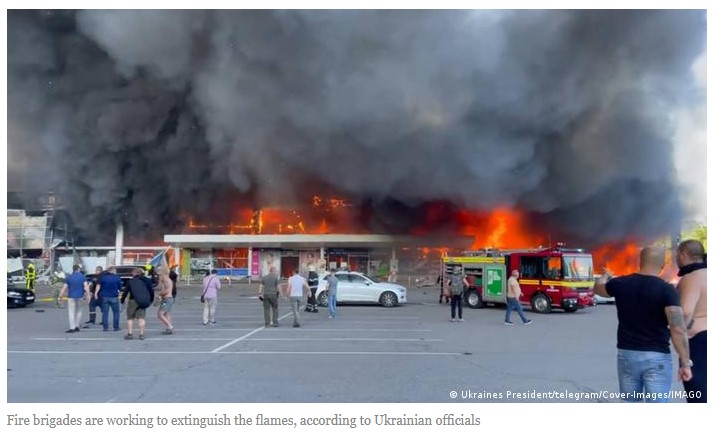
În Ucraina mor oameni.

Iar ceea ce se întâmplă acolo are efecte pe întreaga planetă.

În primele două războaie mondiale au participat luptători de pe aproape tot globul. Aproape toate țările si-au declarat război una alteia, chiar dacă nu au participat toate la operațiunile militare.
Al treilea război mondial – cel Rece, a avut loc pe șestache. Și a fost primul care a împărțit lumea în trei.
Tabăra ‘democrat-liberală’, tabăra ‘democrației populare’ și tabăra ne-aliniată.

Ca și până acum, al treilea război mondial a fost pierdut de tabăra cea mai puțin flexibilă.
De către tabăra condusă în mod mai dictatorial. De către tabăra care, tocmai din cauza modului autoritar în care erau elaborate deciziile, nu a reușit să mobilizeze toate resursele pe care le avea, potențial, la dispoziție.

Am să fac o paranteză.
Orice act de agresiune este o idioțenie. Indiferent de deznodamantul pe termen scurt, pe termen mediu și lung agresorul are mai mult de pierdut decăt victima agresiunii.
Acest fapt nu are nevoie de demonstrație. Orice lectură a istoriei, chiar și pe cant, este suficient de elocventă.
Aici discut războiul ca ‘fenomen în desfășurare’, nu încerc să-l integrez în istorie.
Orice război, orice act de agresiune, este inițiat în niște condiții determinate de istoria petrecută până atunci și va fi, la un moment dat, integrat în istoria scrisă după aceea.
Iar modul în care va fi el integrat în istorie va determina condițiile în care va fi, sau nu, inițiat următorul război. Următorul act de agresiune.

Să revenim la momentul prezent.

Acest al patrulea război mondial este primul război mondial mixt. Primul război ‘călduț’.
Consecințele sunt resimțite pe întreg globul, aproape toate statele iau parte la el – împărțite tot în trei tabere, în timp ce actul de agresiune ‘fizică’ este relativ limitat.

Reacțiile la acest act de agresiune – adică modul în care se raportează la conflict cei care au de suportat consecințele sale, reprezintă începutul modului în care va fi integrat în istorie acest episod de agresiune fizică.

Tabăra democrat-liberală ajută victima în măsura în care poate face acest lucru – aici este loc pentru o discuție foarte lungă.
Tabăra autoritarist-populistă ajută agresorul. În măsura în care își permite să-și dea arama pe față.
Tabăra declarat ‘ne-aliniată’ s-a constituit în victimă și îndeamnă la negocieri.

Aici am nevoie să mai fac o paranteză.
Agresorul este ‘Putin’. Un personaj colectiv care are în centrul său pe actualul dictator de la Kremlin.
Faptul că personajul colectiv Putin conduce în acest moment destinele Rusiei ține de mersul istoriei.
Are de a face cu Rusia și cu poporul Rus dar a transfera întreaga răspundere pentru atrocitățile care au loc în Ucraina pe umerii Rusiei ar fi o greșeală. Un diagnostic eronat care ar putea genera un tratament ‘contraproductiv’.

Foarte mulți analiști și comentatori, încercând să…, își concentrează atenția pe ‘capul răutăților’.
Pe Putin.
Unii îi explică acțiunile iar alții vor să ne distragă atenția de la ce face Putin încercând să argumenteze că Putin a fost obligat să facă ce a făcut pentru că ‘ceilalți’ au acționat așa cum au acționat. De parcă niște greșeli deja comise ar putea constitui vre-o justificare pentru niște atrocități…

Înapoi la explicații.

Ideea principală care se degajă din ‘textele’ ce ne sunt oferite – indiferent de motivațiile propuse pentru deciziile adoptate de Putin, este că orice cedare în fața pretențiilor agresorului va fi plătită, cu asupra de măsură, de toți cei implicați.
Pentru simplul motiv că Putin va intrepreta orice firmitură cedată de victima agresiunii ca fiind o victorie personală. Victorie care va trebui repetată, mai devreme mai degrabă decât mai târziu.
Iar toți ceilați Putini de pe lumea asta, toți cei animați de veleități autoritariste, se vor simți încurajați de orice fărâmă de victorie de care s-ar putea bucura Putin I.

‘Ce, noi suntem mai proști?!?
Dacă El a reușit, de ce să nu încercăm și noi?’

Ei bine, până aici a fost simplu.
Putin nu este primul dictator care s-a aflat sub lupa psihologilor. Sau sub cea a politologilor.
‘Nimic nou sub soare’ și nici o contribuție originală. Cam tot ce a făcut Putin a fost tratat deja în literatura de specialitate și poate fi explicat foarte simplu cu ajutorul unor citate din autori mai mult sau mai putin celebri. Sun Tzu, Clausewitz, Marx, Ivan Ilyin…

Din păcate – sau din fericire? – Putin este ‘transparent’.
Devine cât se poate de ‘evident’ după o analiză chiar foarte sumară.
Și, de fapt, dictatorii – toți dictatorii, sunt niște subiecți cât se poate de simpli.

Niște indivizi unidimensionali.
Preocupați doar de accesul la puterea cât mai absolută și, în a doua fază, de conservarea acesteia.
Restul fiind butaforie. Joc de gleznă și multă propagandă.

Eu sunt interesat de altceva.

Putin face ce face pentru că poate. Pentru că a ajuns într-un set de circumstanțe în care își poate manifesta ‘pornirile’.
Putin a ajuns în situația în care este pentru că cei din jurul său – cei care puteau face ceva ‘pe chestia asta’, nu au înțeles la timp ce ce întampla, cu adevărat, sub ochii lor.

Pot să înțeleg și acest lucru. ‘Orbirea temporara’ nu este un lucru ‘excepțional’.

Dar totuși. De la un moment dat încolo – adică după ce ‘laptele a dat în foc’ și după ce realitatea a început să-ți dea palme peste ochi, să continui cu … ‘orbirea temporara’… doar de dragul confortului de moment… fără să realizezi că ești condus spre prăpastie…

‘Putin’ nu ia prizonieri. Chiar dacă te-ai considerat aliatul său, sau sluga lui credincioasă, și indiferent de câte promisiuni ți-a făcut, atunci când nu mai are nevoie de tine… te termină!
Atunci când nu mai are nevoie de tine, devii cost. Iar în lumea lor, în lumea dictatorilor, costurile trebuie tăiate. La sânge!

În afară de faptul că ai mari șanse să te mătrășească pe măsură ce își centralizează puterea, asocierea cu alde Putin este periculoasă prin definiție.
Indiferent de cât de puternici au părut la un moment dat, toți Putinii au sfârșit prost. Cu cât mai Putin au fost, cu atât mai rău au căzut. Ei și cei care le-au ținut trena….

Știe cineva un dictator care a sfârșit pe tron?

Stalin? Hrushcev? Brejnev? Andropov?
Asta ne dorim?!?

Iar concluzia trasă de unii dintre observatori, “În final deznodământul are doar două valențe: Putin pierde sau Putin câștigă” este valabila doar pe termen scurt. Foarte scurt!

Pe termen mai lung, Putin pierde. Putin a pierdut întotdeauna.

Doar că pe pielea noastră!
Cu cât îl răbdam mai mult – de dragul confortului de moment sau de frica disconfortului potențial, cu atât vom avea de tras mai mult.
În viitorul cât se poate de apropiat!


2017

““How could you square that statement with legal abortion?” Durbin asked him. “Senator, as the book explains, the Supreme Court of the United States has held in Roe v. Wade that a fetus is not a person for purposes of the Fourteenth Amendment, and the book explains that,” Gorsuch replied.

“Do you accept that?” Durbin asked. “That’s the law of the land,” Gorsuch answered. “I accept the law of the land, senator, yes.””

2022

“In a statement following the Supreme Court’s decision to overturn Roe v. Wade, Sen. Collins expressed her dismay that Justices Neil Gorsuch and Brett Kavanaugh misrepresented their alleged respect for precedent and private conversations with her and in their confirmation hearings. “This decision is inconsistent with what Justices Gorsuch and Kavanaugh said in their testimony and their meetings with me, where they both were insistent on the importance of supporting long-standing precedents,” she wrote.

Rolling Stone reported last month that Collins was deliberately manipulated by Trump officials into voting for Kavanaugh despite his judicial history indicating a liability to strike down Roe. The White House correctly predicted that as long as they “let the Susan Collins-es of the world think what they needed to think and hear what they needed to hear,” as one ex-official put it, the fence-sitters would fall in line and vote to confirm Trump’s nominee.”

2016

“My people are so smart — and you know what else they say about my people? The polls?” Trump asked a crowd at a Sioux Center, Iowa, rally Saturday. “I have the most loyal people — did you ever see that?”

“I could stand in the middle of Fifth Avenue and shoot somebody, and I wouldn’t lose any voters, OK?” he said, referring to the major street in New York City that cuts through Manhattan’s large commercial district. “It’s, like, incredible.”

2022

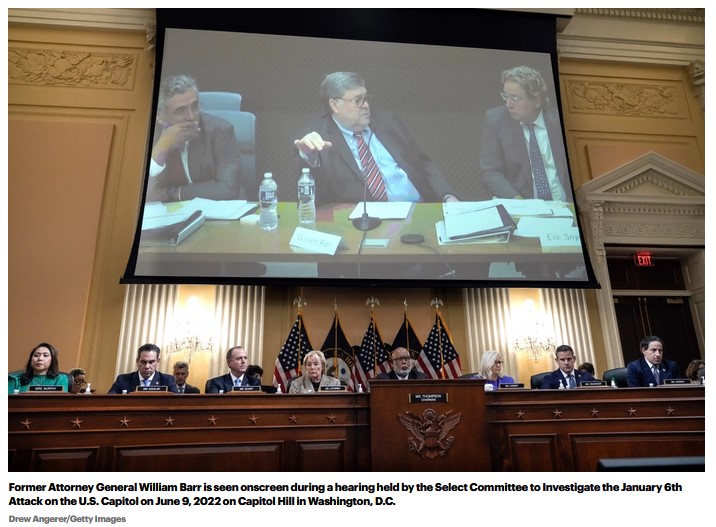
“In its first hearing, the Jan. 6 committee last week played a clip of former Attorney General Bill Barr testifying that he told former President Trump that claims the 2020 election was stolen were “bullshit.” In its second hearing, the committee on Monday played several additional minutes of Barr’s testimony, during which he described unsuccessful effort to convince Trump that the election was legitimate.”

“Barr met with Trump again on Dec. 14. “He went off on a monologue saying there was now definitive evidence of fraud through the Dominion machines,” Barr said of a Dec. 14 meeting with Trump, noting that he gave Barr a report he said proves that the election was stolen and that he would have a second term in office. Barr said the report looked “amateurish” with no real evidence to support its claims that voting machines were rigged. Barr said he was “demoralized” after looking at the report. “I thought, boy, if he really believes this stuff, he has lost contact with — he’s become detached from reality,” Barr said.”

2022-06-24

“In voters, lack of expertise would be lamentable but perhaps not so worrisome if people had some sense of how imperfect their civic knowledge is. If they did, they could repair it. But the Dunning-Kruger Effect suggests something different. It suggests that some voters, especially those facing significant distress in their life, might like some of what they hear from Trump, but they do not know enough to hold him accountable for the serious gaffes he makes. They fail to recognize those gaffes as missteps.”

“Again, the key to the Dunning-Kruger Effect is not that unknowledgeable voters are uninformed; it is that they are often misinformed—their heads filled with false data, facts and theories that can lead to misguided conclusions held with tenacious confidence and extreme partisanship, perhaps some that make them nod in agreement with Trump at his rallies.”

“….. himself also exemplifies this exact pattern, showing how the Dunning-Kruger Effect can lead to what seems an indomitable sense of certainty. All it takes is not knowing the point at which the proper application of a sensible idea turns into malpractice.”

I have no way of knowing what the creator of the meme actually wanted to convey through it.
All I know is what I make of it.

The ‘Austrian’ will eventually fall. Not only that nobody can stay in the saddle for ever but the guy uses only one hand to steer his bike. And the fact that he doesn’t use a helmet is the second proof that he doesn’t care much for safety. For his safety… At his age, he should have known better!

Hard to argue with Mises – the quintessential Austrian economist, if I remember right.
Specially since I grew up under a communist regime. Where laissez faire was absent and where the government was inept and immoral. Which regime, like all other authoritarian/totalitarian regimes in history, had crumpled under it’s own weight.

But wait!
Countries which use laissez faire had long ago invented the necessary mitigation mechanisms.
The unlucky entrepreneurs can declare bankruptcy and start all over.
The fraudulent entrepreneurs – well, many of them, go to prison.
While the inept and immoral governments get booted. Democratically!

My point being that laissez faire works better if there’s a safety net in place.
And that people should trust their government. But also keep it on a very short leash!

Wishful thinking!

Conspiracy theorists are absolutely convinced that they are the true critical thinkers…

That their critique of how things works on the face of the Earth is the only reasonable one!

Then what?
Sheeple and conspiracy theorists are nothing but the very same thing? Each of them on the other ‘side’ of the dividing mirror? The surface on which the conspiracy theory dew has been craftily etched? To blurr the vision of all those attempting to look through?

After all, what’s the difference between sheeple – those who follow the official narrative and consider the ‘alternative’ to be wrong, and the conspiracy theorists? Those who consider theirs to be the true version and the ‘official version’ a misleading lie?

Each of them exercise their right and ability to doubt. To look for alternatives. And to discard the alternatives they deem to be implausible!

Most conspiracy theories have already been proven as having been bogus?
With the current ones waiting in line?

This, I’m afraid, is the moment for me to remind you that science is wrong by definition. That all scientific theories are, by definition, falsifiable. That the scientific community is convinced that all knowledge is maybe not completely wrong but definitely incomplete!
Hence there’s a lot of room out there for conspiracy theories to thrive!

‘OK.
I can follow your arguments.
Or, more exactly, I can follow your logic….
But I still believe you’re wrong.
Conspiracy theories ARE bogus!’

Let me put it differently.
Both the official narratives and the conspiracy theories are fueled by the same human need.
By our need for consistency!
Human mind has a hard time processing cognitive dissonances. Pieces of information which contradict each-other. Hence we need a ‘script’. A meta explanation for ‘everything’. A way to discharge the tensions produced by the conflicting pieces of information which assault our attention.

‘And why some people choose to become sheeple – to buy into the official version of things, while others remain conspiracy theorists for life?’

You’ve just set aside the vast majority.
Those people who are explicitly or implicitly aware that both the official version and the conspiracy theories are at least incomplete. And sometimes promoted by people with ‘ulterior motives’.
People who have a deeper creed. Many times of a religious nature but not necessarily.
People who have too many on their heads, mostly worries, so are no longer ‘available’ for ‘petty things’.
As for conspiracy theories being bogus…
I just mentioned how science works. Whenever a theory is judged to be plausible by the peers involved, it becomes the official narrative. All other competing theories become bogus. But all those earnestly involved in the process are convinced that sooner or later the official narrative will be proven if not wrong, then at least incomplete!

‘Then what about ‘critical thinking’? Is it good or not?
And you haven’t answered my question!’

Critical thinking is a tool!
And as all other tools, it becomes good or bad only in the hands of the person who yields it!

The most important thing about critical thinking is that we must remain critical relative to our own opinions!
Open to whatever new evidence happens to cross our path!
Sometimes the evidence which comes first might be misleading. Or false. We might reach the wrong conclusion. If we cling to the already reached conclusion we might be wrong. It is absolutely understandable – admitting an error is hard, but still wrong. That’s why some people remain sheeple while others cling to their beloved conspiracy theories.

You see, the true definition for sheeple is not ‘those who believe the official version’. Far from it!
The real sheeple continue to pay lip service to the official version long after fresh evidence prove the official version has been ‘incomplete’!

These people no longer communicate.
As in no longer care to understand what the other has to say…
Mind you, not ‘agree with’, just understand. Just develop a ‘mere’ understanding of what the other feels/thinks/has to say about a subject.

The consequence?

Both sides have become so focused on contradicting each-other on no matter what subject that both of them have lost the ability/exercise to look for the real issue.

The Ukrainians have enough AK-47s. They don’t have any use for any AR-15s. What they need is howitzers. And HIMARSs!
As for the 2nd amendment…

“A well regulated Militia, being necessary to the security of a free State, the right of the people to keep and bear Arms, shall not be infringed”

Given the Ukrainian experience, should we read the 2nd Amendment in such a manner that ordinary people would be able to keep and bear howitzers? Or HIMARSs?

Or should we focus our attention on the notion of ‘a well regulated Militia, being necessary to the security of a free State’…?
Meaning that without a well kept and well trained Army, the State, any state, would soon loose its sovereignty?

After all, the Ukrainians fight, together, against an invader. They cooperate in order to defend their State.
Meanwhile, many of those clamoring about the 2nd Amendment are more preoccupied about using their guns to defend their individual freedom against the State than about cooperating with their fellow citizens towards defending the State against any aggression.

Counter-protesters Kenya Stevens, left, of District Heights, Md., Steve Tidwell, of Arlington, Va., and a protester who asked not to be named, shout their support for gun rights across from a protest of gun control advocates next to Realco Gun Shop in District Heights, Md., on Tuesday, Aug. 28, 2007. The protest of gun control advocates was part of the Rev. Jesse L. Jackson Sr.’s National Day of Protest. The gun store, located very near the border with Washington, is a large source of guns used in crimes in the nation’s capital, according to District officials. (AP Photo/Jacquelyn Martin)


In these circumstances, am I allowed to remind you that Putin – the guy who had initiated/ordered the invasion of Ukraine, is a “genius”?!? According to Trump…

Whence comes nihilism, the uncanniest of all quests?
by Lou Keep

Friedrich Nietzsche was most famously concerned with the problem of nihilism. All societies, in his view, rely on implicit value judgments. If the foundations of these are lost, he predicts terrible consequences: widespread apathy or violent, fanatical attempts to reclaim a sense of purpose, or perhaps both. We talk about values a lot, and we know they do something, but we have little idea how. Compounding this is uncertainty over their loss. Nihilism is not a choice or intellectual commitment, but a thing that comes upon you. As Nietzsche put it in 1885: ‘Nihilism stands at the door. Whence comes this uncanniest of all guests?’

Part of the answer comes from understanding how values connect to knowledge and action. In Seeing Like a State (1998), the political scientist James C Scott classifies knowledge in two ways: epistemic knowledge, which can be quantified, theorised and transmitted in abstract, and metis (from the classical Greek), which concerns knowledge gained from practical experience, such as personal relationships, traditions, habits and psychological states. Metis governs local experience: farming the family’s land, for example, rather than agronomic study. We all recognise it; it’s why we hire for experience. For instance, Jane and Martha have identical diplomas, but if Jane’s first shift was on Tuesday and Martha’s was in 1970, then Martha will have certain tricks and habits to expedite her work. Still, it’s not easy to quantify just what that is: Martha has metis, and metis can’t easily be reproduced. If it were trainable, it would have been in Jane’s training.

Scott’s genius is to compare metis to local traditions. Over a long enough time, habits and behaviours are selected for and passed down, just as evolution selects helpful traits. A successful group will institutionalise an irreducibly complex set of cultural tools that relate to its environment. Since these are metis, and not epistemic, they won’t always be obvious or quantifiable. Scott recounts dozens of examples of customs that might appear backwards, confused, unscientific – yet when they’re banned or discouraged, productivity collapses. He calls this the problem of ‘legibility’.

Epistemic theories rely on isolated, abstracted environments capable of taxonomy, but these are far removed from the dynamic, interconnected systems of nature and human culture. Metis, by contrast, develops within complex, ‘illegible’ environments, and thus works with them. But that also means its application is limited to a specific act, rather than a broader theory. Outsiders want to know why something works, but locals will explain it in a language unintelligible to them.

These practices and traditions are, of course, more than work experience. They’re used to efficiently solve political problems. In The Righteous Mind (2012), the social psychologist Jonathan Haidt describes Balinese rice farmers who needed to coordinate irrigation along a river. Since they were politically divided into small familial units – called subaks – they needed to rely on means older than governance to ensure cooperation:

The ingenious religious solution to this problem of social engineering was to place a small temple at every fork in the irrigation system. The god in each such temple united all the subaks that were downstream from it into a community that worshipped that god, thereby helping the subaks to resolve their disputes more amicably. This arrangement minimised the cheating and deception that would otherwise flourish in a zero-sum division of water. The system made it possible for thousands of farmers, spread over hundreds of square kilometres, to cooperate without the need for central government, inspectors and courts.

This still occurs. A 2017 paper by the economists Nathan Nunn of Harvard University and Raul Sanchez de la Sierra of the University of California, Berkeley mentions gri-gri, a magical powder that witchdoctors manufacture. In 2012, following a period of widespread banditry and state insecurity in the Democratic Republic of the Congo, gri-gri came to a village elder in a dream. Applying this powder made the user bulletproof, and it worked so well that neighbouring communities swiftly adopted it. The reason was simple: groups fight better than individuals, and more people will dare to fight if they believe they are bulletproof. Hence, a village using gri-gri was more likely to survive.

Gri-gri and water temples are kinds of metis, but they require belief in larger structures: respectively, magic and gods. However these structures first developed, it’s critical that they rest on more than mere faith or tradition. Shared values provide conviction for greater actions, but those values are certified by the success of those actions. Gri-gri’s success is an empirical testament to magic, and its utility inclines one towards trusting more activities by witchdoctors. Nunn and Sanchez de la Sierra point out that

many of [the spells] appear to provide individuals with a greater sense of security and confidence, which could serve to … reduce their anxiety and thus improve their performance. For example, most of the spells provide protection, whether it be from drought, disease, attacks on the village or even to harm potential thieves – and thieves also believe in their efficacy, which acts as a deterrent.

In other words: these practices and institutions serve several different roles, all bound up in one another. This intermingling exacerbates the problem of legibility.

When we discuss changing values, we often think top-down: a new and persuasive ideology that took hold for intellectual reasons. What Scott and the adoption of gri-gri suggest is the opposite: the motive force of values requires a degree of certainty that is dependent on action. It was gri-gri’s empirical demonstration that allowed it spread it to neighbouring villages, not its poetry. The inverse to this is also important: we can improve on a specific task, but other roles need time to sediment and evolve. Trade the temples for a government, and you have zero-sum bickering. Explain the game theory behind gri-gri, and no one will fight with it. The utility of a cultural institution first allows adoption, but its maintenance allows metis ample time to tinker and perfect.

If we’ve lost faith in certain values, then I doubt this was because of academic debates. The 20th century profoundly changed labour, technology and social organisation in the Western world. It’s hard to imagine that this didn’t change metis, or render older forms of metis irrelevant. While the values of metis might still be desired – or even identified with – they lack the same certainty they once had. Nothing can prove them and thus justify the higher claims. ‘Faith without works is dead,’ as the Bible said, but faith without metis is unbelievable.

A top-down view of value implies that we can simply create new reasons for living, that the ideology itself is its own proof. But if values come bottom-up, then man’s quest for meaning cannot be separated from his labour. They are the same.

[object Object]

This article was originally published at Aeon and has been republished under Creative Commons.

https://aeon.co/ideas/whence-comes-nihilism-the-uncanniest-of-all-guests

“legible” versus “illegilbe”…

After all, metis remains – for now, illegible simply because we haven’t yet found a way to ‘read’ it.

And to write it back in a teachable form!

Or, to put it in a more concise manner, we haven’t got, yet, to the bottom of it!

The key word here being we.
WE haven’t got to the…
It all boils down, again, to the limited nature of our consciousness!

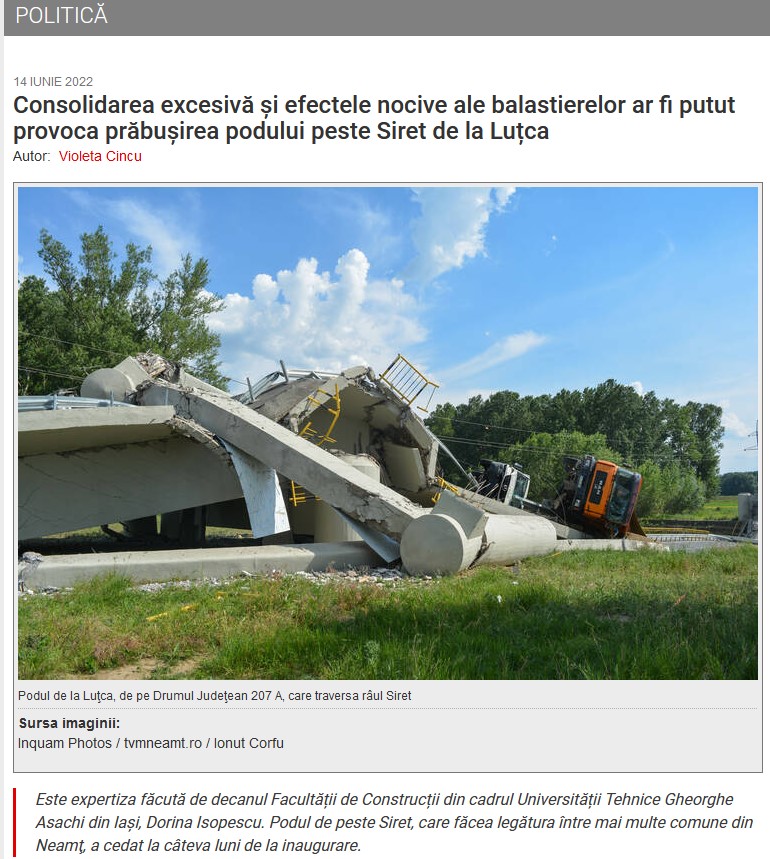
Avem un pod.

Aveam un pod… Aveam 216 m de pod, din beton, care permiteau traversarea Siretului în dreptul localității Luțca.

Acum mai avem doar o grămadă de moloz.

Și multe întrebări…

Cine să ne răspundă?
Specialiștii, prin intermediul presei.
Cel puțin deocamdată… până când va apărea un raport oficial. Despre (pe) care (îl) vom citi tot în presă…

Și cum se întâmplă treaba asta?
Ziaristul sună un specialist iar acesta acceptă – sau nu, să își spună părerea. Ziaristul își notează/întregistrează informațiile, redactează materialul – eventual cere o reacție din partea specialistului, după care articolul ajunge pe masa secretarului de redacție. Unde capătă titlul definitiv și ultimele retușuri.

Nu pot să mă pronunț mai mult pentru că nu am fost acolo, am văzut doar fotografiile pe care le prezintă presa și nu sunt concludente.”

După care urmează circul…
Se apucă câte unul să citească. Și să pună întrebări….

Articolul este … banal. Nici nu muge, nici nu rage. Nici măcar nu știu câți cititori ajung la capătul textului…
Unde dau cu nasul de disclaimerul citat mai sus.
Acesta fiind momentul în care cei cu memoria bună își aduc aminte de cuvintele cu care începe articolul:

Este expertiza făcută de decanul facultății de construcții…

Pe bune?!?
Atâta vreme cât decanul cu pricina a simțit nevoia să sublinieze, iar autorul articolului să consemneze, „nu pot să mă pronunț mai mult pentru că nu am fost acolo” cum mai poate cineva să catalogheze considerațiile făcute de respectivul specialist ca fiind o „expertiză”?!?

Și după aia se scarpină câte unii în cap încercând să înțeleagă ‘fenomenul’ prin care ‘specialist’ a devenit subiect de bășcălie iar din ce în ce mai mulți oameni cumpără ziare doar pentru a avea pe ce să curețe cartofi…

The human head works like an organic computer.
It has a ‘hard’ component. Which is actually soft. The brain tissue.
And many levels of ‘software’.

You might want to skip this introductory part if you’re not familiar with/interested in how computers work
The ‘machine code’. The inner workings of the brain. The ‘things’ which continue to function when we’re not at all conscious. Breathing, coordination of the of various organs which keep us alive, etc.
‘Assembly language’. The level which works on ’emotions’/’feelings’. A not yet conscious baby suckles when hungry and cries when uncomfortable. A patient with dementia is not a ‘fully functional human being’ but can learn/retain many human functions.
‘High-level language’. Human conscience. While the ‘machine code’ and the ‘assembly language’ levels run in the ‘background’, human conscience constantly evaluates ‘what’s going on’ and decides ‘the next move’.

Humans, like computers, work a lot better when ‘put together’.
Each individual’s human conscience develops only ‘in concert’ with other people while the most powerful computer chip is ‘dead’ before the operating system has been installed. A (mature) individual human being might survive in isolation, but not for very long. A computer is completely useless if not ‘put to work’ by an ‘operator’. Alone or ‘inside’ a network.

Computers can ‘cooperate’ because we made them so.
Even if using various operating systems and communication protocols, we – humans, have developed them – computers, in such a way that we can communicate with them and they can communicate among themselves.

For humans to be able to communicate among themselves, they need a common language.

Computers do not need to coordinate among themselves. We’ve made them, instructed them, in such a manner that they (still) do what they are told.

For humans to be able to coordinate themselves – to act in a congruent manner, they need to use – or at least to acknowledge, the same referential system.

To think ‘alike’ or, at least, to acknowledge that ‘those who do not think like me/us might have a point’.

Historically speaking, humankind has achieved ‘coherence’ through the use of ‘religion’.

‘Reality’ – which was far more complex ‘before’ simply because the unknown is the place where fantasy is free to give birth to anything, had to be tamed. Translated into ‘operable’ things. Into generally accepted concepts. Into generally accepted ‘myths’.
And for as long as a given set of ‘foundational myths’ had maintained their ‘magic’, the religion which had been developed starting from those myths had continued to be ‘the coalescing factor’ for the community which believed those myths. Or, at least, behaved as if those myths were still ‘valid’.
Whenever those myths had failed – or were no longer enough, the corresponding religion had been quickly replaced. By another.
This was the heave-ho approach. Wholesale replacement of the referential system, which is both ‘wasteful’ and time-consuming.

In time, people have learned that it was far more ‘efficient’ to pay ‘lip service’ to each-other’s opinions
when the other side was too ‘strong’ for outright ‘coercion’. Read “conversion”.

When/where things had become ‘ripe’, some people had invented ‘science’.

Science, like religion, is a manner of thinking. A manner of translating reality into something which can be managed by the human brain.

Religion relies on a set of ‘axioms’. Which had been considered true – by those who had established any given religion, at the moment when that particular religion had been established. When freshly acquired knowledge diverges too far – and too convincingly, from the until then generally accepted ‘founding myths’, the religion which depends on those myths conserving their ‘allure’ is abandoned in totum.

Science, on the other hand, relies on a different set of ‘beliefs’.
Derived from the basic tenet of the Judaeo-Christian creed and no less axiomatic but still different.
The point being that instead of trying to fit any new information into the previously held set of ‘teachings’ science mandates the diligent use of the ‘scientific method’ whenever we attempt to evaluate any ‘piece of knowledge’:

Reproducibility: ‘do I find/learn the same thing each and every time I examine this phenomenon/class of objects using this particular procedure?

Peer review: Does everybody else who examines the same subject, using the same procedure, reach the same results? In earnest?

Falsifiability: Does the subject of our musing have a correspondent in reality? Are we concerned about something which has consequences? Can this particular ‘piece of knowledge’ be proven wrong? Or, at least, incomplete?

The three paragraphs above have described the scientific method yet I still have to mention the Judaeo-Christian belief without which science makes absolutely no sense.

Then God said, “Let Us make man in Our image, after Our likeness, to rule over the fish of the sea and the birds of the air, over the livestock, and over all the earth itself and every creature that crawls upon it“.

According to the Old Testament, God had made man to “rule… over all the earth itself”. Which means that God was going to refrain himself from performing other miracles. The Earth being entrusted to the rule of man means that man was going to ‘see’ the same thing each and every time he was looking at the same thing. From that moment, ‘things’ were going to ‘happen’ in a ‘rigorous’ manner. No more ‘hanky-panky’, no more divine intrusion. From then on, things were going to happen according to the ‘law’. ‘Regularly’, hence ‘reproduciblely’. In a consistent manner!
Again according to the Old Testament, ‘God had made man in His image’. Hence all men – and women, had been created equal. In the same image, that is. And all men – and women, harbor something ‘special’. A spark of divinity! They have all been created in the image of God itself, hence they all should respect each-other. And each-others’ opinions! Hence ‘peer-review’.
All that remains to be ‘explained away’ is the small matter of falsifiability. Of science concerning itself only with verifiable subjects. Which brings us back what was the man supposed to rule over. ‘The earth itself’. The realm of reality. Man – men and women, were supposed to rule over ‘reality’, not over other people.
They were supposed to concern themselves with ‘evident’/measurable things found ‘on earth’, not with ‘fancy’ figments of ‘unaccountable imagination’.

Ooops!
If both religion – well, at least the Judaeo-Christian one, and science depend on the same axiom/fundamental myth, then where’s the difference?
As I mentioned before, whenever fresh knowledge contradicts ‘irreparably’ the before held religious convictions, the community who upholding those convictions reaches a ‘passage rite’. Has to either ‘close its eyes’ – actually denying reality, or change its religion. The very definition of the ‘heave-ho’ approach.
For those using the ‘scientific method’, things are a lot simpler. And smoother. For them, reality suffers a constant change. Piece-meal instead of wholesale. ‘Easy-does’ it instead of ‘gung ho’.

One other thing before I let you go.

“If you’re not a scientist, and disagree with scientists about science, that’s not disagreement! You’re just wrong!”

Well, this is the most unscientific thing I’ve read for a long time.
What comes next makes absolute sense. If you apply the scientific method to “Science is not truth. Science is finding the truth.” you determine that the message is consistent, agreed among the peers and falsifiable. Science can be misused and, potentially, the very meaning of the word can change in time. For now, the generally accepted meaning of ‘science’ is, indeed, ‘the path towards truth’. And, by definition, all scientific knowledge is considered to be ‘improvable’. Hence forever ‘not yet true’.
Coming back to the ‘disagreement’ part, this is an obvious ‘sleigh of hand’. For starters, ‘scientists’ do not concern themselves with ‘science’. Each of them controls an area of expertise. Which is not the entire science…
Furthermore, what does it mean ‘you’re not a scientist’?!? You don’t have a formal accreditation? Anybody who uses the scientific method when examining the reality is a scientist, regardless of their credentials.
I presume the author meant well. There are quite a few people out there who are in the ‘business’ of sowing doubt. Who contradict whatever ‘starts their ire’. Who very ‘skillfully’ spin apparently convincing words about subjects of utmost importance. But if we want to remain true to our words, if we want to remain on the straight and narrow path to truth, we must convince our audience with arguments. We must un-spin those ‘words’ in a rigorous manner.
Using the very same set of ‘spinning skills’ downgrades us to ‘their’ level.
As the saying goes, ‘Don’t allow your opponents to drag you to their level of expertise. Remain on yours. Any attempt to beat the other guy using their weapons will, more often than not, yield the undesired result. For the obvious reason that they have used those weapons for far longer than you’.

Aflăm de pe internet:

Comentariu ‘la botul calului’:

Până la urmă, sunt două chestii diferite…

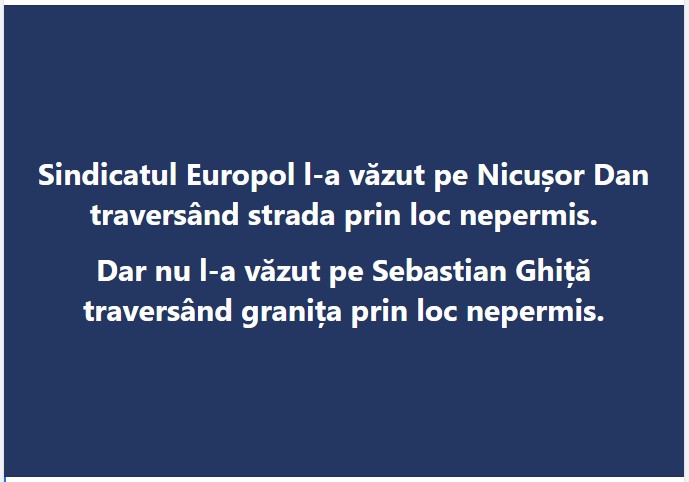
Ghiță a fugit peste graniță cu un sac de bani în spate. Că altfel n-avea ce să mănânce ‘dincolo’.

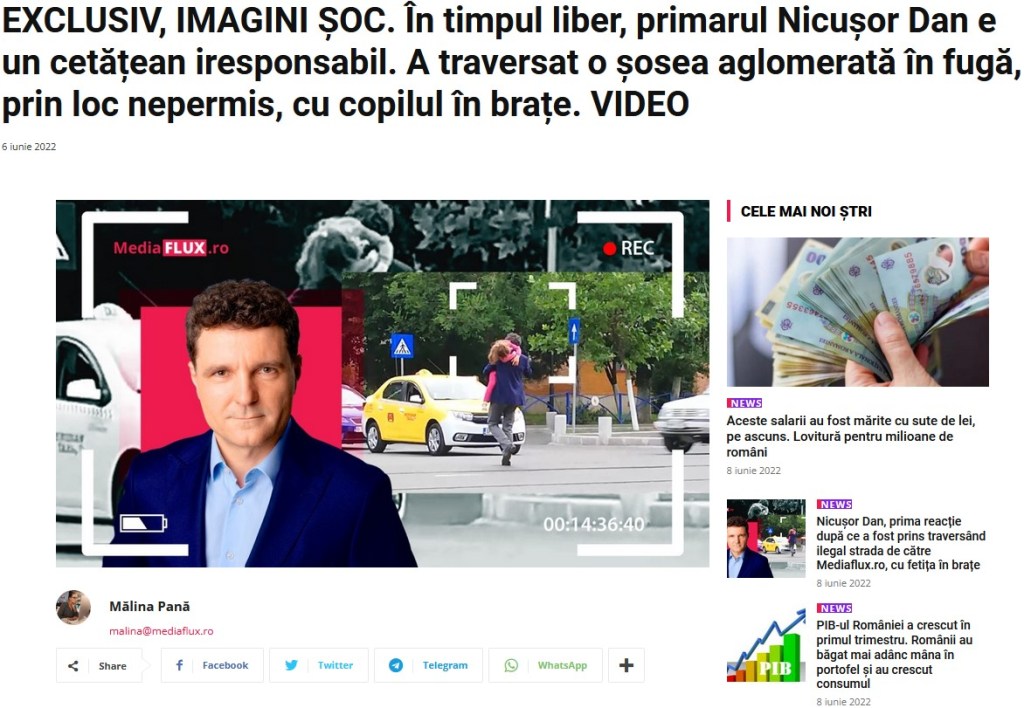
Nicușor Dan a trecut strada ca să scoată niște bani. De la bancomat. Cu copila-n brațe. Vorbind la telefon. În fugă…

Dacă se împiedica Sebastian Ghita… îl prindea Europolul.

Daca se împiedica Nicușor Dan, își rupea ceva copilul ăla nevinovat.

Dacă dădea cineva peste Ghița, primea o medalie. Sau măcar o citație pe unitate.

Dacă dădea vre-un șofer peste Dan… avea ceva de tras!

Dacă noi, cei care trebuie să tragem din 4 in 4 ani niște concluzii, nu vedem că diferențele astea sunt, de fapt, niste ‘trăsături de unire’ … ne merităm soarta!

Care e realitatea ‘din teren’:

Și încă ceva.
În principiu, nu am mare considerație pentru presa de scandal.
Sau, mai bine spus, pentru modul ‘scandalos’ în care ‘se face presă’ în zilele noastre.
Dar uite că așa mai aflăm și noi chestii interesante din viața aleșilor noștri…

This is the first time that I’ve read anything written by Daniel Kowalski. Here’s what I learned, about Kowalski, while reading his his essay about Marx.

I’m not sure that Kowalski had actually read the communist manifesto. And I’m sure that he didn’t understand much of it.

The point being that Marx described society as being composed of the ruling class – those who owned things and gave orders, the ‘doers’ – the qualified/skilled workers, those we currently describe as ‘middle class’, and the ‘underdogs’ – the lumpen-proletariat.

And if Marx hated anybody more than he hated the rulers… those people were the lumpen-proletariat! Because the lumpen-proletariat were so poor that they did everything the rulers asked them to do.

Let’s get to the ‘visionary’ part. Read carefully, the manifesto is crystal clear. Communism was not supposed to ‘dawn’ while Marx was still alive. For communism to become viable, the middle-class had to became poor. To loose their perks. To be reduced to ‘lumpen’ status. But since the middle class already had ‘conscience’ – was aware of its ‘value’, they were supposed to understand what was happening to them. And to revolt against those who were benefiting from the process.

In Marx’s vision, the impoverished middle class was supposed to become aware of its predicament, and only then to let itself be led into the new era of ‘eternal bliss’ by the “the most advanced and resolute section of the working-class parties of every country, that section which pushes forward all others; on the other hand, theoretically, they have over the great mass of the proletariat the advantage of clearly understanding the line of march, the conditions, and the ultimate general results of the proletarian movement.” Also known as ‘communists’.

I’ll end up my comment drawing your attention to the growing wave of anti-capitalist propaganda which is being ‘vented’ over the internet.

The fact that Marx’s remedy for what he saw as the scourge of capitalism – inequality, was an absolute idiocy – the “workers’ dictatorship”, doesn’t erase the fact that Marx the prophet was right after all. The middle class is being squeezed out.

The communism has failed. Because it was based on dictatorship.

The current flavor of capitalism – increasingly monopolistic, will soon follow suit. Not because its capitalist nature but because of its monopolistic – aka dictatorial, dimension.

In my book – I have experimented both communism and democratic(ish) capitalism, there’s no real difference between the communist ‘one ideology solves all problems’ and the ‘greed is good’ mantra.
In practice, all we have is a single, uni-dimensional, idea forcefully being imposed upon all the people who happen to live in a place at the given moment. ‘Money/capital is bad’, hence it has to be abolished, versus ‘money/capital is everything’, hence it has to be enshrined.
I’m not a christian but I’m fully aware that ‘you shall not make yourself an idol’ is a very wise teaching. Specially when that idol is golden.