Archives for category: altruism

Weapons are nothing but repurposed tools. Sometimes ‘enhanced’ to fit the new goal.

Clubs had started as fruit harvesting utensils, then used for hunting purposes and eventually for bashing in the heads of those who had slept with the missus when the wielders weren’t looking. And so on…

As a tool, an implement is used to ‘put things together’. As a weapon, the same (kind of) implement is used to ‘set things apart’. An axe can be used to split wood in order to build a fire or to ‘split’ furniture during a fit of rage.
Generally speaking, a tool is used towards the ultimate goal of adding to/fine tuning a structure while a weapon is used to destroy/disable something which is meant to remain so.

Our ability to communicate was ‘the’ tool which actually transformed us into what we are today. Humans.
At least according to Humberto Maturana. His theory maintains that we’ve become self-aware social individuals through what he calls languaging.
In a nut-shell, he says that we’ve become humans – self conscious apes, by continuously expressing our thoughts towards the other members of the community. Hence simultaneously building an ‘agora’ and ‘walling in’ individual private spaces.

Yet the same ability to communicate can be used also as a weapon.
Instead of being used by individuals to mutually groom themselves, and ultimately adding to the overall resilience of the community, ‘weaponized’ communication is used to ‘downgrade’ susceptible individuals.
To lower the ability of certain individuals to contribute to the community to which they belong, to lower the ability of entire communities to hold together… or both at the same time.

History suggests that, in the longer run, democracy – as a manner of decision making, increases the survivability of the communities which use it. Simply by pooling the decision making resources of the entire community instead of relying on the mental prowess – and good will, of a single authoritarian leader.
Only for democracy to be fully functional, the individual members of the community have to be able to share, in earnest, their thoughts.
This is why Freedom of Speech has been enshrined in the First Amendment.
That’s why whenever the public discourse becomes increasingly dominated by ‘fake-news’ things start to go south.

That is why whenever people allow themselves to be split into warring parties – with no real communication between the sides except for the misinformation hurled across the divide, both sides eventually end up wondering at the destruction they had allowed the ‘communication warriors’ to inflict upon them.

For some of you, this is nothing new.
For most of you, this is not at all complicated. The image being different from the real thing is rather obvious. Specially when we’re not already invested in the subject…

What on Earth is he trying to say?
Abolish his own kind? There’s nobody whiter than he is…
Or abolish ‘Whiteness’ as a race? Along with all other ‘races’?

Do you see what I mean?
Had he paid more attention in class, he would have known that such an image cuts both ways.

Magrite’s painting worked because his message was ideologically neutral. Nobody – well, almost nobody, has feelings about ‘pipes’. Hence people find it easy to keep their cool about the whole thing. To probe deeper than ‘face value’.

‘Whiteness’, on the other hand, is ‘choke’ full of sentiment. I’m certain you know what I mean. It’s a lot harder to keep a level head when the subject is mentioned.

Back to the drawing board!
The idea is generous but it doesn’t get across.
Simply because the ‘window dressing’ isn’t appropriate.

https://www.lrb.co.uk/blog/2020/june/abolish-whiteness

So, in the name of liberty and in order to protect the lives of the innocents, the government should not mandate wearing a mask in public – for the duration of the current pandemic, but should close the public funded ‘planned parenthood’ clinics forever…

Individuals – both men and women, are to be trusted to take, on their own, the appropriate measures to protect themselves – and the others, but women are not to be trusted to decide, on their own, about what happens inside their own bodies.

Meanwhile, “The US and Brazil each recorded more than 100,000 cases over the seven days from June 15 to June 21, the WHO said, the only two countries with such high infection numbers.
Do I need to refresh your memory about the fact that neither of their presidents, Trump and Bolsonaro, have never been seen wearing a mask in public?

Cică „Dacă nu noi, atunci cine? Și dacă nu acum, atunci când?”

Am auzit prima oară sloganul ăsta în timpul unui miting de protest.

La ceva vreme după aia, s-a petrecut schimbarea. Au ajuns alți „noi” la putere. Numai că aproape totul a rămas aproape la fel. La fel de prost…
După care s-au mai perintat câteva generații de „noi”.

Sau, având în vedere că lucrurile s-au îmbunătățit foarte puțin pentru noi și foarte mult doar pentru ei, ar fi poate mai potrivit să spun că s-au perindat câteva generații de „ei”?!?

Și cu noi cum rămâne?

Rămâne cum am stabilit.
Dacă nu noi, atunci cine? Și dacă nu acum, atunci când?

Dacă le tot cerem „lor” să se schimbe – între ei, pe ei îșiși, treaba lor, numai să facă treabă, când avem de gând să ne schimbăm și noi?

Când vom învăța să:

Să ne spălăm pe mâini, să purtăm mască, să nu mai punem botu’ la toate prostiile…?
Să nu mai aducem acasă hârtie de scris și agrafe de la birou? Să nu mai întoarcem capul atunci când unii dintre colegii noștrii fac chestia asta?

Să nu ne mai ajutăm șefii să fure în speranța că noi vom fi cei păstrați atunci când va veni restructurarea cea mare? Cea cu care suntem amenințați continuu, indiferent de locul unde muncim pentru a construi ‘societatea capitalistă multilateral dezvoltată’…
Să nu mai întoarcem capul atunci când alții își ajută șefii să fure în speranța că…

Și asta pentru simplul motiv că dacă mai stăm mult cu capu-n partea-ailaltă s-ar putea să nu mai fie nimic de văzut atunci când vom reveni la poziția firească.

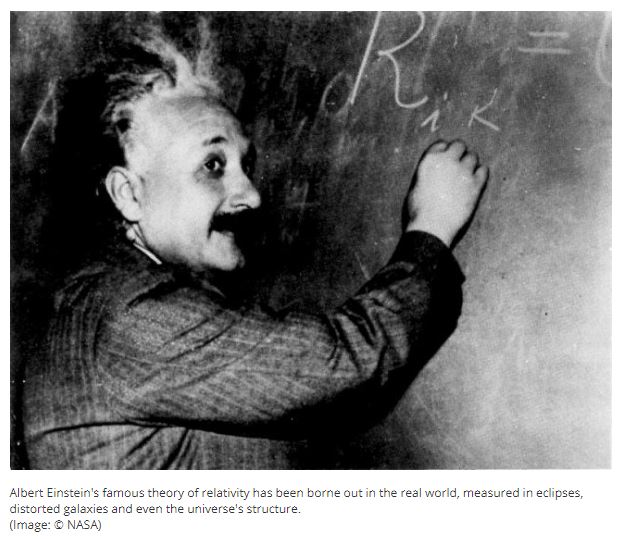
Albert Einstein, a physicist, had noticed that observations are relative to the “frame of reference” where the observer happens to make his observations.

Humberto Maturana, a biologist, has reached the conclusion that consciousness – or ‘self awareness’, as he prefers to call it, is a personal trait which is developed by individuals living in concert.

Blending Einstein’s and Maturana’s ideas, it is easy to ‘see’ that observations made by human individuals depend, simultaneously, on two referential systems. Or frames of reference, in Einstein’s terms.

On the actual, ‘geographic’, ‘place’ where the individual makes their observations.
And on the ‘cultural place’ where the conscience – inner referential system, of the observing individual had been ‘shaped’.

Otherwise put, nobody can see things which are not there. Nor ‘see’ – a.k.a. understand, things which are too ‘distant’ from what that person already ‘knows’. Accepts as being ‘normal’. Feels like being ‘right’.

To make things just a tad ‘clearer’ – ‘nature versus nurture’, we must consider the vagaries of individual ‘biology’. Some people see/hear/smell/feel differently than others. And even ‘think’ differently.

And my point is?

Maturana made it before me. The ‘other’ – the more different, the better, is a source of richness. IF we treat each-other the right way. If we help each-other by ‘concerting’ our observations about what we have in common.
The ‘place’ we observe. Einstein’s referential frame. Where we ‘happen to stand’. Together.

And there’s something else I’d like you to read.

“J.K. Rowling Writes about Her Reasons for Speaking out on Sex and Gender Issues”
https://www.jkrowling.com/opinions/j-k-rowling-writes-about-her-reasons-for-speaking-out-on-sex-and-gender-issues

“You shall not make for yourself an image in the form of anything in heaven above or on the earth beneath or in the waters below. You shall not bow down to them or worship them; for I, the Lord your God, am a jealous God, punishing the children for the sin of the parents to the third and fourth generation of those who hate me, but showing love to a thousand generations of those who love me and keep my commandments.

Science teaches us many things.

In fact no, science teaches us nothing!
Science cannot teach, at all. Simply because science is not a teacher.

At individual level, science is an attitude. A mind open enough to accept its own fallibility. To accept the fact that, sooner rather than later, it will fail.
To accept the fact that the image it constantly generates during its interaction with the surrounding world is, at best, incomplete.
To accept the fact that the understanding it has reached during its existence is, and will remain forever, a work in progress.

At the social level, science is a way of conducting business.
Based on ‘trust but verify’. A scientifically minded community trusts its individual members to be honest in their efforts but verify their work because – as mentioned above, each of us will, sooner rather than later, fail.
Hence, by aggregating their efforts, a scientifically minded community will eventually paint a still imperfect image but one closer to the reality than any of those belonging to its individual members.

In order for the community to be able to continuously improve their ‘work in progress’ each, or at least, enough of its members need to preserve their scientific mental attitude. Their intellectual humility.
As soon as too many of the individuals reach the conclusion that their image of the world is the only correct one – and they start not only to bow towards it but also to convince others to join them, things start going south.

“Let any one of you who is without sin be the first to throw a stone at her.”

Who among us is perfect? Perfect enough to be sure?

And why had been chosen an adulterous woman as the main character for this lesson?
Because adultery is a sin which cannot be committed in solitude? Only in cooperation with ‘the other’? As a relationship? Where each member contributes to the shared doom?

Do you see how similar science and sin are?

Both start ‘individually’ and are put in practice ‘together’.
Both are initiated as individual pulsions and put in practice as choices.

I’ve started this post by mentioning science.
The scientists among us have reached the conclusion that there was no need for a God to start the process of which we are the alleged pinnacle. That evolution was enough to drive the whole thing. I tend to agree.
On the other hand, history – yet another branch of science, has produced enough evidence to prove that God had a tremendous contribution to the present state of civilization.

Not God himself but the image of God we have created for ourselves. The Image we’ve been bowing to for some time now.

Go figure….

I’ve always been fascinated by quotes which are ambiguous enough to be simultaneously wrong and right.

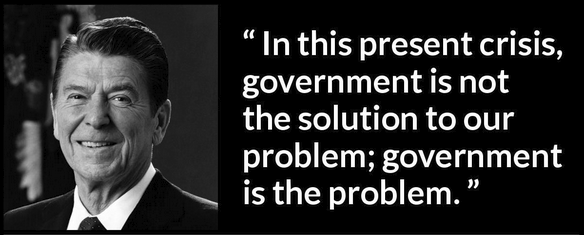
In this situation, the ambiguity comes from ‘government’ covering three ‘patches of ground’.

‘Method of running a place/country’. (Self)Organized versus chaotic.
‘System in place’ which is used in running a country.
A particular group of people who man, at any given moment, the above mentioned ‘system in place’.

Now, which of the three meanings was at the top of Reagan’s mind when he was uttering those ‘famous’ words?

All governments suffer a recurring problem: Power attracts pathological personalities. It is not that power corrupts but that it is magnetic to the corruptable(sic). Such people have a tendency to become drunk on violence, a condition to which they are quickly addicted.

Frank Herbert

The way I see it, government ‘as a manner of running things’ is a very powerful method. Which had served us rather well, on aggregate. Only it is not fail-proof. Or, more exactly, fool-proof.
Government as a ‘system in place’ is a work in progress. We’ve been improving it since we’ve invented government as an alternative to chaos. Only we need to be very careful. As a man made system it will always be far from perfect. It has not been perfect in the past and, no matter how much effort we’ll put into it, it will always remain perfectible.
Finally, government as ‘the team temporarily in charge’ ‘suffers’ mainly from being composed of humans. Hence both corruptible and attracted to power. Hence liable to do everything to maintain their positions.

‘Liable to do everything to remain in power’.
Which means that it’s our job to keep them on the straight and narrow.
We, The People, are the first to experience the consequences of their decisions. Hence we, all of us, are those who need to keep Government – ‘the team in charge’, on a short leash.
If they want to remain in power, they need to keep us ‘alive’.
They need to keep the system in shape. Working good enough for the vast majority, not for just a few of us. For a few of them, to be more precise.

Otherwise ‘government as a manner of keeping chaos at bay’ would have failed.


War has been the subject of many books. From war novels to ‘how to’ treaties.
When the subject is mentioned, two stand up high. Sun Zu’s “The Art of War” and Clausewitz’s “On War“.

I’m not going to discuss the relative merits of the two treaties. Only to point out a few parallels.
The authors had been involved in wars. Wars between states inhabited by more or less the same people. Sharing more or less the same culture. Wars which had ended when the warring parties had coalesced into what we call nations. China and Germany, respectively.

Yet we currently refer to those two treaties when we consider war between totally different nations/cultures.

Furthermore, we consider those two as being the pinnacles of strategic thinking. In a sense, that would be right. After all, both had been written by the winners of those respective wars.

But what happened next?

What major war had China won after becoming an united nation? WWII? When her enemy had been first beaten to a pulp, literally, by the US?
What major war had Germany won after becoming an united nation? The one against France in 1870? OK. And afterwards?

And what is the real meaning of ‘Si vis pacem, parabellum’?

‘If you want peace, prepare to wage war’ or ‘if you want peace, make your self resilient to war‘?

What if our self awareness, otherwise known as conscience, has evolved in order to understand, accept and mitigate randomness?

There’s no evolution – hence no life, without randomness.
Yet life, anyway you look at it, is about maintaining a certain degree of order.

Whenever there’s so much randomness that life can no longer adapt to it… evolution stops.
Whenever structures become so big/rigid that they find it harder and harder to evolve, they eventually succumb to an otherwise survivable amount of randomness. Dinosaurs and too big to fail corporations versus mice and flexible operators.

In a nutshell, self-awareness is about not being ‘fooled by randomness‘.

And to avoid the deepest pitfall we’ll encounter during this never ending journey – randomness will always be wider than our individual ability to encompass it, we must keep remembering that conscience is selfish. Untrained, it is more about protecting itself than about helping the entire ‘individual’ to survive.

‘What?!?’

Yes, it’s hard to believe!
But what other explanation is there for so many of us continuing to smoke after finding out, the hard way, that this habit might actually kill us?
I use this example simply because I still remember the cigarette I smoked when I last visited the grave where rests a woman I loved dearly. And who is no longer with us because of lung cancer.

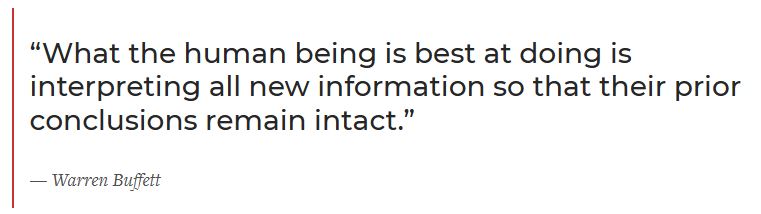
Too often our conscience will prefer to rationalize away new information than accept that past choices could have been better.

I’m certain all of you are already too familiar with ‘confirmation bias‘.

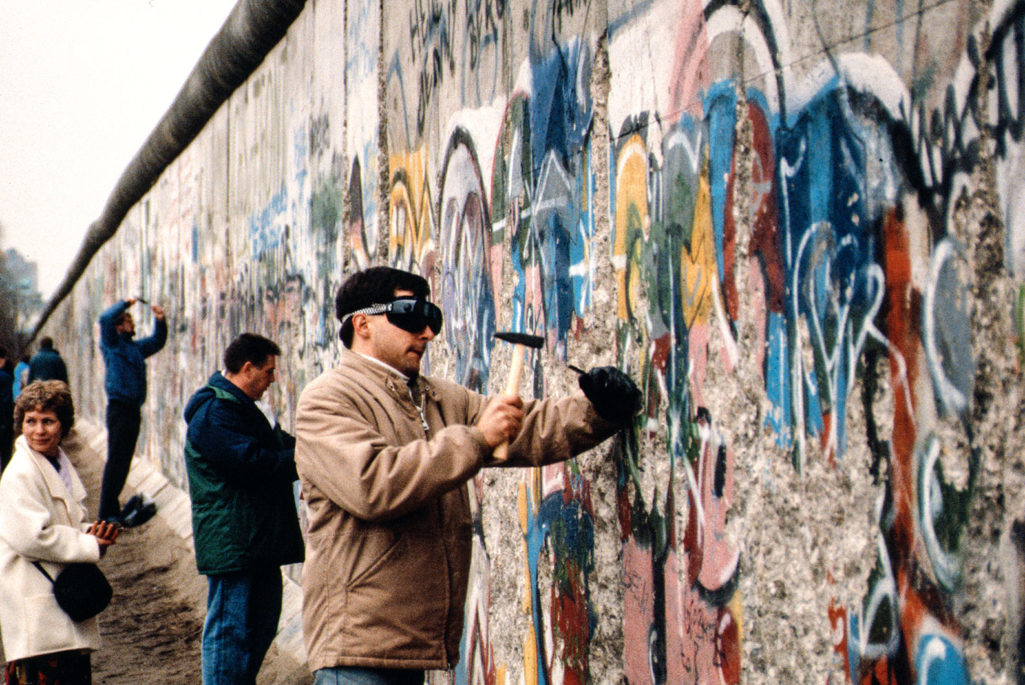
Until thirty one years ago, the Eastern half of Europe was self isolated behind the Iron Curtain. Which had suddenly disappeared in a matter of months.

Nowadays, when SARS-CoV-2 has forced each of us to shelter in place and our nations to self isolate behind the borders, we have not only the opportunity but also the obligation to re-evaluate our take on many of the things we took for granted.

The most important one being our Weltanshauung. The way we see the world.
The fact that we have convinced ourselves – simply because our lives have been good enough, that we’ve been doing things the right way.

Marx’s communists had been convinced that dialectic materialism – supposedly backed up by science and a generous political doctrine, was the way in which humankind was going to built its future.
Not the best way, the only way!
For which reason, no transgression from the official line was allowed.
Solutions were to be found only where the official doctrine mandated that answers might have existed.

Communism had fallen. Mostly from within.
Which has prompted those on the other side of the fence to consider that their vision had been better. Which was obviously true.
Slowly, people on both sides of the previous fence have started to convince themselves that their vision was the only correct one. The only alternative had proven itself to be a failure, didn’t it?
Which seems also true. I know of no better alternative. For us. I know of no alternative which would be more helpful for us. Only the fact that I’m not aware of an alternative doesn’t mean much. The alternative might as well exist. Or not….

And here’s the problem.
Marxism had failed for no other reason than those who followed it behaved as if they were convinced that Marxism was perfect. They were implementing the Marxist doctrine by the letter. Not that its spirit was any good… long discussion. My point being that arrogance was built in the Marxist spirit. Marx had actually given carte blanche to his adepts to impose communism, by force, to the rest of the world.

Unfortunately, the last 30 years had convinced me that many individuals belonging to the dominant culture, to any dominant culture, have a hard time keeping their cool.
Too many of them reach the conclusion that ‘theirs’ is the best way. That all the rest are wrong.
Which conviction has a malignant consequence. It makes them deaf. They no longer consider any other option but theirs.
They no longer hear anything but their inner voice.

For all it may be worth, here’s what I learned about liberty during the last 30 years.

Liberty as breadth.
Liberty is the breadth of the opportunity field where we might search solutions for our problems. But no matter how large that breadth might become, we’re never ‘out of the woods’.
Liberty is but an opportunity, never a guarantee.
We are the ones still responsible for the solutions we pick. For the simple reason that we’re going to bear the brunt of the consequences.

It is easier to search for solutions in a freer environment. Hence better solutions might become available sooner. But it’s still our job to look for them. To experiment. To widen our scope.

Liberty as a form of social interaction.
We can relate to freedom in at least two manners.
As an individual goal – ‘I want to be free’/’I want freedom for my people’, or as a ‘manner of doing business’.
We are free, together, because we respect, and trust, each-other. We are free, together, because generations and generations of us have build a social arrangement based on mutual respect. A social arrangement which includes certain mechanisms which attempt to bring things back on track whenever disturbances appear.
Some of which mechanisms have been put into formal law, while others have remained in the ‘public domain’.

When we put these two visions together, the ‘binocular’ image starts to develop ‘depths’.

A social group may enjoy freedom – a wider opportunity field, only as long as its individual members – all of them, enjoy their individual freedoms. For only as long as all individual members are free to roam the entire opportunity field discovered/maintained by the community.
And as soon as some individual members start to corner portions of the opportunity field for themselves… the whole social mechanism will grind to a halt.

Sooner rather than later.
The more intense the desire of the individual members to increase their ‘own’ individual liberty, the narrower the aggregated opportunity field becomes.
Each of the individuals guarding their plot means each of them staring at their feet. Individuals become more interested in guarding their fences rather than in raising their eyes to the horizon.

People obsessively defending their past will never be ready for the future.
Meanwhile individuals charging ahead with no consideration for the rest of the team will soon find themselves stranded on thin ice. With no one around to help.