Archives for posts with tag: individualism

“If you’re an academic (like me),
Epstein has a particularly uncomfortable example
of how people in a perfectly comfortable profession like mine
can be happy and yet still itch with ressentiment about others
whose talents seem more valued than our own.
“Why does some ignorant lawyer have enough money to buy a villa in Tuscany
when one knows so much more about the art of the Italian Renaissance?
What kind of society permits this state of things to exist?
A seriously unjust one, that’s what kind.””
Our worst enemy..., Tom Nichols

Aaron Mostofsky, the guy pictured above, “has worked as an assistant architect in New York“.
Which means he must have at least some idea about the ‘art of the Italian Renaissance’, right?
And now I wonder. His ressentiment had been seeded in his soul during college? Earlier?

Popper, Karl Raymund, had witnessed the entire XX-the century. Both WWs and their aftermath. The advent of the USSR, that of the III-rd Reich and that of the Red China. And the defeat of the imperialistic Japan. Him insisting that collectivism – as put in practice by the fascists and by the communists – leads to a very dark cul-de-sac is spot on and perfectly aligned with what history teaches us.
But who has enough time to read nowadays … we glance at the internet, catch a meme … interpret it according to our own weltanschauung… and then storm the Capitol!
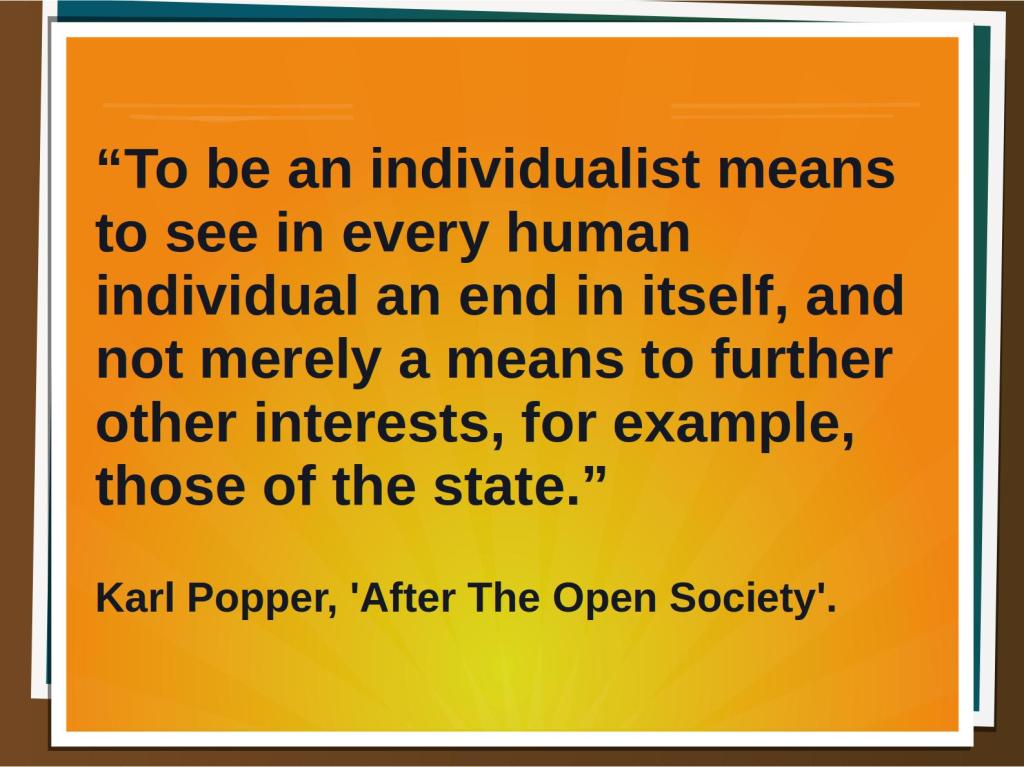
Because the individual is above the state. “An end in itself”…

The teachers/parents should have done a better job? At explaining what Popper had in mind? At teaching the next generation that you don’t ransack the Capitol whenever you don’t like the outcome of an election?

Which teachers?
Which parents?

WE?!?

https://www.amazon.com/Our-Own-Worst-Enemy-Democracy/dp/0197518877

https://www.routledge.com/After-The-Open-Society-Selected-Social-and-Political-Writings/Popper-Turner-Shearmur/p/book/9780415610230

Survival of the fittest?!?
No, only the demise of the unfit!

Ernst Mayr, What Evolution Is?

An end in itself…

For whom? For the concerned individual?
For the philosopher pondering the concept?
For the ideologue promoting the idea?

And who determines ‘the interests of the state’?!?

“Plato suggests, and all later collectivists followed him in this point, that if you cannot sacrifice your self-interest for the sake of the whole, then you are a selfish person, and morally depraved.”

Since there’s no better judge for ‘sustainability’ than mere history, let’s ‘look back’.

Whenever the powerful of the day considered that everything belonged to them, and that the collective wasn’t worth any consideration, that ‘arrangement’ soon ended in chaos. From Alexander the Great to Saddam Hussein. Hitler, Stalin, Ceausescu…
Whenever the meek had accepted everything which came from ‘above’, very soon the ‘arrangement’ also ended in chaos. The Khmer Rouge experiment, the Chinese Cultural Revolution, communism being instated in the Eastern Europe by the Soviets…

As a rule of thumb, individuals can exist only as members of a collective.
None of us can birth itself (?!?)
None of us can educate itself ON ITS OWN. OK, one might teach itself to read. And then devour a whole library. But for that to happen, somebody else must have invented the letters first!
None of us can develop into a conscious human being without living with other human beings.

Furthermore, the same rule of thumb states that collectives which value their individuals, all of them, fare a lot better than the highly ‘hierarchical’ ones.
In this sense, Popper was right. ‘Individualistic’ societies – the collectives which ‘see individuals as ends to themselves’ – fare better than the collectives which allow, for a while, their temporal leaders to lure them into obedience.

” Cea mai serioasă disfuncție societală este aceea când
publicul care populează colectivitatea respectivă
nu știe sau uită că el este cel ce are nevoie de intelectuali și nu invers.
Nu intelectualul are nevoie de vreun public, pentru a se împlini. “

Diagnosticul, „disfuncție societală”, este cât se poate de corect.
Atunci când intelectualul nu-și găsește locul în societate, întreaga societate are de suferit.
Doar că…. de cele mai multe ori situația atât de corect diagnosticată este produsul unor intelectuali care nu și-au înțeles cu adevărat menirea.
Ceea ce este cunoscut îndeosebi sub numele de comunism a fost consecința strădaniilor unor intelectuali care o luaseră razna. De la Marx până la politrucii care îl făcurseră posibil pe Ceaușescu.
Ceea ce este cunoscut sub numele de fascism a apărut tot datorită unor așa considerați intelectuali.

Una dintre contribuțiile esențiale ale ‘intelectualismului’ este confuzia malignă din jurul pretinsului conflict dintre colectivism și individualism.
Comunismul – și câteodată fascismul – fiind prezentate ca fiind colectivisme nocive în timp ce ‘individualismul’ este prezentat de promotorii confuziei ca fiind ideal.
Am pus individualismul între ” pentru că în zilele noastre avem de a face cu o formă cel puțin ‘confuză’ de individualism. Individualismul de tip ‘fiecare împotriva tuturor’.
Mai mult, faptul că individualismul, de toate formele, provine din liberalism este ocultat cu obstinație, ‘liberalismul’ fiind nociv în ochii intelectualilor ‘individualiști’!
Ei bine, dacă ridică puțin capul deasupra ceței pompate de individualiștii teoretici devine cât se poate de evident că atât soluția comunistă – la care se poate ajunge doar prin dictatură socialistă – cât și cea fascistă – dictatură mândră de natura sa – sunt, în realitate, forme maligne de individualism. Pentru simplul motiv că întreaga societate este dusă de râpă din cauza concentrării disfuncționale a puterii. Din cauza acaparării puterii de către un număr foarte redus de indivizi! De indivizi cât se poate de individualiști…
Asta în timp ce societățile care funcționeză în regim de democrație liberală sunt niște colectivități compuse din indivizi care se respectă între ei!
Așa zisul colectivism asociat comunismului și fascimului este doar o fentă! O promisiune calpă făcută de niște intelectuali cu o viziune extrem de egoistă unei gloate suficient de exasperată pentru a pune botul la o asemenea prostie. Gloată ajunsă la exasperare tocmai pentru că intelectualii care ar fi trebuit să o avertizeze au preferat să doarmă-n post.

Cum rămâne cu individualimul?
Individualitatea se poate defini și apăra doar împreună. Împreună cu ceilalți și doar în măsura în care indivizii care participă la proces își respectă unii altora individualitatea.
Cu alte cuvinte, comunismul și fascismul – pretins colectiviste – sunt doar individualisme duse la extrem. Asta în timp ce democrația liberală este un foarte bun exemplu despre ce înseamnă un colectiv care se autoreglează. Tocmai pentru că – și doar atâta timp câtă vreme – indivizii care trăiesc în acel colectiv își respectă reciproc individualitățile.

Au mai rămas doar ‘nevoile’ intelectualilor. Că și ei sunt oameni, nu?
Au intelectualii nevoie de „public”?!?

Care dintre intelectuali?

Cei care se definesc „pe sine se”, în fața oglinzii?
Plini până la refuz de libertate interioară? Suficient de liberi în sinea lor încât devin capabili să se strecoare printre toate restricțiile impuse de regim? Indiferent de cât de dictatorial ar fi acesta?
Sau intelectualii recunoscuți ca atare de către cei în mijlocul cărora trăiesc?

Care intelectuali?
Cei care au nevoie să fie apărați în fața dictatorilor?
Sau intelectualii care se pun la dispoziția dictatorilor? Cozile de topor folosite de Lenin pentru a-i distruge pe cei care au îndrăznit să se opună ‘voinței poporului’? Voinței poporului personificată de voința lui Lenin… a lui Lenin și a (ne)’demnilor’ săi urmași…
Poate intelectualii care preferă ‘liniștea’? Care scriu ‘pentru sertar’? Dacă se mai ostenesc să facă și chestia asta….
Primii au nevoie de o societate funcțională. Care acționează ca un colectiv. Ai căror membrii se ajută și apără unii pe ceilalți. Care știu că respectul reciproc este singura cheie care păstrează deschisă ușa către viitor.
Cei din doua categorie sunt politrucii lui Ceaușescu. Care o duc bine pentru o vreme. După care li se prăbușește ceru-n cap. De cele mai multe ori încă din timpul vieții! Trași pe linie moartă, câteodată chiar la propriu, pentru orice ‘deviație’…
Cei din a treia categorie o vor duce la fel de prost precum restul societății lăsate la dispoziția dictaturii. Precum societatea ramasă la dispoziția ‘celorlalți’. Precum societatea lăsată fără alternative tocmai pentru că ei, intelectualii, au ales să se dea la o parte.

‘On the face of it’, it makes perfect sense.

But why bother?

If I’m on the ‘right’ side, why would I make it easier for the other guy?
If on the ‘wrong’ side, why not just switch sides? Why would I bother to straighten the tree? Against the wishes of those who have a lot to lose in the process?

From the other side of the looking glass, things are a lot simpler.

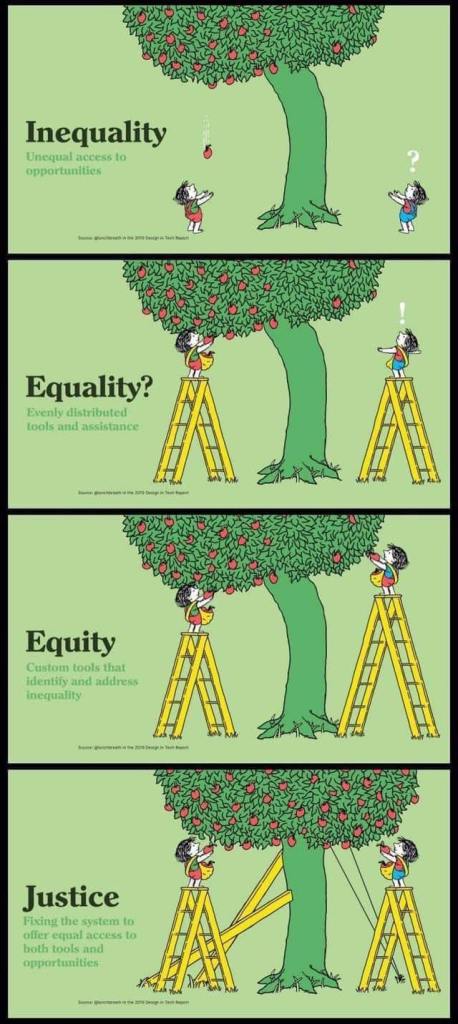
‘Fiat justitia, ruat caelum’ is a warning, not a behest.

‘Make sure that justice is served, unless you want the heavens to fall on your shoulders’ is what any open minded reader of history makes of this ancient adage…

The fact that we concentrate our attention on what justice means for each of us is a measure of our individualism.
Of our nearsightedness…

Our respective individualities, each and everyone of them, have grown into what they are now in a social context.
None of us can exist for long, let alone protect and develop their individuality, in solitude.

We need the others.
We, each and everyone of us, need to belong. To a community.

To a functional community!
To a community where each individual is cherished.
Where each individual can develop its potential.

Where each individual has the opportunity and the tools to develop their potential.
For his own good, in concert with the main interest of entire community.

Survival.
Things remaining as they should be.

Us toiling here, on the surface of the Earth.
The heavens perched safely up there.

Justice must be served if things are to remain as we, each and all of us, need them to be.

Am citit mai puțin de un sfert din cărțile pe care le-am primit ca temă în timpul școlii/liceului.
Și nici una dintre cele care aveau ceva de a face cu critica literară.
„Autorul vrea să ne spună…” îmi ridica părul pe ceafă.
‘Păi ce, eu sunt prost? Nu știu să citesc? De ce trebuie să-mi spună ăsta ce vrea să spună autorul?!?’

‘Și atunci? Ce te-a apucat acum?’

Tocmai ce am aflat că un premiu literar, pentru poezie, a băgat zâzanie în bula feministă din internetul românesc. Discută oamenii cu o pasiune…

Eu sunt inginer. Nu le am p-astea cu exprimarea elegantă.
Mă doare la bască despre cine ce cuvinte folosește.

„Uitând de toate
(O portiune a anatomiei mele, dar nu creierul) e o mașinărie războincă
Care vrea să-și facă dreptate”.

Acuma, că nu vă mai puteți ascunde după frusta pizdă, ce înțelegeți din textul de mai sus?

Eu, unul – inginer fiind, citesc că o „pizdă” – independent de restul ființei de care este ‘atașată’ și făcând abstracție de toate celelalte condiționalități care ‘limitează’ existența tuturor ființelor, cu și fără pizdă – se operaționalizează în „mașinărie războinică” și se pornește să-și facă dreptate. Sieși… Adică pentru sine!

Cum bine zicea mai sus unul dintre comentatori.
‘Copilul intolerant care se pornește să-și devoreze mama anacronică.’

O parte dintre observatorii lumii cultural artistice susțin că adevăratul artist ‘șochează’.
Că pentru a ‘deschide ochii privitorilor’ artistul trebuie să le ‘violeze’ acestora ‘retina’.

OK, cică scopul scuză mijloacele…
Dar care scop?

Tot de pe net:
Ce scandal! O femeie vorbește despre propriul ei corp!!
Dacă v-a picat rău, luați niște versuri respectabile (cum altfel?) de Eminescu:

(Urmează o serie de citate, din care voi folosi doar unul)

Ah, cum nu-i aicea nime
Să mă scap de mâncărime
Să storc boţul între craci,
Să-i sug măduva din saci.

Și uite-așa ajungem tot la ‘ce vrea să spună artistul’…
Până la urmă, contează cu ce rămâi după ce ți-a fost ‘violată retina’!

Eminescu și proaspăta laureată folosesc, într-adevăr, aceleași cuvinte.
Dar nu spun același lucru…
Eminescu glosează, cât se poate de la obiect, despre cum e să ajungi, împreună cu cineva, la orgasm.
Iar laureata NOASTRĂ vorbește despre jihad. Despre dorința arzătoare de a-și face singură dreptate. În orice condiții…

Și de ce am ‘strigat’ „noastră”?

Pentru că Ileana Negrea n-a apărut din pustiu.
A crescut printre noi și trăiește cu noi.
În timpul acestei vieți a adunat toate simțirile pe care le strigă acum.
De la noi a învățat ‘expresia artistică’ de care se folosește pentru a-și exprima trăirile.
Expresie artistică pe care tot noi i-am validat-o!
Noi, contemporanii ei, suntem cei care i-am dat premiul care „a băgat zâzanie în bula feministă din internetul românesc”.

Noi, contemporanii ei, suntem cei care pierdem vremea discutând despre pizdă în loc să ne vedem în oglinda pe care ne-o ține Ileana Negrea.

Am devenit atât de individualiști încât restul ni se pare normal.
Restul, adică tot ce nu ne oripilează pe NOI.

„Uitând de toate
….mea e o mașinărie războinică
Care vrea să-și facă dreptate”

Uitând de toate…

LE

Între timp ‘am făcut rost’ de textul integral.

Avertisment

Ai grijă
O să te prind în mine cu răutate
Răutatea copilului egoist
Care nu a avut nimic al său
Să-ți opresc pentru o clipă mișcările
Să stăm așa
În timp ce lumea asta
Se duce dracului
Cu virușii și ghețarii
Și animalele și planeta
Și chiriile și evacuările și șomajul
Și violența domestică și precaritatea
Încremeniți
Și perverși
Uitând de toate
Pizda mea e o mașinărie războinică
Care vrea să își facă dreptate
Capturat și cuminte
Mă vei privi cu ochi tremurători
Și-abia atunci te voi primi cu-adevărat
În mine
Și-abia atunci
Te vei putea mișca
Și-abia atunci
Revoluția.

Poezia asta chiar începe să-mi placă.
Realitatea descrisă – așa cum a fost ea percepută de Ileana Negrea, continuă să mă oripileze.
Pe voi ce vă oripilează? Ce ați vrea să schimbați?

Attempting to value individualism over collectivism is similar to trying to establish which came first, the chicken or the egg.

Having experienced both – collectivism and individualism put in practice as political principles, I have noticed that neither extreme is capable of working in a sustainable manner.

Communist regimes had fallen one after another.
Fascist regimes did the very same thing.
Pirate republics could never resist for long.

Coming back to what is happening in the US, I’m afraid very few people are aware of how much collective thinking had been embedded in the American Psyche. The good kind of collective thinking…
Americans go to church. A place where you go to to be together, not alone.
Americans used to help each-other. Charity used to be a big thing. Slowly, it had become a dirty word.
And so on.

Individuals can not exist on their own. They need each other to survive. And to thrive.
Collectives can not last for long unless the individuals who constitute them do respect each-other. Help each-other maintain and develop their individuality.

As simple as that.

Let’s face it. The homeless are ‘survivors’ who don’t pull their weight as members of the community. They live ‘off the land’ – but the land they use to live off is us, and they don’t give anything back in return. Except for the garbage they leave behind…

Hence we have a problem.
Which we might choose to ignore. Or to solve.

I’ll presume we want to solve it.
First step to solving any problem is, of course, to understand its nature.

So, what is bothering us?

The garbage they leave behind?
The sore sight they offer each time we see them?
The danger they represent for public safety?
The fact that they occupy public property? And prevent the rest of us from using it?
The fact that they don’t contribute?
The loss of their creative potential?
The bad example for our children?
They are a reminder of what could have happened to any of us?

Second step, the ‘how’ of the matter.

What caused such a number of able bodied people to live in the streets?
Why do so many of them use drugs? And alcohol?
Why do so many of them refuse to be helped? By the institutions which care for them?

I don’t have a real answers for any of these.
The first category of questions depends on each of us while the second on each of the homeless.

Nevertheless, I would like to point out a few things.

Very few of the homeless have been born on the street.
Most of them have been educated into the values of the society to which each of them belongs. Very few are recently arrived immigrants, at least in the US.
“we found that the longer that immigrants had lived in the United States, the greater their risk for homelessness. This is a unique finding that has not been reported before and suggests that immigrants are more likely to shed previous practices and attitudes from their origin countries over time as they live in the United States, which can put them at increased susceptibility to mental illness, substance abuse, and other factors that can increase homeless risk.This idea would be consistent with the literature finding that the health immigrant effect declines for immigrants in the United States as they acculturate and develop habits and practices similar to native residents”. J. Tsai, X.Gu, Homelessness among immigrants in the US

Why do I bother? Specially if I don’t have any answer?

The way I see it, each society is a social organism.

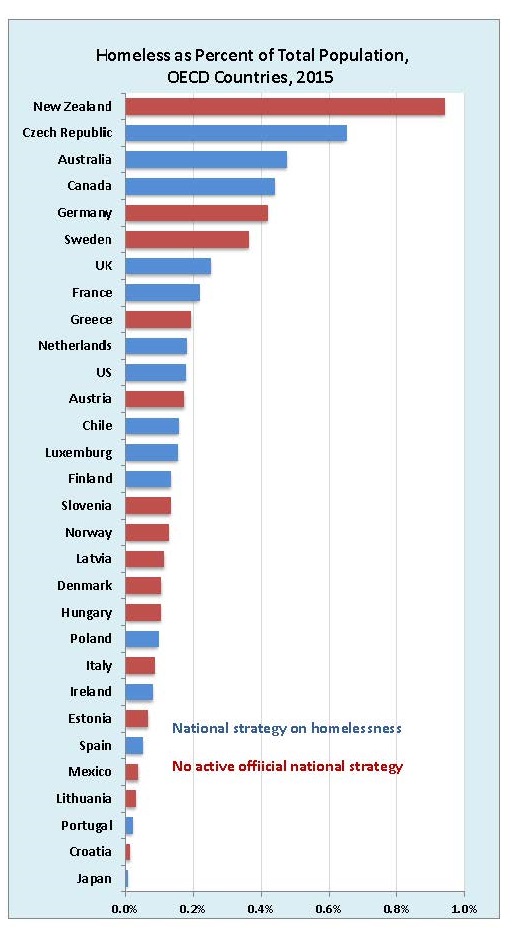
This image had been labeled ‘misleading’ by the Reddit users who cared enough about the subject. And rightly so. “This data is incredibly unreliable. It spans from 2009 to 2015 in different countries and has different criteria for defining homelessness.”
More about how this kind of data is been gathered and why it becomes misleading can be found in the OECD report on the subject. Click here for the 2019 one.

And what might we learn from this? Leaving aside the ‘vagaries’?
That New Zealand has way more homeless people than Japan?
And why nobody knows anything about the New Zealand homeless – or about those in the Czech Republic, but all concerned netizens are horrified by the manner in which the US are treating their homeless?

“”Where are we going to go now?” Denver closes park near Capitol, clears homeless camp citing rats, health hazards.”

For starters, and given the relative size of the US population, there are way more homeless in the US than in the rest of the OECD. Roughly counting, of course.
Secondly, the US is the wealthiest country in the world. And the one which used to describe itself as being the place where all dreams could be fulfilled.

Then, and this is only a hunch, there is the ‘small’ problem of the ‘native citizens’. Oops… not a mere hunch anymore. “In 2013, 12,754 Māori were homeless, comprising 32% of the homeless population compared to comprising just 14.9% of the total population” Same considerations may be taken into account when evaluating the situation in Australia and Canada while Europe has a rather consistent Roma population. Many of whom continue to live in a ‘traditional’ manner.

So, after all, is there anything to be learned here?

Actually, yes.

That luck does play a huge role. It makes a hell of a difference being born a Maori in New Zealand or a billionaire’s child in California.
And that becoming acculturated in the US actually increases your chances of becoming homeless.

What?!?

Have you already forgotten? 😦
“we found that the longer that immigrants had lived in the United States, the greater their risk for homelessness. This is a unique finding that has not been reported before and suggests that immigrants are more likely to shed previous practices and attitudes from their origin countries over time as they live in the United States, which can put them at increased susceptibility to mental illness, substance abuse, and other factors that can increase homeless risk.This idea would be consistent with the literature finding that the health immigrant effect declines for immigrants in the United States as they acculturate and develop habits and practices similar to native residents”.” J. Tsai, X.Gu, Homelessness among immigrants in the US

The way I understand all this is that there must be a link between homelessness and the intensity, and character, of the social interaction prevalent among the members of any given society.

People in the West, and specially in the US, see personal success as paramount. And personal failure as … well… something to be shunned. Simply because it reminds us of what may happen to any of us.
Specially when taking on the risks we must assume if we want to really succeed. As we are pressured from early childhood.
The risks the immigrants grow accustomed to the longer they live in the US.

I’m afraid I was that close of forgetting a point I planned to make.
Why so many of the homeless use drugs and have an alcohol problem.

“The new study, led by NIDA’s Dr. Marco Venniro, required rats to choose between social interaction with another rat or access to a drug (heroin or methamphetamine). The animals consistently chose social interaction when given the choice, and this was true when they were first given access to the drug or when they were experienced drug takers.”

For a (free) market to function, at all, it needs active economic agents.
Which economic agents need, in their turn, certain amounts of concentrated resources at their disposal. A certain amount of ‘capital’. Regardless of who owns it. Or disposes of it.

In this sense, no matter where each of them finds itself on the individual to socialist spectrum, all societies are ‘capitalist’.

On the other hand, individual capitalists – economic agents, do not need a free market to thrive. The do indeed need a market to sell their products/services, only that market does not have to be free. On the contrary, even.

OK, no monopolistic market has survived for long. And all monopolies have eventually failed. Even those who had grown ‘too big to fail’!

But go and tell this to any of those who happen to be at the helm of a monopoly… be it of economic or political nature …

And why are we still trying to solve this riddle?

‘Cause this is indeed a riddle…

Remember those metaphorical stories whose heroes end up having to find the answer to one in order to save themselves/the day?
Like Sophocles’ “What walks on four feet in the morning, two in the afternoon and three at night?”

A riddle, of course, being a question which cannot be answered until the individuals attempting to solve it stick their heads out of the box into which the riddle had been framed.

So. Individualism? Collectivism?

Having grown up under communist rule – supposedly the most collectivist social arrangement to date, I can testify that there is no such thing as collectivism without individualism nor individualism without collectivism.

Libertarians’ mantra is that socialism/communism – and even liberalism, as Americans understand it, is a form of collectivism. And, of course, that collectivism is bad for you.
Socialists, on the other hand, maintain that the current situation – which is seen as being bad, is the consequence of the growingly extreme individualism which plagues modern societies.

Interestingly enough, both sides are simultaneously right.
Communism is indeed bad for you and the bad aspects of today’s society are a consequence of callous selfishness.

On the other hand, all communist societies are composed of a huge mass of obedient subjects AND a small number of individual, and very individualistic, leaders.
Similarly, all developed capitalist societies – including those sporting huge discrepancies between the shrinking number of haves and the growing number of utterly destitutes, have reached the current level of sophistication because most of their members continue to share the belief that ‘all men have been created equal and that all of them have certain, nonnegotiable, rights: Life, Liberty and the Pursuit of Happiness’.

“Share the belief…”
But wasn’t this the very definition of collectivism?
A social arrangement where the most important possession belongs to THE public?
Was there anything more consequential for what is currently known as the ‘Euro-Atlantic’ civilization than this shared belief? Other peoples have been in possession of way more abundant natural resources. Had reached ‘astronomical’ levels of civilization way before we were even able to wipe our noses… And yet…

Haven’t we, individual thinkers, figured out yet that unless we agree on ‘the basics’, we’ll be easy prey for the callous ‘snake oil merchantmen’ who have no qualms to use collectivist slogans to pitch some of us against the others?

Haven’t we figured out, yet, that there is no ‘political collectivism’ without fear? All collectivist social arrangements, both socialist and fascist/nazist, have been built using fear/contempt (of the other) to cement ‘the people’ into believing the lies proffered by false prophets. Lenin, Mussolini, Stalin, Hitler, Mao… Lies proffered by callously individualistic political agents… bent on satisfying their own domineering instincts and making ‘good use’ of pre-existing conditions.

Haven’t we figured out yet that individualism, the tame version developed along with the good aspects of the Western Civilization, is, by nature, the very beneficial consequence of the mutual respect which (still) exists among the members of our societies?

So, to answer the riddle, we need to understand that there is no real conflict between bona fide individualism and bona fide collectivism.
Just as there is no conflict between two perpendicular lines.

Since, by trade, I’m a mechanical engineer, I’ll use a very practical metaphor to illustrate this idea.
Consider a pressurized Oxygen tank. The more pressure inside, the more Oxygen you can store in it. The more useful the tank. Only if you ramp up the pressure too much, you end up with an explosion.
In this situation, you might consider ‘pressure’ to be in conflict with the ‘walls of the tank’, right?
Wrong. The conflict is only in your mind. Pressure is simply perpendicular to those walls. The more pressure those walls can withstand, the more useful that tank is for you.

But it’s your responsibility to determine the thickness and resilience of those walls. It’s your responsibility to choose how much to ramp up the pressure.
For the very simple reason that that tank is yours.
It is you who will suffer the consequences.