Chapter 1. Explaining prediction.

I’ve trained to be an engineer. And practiced being one.
Then I felt the need to understand. And studied sociology.
That’s how I learned, the hard way, the difference between ‘hard’ science and ‘soft’ science.
Between ‘bona fide’ science and ‘bogus’ science…

Those of us still convinced that soft science is bogus have yet to grasp the whole meaning of ‘science’.
A collection of ‘special’ data, a ‘special’ method of gathering data and a ‘special’ state of mind.

We all know what ‘scientific data’ and ‘scientific method’ mean.
But there is almost no talk about ‘scientific state of mind’.
Most people consider that ‘scientific thinking’ is solelly about applying the scientific method when dealing with the ‘reality’. With what happens ‘outside’ of us.
Outside of our individual consciences…

Historically, science – the concept of science, had sprung up in the minds of people concerned primarily with physics and chemistry.
Hence the subsidiary concept of ‘consistency’.
Data can be considered to be scientific only if it had been gathered in a ‘consistent’ manner.
If by applying the same method, in the same circumstances, the end results will be the same – regardless of who had happened to be at the helm of the experiment.
And a method can be considered to be scientific only if it produces the same data whenever it is applyed, in the same circumstances, by no matter whom.

I’m sure that, by now, at least some of you have figured out what I’m driving at.
The main difference between ‘hard’ and ‘soft’ science is, of course, related to the relative inconsistency of the data yielded by the ‘soft’ sciences. This being the reason for which some people cannot even accept the ‘scientific’ nature of the soft sciences…

Hence the need to discuss about the ‘scientific’ ‘state of mind’…
Let me start by pointing out the fact that we, people, are rationalizers.
We pretend to be rational, true, but in reality we are nothing but very astute rationalizers.
So astute that we are not even aware of the fact.
We are so convinced of our rational nature that we are fooling ourselves.

Please read about this subject by hitting the link below if you are not familiar with the concept of rationalization before proceeding.
https://cushmanlab.fas.harvard.edu/docs/rationalization_is_rational.pdf

Accepting that we are deep enough into rationalization that we need to pay special attention when trying to be objective is the first step towards attaining a scientific state of mind.
The second, and just as important, step being the respect we need to extend towards our peers. Towards our fellow experimenters.

Changing tack – and approaching ‘scientific state of mind’ from another angle, I might try to describe it as a ‘work in progress’.
A never ending attempt at self improvement made by someone fully aware of the fact that they’ll never get there. Yet still striving towards that goal.
A never ending attempt made by somebody who knows they’ll never get ‘there’ yet they continue to encourage others to go further and further up that road.
A never ending attempt made by people who know they’ll never get there yet they respectfully help each-other towards their common goal.

And now, that I’ve done my best to explain what I mean by ‘scientific state of mind’ let me delve in the main subject.
The real difference between soft and hard science.

By their very nature, hard sciences are defined by the fact that an explanation constitutes a very good prediction.
If you are capable of explaining the Earth rotation around the Sun you are also able to compute where the Earth will be 10 seconds from now. As well as ten centuries from now…
If you are capable of explaining radio-activity you are also able to build an atomic bomb.
By understanding how DNA works we have been able to come up with a mRNA vaccine against the SarsCOV-2 virus.
https://www.cdc.gov/coronavirus/2019-ncov/vaccines/different-vaccines/mrna.html

The problem with soft sciences being that in their case, explanations – no matter how precise, cannot predict much.
We know why a maniac behaves like one – because …, but we don’t know what a maniac will actually do. Nor when…
We know that a free market works better than a monopoly but we cannot agree upon how free a market should be. Nor can we agree upon what a ‘free market’ really looks like…
We know what will eventually happen to an empire – it will fall, because of ‘negative selection’, but we never know exactly when and how that will happen… nor what will occur between the establishment of the empire and its eventual demise.

Savvy?
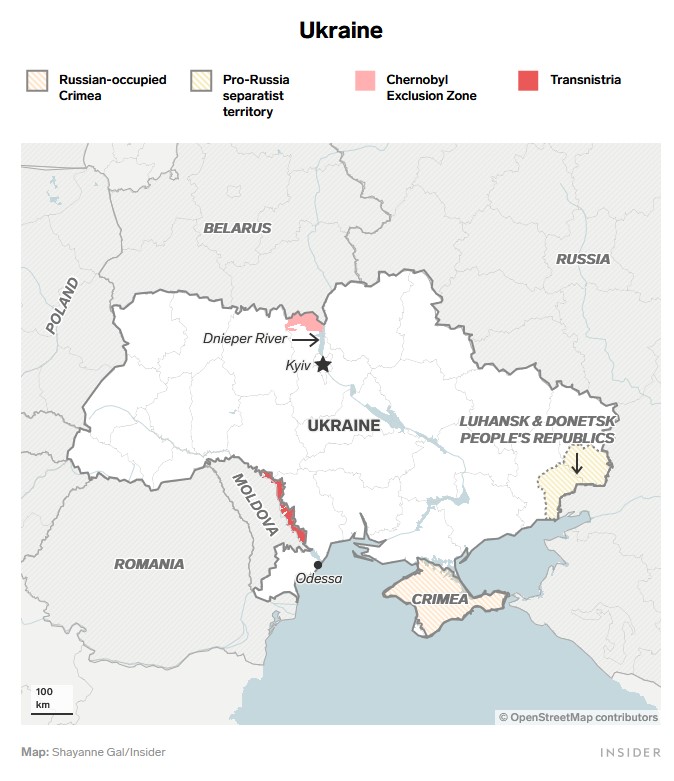
Now, that Putin had recognized Donetsk and Luhansk as independent states, I keep hearing that ‘if NATO hadn’t integrated the former socialist states in the Eastern Europe, Russia wouldn’t have occupied Crimea nor encouraged the ‘freedom fighters’ in Luhansk and Donetsk’.

NATO, and UE, are not perfect. Far from it.
Yet the former USSR had been even less perfect.

What drove me to this conclusion?
Well, both NATO and the EU are thriving. People and countries flock to join in. The very present conflict in and around Ukraine had been sparked by Putin’s ‘unhappiness’ with the Ukrainian people insisting in joining both NATO and the EU.
Meanwhile, the USSR is no longer with us. Had collapsed, under its own weight, some 30 years ago.

The second difference between these supranational entities – NATO and the EU on one side and USSR on the other, is the ‘small’ matter of how a member got to join the club.

In NATO’s case – valid also for the EU, a prospective member state has to ask for it first and then wait to be accepted.
The USSR had been organized under the ‘invitation only’ principle. If you were invited, you had to join. Regardless…

CSI, the Community of ‘Independent’ States, is organized under the same principle!


Btw 1.
Did I mention that the USSR had crumbled under its own weight?
By allowing self serving callous political operators to grab too much power?
Too much power for their own selves as well for their country’s well being?

Could we attribute the demise of the USSR on the fact that the bolsheviks were ‘house broken’ into ‘toeing the line’ while here, in the West, some people still dare to speak up their minds?

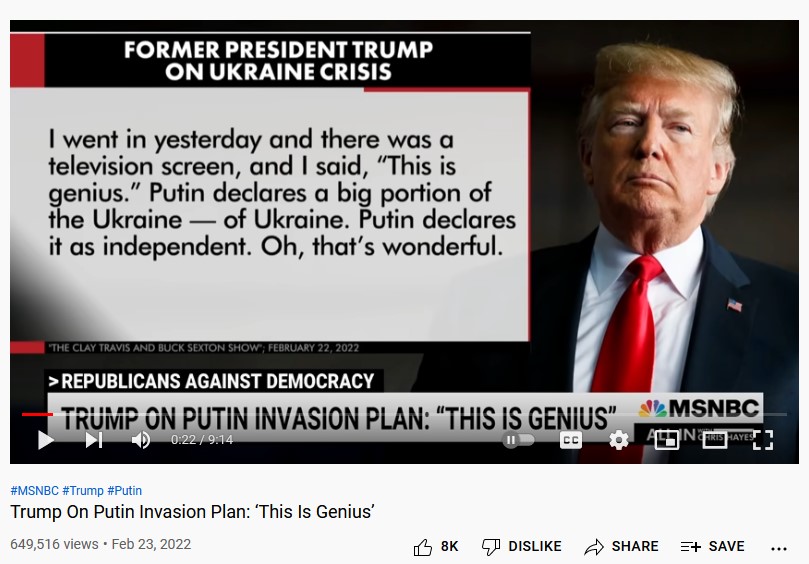
Rep. Liz Cheney, R-Wyo., a Trump critic who he is targeting for defeat this fall, responded Tuesday: “Former President Trump’s adulation of Putin today — including calling him a ‘genius’ — aids our enemies. Trump’s interests don’t seem to align with the interests of the United States of America.”

Btw 2.

No home means ‘no sleep’.
No place secure enough for you to let you guard down – no matter how shortly, and relax.
Survival becomes problematic and occupies all your time. And brain power….

An uncomfortable home means ‘no dreams’.
Every waken moment is occupied by ‘how do I get a bigger home’ and whatever sleep you might muster is fitful.
You cannot rest properly so you cannot do much during your active hours. You’ll never reach your full potential so you’ll never be as useful/productive as you could possibly be.

Too big a home means ‘nightmare’.
Difficult to maintain – for your means, impossible to ‘explore’/’exploit’, always afraid somebody would try to steal it from you.
And, above all, too big a home means ‘insulation’ from the real world. You’re so far away from what’s really happening out there that you’re no longer able of proper decision making.
Nightmare.

I wish you a string of very good nights and some pleasant dreams.

“Legea este o barieră peste care sar dulăii,
pe sub care trec cățeii
și în fața căreia se opresc numai boii”

Capitolul 1.
Schimbul de ulei.

Povestea asta este menționată de fiecare dată când cineva vorbește, în prezența tatălui meu, despre ‘autoritatea publică’. De multe ori și atunci când el nu este de față…

1984.
Fabrica de locomotive din cadrul ‘concernului’ 23 August avea o echipă de service în RDG. Echipa era ‘permanentă’, doar membrii ei se schimbau la fiecare 6 luni. Aveau și o mașină, un ARO, cu care se deplasau la diferitele depouri unde aveau de făcut reparații.

Pentru echipă fusese închiriat un apartament dintr-un bloc ‘ceaușist’ din Berlin – existau în tot lagărul comunist, iar mașina era parcată pe stradă.
Prin primăvară, cei trei proaspăt sosiți din țară membri ai echipei ajung la concluzia că trebuie să schimbe uleiul din motorul ARO-ului.

Aici e momentul să fac câteva precizări.
Cei trei erau mecanici. Fiecare dintre ei era capabil să schimbe uleiul dintr-un motor cu ochii închiși și cu o mână legată la spate.
Pe vremea aia, și mai ales în țările ‘în curs de dezvoltare’, uleiul de motor se schimba în funcție de anotimp. Când era cald, era folosit un ulei ‘de vară’ – mai gros, iar când era frig, unul mai subțire. De iarnă…
Uleiul ‘ars’ era folosit, ‘la țară’, pentru ‘vopsit’ garduri. Sau alte construcții din lemn. Ca să nu putrezească… Iar dacă nu aveai rude la țară – sau gard la casă, aruncai, pur și simplu, uleiul la canal.
Cei pricepuți, care nu aveau nevoie să se ducă la ‘atelier’ pentru a schimba uleiul, trăgeau mașinile deasupra unui canal de scurgere – cu două roți pe trotuar, se băgau sub mașină, scoteau bușonul, lăsau uleiul să curgă, puneau bușonul la loc, turnau uleiul proaspăt în motor și apoi își vedeau de treaba lor.

Cei trei români proaspăt sosiți în RDG au adoptat aceiași strategie. Au pornit motorul, l-au lăsat să mergă vreo cinci minute ca să se încălzească uleiul, au tras mașina de-asupra unui canal, au băgat un carton sub ea, au scos niște scule din portbagaj și, înainte de a apuca să scoată bușonul, s-au trezit cu miliția pe cap.
Care miliție fusese chemată de o ‘babă’. O pensionară care locuia la parterul blocului în fața căruia meștereau mecanicii noștrii. Cărei pensionare i se păruse că cei trei erau angajați într-o activitate ‘dubioasă’.
Milițienii veniți la fața locului le-au explicat celor trei meșteri că în RDG era interzis să repari mașini pe stradă și că dacă ar fi apucat să arunce uleiul la canal ar fi primit o amendă echivalentă cu venitul lor pe nu știu câte luni.

Fiecare dintre cei implicați, la fața locului sau indirect, au înțeles câte altceva.

‘Baba’, și milițienii nemți, au înțeles că românii sunt muncitori dar cam necivilizați.
Cei trei au înțeles că ‘a dracului babă!’.
Iar șefii celor trei au înțeles că ‘de aia e ordine în Germania, pentru că au legi dure și le aplică întocmai’.

Capitolul 2.

Schimbul de generații.

Pe vremea aia, adică acum aproape 40 de ani, în România încă nu se terminase bine ‘diviziunea muncii’. Fiecare dintre noi se pricepea la mai multe lucruri. Și la nimic cu adevărat bine, dar asta e altă chestie.
Și pentru că toți ne pricepeam la toate, toți aveam câte o părere. Despre orice. Și fiecare cu părerea lui. Inclusiv despre ce e aia ‘lege’ și despre cum ar trebui aplicată ea.
Adică celorlalți. Întotdeauna legea trebuia aplicată celorlalți și niciodată celui care avea părerea ‘lui’.

Acum, la mai bine de o generație distanță de povestea cu care am început, foarte mulți dintre români sunt încă de acord cu ‘șefii’ menționați mai sus.
Foarte mulți români se leagănă încă în iluzia că dacă vine ‘cineva’ care să facă niște legi drepte, și pe care să le aplice ‘întocmai’, (mai rămâne de văzut cui)… atunci se va pogorî, în sfărșit, raiul pe plaiurile mioritice.
Iar experiența ‘căpșunarilor’ n-a făcut nimic altceva decât să întărească această iluzie. „Ai văzut mă ce ordine e mă peste tot?”. „Păi da, pentru că de câte ori arunci o hârtie pe jos, hop și un polițist care te amendează”.

„Păi da”, doar că ‘românii noștrii’ uită o chestie.
Câteva chestii, de fapt.

Polițiștii aia care îi amendează pe cei care aruncă hârtii pe jos – români sau de orice altă nație, pot face asta pentru că cei care aruncă hârtii pe jos sunt foarte puțini. Iar polițiștii știu, din fragedă pruncie și împreună cu imensa majoritate a populației, cât de importantă este ‘curățenia’.
Acolo, acolo unde este ordine, aruncatul de hârtii pe jos este excepția. Regula respectată, de la sine, de marea masă este că hârtiile trebuie să ajungă în coș.
Polițiștii aplică legea pentru a descuraja excepțiile.
Cei care adoptă legile pur și simplu formalizează ceva deja existent în societate. Pun pe hârtie concluziile la care au ajuns ei în urma interacțiunilor care au avut loc între ei și realitatea din jurul lor.
Iar atunci când chiar cei care fac/administrează legile se întâmplă să calce pe bec, reacția societății – a unei porțiuni suficient de mare și de activă din societate, este suficientă pentru a readuce lucrurile în zona firescului.

Capitolul 3.

Bine, și?!?

‘OK, povestea a fost fascinantă. Teoria interesantă…
‘Dar eu cu cine votez?’
Noi ce facem acum?’

În primul rând, trebuie să ne uităm în jur.

Au trecut aproape 40 de ani de la povestea din RDG.
RDG-ul nu mai există. Fabrica de locomotive a fost dărâmată. 23 August se cheama acum Faur. A devenit o curte imensă, mai mult goală, care nu mai are nici o legătură cu ce se întâmpla acolo pe vremea comuniștilor.
Și cu toate astea, România – în ansamblul ei, o duce mult mai bine decât acum 40 de ani.
Sunt, într-adevăr, unii care o duc mai prost decât pe vremea aia. Doar că cei mai mulți o duc mai bine.
Diferențele dintre clasele sociale din Romania sunt mult mai mari decât erau acum 40 de ani dar diferentele dintre România, în ansamblul ei, și Europa de Vest au scăzut foarte mult.

România a avansat mult!
Și asta în condițiile în care – iar toți suntem de acord cu privire la chestia asta, legile adoptate ar fi putut fi mult mai bune iar aplicarea lor ar fi putut fi mult mai riguroasă!
Cât de mult s-ar fi micșorat distanțele dintre noi și țările din Vestul Europei? Ca nivel de trai dacă … și ca ore de condus dacă am fi construit autostrăzile alea odată…

‘Păi da, dacă Iliescu/Constantinescu/Băsescu/Iohannis ar fi…’

Parcă m-ai întrebat ‘ce avem de făcut’, nu ‘cine e vinovat de chestia asta’!
Cine ce a făcut… e treaba istoricilor. Și a DNA-ului!
Doar că ce vor face istoricii și procurorii nu ne va face pe noi să trăim mai bine.
Pentru asta, trebuie să facem noi câte ceva.

Adică să facem și noi ce a făcut ‘baba de la parterul blocului’.

Să chemăm poliția de câte ori constatăm ceva ‘dubios’.
Să înțelegem cum am ajuns unde suntem acum.
Și să aplicăm înțelepciunea populară. „Fă ce spune popa, nu ce face popa!”

Sau, altfel spus, atâta vreme cât prea mulți dintre noi îi vom permite – sau chiar îi vom ajuta, pe cei care pescuiesc în ape tulburi… vom continua să trăim, toți, în mizerie.
Chiar dacă pentru unii mizeria este fizică iar pentru alții doar morală…

Iar apele vor începe să se curețe abia atunci când suficient de mulți dintre noi vor fi animați de sentimentul că ordinea – exprimată prin lege, este mult mai bună decât haosul.

Sentimentul.
Simpla cunoaștere nu este suficientă!
Știm cu toții că fumatul face rău dar uite cât de mulți dintre noi continuă să fumeze.

Karl Popper had described science as a (virtual) place where things happen like this:

Some guy has an inkling. Studies it and gathers a lot of information on the subject.
Based on that information, develops a hypothesis. Then attempts to prove it.
After being satisfied with how much proof they had found, the hypothesis is declared a theory. And published as such. Along with all pertinent evidence. For all those interested to see.

So that all those interested to be able to replicate the experience.
To be able to retrace the proving process. To certify its validity.

And for all those interested to be able to find any proof to the contrary!
So that, as soon as that proof had been found – and declared acceptable, the theory to be considered false. Or, at least, incomplete.

The first example which comes to my mind being that the simple existence of Einstein’s Relativity had proven that Newton’s Physics was incomplete….

Fast forward to our days.
To our raging Covid-19 pandemic.

When vaccines are already available and where there are people who refuse to be vaccinated.

The vaccine was supposed to protect us.
From becoming infected.
From needing to go to the hospital.
From dying. From ending up suffocating alone…

But people continue be infected. Even after receiving the vaccine.
People continue to be admitted to the hospital.
And people continue to die. Even after receiving the vaccine.

Wouldn’t all these evidence strongly suggest, scientifically speaking, that the vaccine is useless?
‘Useless’, to say the least?

Wouldn’t it be actually rational to frame the situation in these terms?

Well, according to Popper’s reasoning, the first vaccinated individual becoming ill had been ample enough proof of the fact that the vaccine was not 100 % foolproof. That it isn’t fail-proof!
The first vaccinated individual being admitted to the hospital had been ample enough proof that the vaccine is no absolute shield against any of us who has been infected will ever have to go to the hospital.
The first vaccinated person who had died with Covid-19 had been ample enough proof that the vaccine will not protect all of us from dying after becoming infected with this virus.

And the fact that so many of us continue to refuse to be vaccinated is ample proof of the fact that reasonable should trump rational. Yet it still doesn’t….
Of the fact that too many of us continue to consider that their short term/self serving interests are more important than other people’s lives.
And of the fact that too many of us continue to ignore how vaccines work.

The key aspect here being the last!
People continue to ignore how vaccines work simply because of the huge amount of disinformation which is being peddled on the internet right now.
It’s not the ‘refuseniks’ who put their short term/self serving interests in front and above the lives of innocent people!
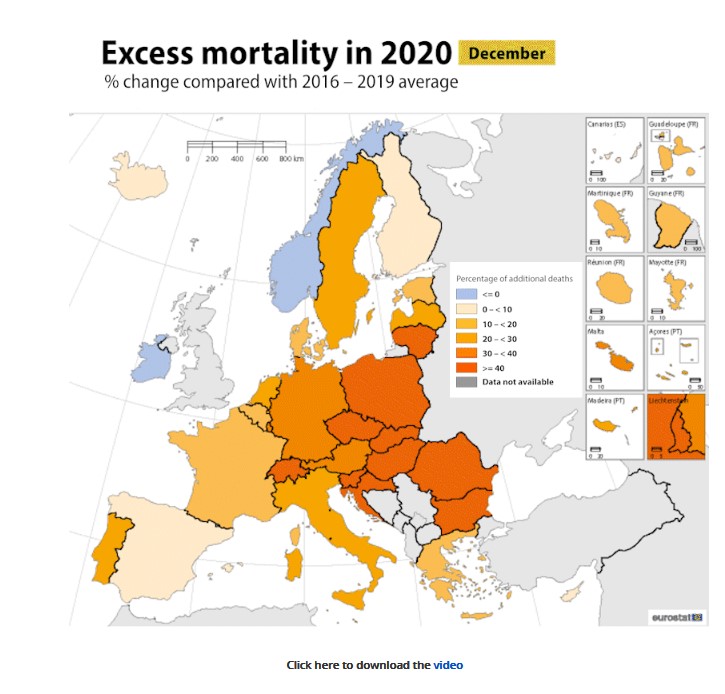
It’s those who have initiated, and continue to drive, the fake-news process who will be eventually determined as having been the root-cause of the excess mortality we’re currently experiencing.

When?
Hopefully, after a reasonable amount of time.
If enough of us start behaving rationally… In a comprehensively rational manner…

In a truly scientific manner!

https://plato.stanford.edu/entries/popper/

Someone asked me a few months ago:
‘These guys who spread misleading information on the internet, whether out of sheer stupidity or out of personal interest, will at some point understand how many people they have killed. Directly or indirectly.
How will they feel? In that moment…’

Until then, none of my vaccinated acquaintances have kicked the bucket.
Nor seen the inside of any hospital… after being infected with Covid.
Among those who have not been vaccinated… the situation is somewhat different… Although the unvaccinated are, among the people I’m personally acquainted to, about 4 times less frequent than the others, 8 of them are missing already. All 8 of them are no longer with us after having been diagnosed with Covid.

I hope you’ll have a ‘light’ conscience when we’ll arrive at the end of this mess.

M-a întrebat cineva acum câteva luni:

‘Oamenii ăștia care răspândesc informație înșelătoare pe internet, indiferent că o fac din prostie sau din interes, vor înțelege la un moment dat cât rău au făcut. Cum or să se simtă atunci?’

Până una alta, nici una dintre cunoștințele mele care s-au vaccinat nu a dat colțul. Și nici n-au văzut interiorul vreunui spital… infectați fiind cu Covid.

Printre cei care nu s-au vaccinat… situația e oarecum diferită… Cu toate ca nevaccinații sunt, printre cunoștințele mele, de vreo 4 ori mai puțini decât ceilalți, 8 dintre ei lipsesc la apel. Adică nu mai sunt printre noi, după ce au fost diagnosticați cu Covid.

Să aveți conștiința ușoară!

The title is misleading enough to become an abomination!

What Leschziner said during the interview was:

what we term reality is entirely a construct of our nervous system.”

Guy Leschziner is right.

And the guy who wrote the title is an a$$hole!

In the sense that for that person, ratings – a.k.a. ‘money’ – are far more important than presenting an as accurate as possible version of reality…

Hence the public belief that ‘media are not to be trusted’.

A reality created by the greed with which we, as a cultured species, attempt to transform everything into money…., power…, or any other kind of ‘influence’/relevance we happen to covet….

https://www.theguardian.com/science/2022/feb/06/guy-leschziner-reality-is-entirely-a-construct-of-our-nervous-system

http://perflensburg.se/Berger%20social-construction-of-reality.pdf

For those of you who don’t know about the most recent controversy on the internet, let me sum it up.

Joe Rogan is a comedian.

Rather experienced in creating controversy. Controversy is good for the ratings, isn’t it?
For example, in September 18, 2020, “Joe Rogan apologized for spreading misinformation about Oregon fires“.

Well, at that time Rogan had just moved his podcast – from September 1, 2020, on Spotify. After receiving $100 million for a “multi-year licensing” deal.

If you don’t know, we’re still in the middle of a pandemic.
Caused by SARS Cov2, an airborne virus which kills people. 5,682,971 worldwide when I last checked.

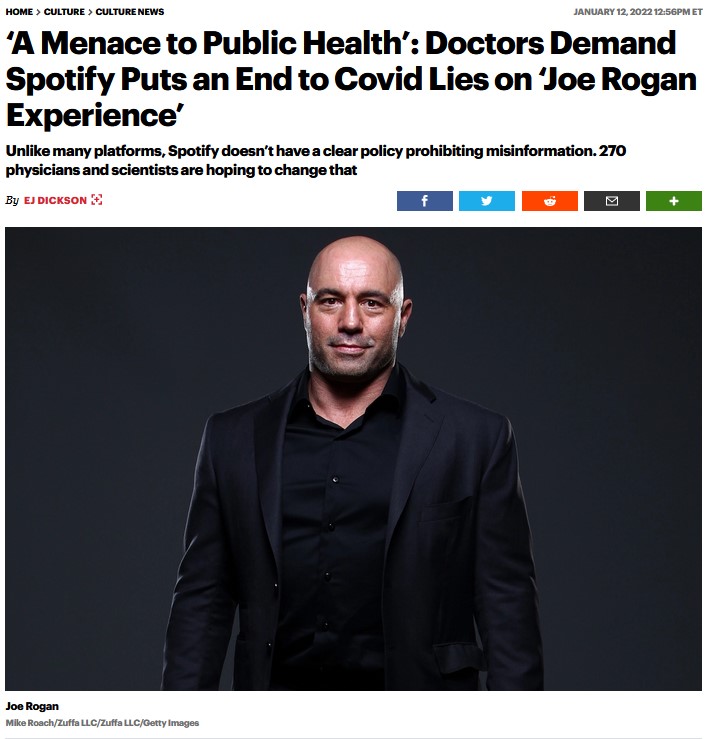
Joe Rogan, the comedian, thought he had to cover the subject. So he had invited a controversial figure, Dr. Robert Malone, for an interview.
The interview had become viral. But the ‘information’ being peddled by Dr.Malone had provoked the indignation of his fellow physicians.


A few days later, Neil Young – then followed by Joni Mithchell, asked Spotify to choose between him and Rogan.
Understandably, Spotify had chosen to keep Rogan.
But the row didn’t end there.
Even sites like the financially minded Sport Bible have noticed that “Joe Rogan Has Lost Spotify A Staggering $2 Billion In Market Value In Less Than A Week
So Spotify announced a change in policy and Rogan issued another apology.

As usual in this kind of circumstances, the netizens have taken sides.
Some manifest their indignation against the capitalists who make money by spreading false information.
Others manifest their indignation against the ‘cancel culture’ which limits the freedom of expression of those who contradict the opinions held by the intransigent majority.

As usual in this kind of circumstances, I try to explore alternative venues of looking at what’s going on.
Let me remind those of you who are not familiar with the Romanian language that ‘Nici-chiar-asa’ means ‘not so fast’ (or ‘don’t over do it’) in my native language.

So.
Why would a huge number of people – the Malone interview went “viral”, attempt to get information about a raging pandemic by watching a stand-up comedy show? Hosted by a “comedian” who recently had to issue an apology for things which he had said in one of his shows…
Those people had been mesmerized by the ‘past experience’ of Dr. Malone? “Who touts himself as one of the architects of mRNA technology”….
Maybe… but those people shouldn’t have googled Dr. Malone’s name before sharing the interview? To their like minded brethren?
Before making it viral? They would have learned that Dr. Malone had already been banned from Twitter for spreading misinformation…

‘Those people do not believe that media venues should restrict the freedom of people speaking up their minds’…

Then whatever preventive measure are put in place by the likes of Spotify will amount to exactly nothing!

We need a different approach.

Three truths about what ‘science’ means.
First part, We.

According to Heidegger, there are two kinds of truths.

A. A proposition is ‘true’ if what’s being said there is in perfect correspondence with reality.
B. A proposition is ‘true’ if the proposition encompasses everything the ‘communicator’ knows about the subject at hand.

‘OK, you promised us a discourse about science and here you are babbling about truth…’

Impatient as always!
How do you determine whether something being said, a proposition, is in (perfect) correspondence with the reality of the fact described there?

To be able to do that, you need first to determine the reality itself.
You know what’s being said – more about that later, and, if you are to determine whether what’s being said is true, you now need to know the truth itself.
How are you going to do that?
You either know it already or you proceed to determine that particular truth.

I’ll leave aside the ‘already known truth’ and proceed towards the ‘future truth’.

A particular individual has two possible approaches towards finding out a ‘new’ truth. A piece of ‘true’ information which is new for that particular person.
Consult a reliable source or investigate the reality.

‘Consulting a reliable source’ brings us back to square one. How do you determine whether a source is reliable or not….
‘Investigate the reality’… Easier said than done!

How do you do that? How do you investigate the reality in a reliable manner? How do you determine the truth of the matter when ‘things’ are a tad more complicated than touching a stove to determine whether it’s hot or not?

You use the scientific approach?
Start from the scientific data base which already exists on the subject(s) closer to your object of interest then proceed using the proven scientific method of trial and error? Emit a hypothesis, try to prove it, formulate a theory and then challenge your peers to tear apart the results of your investigation?

Results you have chased being convinced from the beginning that you’ll never reach the ‘pinnacle’?
Convinced from the beginning that the ‘absolute truth’ – even about the merest subject, is out of reach?
For us, mere mortals, anyway?

‘But if ‘absolute truth’ is out of reach, then how can we determine whether the simplest proposition is actually true?
And why continue to bother about the whole subject, anyway?!?’

Before attempting to find an answer to your question, let me formulate another one.

Let’s consider that you have reached a conclusion about something. That you are in possession of ‘a truth’. How are you going to share it? With your brethren/peers?
I must remember you at this stage of our discussion that language is beautiful but rather inexact. Are you sure that you’ll be able to communicate everything you want to say? To cover every minute aspect of the truth you have just found?
So that the proposition you are about to put together will be in absolute correspondence with the piece of reality you have just discovered?

You are not going to use language at all?
You’re just going to point to your discovery? And let everybody else to discover the truth for themselves?
And how many are going to take you seriously? To pay attention? To what you have pointed?
And how many are going to suspect that you just want to take their focus off what’s really important? To lead their attention away of what you want to keep under wraps?

I’ve got your head spinning?
Then you must understand my confusion. I’m so deep in this that I have to go back and read again what I’ve been writing…

So.
‘Science’ tells us that the ultimate truth is out of our grasp, linguistics/theory of communication tells us no messenger will ever be able to be absolutely precise nor convey the entire intended meaning … what are we going to do?
Settle down and wait for the end to happen to us?

OK, let me introduce you to an absolute truth.

WE ARE HERE!

Who is here?
‘Us’. We are here.

What are we doing here?
‘Are’. We are here.

Where are we?
‘Here’. We are here!

I’ve been recently reminded that mathematics, the most exact language we have at our disposal, is based on a number of postulates. On a small number of axioms – pieces of truth we consider to be self evident, which have constituted a wide enough foundation for mathematics to become what it is today.
But mathematics is far more than a simple language. It is also a ‘virtual space’. A space where special rules apply. A space where our thoughts move according to certain and specific ‘instructions’. A space where we enter holding our arms around a problem we need to solve and which we exit, if successful, with a solution inside our head.

A little bit of history.
Our ancestors had a problem. A class of problems, actually.
How to build something – a house, a temple, a boat, and how to ‘manage’ property – arable land, in particular, but also crops and other ‘stocks’. Problems easier to formulate, and solve, using numbers.
To solve this class of problems, some of our ancestors have invented ‘mathematics’. Had ‘discovered’ the self evident truths – axioms, and then ‘carved’ an entire (virtual) space using the axioms as the foundation upon which they, and those who have followed in their steps, have built – and continue to build, the scaffolding of rules which keep that space ‘open’.

Through thinking, our ancestors have carved a space in which to solve some problems they have encountered in the ‘real’ world…

‘Please stop!
I don’t understand something.
Do you want to say that mathematics is not real?’

To answer this question, this very good question, we need to settle what ‘real’ means.
To us, at least…

Let’s examine this rock. Is it real?
Why? Because you can feel it? If you close your eyes, I can make it so that you experience the same feeling by touching something else to your stretched out fingers than the original rock. In a few years, I’ll be able to produce the same sensation in your brain by inserting some electrodes in your skull and applying the ‘proper’ amount of electric current. What will ‘reality’ become then?

Forget about that rock, for a moment, and consider this table.

Is it real? Even if it’s not as natural as the rock we were analyzing before?
‘Artificial’ – as in man made, starting from natural ‘resources’, might be a good description of the difference between a table and a ‘simple’ rock. Both ‘real’ in the sense that both imply consequences. Your foot will hurt if you stumble in the dark on either of them. Regardless of the rock being natural and the table happening to be artificial…

‘But what about things which are not of a material nature?
Are they real?’

Are you asking me whether ‘metaphysical’ objects – God, for instance, are real?
Then how about ‘law’. Is it real? As an aside, does law belong also to the metaphysical realm? Alongside God? Who determines which thing belongs there?

Or have you glimpsed the fact that ‘truth’, the concept of truth, is a metaphysical ‘object’?
Something which, like God, has a ‘real’ side but makes no sense (to us) unless we think about it?
Something which we have extracted – someway, somehow, from the surrounding reality – where else from? – then ‘carved’ a virtual space around it? So that we may examine it without the distractions of the rest of the ‘real’ world?

Or have you glimpsed also that even the concept of ‘reality’ is a figment of our self-reflecting conscience?