Am aflat pe FB, și apoi am verificat în presă – adică pe net, adus pe ‘fibra’ de RCS-RDS, că Digi l-a concediat pe CTP.
Reacțiile internauților – a celor din bula mea, a fost ‘vigilentă’.
(Nu-)(Î)mi place CTP, (dar) așa ceva nu se face! Nu voi mai urmări acest post de știri.
OK, pot înțelege genul ăsta de răspuns. Cât se poate de adecvat, de altfel. Mai ales că nu m-am mai uitat cam de mult la vre-un buletin de știri la tembelizor. Nu în limba română, în orice caz.
Și aici începe adevărata problemă.
Eu mă uit la BBC. Ascult RFI. Și mă dau pe net. Nu prea rămân de din-afară…
La cât m-am uitat, cu câțiva ani în urmă și, expre’, aseară… Digi 24 e, de departe, cel mai civilizat post de știri în limba română. Restul… Mai sunt, cei drept, telejurnale relativ civilizate la Pro-Tv și la TVR. Doar că la capitolul televiziuni de știri… Digi e singura frecventabilă. Dintre cele cu o oarecare tracțiune… or mai fi și altele, dar nu am auzit eu de ele.
Și atunci? Dacă singura televiziune civilizata de știri face așa ceva… Poate că hotărâseră mai demult să ‘scape’ de CTP. Poate că CTP-ul aflase de faptul că era deja pe făraș și a băgat ‘șopârla’ ca să nu rămână dator. Indiferent de variantă, faptul că toată tevatura asta a avut loc în spatele siglei Digi 24 și în mijlocul singurei televiziuni de știri cât de cât civilizata de pe malurile Dâmboviței demonstrează, fără drept de apel, că noi avem o problemă! Noi, nu Digi!
‘Piața’ noastră e informație este disfuncțională în ceea ce privește zona audio-vizuală. La radio e mai mult miștocăreală iar la televizor…
If you really need to read the rest of the story, click on the picture above.
If you’re ready for the ‘next level’, consider this perspective:
We, the human species, have been ‘eating away’ the Earth, our home, ever since … Now, that we’ve finally figured out we’re ‘trapped’ on a finite planet, we’re making analogies! Conjuring the next generation to behave responsibly.
Because you’re alive, because of the previously made decisions and because of ‘hazard’.
You notice what’s happening around you – not necessarily to you, because you’re alive. A sensitive animal. And you try to make something out of it – to find meaning, because you are conscious. A conscious human being.
Everything around you – assuming you live in the civilized world, is man-made. The consequence of previously made decisions. The consequence of culture – string of accrued decisions, and the consequence of culturally influenced present day decisions. Decisions which are being made, by us, as we speak.
Your life, and everything in it, has been shaped by hazard. You could have been born a slave somewhere a few centuries ago or you could have been born as the only child of Kim Il Sun. You could have been born healthy – I hope you were, or you could have been the victim of a rare genetic abnormality.
We can’t, none of us, do anything about ‘hazard’. We can’t change culture. But we can reinterpret it. Learn more from it than blindly following rules. We can make better decisions.
And, for starters, we may decide to stop killing each-other. To stop hurting each-other. To stop bullying each-other. NB. ‘Stop killing’ doesn’t mean give up defending ourselves. ‘Stop hurting’ doesn’t mean giving up. ‘Stop bullying’ doesn’t mean the bully has stopped bullying because the victim caved in.
What we really need to do is to stop all forms of aggression.
Putem negocia si cu stră-strănepoții lui Kim-Ir-Sen… Toate negocierile astea vor avea același rezultat!
Dacă vrem să rupem cercul vicios, dacă vrem să evităm apariția unor noi Putini/Stalini/Zedongi, trebuie să înțelegem că Putin este consecința modului în care am negociat, noi, cu Stalin. Că Xi este consecința modului în care noi am re-integrat China în lume. După ce am negociat acest lucru cu Mao Zedong.
Da, evident, orice război se încheie printr-o negociere. Da, Macron are dreptate. O Rusie umilita va fi un partener de negociere mai dificil decât o Rusie care va reuși să-și salveze ‘fața’. NB. Vorbim aici de Rusia, nu de Putin! Rusia trebuie să găsească o cale cât mai onorabilă de ieșire din această situație. Situație în care a fost pusă de Putin… Că Rusia va ieși din această situație împreună cu Putin… sau fără… asta e treaba Rusiei.
Treaba noastră este să ne asigurăm că Rusia care va fi ieșit din această situație nu va mai reprezenta un pericol pentru noi. Și asta nu pentru că Rusia va fi slabă! Ci pentru că noi ne vom fi organizat astfel încât să nu mai fim la mâna Rusiei. Sau la mâna oricui altcuiva.
Suntem suficient de multi si de diferiți – Europa, America de Nord, Japonia, Australia, încât să putem face față oricăror provocări. Dacă vom reuși să devenim un exemplu pentru restul lumii…
Doar că înainte de a deveni un exemplu cu adevărat demn de urmat, avem mare nevoie să facem curățenie în curtea din spate!
‘Most people confuse liberty and democracy. They are not the same.’
Liberty and democracy are not the same indeed.
Like my left hand is not the same with my right one.
But I need both in order to lead what I consider to be a normal life.
Most people – specially if they get help, can survive without a hand. Or without either liberty or democracy.
But without both… without both hands or without both liberty and democracy… I’d be at somebody else’s mercy!
‘What?!? What kind of liberty is there under communist rule???’
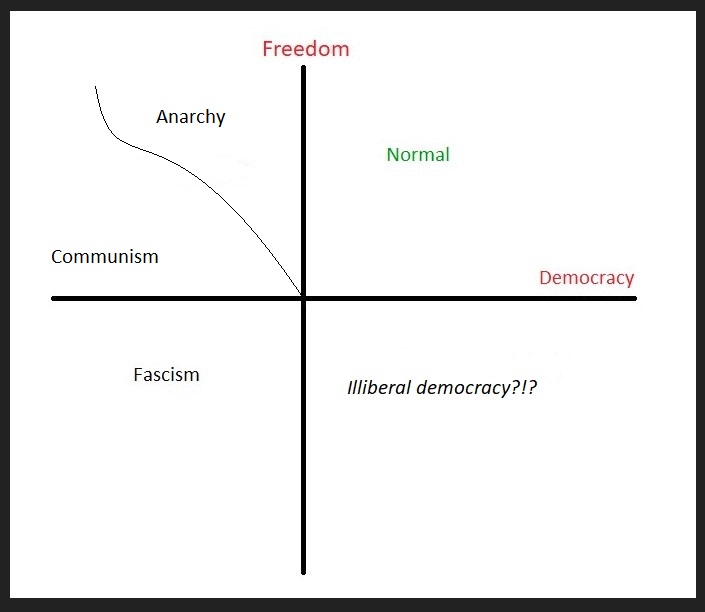
You see, liberty has two ‘faces’. Two dimensions. Three, actually, but I’ll be talking about only two of them in this post.
There is the ‘inner liberty’ and there is the ‘socially sanctioned liberty’.
Liberty itself is a human concept. We have noticed something, wondered about it, named it and then attempted to understand it. This was, and continues to be, a collective effort.
In some places ‘liberty’ had appeared ‘naturally’. There was enough liberty naturally sloshing around, hence the circumstances were right for those who had happened to live there at the right time to notice it. Furthermore, the conditions had been right again for the entire community to be able to agree among themselves about the concept and about how to use it/put in practice their new intellectual achievement.
Other places have not been so lucky. They had been close enough, geographically and socio-historically, to notice the ‘birth of liberty’ but their specific conditions were not ‘right enough’. Many people living there coveted liberty but the local conditions made it impossible for liberty to take hold. In these places ‘inner liberty’ – individually assumed freedom, can be found a lo more easily than presumed by those unfamiliar with the local realities.
Yet other places had it even worse. Initially on the path towards liberty – and democracy, they have somehow stumbled. For whatever causes – internal and/or external, something went wrong. People became disappointed enough to give up not only democracy but also liberty. Including their own, individual inner freedom.
A somewhat intermediary situation constitutes the third abnormal quadrant. The people involved have given up their liberty – partially, but those running the show continue to use (‘pretendingly’) democracy as a window dressing to hide their true intentions.
The last hundred years or so have been extremely relevant in this matter. All communist regimes had fallen. Under their own weight. Most fascist/nazi regimes are no longer with us. Had been so ‘arrogant’ – read self destructive, that their neighbors had to do something about them. Had created so much disruption around them that those whose very existence was endangered had been forced to spring into action. ‘Illiberal democracy’ is a rather new ‘development’. Would be fascist/nazi dictators don’t have all circumstances aligned to make their final move so they have to make do with what there is at their disposal. The local population is ‘despondent’ enough to pay attention to their arguments but not desperate enough to follow them into the ‘unknown’. Hence this oxymoronic abomination.
‘Illiberal democracy’… On the other hand, the spin doctors promoting illiberal democracies hope to be able to reap the benefits of democracy – the population being ‘rather favorably disposed’ towards the government while having to pay less ‘lip service’ to individual human rights. A balancing act, with no safety net, which is alluring to those reckless enough to attempt it but which will end up badly. Sooner rather than later.
But the most interesting ‘combination’ – for me, at least, is Anarchy. In the sense that those who ‘swallow’ the lure are self delusional. They have somehow convinced themselves that their, own, liberty somehow trumps the liberty of everybody else. They feel so strong, so immune to any outside influence, that they would willingly accept to live in a no rule environment. Without understanding that ‘no rule’ means ‘no holds barred’. They actually don’t realize that unfettered liberty actually means ‘Each of us free against all others’. This being the reason for which Anarchy, as a political arrangement, has never survived for long enough to be noticed. Except as a transitory phase.
Many people interpret Darwin’s Evolution as ‘the survival of the fittest’. Ernst Mayr, What Evolution Is, made is crystal clear that ‘evolution is not as much about the survival of the fittest as it’s about the demise of the unfit. Read the book, it’s well worth the time. https://www.scribd.com/document/358382958/Ernst-Mayr-What-Evolution-is-PDF
The fact that we have so many, and so conflicting, views on such a simple natural law as the law of evolution means that… we don’t know shit!
Hence Samuel Adams was right. Since we know basically nothing, none of us should have ‘authority’ over others. Each of us should be free. To do as they please. To follow exclusively the ‘laws of nature’.
Which one of them? Darwin’s – as some of us have chosen to interpret, or Mayr’s?
‘Survival of the fittest’ or ‘The demise of the unfit’? ‘I’m stronger than you so move over’ or ‘If you don’t agree with our commonly shared values, please find another place to live?’ ‘Free against all else’ or ‘free together with everybody else’?
There are so many of us who consider that ‘if you can’t pull your weight, you don’t deserve to live’…
On the other hand, there was a moment in time when the Brits had abolished the institution of debtor’s prison… And a second moment, no less significant, has been the Marshall Plan.
You see, for whatever reason, an individual or a business might fail. Sometimes, even a whole continent might fail…
Until recently – historically speaking, debtor’s prison was abolished in 1869 and the last war reparations had been extracted after WWI – it was a matter of ‘one strike, you’re out’. One mishap, for what ever reason – bad luck was enough – and you were practically reduced to ‘servitude’. If somebody else didn’t bail you out, your chances of getting out ‘alive’ were very slim. No matter whether you were an individual, a business or even a country.
Interestingly, the first who was allowed the protection of bankruptcy was the business sector, countries came next – but only if they were sovereign states, while individuals are not yet completely out of the woods.
Now, where would any of you prefer to live? In the XIX-th century Britain or in the XXI-st century Britain? Ceteris paribus. As in ‘conserving all other ‘variables’ ‘. Given the fact that hot water was practically absent in XIX-th century Britain, I’d prefer the present century anytime.
Was ‘bankruptcy’ the only explanation for the economic take-off which happened after the second half of the XIX-th century? Probably not but it surely helped. Just as the present day Europe owns a lot to the Marshall Plan.
Then why aren’t we extending a more helpful hand to more of those who have ‘stumbled’?
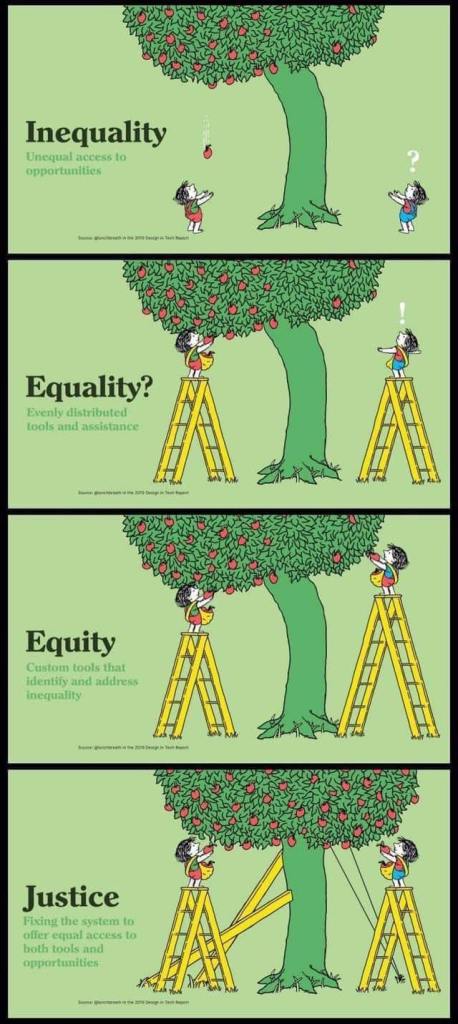
If I’m on the ‘right’ side, why would I make it easier for the other guy? If on the ‘wrong’ side, why not just switch sides? Why would I bother to straighten the tree? Against the wishes of those who have a lot to lose in the process?
From the other side of the looking glass, things are a lot simpler.
‘Fiat justitia, ruat caelum’ is a warning, not a behest.
‘Make sure that justice is served, unless you want the heavens to fall on your shoulders’ is what any open minded reader of history makes of this ancient adage…
The fact that we concentrate our attention on what justice means for each of us is a measure of our individualism. Of our nearsightedness…
Our respective individualities, each and everyone of them, have grown into what they are now in a social context. None of us can exist for long, let alone protect and develop their individuality, in solitude.
We need the others. We, each and everyone of us, need to belong. To a community.
To a functional community! To a community where each individual is cherished. Where each individual can develop its potential.
Where each individual has the opportunity and the tools to develop their potential. For his own good, in concert with the main interest of entire community.
Survival. Things remaining as they should be.
Us toiling here, on the surface of the Earth. The heavens perched safely up there.
Justice must be served if things are to remain as we, each and all of us, need them to be.
This morning I almost blew my top. I was listening to the radio. A usually decent station. Usually decent and, like all of us, imperfect.
The news anchor was interviewing an ‘expert’. An Ivy League Professor of International Relations and other blah-blahs. I’m not giving their names because I want them forgotten, not even more famous than they already are.
‘Is there any chance for this conflict to end in a negotiated manner?’ ‘Yes, if/when both sides will find a mutually acceptable solution. For example, if the Ukrainian side would accept a referendum in Donbass – and in Crimea, and if the Russian side would accept UN inspectors to validate the process. This would be in line with the general accepted policy of self-determination and ….’
OK, and where’s the difference between what Putin keeps saying and what I’ve just heard?!?
Two non-Ukrainians telling Ukraine what to do…
I’m going to set aside, for now, what these two – wait, three! – people are saying. That Ukraine, the Ukrainian People, should give up a piece of their land. My immediate interest lies in ‘who these three guys think they are’?!?
OK, only those who don’t want to see haven’t yet found out that Putin is a dictator. But for a renowned Ivy League Professor to elaborate a scenario according to which the UN would supervise a referendum where an occupied population would have the opportunity to vote whether they want ‘their’ aggressor to maintain its control over the already occupied territory….
Would that distinguished Professor be comfortable with a referendum – equally supervised by the UN, taking place in California? Which California had already been occupied by Mexico? For which referendum, the Californians were asked where they want to live? Whether Mexico should continue its occupation or should the Mexican army retreat behind the internationally recognized border?
No, I don’t think the Professor has been paid by Putin. Or ‘compensated’ in any other way by the ‘red Satan’. I just consider he was not paying real attention to what he was saying. He had just opened his mouth and verbalized what his mind was churning. The current ‘events’ have disturbed his pleasant existence to such a degree that he really needs this ‘fly in the ointment’ to ‘fly away’.
He is so ‘driven’ by his ‘need’ that he is no longer ‘patient’. He just can’t ‘stop talking’ for long enough to realize how fast Putin’s propaganda machine will make ‘good’ use of his ‘verbalizations’…
‘See, the good Professor confirms what our Beloved Leader has already done. It’s the Ukrainians who are not reasonable! They should first change their leadership then come back into Mother Russia’s arms.’
When are we going to understand?
Don’t tell others what to do unless you are prepared to ‘take advice’ yourself… And, for your own good, don’t trade your future freedom for your present comfort!
– If ‘no government’, then who would pay for the army we need to defend ourselves?
Ooops… you’ve just answered the ‘why does Russia ‘encourage’ the trolls who push ludicrous libertarian ideas’ question. Which trolls attempt to achieve two things at once. Weaken the concept of free government and give libertarian-ism a bad rep. Transforming libertarian-ism into yet another form of extremism.
Let’s get serious and try to find an answer to ‘why, and how much of it, do we need government?’
The boring one would be: ‘Whenever one government falls, another one takes over. The interregnum is always bad so… let’s get used to it’.
‘Getting used to it’ works only for very short expanses of time. Left on its own, all ‘government’ becomes sloppy. So sloppy that it soon becomes such a burden that even the most ‘used to it’ lose their patience. Government, all of them, need to be kept on a tight leash. Otherwise it will soon cease to perform as intended.
– But if you have to keep it on a tight leash, why bother with any in the first place? Can’t we do without such a bothersome pet? What’s the point of the whole thing, anyway?
Instinctively, we’re against ‘government’ for two reasons. It costs us a lot and it used to represent the interests of the ruler.
Until 10 000 or so years ago, we didn’t need ‘government’. People were living more or less like the modern day Sun People still do. In the Kalahari desert… small bands roam the place, living of the land. The bands are small – so that they might find sustenance, they don’t have any ‘private’ property to protect, hence they don’t need government. Neither did our ancestors.
As soon as people ‘invented’ agriculture – raising ‘tame’ animals at first and working the land soon after, things had changed dramatically. The advent of agriculture brought two things. An increased productivity and private property. Soil has not been born equal. Both pastures and arable land can be good, passable or bad. People wish to have the best. Those who already have it are willing to defend it and those who don’t are willing to steal it. Increased productivity means that those who produce are able to hire people to protect their ‘means of production’. Their property. As a consequence of fighting for it, some people accumulate more and more of it. More and more ‘means of productions’ – property, means an ever increasing need for ‘management’ and an ever increasing need for ‘protection’. Soon you have a very ‘wealthy’ owner – the lord of the place, call it what you like or use the name given to him by his subjects, the people who perform the day to day management of the ‘whole-sale property’ and those who protect it from ‘marauders’. Both the ‘managers’ – read ‘government’, and the ‘protectors’ – read ‘army’, used to be under the direct supervision of the local lord. For a while – for as long as the lord kept everything in balance, everybody was happy. The ‘peasants’ were happy because thy were safe, the ‘managers’ were happy because the wise lord used to appreciate their work and ‘compensated’ them accordingly, the ‘protectors’ were happy because they were well fed and taken care of. According to this article, the great Egyptian had been built by willing people, not by slaves. https://www.harvardmagazine.com/2003/07/who-built-the-pyramids-html But soon enough, the lord had become estranged from his people. Government had become an instrument used to extract more and more wealth from the peasants while the army was used to protect the government against the people and, whenever possible, to increase the property of the ruling lord by stealing some from the neighboring ‘lords’. The ’empire’ was born.
But this development could take place only in certain circumstances. Where those below the ruling lord had nothing more to do than to obey. Where the best subject was the disciplined one. Where autonomous thinking and imagination were frown upon by the ruler. Where one mind was enough. Whenever the ‘environment’ mandated the individuals to remain relatively autonomous, proto-democratic forms of self government had been experimented. From the nomadic pastoralists of the Central Asia to the sailing communities in Ancient Greece and Medieval Scandinavia. Those driving herds or sailing ships need to be a lot more independent-minded that those who just tile the earth. No offense intended here! Simple observation will notice that where the geography of the place had allowed it, somebody had ‘built’ an empire. The Nile Valley, the Middle East, the Russian plain, China, Mexico… Where ever the geography of the place was fragmented enough by sail-able sea, proto-democratic forms of self-management had been developed. The sailing Ancient Athens versus the land-locked Sparta, Medieval Scandinavia versus Medieval France…
Fast forward to present day. When we have two forms of government. The more or less democratic ones. Those under whose ‘guidance’ discussions like the present one can happen. And the more or less authoritarian ones. Which actively discourage autonomous thinking.
Mind you, there are no ‘perfect’ governments. There’s no perfectly democratic arrangement anywhere on Earth. Because we are imperfect human beings. And there’s no ‘perfect’ authoritarian government. Because no government can survive for long if it attempts to centralize the decision power. The closer a government gets to being perfectly authoritarian, the smaller is the crisis needed to topple it. Unless it is supported from the out-side but that’s another topic.
So. It is fairly simple to understand how authoritarian governments fail. Too much ‘stiffness’ makes it impossible for authoritarian governments to evolve. To find solutions for whatever challenges pop up constantly.
But what can go wrong with the collective forms of self-rule? With the participative forms of social self management? Otherwise known as democracies? Lack of enough popular involvement. Due to a sense of apparent safety, initially. And to a feeling of apparent impotence, soon after. Lack of enough fore-sight. Those who should know better become distracted, for whatever reasons. Too much opportunism. More and more of the ‘insiders’ use ‘the power of the government’ to fulfill their own, private, goals instead of making sure that ‘government’ works properly.
And what does that mean?
A government works properly when the community which self manages itself using that particular (form of democratic) government survives in the long run. When those momentarily working inside the government make things happen for the community at large. When people, both inside and outside the government, follow, in spirit, Kennedy’s words.
Am I being naive? Maybe… But wouldn’t it be a nice thing to have? A nice thing to chase, anyway?
And what better way to chase ‘it’ than voting for people who at least pretend to be honest? Who at least make the ‘right’ noises? Whom we can hold accountable whenever they break their promises? Instead of voting for those who promise barrels and barrels of ‘pork‘? https://grammarist.com/idiom/pork-barrel/
Ideological pork or hands-on pork, I don’t know which is worse…





 nicichiarasa