Someone asked me a few months ago: ‘These guys who spread misleading information on the internet, whether out of sheer stupidity or out of personal interest, will at some point understand how many people they have killed. Directly or indirectly. How will they feel? In that moment…’
Until then, none of my vaccinated acquaintances have kicked the bucket. Nor seen the inside of any hospital… after being infected with Covid. Among those who have not been vaccinated… the situation is somewhat different… Although the unvaccinated are, among the people I’m personally acquainted to, about 4 times less frequent than the others, 8 of them are missing already. All 8 of them are no longer with us after having been diagnosed with Covid.
I hope you’ll have a ‘light’ conscience when we’ll arrive at the end of this mess.
‘Oamenii ăștia care răspândesc informație înșelătoare pe internet, indiferent că o fac din prostie sau din interes, vor înțelege la un moment dat cât rău au făcut. Cum or să se simtă atunci?’
Până una alta, nici una dintre cunoștințele mele care s-au vaccinat nu a dat colțul. Și nici n-au văzut interiorul vreunui spital… infectați fiind cu Covid.
Printre cei care nu s-au vaccinat… situația e oarecum diferită… Cu toate ca nevaccinații sunt, printre cunoștințele mele, de vreo 4 ori mai puțini decât ceilalți, 8 dintre ei lipsesc la apel. Adică nu mai sunt printre noi, după ce au fost diagnosticați cu Covid.
In the sense that for that person, ratings – a.k.a. ‘money’ – are far more important than presenting an as accurate as possible version of reality…
Hence the public belief that ‘media are not to be trusted’.
A reality created by the greed with which we, as a cultured species, attempt to transform everything into money…., power…, or any other kind of ‘influence’/relevance we happen to covet….
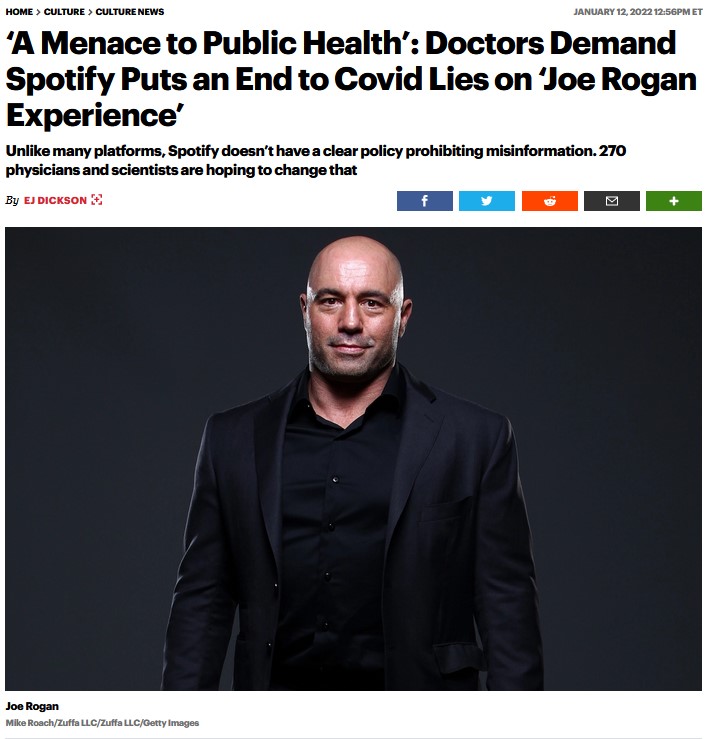
Well, at that time Rogan had just moved his podcast – from September 1, 2020, on Spotify. After receiving $100 million for a “multi-year licensing” deal.
If you don’t know, we’re still in the middle of a pandemic. Caused by SARS Cov2, an airborne virus which kills people. 5,682,971 worldwide when I last checked.
Joe Rogan, the comedian, thought he had to cover the subject. So he had invited a controversial figure, Dr. Robert Malone, for an interview. The interview had become viral. But the ‘information’ being peddled by Dr.Malone had provoked the indignation of his fellow physicians.
As usual in this kind of circumstances, the netizens have taken sides. Some manifest their indignation against the capitalists who make money by spreading false information. Others manifest their indignation against the ‘cancel culture’ which limits the freedom of expression of those who contradict the opinions held by the intransigent majority.
As usual in this kind of circumstances, I try to explore alternative venues of looking at what’s going on. Let me remind those of you who are not familiar with the Romanian language that ‘Nici-chiar-asa’ means ‘not so fast’ (or ‘don’t over do it’) in my native language.
So. Why would a huge number of people – the Malone interview went “viral”, attempt to get information about a raging pandemic by watching a stand-up comedy show? Hosted by a “comedian” who recently had to issue an apology for things which he had said in one of his shows… Those people had been mesmerized by the ‘past experience’ of Dr. Malone? “Who touts himself as one of the architects of mRNA technology”…. Maybe… but those people shouldn’t have googled Dr. Malone’s name before sharing the interview? To their like minded brethren? Before making it viral? They would have learned that Dr. Malone had already been banned from Twitter for spreading misinformation…
‘Those people do not believe that media venues should restrict the freedom of people speaking up their minds’…
Then whatever preventive measure are put in place by the likes of Spotify will amount to exactly nothing!
A. A proposition is ‘true’ if what’s being said there is in perfect correspondence with reality. B. A proposition is ‘true’ if the proposition encompasses everything the ‘communicator’ knows about the subject at hand.
‘OK, you promised us a discourse about science and here you are babbling about truth…’
Impatient as always! How do you determine whether something being said, a proposition, is in (perfect) correspondence with the reality of the fact described there?
To be able to do that, you need first to determine the reality itself. You know what’s being said – more about that later, and, if you are to determine whether what’s being said is true, you now need to know the truth itself. How are you going to do that? You either know it already or you proceed to determine that particular truth.
I’ll leave aside the ‘already known truth’ and proceed towards the ‘future truth’.
A particular individual has two possible approaches towards finding out a ‘new’ truth. A piece of ‘true’ information which is new for that particular person. Consult a reliable source or investigate the reality.
‘Consulting a reliable source’ brings us back to square one. How do you determine whether a source is reliable or not…. ‘Investigate the reality’… Easier said than done!
How do you do that? How do you investigate the reality in a reliable manner? How do you determine the truth of the matter when ‘things’ are a tad more complicated than touching a stove to determine whether it’s hot or not?
You use the scientific approach? Start from the scientific data base which already exists on the subject(s) closer to your object of interest then proceed using the proven scientific method of trial and error? Emit a hypothesis, try to prove it, formulate a theory and then challenge your peers to tear apart the results of your investigation?
Results you have chased being convinced from the beginning that you’ll never reach the ‘pinnacle’? Convinced from the beginning that the ‘absolute truth’ – even about the merest subject, is out of reach? For us, mere mortals, anyway?
‘But if ‘absolute truth’ is out of reach, then how can we determine whether the simplest proposition is actually true? And why continue to bother about the whole subject, anyway?!?’
Before attempting to find an answer to your question, let me formulate another one.
Let’s consider that you have reached a conclusion about something. That you are in possession of ‘a truth’. How are you going to share it? With your brethren/peers? I must remember you at this stage of our discussion that language is beautiful but rather inexact. Are you sure that you’ll be able to communicate everything you want to say? To cover every minute aspect of the truth you have just found? So that the proposition you are about to put together will be in absolute correspondence with the piece of reality you have just discovered?
You are not going to use language at all? You’re just going to point to your discovery? And let everybody else to discover the truth for themselves? And how many are going to take you seriously? To pay attention? To what you have pointed? And how many are going to suspect that you just want to take their focus off what’s really important? To lead their attention away of what you want to keep under wraps?
I’ve got your head spinning? Then you must understand my confusion. I’m so deep in this that I have to go back and read again what I’ve been writing…
So. ‘Science’ tells us that the ultimate truth is out of our grasp, linguistics/theory of communication tells us no messenger will ever be able to be absolutely precise nor convey the entire intended meaning … what are we going to do? Settle down and wait for the end to happen to us?
OK, let me introduce you to an absolute truth.
WE ARE HERE!
Who is here? ‘Us’. We are here.
What are we doing here? ‘Are’. We are here.
Where are we? ‘Here’. We are here!
I’ve been recently reminded that mathematics, the most exact language we have at our disposal, is based on a number of postulates. On a small number of axioms – pieces of truth we consider to be self evident, which have constituted a wide enough foundation for mathematics to become what it is today. But mathematics is far more than a simple language. It is also a ‘virtual space’. A space where special rules apply. A space where our thoughts move according to certain and specific ‘instructions’. A space where we enter holding our arms around a problem we need to solve and which we exit, if successful, with a solution inside our head.
A little bit of history. Our ancestors had a problem. A class of problems, actually. How to build something – a house, a temple, a boat, and how to ‘manage’ property – arable land, in particular, but also crops and other ‘stocks’. Problems easier to formulate, and solve, using numbers. To solve this class of problems, some of our ancestors have invented ‘mathematics’. Had ‘discovered’ the self evident truths – axioms, and then ‘carved’ an entire (virtual) space using the axioms as the foundation upon which they, and those who have followed in their steps, have built – and continue to build, the scaffolding of rules which keep that space ‘open’.
Through thinking, our ancestors have carved a space in which to solve some problems they have encountered in the ‘real’ world…
‘Please stop! I don’t understand something. Do you want to say that mathematics is not real?’
To answer this question, this very good question, we need to settle what ‘real’ means. To us, at least…
Let’s examine this rock. Is it real? Why? Because you can feel it? If you close your eyes, I can make it so that you experience the same feeling by touching something else to your stretched out fingers than the original rock. In a few years, I’ll be able to produce the same sensation in your brain by inserting some electrodes in your skull and applying the ‘proper’ amount of electric current. What will ‘reality’ become then?
Forget about that rock, for a moment, and consider this table.
Is it real? Even if it’s not as natural as the rock we were analyzing before? ‘Artificial’ – as in man made, starting from natural ‘resources’, might be a good description of the difference between a table and a ‘simple’ rock. Both ‘real’ in the sense that both imply consequences. Your foot will hurt if you stumble in the dark on either of them. Regardless of the rock being natural and the table happening to be artificial…
‘But what about things which are not of a material nature? Are they real?’
Are you asking me whether ‘metaphysical’ objects – God, for instance, are real? Then how about ‘law’. Is it real? As an aside, does law belong also to the metaphysical realm? Alongside God? Who determines which thing belongs there?
Or have you glimpsed the fact that ‘truth’, the concept of truth, is a metaphysical ‘object’? Something which, like God, has a ‘real’ side but makes no sense (to us) unless we think about it? Something which we have extracted – someway, somehow, from the surrounding reality – where else from? – then ‘carved’ a virtual space around it? So that we may examine it without the distractions of the rest of the ‘real’ world?
Or have you glimpsed also that even the concept of ‘reality’ is a figment of our self-reflecting conscience?
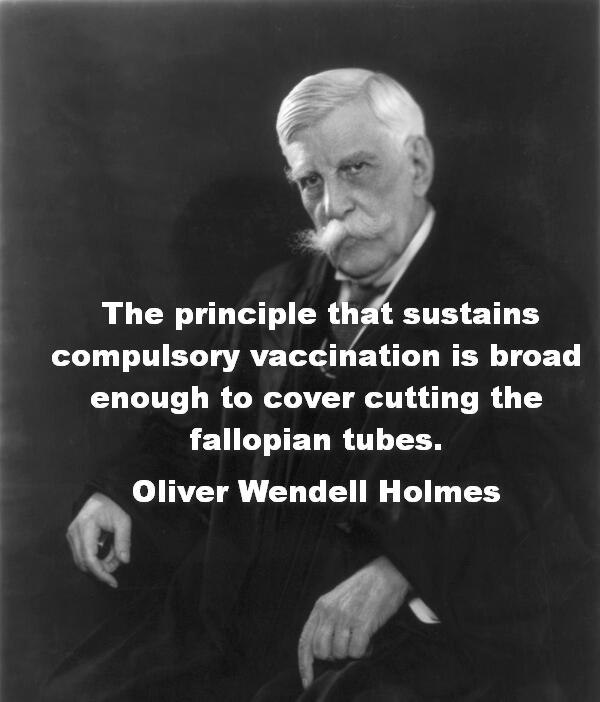
Having no previous intel about this guy, my ‘jerked’ reaction was simple.
‘Leaving aside any principle, a society which cuts ‘fallopian’ tubes will have a lower birth rate while that which vaccinates its children will notice a decrease in healthcare costs. And a lower mortality across the entire age spectrum!’
OK, let’s calm down and google. To find out who was this Oliver Wendell Holmes, after all.
“In that long span of (30) years on the Supreme Court he became acknowledged as one of the most notable jurists of the age—in the opinion of many the foremost. Often he has been called The Great Dissenter because of the brilliance of his dissenting opinions, but the phrase gives a falsely negative emphasis, and his penetration and originality are seen as fully in the opinions in which he expressed or concurred in the majority view of the court as in those in which he was in dissent.”
“Perhaps his best-known phrase is from Schenck v. United States, where he introduced the ‘clear-and-present-danger’ test as a means of limiting the power of the state to restrict speech and illustrated it by reference to a person’s ‘falsely shouting fire in a theater.’ His later development of this test, coupled with his emphasis on a basically unregulated ‘marketplace of ideas,’ was seminal for the development of modern free-speech law. His retirement in 1932 was a national event, and he has remained, along with John Marshall, among the best known of all those who have served on the Supreme Court.”
“Few American jurists are as revered as Oliver Wendell Holmes Jr. A United States Supreme Court justice for close to 30 years, Holmes wrote seminal opinions that were clear and clever and elegantly phrased. It was Holmes who defined the limits of free speech in 1919 by noting that the law did not protect someone “falsely shouting fire in a theater.” And it was Holmes who thoughtfully amended those words a decade later by writing that nothing in the Constitution was more sacred than “the principle of free thought — not free thought for those who agree with us but freedom for the thought that we hate.” By most accounts, Holmes, an upper-crust Bostonian, served the nobler instincts of America’s privileged classes. That is why his reckless majority opinion supporting forced sterilization in a 1927 case remains an enigma. Was it an isolated misstep or something more: an indictment of Justice Holmes and the Progressive movement he appeared to embrace?”
“We have seen more than once that the public welfare may call upon the best citizens for their lives. It would be strange if it could not call upon those who already sap the strength of the State for these lesser sacrifices, often not felt to be such by those concerned, in order to prevent our being swamped with incompetence. It is better for all the world if, instead of waiting to execute degenerate offspring for crime or to let them starve for their imbecility, society can prevent those who are manifestly unfit from continuing their kind. The principle that sustains compulsory vaccination is broad enough to cover cutting the Fallopian tubes. Three generations of imbeciles are enough.“ . . .
Perhaps worst of all, Carrie Buck was not an imbecile. Both she and her mother were deemed “social undesirables” due to a perception of promiscuity which, in Carrie’s case, partially resulted from an illegitimate child who was the product of incestuous rape. This was fairly typical. The linked article describes how “people as young as 10 in North Carolina were sterilized for not getting along with schoolmates, being promiscuous or running afoul of local social workers or doctors.”
In all, more than 60,000 people—including 7,600 in North Carolina—were forcibly sterilized in the United States in the name of “progress.” Progressives of the time lauded the decision in Buck. Individual rights, they firmly believed, should not be allowed to stand in the way of collective progress. Justice Brandeis called Buck an example of properly allowing states the freedom to “meet modern conditions by regulations which a century ago, or even half a century ago, probably would have been rejected as arbitrary and oppressive.””
So. Who was the ‘real’ Oliver Wendell Holmes? That one whose teachings we choose to put forward, of course! Exactly as Justice Holmes had done himself. And why is it our responsibility to choose? Simple. It’s us, and our children, who will bear the consequences. Who will have to live in the environment shaped by those choices.
Cassandra by Evelyn De Morgan (1898, London); Cassandra in front of the burning city of Troy
“Oh God, please make it so that my prophecies won’t come to life!” “I’m sorry Cassandra, that’s what I made Man for. Now, it’s Their job to heed to your warnings!”
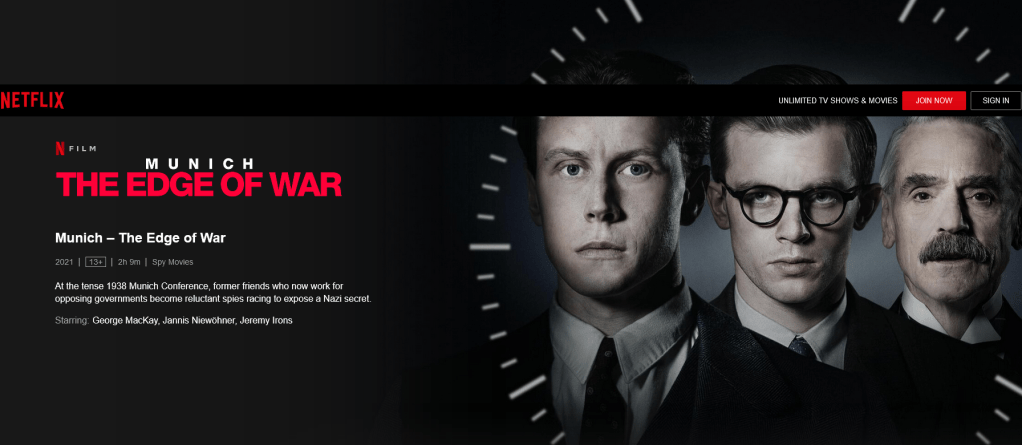
Spune cineva pe net că filmul se termină cu discleimărul:
“UK a mai câștigat un an de pregătire și, în cele din urmă, a învins”
Nu l-am vazut. Nici n-am de gând…
Dacă se vede cineva cu scenaristul, vă rog să-i transmiteți din partea mea că anul ăla de pregătire a fost valabil și pentru Hitler.
Diferența dintre cele doua spații socio-culturale fiind că nazismul era deja ‘copt’ în timp ce englezii nu erau, încă, pregătiți din punct de vedere psihologic pentru un ‘nou’ război. În anul ăla de pregătire, Hitler a construit tancuri și avioane în timp ce englezii s-au obișnuit cu gândul că vor trebui să mai învingă odată Germania. Hitler a început războiul tocmai în 1939 pentru că abia atunci a avut la dispoziție suficiente arme. Dacă le-ar fi avut in 1938, intra atunci în război.
Cam același lucru se întâmplă și acum. După WWI, americanii s-au retras dincolo de Atlantic, englezii dincolo de Marea Mânecii iar francezii au impus despăgubiri imense de război Germaniei învinse. Economia germană s-a scufundat în mocirlă iar mizeria rezultată a constituit ‘îngrășămantul natural’ în care au înflorit aberațiile lui Hitler. După WWII, americanii au fost mai isteți. Și-au dat seama că dacă se mai retrag odată, Europa va relua ciclul. Poate cu alți actori, doar că războiul s-ar fi întors cu aceiași regularitate. Așa că planul Marshall și NATO. Europenii, care învățaseră și ei lecția, au constituit UE. Aranjament care a ‘conținut’ comunismul în spatele Cortinei de Fier, unde s-a prabusit sub propria greutate – precum toti colosii cu picioare de lut. Odată cu sfârșitul Războiului Rece, am reintrat în ‘necunoscut’. “Neconoscut” pentru că l-am uitat deja, dacă l-om fi înțeles cu adevărat vreodată… Euroatlanticii au clamat victoria – vezi ‘sfârșitul istoriei’ prevăzut de Fukuyama, analist la State Department pe vremea când i-a venit ideea, în Martie 1989 – iar postsovieticii au refăcut traseul urmat de naziștii nemți. Au dat vina pe trădătorii interni – adică pe ‘Gorbaciov’- refuzând să recunoască – cu toate că abia ce se confruntaseră cu ele, ‘limitările’ intrinseci modelului autoritar.
Din păcate, euroatlanticii au uitat de învațămintele trase la sfârșitul WWI. Au lăsat spațiul ex-sovietic să se descurce singur. Și pentru că shit happens… it did!
Revenind la Hitler, francezii ar fi trebuit să reocupe Germania în 1936. Când Hitler a intrat in Renania, încâlcând brutal tratatul de la Versailles. Doar că ‘elitele politice’ franceze și britanice ale momentului nu erau ‘pregătite’. Drept pentru care a venit momentul 1938. Nici atunci nu ar fi fost târziu. Armata germană încă nu era suficient dotată pentru a face față unui asalt hotărât, declanșat de toate țările din jurul Germaniei. Dar, din nou, elitele politice nu erau suficient de ‘pregătite’.
Suntem, iarăși, în aceiași situație. Ne punem, din nou, aceiași întrebare. Merită să-l înfruntam pe dictator? Mai ales că acum dictatorul ne poate distruge. Și pe el s-ar putea să nu-l intereseze ce rămâne in urma lui!
Întrebările la care trebuie să găsim răspunsuri sunt următoarele:
Cât de departe sunt dispuși să meargă cei din jurul dictatorului? Cei care fac posibilă dictatura ‘internă’.
Iar după ce vom fi aflat răspunsul la prima întrebare va trebui să ne uităm în sufletele noastre și să ne întrebăm
CUM DRACU’ DE-AM AJUNS, DIN NOU, ÎN ACEASTĂ SITUAȚIE!?!
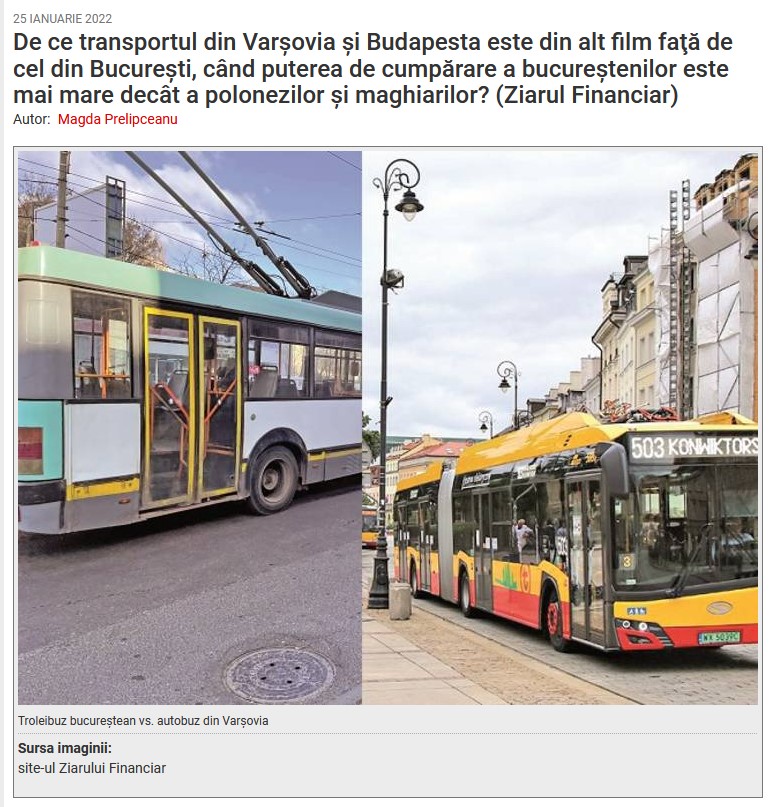
40% dintre cei 11 000 de angajati sunt șoferi și mecanici. Restul, „personal administrativ”. 80% dintre veniturile STB se duc ‘pe salarii’.
Mai sunt multe cifre prin articolele apărute ‘pe chestia asta’. Aveți două linkuri mai jos. Sincer să fiu, mie mi se pare că șoferii sunt plătiți prost. Și că 60 tone de motorină furate, într-un an, dintr-o întreagă autobază, nu e foarte mult.
Doar că am mai aflat ceva. Pe propria piele. Orașul nu s-a blocat. Nu doar că viața a continuat neabătută, dar nici măcar nu a fost mare aglomerație de ‘autoturisme personale’. Și taxiuri câte vrei la toate colțurile…
Ce rezultă de aici?
Că cei care au organizat greva au tendințe sinucigașe. Și cei care au pus botul.
Păi… șoferii știu că nu pot fi înlocuiți. Că la banii ăștia nu găsești prea mulți doritori care să tragă de covrig prin aglomerația din București. Le-a fost frică celor care au băgat mâna în rezervor? Și pentru asta faci grevă? Ca să atragi și mai tare atenția asupra ta?!?
Șefii de sindicat ar trebui să știe structura de personal. Și că n-are cum să mai meargă în felul ăsta. Că orice om sănătos la cap ar trebui să facă o restructurare la sânge a companiei.
Și atunci? Faci o grevă? Ca să ce? Să se oftice lumea pe tine? Să nu mai aibe nimeni nici un fel de milă pentru cei ce urmează să fie disponibilizați? Mai ales că disponibilizații vor veni mai ales din rândurile personalului administrativ, nu dintre șoferii care au făcut grevă… dacă cei ce vor face restructurarea vor fi oameni cu scaun la cap, bineînțeles… că doar n-o să dea afară șoferi și să-i păstreze pe ceilalți…
‘Neo-liberalii’ ar trebui să-și frece mâinile de bucurie… Încă o trăsnaie din asta și să vezi cum se găsește cineva să spună că STB trebuie privatizată. Că altfel nu se mai poate ieși la liman….
Iar bucureștenii, exasperați, s-ar putea să cam fie de acord!
I came across this over the internet. I couldn’t have said it better myself, hence I ‘borrowed’ it. Click on it and read the whole post, it’s very interesting on its own.
Below is the comment I left on the FB wall where it all happened. Don’t see any need to change anything.
“The key words here being “are recognized for”. Real mastery involves knowing your limits. Being recognized as a master by somebody else – the more ‘recognizers’, the worse, tends to annihilate any ‘master’s’ ability to own the very existence of their limits. The intellectual limits are the hardest to notice/accept. ‘Accrued’ age brings about crystal clear evidence about our physical limitations. Accrued knowledge enlarges one’s vision. Puts distance between the observers themselves and the limits of their ability to ‘observe themselves in the act of observing‘.
And if/when the above mentioned accrued knowledge becomes recognized/admired by the (naive) ‘general public’… You don’t have to trust me on this because of my white beard. I have a better argument. I’m an engineer!”
‘OK, and the point of this post is …?’
The fact that there’s no such thing as ‘personal improvement’. Any ‘improvement’ which we might ‘inflict’ upon ourselves derives from our intercourse with the others. Through ‘learning’. All change which happens to us, actually, comes from our ultimately aleatory intercourse with the environment in which we happen to live. From being taught to being ‘influenced’ by the passage of time. All that is ‘personal’ in ‘personal improvement’ is that we do it ‘willfully’.
Much of the change which happens to us goes either unnoticed – up to a point, or is merely accepted by us. ‘Personal improvement’ is chosen by us. And imposed by us upon our own selves.
To do it – ‘improve’ ourselves, that is, we follow ‘suggestions‘. We should keep in the back of our mind that it’s our call to follow – or not, those suggestions.
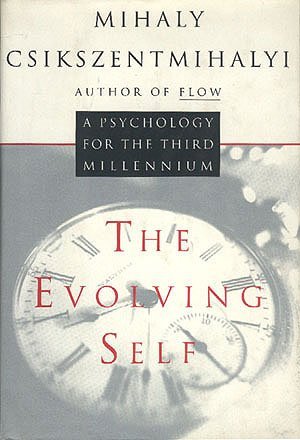
Disclaimer. I have no idea who the ‘suggested’ guy is. Just googled ‘personal improvement books’ and chosen the most visually appealing – for me, obviously, link. Just wanted to illustrate the deluge of suggestions which is constantly directed at us.





 nicichiarasa