Archives for posts with tag: Profit

None other than Jack Welch, former chairman and CEO of General Electric,
has called shareholder-value ideology ” the dumbest idea in the world.”
Yet business executives still pretend that maximizing shareholder value
is their primary fiduciary obligation,
which is nonsense except in few restricted cases,
such as when a company is going to be sold.

Value… What is that?!?
Does it exist on its own?

Something must exist if anybody is to extract it, right?
If that something may be created, then it would be a no brainer to make some before attempting to extract it… if you want to be involved in a sustainable process, right?

How do you make value?
How does anybody establish that something is valuable in the first place?

– I declare this to be valuable.
– Who owns it?
– I do.
– How much do you want for it?
– xxx
– OK

That ‘this’ had became ‘valuable’ only when ‘OK’.
Before its value had been agreed upon, it being valuable was on the declarative level only.
‘Virtual’ versus ‘real’.

Only after two interested parties had negotiated about and agreed upon the value of something the value of that something has become established.

Jack Welch again:
“Shareholder value is a result, not a strategy…

your main constituencies are your employees, your customers and your products.
Managers and investors should not set share price increases as their overarching goal. …
Short-term profits should be allied with an increase in the long-term value of a company.”

As an engineer, as down to Earth as it gets, I tend to agree with Jack Welch. A company should be managed as a long term project. It needs to satisfy the natural interests of the investors – profit – in a sustainable manner. Providing something useful to both parties involved. A useful ‘thing’ to the buyers and a satisfying profit to the investors. While creating little to no damage to the ‘environment’ in order to remain acceptable to those living on the same planet…

But who am I to judge… even if I have the blessing of Jack Welch…
Who am I to tell anybody – any investor and/or any manager – how to run their business?!?

Are they blind? Don’t they see this economic model doesn’t work?

Inequality holds back the growth of the entire economy,
as research supported by INET has shown.
Even today’s business elites are worried about its impact:
In a 2015 poll of over 2,700 Harvard Business School alumni,
respondents said that they were more concerned about growing inequality than ever before.

Hm…
“Share holder value is a result, not a strategy”, remember?
Same with ‘inequality’.
Let’s focus on sustainability. On the process.
And notice that the process sputters!
As a consequence of our own decisions!

We have told/allowed the investors and the managers to run the business – not their businesses, the entire business environment – in the current manner.
And we are the ones bearing the brunt. Having to deal with, among other things, the current level of inequality.
We, our decisions, have produced the current situation. Inequality is but one of the consequences.
One, among many, of the consequences engendered by our own weltanschauung.

Scopul pentru care cineva înființează o firmă este să facă profit.
Cu cât este mai mare profitul cu atât e mai bine pentru firmă,
și implicit pentru proprietarii firmei.
Scopul statului este să ia cât poate de mult de pe urma funcționării unei firme.
Cu cât poate lua mai mult cu atât e mai bine pentru stat

Noi, oamenii, avem ceva în plus față de celelalte animale. Capacitatea de a acționa ca un agent liber. De a lua hotărâri, de preferință în cunoștință de cauză. În mod conștient.
Capacitate codificată în legislația românească sub numele de „capacitate de exercițiu”.

O parte dintre societățile/culturile umane au devenit, în timp, democratice. Evoluția – adică fenomenul acela care impiedică supraviețuirea organismelor, biologice sau sociale, care nu fac fața ‘provocărilor’ la care sunt supuse – a făcut ca anumite societăți/state/culturi să inventeze – în mai multe rânduri și locuri – ceea ce noi numim, astăzi, democrație. Un spațiu de libertate în care fiecare face ‘ce vrea’ – atâta vreme cât nu răstoarnă barca – și în care hotărârile care influențează soarta comunității sunt luate abia după consultarea onestă a celor cărora le pasă de mersul lucrurilor.

Spațiul ăsta ‘de libertate’ presupune și libertatea cuvântului. Toată lumea poate spune tot ce are pe suflet.
Treaba asta e esențială pentru procesul de „consultare onestă a celor cărora le pasă de mersul lucrurilor”. Ce fel de consultare onestă a aia în timpul căreia cei consultați nu pot spune ce au pe suflet? Tot ce au pe suflet… Chestie care trebuie să fie liberă tot timpul, nu doar pe durata campaniei electorale!

Dacă tot putem spune tot ce ne trece prin cap – e o oarecare diferentă între ce avem în suflet și ce ne trece prin cap, numai că diferența asta poate fi făcută doar de fiecare dintre noi – atunci hai să ‘comunicăm’. Să împărtășim lumii toate gândurile noastre!

Să lăsăm lumea să discearnă! Să facă diferența între ….

Suficientă ‘pregătire de artilerie’!

Noi toți, fiecare în calitatea sa de agent liber, suntem supuși unor mai multe influențe.
Care acționează pe mai multe paliere și care sunt luate în calcul, atunci când decidem/spunem câte ceva, mai mult sau mai puțin conștient.
E foarte greu de discutat filozofie atunci când ți-e foame. Sau în prezența unui foarte atractiv, și evident disponibil, potențial partener sexual….
Ultimele două influențe care continuă să ne structureze procesul de decizie după ce toate celelalte au încetat să-și mai facă simțită prezența sunt cultura și ideologia.

Si nu, nu sunt deloc chiar același lucru.
Da, ideologia face parte din cultură – în sensul că amândouă au fost făcute de oameni și au fost transmise din om în om.
Numai că ansamblul cultural în care am evoluat este o devenire ‘naturală’ – fără scop în sine și rezultatul cooperării unul mare număr oameni care au făcut parte dintr-un imens șir de generații.
În timp ce fiecare dintre ideologiile care s-au perindat pe aici au fost opera unor inițiatori și suporteri care aveau câte o agendă. Câte ceva de demonstrat și/sau obținut.

Ute-așa am ajuns ca în însuși spațiul de libertate care presupune exprimarea fără opreliști, care inveterează decizia individuală cât se poate de aproape de dorințele și considerațiile fiecăruia dintre noi și care impune consultarea populară înaintea adoptarii oricărei decizii colective există oameni care ‘știu ei mai bine’!

Care știu ei, fără să întrebe pe nimeni, de ce sunt înființate firmele. Toate firmele!
Ce trebuie să facă statul și ce este mai bine pentru el…
Și, mai ales, că statul este – în mod absolut dar, în același timp, într-un fel extren de nebulos – diferit de restul societății!

Autorul citatului de mai sus este o persoană cât se poate de respectabilă.

Autorul citatului de mai sus este o persoană cât se poate de respectabilă.
Citatul descrie cât se poate de exact starea de fapt din momentul actual. Moment în care chiar noi, cei care trăim acum, suntem liberi să ne exprimăm părerile și să ne votăm viitorul.

Doar că citatul a fost redactat sub o puternică influență ideologică.
Sub o triplă influență ideologică.
De convingerea raționalistă că fiecare ‘trestie gânditoare’ poate cunoaște adevărul absolut – dacă se străduie suficient de mult și doar dacă rămâne fidel metodei raționale de căutare a adevărului.
De convingerea neo-liberală că statul este dușmanul împilator al tuturor celorlalți.
Și de concluzia lui Milton Friedman ca ‘profit uber alles’.

N-am să mă apuc acum să mă/vă întreb dacă e bine sau nu.
Vă întreb doar dacă vi se pare că lucrurile funcționează? Dacă vi se pare că mergem în direcția bună?

Eu aș reformula puțin.

Scopul pentru care cineva înființează o firmă este cunoscut doar de cel care înființează firma respectivă.

Tot așa, tot doar cel care înființează firma știe cât profit își dorește să facă. Ce profit i se pare lui rezonabil să aibe.

În ceea ce privește statele, sunt două tipuri de politicieni.

Unii care – forțați de împrejurări/condiționați de educația primită – înțeleg că impozitele colectate – multe, puține, nu contează, trebuie cheltuite în așa fel încât întreaga societate – populația organizată sub forma unui stat, să devină din ce în ce mai funcțională. Si alții care mai cred că odată ajunși la butoane îșii pot permite să sifoneze în interes propriu o din ce în ce mai mare proporție din bugetul colectat de stat.

Fiecare dintre aceste doua tipuri de politicieni – care sunt, de fapt, niște oameni ‘din popor’-ul care locuiește într-un anumit stat – învârt câte un cerc.

Primul, cel în care impozitele sunt cheltuite în mod judicios, este un cerc virtuos. La fiecare învârtitura lucrurile merg din ce în ce mai bine. Oamenii din societate percep impozitele ca pe un cost pe care îl plătesc pentru a trăi așa cum li se pare normal să trăiască. Părere pe care o vocalizează în mod constant. Mai apăsat în timpul campaniilor electorale. Și părere pe care o ‘formalizează’ cu ajutorul buletinului de vot.

Al doilea cerc, cel prin circumferința căruia din ce în ce mai mulți bani o iau ‘pe alături’, este unul vicios.
S-ar putea ca lucrurile să meargă bine pentru o oarecare perioadă. Mai ales atunci când există un mare decalaj între țara respectivă și cele din jurul/apropierea ei. Respectiva țară este, pur și simplu, aspirată în trena celorlalte. Așa cum s-a întâmplat cu Grecia până nu demult.

Doar că ‘mersul la aspirație’, după cum știu toți bicicliștii care s-au ținut suficient de mult timp bprea aproape de autobuze, implică anumite riscuri. Mai devreme sau mai târziu, autobuzul se oprește brusc iar biclistul se alege cu nasul spart. Și, pentru că și-a cheltuit toți banii pe concedii – chiar dacă nu erau ai lui, acum n-are cu ce să-și repare biclicleta.

Credit… ioc!
Cine-i așa prost să dea bani cuiva care își asumă genul asta de riscuri?
Care nu se gândește la ‘și eu ce mă fac mâine? Dacă mă prind aștia?’

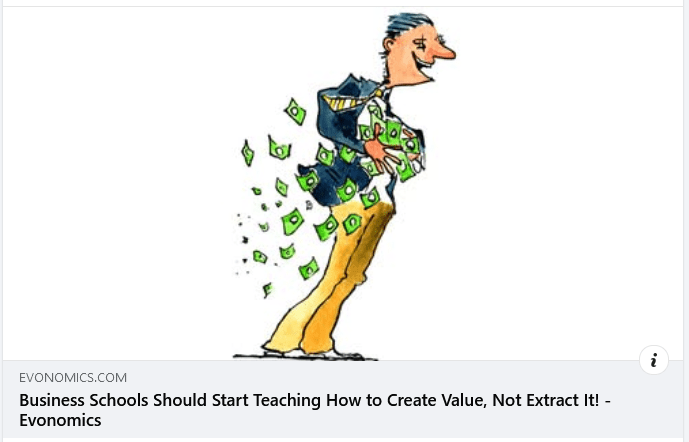
In a free-enterprise, private-property system, a corporate executive is an employee of the owners of the business. He has direct responsibility to his employers. That responsibility is to conduct the business in accordance with their desires, which generally will be to make as much money as possible while conforming to their basic rules of the society, both those embodied in law and those embodied in ethical custom.” Milton Friedman, 1970

Between 1776 and 1970 the world had leaped forward. Technologically, economically and socially. Not only that we’ve managed to learn so much about the world and to produce immense wealth but we’ve somehow managed to ‘spread around’ the results. The proportion of people who had improved their fortunes had grown constantly during the entire period.

The majority of Americans share in economic growth through the wages they receive for their labor, rather than through investment income. Unfortunately, many of these workers have fared poorly in recent decades. Since the early 1970s, the hourly inflation-adjusted wages received by the typical worker have barely risen, growing only 0.2% per year. In other words, though the economy has been growing, the primary way most people benefit from that growth has almost completely stalled.” Jay Shambaugh, Ryan Nunn, HBR

Isaac Newton hadn’t invented gravitation. He only ‘noticed’ it. Put it in words.
Adam Smith hadn’t invented the free market. He had noticed how it used to work and opened our eyes about it.
For what ever reasons, enough of us had chosen to close those eyes back. And have reached the conclusion that ‘greed is good’.

Milton Friedman was both horribly wrong and exactly right.

He was right in the sense that he had gouged correctly what the ‘general public’ wanted/was ready to accept. “in accordance with their desires, which generally will be to make as much money as possible

He was horribly wrong in the sense that he had perpetuated Marx’s error. Karl’s, not Groucho’s.

Money isn’t everything. Life beats it to the post.
Profit is, indeed, essential. Only it is nothing but an indicator. About how efficient a corporation is.
Meanwhile the role of a corporation is to accomplish – as Friedman himself had dully noted, the will of the shareholders.

The problem arises from the fact that ‘near mindedness’ blinds.
If/when both shareholders and management have nothing but ‘money’ in their scopes the market actually looses its freedom.

Economic agents no longer converge towards the market to solve each-others problems – like Smith had noticed, but to ‘make money’.

Not the same thing. Not by a long shot.

What do we have an economy for?

To make ends meet? To make it easier for our needs to be met?

What do we have a banking/financial system for? To mobilize capital for the economy? To make it possible for our needs to be met easier? More efficiently?

Or just for profit to be made?

“It really is possible to do two good things at once: address the abuse of the working poor by payday-loan and check-cashing outfits while expanding the range of services provided by the USPS. Media outlets have called Warren’s proposal “radical.” That’s ludicrous. She’s simply using her position and prominence to highlight the findings of a new study by the Postal Service’s Office of the Inspector General, which notes that roughly 68 million Americans are underserved by the private banking system. “With post offices and postal workers already on the ground,” says Warren, “USPS could partner with banks to make a critical difference for millions of Americans who don’t have basic banking services because there are almost no banks or bank branches in their neighborhoods.”

This is not a new idea. From 1911 to 1967, the Postal Service maintained its own banking system, allowing citizens to open small savings accounts at local post offices—actually a better approach than “partnering” with banks. The system was so successful that after World War II, it had a balance of $3 billion, roughly $30 billion in today’s dollars. Congress did away with postal banking in the 1960s, but post offices in other countries—including Japan, Germany, China and South Korea—provide banking services. Japan Post Bank is consistently ranked as one of the world’s largest financial institutions based on assets.”

Or, to put it the other way around,
‘what profit is?’

The well deserved ‘consequence’ – considered as such by the vast majority of the stakeholders, of a well-done job?
Or a self serving benchmark to be reached at all costs? Which costs are to be ‘shouldered’ by anybody else but the profiteer himself… till reality slaps us, all of us, over our faces…

Maybe it’s to early… I’ll take my chances though.

Germany has weathered this crises a lot better than most of her neighbors.

There are no toll- booths on the German highways. Not that I know of, anyway.

And what has this to do with anything?!?

Well, does your heart bill you for its services?
Your lungs? Your gut? Brain?
The immune system?
Even if each of them works at a cost… for the whole organism!

The health care system is the social equivalent of the immune system.

We, each cultural community around the world, might treat it as an industry. Fine tuned to maximize profit.
Or as a social service. Meant to protect the society from the consequence of disease. And run as efficiently as possible, of course. But sized to be able to cope with reasonably estimated ‘loads’.

There is a fine balance to be held here, of course. A multi-dimensional equilibrium, actually.

It depends on us, as individual members of the brain, to fine tune that equilibrium.

Or else…

“Between 1970 and 2010, the number of administrators in health care grew more than 3000%, while the number of physicians grew about 200%, according to the Bureau of Labor Statistics. During that same 40 years, U.S. health-care spending rose 2300%. Doctors’ fees account for only 8 cents of the health care dollar. Where do you think the other 92 cents are going?”  (Marni Jameson Carey, Focus on Health Coverage Misses the Point, Forbes.com, Oct 24, 2017)

A few years ago I was arguing that profit was overrated.
It seems that Forbes, a magazine which cannot be accused of any socialist tendencies, has reached a somewhat similar conclusion.

Even more interesting is the solution proposed by Forbes to the health care problem.

A return to the free market!

Free from what? Who says the American health care market is not free?
Well, click on the quote above and see what Forbes has to say about this…

But what happened? How did we get here?

Well, the free market described by Adam Smith was an environment where people used to fulfill their needs by selling their wares.
The butcher sold meat and bought everything else he needed, the brewer sold beer and bought everything else he needed, the baker… and so on!
OK, there  was a certain kind of competition which kept the things in check. The butchers competed against other butchers, the brewers…
And because of this competition, all traders – those who wanted to survive, anyway – streamlined their operations and became more and more efficient. Hence profitable.

I mentioned the link between the survival of a commercial enterprise and its ability to generate profit.
Apparently, it doesn’t make much sense to elaborate on this. Bear with me, please.

The whole point of the free market is the division of labor. Besides its freedom, of course.
Each of us does what he knows better and then we trade our respective wares. This way all of us fare better than if each of us would have had to produce everything each of us needs to survive.
In this scenario, competition – between ‘bakers’, for example – is actually a tool which makes it so that the market, as a whole, doesn’t waste resources. When the less efficient bakers are ‘encouraged’ to find something else to do, the entire market is better off. And so on.
In this sense, profit is only one indicator – and a very good one – of how able to survive is a certain commercial venture. But not the only goal of the entrepreneur who started/runs the enterprise. What he wants is to make an as good as possible living by doing what he knows best, in close collaboration with the other participants to the free market.

Adam Smith had written his books some two and a half centuries ago.
And the free market had served us well, for a while.
Just look at what we’ve accomplished in these two and a half centuries.

But, just as Forbes points out, things are no longer going in the right direction.

Why?

Simply because the market is no longer free!

Not only because some of the participants have become ‘heavy’ enough to crush all competition. This is only the lesser part of the problem.
The really big one, and so well hidden that it’s almost invisible, is that too many of us have become obsessed with the same thing. Money!

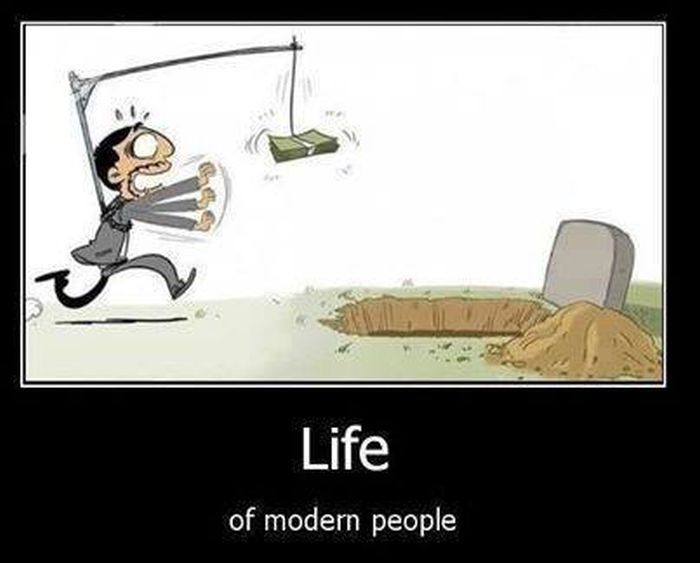
Life-of-modern-people

Profit has become THE absolute goal of everything we do. Too many of those who participate in the free market no longer want to collaborate with the others but simply want to get rich. By any (legal) means.

Some say this is a good thing.
They invoke Adam Smith’s words as a justification for their beliefs.

I beg to differ.

The simple existence of our current obsession has profoundly altered the very nature of the market. Which is no longer free.

Because WE are no longer free. When too many of us are obsessively concentrated on the same thing, they will necessarily disregard all other options. And the rest have no other option but to follow.

This is not freedom!

Mesmerized people can not be described, by outside observers, as being free.
Regardless of how they consider themselves.


‘Optimizare fiscala’ este o caciula foarte mare.
Sub ea poate fi ascuns orice.
Bineinteles ca toti oamenii normali la cap isi planifica afacerile in asa fel incat sa obtina cat mai mult profit.
Diferentele apar din metodele folosite pentru a obtine acest profit. Unele dintre aceste metode sunt atat legale cat si morale, altele legale dar amorale sau chiar atat ilegale cat si imorale.
Practica sugereaza, cat se poate de puternic, ca pietele sunt cu atat mai fragile cu cat accepta mai multa imoralitate.
Ne e mult mai usor sa intelegem cat de periculoasa e acceptarea ilegalitatii – tuturor ne e frica de talhari.
Ne e mult mai greu sa intelegem ca ‘hotii’ care se folosesc de imoralitate in loc de violenta sunt mult mai periculosi decat talharii. Tocmai pentru ca nu ne e frica de ei. Ni se pare ca suntem suficient de smecheri incat sa ne pazim singuri de excroci iar chestia asta ne da un fel de mana libera sa incercam sa-i pacalim noi pe altii.
Nu facem altceva decat sa ne furam singuri caciula. Aia optimizata fiscal.

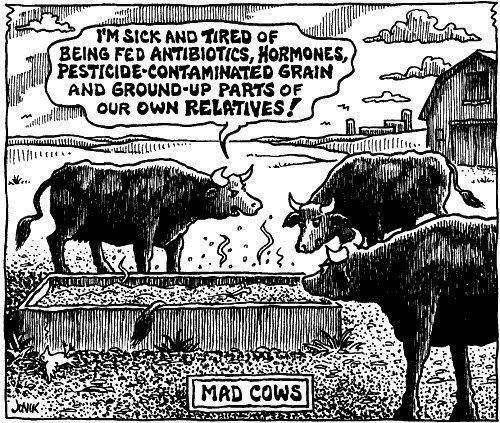
mad cow.jpg

The current mantra is ‘consumer driven economy’.
I think this is a blatant lie. Currently the economy is not ‘consumer driven’ but ‘driven by marketeers’. The consumers do nothing but set the limits… (or more precisely the limits are set by the consumers’ ability to borrow against their future).
Some nights ago, while listening to Zhang Xin about the Chinese economy becoming more consumer oriented (http://www.bbc.co.uk/iplayer/episode/b0371br6/HARDtalk_Zhang_Xin_Chief_Executive_Soho_China/) I started to see the stages we passed in order to get here:

– Hunter-gatherers for most of our pre-history. Minimal material progress: Chipped stone tools, bow and arrows, fire, some weaving.
– Agriculturalists. Second longest period. Increased productivity freed some people to do something else but toil for food. Most important features of modern life appeared now: lifespan improved dramatically, at least for those not having to work endlessly under the sun, water and waste management in the cities, commerce, manufacture, thinking for the sake of thinking. Still, people tended to mind a natural order: first things first and thrills later.
– Industrialists. The advent of the machine tool. Apparently things were going even better. People started to become less ‘poor’.
– Economists. Mass production, economy of scale. The poor were still improving their lot but the rift between the have’s and the have-not’s was already widening.
– Marketers. Rational, profit seeking agents. The economy is no longer a human activity that provides goods for the consumer to choose from but a ‘killing field’ were everybody tries to get rich and the weakling be damned. People are faking the very food they serve to their fellow humans just because they need additional money to buy more trinkets. Planned obsolescence. Redundancies. Corporations try to control everything, including drinking water. http://www.forbes.com/sites/nadiaarumugam/2012/10/19/nestle-sued-again-for-falsely-representing-bottled-tap-water-as-naturally-spring-sourced/

Surely we must be doing something wrong.
I’m all in for science, reason and everything else. The problem is what are we going to do with all these!?!

No Hope for a Consumer-Driven Economic Recovery


http://online.wsj.com/article/SB10001424127887323740804578601472261953366.html?fb_action_ids=10151510769946641%2C10151508961426641&fb_action_types=og.recommends&fb_source=other_multiline&action_object_map=%7B%2210151510769946641%22%3A137344176473019%2C%2210151508961426641%22%3A1392368000981860%7D&action_type_map=%7B%2210151510769946641%22%3A%22og.recommends%22%2C%2210151508961426641%22%3A%22og.recommends%22%7D&action_ref_map

http://www.project-syndicate.org/commentary/the-myriad-problems-of-intellectual-property-by-joseph-e–stiglitz

“Fortunately, what motivates most significant advances in knowledge is not profit, but the pursuit of knowledge itself. This has been true of all of the transformative discoveries and innovations – DNA, transistors, lasers, the Internet, and so on.”

This observation is in synch with a concept introduced by Csikzentmihalyi: “flow – the state in which people are so involved in an activity that nothing else seems to matter; the experience itself is so enjoyable that people will do it even at great cost, for the sheer sake of doing it.” (http://edutechwiki.unige.ch/en/Flow_theory)

Unfortunately modern world is dominated by another concept: “monetization”. “To monetize is to convert an asset into or establish something as money or legal tender. The term monetize has different meanings depending on the context.” http://www.investopedia.com/terms/m/monetize.asp.

In real life reaching the state of ‘flow’ is not enough, one also has to eat. Maslow’s pyramid is eloquent enough. If somebody wants to discern between two flow producing activities ‘profit’ comes in quite handy. Being profitable means not only a real demand for whatever is supplied but also that that activity is run by a diligent operator. In this sense profit is a very good efficiency indicator.

Contemporary economic and social life seems to be dominated by another logic. Profit has become a goal, not an indicator. Instead of trying to achieve the state of ‘flow’, people try to get rich. Instead of finding happiness by doing something meaningful people try to numb themselves by ‘consuming’. We have transformed ourselves from ‘free spirits’ into ‘consumers’.

It seems that we have forgotten what Max Weber tried to teach us. “As Calvinism developed, a deep psychological need for clues about whether one was actually saved arose, and Calvinists looked to their success in worldly activity for those clues. Thus, they came to value profit and material success as signs of God’s favor.” In this vision ‘profit’ is indeed an indicator and we should also remember about “Asceticism and the Spirit of Capitalism.” http://www.sparknotes.com/philosophy/protestantethic/summary.html

And yes, this is indeed an agency problem.