https://kmkz.ro/de-ras/daca-vreti-sa-va-invatati-pisica-sa-latre-asta-e-poza-pe-care-trebuie-sa-i-o-aratati

Cică ‘ridendo castigat mores’…
Poate…
În orice caz, examinarea bancurilor care circulă într-un anumit spațiu cultural ne oferă o foarte exactă masură a preocupărilor celor care viețuiesc pe acel tăram. Mioritic, în acest caz…

Bucureștiul dârdâie. Bine, doar o parte din el. Adică cei care n-au avut bani/nevoie să-și pună centrală până acum. Nu foarte tare, pentru că afară încă nu a venit iarna. Încă…
Bucureștiul se sufocă. Pentru că transportul în comun nu funcționează suficient de bine încât să fie atrăgător pentru suficient de mulți dintre cei care au de mers de colo-colo. Iar aceștia sunt foarte mulți și pentru că școlile/grădinițele/creșele bune sunt puține. Adică la distanță mare față de cei care au nevoie de ele.

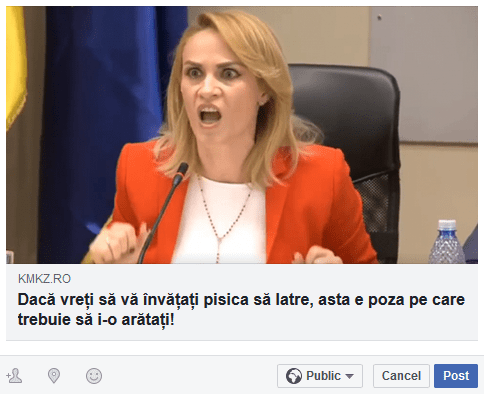
Iar beneficiarii acestor minunate condiții de trai se chinuie să-și învețe pisicile să latre….

Luați-vă bre un câine!!!

“We are the tools and vassals of rich men behind the scenes. We are the jumping jacks, they pull the strings and we dance. Our talents, our possibilities and our lives are all the property of other men. We are intellectual prostitutes.”

The words, attributed to John Swindon by Richard O. Boyer and Herbert M. Morais were supposedly uttered sometimes in 1880.

Nowadays, back in 2019, more and more people blame the MSM – main street media, for the sorry state the contemporary society finds itself in.
In fact, those who consider the media to be the source of all evil have been numerous, and focused, enough to elect somebody from their ranks to the highest office in Washington…

Don’t get me wrong. I’m not naive enough to pretend that journalism is any different from any other human activity.

And this is exactly my point.
Journalists are humans. Like all of us.
There is no way that they’ll behave any different than the rest of us.
The day to day practice provides ample proof that far too many of us currently “are the tools and vassals of rich men behind the scenes”. Sometimes even without being aware of it… but that is another issue.
While it is true that too many of the journalists function as “intellectual prostitutes”, the same thing is valid for the members of too many other professions.

Then why do we – all of ‘us’, demand that journalists behave any differently from the rest of us?
Why do we accuse them for not being saints when we are sinners ourselves?
Our sins are lighter? Have less impact?

Are we so thick in our vehemence against journalists that we are deaf to Swindon’s real message?

“We are the tools and vassals of rich men behind the scenes. We are the jumping jacks, they pull the strings and we dance. Our talents, our possibilities and our lives are all the property of other men. We are intellectual prostitutes.”

La prima vedere, spunerea asta aduce a pleonasm.
Curiozitatea este, în sine, o nevoie. Nevoia de informație. De cunoștințe. De a înțelege ce se întâmplă.

Și atunci?
Nevoia de nevoie?!?
Cine are nevoie de nevoi?

Și totuși…
Am putea vedea lumina dacă n-ar fi de fața și măcar un petec de întuneric?
Am duce paharul la gură dacă nu ne-ar fi sete?
De ce să mâncăm dacă nu ne e foame?
Cât de conștienți suntem înainte de a înțelege nevoia de celălalt? De cooperare? De dragoste?

Ce ne întreabă nenea doctorul?
‘Aveți poftă de mâncare?’
Viața însăși este, până la urmă – și nu glumesc aici, o nevoie continuă.
Abia după ce murim…

Elliott Wave is a theory used by ‘technical analysts’ to predict the evolution of the stock market.
It works.
Robert Prechter had expanded the scope of Elliott’s ideas. He uses them to study how our societies work.
https://www.socionomics.net/

Here’s what I make out of all this.

Things, Structure, Mind.
The world, as we experience it, is the consequence of ‘things’ becoming structured enough for ‘mind’ to evolve out of the whole ‘mess’.

Art, Science, Religion.
Knowledge – everything that we know about the world, has started as ideas gleaned by ‘artists’, structured by ‘scientists’ and put together by ‘religious leaders’.

Opportunity, rules, conscience.
Each of us, individual human beings, are the consequences of the opportunities we had been able to identify. Of the manner in which we had put into practice the applicable set of rules. And the kind of conscience each of us has built for themselves.

By putting together these three sides of the evolutive mountain, we notice that ‘knowledge’ (our image about the world) is entirely ‘ours’. And that the world itself is increasingly being shaped by our actions. Actions which are shaped by us, according to our wishes. Wishes which are shaped by what we know about the world.

My point being that while until not so very long ago the world was evolving under its own steam, since we’ve become conscious – aware of our own awareness, in Humberto Maturana’s terms, our influence had grown significantly. Exponentially, in fact.
We’ve changed the geography of our planet. It’s biology, even.

And even though the planet is huge, the opportunities we’ll be able to identify are not infinite. For the very reason that the planet itself is not infinite.

Rather Malthusian, I know, but with a twist. It will be not our numbers which will be our undoing. Only our carelessness. Our infatuation. Our inability to look farther than the ends of our noses.

Wilhelm von Humboldt had initiated a current of thinking, linguistic relativity, which posits that the language used in a cultural space is a reflection of the ideas populating that space. And that there is a strong link between the workings of that language and the manner of reasoning favored by those who use it.

‘Dull as fuck’ is a perfect example.

Nowadays ‘conventional’ fuck is considered to be boring.

We’ve arrived to need all kinds of ‘gadgets’ and a cornucopia of titillation.

We’ve become addicts. Depending on porn.

Isn’t it interesting?

There is a then and there is a now.
We’re OK with ‘then’ and we’re not so comfortable with ‘now’.
Yet the only link between ‘then’ and ‘now’ is us.

Our generation took ‘then’ and brought it ‘now’.

Everything that happened between then and now had happened to us, by us.

Hunters and growers.

Then fighters, doers and rulers.

Now, doers and ‘commentators’.

Some people actually do something – be it ‘fighting’, producing something or being involved in government, while other just ‘speak’. OK, their ‘speech’ does have consequences.
So we might say they also ‘do’ something… yes, true enough, only their deed is more than indirect. And no, teachers don’t belong here. Nor ‘actors’. Or even writers. All these people might do nothing but ‘speak’ only they produce something through their speech. Education, show, literature…
‘Commentators’ is very straightforward. Even more straightforward is ‘talking heads’. But ‘talking heads’ isn’t wide enough!

The philosophers have only interpreted the world, in various ways; the point is to change it. ” Karl Marx, Theses on Feuerbach

We all know the consequences of people following Marx’s advice…
But what could have gone wrong? Weren’t philosophers supposed to be the brightest amongst us?
Wasn’t Plato – the founder of Western philosophy, advocating the very same thing? That society should be run by specially trained philosopher kings?

Let’s go back to the original division of work.
Not all people have become farmers. There still are a lot of humans who survive as hunter-gatherers. Some don’t need to bother – there’s enough food to be gathered where they live , while others couldn’t possibly farm anything. The Inuits, for instance.
Among the farmers, there’s further division. Some farm plants while others farm animals. Because of the specifics of local soil, geography…
Also, farmers need tools. Hence wood workers, metal workers, weavers… etc.
The farmers need protection. Hence soldiers.
Society, as a whole, needs organizing. Hence government.

Let me pause for a moment. These arrangements work simply because they are more efficient than each individual providing everything they need for their own survival.
The soldier protects so the farmer might plow in peace. Some farmers use better plows because of the woodworkers and the metal workers who have cooperated to produce it. The farmers with the better plows produce more than those who use a rudimentary one, built by themselves. And so on. But please remember that each of these people have a first hand experience in their domain of expertise. And that their livelihood depends directly on their expertise.

Now, the next level of analysis shows us that organized societies fare better than those who lack any ‘structure’. ‘Fare better’ in no other sense than having a better chance of survival, as a social organism.
Nota Bene! While an Inuit – or an Inuit family, has a far better chance to survive in the Arctic than you and me, we, together, have a better chance at surviving – and even thriving, anywhere on the planet. Including in the Arctic. But only as long as we act as an organism. Only as long as we cooperate among us.

And whose job is to organize this cooperation?
The government and the ‘commentators’, who else…
The government to act as a referee – to prevent the rogue among us from ruining the game, and the ‘commentators’ to convince us that behaving is a lot better than mis-behaving.

Yeah… only this is nothing more than an ideal… seldom maintained for long…
Usually, the ‘government’ becomes too powerful, the ‘commentators’ convince us – both ‘government’ and general public, that this is how it should be… tensions build up… and something snaps!

And the problem becomes even more acute when the ‘commentator’ pretends to become king. Pretends to have the ultimate truth. Pretends to be obeyed. Convinces us – this being his only skill, to obey him.

This being the moment for us to remember that the commentators have only indirect knowledge about the world. While each of the doers has at least some first hand experience about something, the commentators have nothing but second hand expertise. Everything they know, they know it because somebody has told them so. Or because they have read about it somewhere.
The commentators’ vision might be far wider than that of the doers but it is at least ‘once removed’ from the reality.

And this is the reason for which societies who have used Marx as their spiritual leader have failed. They have not respected the main principle which makes division of work function properly. Let those who know about it make it their job.
Let the doers do and let the commentators gather and aggregate knowledge.

Don’t mess up things.

Îl scoli de la 7. Poate, dacă are noroc, de la 7 jumate.
Îl îmbraci și-l bagi în mașină. Adormit și nemâncat, o să-i dea ăia ceva acolo.
Ajungi, odată cu traficul, și începi să cauți loc de parcare. De multe ori blochezi un garaj. Și te înjură câte cineva care întârzie el din cauza ta.
– Dă-l în mă-sa, uite ce căsoi are. În mijlocul Bucureștiului. Când o să am banii lui, am să-mi fac o casă în mijlocul câmpului, să nu mai miros eșapamentul altora.
O să ridici din umeri dacă te întreabă cineva cum o să meargă la școală copilul pe care îl duci la creșă. Acum ești prea ocupat să ajungi repede la servici. Iar o să te fută șeful la cap cu chestia aia care trebuia făcută ieri. Ca toate celelalte…

Pleci, în sfârșit. Bine că trebuie să-l iei pe ăla micu’, că altfel te mai ținea nebunul cine știe căt. Chiar dacă ai stat deja o oră peste program și iar o să fii ultimul părinte. Bine că măcar o să-l îmbrace educatoarea … Nu de alta, dar vrea și ea să plece odată acasă. La copiii ei…
Nici tu nu știi cum ai ajuns. Nebunia de pe stradă crește de la o zi la alta. Descoperi că nu ești ultimul. Atât de ne-ultimul încât și la ora asta singurul loc de parcare e tot în fața garajului celui cu care te-ai certat azi dimineață.
– Dă-l în mă-sa, doar n-o veni chiar acum!
Fugi înăutru și descoperi că trebuie să-l și îmbraci. Mai sunt cinci copii și educatoarea stă cu ei la povești. Nu poate să-i îmbrace pe toți odată și, oricum, ar muri de cald. Îl bagi cumva în haine, îi dai banana care trebuie să-i țină de foame până când ajungeți acasă, îl iei de mână și…
Bine măcar că n-a venit ‘căpcăunul’ acasă. Mai stai un minut să termine prâslea banana. Arunci coaja pe jos – de unde coș de gunoi pe străzile astea mici și doar n-o să murdărești mașina firmei. Pleci în sfărșit spre casă.
Unde-o să ajungi peste vre-o oră…

Poate că ai folosi și tu transportul în comun, ca cei care n-au mașină… dar cea mai apropiată stație e la aproape un sfert de oră…. și asta doar dacă-l iei pe ăla mic în brațe… iar drumul e plin de gropi și bălți… afară e întuneric… și dimineața și seara… bine că măcar au strâns căinii vagabonzi…

Uite, Ceaușescu a făcut creșele astea când i-a adus pe muncitori de la țară! Îl duceai frumos luni de dimineață… și-l luai tocmai sâmbăta! Nu te interesa că era departe de stație. Aștia de ce nu mai fac altele? Poate mai mici și mai dese, să nu mai pierzi atâta vreme pe drum… Că tot spun ei că-i interesează îmbătrânirea populației și lipsa forței de muncă!

Dar tu, tu ce faci?
Ce faci ca să ieși din ‘cercul ăsta strâmt’?
Și nu singur… că ieși degeaba, dacă toți prietenii tăi rămân acolo!

Universal Grammar (UG) is intended to specify the most general principles of human language. It must provide an explanation for the extraordinary fact that a Japanese child raised in Paris will acquire French, but not Japanese, and a French child raised in Tokyo, Japanese, but not French. Either child may acquire both French and Japanese, of course, but neither will fail to acquire French or Japanese. Linguists and philosophers may have known this in antiquity; they did not say so with any great conviction, and they may not have said so at all. It was left to Chomsky to remark with the full force of his genius that every human language can be acquired by any human being. Universal Grammar, Chomsky concluded, must be a species-specific characteristic of the human race, biologically encoded, genetically transmitted.

The quote comes right out of an article written by David Berlinski and Juan Uriagereka. Never heard of any of them.

Reading that article, I remembered the reason for which I tend to avoid modern philosophers. Or linguists. Hard to discern which is which, anyway…

Let me return to the quote itself.
“An explanation for the extraordinary fact that a Japanese child raised in Paris will acquire French, but not Japanese, and a French child raised in Tokyo, Japanese”.
Read this to anybody who isn’t familiar with the notion of ‘Chomsky’. You’ll get a laugh and a troubled look. ‘What’s so extraordinary here?!? People will always learn whatever language is spoken around them… but only if they come in contact with the ‘exterior’ world!’

Home-school those Japanese/French children in Paris/Tokyo while preventing them from getting in touch with anybody else but their immediate family/trainers and they’ll learn only whatever language(s) their trainers/family will have chosen for them.

As an aside, what does Chomsky mean by ‘French’ and or ‘Japanese’?
‘Genetically’ French/Japanese? What if one parent is French/Japanese and the other German/Korean? What will the child be? Like the father or like the mother?
‘Culturally’ Japanese/French? According to their ‘mother’ tongue?!?
Forget it…

“Universal Grammar, Chomsky concluded, must be a species-specific characteristic of the human race, biologically encoded, genetically transmitted”.

‘Species specific characteristic of the human race’… told you these guys have a lot of humor… or, maybe, they cannot make up their minds…
What are we, humans?!? A species or a race?

OK, let me move forward.
Hidden underneath all this ado, there is a piece/gem of ‘harsh’ reality.
The simple fact that if/when we want to, we are able to understand each-other. To communicate with each-other. To exchange ideas. To trade meaning.
And there is indeed something species-specific about this ability of ours. Nobody else has it… according to our present knowledge about the world, anyway.

‘Nobody else has it’… yeah, right… as if you hadn’t watched, time and time again, two dogs ‘greeting’ each-other in the park.
OK, those dogs were interacting in highly unnatural circumstances. Walked by people, in a people infested environment …
Fact is that all animals have ‘procedures’ for interacting with other animals. Belonging to the same species or belonging to other species. Some of the procedures being inbred while others had been acquired trough learning or training.
Cats, for instance, have an inbred ‘procedure’ for chasing anything which might become a prey but need to be taught by their mothers how to finish the chase. How to kill that prey.
And yes, cats do have a species-specific, biologically encoded and genetically transmitted characteristic which allows them to kill and eat their prey. Or to play with the people who take care of them. They kill and eat using their claws and teeth while they play using their brain. OK, the brain also contributes during the chase… don’t be a nit-pick.

Let me summarize.
So cats have a specific set of tools, teeth and claws, which are ‘coordinated’ by a brain which needs to be taught in order to become fully functional.
And the overall ‘functioning’ of any given cat depends simultaneously on how well their organism works AND the quality of the learning they have been able to amass.

Then where’s the difference between humans and cats?
What is so species-specific in our ability to interact with the world?

I’m exaggerating, of course. We are able to understand each-other far deeper than the other great-apes, our cousins. There is something species-specific in all this.
But only in ‘depth’, not in ‘nature’.
We’ve been able to teach chimps to write. And cats to play with strings instead of catching mice. All three of us ‘share’ the more or less same kind of brain and surprisingly similar anatomies.

What really sets us apart is our learned ability to watch ourselves while doing something. To observe ourselves observing, as Maturana puts it.
And our ability, learned again, to formulate information in a transmittable form. To ‘build’ highly specific messages using rather ‘fungible’ building blocks and in such a manner that those messages might be transmitted from one individual to another. From one generation to another, even.
To make good use of the Universal Grammar noticed by Chomsky.

Can any of this be construed as species-specific? Of course. Without the huge brain we’ve got – or without the ability to articulate sounds, we most likely wouldn’t have been able to reach this stage of our evolution.
But to reduce everything to mere biology … I’m afraid that would be too simplistic.

Consciousness – or self-awareness, opens up huge evolutionary venues. Powered by our very ability to communicate so intensely. To use ‘Universal Grammar’, even without being aware of its existence.
But since both self-awareness and talking depends upon learning them from/with the others… biology is not enough. Necessary, indeed, but not enough.

Not by a long shot.

I thought I had it all figured out.

I had already learned that individuals needed to preserve their self esteem. The good opinion they have built about themselves during their entire lives.
This being the reason for which most self made people see their own efforts as the main reason for their status. While being adamant that Lady Luck had played no role whatsoever in their advancement…

I had also observed that all imperia had eventually failed. No matter what kind of imperia… Political dictatorships, commercial monopolies, abusive families…
For no other reason than dictators’/patriarchs’ tendency to drive away those who don’t kowtow to their opinions.
Which attitude effectively empties the structures led by authoritarian figures of any ‘alternative’ expertise. Of any other expertise but that of the leading figure. And since no expertise was ever infinite – not even Napoleon’s, the end of all imperia had been sealed from the moment when a single will had imposed itself over the entire structure.

OK, from the outside everything made sense. The added figures matched the measured total.

But something still bothered me.
As a constant rebel, I perfectly understood those who chose to leave instead of bowing to the higher authority.

But why act in a dictatorial manner in the first place?
Why drive away all those who might come handy in a dire strait?
Why not replace those who choose to leave with equivalent people? Instead of favoring increasingly obedient ones?
Specially when speaking about very intelligent people… and very few individuals have ever arrived at the top of any complicated structures only because Lady Luck had a crush on them …

Yesterday, when discussing the subject with my father – we each support different political parties and Romania had just elected it’s president, he told me: “You had been lucky enough to never have had to make a compromise. That’s why you can afford to think like this!”
We were using Romanian. I used ‘can afford’ to convey what he said to me because I’m not aware of a closer English equivalent. Maybe I could have used ‘allow yourself to think like this’…
Anyway, that was the moment when it struck me.

That past ‘compromises’ tend to compromise our ability to see the forest for the trees.
That whenever somebody aired an opinion which even slightly contested any of the compromises we ever had to make in our pasts we perceived it as an aggression. As if our self esteem was under assault. No matter that the ‘assailant’ had no way of knowing that we had to compromise our own beliefs at one point.
The simple fact that we remember that moment is enough. We’ve found ways to soothe our souls. We’ve already have invented excuses. Otherwise we wouldn’t have been able to function… But we’ve never been able to really come to terms with ourselves. We’ve never forgiven our own weaknesses. Never assumed them in earnest.

And this is how past ‘mistakes’ continue to haunt us.
Preventing us from accepting advice.
Because ‘deep down’ we feel the urge to continue the path we have already chosen’. That being the easier way to preserve our psychological well being. Our mental consistency…

Further reading:
Cognitive Dissonance
Customer cancels Zomato order for sending non-Hindu delivery boy.