Archives for category: 1989

Mă tot lovesc de indivizi care repetă: „Comuniștii au făcut și lucruri bune.”
Da, au făcut o grămadă de lucruri bune. Asta fiind explicația pentru faptul că ‘lagărul comunist’ a dăinuit vreo 70 de ani în timp ce doar un singur regim fascist a rezistat mai mult de 30. Unul singur, cel condus de Franco.
Dar toate s-au prăbușit până la urmă. Precum toate celelalte forme de dictatură. Cele care au precedat comunismul și cele care vor mai urma. Daca vor mai urma…

Și uite-așa ajungem la subiectul de astăzi.

A fost vreun moment important al istoriei în care ați devenit convins că regimul comunist era pe ducă?

„Da, un eveniment mărunt, dar radical. Havel mi-a povestit de el. Nişte prieteni din copilărie din Moravia au venit la el pe neaşteptate, şi cum nu avea nimic de băut în casă, Havel a încercat să facă ce face tot praghezul: să ia o cană de porțelan de un litru şi să se ducă la crâşma din colț să cumpere bere la halbă. Doar că atunci când a ajuns jos, unul din securişti l-a oprit şi i-a spus: „Am cercetat, vizitatorii voştri nu sunt dizidenți, dă-mi cana, mă duc eu să iau bere şi o aduc imediat sus.” Când am auzit asta în 1989, am fost sigur că regimul e pe ducă. 29 decembrie 1989, când Václav Havel a devenit preşedinte, a fost cea mai bună zi din viața mea. Am ştiut că coşmarul țării mele se terminase. Eram din nou acasă, am supraviețuit secolului 20.”

În 1989, Havel – și orice alt praghez, se putea duce la colțul străzii – cu toate că era păzit de gealați – să cumpere bere la halbă.
Mircea Dinescu – ales la întâmplare dintre dizidenții români cu domiciliul ‘supravegheat’ – nu putea face același lucru. Pentru că nu era sigur că va găsi bere la cârciuma din colț… Trebuia să te duci în centru – dacă locuiai în București. Și nu erai sigur că merita efortul! Berea era ‘cam’ proastă…

Cu alte cuvinte, or fi făcut comuniștii și lucruri bune dar e sigur că au stricat berea. Printre alte lucruri…

Sunt suficient de bătrân pentru a-mi aminti ce gust avea berea la mijlocul anilor ’70. Și cum a devenit din ce în ce mai nasoală…
Iar comuniștii au mai stricat și alte chestii.

Iar cel mai grav e faptul că au stricat ‘educația’.
Nu doar învățământul, întreaga educație.
Au denaturat tot ce se transmite de la o generație la alta!

Nu intru acum în amănunte ‘tehnice’.

Redactorul care a pus laolaltă articolul din care am ‘extras’ ‘ilustrația’ cu care am început habar n-are ce înseamnă cei 12.5% menționati pe eticheta de Gambrinus.
Și nici o apăsare atunci când vine vorba despre exprimarea unei păreri cu privire la ceva… Cu privire la ceva despre care nu știe nimic…
Care părere, o dată exprimată, îi va scoate la iveală atât ignoranța cât și autosuficiența.

„Aveau concentraţii alcoolice de peste 12% (în care puţini mai cred azi)”….

Persoana respctivă scria la ziar în 2013. Cât de precoce o fi fost, tot a apucat câțiva ani de școală făcuți înainte de ’89.
În timp ce marea majoritate a celor care au educat copiii României în primii 10 ani ‘de libertate’ au fost și ei formați pe vremea când lumea era văzută, și predată, prin lupa ideologiei comuniste.
Știu că mă repet, sunt suficient de bătrân să țin minte diferența dintre profesorii formați înainte de venirea la putere a comuniștilor și cei care apucaseră să devină ‘oameni noi’.

Ce mă deranjează cel mai tare la chestia asta e că redactorul respectiv n-a avut nici un fel de apăsare. Nici o curiozitate…
Google funcționa bine mersi în 2013! Ți se pare ciudat? ‘Cum adică o bere cu 12.5%?’ Uită-te mă pe net! Întreabă pe cineva… Nu te repezi înainte precum un secretar de partid… că te faci de râs!
Am ceva cu omul ăsta?
În nici un caz. A fost ‘sub vremi’. A crescut ‘strâmb’ pentru că ‘așa bătea vântul’. N-a avut cine să-l sprijine!
Părinții au tot construit comunismul iar copiii au crescut cu cheia de gât.
Comunismul s-a prăbușit – precum toate dictaturile ce au fost și cele ce vor să vină, iar copiilor neglijați de părinții prea obosiți de efort li se pare că… dacă tot e libertate, atunci pot să facă tot ce vor! Fără să se mai gândească la consecințe…
Și de ce și-ar pune problema consecințelor? Și-au petrecut ‘cei 7 ani de-acasă’ la creșă iar la școală au învățat sub privirea binevoitoare a celui mai iubit dintre fii patriei…
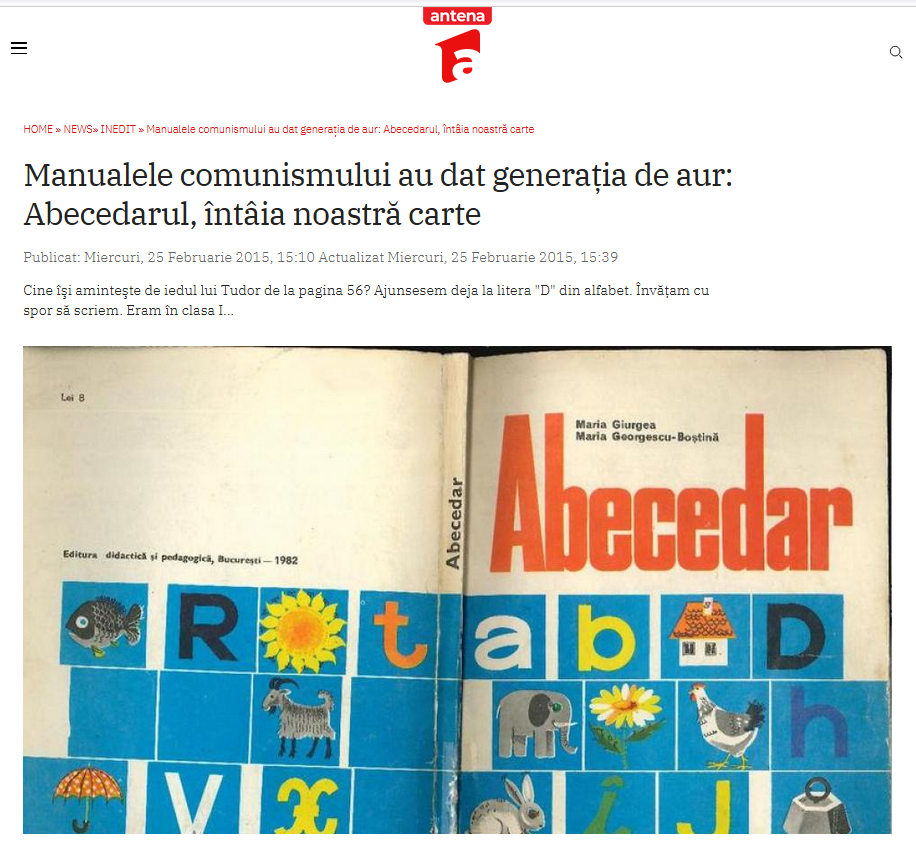
Pentru generația mai nouă.
Berea se produce plecând de la un amestec de apă, malț și făină de orz. Ăia 12% erau proporția de ‘solide’ adăugate în amestec. Acum se măsoară câte zaharuri fermentabile sunt în mustul de bere, pe vremea aia se lucra mai ’empiric’.
Aveți aici mai multe amănunte:

Ana nu mai are mere.
De fapt, Ana nu mai are nimic. Zilele ei s-au terminat.

Noi, cei care mai avem de trăit, aici, putem înțelege ceva din ce s-a întâmplat.
Sau nu…

Ca să înțelegem ceva, orice, avem nevoie de informații.
Despre cum a fost posibil ca un om să fie omorât de câini într-un spațiu public dintr-o zonă urbană.

Informația este distribuită. La oameni. Fiecare dintre noi știe câte ceva despre unele lucruri.
Dacă punem laolaltă aceaste frânturi de informație, vom avea o imagine mai completă.

Circulă, în spațiul public, tot felul de amănunte de la fața locului.
Despre cum se ascund câinii prin curțile oamenilor.
Despre cât de neputincioși sunt cei de la ecarisaj. Cum nu pot ei să intre în curțile oamenilor după câinii care s-au refugiat acolo.
Despre cum se ceartă între ei ‘factorii de decizie’ în loc să ‘rezolve problema’.

Și mai circulă tot felul de ‘aprecieri’.
De la ‘și-a căutat-o cu mâna ei’ până la ‘statul trebuie să intervină în forță dacă oamenii nu înțeleg cu frumosul’.

Eu mă simt ‘la mijloc’.
Iubesc câinii. Dar, în același timp, înțeleg necesitatea ca cei fără stăpân să fie, după o perioadă, eutanasiați. Care câini fără stăpân trebuie, înainte de orice, să fie strînși în adăposturi. Strânși în adăposturi, nu castrați și aruncați înapoi în stradă!
Înțeleg nevoia politicienilor de a ieși în față. De a folosi orice prilej pentru a-și face reclamă. De a folosi orice prilej pentru a arăta ce ar fi trebuit făcut altfel. De către ceilalți, bineînțeles… Dar nu pot înțelege ‘bătăile de pe pod’! Ne-am pornit împreună să ajungem undeva? Atunci tragem cu toții la căruță. Mai ales când dăm de greu! Și noi ce facem? Când ajungem pe pod începem să ne batem? Poate doar, doar, hop cu căruța-n prăpastie… În speranța că ‘noi’ vom fi în stare să ne agățăm de margine și că doar ‘ceilalți’ vor cădea până la fund…
Sunt atât de la mijloc încât sunt singur. Am stat foarte aproape de Lacul Morii și știu cum gândesc unii dintre oamenii de acolo. Nu foarte departe de cum gândim cu toții, de fapt. Și nu sunt de acord cu acest mod de gândire! Noi versus restul lumii. ‘Ce știu aștia? Să vină să trăiască aici înainte de a vorbi! Înainte de a ne spune nouă ce trebuie să facem!’

Că zona are mari probleme se vede cu ochiul liber. Chiar în timp ce forţele de ordine desfăşurau cercetarea la faţa locului, câini maidanezi treceau prin apropiere. Mai mulţi angajaţi ai ASPA au fost chemaţi să-i vâneze.
Oamenii care locuiesc în zona susţin că au făcut nenumărate sesizări.
Tragedia de acum ridică mari semne de întrebare legate de felul în care autorităţile îşi fac datoria. Câmpul de lângă Lacul Morii, unde a murit ANA, se întinde pe 60 de hectare pe care primăria Chiajna şi Primăria Capitalei se ceartă în instanţă, Dar pe care niciuna dintre instituţii nu îl curăţă.
Nu departe de zona unde femeia a fost ucisă de câini există această imensă grămadă de gunoaie unde animalele vin să caute de mâncare. E lesne de înţeles de ce câinii maidanezi vin în zonă. Acolo la câteva sute de metri sunt criminaliştii.
După câteva ore reprezentanţii ASPA au reuşit să captureze un câine care avea blană murdară de sânge. Nu se ştie însă dacă era al victimei sau dacă provenea de la stârv de măgar din care câinii din zona se hrăneau de zile bune.
Medicii legişti vor da, în zilele următoare, şi răspunsul clar privind cauza decesului. Nu se ştie însă cine va răspunde pentru moartea Anei.

Hai să o luăm invers.
Avem un mal de lac la marginea Bucureștiului. Unde sunt grămezi de gunoi și cel puțin un “stârv de măgar”. Într-o latură a terenului de 60 hectare aflat în dispută sunt case de oameni. Unii mai bogați, alții mai săraci… Unii au după ce bea apă, alții nici măcar apă curentă… Și atunci? De unde porți la curțile alea în care se adăpostesc câinii fugăriți de echipele de la ASPA?!?

Vrem să scăpăm de câinii vagabonzi? Vrem să putem fugi liniștiți pe lângă Lacul Morii?
Vrem să trecem podul către viitor?

Atunci trebuie să terminăm cu trasul spuzei pe turta proprie!
Trebuie să facem curat în bătătură, să stabilim care câmp ține de care primărie… și să vezi cum or să apară și locurile de muncă pentru oamenii ăia care acum nu au apă curentă și poartă la gard.
Abia după ce le vom oferi aceste condiții minime – apă, canalizare, drumuri, școli, transport în comun ca să poată ajunge la muncă, vom putea să le pretindem oamenilor – acelora dintre ei care n-o fac încă, să-și țină câinii în curte. După ce-i vor fi castrat, bineînțeles!

Am să închei cu o nedumerire.
Când o să ne dăm seama cât de crudă e pâinea pe care o mâncăm?
Atunci când tot tragi spuza de pe o turtă pe alta, nu iese nici una bună…

Asta e bariera de tăcere pe care trebuie să o depășim odată.
Să recunoaștem, măcar în sinea noastră, că ‘nu e bine’.
Să ne spunem, noi nouă, că ‘împăratul este gol’!

Că și ‘noi’ greșim, nu doar ‘ceilalți’.

You are entitled to your own opinion.
But you are not entitled to your own facts!

Daniel Patrick Moynihan

“a practice or interest followed for a time with exaggerated zeal : craze”

“Something that has actual existence. An actual occurence.
A piece of information presented as having objective reality.
The quality of being actual.
A thing done: such as”

Destination first. If you know where you’re going, getting there will be a lot simpler.

According to Daniel Moynihan – “you are not entitled to your own facts”, facts are obvious.
So obvious that doubting their existence, their factuality, would push us beyond the realm of the reasonable.
Appropriating facts – transforming them into ‘private property’, banishes the perpetrator from the community….

Hm…

Let me put it differently.
Moynihan had said something.
What was it? A fact? Or an opinion?

Currently, we – well, most of us – believe that freedom of opinion is the cornerstone of our Weltanschauung.
When it comes to facts… We’re OK with the definition – we do use the word/concept, quite extensively – but we seem to have some problems when dealing with the actual reality. Remember the still famous ‘alternative facts’?

Let me add something personal to all this.
My opinion about ‘facts’.

The current definition is somewhat incomplete.
We take something for granted. To the tune of no longer mentioning it.
We assume all of us see the elephant in the room and no longer talk about it.

For something to become a ‘fact’ we have to notice it.
First.
And then we have to agree among ourselves about its meaning!

Things used to fall down since ….
We’ve been discussing the matter since… we’ve learned how to speak!
But gravity had become a fact only after Newton had noticed the famous apple, wrote about it and we agreed. Gravity had become a fact, and continues to be one, only because his contemporaries had agreed with Newton on this matter. And we continue to believe Newton was right!

In this sense, alternative facts have been with us since day one. Well, something like that…
God had told something to Adam and Eve, the serpent had said something else… and the rest is history! For some…

Newton had said something to us. And most of us had chosen to believe him. Or ignore his words…
Darwin had said something to us. Many of us have chosen to believe him. To accept his arguments about the matter. While some others have chosen to dispute Darwin’s findings. To actively negate Darwin’s explanations about how we’ve got here.

Gravity is a fact while Evolution is still a theory.
Statistically speaking, of course.

In this sense, Moynihan was wrong.
For his words to ‘hold water’, we must to agree on how to separate facts from opinions.
Until we agree among ourselves about how to determine ‘factualness’, we’ll keep having to deal with ‘alternative facts’.

I actually cannot wrap this up before ‘unveiling’ my litmus test for factualness.
Consequences.

Does it have consequences?

Yes? It’s a fact!
No? Then it’s not – not yet, at least – a ‘fact’. It did happen – otherwise we wouldn’t be speaking about it. It even does have consequences – we do speak about it, but that occurrence doesn’t yet have meaningful consequences. It is not a ‘factual’ fact.

It had to do with FOCUS.

The answer, like always, is to be found inside the question which generates it.

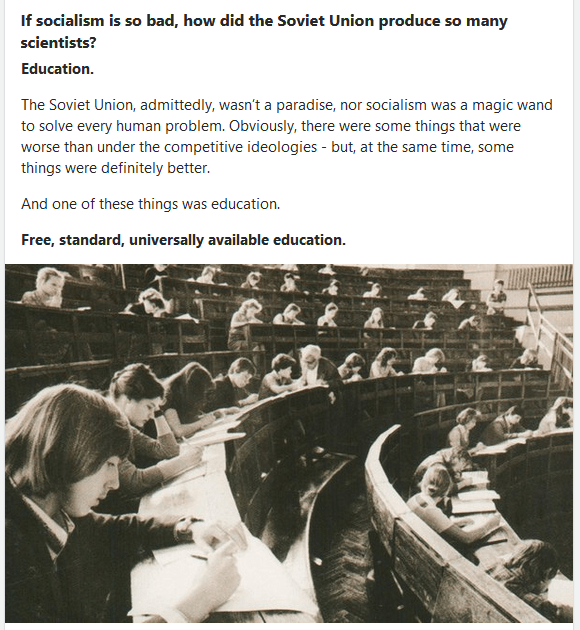
“If socialism is so bad, how did the Soviet Union produce so many scientists.”

The key word here is ‘produce’.
First of all, Russia did have an important cultural and scientific tradition to start with.
Secondly, the communist leaders – mostly Lenin but more or less all of them, had a clear understanding of the literacy gap which separated Russia from the rest of the world. Filling that gap was the first step towards Russia/the Soviet Union becoming a First Tier country. Hence the ‘free, standard, universally available education’.

But there’s a caveat here.
When we’re speaking about education – in the West, we mean ‘everything already known to man’.
Students are allowed to read everything in the library – except for certain places in the US, but those are exceptions.
When we speak about the education in the Soviet Union we must remember that each of the ‘free, standard and universally available’ aspects had its own limitations.
It was free in the sense that everybody – well, almost – had the right to apply for it. Actually getting it was something else.
It was standard in the sense that it was standardized. Only what was deemed safe/useful was allowed to reach the students.
It was universally available in the sense that everybody was subjected to some form of education. Much of which was nothing more than indoctrination…

Finally, let’s remember that the Soviet Union was able to produce scientists only for so long. Until it collapsed under it’s own weight…

Moral of the story?

Producing scientists is not enough.
Science teaches you only how to do whatever you want to do.
What to want… that’s something else!

People who have never experienced communism speak freely about it.
Some are frightened by it – as they should be, while others are looking forward to it.

People who have no real idea about what fascism/nazism was about speak freely about it.
Some are frightened by it – as they should be, while others are looking forward to it.

While there is a consensus about communism being a ‘far left position’, fascism is usually – but not unanimously, considered to be ‘far right’. Some even speak about a ‘third position‘, whatever that might mean.


The way I see it, what we have experienced as fascism is what Marx had in mind when he wrote the Communist Manifesto.
According to Marx, at some point in what he hailed as ‘the future’, the middle class was going to become poorer and poorer. All the wealth generated by the capitalist economy and governed by the increasingly imperialist/monopolist states was going to be herded into fewer and fewer hands.

As a consequence, once impoverished, people until then belonging to the middle class were supposed to realize they had been duped and let themselves be led – out of misery – by the communists. ‘The most advanced and resolute section of the working-class parties of every country …’

What Marx was prophesying had soon enough come to be. The post WWI German and Italian peoples had lost their hopes and allowed themselves to be led by those who pretended to put ‘the best interests of the people’ above everything else.

Same thing happens whenever a crises is deep enough to impoverish a significant number of people. Who loose their hopes and allow callous political operators to advance closer and closer to power.

What we have experienced as ‘communism’ was a Leninist short-cut.
In Marx’s view, communism was going to happen after economically advanced societies had reached a certain pinnacle.
Lenin – and Mao, had introduced ‘socialism’ and ‘popular democracy’ as intermediary stages between their underdeveloped societies and what Marx had in mind.

So no, there is no such thing as a ‘third position’. We have democracy – where left and right cooperate towards the common good, and authoritarianism.
While democracy is clear and transparent, authoritarianism hides its true nature under a chameleonic cloak. Painted, by the spin doctors who run the show, in whatever hue happens to be more attractive to the masses which are about to be fooled.

Afterthought. I googled ‘third position’ and found out that:

“In the last few years of the 20th Century, according to an article by Chip Berlet, a new form of fascism emerged in a period of resurgent neo-fascism. Called the Third Position, it seeks to overthrow existing governments and replace them with monocultural nation states built around the idea of supremacist racial nationalism and/or supremacist religious nationalism.”

Footnotes:


https://www.marxists.org/archive/marx/works/download/pdf/Manifesto.pdf

Who wrote the Bible?
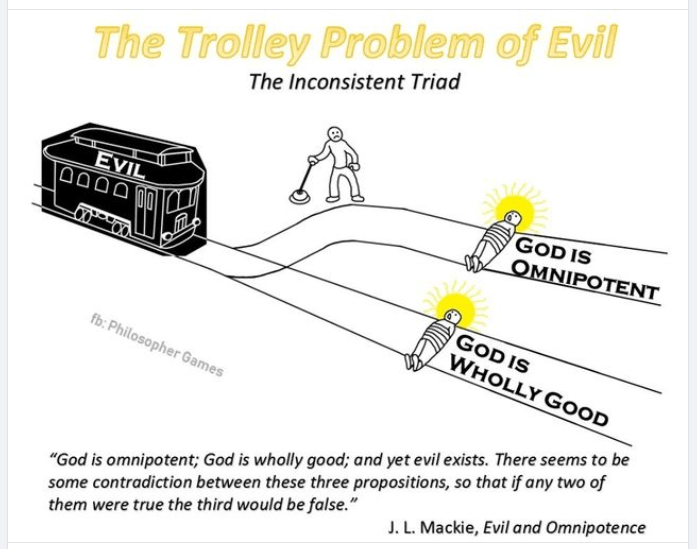
Who considers God to be both omnipotent and wholly good?
Who had become human by learning ‘to tell good from evil’?
Does evil even exist outside our minds? Is anything actually evil unless considered so by one of us?

And no, I’m not hair-splitting when speaking about the huge difference between bad and evil!
An earthquake, for example, is bad for those affected. Yet no evil is involved here but for those who ‘question God’s actions’.
An individual who tortures animals for fun is also bad. Arguably less so than a major earthquake… but for everybody in their right mind that person is undoubtedly evil!

According to the Bible written by some of our ancestors, by “knowing good and evil” we have become “one of us“. “Like one of us“… Not (yet?!?) able to “live forever” and for certain ignorant of most things.

‘What?!? “Ignorant of most things” yet still “knowing good and evil”?!?’

Yep!

A more relaxed reader of the Bible may notice that what’s written there recounts, symbolically, the becoming of Man. The foremost apes notice the difference between night and day. And name both. The difference between ocean and dry land. And name them both. Notice the stars above and the living things, plants and animals, with whom they share the place. And name them all.
“Apes”, not ape, because nobody can learn to speak by oneself. Nor become self aware. As in ‘able to observe oneself while observing other things’. (Maturana, 2005)

That same relaxed reader may also notice that the very ‘fallen nature’ of Man stems from the ‘inconsistency’ noticed above.

We’re basically ignorant yet still able to call out evil!

Oops…

Humberto Maturana, “The origin and conservation of self consciousness…”, 2005, https://cepa.info/702

James Garvey, “Ethics is invented, not encountered…”, 2017, https://www.prospectmagazine.co.uk/philosophy/ethics-is-invented-not-encountered-why-the-philosophy-of-jl-mackie-remains-essential-reading

Isn’t it rather funny that something called “crypto” is run on a completely transparent platform?
So transparent that all the tracks are apparent but many of the ‘access points’ remain cloaked?

“The thing is, once smart-contract code is live on a blockchain, you can’t update it. If you discover a bug, it’s too late: the whole point of blockchains is that you can’t alter stuff that’s been written to them. Worse, code that’s hosted on a blockchain is publicly visible—so black-hat hackers can study it at their leisure and look for mistakes to exploit.”

Ideology is but one of the many tinted glasses which shape what we feel into actual, and actionable, perceptions.

Ideology stands out because it’s the only one chosen by us.

We may grow up steeped in ‘tradition’ – in any tradition, but the ideas we become into become our ideology only after we assume them.
We, each of us, become mature agents only after knowingly and self-awaringly chose our ways in life. Our own ways!

ideology, a form of social or political philosophy in which practical elements are as prominent as theoretical ones. It is a system of ideas that aspires both to explain the world and to change it.”

As you already know, choosing something is very much like entering a door.
It’s not like the other doors suddenly close!
By entering a door, all other previously apparent doors only disappear from your immediate perception. Your recollectible memories tell you they were still there when you last looked and your imagination helps you visualize them. If you care to remember…
But you cannot actually see them. And they slowly fade away…

Here’s a glass.
Is it half empty? Half full?

I’m not going to spell out the obvious! This is the sensible way to pour a glass of wine…
I’m only going to point out that it’s not such a bright idea to full a glass up to the brim. You might easily pour too much and then it will be practically impossible to raise. And to drink from it…

Then why have we transformed a ‘fully functional glass’ into such a big topic?
Because we like to split hairs?

Since I have no idea about what’s going on in other people’s heads/minds I’m going to point your attention to something else.
To the dangers of waddling into murky waters.

Are you happy with the half full glass? You might end up with less than you might have gotten.
Are you disappointed with the half empty glass? So disappointed that you’re going to give it up as being inadequate?

You’ve just wasted a perfectly ‘workable’ glass!
Both of you.

When given a half full glass you don’t just enjoy what’s in it! And walk away…
When given a half empty glass you you don’t just refuse it! And throw it away…

Before stepping into a room, no matter how much personally inclined to do it, check out the other open doors which happen to be around you. And even pry some of the closed ones…

Don’t allow others to fool you into seeing the world as they want you to!
Don’t allow yourself to be entangled into other people’s problems.

And, even more importantly, don’t accept – indiscriminately, their methods of solving the problems they have invented for you!

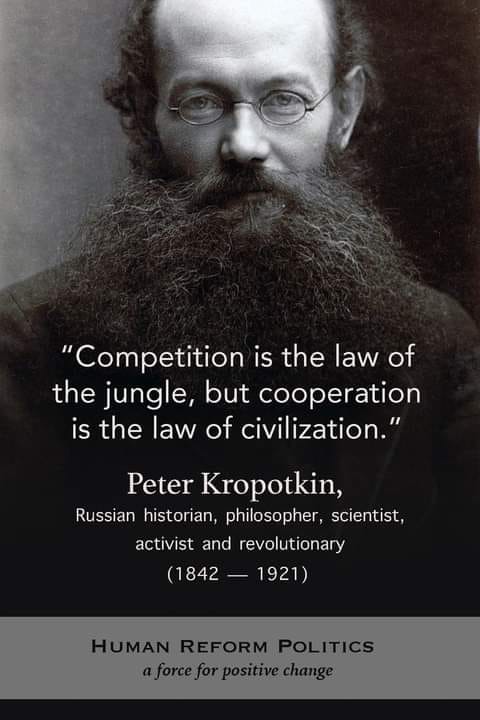
The Bolshevik Revolution had nothing to do with cooperation. Nor with civilization.
It was nothing but the famished underdog eating the bloated plutocrat.
The ensuing indigestion lasted for almost a century and resulted in a huge number of people suffering from ideological food-poisoning. Too many of the poisoned ending up dead…

Yet here we are. Again!
Trying to sort out a re-heated dish.
Which had already been proved to be unpalatable!

No wonder ‘gaslighting’ had been determined to be ‘word of the year’…

As for Kropotkin… he was a true revolutionary!
He was gaslighting his audience before the term had even been coined…

‘Jungle’ – or ‘bush’, is where evolution takes place.
Some of us might see it as a venue for cut-throat competition but it’s nothing but the opposite of it.
The fact that some of us misperceive the jungle doesn’t change the evidence.
In nature, death doesn’t happen at the whim of someone.
A lion kills only when hungry. And chooses to hunt the already weak. Leaving the rest of the herd in a better situation.

The kind of cooperation designed by Marx and put in practice by Kropotkin – the communist ‘civilization’, is the epitome of stagnation. When humans are no longer free to fine-tune competition with cooperation – and are forced to cooperate as they are told to from above, things end up in chaos.

All revolutions – 1789, 1917, 1989, have proven – time and time again, that things cannot be sustainably maintained as the rulers consider to be appropriate. That no matter how skillful the ‘designers’ consider themselves to be, society is a too complex thing for a small gang of however powerful people to be able to ‘keep afloat’.
This being the point where Marx, along with all other ideologues, had gotten it completely wrong.

The Communists, therefore, are on the one hand, practically, the most advanced and resolute section of the working-class parties of every country, that section which pushes forward all others; on the other hand, theoretically, they have over the great mass of the proletariat the advantage of clearly understanding the line of march, the conditions, and the ultimate general results of the proletarian movement.

According to Marx, it’s enough for a bunch of people to pretend they have a ‘theoretically clearer understanding of the line of march’!
In fact, this is the sole argument made by Marx when explaining why the communists were entitled to lead the proletariat.
‘Because they knew better!’

Well, we know, now, what it means to be led by people who pretend to be above all others!
By people who pretend to be better than the rest…

Cei mai mulți dintre noi suntem extrem de supărați pe lingăi.

Pe cei care se dau bine pe lângă șefi.
‘Aprobă’, slugarnic, orice iese din gura acestora.
Transformă spusele șefilor și le transferă mai departe sub formă de sarcini.

De cele mai multe ori, nu fac nimic altceva.
Ar face, dacă ar fi în stare. Nevoia lor de a fi apreciați de către ștabime e atât de mare încât pentru un cuvânt de laudă venit ‘de sus’ s-ar apuca și de muncă!. Doar că nu sunt în stare…
Și atunci ling. Ling pumnul care îi strivește…

Iar ceilalți, oamenii care îndeplinesc sarcinile, îi disprețuiesc. Pe lingăi…
Iar ceilalți, oamenii care duc tot greul, sunt extrem de supărați. Pe lingăi…
Convinși fiind că dacă nu ar exista aceștia, adică lingăii, viața ar fi mult mai frumoasă.
Că dacă nu ar exista lingăii, șefii ar fi mult mai de treabă.

Din păcate, lucrurile nu sunt chiar atât de simple.

Având în vedere că foarte puțini dintre șefi ajung ‘acolo’ de la început, pervertirea acestora este un întreg proces.
Înainte de a beneficia de serviciile unui lingău profesionist – sau a mai multora, fiecare dintre (viitorii) șefi a început prin a fi ‘lins’ ocazional.
O mamă ‘excesivă’, o rudă ‘binevoitoare’, un ‘prieten’ care avea altceva de câștigat…
Și toți cei care, deranjați la vre-un moment dat de comportamentul acestuia, au considerat că ‘nu merită să fac caz pe chestia asta’, ‘e, de fapt, un băiat foarte bun’, ‘ce rost are să mă bag eu, are cine să-i facă educația’, ‘dacă n-au reușit alții, ce să mă mai chinui eu’… și așa mai departe!

Mecanismul este cât se poate de insidios.
Prea puțini dintre noi suntem dotați cu suficient de mult bun simț. Acesta, precum toate celelalte trăsături de caracter, are nevoie de încurajare pentru a ‘înflori’.
Și de câte ori ați auzit ‘Bravo! Gestul tău de a te scula de pe scaun pentru … este meritoriu. Felicitări!’?
În schimb… E plină lumea de ‘tinerii de astăzi sunt niște nesimțiti’!

În afară de a fi ‘nesimțiti’, tinerii de astăzi – precum cei dintotdeauna, sunt foarte atenți. Chiar dacă noi, tinerii de ieri și nemulțumiții de astăzi, am uitat acest lucru. Și multe altele…
Ce face un om – indiferent de vârstă, căruia i se spune de suficient de multe ori că e nesimțit? Dar care nu simte nici o repercursiune a faptului că cei din jur îl consideră a fi nesimțit?
Vorbim aici despre oameni logici. Cât se poate de logici.
Să nu uităm că tinerii, dintotdeauna, adoră să le dea bătrânilor cu logica peste nas!

‘Păi dacă îmi tot spui că sunt nesimțit dar nu faci nimic pe chestia asta… nimic palpabil… înseamnă că e cool. Suficient de cool încât nu merită să-mi mai bat capul cu prostia asta’.

Exact acestă (auto)validare a comportamentului, un mecanism de natură psihosocială, poate transforma în sociopat pe oricine are cea mai mică tendință de a deveni așa ceva.
Nimeni, dintre cei implicați, nu si-a dorit ca Ceaușescu – sau oricare alt dictator, să ajungă ce a ajuns. Bine, vorbesc aici despre oamenii normali la cap, nu despre unii care erau deja sociopați atunci când au ‘contribuit’.
Doar că fiecare gest de abdicare de la condiția umană reprezintă o treaptă pentru un potențial dictator.
Aceia dintre noi care, extenuați fiind, nu găsesc suficientă energie pentru a reacționa firesc, contribuie, fără să vrea, la nefericirea de mâine. A lor și a copiilor lor.

Aceia dintre noi care vedem ce se întâmplă dar nu ne băgăm – pentru că nu e treaba noastră, ne pregătim singuri patul.

Patul lui Procust!

Mai întâi i-au arestat pe socialiști, iar eu am tăcut.
Fiindcă nu eram socialist.
Au venit apoi după sindicaliști, iar eu nu am protestat.
Fiindcă nu eram sindicalist.
Apoi au venit după evrei, iar eu nu m-am revoltat.
Fiindcă nu eram evreu.
Într-un final au venit să mă ia pe mine.
Și nu mai rămăsese nimeni care să-mi ia apărarea.

Martin Niemoeller