Everything which has a temporal dimension – movement, transformation or both, incurs costs and produces consequences.

From a rock sliding down a slope to me writing this.

The difference between these two being the simple fact that no rock has ever had any goal.

You see, the rock looses some energy and mass while sliding down. It accelerates at first but since no rock has ever slidden for ever.
Only rocks never do anything on their own. Something has to happen to them first.
They do bear the costs – they wear down, break, etc., yet they don’t mind. For they are not, at all, aware of what’s going on. And, anyway, completely unable to do anything about it. Hence not at all ‘responsible’ about any of the consequences produced by whatever they had been involved in. Happened to them, actually.

Fast forward to me. I’m not only alive – hence reactive to whatever happens to me, but also aware. Aware of my own awareness even.
I notice the costs I have to pay. Hence I try to minimize them.

And here’s the gist of the matter.
My awareness drives me to minimize the costs I incur during my life AND to be very careful about the consequences of my endeavors.

Theoretically, at least…
Pentru ca ceva să se întâmple este nevoie de:

– Suficient loc. Care să fie și adecvat.
– Suficiente resurse. Care să fie și adecvate.
– Un factor declanșator. Specific…

‘Trivial…’

Perfect. Înseamnă că știai deja ce vroiam să spun.
Că pentru a încerca să controlezi ceva trebuie să:
– Ai habar de existența acelui ceva.
– Să-l înțelegi.
– Să-ți pui mintea cu el.

Nothing will ever happen unless:

– There’s enough, and suitable, space.
– There are enough, and suitable resources. In that place, of course.
– Something starts it.

Trivial?

Good!
What you’ve just read being trivial for you only means you’ve already figured this out.
That you cannot master anything
– which happens outside your consciousness,
– you don’t really understand,
– you haven’t set your mind on.

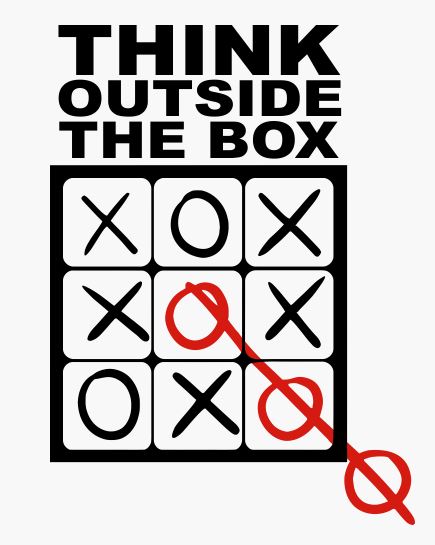
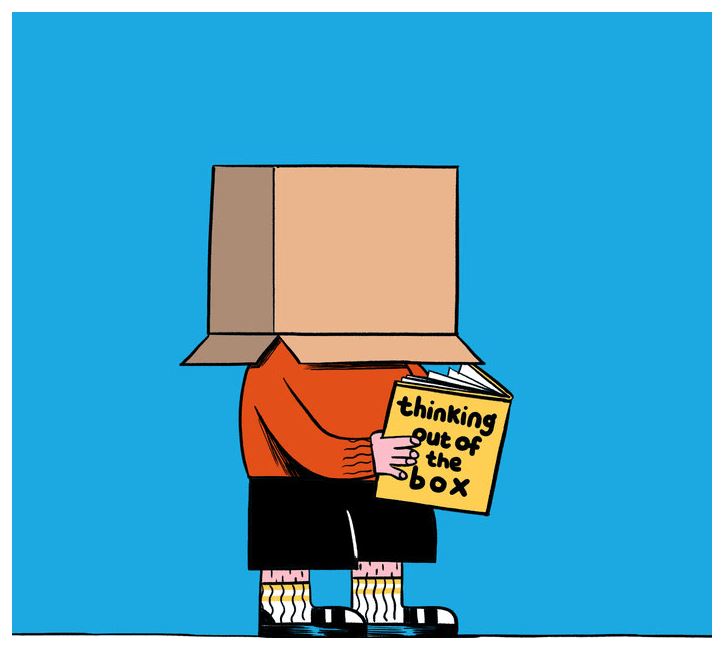
There are a lot of people who prod us to ‘think out of the box’.
And a few who dare to warn us about the perils of pushing it too far…

I’m gonna invite you to the next level.
Instead of sending your imagination to think outside the box – while the rest of you remains comfortably inside, let’s step outside ‘in person’.

Classic thinking outside the box does nothing but enlarges the box. Brings inside a portion of the outside. Moves the walls.
Bringing in a lot of additional clutter in the process.

By stepping outside, physically, you have the opportunity to actually see the problem as an ‘independent’ box. Separated from you and separated from the environment.

How about this for a change in perspective?

This way it will be easier for you to notice, and carefully examine, the links which exist between you and the problem. Between ‘the’ problem and the rest of the problems. Between the problems and the environment. The place where you have to cope with the problems.

The place where you live.

And that, my friend, is your biggest problem.
How to step out of your own life.
In order to make it better.

I need you to pretend a few things.

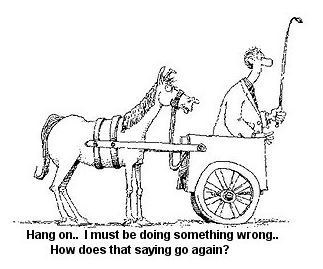
That you don’t know what a cart is. Or a horse.
That you are a logical machine.
That you are told a cart is something laden with merchandise, that the horse is what moves the cart and that the purpose of the whole endeavor is to transport the merchandise from A to B.
Then you will be asked to stack the three elements according to their importance.

How likely are you to arrange them in this order:
Merchandise, cart, horse?

It would be perfectly logical, right?

Remember that you don’t know anything else but what you’ve just been instructed.
That the ‘action’ is ‘transport merchandise M, laden in cart C – moved by the horse H, from A to B’.

Mere logic convinces you that the most important thing here is M. Simply because the whole brouhaha revolves around M. Followed by C – closest to M, and only then by H. Right?

Only mere logic is seldom enough… Each of those three has its own merits and their relative importance depends on many things.

On what the owner thinks about each of them. If all three belong to the same person.
On the relationship between the person asked to determine their relative importance and each of those elements.
The owner of the merchandise will certainly consider his property to be more important than either horse or carriage. But will consider the horse more important than the cart if the merchandise has to arrive sooner rather than whenever. Or the carriage more important than the horse if the merchandise is fragile…
The owner of a single horse will try to protect the animal. Simply because he will also need it tomorrow.
The owner of the trucking company will ask the drivers to drive the horses to their limits. Simply because he has so many of them.
And so on.

My point being that logic is almost never enough.
We must also understand what’s going on there before passing judgement on something.

Otherwise we’ll end up scratching our heads.


Click the drawing above and read what tborash has to say about the whole thing. He’s right too, you know.

O femeie terorizată de soț este compătimită.
Cel puțin de către cei normali la cap…

Un bărbat aflat sub papuc este batjocorit.
De toată lumea. Inclusiv de către femei.
Chiar și de cele terorizate de bărbații lor…

What do we have an economy for?

To make ends meet? To make it easier for our needs to be met?

What do we have a banking/financial system for? To mobilize capital for the economy? To make it possible for our needs to be met easier? More efficiently?

Or just for profit to be made?

“It really is possible to do two good things at once: address the abuse of the working poor by payday-loan and check-cashing outfits while expanding the range of services provided by the USPS. Media outlets have called Warren’s proposal “radical.” That’s ludicrous. She’s simply using her position and prominence to highlight the findings of a new study by the Postal Service’s Office of the Inspector General, which notes that roughly 68 million Americans are underserved by the private banking system. “With post offices and postal workers already on the ground,” says Warren, “USPS could partner with banks to make a critical difference for millions of Americans who don’t have basic banking services because there are almost no banks or bank branches in their neighborhoods.”

This is not a new idea. From 1911 to 1967, the Postal Service maintained its own banking system, allowing citizens to open small savings accounts at local post offices—actually a better approach than “partnering” with banks. The system was so successful that after World War II, it had a balance of $3 billion, roughly $30 billion in today’s dollars. Congress did away with postal banking in the 1960s, but post offices in other countries—including Japan, Germany, China and South Korea—provide banking services. Japan Post Bank is consistently ranked as one of the world’s largest financial institutions based on assets.”

Or, to put it the other way around,
‘what profit is?’

The well deserved ‘consequence’ – considered as such by the vast majority of the stakeholders, of a well-done job?
Or a self serving benchmark to be reached at all costs? Which costs are to be ‘shouldered’ by anybody else but the profiteer himself… till reality slaps us, all of us, over our faces…

Păi nu-i faci!

Din simplul motiv pentru că dacă ai încerca așa ceva ai valida conceptul.

O s-o iau de la început.

Atât comuniștii cât și naziștii au încercat să ‘crească’ Omul Nou. Fiecare pe-al lui, dar conceptul era același. Un om care ar fi urmat să se comporte așa cum își doreau creatorii lui. Știm care au fost consecințele.

„Tot ce vreți să vă facă vouă oamenii, faceți-le și voi la fel.”

Nu-i o metodă mult mai bună decât să-i „faci să…”?

‘O s-ajungem ca Episcopul Bienvenu… o să facem numai fapte bune așteptând ca toți ticăloșii să urmeze exemplul lui Jean Valjean… Câți din ăștia ai întânit la viața ta?’

În primul rând, Episcopul Bienvenu e un personaj fictiv. Chiar dacă Victor Hugo a plecat de la un personaj istoric…
În al doilea rând, nu cumva lumea ar deveni mult mai bună dacă toți cei care s-ar întâlni cu un Jean Valjean ar fi suficient de înțelepți încât să se comporte precum Bienvenu?

‘Tot nu-nțeleg mare lucru. Și dacă cel cu care am de-a face nu e Jean Valjean? Sau dacă eu nu sunt în stare să-l recunosc ca atare? În las să mă jefuiască doar pentru că așa mi-ar place mie să se întâmple dacă aș fi în locul lui?’

Cred că ți-ai răspuns singur la întrebare. Nici unui hoț nu i-ar place să fie jefuit. De ce ți-ar place ție?

În schimb, tuturor ne place să fim tratați cu respect.
Și-atunci? De ce sunt atât de mulți cei care consideră că știu ei mai bine cum ar trebui să se comporte ceilalți? Cum ar trebui, ceilalți, să-și ducă viețile?
Care se consideră a fi deasupra tuturor…
Îl mai ții minte pe doctorul care ți-a spus că trebuie să te lași de fumat? Și care avea un pachet de Kent în buzunarul halatului?
Pe ziaristul care scrie articole despre corupti și care ia bani ca să nu le publice?
Pe politicianul care…

Pe alegătorul care se lasă păcălit? Știind foarte bine că promisiunile sunt deșarte? Doar pentru că-i place ce aude?

Well, you don’t.

You just don’t do such a thing.

For the very simple reason that by attempting it you validate the concept.

Let me start it anew.

Both the communists and the nazis had attempted to ‘bring about’ people’s minds. To create a ‘new’ man. One who was meant to behave as their creators saw fit.

We all know the consequences.

“Do unto others as you would have them do unto you”.

Isn’t this a better way than ‘making’ somebody do as you think they should?

‘But won’t we end up like Bishop Myriel? Doing good deeds and hoping that all villains will ‘turn around’ like Jean Valjean did? After all, how many Jean Valjean-s have you met in your life?’

First of all, Myriel was a fictional character. Victor Hugo might had been inspired by a real bishop when he had created Myriel but this doesn’t alter its fictional nature.
Secondly, wouldn’t this world be a far better place if those who have the chance to encounter the likes of Jean Valjean would be wise enough to act like Bishop Myriel?

‘You still don’t make much sense. And what if the guy I meet isn’t Jean Valjean? Or if I’m not wise enough to recognize his Jean Valjean-ness, whatever that might be… What should I do then? Treat him like I’d like to be treated if I was in his place? Allow him to rob me?!?’

I guess you just answered your own question. No thief would allow another to steal from him, would he? Why would you?

But all people appreciate when treated respectfully!
So why don’t we do it, on a regular basis?

Why are so many of us who consider they know better how others should behave? What others should do?
And who consider themselves above the fray…
Remember the doctor who told you to quit smoking? While having a pack of cigarettes in the breast pocket of his white coat?
The journalist who writes for ratings rather than to inform you?
The politician who…

The voter who allows himself to be fooled? Knowing very well he had voted a conman? Only because he had made all the right noises?

There are facts which need to be checked.
And facts which are ‘somewhat’ obvious.

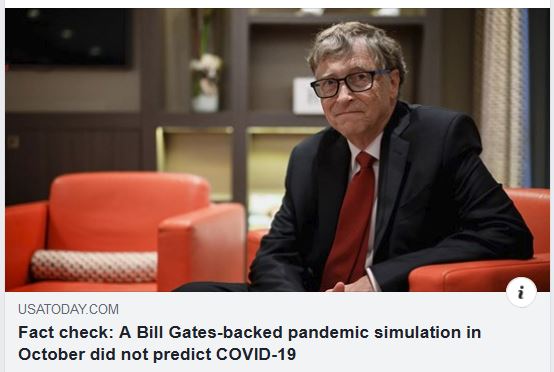
USAToday felt the need to fact check whether Bill Gates sponsoring a ‘pandemic simulation’ didn’t predict COVID-19…

What next?
Fact checking whether a fire crew exercising fire fighting didn’t predict the next … fire?!?