
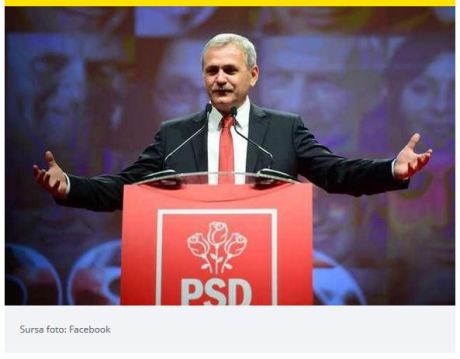
“Păreri personale putem avea fiecare dintre noi în baie sau în alte locuri.”
Dupa o singura zi au inceput sa curga contestantiile.
Foarte multe canale media au cerut lamuriri de la Eurostat. Acesta a raspuns ca statisticile pe 2016 nu au fost centralizate inca si ca cele mai noi de care dispune sunt cele din 2015.
Altii s-au apucat sa cotrobaie ei prin internet.
Linkul invocat de Hotnews deschide tabelul de mai jos,

sub titlul “File:Foreign-born population by country of birth, 1 January 2015 (¹) YB16.png”
Mai pe romaneste, “Populația cetățenilor născuți în străinătate în funcție de țara de origine, 1 ianuarie 2015 (1)”
Recunosc ca si mie mi-a luat cam mult pana am inteles despre ce e vorba aici, cu toate ca stiu ceva engleza. Si oarecare statistica – sunt inginer, ce dracu!
M-au salvat belgienii… cum e foarte greu de crezut ca 16% dintre belgieni au ales sa-si nasca copiii in afara tarii lor rezulta ca avem de a face cu o cu totul si cu totul alta chestie.
Pe romaneste se intelege un pic mai bine, cu toate ca si aici e cam neclar.
Numerele din tabel se refera la locuitorii tarii respective care s-au nascut in afara tarii despre care este vorba. In alt stat membru UE, cifre absolute si procentaj din populatia tarii (coloanele 3 si 4), sau in afara Comunitatii Europene (coloanele 5 si 6).
Nici o legatura cu copii nascuti de mame romance aflate peste granita….
Sa trecem peste, revenind la afirmatiile doamnei Pastarnac.
Si daca are dreptate?
OK, o fi citat niste cifre pe care nu ar fi trebuit sa le stie inca – de unde si dezmintirea ‘oblica’ data de Eurostat.
Pe care le-o fi citit precum cei de la Hotnews si n-o fi inteles mare lucru (“Potrivit Eurostat în anul 2015 s-au născut 197491 de copii vii în România, adică o rată a natalității de 10 la 1000. Un astfel de număr de noi născuți raportat la 4,4 milioane ar reprezenta o rată de aproape 45 la 1000, ceea ce ar plasa Diaspora românească alături de țări ca Niger sau Mali, cu cea mai mare natalitate din lume.“)
Dar daca a inteles, totusi, esentialul?
Si anume ca diaspora romaneasca a avut o rata a natalitatii mai mare in 2016 decat populatia ramasa in tara?
Pe romaneste, nu cumva romanii plecati peste hotare au facut, proportional si nu neaparat in cifre absolute, mai multi copii decat cei ramasi acasa?
Pentru a putea trage niste concluzii cu adevarat relevante ar trebui sa avem date mult mai clare decat am fost in stare sa ‘minez’ eu.
La o prima evaluare nici nu ar fi de necrezut, pana la urma transa de varsta a celor plecati la munca este cea potrivita atat pentru a incepe o noua viata cat si pentru a da nastere uneia noi…
Si tocmai aici se ascunde ‘capcaunul’.
Daca afirmatiile doamnei Pastarnac, indiferent de cat de stangace, sunt adevarate, atunci situatia e ‘albastra’. Ar insemna ca cei plecati afara au mai multa incredere in viitor decat cei ramasi acasa.
S-or mai intoarce vreodata?
Dupa vehementa cu care s-au manifestat cand a fost vorba de alegerile prezidentiale s-ar spune ca da. Dupa cati bani au trimis in tara… inca le pasa de ceea ce se intampla aici.
In principiu, ar fi trei lucruri care sa indemne la eventuala intoarcere.
Perspectiva iesirii la pensie, pierderea locului de munca/imbolnavirea unuia dintre membrii familiei, dorinta de a oferi copiilor posibilitatea de a-si pastra limba natala si traditiile.
Luand in calcul starea actuala a Romaniei, cati dintre noi – cei care traim aici, ne-am intoarce intr-una dintre cele trei situatii?
Asta sa fie motivul pentru care problema a fost ridicata in cadrul unei “dezbateri privind politicile pentru tineret“?
Si-au dat seama, macar unii dintre ei, ca daca o mai tinem mult asa, in curand majoritatea romanilor vor fi prea batrani, sau prea descurajati, sa mai stinga macar lumina?
Noi mereu le-am suportat pe toate,
Duca-se dezastrele de-a dura,
Dar de ce, în plina libertate,
Cea mai mare sa devina ura?”
Adrian Paunescu,
Cine iese ultimul din tara?
Some 350 years ago, when the street level was more than a meter lower than it is now,

some people had built a church.
Later, some others have started to build around it.

Closer and
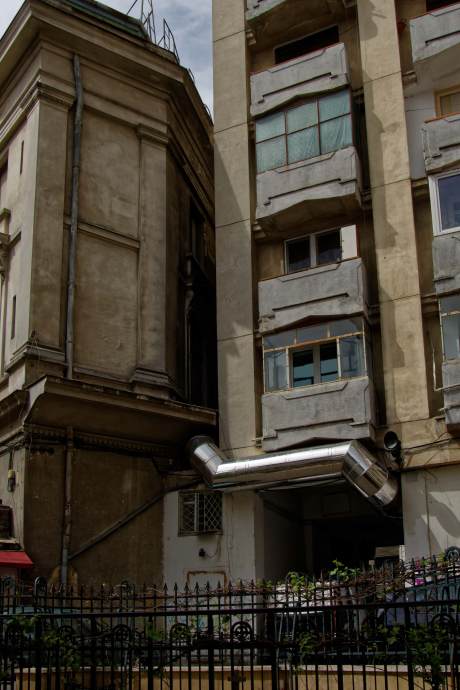
closer
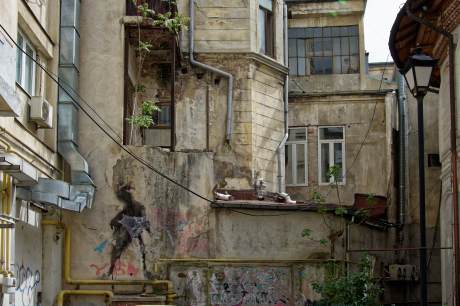
until the church was completely surrounded.
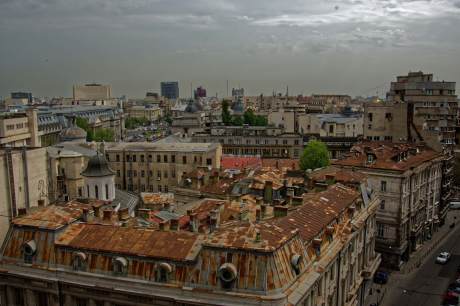
Things were so settled that trees had found a place to grow
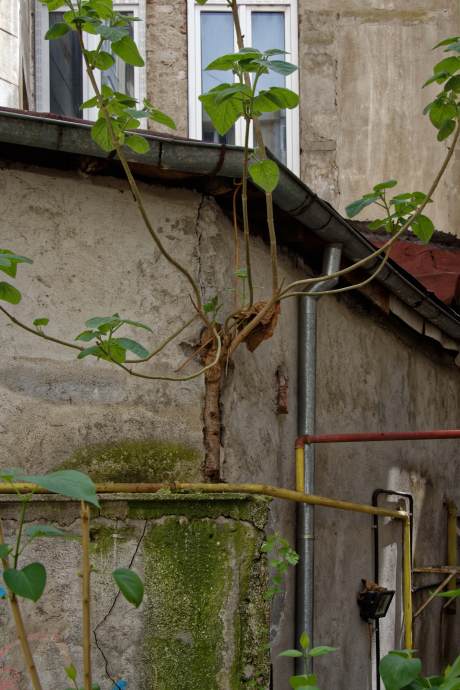
so careful people decided to protect the medieval church using state of the art aluminium window panes.
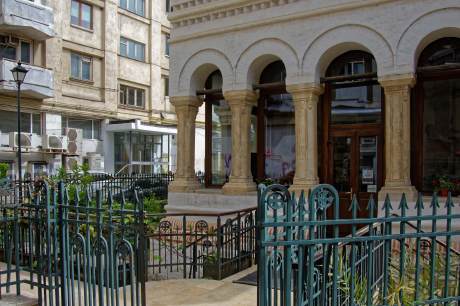
Meanwhile other buildings were popping up.

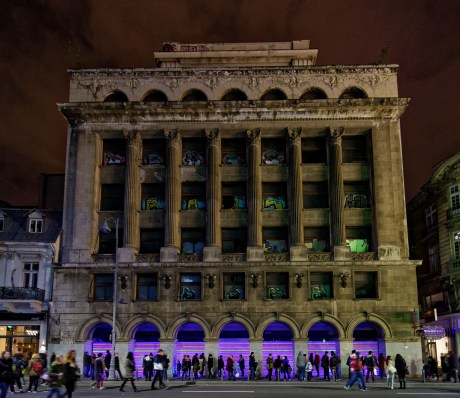
Some of them
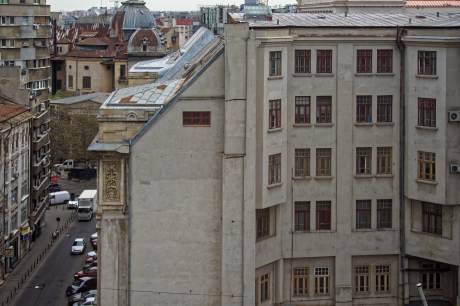
bearing very intricate decorations. Both having to do with the banking industry, by the way…
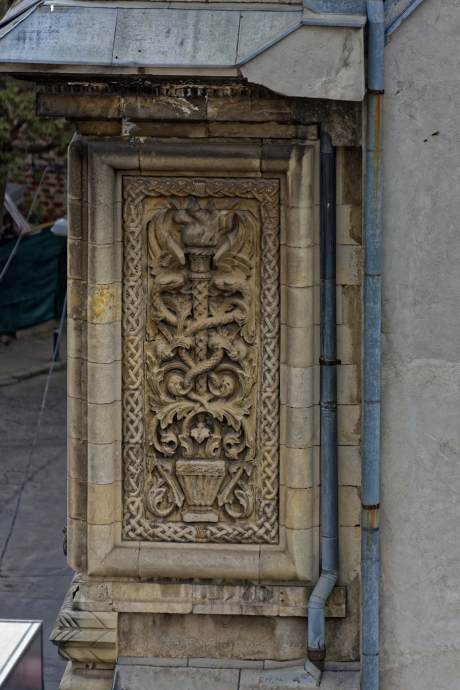
But times had passed… people got bored… more trees had established themselves,
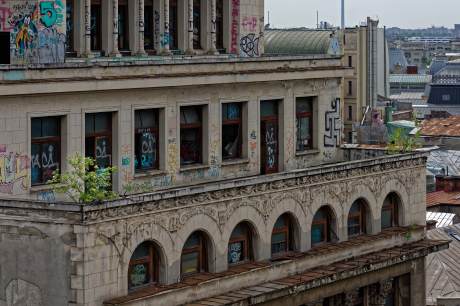
a new kind of decorations had miraculously sprung up,

in more than one place.

So people started planting gardens on top of the buildings
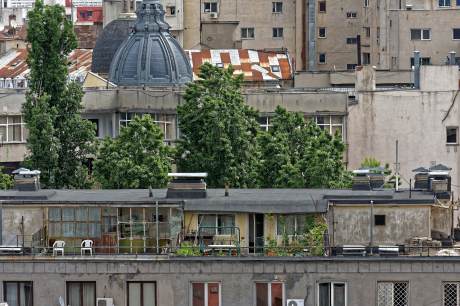
because, you know, concrete is so passe…
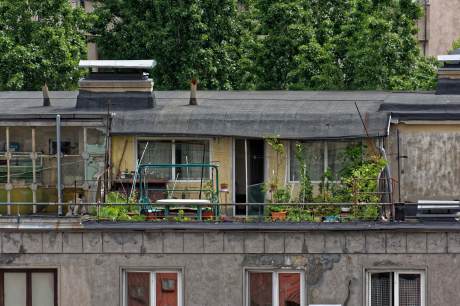
Somewhat creepy, don’t you think?
I checked my FB wall before ‘reloading’ ‘on the thickness of things’.
‘Zuckerberg’ made me an offer I couldn’t refuse:
“Your Memories on Facebook
Sarchis, we care about you and the memories you share here. We thought you’d like to look back on this post from 4 years ago.”
Wow, a robot – you know that FB is involved way over its head in AI, don’t you? – which cares about it’s client…
Anyway…
Here’s what I posted then:
“A Dog’s Life
An older, tired-looking dog wandered into my yard.
I could tell from his collar and well-fed belly that he had a home
and was well taken
care of.
He calmly came over to me, I gave him a few pats on his head. He
then followed me into my house, slowly walked down the hall, curled up in
the corner and fell asleep.
An hour later, he went to the door, and I let him out.
The next day he was back, greeted me in my yard, walked inside and
resumed his spot in the hall and again slept for about an hour.
This continued off and on for several weeks.
Curious I pinned a note to his collar: ‘I would like to find out who
the owner of this wonderful sweet dog is and ask if you are aware that
almost every afternoon your dog comes to my house for a nap.’
The next day he arrived for his nap, with a different note pinned to
his collar:
‘He lives in a home, with my non stop chatting and nagging wife,
he’s trying to catch up on his sleep ……
Can I come with him tomorrow ?
Thanks !”
Since I do not have any recollection about this I googled some of it in an attempt to find it’s origin.
Many of these articles were submitted by PetPlace.com dog lovers and the original source is unknown in terms of origin, author or copyright. It is not our intent to infringe on anyone’s copyright and if it is done, it is done unknowingly and we would be happy to remove the offending content. Just email us!.”
The same text has been published by tens and tens of sites.
Or maybe more? I just scrolled down on the search results page, didn’t count them…
It looks like things do have a certain thickness, don’t they?
Regardless of nobody being absolutely sure about who said this, there is a more or less shared consensus about history being written by the victors. After they had finished butchering the heros…
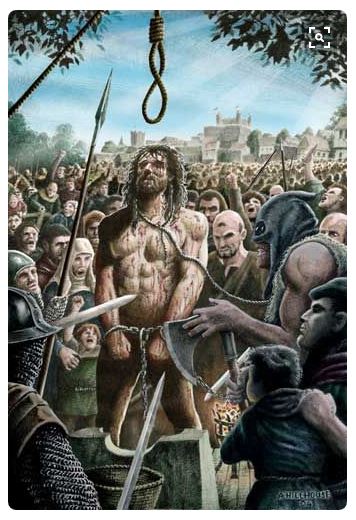
William Wallace
The problem being that most (written) history is a compelling proof that too often the ability to win doesn’t necessarily imply a real understanding of what had happened during the contest!
That all things, at least those belonging to the real world, have a certain thickness… is a truism.
Yet so often we ignore this evidence and relate only to the appearance we are looking at.
At a given moment.
By chance, by design or by negligence.
Take for instance Marine le Pen’s ascension to the second tour in the French elections.
Quite a number of ‘pundits’ put the ‘blame’ for this squarely on ‘Bruxelles” shoulders. Including her and her followers. And, not at all surprisingly, Trump and Putin.
And not without reason!
After all the EU bureaucracy, headquartered in Bruxelles, is responsible for many of the consequences brought upon our heads by the very existence of what is currently known as the European Community.
Click on the bloody picture, will ya!
First of all let me remind you what brought about the current edition of the ‘European Project.’
OK, it has been attempted before. By the Romans, by Charlemagne, by Napoleon, by Hitler… and don’t tell me that Putin wouldn’t love to be ‘crowned’ as The European Leader.
The problem is that all those attempts had started as individual initiatives and had happened to be ‘against the grain’. As in those who had to shoulder the burden for it didn’t see any benefit from it coming to life.
A small parenthesis. There is nothing ‘unnatural’ for strong willed individuals to try to widen their domination to the farthest possible corner. It had happened when and where ever geographical and historical conditions had allowed it.
The problem is that all imperia have eventually failed, usually in an abysmal manner. History is so full of examples that I won’t bother presenting any.
This edition of the European Project has started out of necessity.
At the end of WWII the continent was in a state of disarray.
The West was mired in self doubt and extremely tired while the East had experienced both the German occupation and the blessings of being liberated by the Soviets.
Understanding that Europe had to be helped, or else – it could have been, in a short while, overwhelmed by the Soviets, America had drafted the Marshall Plan.
For the sake of efficiency, the Americans had asked the Europeans to organize themselves at the receiving end. The Europeans responded by calling a Conference for European Economic Co-operation. It would be beyond the scope of this post to get into further details but this was the start of the Organisation for European Economic Co-operation which a short while later had set the stage for the European Coal and Steel Community – the precursor of the present-day European Community.
As we all know, the project has fulfilled its intended goals.
Europe has recovered nicely and the Soviet Union was contained.
‘But you haven’t mentioned, at all, the (professed?) reason for which the European Community was forged in the first place! To make sure that Europe will never again be drenched in blood as a consequence of war!’
Yes, this had indeed been the professed motive, “The European Union is set up with the aim of ending the frequent and bloody wars between neighbours, which culminated in the Second World War“.
It did its job, briliantly, only it was just a ‘marketing gimmick’. Ever since the Soviet Union had started to export, by force, its particular brand of (extremely authoritarian) socialism to the countries under its ‘sphere of influence’ it had become abundantly clear that the rest of Europe had only two alternatives. Stick together in order to be able to fend of the Soviets or be gobbled up piece by piece.
Fighting among themselves? In those conditions? Not even Stalin could have dreamed of something like that…
Why did America continued to help?
First of all, they were already heavily invested here. Just think of it. To save Europe from the Nazis only to allow the Soviets to occupy it… doesn’t make much sense, does it?
Then why are so many trying to tear it apart now? From inside as well as from outside?
You don’t have to be a rocket scientist to understand Putin’s motives so I won’t waste any of your time on this.
It’s a little bit harder to understand the Americans who wish the European Project would fail. After all we are their most important trading partner AND their closest ideological neighbor. I used ‘neighbor’ on purpose, instead of ‘friend’.
Distant neighbor, I have to add…
You see, being protected by two oceans and by a very effective ‘nuclear umbrella’ may induce a certain feeling of coziness… just remember how long they had waited before intervening in WWI and WWII. Add to that the fact that people’s memories are very short and you’ll understand why the ordinary Americans do not care much for what is going on this side of the Atlantic.
Why are some of the American ‘plutocrats’ weary of the EU and rather friendly towards Putin? For the very same reason for which their peers had done business with Hitler, even after the start of the war…. Some of them might still be convinced that their corporations would be more profitable under an authoritarian regime than under a more democratic one. And since Putin makes the right noises…
And we have reached now the really tricky part.
Why on Earth are some people trying to tear apart the EU from the inside?!?
One might very well consider they, or at least some of them, constitute a post-Soviet fifth-column, meant to destabilize Europe and make it more susceptible to be influenced by Putin and his eventual heirs.
Since I cannot prove any of this, one way or the other, I’m going to use a different tack.
History teaches us that people commit mistakes for two reasons. Alone or in conjunction: Lack of adequate understanding of the matter and/or callousness.
Take your pick: Quisling, Petain, Lord Haw-Haw… but don’t forget Daladier, Chamberlain and also von Papen.
But there’s a catch.
No amount of stupidity and/or callousness on the part of any of the politicos may produce any damages unless the situation is ‘right’. Or ‘ripe’?!?
You see, all these jerks had been able to make their ultimately stupid moves simply because the social yarn had already been messed up by a long line of political, and economic, blunders. From the French insistence that the Germans pay huge war reparations after WWI to, but not exclusively, the Fed mishandling rates during the ’20es and the 30es.
The current situation is nowhere near as bad as it was before WWII but does share with that a couple of converging points.
To be continued
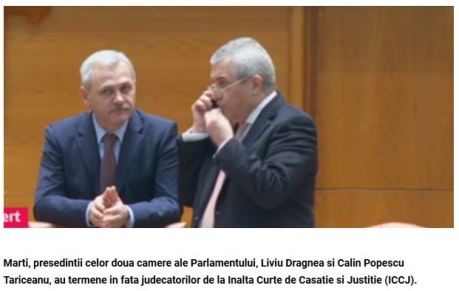
Tocmai ce m-am impiedicat de articolul asta pe Facebook.
Imediat mi-am adus aminte de intrebarea adresata de Basescu contracandidatului sau Nastase:
Sa fie oare vorba despre blestemul urnei de vot?
In fata careia nu reusim odata sa ne urnim “de sub poala lui Tatuca”?
Adica de sub “obișnuința … de a ‘cauta lumină’ la instanțe percepute a fi superioare nouă“?
Sa renuntam odata la “siguranța pe care multi dintre noi o simt atunci când ‘la cârma lucrurilor’ se află o figură paternă care promite rezolvarea tuturor problemelor și care dă impresia că îi pasă“?
In ce alt mod poate fi explicat cum de “Iliescu a fost ales cu atât entuziasm în 1990 și mai ales cum de a fost reales în 2000 după ce Constantinescu a interpretat o cu totul și cu totul altă partitură“?
Sau “alegerea ‘popularului’ Băsescu în fata ‘apretaților’ Năstase și Geoană“?
Uite ca nici de data asta ‘nu s-a putut’…
Ascultandu-i pe salvamontistii care i-au scos din munte pe supravietuitorii tragediei din Retezat mi-am adus aminte de prima echipa care a reusit sa urce pe Chomolungma.
Pana la venirea englezilor, pentru localnici muntii erau doar ‘acasa’. Locul in care traiau si potecile pe care transportau marfa dintr-o parte in alta a granitei ce separa, si separa inca, India de China. Stiau locurile ca-n palma si nici macar nu isi pusesera problema sa urce pe crestetul ‘gainii celei mari’. (Se pare ca asta inseamna, in realitate, Chomolungma. O alta varianta, sugerata de mama lui Tensing Norgay, ar fi “muntele atat de inalt incat nici o pasare nu poate zbura deasupra lui”.)
Ceea ce pentru englezi – care nu prea au munti pe la ei pe acasa, a fost o provocare – cel mai inalt munte din lume, pentru serpasi era doar cel mai ‘larg’ – si cel mai greu de ocolit. De unde si porecla “Big Fat Hen“.
Si atunci? Sa fi fost intregul efort de a urca pe Everest doar un moft? Al unor colonisti plictisiti?
Eu prefer sa il privesc ca pe un succes al colaborarii!
O echipa mixta. Unii au adus imboldul catre nou si necunoscut iar celalti expertiza intima cu privire la realitatea locului. Impreuna au reusit. Ceva ce unii n-ar fi putut face singuri si ce nici macar nu le-a trecut prin cap celorlalti.
Atat ascensiunea initiala cat si, poate mult mai important, transformarea ‘gainii celei grase’ din cel mai greu de ocolit munte din lume intr-o closca cu oua de aur.
Asta avand in vedere contributia turismului, inclusiv cel montan, la PIB-ul Nepalului. Pentru chinezi n-o fi atat de important … dar nu despre ei este vorba aici.
Intorcandu-ma la Retezatul nostru, si reascultandu-i pe cei de la Salvamont, trebuie sa iau in discutie modul in care actioneaza fiecare dintre cele doua categorii de oameni: exploratorii care incearca sa mareasca aria definita de barierele fizice si fiziologice care ne limiteaza si salvatorii care vin dupa noi atunci cand am cazut de partea ‘gresita’ a acelor bariere.
Nici nu stiu pe cine sa admir mai mult. Pe ‘exploratorii’ care, dupa ce toate ‘varfurile’ au fost cucerite, au inceput sa exploreze, de fapt, limitele organismului uman sau pe salvatorii care, cu netarmurita rabdare, isi pun expertiza, si sanatatea, la bataie. Si le ofera exploratorilor siguranta ca va veni cineva dupa ei. Daca, sau mai bine spus ‘cand’, ‘se intampla ceva’.
Poate ca exploratorii, din entuziasm?, sa fi impins putin cam tare limitele… sa duci copii pe varful muntelui doar de dragul ‘aventurii’ …
Dar cine sunt eu sa judec?
Pana la urma nu asta e rolul ‘exploratorilor’? Sa intinda ‘coarda la maxim’?
Si nu asta e rolul nostru, al celor care pretindem ca ‘salvam’ lumea de propriile ei excese?
Sa ii asteptam pe exploratori cu bratele deschise si sa le oblojim ranile?
Bine, in masura in care explorarile lor nu ne pun tuturor viata in pericol… dar asta e alta problema.
Si nu este cazul aici!
 nicichiarasa