Archives for category: Uncategorized

I’ve been asked this – who wasn’t?, for so many times that I’ve lost count…
Only the last instance was different.

The context was a lot more serious than usual. We were discussing ideas!
Individual, social, freedom… and we were doing it in English – my ‘second’ language. Hence I was a tad more alert than when chatting away in Romanian.

Have you noticed that in English ‘you’ has three meanings?
A singular ‘you’, a plural ‘you’ and a formal ‘You’ which covers both singular and plural.
In French we have ‘tu’ for singular and ‘vous’/’Vous’ for both plural and formal.
In German ‘du’, ‘inhen’ and ‘Sie’. Only ‘sie’ – starting with small s, as opposed to capital S, means ‘they’…
In Romanian, ‘tu’, ‘voi’ and ‘Dumneavoastra’/’Domniile Voastre’. Literally, ‘Your Lordship’/’Your Lordships’.

I’m not going to delve into Humboldt’s linguistic relativity hypothesis at this point. It would be very interesting but I have something else in my mind.
I’m going to answer the question ‘personally’. Influenced, indeed, by Maturana’s opinion that human consciousness (self awareness) has blossomed at the intersection between our brain power, our ability to communicate verbally with each other and our emotionally driven memory.

So, who am I?
Just one of you…

Neither of us could have existed independently.
None of us could have given birth to themselves… obviously. But also none of us would have been what we are today without having been raised by and educated in our respective communities. By the ‘you’-s to which each of us belong.

On the other hand, none of these communities would have ever existed without the individuals who compose them AND without those individuals being self aware enough to notice their existence. ‘Their existence’ meaning both the existence of the individual personalities which compose the communities and that of the communities themselves.

To simplify matters a little bit, we – as individuals, depend on the well being of the communities to which we belong while we – as communities, depend on the self-awareness of the individuals who animate each of the communities.

If we add the piled up consequences of all the decisions we – as a species, have ever made we end up with ‘culture’ and the present state of the environment which surrounds us – also known as ‘civilization’.
I’ll leave these for another time.

Genetics of Design's avatarThe Genetics of Design

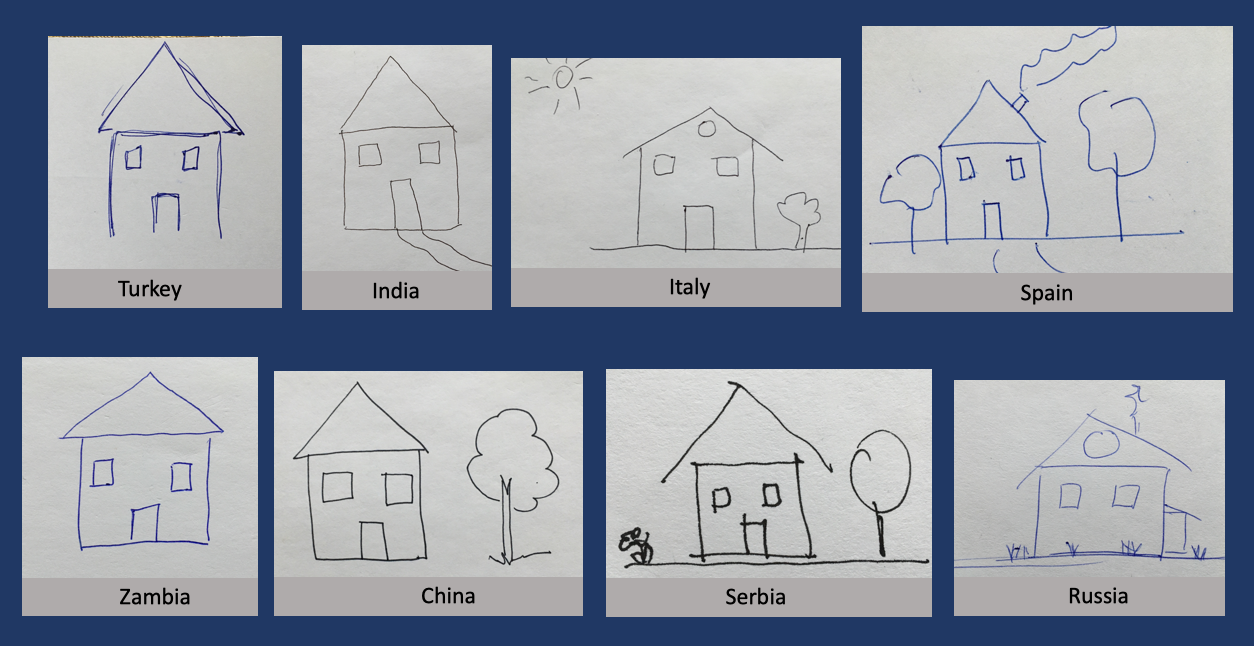
screen shot 2019-01-22 at 9.48.36 pmWhat connects us to other people? One commonality: we share an evolutionary path with similar internal templates. That’s what the ‘House Experiment’ demonstrates so well. Asked to “draw a house as if they’re five years old,” people draw almost identical images, without looking at anyone else’s work, no matter where they come from. The drawings above are by eight people, born and/or raised in eight different countries in three continents.
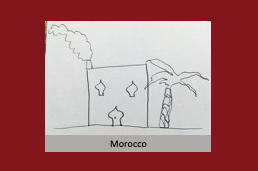
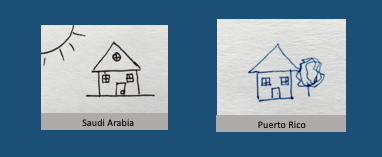
screen shot 2019-01-24 at 5.40.08 pmCultural preferences sometimes creep in, such as in the house above, by someone from Morocco, Northern Africa – but, most often they do not. In fact, it’s astonishing to see two people, at different events, coming from opposite sides of the planet, draw nearly identical houses, as below:
screen shot 2019-01-24 at 5.42.09 pm

It just goes to show, no matter our background, we are more the same than we realize and what we most like to see, what most grabs our attention – is pre-set…

View original post 70 more words

https://i.kym-cdn.com/photos/images/original/001/178/733/780.jpg

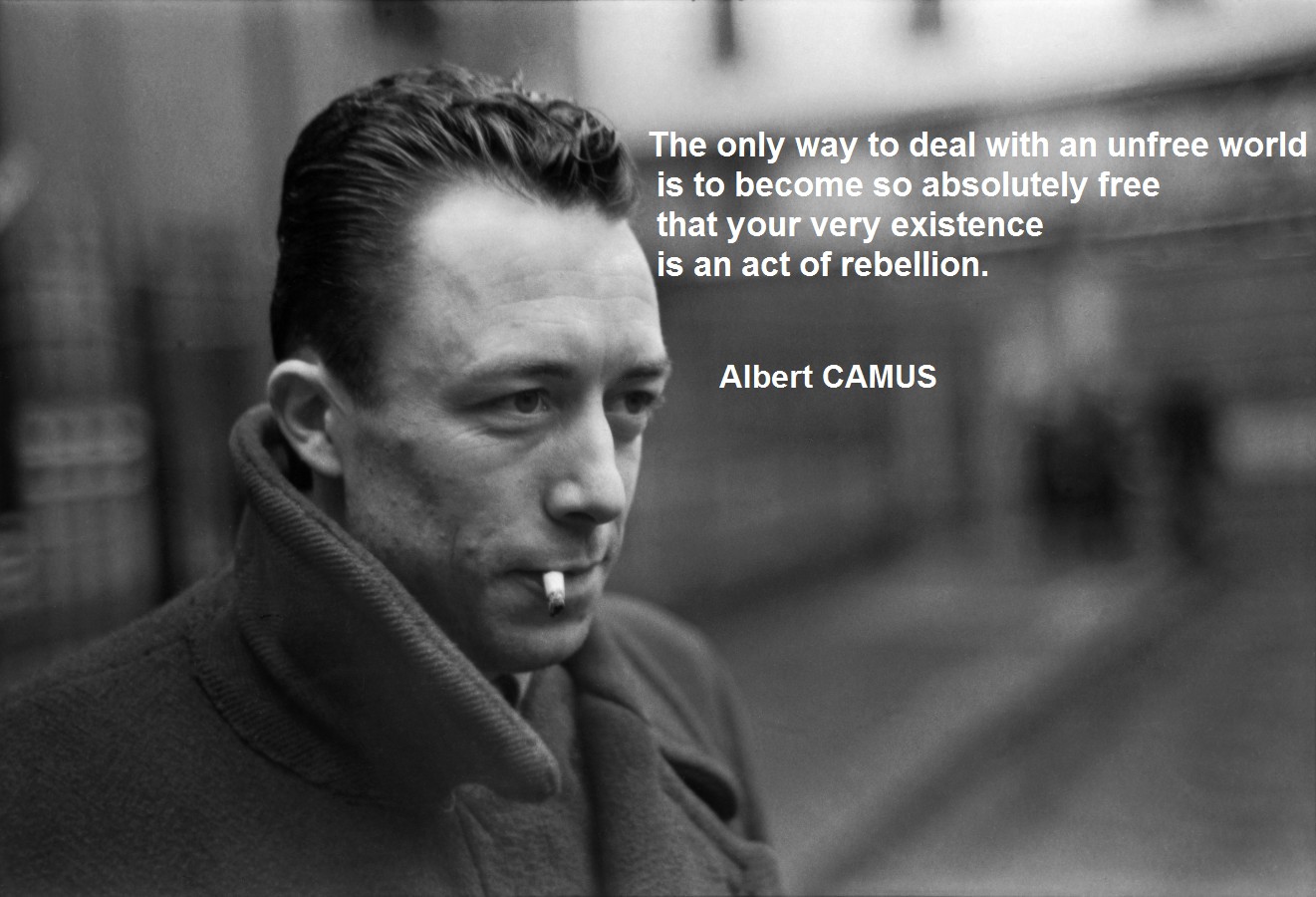
Last time I checked, for a rebellion to make sense, it had to be against some precise thing. Otherwise…

On the other hand, there are only two kinds of freedom.
‘Against all others’ – which starts as anarchy and very soon becomes atrocious dictatorship. Where the dictator is free to rule and the oppressed are free do obey. Or to attempt to climb into the dictator’s shoes…
Or ‘with all others’. Also known as ‘democracy’. The real thing, of course, not the ‘mob rule’ variety which is currently creeping upon us.

Hence the only sensible rebellion would be the one against any form of dictatorship and ‘executed’ in concert with the rest of the oppressed.

There is a technical reason. And some subjective ones. Acting in a synergic manner.

Trump had bean the darling of the high ratings/low expectations media for most of his adult life. During this period he had learned how to use it towards his own goal – an ever increasing notoriety, and those involved in the media had learned to love him back for the amount of publicity they had been able to sell on his back.

Now for the subjective ones.
First of all, he is a very ‘penetrant’ person. Like him or not, but you can’t ignore him.
Secondly, he happens to be the most powerful individual on Earth. Simply because he had been elected the President of the United States of America. Which is not only the most potent/civilized/democratic/you name it country, but also the leader of the free world. Meaning that the rest of the planet, democratic or not, sets it’s time after America’s clock. Willingly or unwillingly.
So the rest of world is watching anxiously everything that is going on in Washington. Wondering whether ‘Trump-ism’ will spread around. Or will remain yet another measure of American exceptionalism.

Thirdly, but maybe the most important reason, Trump can be analyzed as a symptom rather than as a cause.
In fact, there are a lot of Trumps scattered around the world.
Basically, there is very little difference between Trump and Putin. Trump and Erdogan. Trump and Bolsonaro. Trump and Dragnea – the most powerful politician in today’s Romania, my country. Even between Trump and Modi. Only none of these countries is similar to the US of A. None of them has such a distinguished democratic tradition.
And this is why so many people try to understand what’s going on.
Is Trump nothing more than an unhappy accident? Or the visible symptom of democracy becoming decrepit?

PS.
Even Abe is showing signs of contagion.
Post WWII Japan had survived by feeding whales to its people.
Now it is going to resume commercial whaling. In spite of all other previously whaling nations asking him to reconsider.
Really Abe? You need whale meat to survive?

What we currently call ‘science’ is both an activity and an attitude. Something some of us do and the way in which some of us see the world.

In current lingo, those who ‘do science’ are involved in ‘technology’ while those who see the world ‘scientifically’ partake in a certain philosophical tradition.
If we look at things in this way, it becomes obvious that doing science and thinking scientifically might not be the same thing.

Science, as an attitude, had sprung up in Ancient Greece, been kept alive by the early Islamic scholars, rekindled by the Medieval Catholic theologians, come of age during the Renaissance and ‘exploded’ after the Enlightenment.
Technology, on the other hand, is way older. And had been developed mainly elsewhere than the scientific attitude. China and India had been technological powerhouses and thriving civilizations in times when Europe was still learning to wash its hands before dinner.

‘Modern’ science – what we have now, appeared only after technological prowess had been married to the right attitude. 

OK.
It is easy to accept that technology, the more widely distributed part of ‘science’, had appeared as a consequence of mere necessity. People needed things in order to survive, then wanted things in order to increase their comfort… things which had to be produced… as efficiently as possible… hence people had put their minds to it and … voila!
But what had driven some of those around the Mediterranean Sea to develop the scientific attitude?

The same thing which drives us?
The attempt to find out the future, one second earlier than it really happens?
Because they thought, like we do, that reality is unique and that man is meant to master it?

Man, the guy who was made by God in His own image and who was told to rule the world?

Roger Bacon, Duns Scotus, Occam,  Galileo, Newton, Darwin, Georges Lemaitre… some of them might have been persecuted by the church – personally or had their their ideas ‘challenged’, but they all had been raised in the Christian tradition and had been active members of their religious communities. Even Galileo, the only one among these who had been ‘physically’ affected by the way in which his ideas had been received by his contemporaries, had a more or less ‘functional’ relationship with the heads of the Church… he had died in his own bed, arrested in his own villa, not at the stake …


Anumiți activiști politici și-au adus aminte că „dacă nu votezi, nu exiști”.

Ceea ce este perfect adevărat.
Pentru alegerile ‘normale’!
Locale, legislative, prezidențiale, pentru Parlamentul European….
In situația de mai sus, orice absență este un vot în alb dat întregii clase politice.

„Dați-i înainte că pe mine chiar nu mă interesează ce faceți voi acolo. Și voi accepta, cu ochii închiși, orice vă trece vouă prin cap.”

La referendum, la orice referendum, chestia e un pic diferită.
Din cauza pragului. Daca nu vin suficient de mulți oameni la vot, rezultă că subiectul nu este suficient de interesant pentru cetățeni așa că lucrurile vor fi lăsate așa cum erau și pănă atunci.
Cu alte cuvinte, la cele mai multe dintre referendumuri, absența echivalează cu un vot negativ.

„Nu mi-ați stârnit interesul. Ați ridicat o flamură mincinoasă!”

La referendumul ăsta, în mod special, absența devine o necesitate.
De data asta, însuși actul de a vota – indiferent cum, denotă că respectivul cetățean a acceptat deja principiul că drepturile omului pot fi reduse prin vot.

Referendumul acesta reprezintă, pur și simplu, o întoarcere în timp.

Cineva spunea că drepturile omului nu se votează iar altcineva îi replica că toate drepturile au fost înființate prin vot.
Amândoi au dreptate. Drepturile omului au fost, peste tot, confirmate prin vot. Al cetațenilor, al parlamentarilor… nici nu contează. Confirmarea drepturilor a fost, într-adevăr, un demers politic și democratic.

A le restrânge, chiar dacă tot prin vot, este extrem de periculos.

După îngustarea definiției cu privire la familie vor urma dreptul de a face avort, de a da divorț, de a  ‘glumi cu cele sfinte’, egalitatea femeii cu bărbatul, dreptul la vot al femeilor … iar lista poate fi prelungită până la infinit.

Educația pe care am primit-o, adică toată istoria pe care am citit-o până acum, mă obligă să stau acasă. Și să sper că mai puțin de o treime din electorat va considera că este normal să se bage în viețile concetățenilor lor.
Folosind cabina de vot pe post de scurtătură.

„Dacă nu vii la vot, doi bărbați vor putea adopta copilul tău!”

Vrei să eviți asta?

Crește-ți singur copilul! Nu-l abandona în brațele statului.

Ia tu acasă un copil dacă nu vrei să ca acesta să fie crescut de cineva în care nu ai încredere! 20 000 dintre cele 57 000 de suflete aflate în grija statului stau la grămadă în orfelinate.


I just finished reading an excellent article about AI.

And it hit me.

We are simultaneously capable of noticing our limits and utterly incapable of dealing with them.

Well… if you think of it, this is the very definition of a ‘limit’.
Something which cannot be overcome…

We have a limited understanding of the world, we know this and yet we’re arrogant enough to embark on building  autonomous mechanisms to help us react to something we haven’t yet fully understood ourselves…

Archimedes was famous for “give me a place to stand, and a lever long enough, and I’ll move the Earth”.
Robert K Merton warned us about the ‘Law of the unintended consequences’.
The last financial melt down was yet another proof of what happens when highly leveraged instruments are used without any shred of ‘modesty’.
All major religions warn us about the consequences of building our own idols.

Despite all this, we barrel on.
Regardless.

In Nature, ‘evil’ is suicidal.

‘Evolution is not about the survival of the fittest but about the demise of the unfit’.

Ernst Mayr, What Evolution Is, 1964.

In ‘social’, a sub-domain of Nature, Evil has to be weeded out. By us.
For no other reason than here it is us who determine what is evil or not. By honestly assessing how detrimental that thing is to our own well being.

And we need to act diligently yet sparingly.
Diligently, lest we become engulfed by ‘weeds’.
And sparingly, lest we become evil ourselves.

“One of the main arguments for Durkheim’s theory is that since crime is found in all societies, it must be performing necessary functions otherwise it would disappear in an advanced society. (Hamlin, 2009). One of these necessary functions is social change. Crime is one of the most effective sources of social change in any society. When crime goes against social norms, eventually a society’s collective belief will transform thus bringing about social change. A prime example is the Anti-miscegenation laws in the United States that promoted racial segregation. As society progressed many people began violating the laws at the time until society reached a point where it was considered a norm for inter-racial relationships in society. Eventually racial segregation was abolished and in today’s society would violate social norms.One of the main arguments for Durkheim’s theory is that since crime is found in all societies, it must be performing necessary functions otherwise it would disappear in an advanced society. (Hamlin, 2009). One of these necessary functions is social change. Crime is one of the most effective sources of social change in any society. When crime goes against social norms, eventually a society’s collective belief will transform thus bringing about social change. A prime example is the Anti-miscegenation laws in the United States that promoted racial segregation. As society progressed many people began violating the laws at the time until society reached a point where it was considered a norm for inter-racial relationships in society. Eventually racial segregation was abolished and in today’s society would violate social norms.”

Mike Larsen, Durkheim: Crime serves a Social Function, 2012


BetterFailling's avatarOK, But What If?

einstein energy

According to Einstein’s theories – and verified by rather numerous nuclear experiments, matter can be transformed – some of it, anyway, into energy.

According to some mathematical rule, E=mc2 introduces the notion that m=E/c2.

Otherwise said, energy might somehow/someway transform itself/be transformed by some very skilled alchemists or even through a natural process into matter.
Never yet observed by us but that doesn’t mean it cannot/could not happen.

Some modern alchemists actually plan to put this idea in practice. Read all about this here and here.

Now let me point your attention towards the ‘missing’ energy/matter. A.k.a. dark energy/matter problem.
According to the mainstream cosmologists, in order to make sense of what we already ‘know’ about what’s going on around us we must consider that “that roughly 68% of the universe is dark energy. Dark matter makes up about 27%. The rest – everything on Earth, everything ever observed…

View original post 316 more words