Sunt câte unii convinși că ‘și-a căutat-o cu lumânarea’. Că ‘și ea e de vină. De ce-a ieșit pe stradă cu fusta până-n cur?’ ‘Și acuma, dacă tot a început ăla s-o violeze, de ce nu stă dracului liniștită? Să termine ăla odată ca să putem și noi să ne întoarcem la ale noastre!’
Ăștia or fi sănătoși la cap? Până unde poți întinde conceptul de ‘realPolitick’?!?
Ce trebuie să se întâmple ca să-ți dai seama că și mama/soția/fiica ta ar putea ajunge în aceiași situație? Cu atât mai abitir dacă tu îi încurajezi, oricât de indirect, pe violatori! Indiferent de câte năframe o pui tu să poarte.
War and chess have a lot in common. Most strikingly, the different manners in which both of them end.
The king is captured. Or the other side gives up.
A tie is nothing but the prelude for an encore, not a real end.
Even the roads to the end are very similar in both cases. While at the start of the game/’joust’ everything is ‘possible’ – nobody knows what the other side might be doing next, as the end nears each of the combatants are more and more limited in their currently available choices by the consequences of their previous decisions. By the very path they had followed since the beginning. Which path becomes more and more evident for everybody present. Opponent as well as spectators.
Finally – but not the least important, the similarities go even further. Deeper? The king is the most ‘important’ piece but not the most powerful. In fact, the king cannot do much by itself. It can help the other pieces achieve their common goal but when left alone it is basically powerless. The only thing it can do is run. But only as far as the board allows it to go… A pawn, if it manages to reach the eight rank, gets to be promoted. To become the new ‘right hand’ of the king. The new ‘most powerful member of the team’.
‘OK. And the real point of your post is?’
Putin cannot win this war – cause war it is, by himself. Hence he needs to preserve the loyalty of his henchmen, to instill enough fear into his opponents to make them quit and to convince the ‘spectators’ that their efforts to help Ukraine are too expensive.
Now! Are we smart enough to understand that we, each of us, are ‘next’? That each time a bully gets his way, all other (would be) bullies present become even more bullish? Are we smart enough to understand that the most meaningful thing we can do in this situation is to separate Putin from his power base? From the ordinary people who see no other alternative and from those who, for various reasons, continue to support Putin’s misconstrued ‘vision about the world’? Are we smart enough to understand that no matter how hard it is for us, the Ukrainians have it ten times harder?
Democracy is about every body having the opportunity to speak up their minds. To speak up their minds, not to kill their neighbors under the pretext that there is a difference of opinion between them!
“We didn’t invade Ukraine,” he claimed. “We declared a special military operation because we had absolutely no other way of explaining to the West that dragging Ukraine into Nato was a criminal act.” “Russia is not squeaky clean. Russia is what it is. And we are not ashamed of showing who we are.”
Are you trying to figure out what’s the real meaning of Lavrov’s words? Let me translate for you this fine example of NewSpeak.
‘We – those who are currently running Russia, will do whatever we need to do in order to preserve our power. In order to achieve that, we first and foremost need to convince the ordinary Russians to continue to obey our orders. In order to achieve that, we need to convince the ordinary Russians that you are the enemy and that their only chance lies with us, their current masters. Hence each time we destroy an Ukrainian apartment block and any of you says ‘Russians are savages’ we’re one step closer to our goal. Each and every time any of you declares ‘Russia has to pay for what it has done in Ukraine’ we tell them, the ordinary Russians, ‘See? This is what they plan to do to you once we’re are gone’.
WWI had lasted until 1945. We have the opportunity to end the Cold War now. The war in Ukraine will reach a conclusion. Let’s make it so that after the war will have ended, Russia will fold in the family of ‘civil’ nations.
Those nations that choose to live in peace! Not because they cannot win wars but because they have learned that winning wars it’s not enough. Those nations which have learned, the hard way, that war has but one winner while for peace to last every body must be a winner.
For the outsiders, it seems like Gorbachev ‘made’ Putin. Gorbachev had destroyed the Soviet Union and, thus, had set the scene for Putin to take over.
I’m afraid things are a little more complicated than that.
Gorbachev – at that time, the best informed decision maker in the whole USSR – had been smart enough to understand that no matter what he might had tried to do, the corpse was already rotten. That everything but a major ‘upheaval’ could not accomplish anything more than prolong the agony. What he had done was nothing more than allowed the things to happen according to their nature.
I’ll make a short break here and remind you that all ‘imperium’ had eventually ended in failure. The tighter the control exercised by the ruler, the more abject the eventual failure. Check your history book.
So. Gorbachev had taken the appropriate steps. What he had done was in step with the natural flow of history.
Eltsin and Putin, on the other hand, had done the exact opposite. Eltsin had tried and Putin had succeeded in regaining the ‘reins’ of the government. The reins, the whip, ever stronger control over the barn where the whole stash of hay is deposited…
Why things had unfolded like this? Because they – Eltsin and Putin, had chosen this venue and because nobody else had been able to do anything about it.
OK, Gorbachev, Eltsin and Putin had made their respective calls in basically the same social and political environments. The economic situations were ‘somewhat’ different but this doesn’t change what I want to stress out. Each of them had done what had crossed each of their individual minds. Each had been able to do whatever each of them had wanted because… Because that particular ‘social arrangement’ allows the ruler to make whatever decisions they may see fit. Because that particular ‘social arrangement’ – dictatorship, no matter how much window-dressing had been slapped on it, allows the person who happens to clamber ‘on top’ to keep making mistakes until the whole ‘carriage’ disintegrates.
The difference between a scientific paper and a piece of ‘mere’ literature. And what can be learned by analyzing a message.
I’ll start with the second.
A message has two layers of meaning. The ‘prima facie’ and the ‘deeper levels’.
When somebody asks ‘What time is it, please!’, the first thing you do is to check your watch. Most of the time, it’s the proper way to react in this situation. But not always! Sometimes, the guy only wants to find out what kind of watch you’re wearing. To determine if it’s worth the effort. To steal it from you!
If looked at from the proper angle, most messages speak volumes. The first volume is always about what the ‘speaker’ wants to convey to their audience. The next ones are about the speaker. About their ability to speak, about their manner of thinking… and so on. When speaking, the speaker wants to convey a limited amount of information. The intended message. When listening, an attentive listener may learn more about the speaker than about the issue at hand!
A scientific paper starts by stating a conclusion. And continues by listing the arguments. An ‘ordinary’ piece of literature builds a ‘scaffolding’. Introduces a series of ‘things’ and leads the reader towards a conclusion. Which is more likely suggested rather than imposed.
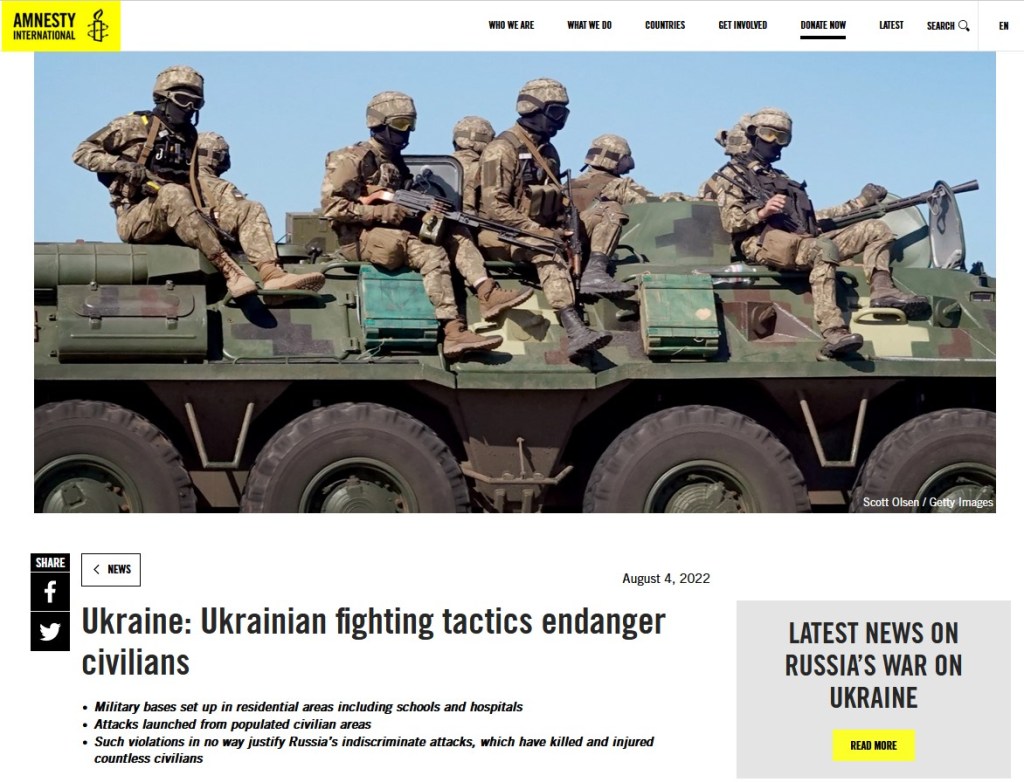
Should I continue? About what I learned by reading the Amnesty International report?
The most important issue here – for Amnesty International, being the fact that “Ukrainian fighting tactics endanger civilians”. As if Ukraine was the big bully. Who had enough resources to carefully select ‘tactics’!
“Attacks launched from populated civilian areas”. Hello!!! Ukraine itself is a populated country! Mostly by civilians… This is not a joust. Which may be organized ‘out there’, on an open field. If both sides agree… This war, like almost all others, is about conquering, and defending, populated areas!
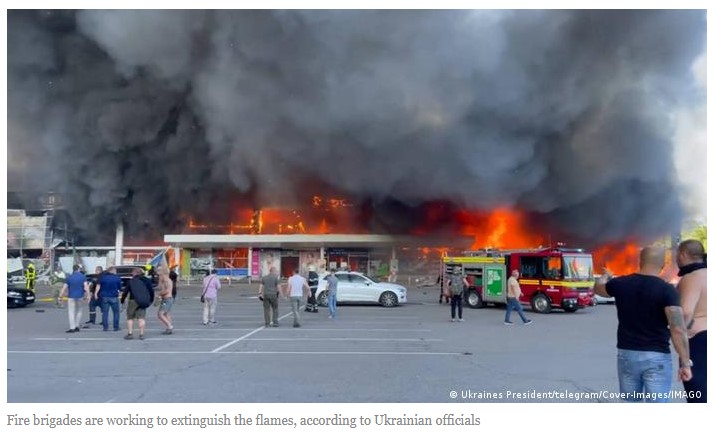
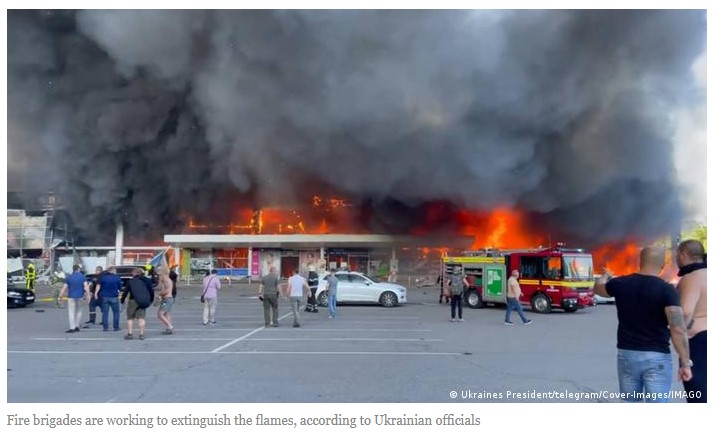
“Such violations in no way justify Russia’s indiscriminate attacks, which have killed and injured countless civilians“ Finally!
But shouldn’t this be the ‘main course’ of the Amnesty International report?!? After all, it was Putin who had ordered the Russian army to invade Ukraine… It had been his orders which had started this mayhem!
And what takes place there has consequences all over the planet.
The first two world wars had been fought by soldiers from almost every corner of the Earth. Almost all countries have declared war on each other, even though not all of them have participated in military operations. The third world war – the Cold One, had been fought ‘virtually’. And was the first to divide the world into three. The ‘liberal-democratic’ camp, the ‘popular democracy’ camp and the non-aligned camp. As always, World War III had been lost by the least flexible among the combatants. By the more dictatorially run camp. By the camp, which, precisely because of the authoritarian manner in which its decisions were adopted, had failed to mobilize all the resources it had, potentially, at its disposal.
I’ll make a parenthesis. Any act of aggression is an idiocy. Regardless of the short-term, medium-term and long-term outcome, the aggressor has more to lose than the victim. This does not need to be demonstrated. The most perfunctory glance at history is eloquent enough. Here I’m concerned about war as an ‘ongoing phenomenon’, I am not trying to integrate it into the narrative. Any war, any act of aggression, is initiated under certain conditions determined by the history spent until then and will be, at some point, integrated into the history written afterwards. And the way it will be integrated into history will determine the conditions under which the next war will be initiated. Or not…
Let’s go back to the present moment. This, the fourth one, is the first mixed world war. The first ‘lukewarm’ war. The consequences are felt around the globe, almost all states take part in it – also divided into three camps, while the act of ‘actual’ aggression is somewhat limited. The reactions to this act of aggression – the way in which those who have to bear its consequences relate to the conflict, constitute the beginning of the way in which this episode of physical aggression will be integrated into history. The liberal-democratic camp is helping the victim as much as it can – this could be the subject of a very long discussion. The authoritarian-populist camp helps the aggressor. As far as it can, lest it shows its true colours… The self declared ‘non-aligned’ camp claims it is one of the victims and urges negotiations.
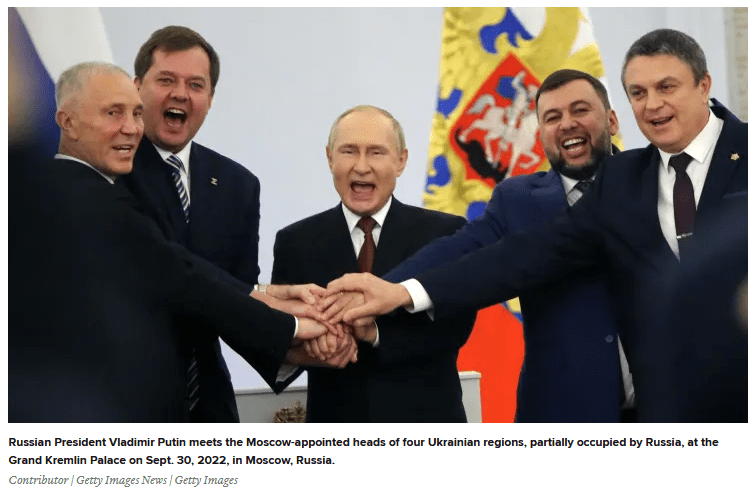
Here’s the place where I need to make another parenthesis. The aggressor is ‘Putin’. A collective character that has at its center the current Kremlin ‘gate-keeper’. The fact that the collective character known as ‘Putin’ is currently leading Russia’s destinies is a matter of history. It has to do with Russia and the Russian people indeed, but placing all the responsibility for the atrocities which are taking place in Ukraine on Russia’s shoulders would be a mistake. A mis-diagnosis which would lead to a ‘counterproductive’ treatment. Many of the analysts and commentators who write on this subject are ‘mesmerized’ by the ‘master of disaster’. By Putin. Some ‘highlight’ his actions and others want to distract us from what Putin is doing by trying to argue that Putin was forced to do what he had done because the ‘others’ had acted as they had done. As if the mistakes already committed could provide any justification for future atrocities…
Back to the subject. The main idea which emerges from the ‘messages’ we are bombarded with – regardless of the motivations attributed to Putin, is that any surrender to the aggressor’s claims will be eventually ‘underwritten’ by all those involved. For the simple reason that Putin will interpret the smallest crumble ceded by the victim of the aggression as a personal victory. Victory that will be attempted again, sooner rather than later. Meanwhile, all the other Putins in this world, all those animated by authoritarian whims, will feel encouraged by any shred of victory which Putin will have enjoyed.
‘Are we stupid?!? He pulled it through, didn’t he? We should try it too!’
Well, so far, so simple. Putin is not the first dictator to be scrutinized by psychologists. Or by political scientists. ‘Nothing new under the sun’ and no original contribution. Almost everything Putin had ever ‘accomplished’ has already been analyzed and can be explained away with the help of quotes pulled from more or less famous authors. Sun Tzu, Clausewitz, Marx, Ivan Ilyin. Unfortunately – or fortunately? – Putin is ‘transparent’. He becomes more than ‘obvious’ after the briefest analysis. And, in fact, dictators – all dictators, are very ‘simple’. Single minded individuals effectively enslaved by a single thought. Concentrated exclusively on how to obtain and preserve absolute power. Everything else about them is bullshit. Make belief and propaganda.
Personally, I’m interested in something else than ‘what drives Putin to…’ Putin does what he does because he has the opportunity. Because he ‘enjoys’ a set of circumstances in which he can act his ‘fantasies’. And Putin got into this situation because those around him – those who could have done something about ‘this thing’, did not understand at the time what was going on before their eyes. I can understand that! ‘Temporary blindness’ is not an ‘exceptional’ thing. But still. From a certain point onward – after ‘the milk spilled over’ and after reality had slapped you over your face, to continue with your head buried in sand… to remain ‘temporary blind’ only because you ‘enjoy’ your current position and/or your current paycheck… without realizing that you are being led to the abyss…
‘Putin’ doesn’t take prisoners. Even if you considered yourself his ally, or his faithful servant, and no matter how many promises he has made to you, when he no longer needs you…. you’re toast! When he no longer needs you, you become a cost. And in their world, in the world of dictators, costs must be cut! No other arguments will ever be considered. Aside from the fact that you have a good chance of getting sacked as Putin becomes more and more powerful/callous, associating yourself with this kind of people is dangerous by definition. No matter how strong they seem to be at any given point, all ‘things Putin’ end up badly. The more powerful the Putin becomes, and the higher they get, the worse they fall. They along with those who ‘waited’ on him!….
Does anyone know a dictator who ended up on the throne? Lenin?Stalin? Khrushchev? Brezhnev? Andropov? Is this what we want?!?
The conclusion drawn by some observers, “In the end the outcome has only two valences: Putin loses or Putin wins” is valid only for the short term. Very short! In the long run, Putin loses. In the longer run Putin has always lost. And it was us who had to endure! The ‘excesses’ committed while the dictator was at the helm and the ‘vagaries’ of the ‘transition period’ which followed. The point being that the more we endure ‘it’ – for the sake of momentary comfort or out of fear for what might happen, the more we will have to pull. In the near future!
As for the five dictators enumerated above, yes, four of them did die on their throne. Khrushchev had been deposed and lived for a while under ‘close supervising’. But after each of them had ‘transitioned’, their ‘close associates’ had been thoroughly ‘epurated’.
What happened to Russia during their ‘tenure’?
Whence my question. Do we really want to take part, any part, in anything even remotely similar?
Iar ceea ce se întâmplă acolo are efecte pe întreaga planetă.
În primele două războaie mondiale au participat luptători de pe aproape tot globul. Aproape toate țările si-au declarat război una alteia, chiar dacă nu au participat toate la operațiunile militare. Al treilea război mondial – cel Rece, a avut loc pe șestache. Și a fost primul care a împărțit lumea în trei. Tabăra ‘democrat-liberală’, tabăra ‘democrației populare’ și tabăra ne-aliniată.
Ca și până acum, al treilea război mondial a fost pierdut de tabăra cea mai puțin flexibilă. De către tabăra condusă în mod mai dictatorial. De către tabăra care, tocmai din cauza modului autoritar în care erau elaborate deciziile, nu a reușit să mobilizeze toate resursele pe care le avea, potențial, la dispoziție.
Am să fac o paranteză. Orice act de agresiune este o idioțenie. Indiferent de deznodamantul pe termen scurt, pe termen mediu și lung agresorul are mai mult de pierdut decăt victima agresiunii. Acest fapt nu are nevoie de demonstrație. Orice lectură a istoriei, chiar și pe cant, este suficient de elocventă. Aici discut războiul ca ‘fenomen în desfășurare’, nu încerc să-l integrez în istorie. Orice război, orice act de agresiune, este inițiat în niște condiții determinate de istoria petrecută până atunci și va fi, la un moment dat, integrat în istoria scrisă după aceea. Iar modul în care va fi el integrat în istorie va determina condițiile în care va fi, sau nu, inițiat următorul război. Următorul act de agresiune.
Să revenim la momentul prezent.
Acest al patrulea război mondial este primul război mondial mixt. Primul război ‘călduț’. Consecințele sunt resimțite pe întreg globul, aproape toate statele iau parte la el – împărțite tot în trei tabere, în timp ce actul de agresiune ‘fizică’ este relativ limitat.
Reacțiile la acest act de agresiune – adică modul în care se raportează la conflict cei care au de suportat consecințele sale, reprezintă începutul modului în care va fi integrat în istorie acest episod de agresiune fizică.
Tabăra democrat-liberală ajută victima în măsura în care poate face acest lucru – aici este loc pentru o discuție foarte lungă. Tabăra autoritarist-populistă ajută agresorul. În măsura în care își permite să-și dea arama pe față. Tabăra declarat ‘ne-aliniată’ s-a constituit în victimă și îndeamnă la negocieri.
Aici am nevoie să mai fac o paranteză. Agresorul este ‘Putin’. Un personaj colectiv care are în centrul său pe actualul dictator de la Kremlin. Faptul că personajul colectiv Putin conduce în acest moment destinele Rusiei ține de mersul istoriei. Are de a face cu Rusia și cu poporul Rus dar a transfera întreaga răspundere pentru atrocitățile care au loc în Ucraina pe umerii Rusiei ar fi o greșeală. Un diagnostic eronat care ar putea genera un tratament ‘contraproductiv’.
Foarte mulți analiști și comentatori, încercând să…, își concentrează atenția pe ‘capul răutăților’. Pe Putin. Unii îi explică acțiunile iar alții vor să ne distragă atenția de la ce face Putin încercând să argumenteze că Putin a fost obligat să facă ce a făcut pentru că ‘ceilalți’ au acționat așa cum au acționat. De parcă niște greșeli deja comise ar putea constitui vre-o justificare pentru niște atrocități…
Înapoi la explicații.
Ideea principală care se degajă din ‘textele’ ce ne sunt oferite – indiferent de motivațiile propuse pentru deciziile adoptate de Putin, este că orice cedare în fața pretențiilor agresorului va fi plătită, cu asupra de măsură, de toți cei implicați. Pentru simplul motiv că Putin va intrepreta orice firmitură cedată de victima agresiunii ca fiind o victorie personală. Victorie care va trebui repetată, mai devreme mai degrabă decât mai târziu. Iar toți ceilați Putini de pe lumea asta, toți cei animați de veleități autoritariste, se vor simți încurajați de orice fărâmă de victorie de care s-ar putea bucura Putin I.
‘Ce, noi suntem mai proști?!? Dacă El a reușit, de ce să nu încercăm și noi?’
Ei bine, până aici a fost simplu. Putin nu este primul dictator care s-a aflat sub lupa psihologilor. Sau sub cea a politologilor. ‘Nimic nou sub soare’ și nici o contribuție originală. Cam tot ce a făcut Putin a fost tratat deja în literatura de specialitate și poate fi explicat foarte simplu cu ajutorul unor citate din autori mai mult sau mai putin celebri. Sun Tzu, Clausewitz, Marx, Ivan Ilyin…
Din păcate – sau din fericire? – Putin este ‘transparent’. Devine cât se poate de ‘evident’ după o analiză chiar foarte sumară. Și, de fapt, dictatorii – toți dictatorii, sunt niște subiecți cât se poate de simpli.
Niște indivizi unidimensionali. Preocupați doar de accesul la puterea cât mai absolută și, în a doua fază, de conservarea acesteia. Restul fiind butaforie. Joc de gleznă și multă propagandă.
Eu sunt interesat de altceva.
Putin face ce face pentru că poate. Pentru că a ajuns într-un set de circumstanțe în care își poate manifesta ‘pornirile’. Putin a ajuns în situația în care este pentru că cei din jurul său – cei care puteau face ceva ‘pe chestia asta’, nu au înțeles la timp ce ce întampla, cu adevărat, sub ochii lor.
Pot să înțeleg și acest lucru. ‘Orbirea temporara’ nu este un lucru ‘excepțional’.
Dar totuși. De la un moment dat încolo – adică după ce ‘laptele a dat în foc’ și după ce realitatea a început să-ți dea palme peste ochi, să continui cu … ‘orbirea temporara’… doar de dragul confortului de moment… fără să realizezi că ești condus spre prăpastie…
‘Putin’ nu ia prizonieri. Chiar dacă te-ai considerat aliatul său, sau sluga lui credincioasă, și indiferent de câte promisiuni ți-a făcut, atunci când nu mai are nevoie de tine… te termină! Atunci când nu mai are nevoie de tine, devii cost. Iar în lumea lor, în lumea dictatorilor, costurile trebuie tăiate. La sânge!
În afară de faptul că ai mari șanse să te mătrășească pe măsură ce își centralizează puterea, asocierea cu alde Putin este periculoasă prin definiție. Indiferent de cât de puternici au părut la un moment dat, toți Putinii au sfârșit prost. Cu cât mai Putin au fost, cu atât mai rău au căzut. Ei și cei care le-au ținut trena….
Știe cineva un dictator care a sfârșit pe tron?
Stalin? Hrushcev? Brejnev? Andropov? Asta ne dorim?!?
Pe termen mai lung, Putin pierde. Putin a pierdut întotdeauna.
Doar că pe pielea noastră! Cu cât îl răbdam mai mult – de dragul confortului de moment sau de frica disconfortului potențial, cu atât vom avea de tras mai mult. În viitorul cât se poate de apropiat!
These people no longer communicate. As in no longer care to understand what the other has to say… Mind you, not ‘agree with’, just understand. Just develop a ‘mere’ understanding of what the other feels/thinks/has to say about a subject.
The consequence?
Both sides have become so focused on contradicting each-other on no matter what subject that both of them have lost the ability/exercise to look for the real issue.
The Ukrainians have enough AK-47s. They don’t have any use for any AR-15s. What they need is howitzers. And HIMARSs! As for the 2nd amendment…
“A well regulated Militia, being necessary to the security of a free State, the right of the people to keep and bear Arms, shall not be infringed”
Given the Ukrainian experience, should we read the 2nd Amendment in such a manner that ordinary people would be able to keep and bear howitzers? Or HIMARSs?
Or should we focus our attention on the notion of ‘a well regulated Militia, being necessary to the security of a free State’…? Meaning that without a well kept and well trained Army, the State, any state, would soon loose its sovereignty?
After all, the Ukrainians fight, together, against an invader. They cooperate in order to defend their State. Meanwhile, many of those clamoring about the 2nd Amendment are more preoccupied about using their guns to defend their individual freedom against the State than about cooperating with their fellow citizens towards defending the State against any aggression.
Counter-protesters Kenya Stevens, left, of District Heights, Md., Steve Tidwell, of Arlington, Va., and a protester who asked not to be named, shout their support for gun rights across from a protest of gun control advocates next to Realco Gun Shop in District Heights, Md., on Tuesday, Aug. 28, 2007. The protest of gun control advocates was part of the Rev. Jesse L. Jackson Sr.’s National Day of Protest. The gun store, located very near the border with Washington, is a large source of guns used in crimes in the nation’s capital, according to District officials. (AP Photo/Jacquelyn Martin)
In these circumstances, am I allowed to remind you that Putin – the guy who had initiated/ordered the invasion of Ukraine, is a “genius”?!? According to Trump…
Putem negocia si cu stră-strănepoții lui Kim-Ir-Sen… Toate negocierile astea vor avea același rezultat!
Dacă vrem să rupem cercul vicios, dacă vrem să evităm apariția unor noi Putini/Stalini/Zedongi, trebuie să înțelegem că Putin este consecința modului în care am negociat, noi, cu Stalin. Că Xi este consecința modului în care noi am re-integrat China în lume. După ce am negociat acest lucru cu Mao Zedong.
Da, evident, orice război se încheie printr-o negociere. Da, Macron are dreptate. O Rusie umilita va fi un partener de negociere mai dificil decât o Rusie care va reuși să-și salveze ‘fața’. NB. Vorbim aici de Rusia, nu de Putin! Rusia trebuie să găsească o cale cât mai onorabilă de ieșire din această situație. Situație în care a fost pusă de Putin… Că Rusia va ieși din această situație împreună cu Putin… sau fără… asta e treaba Rusiei.
Treaba noastră este să ne asigurăm că Rusia care va fi ieșit din această situație nu va mai reprezenta un pericol pentru noi. Și asta nu pentru că Rusia va fi slabă! Ci pentru că noi ne vom fi organizat astfel încât să nu mai fim la mâna Rusiei. Sau la mâna oricui altcuiva.
Suntem suficient de multi si de diferiți – Europa, America de Nord, Japonia, Australia, încât să putem face față oricăror provocări. Dacă vom reuși să devenim un exemplu pentru restul lumii…
Doar că înainte de a deveni un exemplu cu adevărat demn de urmat, avem mare nevoie să facem curățenie în curtea din spate!
This morning I almost blew my top. I was listening to the radio. A usually decent station. Usually decent and, like all of us, imperfect.
The news anchor was interviewing an ‘expert’. An Ivy League Professor of International Relations and other blah-blahs. I’m not giving their names because I want them forgotten, not even more famous than they already are.
‘Is there any chance for this conflict to end in a negotiated manner?’ ‘Yes, if/when both sides will find a mutually acceptable solution. For example, if the Ukrainian side would accept a referendum in Donbass – and in Crimea, and if the Russian side would accept UN inspectors to validate the process. This would be in line with the general accepted policy of self-determination and ….’
OK, and where’s the difference between what Putin keeps saying and what I’ve just heard?!?
Two non-Ukrainians telling Ukraine what to do…
I’m going to set aside, for now, what these two – wait, three! – people are saying. That Ukraine, the Ukrainian People, should give up a piece of their land. My immediate interest lies in ‘who these three guys think they are’?!?
OK, only those who don’t want to see haven’t yet found out that Putin is a dictator. But for a renowned Ivy League Professor to elaborate a scenario according to which the UN would supervise a referendum where an occupied population would have the opportunity to vote whether they want ‘their’ aggressor to maintain its control over the already occupied territory….
Would that distinguished Professor be comfortable with a referendum – equally supervised by the UN, taking place in California? Which California had already been occupied by Mexico? For which referendum, the Californians were asked where they want to live? Whether Mexico should continue its occupation or should the Mexican army retreat behind the internationally recognized border?
No, I don’t think the Professor has been paid by Putin. Or ‘compensated’ in any other way by the ‘red Satan’. I just consider he was not paying real attention to what he was saying. He had just opened his mouth and verbalized what his mind was churning. The current ‘events’ have disturbed his pleasant existence to such a degree that he really needs this ‘fly in the ointment’ to ‘fly away’.
He is so ‘driven’ by his ‘need’ that he is no longer ‘patient’. He just can’t ‘stop talking’ for long enough to realize how fast Putin’s propaganda machine will make ‘good’ use of his ‘verbalizations’…
‘See, the good Professor confirms what our Beloved Leader has already done. It’s the Ukrainians who are not reasonable! They should first change their leadership then come back into Mother Russia’s arms.’
When are we going to understand?
Don’t tell others what to do unless you are prepared to ‘take advice’ yourself… And, for your own good, don’t trade your future freedom for your present comfort!
After reading this interview for a second time, I asked myself: ‘Why are you paying so much attention to this guy?!? After all, he doesn’t say anything new…’
Then it hit me!
“Russia” and “we” are two different things.
Russia, the country, cannot indeed afford to “lose”. To ‘lose it’, to be more precise. Russia will survive, no matter how many more ‘mistakes’ the morons currently running it will commit.
“We”, on the other hand, are the ones who can. And eventually will. Lose. Everything.
And the longer those “we” are allowed by Russia itself to run the Kremlin, the worse it will be. For everybody. Us – the rest of the world, included.
‘But when will this nightmare end?’
That I don’t know. All I know is that it will eventually do that. End.
Look at the picture above. When have you seen anything more British than that? OK, fake British. Make-believe British. But British nonetheless.
That was which hit me. That during its entire history, Russia had tried to emulate Britain. The Russian elite has for ever tried to rise itself to ‘British standards’. From Peter the Great to Putin. All the while convincing the Russian People that the road they were trundling on was unique…
The sooner the ordinary Russians will figure out that they have been misled – and enough of the elite will understand that British-ness is good only for the Brits, they will make peace. Among themselves. With the their Ukrainian cousins. And with the rest of the world!






 nicichiarasa