I’m not a huge fan of the EU but I have a mostly positive opinion about it.

This morning my stance on this matter was about to change, dramatically.

I had found in my email a link towards a newspaper article, in Romanian, which said ‘the European Court for Human Rights in Strasbourg had ordered that starting with March 1 2016 people in Europe are no longer allowed to baptize their under-aged children‘.

Hard to believe something like that, isn’t it?

Are you really sure about that?

Now try to read articles like this – which are reasonably ‘well’ written, using the right lingo and having enough details thrown in to make them sound credible – through the eyes of a guy already worried by the so much hipped ‘migrant invasion’. Who was already pissed off by the various rules and regulations handed over from Brussels and acquiesced by the local, and supposedly sovereign, governments without any fuss.

Most people do not have the exercise of doubting everything they read, specially if the message comes from somebody they trust – a friend, for instance, or if the site where they read it seems legit.
OK, a certain proportion of them – not all, will exert some discretion if money is involved. That’s why phishing has a limited, yet certain, impact.
But when a particular piece of information apparently confirms an already entrenched stereotype – the bossiness of the EU, for instance – quite a large number of readers will fall for it.

Yesterday evening I was reading a comment added by Nassim Nicholas Taleb on his own Facebook wall: What social media finally did: destroy the press. It is more organic to get information from word-of-mouth, which it accelerated.
Corroborate that comment with a quote from an excellent article published by the same guy on Wired.com: “I am not saying here that there is no information in big data. There is plenty of information. The problem — the central issue — is that the needle comes in an increasingly larger haystack.” (Nassim N. Taleb, Beware the Big Errors of ‘Big Data’, Wired.com, 08.02.2013) and things start to gain some perspective.

What we’re dealing here is the famous lack of symmetry that currently bothers the strategic planners who presumably shape the future of the humankind.

In the ‘good ole’ days’ – when we had writers, publishing houses (newspapers, magazines, you name it) and ‘specialized’ readers, things were a lot simpler.
The writers had a certain notoriety and most of them didn’t want to jeopardize it by publishing bullshit.
Publishing houses didn’t dare to publish bullshit – except for those that did it on purpose, because most of their readers would no longer have bought their papers.
The specialized readers – those who usually bought a certain kind of magazines or books – were able to recognize most bullshit when they saw it, simply because they had some experience in the fields that used to elicit their interest.

Bullshit was being pushed in those days too, for sure. But it was a specialized job, that had to be done carefully.
And in that era, for bullshit to be effective, you had to have very ‘favorable’ circumstances.
Communism didn’t take hold but in very poor countries and fascism only in war torn Italy, Germany and Spain.

Nowadays, “…any simpleminded partisan with a political ax to grind can find an online community of like-minded whack-jobs who’ll be happy to provide him with plenty of ideological ammunition (e.g., bogus stats, pre-fab arguments, etc.). Before long, what was once a more-or-less harmless, single-issue troll has morphed into something far more monstrous and formidable: a veritable Swiss-army knife of bullshit, a perfect storm of bad ideas, a walking Wikipedia of stupid.” (John Faithful Hamer, From Here (2016) )

And since it’s very hard to police the Internet – even harder if we are determined to preserve the ‘freedom of expression’, we are in a very delicate position.

Is there anything to be done about this? Considering that there will never be a real shortage of ‘simpleminded partisans with political axes to grind’?

I think there is.

I started this post by mentioning three related concepts.

Freedom, responsibility and discretion.

We should not tamper with Freedom. Basically this is everything we’ve got, our most precious achievement.

So, we are left with ‘responsibility’ and ‘discretion’.

How is it that most sites manage to stay on line?

They are either sponsored by somebody or they sell advertising space, right?
Who provides that money? Who buys those advertised products? Who spreads around the news about those sites?

Who reads those bullshit laden articles and swallow them hook, line and sinker, simply because some of the (seemingly legit) arguments presented there happen to be consistent with our previously held convictions?

So, if you wish that your kids will be able to live in a better world, stop distributing bullshit through social media, stop buying things advertised on bullshit peddling sites – or, even better, stop going there altogether, and, above all, learn your kids to think with their own heads.

Even if that means they’ll end up contradicting us. As long as they’ll do it in a respectful enough manner – the second most important thing we’ll have to teach them about, all will be OK.


Update. A friend of mine, thanks Lucian, has done some digging over the Internet and found out where all this has started from:

baptising

Read the comments to any article that deals with the European Community and you’ll certainly find something to this tune:
“This is the end of the EU”

That might happen anytime, of course, but I’d still like very much to know why so many contemplate this possibility with so much glee? And I’m not talking here about those who think they have something to gain from a weaker Europe. Putin, for instance. Or Erdogan.

Why so many ordinary Europeans are so angry towards the very idea of a closely knit European Union?

How about reading the entire history of this continent as a long story of individuals striving hard to become more and more autonomous?

Some would say that Europe was about individuals becoming free, and I can agree with that. Only that freedom had strings attached.

“My freedom stops where your freedom begins”.

Meaning that none of us is really free unless each of us respects the liberty of all the others. That our individual liberties depend on each-other. Well, that’s the definition of autonomy, not that of ‘absolute freedom’ but let’s not be bogged down by words.

In fact what helped Europe become what it is today is an unique combination of ever growing individual freedom made possible by an ever stricter respect for the rule of law.

This was not at all a smooth process.

From time to time some individuals garnered a lot of liberty for themselves precisely by depriving all other of theirs and sometime even succeeded in writing this into law. For instance, until 1848 it was still lawful to own slaves in France.

Another type of ‘garnered’ freedom is what happens in a dictatorship. The dictator and his henchmen are freer than the rest of the people, but none of them as free as the people living in a truly free country. And Europe had witnessed a considerable number of dictatorships.

Which all eventually failed.

But something lingered in the collective memory of the Europeans. Their disdain for being told what to do. Their mistrust for rules imposed from above, for regulations that did not have the opportunity to become evident, through the passage of enough time, for those called to follow them.

This is why the ‘enthusiasm’ with which “l’aquis communautaire” was peddled by the Brussels bureaucrats to the new entrants has been met with such reticence.
This is why the measures being practically imposed by the more powerful members of the Union to the rest of the gathering are met with such scorn.

Very little real consideration is being given to the manner in which these measures are adopted and then communicated ‘from above’  and, simultaneously, very little attention is paid, by those called to put them in practice, to what their real effect would be – if they’d be applied in earnest.

And, unfortunately, there is no real shortage of callous political mavericks who eagerly try, and sometimes succeed, to capitalize on these misgivings.

As if we didn’t know any better.


Modern England was shaped by a bunch of ‘French immigrants’ led by William II of Normandy. In the following centuries England and France fought each-other bitterly, in one instance for more than 100 years. Yet they ended up being best buddies, close enough to have fought, and won, two World Wars.

France and Germany started as the two wings of the Carolingian Empire. After it was divided in 835, France was the first to become a national state and, for a while, was Europe’s hegemon of sorts. During that period the French culture had influenced heavily the life of the entire German area. Take a walk through the Sanssouci palace in Potsdam and the Schonbrunn in Wien if you need any confirmation.
But none of this stopped a considerable number of French and German leaders from marshaling numerous armies that fought each-other bitterly, for various reasons.

In fact one could say that Europe itself was forged during those battles.

In this context, the Peace of Westphalia – that ended a 30 years long war, can be considered the seed of what we have now: a system of sovereign states that interact according to a set of practices that have been enshrined into international law.

But it seems that one war was not enough for the rulers that happened to gain precedence in both French and German speaking areas of Europe. So others followed. Culminating with the two World Wars that have involved almost the entire planet.

And what do we have now?
An European Union that has been built precisely in the spirit of the Franco-German Elysee Treaty signed in 1963?

So, could we say that Europe is the success story of so many nations, speaking different languages and having various cultural traditions, who have finally learned to live in peace?
Who have finally learned to silence the war-mongering among them?

Who have finally realized that they are “better off together than apart” and that what it takes for this to happen is “Mutual respect, no love, …but a considerable amount of curiosity“?

Then how come we are not able to extend that wisdom, that literally soaked in blood body of  knowledge, to cover the current events?
How can we not find in ourselves an effective way to help the so many people who are literally dying outside our closing gates?

Why is it that so many of us still pay any attention to those who teach us to ‘circle the wagons’ and to ‘leave behind those who didn’t make it’?

This tactic seldom worked, if ever.

trump torture

As a young adult I understood that there was no real difference between Hitler and Stalin. It didn’t matter that one of them was considered to come from the left while the other was depicted (by the communists but not exclusively) as a paragon of the right. Both of them had in common the absolute disrespect for everybody else. Each of them was convinced that only their opinions mattered and that all others were absolute morons.

That was when I started to have an inkling about what ‘the elders’ wanted to convey to us, green-horns bucking under the communist rule – which was crippling Romania at that time, when whispering:

‘there isn’t much difference between USSR and America. Their leaders want to rule as much of the world as they can grab while the ordinary people, in both countries, don’t have a clue about what’s going on’.

As I’ve become older I’ve started to figure out that the real difference between various activism-s has nothing to do with the ‘hue’ displayed on their banners. All that counts is the intensity of the sentiment that fuels them and the manner in which the activists relate to the other participants in the game.

At first glance the very notion of ‘conservative activist’ would be an oxymoron, given the fact that (most of the) conservatives define themselves as defenders of the existing order.
Who simply react, within the boundaries of the law and using the tenets of the Constitution, to whatever follies the progressive ‘liberal activists’ are trying to bring upon our heads:

“Like the American people I have watched this process for a number of years, and I fear this empathy standards is another step down the road to a liberal activist, results-oriented and relativistic world where — laws lose their fixed meaning, unelected judges set policy; Americans are seen as members of separate groups rather than simply Americans, and where the constitutional limits on government power are ignored when politicians want to buy out private companies… Call it empathy, call it prejudice, but whatever it is, it is not law. In truth, it is more akin to politics. And politics has no place in the courtroom.” (Senator Jeff Sessions (R-AL), speaking at Sonia Sotomayor’s confirmation hearings)

As usual, practice trumps theory. Regardless of whatever the theory says – and some of the pundits pretend, everybody has an agenda and everybody who has an agenda is actually an activist.

Now that we’ve successfully climbed down to the practical level let’s see what’s the real meaning of Trump backing down from his trumped up stance on torture:

trump defending torture

Hey, wait a minute! So he actually said that ‘we should go tougher than waterboarding’ and he still has such a strong following among the ‘law abiding defenders of the Constitution’?

Well, I’m afraid things are more complicated than that.
Here’s what he says about those who trust him:

trump shooting people

“The people, my people, are so smart…
And you know what else? they say about my people? the polls?
They say I have the most loyal people! Did you ever see that?
Where I could stand in the middle of Fifth Avenue and shoot somebody and I wouldn’t lose any voters.”

Well, if this isn’t ‘activism’ then I don’t know what else is.

But what kind of activism is it?
I’m not asking about where it should be placed in the political spectrum! I’m just wondering how are his proponents, Trump’s people, going to relate with their fellow citizens?
Or with the rest of the world…

And what’s the true meaning of the conservative activists coming out of the closet and assuming such an active stance? So active, in fact, that – as I said before – it is now way outside the realms of typical conservative behavior.

The explanation – as I see it – has little to do with Trump itself and everything with the present situation of the American society as a whole.

First things first.
Trump is nothing but an opportunistic bug, the real problem being how come the American Conservatives have not seen him for what he is and have not thrown him out yet.
I’ll concentrate on this from now on.

The American Conservatives, and not only those ‘loyal’ to Trump, behave as if they have been under a two thronged siege.
‘ The liberals are destroying America from within, the enemies from the outside are growing stronger and stronger yet the American Political Establishment does nothing meaningful about any of these, not even the ‘entrenched’ conservative ‘figureheads’.’

This didn’t start yesterday.

“Whenever you get a group of people together who share certain basic assumptions, there’s a natural tendency for the group to gravitate toward the most uncompromising, extreme, strident, fundamentalist, hard-core positions. Social psychologists call this tendency group polarization. It happens on juries with some regularity. It explains why the Tea Party became so insane, so deeply out of touch with the needs and views of the average American voter. And it explains why the Bush Administration invaded Iraq without an exit strategy (they stopped inviting people who disagreed with their assumptions—people like Colin Powell—to the planning meetings).” (John Faithful Hamer, From Here (2016))

But because of the internet things have gotten even worse:

“These days, any simpleminded partisan with a political ax to grind can find an online community of like-minded whack-jobs who’ll be happy to provide him with plenty of ideological ammunition (e.g., bogus stats, pre-fab arguments, etc.).” John Faithful Hamer, From Here (2016)

“Worse” not because of the ease with which these communities can grow but because too many of the members of these communities tend to give in to the apparent comfort and safety of single-mindedness.

Arguments are no longer able to penetrate the boundaries of this kind of communities.
Walls are erected to keep the odd man out. Then defended fiercely.

And this is why any attempt to cross those walls, be it aggressively or even in good faith, is too often perceived as a mortal threat by those within.

This is the mechanism through which the likes of Hitler and Stalin have managed to dominate for so long their hapless followers, by convincing them that all outsiders, all aliens, are conspiring to destroy ‘Das Vaterland’.

Fortunately the Internet works both ways. It’s true that the members of those communities can chose not to read anything else but the ideas promoted by their insiders but, just as easily, any of them can find out everything that ‘the others’ have to say about the matter.

But what if things are not (yet) as bleak as some of the media venues present them to be?
Not that all the media wants to scare the shit out of us or that all of them are politically biased. No. This happens simply because all of them want to make better ratings and because very few of them understand that ‘he who saws the wind will reap the whirlwind’. (Well, some of them might actually do it on purpose and that’s exactly what activism means but my post is more about those who let themselves be sucked into the whirlwind than about the tempest sowers).

A very short search of the Internet produced two extremely interesting ‘snapshots’.
The first, that the CPAC straw poll placed Trump no higher than the third place, should not surprise us very much. After all most of the participants are either GOP officials or young wannabees and for them Trump is akin to a ragging bull.
The second, though, is rather mind boggling.

gallup, candidates popularity, february 2016

Gallup, daily tracking

Four out of the six still running candidates nomination are perceived more or less unfavorably by the American public?

So what is this? A contest for ‘the least un-liked presidential candidate’ title? (The answer to this question might also explain why Trump has backed down on torture. He figured out that that was too much, even for him. And for ‘his people’.)

We couldn’t blame this on ‘activism’, as such – the remaining two candidates are also ‘active’, but shouldn’t we be asking ourselves about what kind of activism deserves our encouragement?

In any way, shape or form?

Well, before answering this we must consider another issue.
What brought us to the present situation, where both sides of the Political Establishment – and not only in America – are acting as if they want to tear everything apart instead of doing their best to make it all work together?

Lincoln activism

“Abraham Lincoln represented the entire nation, and his most serious actions were aimed at improving the lives of the oppressed and the poor. Lincoln’s values and actions still rank as the greatest period of social activism in the United States. Lincoln’s goal was to create a more perfect union by extending dignity to all — to once and for all end a diabolical, brutal, and oppressive system in which humans were property, mere production instruments.

In other words, Lincoln’s policies were designed for all of the people, not the just the wealthy, the privileged, or vested-interested lobbies.”

Later Edit

‘Conservative activism’ hasn’t been invented yesterday.
Nor by Trump’s supporters!

https://www.everand.com/article/357205089/Surviving-Koch-Nancy-Mac-Lean-Wants-You-To-Ignore-Donald-Trump

https://independentaustralia.net/business/business-display/murdoch-propaganda-machine-catastrophic-for-democracy,18117

Mencken, democracy perfected

Just stumbled upon this meme.

It gave me the creeps.

If such an influential personality like H.L. Mencken had such a warped understanding of the democratic process what can we ask from the proverbial ‘regular guy’?

One question haunts me.
How come so many otherwise bright people fail to grasp the obvious fact that ‘democracy’ is what happens before the voting process?

Voting itself is nothing but logistics, arithmetic and honesty. A process more or less akin to a social survey, one through which the electoral commission determines ‘the will of the people’ at a certain moment. A ‘mechanical’ process that has nothing to do with the living thing encapsulated in the concept of democracy.

…’living thing encapsulated in the concept of democracy’…

Do you think I’m exaggerating?

Then let’s go back to the Agora (the meeting place where the ancient Greeks congregated to discuss the public matters at hand) and watch carefully what happened there before each issue was decided upon.

Everybody who wanted to say something about a subject of interest had the opportunity to make his voice heard.

Yes, that’s the real essence of the democratic process! That’s why the Founding Fathers insisted so much about ‘The Freedom of Expression’. That’s why ‘the right to speak up’ comes First, before all others!

You see, the right to vote has no real meaning if the voters are kept in the dark, if they didn’t had access to all the information available prior to the deciding moment.

People will make a choice regardless of how much information they have, at a given moment, about something, precisely because they think they know everything that is to be known about that something.

That’s why people privy to more information than the ‘general public’ have come to reach the conclusion that the ‘ordinary voter’ is stupid.

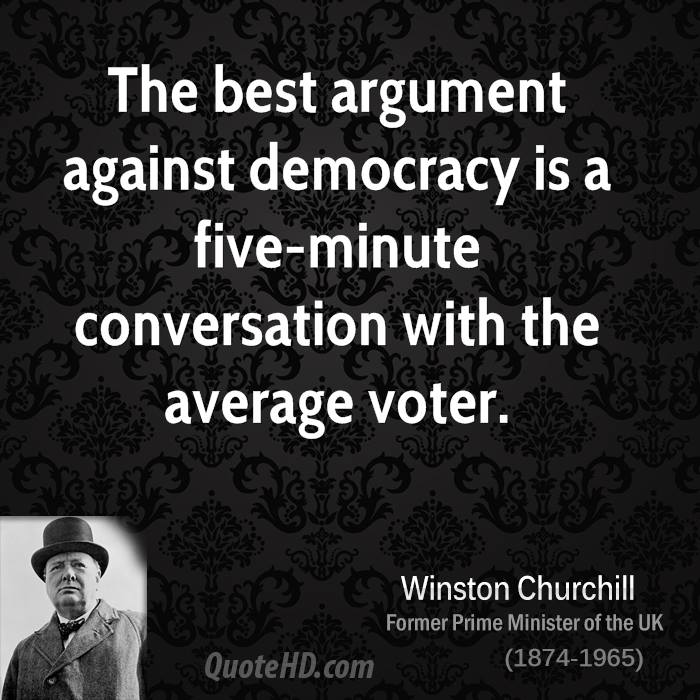
winston-churchill-government-quotes-the-best-argument-against

Because instead of putting everything on the table and letting ‘the people’ decide in earnest, for some time now some of the ‘pundits’ have been playing a dangerous game of  ‘hide and seek’.
One which has resulted in the profound distrust felt by ‘the people’ about the ‘political establishment’. And in the barely masked contempt displayed by the ‘political elite’ towards the rest of the society.

So, instead of having an open discussion about issues and an atmosphere of trust between the various segments  of the social organism we have to pry bits and pieces of information from those who guard it dearly and such mutual distrust that, if we’ll look around carefully, we’ll notice that we’ve been living, for some time now, way inside ‘paranoia land’.

Can we still pretend that our societies are governed in a democratic manner? That each of us tries to shed some light over his area of expertise and by doing so contributes to all of us avoiding as many of the ‘potholes’ as possible?

‘Cause this is the real essence of democracy.
Not finding the best possible solution to every problem but avoiding the known/foreseeable potholes.

No matter how many of us will study a problem we’ll never find the best solution. After five minutes some fresh information will come about and the erstwhile ‘best’ becomes ‘obsolete’.

Compare this situation to somebody stumbling in a pitfall waiting for all of us, coming  back to warn the rest and not one of us heeding to his cries…

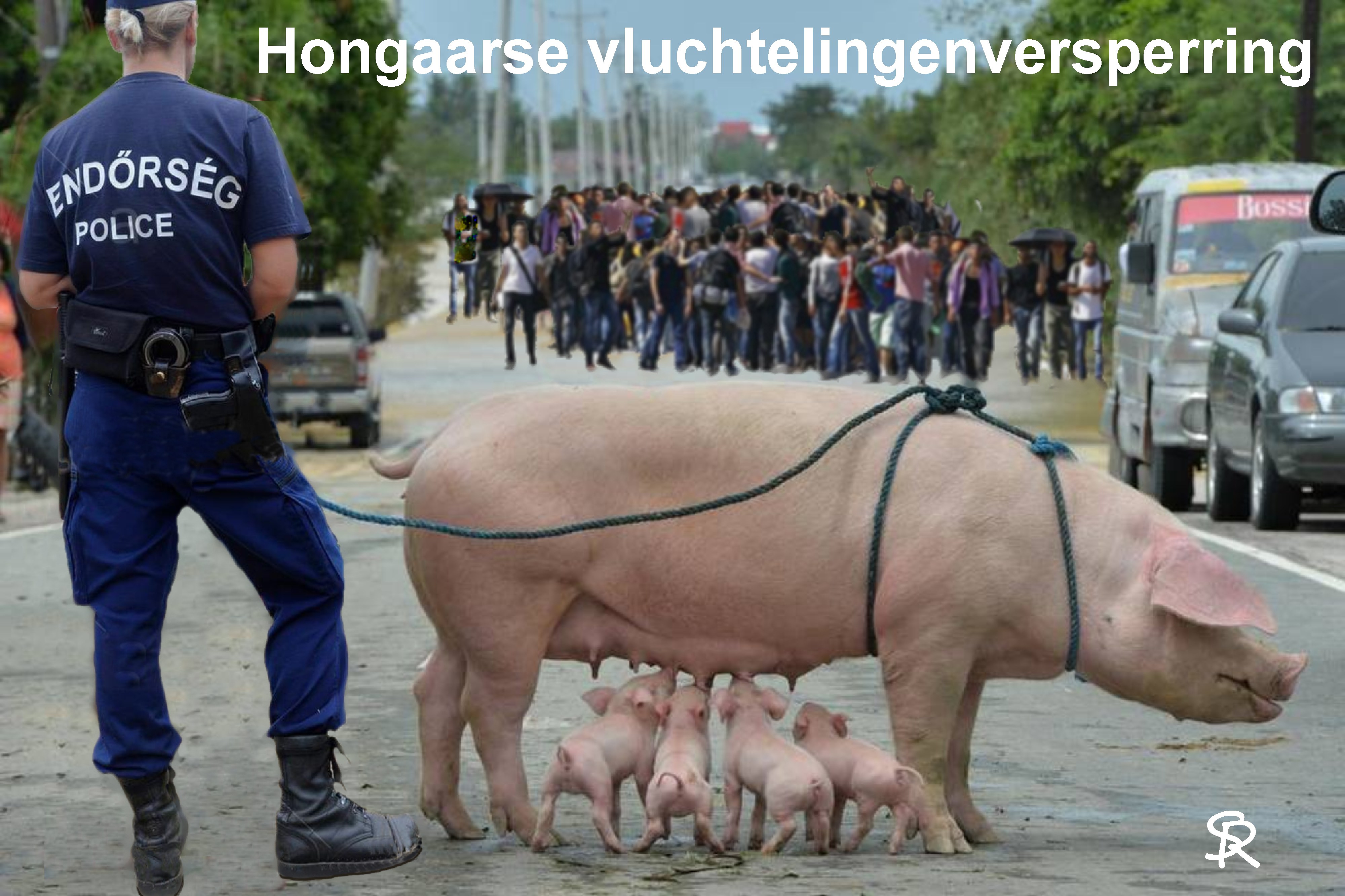
vluchtelingen-wegversperring

‘Hungarian self-defense’


… must we sink in our own, self induced, decrepitude before we’ll be able to notice the stink we, ourselves, have draped around us?

Before figuring out that it’s us who are ultimately responsible for our own fate?

Before figuring out that by allowing this kind of crap to be traded above our heads, and sometimes even by helping to its distribution, we soil the most precious of our ‘belongings’ – our souls?

This image has probably been ‘Photoshopped’ by somebody.
I’m not going to discuss that person’s motives here. We live in a free world and everybody should be able to express his/her feelings.

What I find extremely interesting – and dangerous – is the fact that this picture has been so widely circulated over the internet that it ended up in my mail. A short Google search confirmed that it comes from somewhere in Holland only the guy who sent it to me, horripilated, lives in Canada…

So, what’s the use for us to clamor virtuously about human rights and then make fun, shamelessly, of people who find themselves in a horrible situation?

And, please, do not make any mistake!
I’m not speaking exclusively about the refugees here.

Some of the manifestly dissatisfied Europeans who are protesting these days are not as much against the refugees themselves as they are against the hapless manner in which the European bureaucracy has been (mis) managing so many things recently.

Just as some of the political leaders who are lambasting the European Commission on this subject are not interested in improving the European Community but in ‘scoring swag’ with the disillusioned (and somewhat naive) electorate.

We need to break this vicious circle!

Let’s say you are like me, you are able to change a wireless card in your desktop but are no computer expert AND are running Windows 8 or 10:

Before doing anything else boot the computer and hit RESTART. Not SHUT DOWN but RESTART. For Windows 8 and 10 this not at all the same thing – here ‘shut-down’ is more like what ‘hibernate’ used to be for W 7.

The point being that if the computer has some updates pending (which would have been installed the next time you would have wakened it up) and you change something in it (a wireless card, for instance, 😉 ) it will have some trouble sorting things out. It will succeed, eventually. but it will take some time and it will get you worrying.

So hit RESTART first and open its belly afterwards.

PS
Don’t be sad when it ‘freaks’ out, for any reasons. Just take it as an opportunity to reinstall the OS. It will feel like a new computer. If you played safe and had everything backed up, of course.

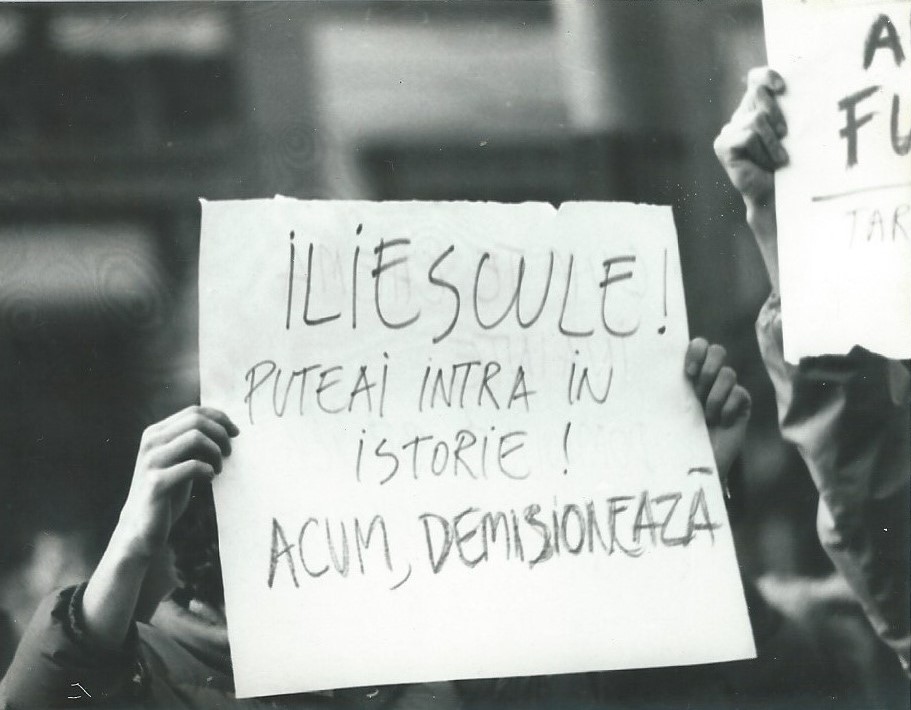
Iliescu, demisia

Fotografia este de pe vremea Pietei Universitatii,  ‘contemporana’ cu strigatura care da titlul postarii.

Sa facem un pic de istorie.

In August 1977 minerii din Valea Jiului au protestat contra indiferentei “regimului comunist fata de situatia de mizerie in care traiau“.
In Noiembrie 1987 muncitorii din Brasov au protestat “fata de masura autoritatilor de a fi redus salariile“.
In Decembrie 1989 prima faza a Revolutiei s-a terminat atunci cand muncitorii din Bucuresti au iesit pe strada in dimineata zilei de 22, indignati fiind de modul in care fusese reprimata manifestatia de protest din seara zilei de 21, cea din fata hotelului Intercontinental.
Din Ianuarie 1990 pana in 13-15 Iunie 1990 au avut loc mai multe manifestatii anti-comuniste, dar fara mare succes. Marea majoritate a populatiei era satisfacuta cu schimbarile ce avusesera deja loc, fapt confirmat in mod decisiv la alegerile din Duminica Orbului, precum si de venirile minerilor la Bucuresti – indiferent ca acestia au venit de capul lor sau au fost chemati, nu poti convinge o asemenea masa de oameni sa faca ceva fara ca ei sa fie deja intr-o stare de spirit care sa-i predispuna catre actiunea respectiva.
In Ianuarie 1999 minerii din Valea Jiului actioneaza, pentru prima oara din 1977, strict in interes propriu. De data aceasta nu mai aveau ca scop ‘apararea ordinii de drept si a statului’ ci ‘siguranta locurilor de munca‘. Pentru prima data dupa Ianuarie 1990 actiunea lor nu a avut rezultatul scontat de ei. Cererile liderilor lor erau total nerealiste si prost vazute de restul societatii romanesti.
In 2000 debusolarea politica a fost atat de mare incat electoratul a fost in stare sa aduca in turul doi al alegerilor pe Ion Iliescu si Corneliu Vadim Tudor.
In 2007 44% dintre alegatori au considerat ca subiectul demiterii lui Basescu era suficient de important incat sa iasa din casa iar 74% dintre ei au votat impotriva demiterii.
In Ianuarie 2012 Bucurestiul a fost martorul unor manifestatii suficient de puternice incat sa produca, in cele din urma, demisia guvernului Boc. Manifestatiile fusesera o reactie la ‘tratamentul’ primit de Raed Arafat ca urmare a opozitie sale fata de unele reforme din domeniul sanitar.
In Iulie 2012 46% dintre alegatori au considerat ca subiectul demiterii lui Basescu era suficient de important incat sa iasa din casa iar 88% dintre ei au votat pentru demitere.
In Noiembrie 2014, suparati pe modul in care fusesera organizate alegerile prezidentiale, foarte multi romani au iesit ‘pe strazile patriei‘ pentru a protesta impotriva guvernului Ponta si in semn de sprijin pentru candidatul Iohannis.
In Noiembrie 2015, indignati de cele intamplate la clubul Colectiv, suficient de multi romani au protestat, sub lozinca “Coruptia Ucide“, in Bucuresti precum si in alte orase din tara si din Europa, impotriva guvernului Ponta incat acesta si-a dat demisia. Este posibil ca o parte din indignarea populatiei sa fi fost produsa si de acuzatiile de coruptie aduse de catre parchet unora dintre apropiații premierului cat si lui personal.
In Februarie 2016, cativa dintre functionarii ANAF-ului incep formalitatile pentru evacuarea unor cladiri ce fusesera confiscate, prin sentinta judecatoreasca, ca despagubire pentru pagubele produse de Dan Voiculescu Ministrului Agriculturii.
Antena 3, una dintre locatarele respectivelor cladiri, se foloseste de prilej pentru a lansa o campanie furibunda de presa prin care se victimizeaza si prezinta cazul ca pe o grava atingere a libertatii presei.
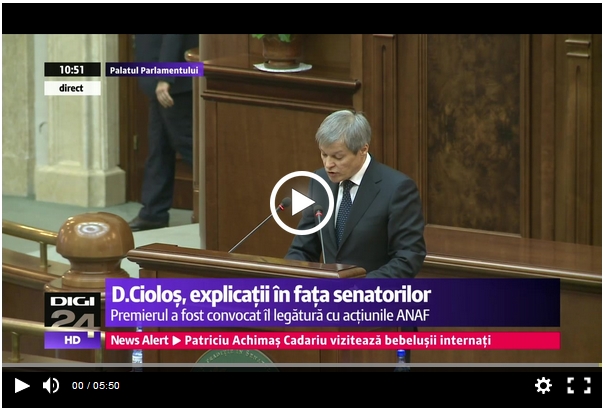
Senatul se aduna in sedinta speciala si cere Primului Ministru Ciolos lamuriri pentru ce se intampla acolo.
Presedintele Iohannis, intrebat cu privire la acest subiect, spune unor reporteri Antena 3: “Eu cred ca ati ajuns intr-o situatie neplacuta si inutila. In primul rand, cred ca libertatea de exprimare in media nu poate fi suprimata pentru banale motive administrative. In al doilea rand, aceasta abordare heirupista a ANAF mi se pare cel putin nepotrivita, daca nu discutabila”
Cateva zile mai tarziu Antena 3 organizeaza un miting de protest la care se aduna cateva mii de persoane.
Peisajul politic se imparte in doua. Unii iau partea Antenei 3 iar altii incep sa-i reproseze presedintelui pozitia pe care a adoptat-o si sa faca misto de cei care s-au adunat la mitingul Antenei 3.

Ei bine, exact acesti “o mână de bătrâni decuplați de România și nevoile sale reale, analfabeți în democrație, săraci, prost îmbrăcați și cu o sănătate precară” sunt cei care au adus Romania unde este acum.

Si, daca citim cu putina atentie enumerarea de mai sus, vom constata, cu bucurie, ca din ce in ce mai multi dintre ei refuza, din ce in ce mai intens, comportamentul discretionar al celor aflati temporar ‘in fruntea bucatelor’. Oamenii, chiar si cei ‘de rand’ au inceput sa inteleaga ca ‘siguranta alimentara’ este, in realitate, un ‘subprodus’ al libertatii si ca ‘mita electorala’ cu care s-au multumit in 1990 nu le-a ajuns pentru multa vreme.

Refuzul arbitrariului, atunci cand acesta a putut fi identificat de catre electorat, s-a manifestat chiar si fata de cei care incercau sa ajunga la putere. Ganditi-va la alegerile din 2000, atunci cand, calcandu-si pe inima, foarte multi oameni au votat cu Iliescu doar ca sa nu iasa Vadim. Iliescu, caruia foarte multi dintre cei care l-au votat atunci ii cerusera, vehement, demisia in 1990, era perceput, 10 ani mai tarziu, ca fiind mai putin ‘imprevizibil’ decat Vadim.

Iar refuzul arbitrarului este exact esența democrației.

Se pare ca ‘cei de-acasă’ au început sa priceapă lucrul asta.
Chiar dacă unii, mai grăbiți, sunt dispuși la expediente.
Uitând ca orice precedent se întoarce, mai devreme sau mai târziu, împotriva celui care i-a dat naștere.


jos-iliescu-ceausescu-basescu-huligan-golan-ciumpalac-hipster

Stiam de fereastra lui peste iar articolul asta mi se pare o explicatie perfecta pentru faptul ca fenomenul se numeste FEREASTRA lui Overton.
Ca orice fereastra si chestia asta este doar o oportunitate.
Faptul ca într-un anumit perete se afla o deschizatura nu inseamna neaparat ca cineva se va uita pe ea sau ca va sari prin ea – înauntru sau în afara.
Tot asa, nici măcar faptul ca cineva ar fi în stare sa croiască ferestre din astea nu înseamna ca acel cineva ar vrea sa se uite/sară prin ele.

Pe de alta parte hai se ne gândim ce ar înseamna sa trăim în niște cutii ermetic închise? Nu-i asa ca am fi perfect apărați de orice intruziune? Si ca ne-am sufoca foarte repede?

mediocruladevarat's avatarMediocrul adevarat

besogon-overton-window

Cred că am pomenit de mai multe ori un banc despre homosexualitate, dar îndrăznesc să-l mai repet.

Un bătrân, abia ținându-se pe picioare, vine grăbit la serviciul pașapoarte.
– Vreau pașaport în regim de urgență, ca să plec cât mai repede din țară.
– Păi n-aveți nevoie de pașaport în Europa.
– Europa e prea aproape… vreau să mă duc la capătul lumii.
– Da’ de ce?
– Nu sunt de acord cu politica față de homosexuali!
– Cum așa?
– Pe vremea lui Antonescu îi împușcau. Gheorghiu-Dej îi băga la pușcărie. Ceaușescu îi închidea la balamuc. Acum, după revoluție, i-au lăsat în pace și le-au dat drepturi.
– Și-atunci?
– Mi-e teamă să nu devină OBLIGATORIU…

Nu o dată mi-a trecut prin minte gândul că e PREA adevărat ca să nu aibă și un substrat teoretic.
Zilele trecute l-am auzit pe celebrul regizor și actor rus Nikita Mihalkov, prezentând…

View original post 1,399 more words


presedintele critica fiscul

Cred că libertatea de exprimare nu poate fi suprimată pentru banale motive administrative. În al doilea rând, această abordare heirupistă din partea ANAF mi se pare nepotrivită, dacă nu discutabilă, și am constatat din discuții avute că există deschidere la factorii de decizie și prin discuții așezate și calme se găsesc soluții convenabile”,

Indiferent de cati ii sar acum la beregata omul are dreptate.

Am folosit ‘omul’ in loc de ‘Presedintele’ pentru a sublinia faptul ca atat el cat si toti ceilalti – admiratori, detractori precum si cei care incearca sa isi pastreze capul limpede, sunt oameni, cu o capacitate de intelegere inerent limitata.
Si tocmai de aceea ar face bine ca macar sa incerce sa se inteleaga unii pe ceilalti inainte de a se exprima in ‘sentinte’.

De ce cred ca are dreptate Iohannis in cazul asta?

Simplu.
Hotararile justitiei au fost puse in aplicare. Din punct de vedere ‘contabil’ pagubele stabilite de instanta au fost acoperite. Imobilele in cauza sunt intabulate ‘pe statul roman’.

Mai sunt, intr-adevar, multe de facut. Aceste imobile trebuie valorificate.

Numai ca aceasta este o problema administrativa. Tine de modul in care niste functionari, niste angajati ai statului, inteleg sa-si indeplineasca indatoririle de serviciu.

Este o lege care cere ca imobilele confiscate sa fie valorificate prin vanzare?
Foarte bine! Atunci sa fie vandute.
Spune legea ca proprietarul are dreptul, in anumite conditii, sa ceara celui care ocupa o cladire sa o evacueze in termen de 5 zile? Asta inseamna ca proprietarul, sau un reprezentant al sau, are intr-adevar dreptul sa ceara acest lucru.

Dreptul!

Nu neaparat obligatia. Aceasta poate decurge, insa, din legea care prevede modul in care sunt valorificate imobilele confiscate.

Iar cei chemati sa aplice aceste doua legi mai trebuie, atunci cand isi indeplinesc obligatiile de serviciu, sa tina cont si de celelalte reglementari care au tangenta cu situatia.

De fapt exact asta este datoria functionarilor publici. Sa faca in asa fel incat interesele noastre, ale tuturor, sa fie respectate.
In conditiile specificate de lege. De toate legile aflate in vigoare la un moment dat.

Inclusiv de cele care le permit celor de la Antena 3 sa ceara tot felul de lucruri in instante.

Iar evacuarea propriu-zisa, daca va fi pusa in aplicare vreodata, va putea fi facuta abia dupa ce toate formalitatile legale vor fi fost indeplinite. Altfel insusi conceptul de justitie va fi fost tarat in mocirla.

‘Da’, dar cei de la Antena 3 se dedau la niste actiuni oribile de manipulare a opiniei publice!’

Da, si mie mi se pare chestia asta.

Numai ca atunci cand te injura cineva ai la dispozitie trei variante.

– Te faci ca nu auzi.
Cateodata merge, mai ales daca nu te vei mai intalni vreodata cu respectivul.

– Il injuri si tu pe el.
Toata situatia degenereaza si peste putin timp vei avea de solutionat o problema mult mai mare decat cea de la inceput.

– Cauti o alta rezolvare.
De exemplu iti pastrezi calmul si ii raspunzi astfel incat sa i se faca lui rusine de ce a facut. Sau macar sa il faci de ras in fata spectatorilor.
Iar daca nu merge cu frumosul, il ‘dai in judecata’. Si astepti ca justitia sa isi urmeze cursul.

Ca daca nu ai o incredere reala in mersul justitiei toata discutia de pana acum a fost degeaba.
Iar daca nu iti plac legile in vigoare la un moment dai nu ai decat sa incerci sa le schimbi.
Daca incerci sa te fofilezi pe langa ele nu faci decat sa creezi un precedent care se va intoarce impotriva ta, mult mai repede decat iti poti inchipui.

Asta asa, ca sa-i dau dreptate si lui Ciolos.

ciolos are dreptate