După 27 de ani de prezență disciplinată la toate manifestațiile de protest semnificative mi-am dat seama, în sfârșit, cum stă treaba.

Scena politică e împărțită în trei, nu în două.

Avem politicieni, ‘protestatari’ și electorat.

În mod ciudat, primii care s-au maturizat au fost protestatarii. Chiar dacă, cel puțin teoretic, te-ai fi așteptat ca politicienii de profesie să facă tranziția mult mai rapid decât toți ceilalți.

Am ieșit, pentru prima dată, în stradă pe 22 decembrie, de dimineață.
Încă nu era nici o diferență între electorat și protestatari.
Nemulțumirea populației dăduse în foc iar oamenii și-au dus furia in piața publică.

Așa că unii dintre politicieni au profitat de moment și s-au cocoțat în fruntea bucatelor.

„Ultimul pe listă, cu voia dumneavoastră…”

A fost prima și ultima dată când politicienii, protestatarii și electoratul au fost de aceiași parte a baricadei.

Câteva zile după aceea, ‘ultimul de pe listă’ a făcut ceva care a aprins o scănteie de nemulțumire populară – imi pare rău dar nu mai țin minte ce și nu stau acum să caut – iar unul dintre ‘politicienii de vază ai vremii’ (Dumitru Mazilu) a încercat să folosească prilejul pentru a se pune pe sine în fruntea listei. Așa că a întărâtat pe cât a putut mulțimea adunată în Piața Victoriei.
Care mulțime, sub euforia momentului – cu doar câteva zile în urmă îl alungaserăm pe Ceaușescu – a ‘pus botul’ (‘hai că se mai poate odată’) și s-a încăierat cu ‘forțele de ordine’.

N-a mai fost să fie.
Dar a fost ultima oară cănd protestatarii s-au lăsat manipulați in halul ăsta de către politicieni.

Nici pe departe ultima dată când politicienii au încercat să folosească în scop propriu nemulțumirea străzii – sau să manipuleze electoratul… exact ăsta e subiectul de astăzi… dar să nu anticipăm.

Apoi Iliescu a transformat FSN-ul – care, pe vremea aia, juca rolul unei structuri de stat –  în partid politic. Ceea ce a produs o nouă repriză de indignare. Nu pot să folosesc expresia consacrată, „indignare populară”, tocmai pentru că indignarea nu a fost suficient de populară încât să aibe repercursiuni cu adevărat semnificative.

Fenomenul Piața Universității a fost însă momentul în care politrucii s-au convins pe ei înșiși că pot manipula electoratul după voia lor și că pot să-i alunge pe protestatari la periferia vieții publice.
Atunci a fost momentul în care electoratul – parțial obosit, parțial mulțumit cu ceea ce primise deja, a făcut ‘pactul cu diavolul’.
Atunci a fost prima dată, din păcate nu și ultima, când prea mulți dintre protestatari au făcut ‘exces de zel’. Intransigența e bună doar atunci cănd este reflexivă. Când se referă la propria persoană. Când refuzi dreptul de cetate tuturor celor care nu sunt complet de acord cu tine cazi, cu capul înainte, în capcana întinsă de cei mult mai experimentați decât tine în materie de manipulare.
Iliescu ne-a lăsat să strigăm ca disperații în Piața Universității știind foarte bine că poate controla eficient informația care ajunge în restul țării. La restul electoratului. Adunăndu-ne pe noi la un loc și lăsându-ne ‘să ne ne facem de cap’ a putut să le arate celorlați o imagine extrem de distorsionată a ‘democrației liberale’.

Următorul ‘puseu inflamatoriu’ a fost atunci cănd Iliescu a vrut să scape de Petre Roman. Pentru ca nu era sigur că poate să-l debarce doar sub presiunea ‘străzii’, și pentru că deja colaborase bine cu minerii, i-a chemat din prima.

Aceste doua veniri ale minerilor la București, ambele la chemarea și sub organizarea unor politicieni, relevă începutul maturizării protestatarilor. Marea majoritate a acestora înțeleseseră încă de atunci că rolul lor este doar să atragă atenția electoratului asupra lucrurilor care nu merg bine și, în nici un caz, să răstoarne ordinea de drept de fiecare dată cănd li se pare lor că cineva a greșit.
Că este rolul politicienilor să repare greșelile și că este rolul electoratului să îi aleagă pe acei politicieni care par mai capabili să le rezolve.

Din păcate evenimentele ulterioare au arătat că degeaba s-au maturizat protestatarii.
Cei mai multi dintre politicieni n-au vrut să înțeleagă mare lucru iar electoratul s-a lăsat pe tânjeală.

Penultimele două pusee demostreaza din plin cele de mai sus.

După ce guvernul Ungureanu a fost demis la presiunea străzii – deci fără vreo schimbare a ordinii de drept, prin mecanisme perfect legitime – mașinațiunile din spațiul politic au continuat după principiul ‘scoal-te tu ca să mă așez eu’. Ce altă dovadă mai bună a faptului că politicienii nu au înțeles nimic din ce s-a întâmplat în jurul lor?

Așa că protestatarii și-au făcut din nou simțită prezența.
A căzut și guvernul Ponta.
Din nou, cât se poate de constituțional!

A înțeles cineva ceva?

Politicienii s-au tras atat de tare pe cur încât a fost nevoie să fie adus cineva tocmai de la Bruxelles ca să formeze guvernul. Ba, mai mult, aproape nimeni nu a vrut să facă parte din el.
În plus, în loc ca cei care au greșit să își asume responsabilitatea pentru nemulțumirea populara, au început să fie colportate tot felul de zvonuri cum că această nemulțumire ar fi fost provocată de manipulările lui Soros….

Electoratul, la rândul lui, s-a tras și el pe cur. Atât de tare încât nici măcar nu a ieșit la vot.
OK, au considerat că nu au cu cine să voteze.
Păi dacă nu ai cu cine să votezi … atunci intri tu în politică și îi dai la o parte pe neisprăviți.
Dacă îți pasă despre ce ți se întâmplă.
Sau măcar te duci și îti anulezi votul.
Pentru că altfel politrucii, la fel de imaturi, interpretează absența de la vot ca fiind indiferență – și nu scărba pe care ai crezut tu că o ‘exprimi’.

Și uite așa am ajuns la protestele de acum…

Judecănd după răspândirea lor, nu doar după amploare, se pare că o parte din electoratul autopăcălit a trecut de partea protestatarilor. Adică a început să se maturizeze.
Cu atât mai mult cu căt nimeni dintre protestatari nu încearcă să iasă din limitele constituției. Protestele sunt cât se poate de pașnice.
Mai exagerează câte unii cu intransigența – cerând interzicerea unor posturi de televiziune, demisia unora care nu s-ar fi mișcat pe cât de repede le-ar fi plăcut unora dintre protestatari, ba chiar și înterzicerea unui anume partid… dureri de creștere.
Care trebuiesc, bineînțeles ‘tratate’, tocmai pentru că întârzie completarea maturizării.

Numai că aceste dureri de creștere sunt incomparabil mai puțin periculoase decât refuzul unora dintre politicieni de a ieși din obsesiva lor credință că doar ei au dreptate și că toți ceilalți sunt proști, manipulați sau la fel de ‘hoți’ ca și ei – ceea ce ar justifica atmosfera de ‘care pe care’, dominantă încă pe ‘mioriticele’ maluri ale Dâmboviței.

La inceputul lui februarie 1990 Ion Iliescu a transformat Frontul Salvarii Nationale, organizatia para-statala care fusese ’emanata’ in urma Revolutiei anti-comuniste din Decembrie 1989, in partid politic.

Operatiune cat se poate de dubioasa, cel putin din punct de vedere al bunului simt, dar avand si o oarecare acoperire: ‘Pana la urma noi suntem cei care am facut revolutia. Acuma ce vreti, sa ne dam la o parte?’
Exact in spatiul delimitat de aceste doua limite – cea a bunului simt si cea a conservarii propriei persoane – ne aflam si acum.

Ion Iliescu a invatat sa faca politica de la Stalin, in Moscova anilor 1950-1954.
In ianuarie 1990 nici o persoana rezonabila nu ar fi avut nimic impotriva ca el sa isi fi organizat ce partid ar fi vrut, cu conditia sa o faca in mod normal. Ca toti ceilalti.
Numai ca, in virtutea celor invatate cu 40 de ani in urma, Iliescu a ales sa utilizeze la maximum resursele pe care le avea la dispozitie. Adica ale proto-statului pe care tot el il organizase. Pe care l-a transformat in partid. Readucand, de fapt, situatia exact in punctul in care era atunci cand Ceausescu s-a urcat in elicopter.
Statul si partidul erau o singura entitate, conduse de un singur om.

Reteta care s-a dovedit a fi nefunctionala.
Nu doar imorala ci, pur si simplu, nefunctionala.
Prabusirea inevitabila a tuturor dictaturilor, nu doar a celor comuniste, demonstreaza cat se poate de elocvent evidenta acestui fapt.

O parte dintre cetatenii Romaniei de atunci au protestat cat se poate de energic. Atunci a luat nastere ‘Piata Universitatii’. Din pacate majoritatea nu a inteles ce i se intampla iar Ion Iliescu, intr-o ultima sfidare a bunului simt, a organizat ‘curatarea de catre mineri a pietii din fata Teatrului National’. Atunci cand, de fapt, nici nu mai avea nevoie de asa ceva. Castigase alegerile iar lumea incepuse sa oboseasca.

Gestul sau a oripilat in asemenea masura Europa incat aceasta s-a intors cu spatele la noi.
Iar o parte dintre concetatenii nostri si-au pierdut speranta in viitor. Asa ca au plecat sa il construiasca pe alte meleaguri.

Noul partid ‘unic’ nu a avut nici el viata lunga. Cele doua aripi – reformistii lui Petre Roman si conservatorii fundamentalisti condusi de Iliescu – au inceput sa se certe intre ele. Aparent pe motive doctrinare.
Cele intamplate mai tarziu sugereaza insa ca adevarata batalie a fost ‘pentru ciolan’. Ei erau prea multi iar resursele statului – adica ceea ce putea fi furat – prea mici pentru lacomia lor.
Mai ales ca ‘poporul trebuia hranit’ – si acesta uitase cum sa-si poarte singur de grija.

Lupta dintre cele doua aripi a continuat tot in spiritul celor invatate de la stalinisti. Armele folosite erau cele aflate in panoplia statului.
In principal Justitia, Administratia Financiara si Bugetul de Stat.
Nastase, Basescu si Voiculescu si-au tras la gioale unul altuia pana cand Justitia ajunsese o palida stafie a ceea ce ar fi trebuit sa fie, Administratia Financiara se blocase iar Bugetul de Stat mai ca secase.

In mod paradoxal, criza financiara din 2007-2008 a fost un fel de balon de oxigen pentru noi. Uniunea Europeana s-a simtit datoare sa ne ajute, iar pentru asta a instituit o serie de mecanisme de control. Fondurile Europene vin doar daca sunt respectate anumite standarde iar continuare procesului de integrare este conditionata de rapoartele ‘pe justitie’ – vestitele MCV.

Usor, usor, au inceput sa iasa primii ‘ghiocei’.

Pe Basescu l-a luat gura pe din-ainte si ne-a explicat cum e cu coruptia:
“Să ieşim din ipocrizie. Dacă există corupţie, singur statul nu poate fi corupt, are un partener. Statul nu poate fi singur neperformant. Are un partener şi acesta este economia privată”, a susţinut preşedintele Băsescu. El a subliniat că asumarea responsabilităţii trebuie făcută de ambele părţi.

Parchetele au inceput sa mai actioneze si de capul lor, nu doar dupa comanda politica.

Iar strada a inceput si ea sa iasa din letargie.
Atunci cand Basescu a fost incomodat de Raed Arafat si a vrut sa scape de el.
Atunci cand Ponta incepuse sa se poarte precum Basescu – daca nu mai tineti minte acesta i-a tras clapa PSD-ului dupa alegerile din 2008 exact asa cum Ponta i-a tras clapa lui Antonescu dupa cele din 2012.

Numai ca degeaba a iesit strada din letargie daca cei a caror menire ar fi fost sa inteleaga ceva au ramas cu capetele intre picioare.

Asa ca strada s-a culcat la loc.

Atat de bine incat nici nu a mai iesit la vot.
Nici la locale si nici macar la parlamentare.

Asa ca unii dintre politicieni au ajuns la concluzia ca ‘acum e momentul’.

Si uite asa ne-am procopsit cu o ordonanta de urgenta prin care “Guvernul Romaniei decriminalizeaza abuzurile oficialilor

Asta e adevarata problema, nu ca unii sau altii scapa de o eventuala pedeapsa.

Ca statul a ajuns, din nou, sa fie redus la statutul de ‘scula’ cu ajutorul careia unii si altii incearca sa-si satisfaca maruntele ambitii.

Macar Iliescu se straduia – declarativ sau din convingere – sa puna in practica niste idealuri.
Acum e vorba despre niste amarati de 200 000 de lei.

Si toate astea doar pentru ca, stiu ca ma repet, cei care ar fi trebuit sa fi inteles deja nu baga odata la cap ca sistemele corupte se prabusesc cu atat mai repede cu cat sunt mai roase de acest ‘cancer’.


Unii susțin că ‘Fiecare popor își are conducătorii pe care îi merită’.

Una peste alta … s-ar putea să aibă dreptate.
Cred ca ar trebui totuși să vedem și cum se întâmplă chestia asta.

N-am să mă apuc acum sa glosez despre diferența fundamentală care există între democrația cu adevărat funcțională – aceea în care fiecare spune, pe rând, ce are de zis iar ceilalți ascultă, și domnia gloatei – unde poporul dezbinat este momit de colo până colo cu tot felul de promisiuni deșarte.

Am să vă arăt doar cum apare, aproape pe nesimțite, prăpastia dintre ‘poporul’ învinuit pentru calitatea conducatorilor ieșiți din urne și cei care îi pune acestuia, cu obstinație, vina în cârcă.

de-plastic-si-de-pruna

Da-ți un click pe poză ca să vedeți cum se amuză Romania.

Și după aceea întrebați-vă de ce își „vând” câte unii voturile pe speranțe deșarte…
Nu cumva disprețul dintre clasele sociale – da, și ei ne disprețuiesc pe noi numai că lor le e aproape imposibil să îl manifeste pe al lor – stă la baza a tot ce se întâmplă rău în jurul nostru?
E adevărat că nu ai cum să nu te tăvălești pe jos de râs după ce vezi clipul ăsta. E aproape genial. Din punct de vedere al „concepției regizorale”.
Numai că este și extrem de coroziv.

Nu v-ați prins că e o făcătură ordinară?
V-am spus eu ca e genial…
Uitati-va si la urmatorul.

biscuitii-capulica

Revenind la zicala cu care am început, da, probabil că e adevărată.
Fiecare popor are, într-adevăr, conducătorii pe care reușește să-i ridice din mijlocul său.

Iar pentru asta avem nevoie de un efort colectiv, de punți de unire și de respect reciproc.
Or fi mișto-urile distractive numai că efectul lor trece repede.
Iar după trece, ne dăm seama că „foamea” a rămas.
Cât timp am râs, doar am uitat de ea. De „mâncat” au mâncat alții.

Atunci când hăhăiam noi, miștocărindu-ne unul pe celălalt.

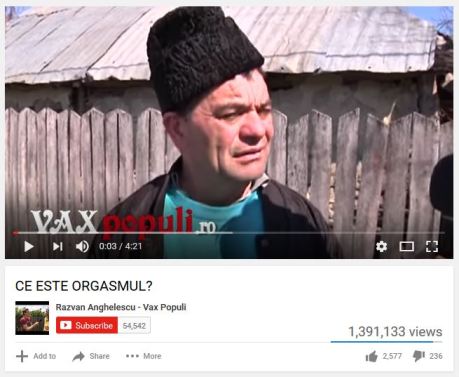
Revenind la idea de „efort colectiv” poate că n-ar fi rău să învățăm ce este un orgasm.
Atunci vom înțelege că cel veritabil se „construieste” împreună cu „celălalt”, nu „holbăndu-ne”, fiecare separat, la clipuri porno pregătite de alții.

Și poate vom învăța odată că te faci de răs doar atunci când vorbești aiurea, nu când recunoști ca nu știi ceva.

ce-este-orgasmul

Both are done ‘by hand’.

Apparently, any likeness between these two stops here.

But, if you pull back in earnest, the ugly thing becomes unraveled.
Not only that it is masturbatory, aka self-inflicted, (political) manipulation should also be classified as sado-masochistic.

Manipulation, as a process, can be examined from two perspectives.
A social one and an individual one.
Now, that everybody knows that ‘manipulation is bad for you‘, any individual who allows themselves to be manipulated into anything must suffer from a masochistic disorder while those who actively manipulate others must be cold blooded sadists.
On the social side, since time and time again manipulation has been proven to have had dangerous consequences, any community that sees any form of manipulation as an acceptable practice must have certain suicidal tendencies. Aka suffer from a ‘social form’ of masochistic disorder. While those who manipulate must be, themselves, cold blooded sadists.

As for being masturbatory, something which is brought upon one self by their own hand, that is almost as evident as Polichinelle’s secret:

Bona-fide politics, that made in earnest, involves open discussion between those who are going to be affected by the decisions and those who propose and support them. Discussions which take place before each major decision is made, during its implementation and after its consequences have started to be felt. The interaction between the politicians and the general public is direct, unmediated.
In Nassim Taleb’s terms, in this situation the politicians have their own ‘skin in the game‘.

Which results ‘risk management’ policy which is the complete opposite of the one adopted by those who believe themselves to be insulated from the consequences of their own actions.

The manipulators, on the other hand, window-dress themselves and the propositions they make. Their goal being not as much to contribute to the well being of their community as to ‘sell to the public’ whatever their minds have been focused on, at that moment. They consider manipulation to be a legitimate tool either because they are not fully aware of the great dangers involved or because they have convinced themselves that they will be forever exempt from contributing to the  the eventual price.
Meanwhile, those who allow themselves to be manipulated either do not realize they are being manipulated or have adopted ‘cynicism as a refuge’ in order to mitigate the cognitive dissonance that is eating away their self esteem.

In an ever-changing, incomprehensible world the masses had reached the point where they would, at the same time, believe everything and nothing, think that everything was possible and nothing was true… The totalitarian mass leaders based their propaganda on the correct psychological assumption that, under such conditions, one could make people believe the most fantastic statements one day, and trust that if the next day they were given irrefutable proof of their falsehood, they would take refuge in cynicism; instead of deserting the leaders who had lied to them, they would protest that they had known all along that the statement was a lie and would admire the leaders for their superior tactical cleverness.

Please note that in this situation the interaction is no longer direct. The manipulator and the manipulated do not ‘touch’ each-other. Therefore neither knows exactly what the other has in mind.
The interaction is mediated by symbols. Which are ‘photo-shopped’ by the manipulators and, sometimes ‘admiringly’, accepted by the manipulated.

It’s exactly this lack of direct contact between the manipulators and the manipulated which determines the whole thing.
The manipulators are, simultaneously, unaware of the true situation and growingly convinced of their ‘impunity’.
The manipulated have initial difficulties in determining that they are subjected to manipulation and, in a second stage, the impression that there is nothing left to be done about the whole thing.

When, eventually, the consequences catch up with both of them, it is usually too late for anything else but ‘damage control’.

People regret that they didn’t wise up earlier, promise themselves they’ll never let something like that happen to them… and forget. Until the next time.

Manipulation: useful tool, mortal sin or what?!?

Hannah Arendt Explains How Propaganda Uses Lies to Erode All Truth & Morality: Insights from The Origins of Totalitarianism

Masochistic Personality Disorder

Secret de Polichinelle

Cognitive dissonance

Karma

“If democracy and open societies depend on constantly providing their citizens with more wealth tomorrow than today, then the Western world — and soon enough the whole world — is in for tough times.” (Zachary Karabell, Forget Dow 20,000 — the Boom Times Are Over. Is Democracy Next?, Foreign Policy, 2017/01/26)

Shouldn’t we ‘back track’ and try to identify what and when, if any, we’ve done wrong before attempting to go any further?

The author identifies, with surgical precision, the stepping stones that have led us to where we are now.

We, in the West, have grown to associate material affluence with capitalism, democracy and liberalism.
In the process, we got “addicted” to a special kind of ‘economic growth’,  the one measured in monetary terms.Lately, after people no longer had as many children as they used to – which, supposedly, is going to hinder and eventually halt ‘economic’ growth, things are no longer seen in the same light.
The economic boom in China and recent developments in Philippines, Turkey and a few other places which “have seen a surge in nationalism of late, a questioning of democracy and skepticism about liberalism even as economic growth has been strong and deep”  are adding to the confusion.
Even “more surprising is the erosion of support for democracy and the norms of liberalism — even of capitalism — in the United States, France, Spain, Greece, and elsewhere”.

He also identifies, with equal precision, some of the barriers that prevent us from seeing the wider picture.

That we haven’t yet developed a clearer understanding of what liberalism and democracy might be. In his own words they still are “adolescent concepts relative to the tenure of recorded history”.
Then there is the matter of how we understand ‘economic’ growth.
“Politicians and governments rise and fall based on how successfully they have been seen to address the problem of wealth and jobs — not the problem of food, shelter, health, and quality of life.”
“we know no other way to assess economic strength and societal success except by the metric of growth. Three hundred ago, the metric was armies and territory. Today, it is GDP, jobs, and wages. You could craft a lovely society with zero growth, but nobody would believe it if GDP, jobs, and wages were shrinking and the rewards remained unevenly dispersed.”
And it’s not only a matter of understanding but also one of perception. “How people react to inequality is hardly straightforward; the populist wave that elected Trump doesn’t yet mind a billionaire cabinet. But the perception that some are reaping rewards at the expense of the many is deep and strong; that, too, was a line almost verbatim in Trump’s inaugural address.”
Which perception leads to a certain way of seeing things. “We clearly are able to provide basic material needs to everyone. But in the developed world, we are failing to provide a sense of security even while most people’s lives are de facto more secure.
On top of this, there is “anger”. Produced by the “evidence that we have the ability to meet our collective needs and wants” corroborated with the “ample evidence that many countries lack the political will or social consensus to make that happen”.

So, what next?

In Mr. Karrabell’s terms, we need to brush off skepticism, fear and anger – since they “are not themselves barometers of the future” – and …

“The greatest questions for the coming years is whether material stability is enough to mitigate against political chaos and societal decay.”

I’m sorry but I really don’t like this kind of ‘wait and see’ attitude.
It doesn’t make much sense to bother about something that will happen outside your sphere of influence, does it?
Place a bet, if you are a betting guy, and go back to whatever you might be able to actually do!

How about rephrasing that question?

What is it that might bring about the “political chaos and societal decay” we are so afraid of?

Now is the moment for me to make a confession.
I’ve altered, just a little bit, the narrative.
While Mr. Karrabell did mention “anger”, he only said about it that it was “evident” – without providing any cause for it. It was I who associated that anger with the “ample evidence that many countries lack the political will or social consensus” to “meet our collective needs and wants”.
The way I see it there is no way that any country might ‘meet our collective needs and wants’, no matter what amount of ‘political will or social consensus’ might be involved in the process. Not in the longer run, anyway.
All communist regimes – which were, declaratively, trying to accomplish exactly that – have failed. Abysmally.  Not because, in reality, all of them did nothing but cater for their ruling elite but because all of them used to be run according to a ‘central plan’.

And stop calling China a ‘communist’ regime. Or Vietnam, for that manner. As long as the ‘means of production’ are more or less private, and their owners free(ish) to use them as they see fit, those countries are not ‘communist’. They might not be entirely free but they are not at all ‘communist’. Venezuela, for instance, is a lot more ‘communist’ than China.

But let’s return to the countries that might attempt to make it so that ‘our collective needs are met’.
How are they going to do that?
First of all, those in charge – the government, right? – would have to determine what those ‘needs and wants’ are and only then make the necessary arrangements for them to be met. But not more than that, because that would be wasteful.

Do I hear any chuckles? You figured out that those ‘willing’ countries would have to use the same ‘central planning’ system that has already led to the failure of the communist regimes?

How about re-framing the whole situation?
How about the “ample evidence” mentioned by Mr. Karrabell suggesting that too many countries – including the one that has recently inaugurated Mr. Trump as President – no longer have “the political will or social consensus” to allow their citizens enough real freedom and enough real opportunities to pursue their own “needs and wants”? As they see fit?

Then shouldn’t we next try to understand the process through which the erstwhile ample opportunities have been curtailed?

As I mentioned before, I’m going to use the ‘back-walking’ method.

First step, anger. We really need to loose that. Nothing good ever came out of it.

Specially when considering the next steps, perception and understanding. If we allow anger to cloud our thinking both perception and understanding will yield errors instead of knowledge.

Which brings us to our obsession with (monetary measured) growth. Could this obsession be explained by the fact that money is the easiest thing to distribute but also the easiest thing to hoard? Panem and circenses eventually failed… Why do we still see hoarding money as a legitimate goal (after amassing more than one could ever spend, with the entire family, in a hundred years)… beats me.
But explains what’s going on.
As long as enough of us see hoarding money as a legitimate past-time, more and more people will engage in it. More exactly ‘try to engage’ in it. And this is the very behavior which produces ‘bubbles’. As in ‘market bubbles’. And, eventually, crashes.

But not only crashes. Misconceptions also.

“There is little evidence that democracy and liberalism (and capitalism) in their current form are the best or only conduit for providing for economic needs and wants for all. If they were, there would be less roiling discontent.”
My point being that none of those, in any form, are ‘conduits’ for anybody to provide, through them, anything for anybody else.
Democracy, liberalism and capitalism, together, determine the three dimensional ‘space of opportunity’ where we, human individuals, try to provide for our own needs. If allowed to, of course.
It fact it is not the “politicians and governments” mission to “address the problem of wealth and jobs”. In a full-fledged liberal democracy the government does nothing but guards the freedom of the economic market  and the safety of the citizens – including their ‘human’ rights and private property.

As for capitalism… it doesn’t provide anything. Lest of all “incentives”. People provide incentives. Capitalists provide their employees with incentives to work and politicians provide the capitalists with incentives to engage in such or such enterprises or to refrain form others. And while the first kind of incentives, those provided by the capitalists themselves, work as intended – increase productivity, that is, if employed wisely, the latter end up curtailing the freedom of the market. Which can no longer work smoothly enough. This being the moment when opportunities disappear for the ‘man in the street’ and when those ‘connected’ to the government start to ‘flourish’.

You see, real capitalism is not as much about money as it is about trust.
Trust that your business partner – well, most of them – is going to fulfill his end of the bargain, not try to rip you off. Trust that if things go wrong – in the rare event that he does try to rip you off – the government will move swiftly on your behalf.

That’s all.
That’s what Deng Xiaoping meant by ‘I don’t care about the color of the cat, all I care is for it to catch the mouse’. That’s why the Chinese imported capitalism works. Because the Chinese government has learned that the market cannot do its job, in the longer time frame, without a certain dose of ‘liberty’.
The problem being that China is but an exception. Along with a few other examples, mostly in South Asia, they are the very few countries whose authoritarian governments have learned to refrain from interfering too much in their economies.

Looking back in time, ‘back-tracking’ that is, we’ll notice that capitalism has emerged in places where the entrepreneurs had both considerable individual liberty and enough wisdom to refrain themselves from trying to con their business partners. Otherwise the whole (budding) economic effervescence of the time would have very quickly been smothered by greed.
Think of the Medieval Venetians trading with the Arab merchants of the time. This being the reason for why the oldest surviving bank in the world, Monte dei Paschi di Siena, is based in Italy – the least centralized country in the Medieval Europe.
Or think about how a hand shake used to be enough to seal a deal between two Americans. Some time ago… nowadays you need an army of lawyers to buy a car… not to mention the flurry of official permits needed in most cases…

So, what we need to do, if we want to continue to be a source of inspiration for the rest of the world, is to restore democracy, liberalism and capitalism to what they used to be. Dimensions which described the space of opportunity that used to be open for all of us.

OK, hindsight is always 20-20… or so they say…
I’m afraid that what I just described was an idealized mental construction but I’m sure that you got my drift.
After-all, if the Chinese were able to learn it from us … we’ll surely be able to restore it to its old glory.
Or else…

http://foreignpolicy.com/2017/01/26/forget-dow-20k-the-boom-times-are-over-is-democracy-next/

The Rorschach test consists of a trained specialist encouraging a subject to share his interpretations on 10 “ambiguous images“.
At the end of the discussion the trained specialist more or less ‘determines the fate’ of the subject, by filing his interpretation of the subject’s reactions.

The democratic process consists of everybody freely expressing their concerns about things.
Periodically some people are invested with enough power to solve the problems encountered by the community, in a manner consistent with the values agreed upon by that community. At the end of each such period the activity of these people is analyzed (interpreted ?!?) by those at the ‘receiving end’ of the political mechanism, with the intended goal of improving the ‘political process’.
The fate of the entire community being under a double determination. The diligence of the politicians invested to run the show and the diligence of the people when evaluating the results of the political process.

As you can see with a naked eye, there are a few striking similarities between  Democracy and the Rorschach test. Both depend heavily on the participants being honest and straightforward.

If the patient ‘doesn’t trust his doctor’ or ‘doesn’t feel like talking’ the ‘trained person’ will undoubtedly have problems in reaching a ‘fair conclusion’. Both will have to ‘suffer some consequences’.
If the ‘doctor’ has ‘ulterior motives’ and ‘unfairly labels’ his patient, it will be the patient to suffer the initial consequences but, eventually, those consequences will ‘bounce back’ to their source.

Same things happen in any society.
The difference between a democratic and an authoritarian one being that in a democratic environment ‘consequences’ become apparent, and are dealt with, a lot easier than in an authoritarian one.
This being the reason for which true, functional, democracies work better than any form of authoritarianism.

As long as both parties involved ‘interpret’ their roles appropriately, of course.

(D)evil is ‘the difference’ we cannot accept.

For some, the fact that anything so ‘distant’ from what they find acceptable can survive for any length of time is a slap in their faces.

Which prevents them from learning anything in that situation.

the-sleep-of-reason
People have started to freak out after realizing the full scale of what has just happened.
Some see him as a just retribution for our past sins – and they are probably right about this – while others look at the whole situation as if it was a sort of a Rorschach test.
How about Trump as an opportunity?
The inverse of a Rorschach test since that is about the shrink trying to learn something while an opportunity is about the subject bearing the responsibility for the consequences …
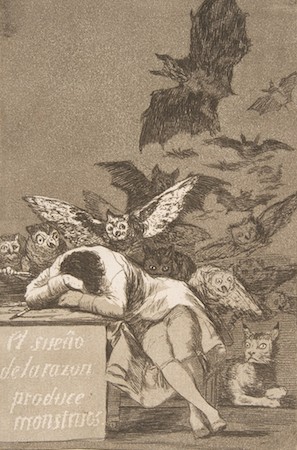
An opportunity, and a prod, for the silent majority to remember that ‘The sleep of reason produces monsters‘?
The way I see it Clinton would have done everything in her power to lull us back into our erstwhile stupor while Trump, willingly and/or unwittingly, is already making enough noise… Even the Sleeping Beauty must have already heard something…
So, test or opportunity, now it’s up to us to find a way out of the current mess. Which, I have to repeat this, is our exclusive responsibility.
The problem being that for those inside, the ‘light at the end of the tunnel’ can be the actual exit or the head-light of a train engine barreling down towards them.
‘Lady Luck’ is a tough bitch and that’s why one should be really careful with these things.
PS. The ‘shrink’ already has a huge ‘blot’ to muse about. Some people never learn.
Emily Linroth being a spokeswoman for the National Park Service, the organization which has cleaned up “the National Mall following the inauguration and the Women’s March on Washington Saturday.

history-written-by-the-victors

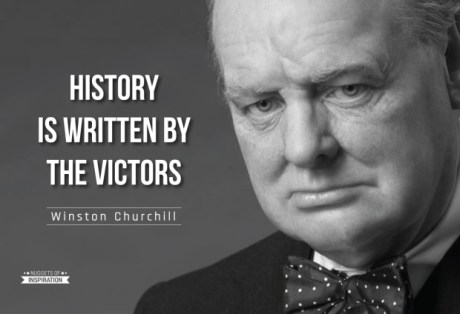
Quite a lot of people, most of them after misreading Machiavelli, have convinced themselves that ‘history is written by the victors’.

Even Winston Churchill, once a victor himself, had fallen into this trap.

Lately, more and more have started to doubt this assertion.

History is written by the writers.
Steve Theodore, professional game developer, amateur know-it-all

Ouch!

OK, let me dig deeper.

In reality, being able to write is not enough.

In order to be able to write about something, you have to survive it first.

And something else. Merely writing it would not necessarily preserve that information for further referral. For us to be able to read it. And be influenced by it.

So, the history that we are aware of today has been written by those who have survived the events, were smart enough to write and to understand the real importance of what they have just done. And to preserve the results of their effort.

But there’s more to it.
Basically there are at least two manners in which someone can describe something.
As close to what they honestly remember or in such a way as to bring as many benefits to the writer as possible.

I’m sure that you’ve already figured out what I’m hinting at.
Yes, the first manner of writing produces ‘true’ history while the second yields mere ‘propaganda’.

Which can be, indeed, useful.

On the shortest of times and only as long as the writer itself does not start to believe in his own writings!

Otherwise they’ll join the fate of the likes of Goebbels and …

goebbels-children

You know, Hitler’s very efficient ‘spin doctor‘ (“Think of the press as a great keyboard
on which the government can play.”) who, at the end of WWII and with the help of his wife Magda, had “murdered their six children and killed themselves as Soviet forces closed in on the bunker.” Would you call that a ‘victory’?
But we have to give him what was really his. He was a ‘man of his word’.
If the day should ever come when we must go, if some day we are compelled to leave the scene of history, we will slam the door so hard that the universe will shake and mankind will stand back in stupefaction..

So.
For some people to write history and for that history to remain as they have written it, the writers had to survive ‘it’, learn from what had happened to them that they were the in possession of very important information and decide to pass on that information, as truthfully as possible, to the next generations.
To help them survive if/when confronted with a similar ordeal.
And this very fact, that the history they had written taught someone how to survive, transforms the writer into the real winner.

In fact ‘history’ will be passed from one generation to another only as long as the next generation replaces peacefully the older one. Only as long as the older one helps the new generation to ascend into the future.

Otherwise, if the ‘children’ have to fight their ‘parents’ – as in ‘contradict what they had been taught by their teachers’ – in order to remain alive, they will also re-write the ‘history’ they had to fight against while struggling to survive.

starea-natiei

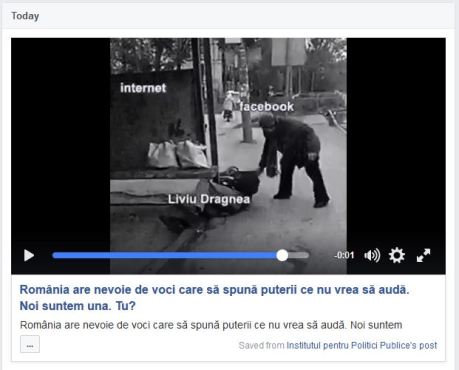
Postarea asta descrie foarte bine ‘starea natiei’.
Un betivan se impiedica si cade.
O baba se sperie si incepe sa ii dea cu poseta in cap in loc sa verifice daca nu cumva si-a rupt gatul.
Niste ‘oameni de bine’ filmeaza incidentul si il pun pe net. (Sper totusi ca dupa ce au terminat de filmat s-au dus macar sa-l scoale de jos pe ‘actorul’ lor ‘principal’.)
Alti ‘oameni de bine’, care pana acum pareau a se ocupa cu lucruri mai serioase, se apuca sa refoloseasca clipul ca pe un ‘purtator de mesaj’ – cu toate ca se potriveste doar pe jumatate, Dragnea nu e deloc beat si stie foarte bine ce face.
 
Si, dupa ce clipul face ocolul internetului romanesc, aceiasi ‘oameni de bine’ se scarpina in cap intrebandu-se:
‘Cum dracu am ajuns aici?
De ce nu ne mai crede nimeni?
De ce nu mai iese lumea la vot?
De ce reactioneza din ce in ce mai multi exact la fel ca baba aia isterica?’
Vi se pare ca exagerez?
In situatia in care un vicepresedinte de partid parlamentar se adreseaza potentialilor sai alegatorilor cu:
In ziua in care cea mai democratica tara din lume il inaugureza pe Trump ca presedinte?