Archives for category: Psychology

According to Humberto Maturana, what we call consciousness – our ability to ‘observe ourselves observing‘, is the result of what sociologists would call a ‘cultural process’.
Meaning that consciousness has been developed in time – as is millennia, and is constantly shaped through daily interactions between us.

I don’t intend to discuss its genesis now, I’m just gonna point to one of its many consequences. Our need to explain everything.

We’ve developed our consciousness by talking to each-other. If we are to accept Maturana’s theory – of course, which I do.
At some point in time, during this process, there must have been an ‘aha’ moment.
Or, more precisely, a ‘what if’ moment.

Until then, everything was ‘natural’. Sun up, sun down, birth, death… and everything in between.
While learning to ‘observe ourselves observing’ one of our ancestors must have noticed that we make a lot of decisions. Unconsciously – until that moment, of course, but, nevertheless, still momentous. To ‘flee or fight’, which fig tree to climb, which cave to use tonight, which pelt to skin, which flint to flake…

The very next moment our ancestor must have asked their-self:

What if the Sun doesn’t get up next morning? Will I wake up from sleep tomorrow?
Who decides these things?
Are there only rules – like ‘every time you touch a flame you get burned’ and ‘ice is always cold’ or on top of the rules there is somebody who calls the shots? As in ‘decides whether this time the lion will attack on sight or it will let this one go’?

And we’ve tried to explain away our fears ever since…
By determining which are the pertinent ‘natural rules’, by placing the responsibility on somebody else’s shoulder – read ‘God’, or both at the same time. Again, I’m not going to develop this subject either, I’ll just remember you that Buddhism – for example, doesn’t reject older creeds. The Japanese, for instance, follow both Buddhist precepts and Shintoist traditions. Also, many Christians entertain a lot of local and not so local superstitions. Like never start walking with the left foot or having a very strong ‘respect’ for the third number after 10.

Let me make a short recap.
We taught ourselves to speak, we talked to each other until we developed something called consciousness to such a level that we’ve started to ask ourselves existential questions and then we came up with more or less credible scenarios meant to allay our fears.

‘OK, … and your point is?’

Don’t be so ‘surprised’ when somebody ‘irrationally’ defends their own ‘story’. ‘Their story’ encompasses their world. That’s where they had been living, together with everybody they used to know/consider their kin.
Don’t attempt to force your story upon them. Let aside that you might be wrong yourself… any attempt to forcefully impose a narrative upon somebody else is nothing but “rape”. Don’t do it unless you are prepared to get raped yourself.
And keep in mind that it’s not ‘their story’ that harms you but ‘their actions’.

No story has ever harmed anyone. For any story to have consequences, people must act upon it. According to how they have chosen to relate to the it.  That’s where we can see eye to eye, regardless of the stories each of us keep dear.
Are we ready to accept that we might be wrong? That our story might be incomplete? That our explanation of the world might need some adjustments?

Are we ready to understand that enlarging our explanation to encompass others will actually increase our own ability to survive?
Or are we going to defend ‘our’ version, no matter what?

Are we going to keep looking for explanations or to become the subject of yet another one?

What’s more important?

Commonalities or differences?

To understand what happened or to determine who’s responsible?

Truth or meaning?

Being safe or being content?

To feel (happy) or to be perceived as being (happy)?


How many of these answers had just sprung up and how many had been the result of careful consideration?

Really?

Am I the first to understand that once you’ve eaten it, nobody will ever again be able to part YOUR cake from you?

It stops being a cake as you chew on it?

Well… yeah. Actually it does. But… it remains a cake in your memory! That’s what you’ll remember having eaten: A cake!

And now, that we’ve settled the ‘eaten cake’ problem, let me ask you another question.

How strange is it that so many conservatives consider taxes as an infringement upon their right to freely dispose of their property yet they have no qualms to impose their beliefs upon other people – women, to be more precise, denying them the right to freely  dispose of their own bodies?

Because all life is sacred!

Hence, in their view, all abortion is murder. Regardless of the age of the fetus. Regardless of the consequences of having an unwanted child. Too early, too many, not enough money, health problems, sexual assault… nothing counts except for the right of the fetus to be born.

Some go even further. They consider that contraception is murder too. Because it denies the right of the egg-cell to become an embryo…

As I said before.
It is not only possible but very normal to have your cake and eat it too.
Same goes for convictions.
Once embedded in our heads they become ours and nobody can part them from us, no matter what logical arguments might be involved. Invoked?

Except for us. We are the ones who can leave behind some of our old convictions and reach new ones.
Conversion is the name of the game.

A game we’ve been playing since the dawn of time.

We pride ourselves for our ability to choose. Rationally!
We call that ‘liberty’ and we consider it an ‘undeniable human right’.

Yet everything, including our understanding of things, exists because of ‘chance’.
While neither chance nor choice can manifest itself/be exerted outside what we’ve learned to call ‘hard reality’.

“First you guess. Don’t laugh, this is the most important step. Then you compute the consequences. Compare the consequences to experience. If it disagrees with experience, the guess is wrong. In that simple statement is the key to science. It doesn’t matter how beautiful your guess is or how smart you are or what your name is. If it disagrees with experience, it’s wrong. That’s all there is to it.”

Attributed to Richard Feynman by
Florentin Smarandache, V. Christianto,
in Multi-Valued Logic, Neutrosophy, and Schrodinger Equation? (2006), 73

Se pare că treaba e mai groasă decât părea la prima vedere.

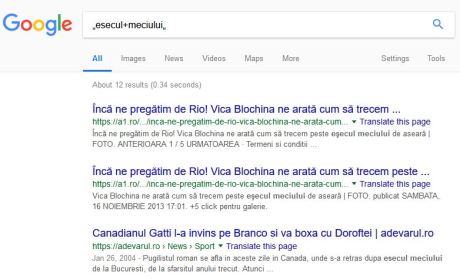
Esecul referendumului

Cică toți oamenii se pricep la fotbal și la politică.
Aiurea. Eu n-am habar despre fotbal iar foarte multă lume se pricepe mult mai mult la fotbal decât la politică.

A auzit cineva expresia ‘Eșecul Meciului’?

Hopa, se pare că ‘grosimea situației’ are accente grotești.

Esecul meciului 2

Avem de a face și cu probleme de logică a limbajului, dincolo de neînțelegerea a ceea ce este un referendum…

Referendumul, și meciul de fotbal, sunt lucruri.
OK, lucruri imaginate de om. Care țin mai degrabă de o realitate virtuală decât de una ‘fizică’. Și cu toate astea sunt cât se poate de reale. Au consecințe.

Eșecul, pe de altă parte, ține de un cu totul alt gen de realitate. De realitatea umană. Tot virtuală, și ea, numai că eșecul este subiectiv în timp ce referendumul, și meciul, sunt obiective.

Referendumul, odată organizat, iese de sub influența voinței și simțirii individuale și intră în cea a voinței și simțirii colective. Devine obiectiv.
Eșecul, în schimb, este, prin natura lui, ceva ‘partizan’. Ține de individual, de partinic.

Lucrurile nu pot avea eșecuri.

Pot fi eșecuri, într-adevăr, dar doar din perspectivă individuală. Partinică.

Un lucru există – virtual sau fizic. Atât.

Poate fi doar privit/comentat ca fiind un succes – de cei cărora le convine situația, sau ca un eșec.

Iar modul în care este privit/discutat spune foarte multe despre privitori/vorbitori.
Și despre ce au înțeles din ce au văzut.

More than 30 years ago, a very good friend of mine had emigrated from then communist Romania to the US. Ten years later he landed  a job with a huge Japanese corporation, his previous position having been that of COO for a way, way smaller corporation. One where the owners were not only involved in running the business but also ‘close’ enough to the ‘daily hustle’.
After a few weeks he phoned me. He was utterly dejected. ‘It’s as if I’m back in Romania, working for a state owned enterprise. Nobody cares for anything but the hide on their own backs. And they act very narrow-mindedly. They lie to their bosses, don’t share work related knowledge with their co-workers and so on, without realizing that by behaving in this manner they actually weaken the structure which ‘feeds’ them. Furthermore, those in charge don’t care about anything else but their fat ‘compensation packages’, not realizing that, on the longer run, their behavior is leading to ruin. Meanwhile, the shareholders  – from ‘far-away’, don’t realize what’s going on. Until too late, of course.’

Some 25 years ago, another good friend of mine had emigrated to Canada. He currently works, as a contractor, for a huge Canadian corporation. A few weeks ago he was here for a short vacation and we had a chat. ‘Nobody cares for anything anymore. The contracting agencies don’t give a damn whether the people they send over are actually able to do the work, the bosses don’t understand, or care, very much… it’s as if we, the ex-communists, have came back from their future…’

Even the ‘family run’ businesses have lost their edge. Their owners are no longer ‘close’ to their employees and the businesses are very quickly sold to the highest bidder. And incorporated into ever-growing entities…

The two friends I already mentioned said that ‘whenever a corporation grows big enough, it starts to resemble a state’. My own experience concurs.

Only I’d take a step further.

‘Whenever an organization grows big enough, those who ‘inhabit’ it start behaving as if employed by a state/state-owned entity’. As if their job/position is theirs to be had/defended by birth-right. A feudalism of sorts.

And these people end up passionately defending the organizations which give meaning to their lives.
As they are! Simply because any change in the organization would imply a change, for the worse, in the fate of the individuals defending the current status.

And why would any individual behave in such a short-sighted manner?

“Every position in a given hierarchy will eventually be filled by employees who are incompetent to fulfill the job duties of their respective positions.”

Peter

BTW, when was the last time you came across the concept of ‘company culture’?


Things consist of what makes them what they are.
These very constituents impose upon things their definitive limits.

Take life, for instance. It’s exactly that which makes the difference between a collection of inanimate chemical substances and a living organism which leads to its eventual demise.

Or our skeletons. And all our organs. They make us what we are and, simultaneously, set the limits of our existence.
Each of us can grow only that high, eat and drink only that much, sprint only that fast and live only that long.

Take our brains.
That’s what we think with. And we make errors with.
That we remember and forget with.
That we love and hate with.
That makes us aware of some things and leave so many others out of our knowledge.

That is capable to understand the nature of our limits and, too often, chooses to ignore that opportunity.

Present owes just as much to Reaction, if not more, as it does to Revolution
Ilie Badescu, PhD.

Newton had noticed  that everything, no matter how ‘inanimate’, reacts whenever ‘prodded’. And, maybe even more importantly, that the reaction is exactly balances the ‘prodding’.
Provided that the ‘prodding’ doesn’t actually ‘destroy’ the ‘target’, of course. But even then, some ‘reaction’ is always exerted against the ‘intruder’.
Walking, for instance. Whenever we walk on tarmac, our weight is fully supported by the pavement. When walking on dry, fine sand, our feet leave an impression. Our weight is eventually counterbalanced but not before some local ‘readjustments’ have been made. Finally, when walking in knee deep water, our feet completely ‘destroy’ the layer of liquid before reaching the ‘terra firma’ below. But not without having been met by some hydrodynamic resistance – which is far greater than the aerodynamic one we constantly overcome when walking on dry land.

Darwin had noticed that species either evolve – and survive, or ‘go under’ whenever something changes in the environment they had been accustomed to.
It’s a no brainer to remark that here the reaction is no longer as instantaneous nor as ‘equally opposed’ as in the first case.

Since Berger and Luckman’s The Social Construction of Reality it is tacitly accepted that our fate is heavily influenced by our actions.
Some of those inclined to entertain religious beliefs will now add that it is our actions which take us to hell or to heaven but since there have always been some ‘misunderstandings’ between the various currents …
Anyway.
My point is that in this third case, each specific ‘reaction’ is actively shaped by the individual ‘reactionary’. According to their own projections of the future, to the prevailing, socially adopted and individually internalized, rules and to the individual understanding of the until then discovered ‘natural laws’.

And that our future, as a species/civilization, is being shaped now.
By us.
Using whatever cultural heritage our ancestors have left us and, maybe more important, according to our limited understanding of the world.
And according to our wishes, of course.

It will be our children who will bear the brunt of our current decisions.

In Nature, ‘evil’ is suicidal.

‘Evolution is not about the survival of the fittest but about the demise of the unfit’.

Ernst Mayr, What Evolution Is, 1964.

In ‘social’, a sub-domain of Nature, Evil has to be weeded out. By us.
For no other reason than here it is us who determine what is evil or not. By honestly assessing how detrimental that thing is to our own well being.

And we need to act diligently yet sparingly.
Diligently, lest we become engulfed by ‘weeds’.
And sparingly, lest we become evil ourselves.

“One of the main arguments for Durkheim’s theory is that since crime is found in all societies, it must be performing necessary functions otherwise it would disappear in an advanced society. (Hamlin, 2009). One of these necessary functions is social change. Crime is one of the most effective sources of social change in any society. When crime goes against social norms, eventually a society’s collective belief will transform thus bringing about social change. A prime example is the Anti-miscegenation laws in the United States that promoted racial segregation. As society progressed many people began violating the laws at the time until society reached a point where it was considered a norm for inter-racial relationships in society. Eventually racial segregation was abolished and in today’s society would violate social norms.One of the main arguments for Durkheim’s theory is that since crime is found in all societies, it must be performing necessary functions otherwise it would disappear in an advanced society. (Hamlin, 2009). One of these necessary functions is social change. Crime is one of the most effective sources of social change in any society. When crime goes against social norms, eventually a society’s collective belief will transform thus bringing about social change. A prime example is the Anti-miscegenation laws in the United States that promoted racial segregation. As society progressed many people began violating the laws at the time until society reached a point where it was considered a norm for inter-racial relationships in society. Eventually racial segregation was abolished and in today’s society would violate social norms.”

Mike Larsen, Durkheim: Crime serves a Social Function, 2012


I’m not going to educate you about what fractals are.
The internet is full of information, go find it. If you care, of course.

I’ll just remind you of an old saying,
‘There’s nothing new under the sun.’

As if nature doesn’t exert itself.
If something works… why invent anything new when you can adapt something which already exists?

In this sense, I somehow must admit that those who believe is God do have a point about this. Sometimes Nature seems to have been fine tuned by an engineer…

Or that engineers have learned a lot from Mother Nature?

Enough with this back slapping between the engineer in me and … whoever is at the other end of this game.

1. The ‘revolving’ principle.

Basically all matter turns around a center, is circled about or finds itself in both situations at the same time.
From the electrons which turn around the nuclei of the atoms to our Sun which spins around the center of the Milky Way.

Behind this principle lies another one.

2. The dynamic equilibrium.

Everything which exists is in a state of dynamic equilibrium.
Both internal and external.
Its components relate to each-other in such a manner as to keep that thing together while the surrounding medium exerts various influences towards that thing.
From the meager proton – whose quarks ‘cooperate’ to constitute a distinct individuality and somehow manage to remain ‘apart’ from the rest of ‘world’ despite the huge forces which keep each atomic nucleus together, to, say, a living organism – which remains alive for only as long as it conserves its ability to interact, both ways, with the environment.

I can probably identify a few more but today I’m going to mention only one more.

N. Killing your host might not be such a good idea.

Remember the fable about the Scorpion and the Frog?

‘Now you really got my attention! How on Earth are you going to spin this into your tale about fractals?!?’

When syphilis first appeared in Europe in 1495, it was an acute and extremely unpleasant disease. After only a few years it was less severe than it once was, and it changed over the next 50 years into a milder, chronic disease. The severe early symptoms may have been the result of the disease being introduced into a new host population without any resistance mechanisms, but the change in virulence is most likely to have happened because of selection favouring milder strains of the pathogen. The symptoms of the virulent early disease were both debilitating and obvious to potential sexual partners of the infected, and strains that caused less obvious or painful symptoms would have enjoyed a higher transmission rate.”

Robert J. Knell, Syphillis in Renaissance Europe…, 2004

Want some more?
How many people have you seen last winter wiping their noses? How many of them actually had the flu and how many suffered from having a benign ‘cold’.
You must have surely got my drift by now… flu kills many more people than the cold. And Ebola kills far many than the flu. And that’s why the cold viruses have far more chances of finding a host than both flu and Ebola.
On one hand, the more deadly a virus is, the less hosts are left for the next generations of viruses.
And on the other hand, the more dangerous a virus – or any other ‘parasite’, is, the more those in peril will try to do something about it.

N+1. If you can’t beat them, join them.

Now that I’ve mentioned parasites, let’s take a step further and talk about symbiosis.

“Mitochondria are rod-shaped organelles that can be considered the power generators of the cell, converting oxygen and nutrients into adenosine triphosphate (ATP). ATP is the chemical energy “currency” of the cell that powers the cell’s metabolic activities. This process is called aerobic respiration and is the reason animals breathe oxygen. Without mitochondria (singular, mitochondrion), higher animals would likely not exist because their cells would only be able to obtain energy from anaerobic respiration (in the absence of oxygen), a process much less efficient than aerobic respiration. In fact, mitochondria enable cells to produce 15 times more ATP than they could otherwise, and complex animals, like humans, need large amounts of energy in order to survive.”
The mitochondrion is different from most other organelles because it has its own circular DNA (similar to the DNA of prokaryotes) and reproduces independently of the cell in which it is found; an apparent case of endosymbiosis. Scientists hypothesize that millions of years ago small, free-living prokaryotes were engulfed, but not consumed, by larger prokaryotes, perhaps because they were able to resist the digestive enzymes of the host organism. The two organisms developed a symbiotic relationship over time, the larger organism providing the smaller with ample nutrients and the smaller organism providing ATP molecules to the larger one. Eventually, according to this view, the larger organism developed into the eukaryotic cell and the smaller organism into the mitochondrion.

Another interesting case of symbiosis is that between each of us and the flora which populates our guts and helps us to digest our ‘daily bread’.

Now, do you remember my post about viruses?
Where I mentioned that viruses are organisms which somehow penetrate into their hosts, take over the management mechanisms of said hosts and ‘convince’ them to actually manufacture the next generation of ‘invaders’.
Killing the host cell in the process, but not necessarily the whole host organism.

This being the difference between the common cold, influenza and Ebola viruses.
On one hand.

On the other hand, there’s the difference between a parasite and a symbiont.
A parasite always being a ‘nuisance’ – from the innocuous common cold to the deadly Ebola, while all symbionts bring along quite lot of added value.

‘OK, and where’s the fractal side of all this?’

How many of the politicians you know behave as parasites and how many as symbionts?
Relative to the rest of the society, of course.
How many of the business people you know behave as parasites and how many as symbionts?
How many of the working age people you know….

And do you remember about the dynamic equilibrium which is essential for survival?
Of everything? Including human societies?
Which need ‘division of labour’ and ‘free market’ in order to thrive?