We make history. We write history. We read the history we wrote about the things we’ve done.
Then we keep ruminating about what we (don’t) learn from and about history…
Are we nuts?
But is there anything to be learned from history?
Yep! What happens when we fail to learn from the mistakes which keep shouting at us from the history books our ancestors had written for us. Had written to warn us…
Some people argue that ‘truth lies somewhere in between’ while others maintain that ‘truth is where it is, not somewhere in the middle’.
Well, both sides are right.
Truth is, indeed, “where it is”. The problem being that ‘that place’ is ‘out there’. Not necessarily ‘out of reach’ but definitely out of anybody’s realm. Hence finding ‘that place’ needs a collective effort. In this sense, the truth is, indeed, somewhere ‘in the middle’. In the middle of our converging efforts, if our efforts are honestly targeted.
On the other hand, truth is not ‘somewhere in the middle’. In the sense that truth is not something we can negotiate. We can indeed pursue truth individually but we cannot negotiate the results.
We can settle for a less than perfect truth, if we’re not able to reach ‘the absolute’, but it must be a workable version, not a lukewarm mean. The result of our quest, even if ‘only for a while’, must serve the goal we’ve been trying to reach! If we settle for something only because that something titillates the ego of the majority amongst us… then our efforts have been wasted!
Allow me to conclude that the truth is not somewhere between us but above us. It makes a lot of sense to thread carefully when trying to reach it – lest we stumble during our quest – but we nevertheless need to broaden our perspective. Lest the truth remains hanging just outside of where we’re looking for it.
Individual organisms, working in concert, for a while, organize themselves in such a manner as to be able to keep the inside it, the outside out, to ingest what ever they need to survive from outside and to excrete the byproducts of their living. Also known as the by-products of their metabolism.
In order to perform the above, the individual organisms use information gathered by their ancestors and transmitted over generations. Which information has been shaped in time, through an evolutionary process, in order to remain useful for the currently surviving organisms. Which said shaping has happened through the natural culling of the individuals bearing information no longer fitting to the then existing natural circumstances.
For life to continue, individuals living at anyone time must engage in reproduction.
For ‘man made’ things to happen – for anybody to do anything – three requirements must be met first. ‘Circumstances’, ‘determination’ and ‘opportunity’.
To serve a meal, the chef needs ingredients and tools, willingness to do it and a hungry client. To engage in an act of terrorism, the terrorist needs a certain set of circumstances, the ‘determination’ to do ‘it’ and a ‘trigger’.
Is it far-fetched to compare these two things? Feeding people and killing them?
From a ‘deterministic’ point of view, there’s no difference between deciding to serve a bowl of pasta and deciding to deliver a bomb. The consequences are, obviously, completely different. Supporting life versus taking it away.
There are more differences. Nobody has yet seriously considered banning restaurants and everybody hates terrorism. When subjected to acts of terrorism! Otherwise…
Meanwhile, PKK continues to remain a terrorist organization!
So… Just as food tastes vary enormously, so does various people’s interpretations on what constitutes a terrorist act. The first constant being the fact that food sustains life while terror tends to make it difficult. And the second one being the fact that both restaurants and terrorist acts are community based phenomena.
A restaurant depends on the people who deliver the goods, on those who operate it and on the paying customers who keep the business afloat. A terrorist depends on those who help and facilitate. And a terrorist depends on the rest of the community turning a blind eye towards what’s going on. For no matter what reasons! Until they realize how foolish they have been…
‘But who is a terrorist?’
That’s a very good question! There are up to three types of ‘associates’ in any act of terrorism. The ‘direct operator’, the ‘first hand facilitators’ and the ‘people behind’. While it is quite simple to understand the roles played by the ‘direct operators’ and by the ‘first hand facilitators’, things become murkier when it comes to the ‘people behind’. For some – including for me, the current Iranian leadership are among the ‘people behind’ the Hamas terrorist organization. But what about those who, willingly or unwittingly, make it so that whole communities become ‘restless’? Restless enough to generate terrorists and careless enough to turn a blind eye towards terrorist acts being prepared in their midst?
My point being that just as nobody becomes a celebrity chef overnight, it’s almost inconceivable that anybody might engage in major acts of terrorism without being helped by some and noticed by many. And just as a chef has to be talented to become noticed, a ‘direct operator’ needs to be in a ‘particular’ state of mind in order to operate. But just as an untalented cook is, eventually, ‘set aside’ by a run of the mill community, a willing ‘direct operator’ ends up, literally, being embraced by a ‘triggered’ community. Or is eventually ‘sent away’ by a normal one. By a properly functioning society!
Just before starting this post, I heard somebody commenting on Antonio Guterres’s words: ‘Even if he will not have to resign, he won’t get another mandate’… Now, as a coda, I feel the need to share that comment with you.
Taking and managing risk is also an acquired skill. Like riding a bike or swimming in the sea. Only nowadays the key word is safety. Safety, not safety net. We are taught to avoid risk, at all costs, instead of how to lend a helping hand towards the fallen ones. This is why we pay lip service to entrepreneurship but despise failure… as if it were possible to have one without the other.
‘Now, that you’ve reached your personal pinnacle, which do you think is more important? Setting the right goal for yourself or reaching it by keeping on the ‘straight and narrow’?’
Well, staying on the straight and narrow is a goal in itself… The way you put it, you’re asking me to determine which came first, the chicken or the egg?
Neither. Evolution came first. At some point reached the ‘chicken and egg’ stage then went forward to giving birth to living offspring.
Same thing here. Life is opportunistic. Setting goals and following rules is OK, as long as you keep an open mind about things. Keep your eyes wide open yet fully aware that nothing is exactly as it looks like.
The only legitimate long term goal is ‘sustainable survival’. The rest are nothing but ‘staging posts’. In order to be able to do something – anything – you need to be alive. And kicking! In order to stay alive, you need to make as little damage as you go along. To yourself – as a living organism – and to the environment in which you live. To the natural environment each living organism depends on and to the social environment which allows us, human beings, to maintain and develop our human-ness. Our capacity to generate meaning by making successive decisions.
How to achieve this meta-goal? By following the common sense rules which become apparent as we go forward in time. Which become evident as long as we keep our eyes open….
“Behold, the man has become as one of Us, to know good and evil. And now, lest he put forth his hand and take also of the tree of life, and eat and live for ever: Therefore the Lord God sent him forth from the garden of Eden, to till the ground from whence he was taken.“
Tradition is a collection of knowledge. Which has been agglutinating in time and is used as a ‘benchmark’ by the currently living keepers of the relevant tradition. ‘Relevant’ in the sense that not everything which is still remembered continues to be useful.
Functionally speaking, tradition is both a filter we use to interpret the reality and a guide we use when shaping future action. And we use it simply because the alternative would be to start from scratch whenever we see anything or have to do something. Like a child learning to walk and speak. Like a child who keeps saying ‘what is this and why do I have to…’ We get many of those answers from the traditions passed over by our ancestors. Without these traditions we would be like a lonely child. A collective child who keeps asking for direction but who gets no answer. Because there’s no one around to answer…
Ideology is also a collection of knowledge. Which has been put together, edited or both at the same time by an ideologue. Or group of ideologues. Psychologically speaking, ideology and tradition work in the same way. Both as a filter used when interpreting reality and as a guide for future action.
But there are some differences.
Tradition has been vetted by evolution. Individual traditions have evolved themselves. No modern Jew would ever consider stoning to death “a woman who had been caught in adultery”. Even if this used to be the biblical standard punishment for such a transgression… Some traditions have disappeared altogether. Because, at some point, they had ceased to be relevant. Their teachings were no longer helpful… At some point, those who were living in those traditions had understood, one way or another, that their particular tradition was suggesting an interpretation of reality which was … wrong! So wrong/useless that the entire tradition had to be abandoned. Like the Egyptian pyramids. Other traditions are still alive today. Because at least parts of them continue to be relevant for those who keep them. “And God said, Let us make man in our image, after our likeness: and let them have dominion over the fish of the sea, and over the fowl of the air, and over the cattle, and over all the earth, and over every creeping thing that creepeth upon the earth”.
In fact, what we call ‘modern civilization’ is based entirely upon this particular piece of tradition. We’ve built it together, as children of the same father. We’ve been building it under the authority of the said father, who had given us dominion over everything which was moving under the sun. And the fact that we considered ourselves to be the children of the same father – siblings, hence equals – has given birth to the very notion of human rights.
Ideology, on the other hand, is still fresh. Some of it might make it, some of it might break us.
The bible itself has been nothing more but a piece of ideology. When it was written… The fact that those who had been inspired by the bible have survived, as a flock, for so long is a strong suggestion that the biblical tradition has been useful. That, overall, the suggestions derived by the ‘keepers’ from this particular tradition have helped them in their quest.
Other ideologies have been less successful…
Communism, for instance. On the face of it, the communist ideology is a continuation of the christian tradition. People are to be considered equals, resources are to be shared among the members of the community… what more can you wish? Well, it didn’t work out that way. It actually failed. Abysmally. I know, I’ve been there myself.
I’m not going to delve into why some ideologies work – and live to become traditions – while others fail. I’m not God, I don’t know everything. What is plainly visible, for those who want to see, is that authoritarianism – under any ideological pretext – is doomed to fail. This being the reason for which God – or the wise guy who wrote that passage – had banned Man from the garden of Eden. An immortal man would stick to his convictions until it would be too late. Until the heaven would had fallen upon his shoulders….
I cannot end this before sharing with you what prompted me to write it. The goal of Hamas – ideologically shaped and ideologically imposed upon its followers, regardless of any of the circumstances – is to destroy the state of Israel and to replace it with an islamic state. Is there a ‘promise’ about how people will live once that islamic state would be imposed? Except that they will have to obey? The goal stated by the communist ideology was equality! Not people’s happiness or anything like that. The way to obtain that goal was a continuous revolution. A sort of jihad, if you will… Now look at what Hamas has accomplished. At what Marx’s communists had accomplished…
Choose wisely. ‘Cause each of us is born into a tradition. Into a particular tradition… But ideology is something that each of us chooses. And can give up!
Țiganii printre care am crescut în Giulești aveau o vorbă. „Nu te hândi în bătătură că-ți intră muștele-n casă!” Adică ‘Ai grijă la ce faci că și tu vei suferi consecințele!’ (Pentru cei nefamiliarizați cu lexicul din mahalalele bucureștene, hândelul – produsul hândirii – este unul dintre cele două personaje din celebra interogație filozofică „De ce trage musca la ‘hândel’?”)
Conștientizarea consecințelor produse de propriile acțiuni asupra propriei sorți este una dintre caracteristicile aristocrației. Aristocrației ca stare de spirit…
După cum am aflat la lecțiile de istorie, aristocrația – ca clasă politică – a dat-o în bară! Și atunci? De unde admirația produsă de orice urmă de ‘comportament aristocratic’? Tocmai din cauza faptului că aristocrații veritabili înțeleseră subtilitățile conceptului de karma. Înțeleseseră că tot ce aveau – de la mâncarea de pe masă până la mătăsurile de pe spinare – trecuse prin mâinile țăranilor care le munceau pământurile. Iar aristocrația – ca organizare socială – a dispărut abia odată cu dispariția legăturii directe dintre aristocrați și pământurile/țăranii lor. Odată cu apariția arendașilor. Din cauza cărora Maria Antoaneta i-a îndemnat pe țăranii morți de foame să mănânce „brioșă”. Din cauza căror arendași – interesați doar de profitul pe termen scurt, Maria Antoaneta – quintesența aristocrației momentului, ajunsese, efectiv, să nu știe pe ce lume trăia!
Suntem deja în fața consecințelor. Consecințele modului în care funcționăm ca societate. Consecințele modului în care este colectat și distribuit bugetul consolidat al Romaniei. Care buget este atât de dezechilibrat încât matușa Europa a zis că ne taie banii de buzunar dacă nu facem un pic de ordine. În ograda proprie, așa cum considerăm noi. Bugetul să fie, cât de cât, echilibrat!
Drept pentru care guvernul a luat măsuri. Care măsuri favorizează partea de colectare și pretind că fac economii pe partea de cheltuieli. Doar că pensiile speciale rămân exagerat de mari – și pot fi cumulate în continuare, între ele și cu un eventual salariu. Nu doar că rămân mari ci rămân pur și simplu. Cum ar fi, de exemplu, ca pensiile speciale agonisite de Buzatu – proaspat arestat cu mita în portbagaj, să fie suspendate odată cu arestarea? Și anulate odată cu eventuala condamnare? Dacă e nevinovat, să-i dea banii înapoi… Cum ar fi ca măsurile de economisire a banilor de la buget să includă și o readucere la normal a numărului de funcții bine plătite din aparatul de stat? Reforma administrativă, simplificarea și comasarea agențiilor care se calca pe picioare, etc., etc…
Si atunci? Ce înțeleg eu din toată tevatura asta? Cei aflați la putere au înțeles – măcar la nivel declarativ, că ‘așa nu se mai poate’. Adică au devenit aristocrați. Au început să înțeleagă că își furau creanga de sub picioare. Și au început să-și dezavueze colegii corupți.
Dar încă nu sunt dispuși să meargă mai departe. Să rezolve cu adevărat problema. Să echilibreze bugetul prin eliminarea căpușelor instituționale.
Adică au devenit aristocrați doar pe jumătate. Conștienți de faptul că acțiunile lor vor avea consecințe, încearcă să prevină aceste consecințe folosind, în paralel, o serie de măsuri populiste. Reduceri de posturi vacante, creșteri de taxe pentru corporatii și pentru cei avuți dar fără să renunțe la prilegiile proprii. Mai ales la privilegiul de a ocupa, ei împreună cu rudele și prietenii lor, tot felul de slujbe plătite gras, și pensionate la fel de gras, din bugetul echilibrat prin creșterea taxelor. Creștere insuficientă de altfel…
Cu alte cuvinte, proaspeții aristocrați se comportă de parcă ar fi luat statul în arendă. Nu-l mai fură pe față. Doar îl căpușează cu acte-n regulă!
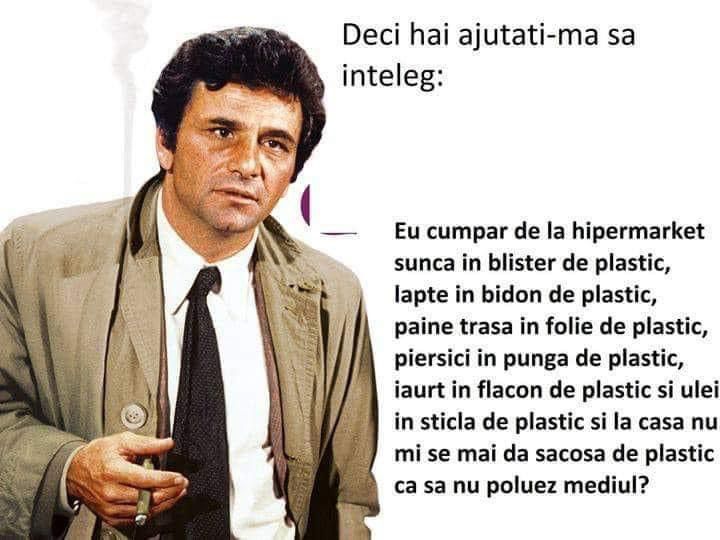
Dintre toate ambalajele menționate mai sus, pungile de plastic sunt cele mai greu de reciclat. Cele mai ușor luate de vânt. Și cele mai ușor de înlocuit.
Dacă ne-ar păsa cu adevărat – de locul în care vor trăi nepoții noștri – n-ar trebui să ne pună nimeni. N-ar trebui să ne pună nimeni să redescoperim sticla. Sticla de lapte – pe care să o umplem la dozatorul de lapte, sticla de ulei – pe care să o umplem la dozatorul de ulei… Sticle pe care să le spălăm și pe care să le refolosim.
Sticlele de lapte și bere, borcanele de iaurt, hârtia cerată pentru mezeluri, brânză și carne, punga de hârtie pentru fructe și legume… și sacoșa pentru dus toate astea acasă!
Da’ noi suntem ocupați cu alte alea! În loc să gândim cu capetele noastre, citim tot felul de trăznăi pe internet! După care le dăm mai departe…
Una dintre știrile care au captat atenția comentatorilor FB în ultimele zile este
„Controversă după moartea unui copil din Bucovina. Medicii susțin că preotul a convins părinții să refuze donarea de organe.”
Părerile sunt împărțite. Ceea ce este cât se poate de firesc. Unii îl condamnă pe preot, unii religia… iar alții susțin că noi nu avem nici un drept să comentăm decizia părinților
Eu unul n-am nici o treaba cu decizia ‘apartinatorilor’. Nici cu „religia”.
Si nici cu faptul ca au simtit nevoia sa se consulte cu preotul. Chiar daca au făcut acest lucru dupa ce isi dadusera deja acceptul. Adica dupa ce fusesera deja de acord sa salveze cateva vieti.
Pana la urma, pot intelege si opinia preotului. Asa ii spune lui constiinta.
Problema pe care o vad, si care e imensa, este publicitatea facuta in jurul acestei ‘intamplari’.
Oamenii aceia au mers mai departe decat simpla razgandire. Au comunicat in spatiul public motivul razgandirii. La ‘oamenii de pe stradă’ a ajuns informatia ca un preot a sfatuit parintii unui copil aflat in moarte cerebrala ca salvarea unor vieti cu ajutorul organelor celui plecat deja pe jumatate dintre noi ar fi “necrestineasca”. Si ca sfatul unui preot poate intoarce o decizie mai mult decat generoasa!
Cu alte cuvinte, ‘stirea momentului’ este ca un preot a invatat o pereche de parinti crestini sa lase alti oameni sa moara. În chinuri!
Si ca acei parinti au acceptat sfatul si s-au conformat invataturii. Că acei părinti au acceptat versiunea acelui preot cu privire la ce înseamnă să te porți creștinește!





 nicichiarasa