If ye continue in my word, then are ye my disciples indeed; And ye shall know the truth, and the truth shall make you free. John, 8:32
Bruno, GiordanoBruno, was speaking the truth. Something we consider to be true… Yet he ended his career as a definitely unfree person! At the hands of people who considered themselves to be disciples of Christ…
Something doesn’t add up! Either at least some of the truth mentioned here isn’t actually true… or we’re dealing with altogether different truths!
The way I see it, Giordano Bruno had died because he was defending an absolute truth while his killers had never realized that the truth pronounced by Christ was relative.
Let me elaborate.
An absolute truth – there are many – is a piece of truth of the kind which will eventually trips over you.
‘Reckless driving will kill you’. ‘High water will knock down the levy’. ‘A red hot iron will brand a cow’.
Relative truth, which has many faces but is essentially one, depends on us. According to Christ, those who follow his word – who remain his disciples – will know the truth. And will become free.
According to Christ, it is not possible for an individual to know the truth – nor become free – in an individual manner. To accomplish the feat, WE have to follow his word.
We have to ‘love’ each-other. To respect each-other! To turn the other cheek…
For us to be able to get near the truth – near the many absolute truths that are there – we need to share whatever knowledge we have. Keeping anything hidden from our brethren – not turning the other cheek for ‘inspection’ – means disrespect. Means distrust. Lack of love. Inability to be in communion with the rest. Incapacity – or unwillingness – to partake in the same piece of reality. To partake in the same piece of absolute truth.
This is why Christ, who was right, has been killed. By those who didn’t want to share freedom. Who wanted to keep freedom for their own use. Who wanted to restrict the freedom of others. This is why Bruno, who was right, has been killed. By people who behaved exactly – and for the same reasons – like those who have killed Christ. Despite declaring themselves to be the disciples of Christ…
Truth and freedom are human concepts. Words. Both need us, human action, to become reality. Both need us, working in communion, to become practice!
Individual absolute truths are relative to us. Are relative to us noticing, formulating, sharing and validating each of them. ‘Relative truth’, the ‘only one’, is absolute. In the sense that the only absolute – and definitive – truth is the fact that we can learn, and become free, only in concert. Respectfully helping each-other.
I’m not going to discuss any of these ‘calls’. In a normal world, it doesn’t matter who makes a decision. At which level.
In the present world, which is far from normal, something jumps at any open minded observer.
‘States are good enough when it comes to setting rules about when a woman might have – or rather not – an abortion but they shouldn’t be allowed to decide, individually, whether a would-be president has been involved in insurrection.’
I agree with the legal minded among my readers that there are sound arguments, legal-wise, for each of those decisions. Unfortunately, most people are ‘legal-blind’. Instead of delving into the obscure paragraphs which shed light into the nook and crannies of any judicial sentence they prefer to decide based on what they see at the first glance. And what’s staring at us is the fact that the President of the USA is elected state-side. Each state sends a number of people to Washington with a clear mandate about who should be the next POTUS. Which means that candidates need to ‘win’ more delegates, not necessarily more individual votes from the general public. States play a critical role in this process. Equally staring at us is the fact that ‘individual rights’ are defined and upheld at the federal level. States no longer have anything to say about an individual right as soon as a particular ‘something’ is assumed – at the federal level – to pertain to the realm of the ‘individual human rights’.
It is a truism that almost any sect, cult, or religion will legislate its creed into law if it acquires the political power to do so, and will follow it by suppressing opposition, subverting all education to seize early the minds of the young, and by killing, locking up, or driving underground all heretics. Robert A. Heinlein, Postscript to Revolt in 2100.
Religion is the metaphusical ‘thing’ inside which people who hold a set of tenets to be true are able to build a community.
Religion is sociological phenomenon. Something belonging to the realm studied by those who try to understand how large number of people work together.
Religions – on the other hand – are ‘sets of tenets’ put in practice by various groups of people. Sets of tenets which survive for as long as they continue to help the people who uphold them in their quest to survive as a group. As a community.
Religion cannot be ‘changed’. Religion can be studied. May be better understood. Like physics. You can’t ‘change’ physics! With what? With chemistry? Things don’t work like this. The only thing you may do about physics is to ‘deepen’ your knowledge about it.
Religions can, and sometimes have to, be changed. By the very people who ‘use’ them to survive.
Since nobody can survive on their own, each and everyone of us needs to belong. To a community. To a religion, actually!
And what do people do when they realize survival is impossible in certain conditions? Die or do something about it, right?
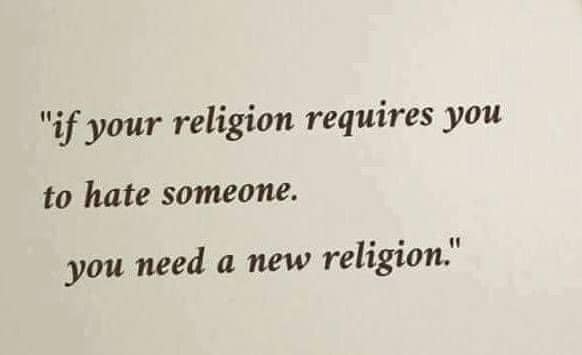
Now, which community can survive based on hate? It doesn’t matter whether you are asked to hate somebody inside or outside your community. Whether you hate individually or collectively. Hating – or despising – somebody blinds you and exhausts you. Puts a huge burden on your back. Focuses your attention so tight that you are no longer able to notice the real dangers. Those which actually make you less likely to survive.
And this is valid both for you as an individual and for you as a hating community.
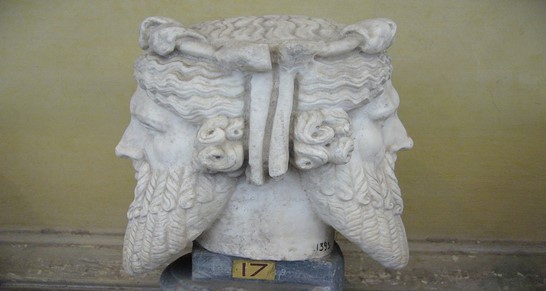
Time, like everything else human, has two sides. Like a coin.
A ‘base’ and an interpretation.
There’s no interpretation without a base – even hallucinations are based on ‘something’ – and there’s nothing which has penetrated human conscience and ever managed to evade interpretation. In fact, human conscience needs to interpret, to assign meaning to, everything it ‘sees’. Everything it perceives. Anything which is uninterpretable, which has no meaning, cannot be controlled.It is, hence, dangerous. If you don’t know what’s going to happen next, you can assume anything. And since assuming the worst – and preparing for it – is far more useful towards survival than sleeping over it, we are biased towards erring on the side of caution. And towards relentlessly searching for meaning.
Time, like everything else human, is both a phenomenon – it happens – and a concept. The difference between the ‘time’ of a star and the human time being that ours has a name – given by us – and that the star cannot do anything about it. While we do!
We can do things to and about time!
We named it, we measure it, we attempt to interpret it…. and we try to do the best of it! We try to do, while alive, what we consider to be ‘the best’.
The best (?!?) for whom?
Tao.
The ‘road’. If everything flows, it has to flow ‘somewhere’. Not only from the start/spring to the ‘end’ (?!?)/never tranquil sea. Everything flowing needs a ‘riverbed’ to flow ‘through’. A plant needs soil to sprout, grow, bear fruit and ‘return to nature’. Even a star needs an Universe in order to shine… besides enough ‘fuel’, of course! I have started this post by saying that there’s no interpretation without a ‘base’ and that we, conscious human beings, need to attach meaning (a.k.a. interpretations) to everything of which we become aware. Same thing here. For anything to happen, a venue is needed. Some wise people in our past have used ‘Tao’ as a name for THE venue. For the venue where everything takes place.
Karma.
At first, when conscience had dawned on us, we were alone in the ‘dark’. And afraid about what was going to happen to us. To assuage that fear, we have identified God. As the ‘the meaning’ of the world. At first, when both the world and time seemed to be endless – to us, consequences came from God. We had to behave. Or else… God was there to punish each and every transgression. Sometimes using one of us as his proxy. After a while, some of our ancestors have learned to write. To reliably transfer information over generations. Very soon, those ancestors of ours have learned the link between cause and effect. Between behavior and consequence. Very soon God had become an outside observer. Or was out-rightly forgotten. But Karma survived.
Future.
I keep hearing that ‘evolution has no purpose’. Like many other human utterances, this one conveys far more information about the utterer than about the phenomenon described by the utterer.
‘This wooden table has 4 legs’. We learn about the table that it is in front of us, that it is made of wood and ‘has’ 4 legs. We learn about the utterer that: It was conscious when uttering those words. Only conscious agents are capable of ‘speaking like a human’. It has, at some point, learned to speak. English, and possibly other languages. It has, at some point, learned to count. At least up to four. And it had conserved that ability up the moment when it uttered those words. It was capable of identifying ‘wood’ as a material. When uttering that phrase, it was in a ‘casual’ state of mind. A ‘scientifically minded person’, a ‘grammar nazy’, for example – when in that mood, would not attribute human ‘abilities’ to a table. Which table is a mere object and objects cannot posses other objects. Tables cannot ‘have’, hence that person was speaking colloquially. Or, given the current ‘technological’ developments, those words might have very well been uttered by a statistically ‘minded’ AI application…. A man made ‘parrot’!
See what I mean?
Let’s go back to the presumably purposeless evolution.
Evolution is a phenomenon. Like a thunder. It takes a lot more time to unfold than a thunder, it’s about as hard as a thunder to predict the exact point where it will ‘strike’ but we know enough about both to be able to point out, quite reliably, a few ‘rules’ about how both phenomena take place. About where, when and how they will unfold. What’s the purpose of thunder? To ‘close the circuit’? To discharge the energy pent up in the cloud? I’m afraid that attributing purpose to thunder is akin to allowing tables to ‘have’ legs. What we have here is a ‘figure of speech’. An ‘implicit’ figure of speech… so implicit that it’s not even considered as such… Same thing when it comes to evolution.
Which evolution is paramount to survival. Just as no cloud can accumulate ad infinitum electric energy – hence thunder – no living thing ever – no species, more exactly – has yet been able to survive ‘everything’. Everything mother nature has thrown at it. Hence ‘evolution’! Which is a mere process which makes life possible. In certain conditions – in a certain Tao – after it had sprung up. And, again, attributing purpose to evolution is akin to allowing a table to own legs.
Then what about ‘future’? If God no longer decides for us – the God we have identified – and if evolution is ‘pointless’… then ‘future is blind’?!?
Not so fast!
Question: Where was God at Auschwitz? Answer: Where was man at Auschwitz?
Could any of those present at Auschwitz have done anything to fundamentally change the outcome? Probably not. Could we, as a species, have done – have behaved, actually – in such a manner as to avoid Auschwitz altogether? Specially after the Armenian Genocide had already taken place? Should we, as a species, have done differently when so many Tutsi had been killed in Rwanda? When 8000 Muslim Bosniak men and boys had been murdered in Srebrenica?
See what I mean? About the future? About our future?
What do we have here? “Eternity and endless return?” Or past mistakes haunting us through time? Until we figure out the way forward? Or else…
Language is the tool we use to convey information. To speak our minds…
The consequences of tool use – messages, in this case – depend on the yielder. The consequences of shooting a gun depend mainly on the person aiming the gun. The consequences of using language … depend on those who are at the both ends of the ‘barrel’.
Messages – consequences of language being used to put together batches of information with the intent of transmitting them to an audience – are interpreted as soon as they reach their ‘target’. Meaning – what the receptor makes of a message, using the same languaging tools as those put to work by the emitter – depends mainly on the receptor. In fact, most of the times, there’s more information to be gleaned from a message than that intended to be conveyed by the person initiating the exchange.
If interested in who said what and what Orwell thought about the subject… just click on the link above. I’ll only add the reasons for which I know it to be a misleading affirmation.
The factual truth is that only dictators need to be guarded by rough men during their sleep. And during the rest of their lives… We, the rest of ‘the people’, go to sleep at night knowing there’s only a very slim chance to be targeted by thieves. Yes, we know that the police will likely come to investigate after the fact. After the fact… But we also know that we are less likely to fall prey to violence than those living in other countries because our societies work better than those which are more violent than ours.
Because our society works better, not because we employ more ‘rough men’ to guard us… On the contrary! The more violent a country, the more ‘popular’ the ‘rough men’ are. On both ‘sides of the isle’!
And the more violent a country, the less peacefully people sleep in that country…
Yes, you who have enough spare time to read things like these and are open minded enough to continue. Who don’t worry too much about what you’re going to eat tomorrow and who would like to figure out what life’s about. What’s the meaning of all this which is going on around you.
You who have just figured out you’re different from the rest of the animals. That you’re able to think. And that you’ll never make it alone.
That no matter how smart you are, you’ll never be able to pull it on your own. That no matter how strong you are, now, you’ll always need to be helped by your brethren.
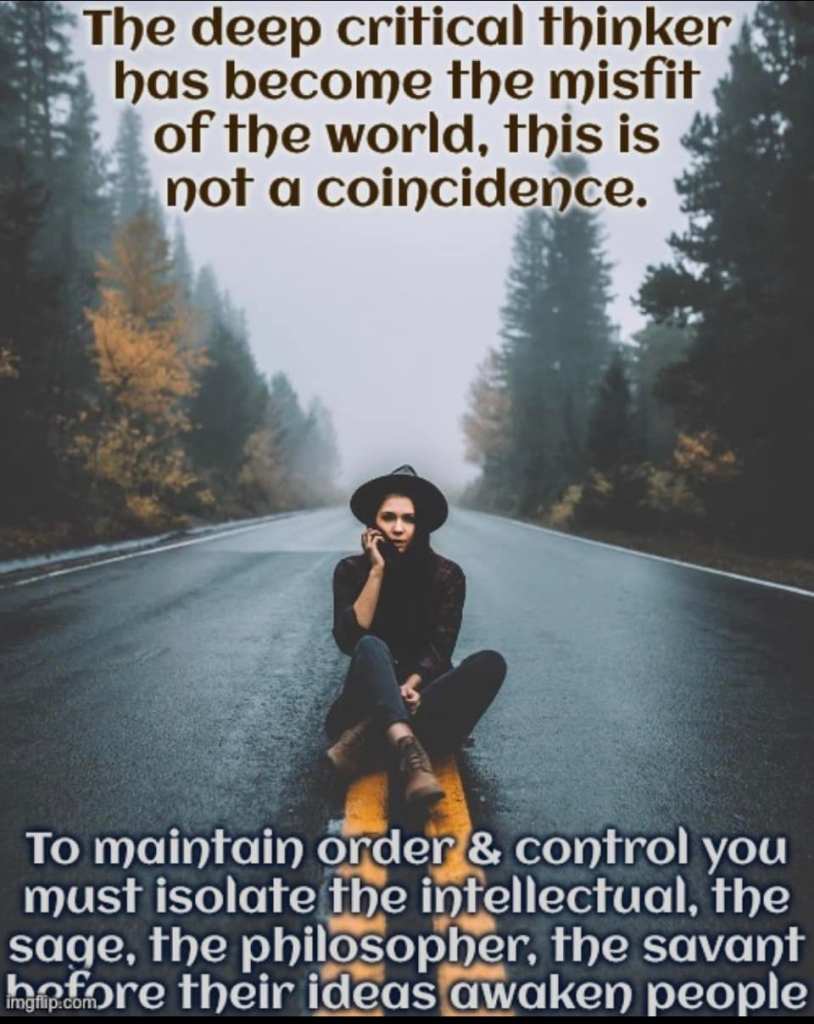
Unfortunately, it was a ‘deep critical thinker’ who had come up with this idea in the first place. That ‘if you want to control, you need to isolate the intellectual’.
A ‘plain-clothes man’ doesn’t think in these therms!
Let me rephrase the whole thing.
I am rational. Which means that all my conclusions are valid. Simply because I have reached them in a rational manner. Hence all other conclusions are wrong. For the simple reason that they are different from mine. Since they are wrong, they should not reach their audience. For they might displace my conclusions from the public mind! Which brings me to the conclusion that if I want to conserve my position – as the official thinker – I must make it so that all other intellectuals must be isolated from the public. Only I need to dress up this conclusion as if it was about the greater public good.
And this is why Protagoras of Abdera and Socrates had been banished from the forum. Why Plato maintained that before being allowed to rule the philosopher-kings had to be specially trained for the mission. Taught to keep an open mind towards alternatives! Why Marxism, Fascism and all other authoritarian lines of thinking lead those who pursue them into the same dead-end. Into abject failure…
Cine a mai văzut mămăligă încălzită pe o plită rece? Și cine s-ar apuca să pună mămăligă direct pe plită înainte de a curăța bine praful depus de vreo 10 ani?
History doesn’t go anywhere. It pesters us with lessons. Until we figure out their meanings. Or until there’s no one left. No one left to be pestered! Darwin 2.0
One of the recurrent lessons history is peppered with: ‘Imperia always fail. Sooner or later, eventually all imperial social arrangements end up in abject failure. Empires as well as monopolies.’
And no, the Pharaonic empire didn’t last for 3000 years. What happened there was 30 something successive empires. Read dynasties. Whenever a dynasty lost its grip, its empire folded. Whenever a new dynasty took over, it presided over a new empire. Same thing happened in modern France. Same territory, same population, same culture, 5 republics and two empires since 1789. The fact that the last three republics have been consecutive doesn’t merge them into a single one.
Europe has been the scene of a whole host of wars. Some of them worldwide wars. Since the French Revolution, all empires which had attempted to subjugate their neighbors have failed.
Napoleon’s attempt had initiated the German ‘coming together’ and turned Russia’s attention back to Europe. Napoleon the 3rd had helped Bismark to finalize Prussia’s taking over the rest of what we currently call Germany. WWI was started by people who had no clue and put on hold by people who had no vision. Started by imperialistically thinking people who didn’t see any need to evaluate the consequences of their countries going to war and put on hold by (other) imperialistically thinking people who continued the well established tradition. Again, without any attempt to evaluate the consequences. Hence the vanquished - the only vanquished that was still standing at the end of the war, Germany – was presented with a hefty bill. And made to pay crippling war reparations. Which clumsy actions had prepared the scene for Hitler’s advent to power. WWII – or, more exactly, WWI 2.0 – was ended by far wiser decision makers. Who had chosen to integrate the vanquished rather than deepening the trenches. Although fought with ‘softer’ weapons, WWIII – also known as the Cold War – fits perfectly. It was also lost by the aggressor. Not as much won by those resisting as lost by the empire attempting to widen its grasp.
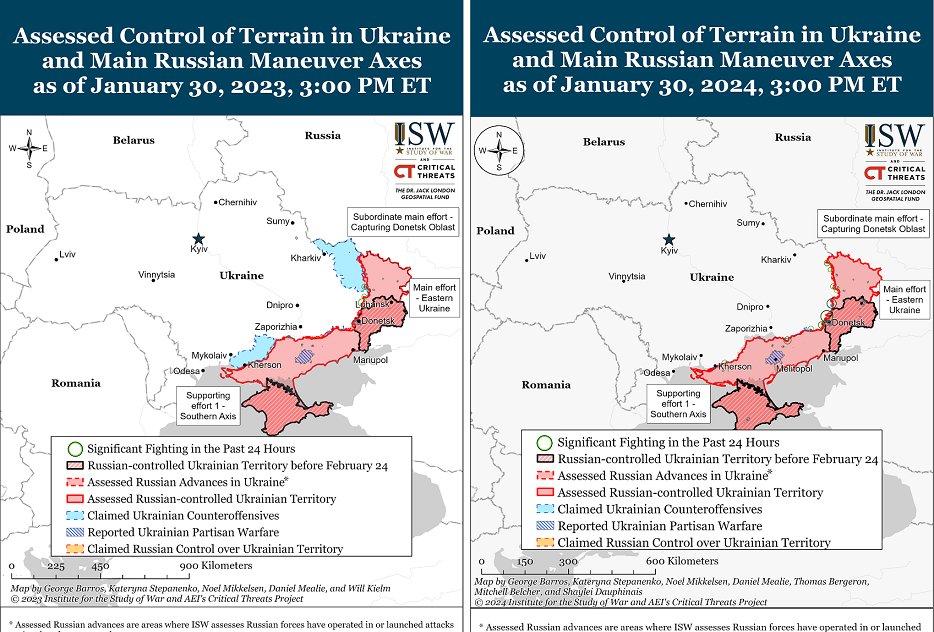
What we currently have on our hands, WWIV, is a ‘pinnacle’. Putin attempting to revive Russia’s ‘old glory’ and the reaction of the ‘free world’ are a case study. And a horrible remake. Mistakes already made since the French Revolution have been reenacted as if never happened. The aggressor failed to realize that at some point his actions will beget a reaction. That even if that reaction will be late, it will surely come about. The ‘good guys’ have forgotten – never really cared to understand? – the lessons of WWI and WWII. No real attempt to integrate post communist Russia into the democratic fold had been made. Not in an organized manner, anyway. Everybody was happy that ‘history had finally reached its end’ and Russia was left to its own devices. Even worse, it was treated as a no-man’s land. Mutatis mutandis, post-communist Russia had been treated just as South America and Africa had been treated after they had been discovered by the Europeans. Even worse, the ‘good guys’ have forgotten – or had never understood – that a bully has to be stopped early. And that the easiest way to stop a bully is to encourage his ‘sycophants’ to free themselves from his influence. And to help, in earnest, those who are bullied to overcome their plight.
Now, almost two years after the aggression organized by Putin against Ukraine has become ‘hot’, there still are people who consider Ukraine should negotiate. Should accept the inevitable. Other consider that helping Ukraine is ‘money down the drain’. That there’s no way for Ukraine to win.
The way I see this, we’re back in 1942. Nazi troops were controlling most of Europe and most of North-Africa. But the signs were already there. Russia, nor Britain, didn’t collapse under the onslaught. The nazis had been driven out from Moscow’s suburbs and Leningrad remained out of reach. From there on… Hitler kept making stupid moves. Until the Third Reich crumbled under its own weight. Helped by the Allied bombardments. And let’s not forget the huge amount of western weapons and munitions shipped by Russia’s then allies to Murmansk. Nor those hauled using the Iranian railway.
Now. Will we relearn the lessons which are readily available to us? The lessons we should have already learned? What’s keeping us? Does anybody still think Putin, or any other dictator, will ever stop? Tired of waiting? Be glad Ukraine isn’t. Be glad Ukraine isn’t tired of fighting!





 nicichiarasa