That all things, at least those belonging to the real world, have a certain thickness… is a truism.

Yet so often we ignore this evidence and relate only to the appearance we are looking at.
At a given moment.
By chance, by design or by negligence.

Take for instance Marine le Pen’s ascension to the second tour in the French elections.
Quite a number of ‘pundits’ put the ‘blame’ for this squarely on ‘Bruxelles” shoulders. Including her and her followers. And, not at all surprisingly, Trump and Putin.

And not without reason!

After all the EU bureaucracy, headquartered in Bruxelles, is responsible for many of the consequences brought upon our heads by the very existence of what is currently known as the European Community.
what we gonna do

Click on the bloody picture, will ya!

First of all let me remind you what brought about the current edition of the ‘European Project.’

OK, it has been attempted before. By the Romans, by Charlemagne, by Napoleon, by Hitler… and don’t tell me that Putin wouldn’t love to be ‘crowned’ as The European Leader.

The problem is that all those attempts had started as individual initiatives and had happened to be ‘against the grain’. As in those who had to shoulder the burden for it didn’t see any benefit from it coming to life.

A small parenthesis. There is nothing ‘unnatural’ for strong willed individuals to try to widen their domination to the farthest possible corner. It had happened when and where ever geographical and historical conditions had allowed it.
The problem is that all imperia have eventually failed, usually in an abysmal manner. History is so full of examples that I won’t bother presenting any.

This edition of the European Project has started out of necessity.

At the end of WWII the continent was in a state of disarray.
The West was mired in self doubt and extremely tired while the East had experienced both the German occupation and the blessings of being liberated by the Soviets.

Understanding that Europe had to be helped, or else – it could have been, in a short while, overwhelmed by the Soviets, America had drafted the Marshall Plan.
For the sake of efficiency, the Americans had asked the Europeans to organize themselves at the receiving end. The Europeans responded by calling a Conference for European Economic Co-operation. It would be beyond the scope of this post to get into further details but this was the start of the Organisation for European Economic Co-operation which a short while later had set the stage for the European Coal and Steel Community – the precursor of the present-day European Community.

As we all know, the project has fulfilled its intended goals.

Europe has recovered nicely and the Soviet Union was contained.

‘But you haven’t mentioned, at all, the (professed?) reason for which the European Community was forged in the first place! To make sure that Europe will never again be drenched in blood as a consequence of war!’

Yes, this had indeed been the professed motive, “The European Union is set up with the aim of ending the frequent and bloody wars between neighbours, which culminated in the Second World War“.
It did its job, briliantly, only it was just a ‘marketing gimmick’. Ever since the Soviet Union had started to export, by force, its particular brand of (extremely authoritarian) socialism to the countries under its ‘sphere of influence’ it had become abundantly clear that the rest of Europe had only two alternatives. Stick together in order to be able to fend of the Soviets or be gobbled up piece by piece.
Fighting among themselves? In those conditions? Not even Stalin could have dreamed of something like that…

Why did America continued to help?
First of all, they were already heavily invested here. Just think of it. To save Europe from  the Nazis only to allow the Soviets to occupy it… doesn’t make much sense, does it?

Then why are so many trying to tear it apart now? From inside as well as from outside?

You don’t have to be a rocket scientist to understand Putin’s motives so I won’t waste any of your time on this.

It’s a little bit harder to understand the Americans who wish the European Project would fail. After all we are their most important trading partner AND their closest ideological neighbor. I used ‘neighbor’ on purpose, instead of ‘friend’.

Distant neighbor, I have to add…

You see, being protected by two oceans and by a very effective ‘nuclear umbrella’ may induce a certain feeling of coziness… just remember how long they had waited before intervening in WWI and WWII. Add to that the fact that people’s memories are very short and you’ll understand why the ordinary Americans do not care much for what is going on this side of the Atlantic.
Why are some of the American ‘plutocrats’ weary of the EU and rather friendly towards Putin? For the very same reason for which their peers had done business with Hitler, even after the start of the war…. Some of them might still be convinced that their corporations would be more profitable under an authoritarian regime than under a more democratic one. And since Putin makes the right noises…

And we have reached now the really tricky part.
Why on Earth are some people trying to tear apart the EU from the inside?!?

One might very well consider they, or at least some of them, constitute a post-Soviet fifth-column, meant to destabilize Europe and make it more susceptible to be influenced by Putin and his eventual heirs.

Since I cannot prove any of this, one way or the other, I’m going to use a different tack.

History teaches us that people commit mistakes for two reasons. Alone or in conjunction: Lack of adequate understanding of the matter and/or callousness.

Take your pick: Quisling, Petain, Lord Haw-Haw… but don’t forget Daladier, Chamberlain and also von Papen.

But there’s a catch.
No amount of stupidity and/or callousness on the part of any of the politicos may produce any damages unless the situation is ‘right’. Or ‘ripe’?!?

You see, all these jerks had been able to make their ultimately stupid moves simply  because the social yarn had already been messed up by a long line of political, and economic, blunders. From the French insistence that the Germans pay huge war reparations after WWI to, but not exclusively, the Fed mishandling rates during the ’20es and the 30es.

The current situation is nowhere near as bad as it was before WWII but does share with that a couple of converging points.

To be continued
If we don’t believe in freedom of expression for people we despise, we don’t believe in it at all.

There’s plenty to criticize about the mass media, but they are the source of regular information about a wide range of topics. You can’t duplicate that on blogs.

The elections are run by the same industries that sell toothpaste on television.

Changes and progress very rarely are gifts from above. They come out of struggles from below.

There’s very little dislike of Americans in the world, shown by repeated polls, and the dissatisfaction – that is, the hatred and the anger – they come from acceptance of American values, not a rejection of them, and recognition that they’re rejected by the U.S. government and by U.S. elites, which does lead to hatred and anger.

It is easier to go to the Internet than to go to the library, undoubtedly. But the shift from no libraries to the existence of libraries was a much greater shift than what we’ve seen with the Internet’s development.

Romania, which had the worst dictator in Eastern Europe, Ceausescu, he was a darling of the West. The United States and Britain loved him. He was supported until the last minute.

Free speech has been used by the Supreme Court to give immense power to the wealthiest members of our society.

As a tactic, violence is absurd. No one can compete with the Government in violence, and the resort to violence, which will surely fail, will simply frighten and alienate some who can be reached, and will further encourage the ideologists and administrators of forceful repression.

Anarchism means all sort of things to different people, but the traditional anarchists’ movements assumed that there’d be a highly organized society, just one organized from below with direct participation and so on.

In ideal form of social control is an atomised collection of individuals focused on their own narrow concern, lacking the kinds of organisations in which they can gain information, develop and articulate their thoughts, and act constructively to achieve common ends.

Governments are not representative. They have their own power, serving segments of the population that are dominant and rich.

I remember at the age of five travelling on a trolley car with my mother past a group of women on a picket line at a textile plant, seeing them being viciously beaten by security people. So that kind of thing stayed with me.

State formation has been a brutal project, with many hideous consequences. But the results exist, and their pernicious aspects should be overcome.

In the literal sense, there has been no relevant evolution since the trek from Africa. But there has been substantial progress towards higher standards of rights, justice and freedom – along with all too many illustrations of how remote is the goal of a decent society.

If you ask the CEO of some major corporation what he does, he will say, in all honesty, that he is slaving 20 hours a day to provide his customers with the best goods or services he can and creating the best possible working conditions for his employees.

Occupying armies have responsibilities, not rights. Their primary responsibility is to withdraw as quickly and expeditiously as possible, in a manner determined by the occupied population.

It’s dangerous when people are willing to give up their privacy.

The doctrine that everything is fine as long as the population is quiet, that applies in the Middle East, applies in Central America, it applies in the United States.

In the United States, we can do almost anything we want. It’s not like Egypt, where you’re going to get murdered by the security forces.

Not all his ideas sound as outlandish as some want us to believe, do they?

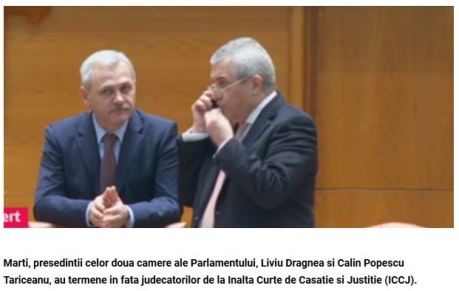
dragnea tariceanu

Tocmai ce m-am impiedicat de articolul asta pe Facebook.

Imediat mi-am adus aminte de intrebarea adresata de Basescu contracandidatului sau Nastase:

“Mai, Adriane, ce blestem o fi pe poporul asta de a ajuns pana la urma sa aleaga intre doi fosti comunisti?”

Sa fie oare vorba despre blestemul urnei de vot?

In fata careia nu reusim odata sa ne urnim “de sub poala lui Tatuca”?

Adica de sub “obișnuința … de a ‘cauta lumină’ la instanțe percepute a fi superioare nouă“?
Sa renuntam odata la “siguranța pe care multi dintre noi o simt atunci când ‘la cârma lucrurilor’ se află o figură paternă care promite rezolvarea tuturor problemelor și care dă impresia că îi pasă“?

In ce alt mod poate fi explicat cum de “Iliescu a fost ales cu atât entuziasm în 1990 și mai ales cum de a fost reales în 2000 după ce Constantinescu a interpretat o cu totul și cu totul altă partitură“?
Sau “alegerea ‘popularului’ Băsescu în fata ‘apretaților’ Năstase și Geoană“?

Uite ca nici de data asta ‘nu s-a putut’…

Ascultandu-i pe salvamontistii care i-au scos din munte pe supravietuitorii tragediei din Retezat mi-am adus aminte de prima echipa care a reusit sa urce pe Chomolungma.

Pana la venirea englezilor, pentru localnici muntii erau doar ‘acasa’. Locul in care traiau si potecile pe care transportau marfa dintr-o parte in alta a granitei ce separa, si separa inca, India de China. Stiau locurile ca-n palma si nici macar nu isi pusesera problema sa urce pe crestetul ‘gainii celei mari’. (Se pare ca asta inseamna, in realitate, Chomolungma. O alta varianta, sugerata de mama lui Tensing Norgay, ar fi  “muntele atat de inalt incat nici o pasare nu poate zbura deasupra lui”.)

Ceea ce pentru englezi – care nu prea au munti pe la ei pe acasa, a fost o provocare – cel mai inalt munte din lume, pentru serpasi era doar cel mai ‘larg’ – si cel mai greu de ocolit. De unde si porecla “Big Fat Hen“.

Si atunci? Sa fi fost intregul efort de a urca pe Everest doar un moft? Al unor colonisti plictisiti?

Eu prefer sa il privesc ca pe un succes al colaborarii!
O echipa mixta. Unii au adus imboldul catre nou si necunoscut iar celalti expertiza intima cu privire la realitatea locului. Impreuna au reusit. Ceva ce unii n-ar fi putut face  singuri si  ce nici macar nu le-a trecut prin cap celorlalti.
Atat ascensiunea initiala cat si, poate mult mai important, transformarea ‘gainii celei grase’ din cel mai greu de ocolit munte din lume intr-o closca cu oua de aur.
Asta avand in vedere contributia turismului, inclusiv cel montan, la PIB-ul Nepalului. Pentru chinezi n-o fi atat de important … dar nu despre ei este vorba aici.

Intorcandu-ma la Retezatul nostru, si reascultandu-i pe cei de la Salvamont, trebuie sa iau in discutie modul in care actioneaza fiecare dintre cele doua categorii de oameni: exploratorii care incearca sa mareasca aria definita de barierele fizice si fiziologice care ne limiteaza si salvatorii care vin dupa noi atunci cand am cazut de partea ‘gresita’ a acelor bariere.

Nici nu stiu pe cine sa admir mai mult. Pe ‘exploratorii’ care, dupa ce toate ‘varfurile’ au fost cucerite, au inceput sa exploreze, de fapt, limitele organismului uman sau pe salvatorii care, cu netarmurita rabdare, isi pun expertiza, si sanatatea, la bataie. Si le ofera exploratorilor siguranta ca va veni cineva dupa ei. Daca, sau mai bine spus ‘cand’, ‘se intampla ceva’.

Poate ca exploratorii, din entuziasm?, sa fi impins putin cam tare limitele… sa duci copii pe varful muntelui doar de dragul ‘aventurii’ …

“Ne-am bagat cum am putut in resturile de panza care le-am recuperate, izoprenele le luase vantul, sacii i-am recuperate, plini de zapada. si am stat cred ca inca o noapte acolo. Inghetasem, nu sa deger, tata degerase la maini.

Imi era frica, batea vantul si ma rostogolea peste tata. Ma gandeam ca o sa m-arunce peste el si o sa alunecam la vale, asa ca incercam sa stau contra vantului sa nu ma miste! Ne foiam pentru a ne incalti cat de cat, miscam intai picioarele apoi din corp, numaram.

[…]

La un moment dat am inceput sa plang, imi era frica, eram inghetata si vroiam acasa! Parca auzeam ceva zgomote in noaptea de cosmar, dar credeam ca deja am halucinatii, asa ca nu ne-am facut sperante.”

Dar cine sunt eu sa judec?
Pana la urma nu asta e rolul ‘exploratorilor’? Sa intinda ‘coarda la maxim’?

Si nu asta e rolul nostru, al celor care pretindem ca ‘salvam’ lumea de propriile ei excese?
Sa ii asteptam pe exploratori cu bratele deschise si sa le oblojim ranile?

Bine, in masura in care explorarile lor nu ne pun tuturor viata in pericol… dar asta e alta problema.

Si nu este cazul aici!

Teoria clasica sustine ca piata cu adevarat libera este singura care reuseste sa ramana in echilibru pe termen nelimitat.

Tot aceasta teorie mai sustine ca orice interventie a statului pune in pericol libertatea pietei si, inevitabil, introduce dezechilibre.

Sa vedem ce se intampla pe o piata reala. A Travatanului, de exemplu.

Pentru cine nu stie, acesta este un medicament – niste picaturi – pentru glaucom. Recent substanta activa, Travoprost, a fost certificata de catre FDA si ca un adjuvant al cresterii parului. Pot certifica ambele proprietati. Glaucomul nu a progresat de cand folosesc aceasta substanta, genele aproape ca mi s-au dublat ca lungime iar barba a inceput sa mi se ridice pe obraz pana aproape sub ochi – partea neagra.

Selfie

In realitate nici o piata, si cu atat mai putin cea a medicamentelor, nu este cu adevarat libera. Influenta statelor se manifesta sub diverse forme.
Medicamentele incep prin a fi protejate de un patent. O chestie foarte normala de altfel. Fara existenta patentelor nimeni nu s-ar mai chinui sa cerceteze si sa dezvolte ceva.

Pe de alta parte, la adapostul patentelor unele dintre firme isi maximizeaza profitul, dincolo de orice ratiune de natura ‘economica’. Pentru ca pot.

Iar patentele sunt ‘aparate’ de catre stat.

Numai ca interventia statului nu se opreste aici.

Chiar si statele cele mai (neo) liberale – cum ar fi America, de exemplu – preiau o parte din costurile asistentei medicale, macar pentru o sectiune din populatie. Pentru cei peste 65 de ani si pentru copii, de exemplu, in SUA. Din postura de cel mai mare cumparator de medicamente statul devine in felul acesta si cel care ‘da tonul’ pe piata, in afara de protector, prin intermediul patentelor si a reglementarilor de acces po piata, a producatorilor deja consacrati.

Sa vedem cum functioneaza chestia asta in Romania.
Aici statul negociaza, pe baza unor legi, cu marii distribuitori de medicamente.
Pe de o parte in calitate de cumparator (Casa de Asigurari suporta medicamentele din spitale precum si compensatia) si pe de alta in calitate de ‘protector al populatiei’.
Iar legea, de fapt o hotarare de guvern, prevede ca pretul medicamentelor vandute in Romania sa fie la nivelul cel mai de jos practicat in cateva dintre tarile din restul Comunitatii Europene.
O hotarare cat se poate de logica. Avand veniturile cele mai mici pe cap de locuitor din Comunitate ar fi imoral sa platim mai mult decat platesc cei mai bogati decat noi.

Plecand, totusi, de la premiza ca producatorul/distribuitorul obtine un oarece profit din toata chestia asta.

Ei bine, din momentul asta lucrurile se complica rau de tot.
S-ar putea ca producatorul/distibuitorul respectiv sa nu scoata profit pe piata luata ca referinta dar sa continue sa o aprovizioneze din motive de marketing. Care s-ar putea sa nu fie valabile si in Romania.
Ar mai fi posibil si ca productia sa fie impartita in doua fabrici, cu costuri diferite. Iar producatorului sa ii convina mai mult sa inchida una dintre ele si sa nu mai aprovizioneze una dintre pietele cu pret minim.

Colac peste pupaza apare si fenomenul ‘exportului paralel’.
La nivelul anului 2015 20% din medicamentele importate in Romania – la preturi ‘negociate’ (in jos) de catre stat au fost reexportate catre alte tari din Comunitatea Europeana
. Presand, tot in jos, preturile de pe acele piete si scazand cu atat mai mult ‘entuziasmul’ marilor producatori/distribuitori de a mai livra unele dintre aceste medicamente pe piata din Romania. O rezolvare de urgenta/temporara a fost blocarea reexportului pentru unele substante dar asta este doar un ‘paleativ’.

Si pentru ca toate astea nu erau suficiente, pe masa Presedintelui Iohannis asteapta sa fie promulgata o lege prin care Parlamentul a permis oricarei farmacii din Romania sa exporta in restul comunitatii medicamente cumparate, la preturi mici, de pe piata interna.

Hai sa facem o ‘recapitulare’.

Principiul ‘Pietei Libere’ este extrem de valabil. Atunci cand poate fi aplicat in mod real acesta da rezultatele scontate.
Dar daca nu poate fi aplicat in integralitatea sa – si in cazul medicamentelor se pare ca ar fi chiar imposibil – atunci hai sa reglementam pana la capat!

Daca ne oprim la jumatatea drumului, si cu un picior in aer, am ajuns intr-o situatie ‘mai rea’ decat la inceput!

Adica am incalcat insusi principiul de baza de la care incepe medicina.

Primum non noccere. In primul rand sa nu strici ‘mai rau’.

Banuiesc ca ati inteles deja ca pe piata romaneasca nu se mai gaseste Travatan.
Am gasit un inlocuitor, Bondulc, numai ca are alti excipienti – adica substantele puse pe langa substanta de baza.
E mai ieftin, intr-adevar, dar de ce sa schimb ceva cu care pana acum mi-a mers bine?
Si nu e vorba despre o crema pentru bataturi…

Si inca ceva.
Cum or putea dormi noaptea cei care fac specula cu medicamente?
Pana la urma nu e acelasi lucru sa vinzi, la preturi babane, parfumuri unor cucoane de lux sau sa te imbogatesti luand medicamentele ieftine din noptiera saracilor pentru a le vinde unora care, de fapt, le-ar putea cumpara si la preturi putin mai mari!
Cat priveste intrebarea ‘de ce ni se pare normal ca medicamentele sa fie considerate, de majoritatea celor implicati, o “marfa” ca toate celelalte?’… ce sa mai vorbim…

PS. Cu cativa ani in urma, atunci cand am aflat ca am glaucom – boala care trebuie tratata pana in ‘ultima clipa’ – m-am intrebat ‘si ce dracu’ o sa fac daca incepe un razboi?’
Uite ca obsesia generalizata pentru bani – la care contribuim, de fapt, cu totii – poate produce ‘neplaceri’ si in absenta unui razboi ‘cald’.

Doi copii, alpinisti experimentati, au urcat pe munte. In Retezat. Acolo unde cel mai inalt varf, Peleaga, are putin peste 2500 de metri.
Fiecare dintre ei urcase deja nu stiu cate virfuri de cel putin doua ori mai inalte.
Erau insotiti de tatii lor, si ei oameni ai muntelui cu ‘vechi state de plata’.
Cu toata experienta lor, intreg grupul a fost surprins de o avalansa. 7 oameni au ajuns in prapastie. Doi dintre ei, cei mai tineri, au fost coborati de pe munte cu picioarele inainte.

Toate acestea au starnit o vie emotie.

Si comentarii acerbe pe net.

“Copiii nu sunt trofee. Şi nici nu trebuie să le obţină ca să le gâdile orgoliul părinţilor.

E drept că nu e doar vina lor că s-a ajuns aici. Este vina noastră, a tuturor, care îi ridicăm în slăvi şi îi glorificăm, fără să ne gândim la riscuri. E adevărat că primii care trebuie să facă asta sunt părinţii. Dar dacă ei sunt prea orbi ca să facă asta, atunci noi măcar n-ar trebui să îi încurajăm. Şi nu e vorba de alpinism. E vorba de orice, de sport, de şcoală, de olimpiade. De presiunea disperată pusă asupra copiilor care trebuie să îşi depăşească părinţii. De competiţia constantă la care îi supunem. Mai întâi noi, comparându-i cu cei din jur. Apoi toţi ceilalţi, care fac exact acelaşi lucru.

Da, e bine să încurajezi copilul să se autodepăşească, să vrea mai mult. Dar tu eşti obligat să îi asiguri integritatea fizică şi psihică.

Iar eu prefer să am un copil mediocru, dar sănătos şi fericit decât unul care doboară recorduri dar moare înainte de vreme.”

Avem de a face aici, suprapuse, cele trei tare ale lumii moderne.

Obsesia pentru maximizarea rezultatului, spiritul de competitie dus dincolo de limita rezonabilui si credinta ca nimic nu poate fi mai presus de concluzia la care am ajuns in urma unui proces de gandire, presupus ‘rational’.

Cel mai tare am fost impresionat de convingerea mamei de mai sus ca preferinta ei pentru un copil viu, fie el si mediocru, are precedenta in fata dorintelor copilului.
Cum o putea fi fericit un copil a carui datorie primordiala este sa ramana, cu orice pret, ‘sanatos’? Bine, extrema cealalta este si ea cel putin la fel de imposibila – un copil, la fel ca toti ceilalti oameni, trebuie sa fie viu pentru a se putea bucura. De orice.

De unde si intrebarea care nu imi da pace de cand am terminat de citit articolul.
Care o fi diferenta intre a impinge un copil pe crestele muntilor si a-l tine legat de fusta mamei?

De unde vine siguranta noastra atunci e vorba despre viitorul copiilor nostri?

Si de unde obsesia asta a noastra pentru ‘recorduri’?
Fata, Dor Geta Popescu, la 13 ani avea deja “8 recorduri mondiale de vârstă, la alpinism de altitudine” iar baiatul, Erik Gulacsi, “a stabilit un nou record european de vârstă când a atins vârful Aconcagua (6.962 metri), la doar 12 ani“. In Ianuarie 2017.

Cristina Bazavan ne indeamna sa nu ne mai miram cand au loc astfel de tragedii daca ne bucuram ‘copios’ atunci cand protagonistii lor stabilesc recordurile. E de-a dreptul schizofrenic sa te miri de rezultate atunci cand incurajezi nefirescul.

Cu asta am ajuns la actiunea in sine.
La doborarea de recorduri ca scop in viata.

Practica, montana dar nu numai, ne-a demonstrat de prea multe ori ca daca vanezi recorduri, ajungi – mai devreme sau mai tarziu, in prapastie.
Singura metoda sa supravietuiesti in domenii de genul asta este sa ‘lasi recordurile sa vina la tine’.
Adica sa faci ce-ti place, pastrand siguranta, a ta si a celorlalti, pe primul plan.
Daca vin, recordurile, bine. Daca nu… macar ai fost acolo – cat mai aproape ‘de varf’, te-ai intors si acum ai ce povesti.
Si nu, nu cred ca a sta acasa, conform principiului ‘sa nu te pui in calea primejdiei’, e o solutie care se potriveste tuturor. Unora li s-ar putea usca sufletul. De Dor.

Totul tine, de fapt, de capacitatea fiecaruia dintre noi de a-si gasi echilibrul. Pe creasta muntelui, intre dorinta de ocrotire a puiului si mandria parinteasca, intre credinta ca le stim pe toate si adevarul ca nu stim, de fapt, mare lucru.

Si, pentru a putea face asta – asa cum frumos spunea Cristina Bazavan, ne-ar ajuta foarte mult “sa ne odihnim putin mintile si sufletele“.


“It is a very difficult decision for all parents because we live in a society that values profit over public health.”

“It’s more like listening to what other mothers were saying…
There was a … huge amount of evidence that it was harmful. Even if there weren’t ways that we could scientifically prove it, it was just talking from one mother to another.”

“Doctors do not do their own research, they are heavily brain-washed when they end school  with this idea that it is all good and then they do not question it much themselves”.

“A beautiful child went to have a vaccine and came back and a week later he had a tremendous fever, got very, very sick and now is autistic”

vaccine sceptic island

Well, the scope of this post goes way beyond the dispute between the vaxxers and the skeptics.

As a matter of fact, at face value all the four quotes I started with are spot on.

Most autistic children living in the so called civilized world have been immunized before having been diagnosed, both the doctors and the anti-vaxxers have been ‘brain-washed’ by their peers into holding to their current beliefs while very few of them have conducted any independent scientific research into the matter and yes, we do seem to live in a society which values profit over public health.

What next?

Ayn RAnd

Ayn Rand in 1957: her novels The Fountainhead and Atlas Shrugged earned her a cult-like following, dubbed the Collective. Photograph: New York Times Co./Getty Images


“But Rand’s philosophy of rugged, uncompromising individualism – of contempt for both the state and the lazy, conformist world of the corporate boardroom — now has a follower in the White House”

So.
The author tells us that Rand despises both (big) government and the ‘corporate boardroom’. He also tells us that the current American President shares the same convictions. I might agree about Trump despising ‘corporate boardrooms’ but I have a definite feeling about Trump having nothing against the notion of ‘big and powerful corporations’ (specially those he controls personally).
“Born Alisa Zinov’yevna Rosenbaum in 1905 in St Petersburg, Russia, she saw her father impoverished and her family driven to the brink of starvation by the Soviet revolution, an experience that forged her contempt for all notions of the collective good and, especially, for the state as a mechanism for ensuring equality.”
It looks like Ayn Rand hated (big) government simply because the Soviet one had failed to deliver what it had promised… And that she had lost confidence in the notion of ‘common good’ for the very same reason…
The problem is that trusting the Soviets, or any other authoritarian regime, is childish to start with…. well then, maybe we shouldn’t wonder about her reaction…
Further more, expecting the government, any of them, to ‘ensure equality’ is even worse! Governments are meant to ‘maintain order’, not to decide the outcome of the game…Regardless of what some of those who climb to power seem to believe!

As for rejecting the very notion of common good, that means rejecting capitalism itself.
“It is not from the benevolence of the butcher, the brewer, or the baker that we expect our dinner, but from their regard to their own self-interest. We address ourselves not to their humanity but to their self-love, and never talk to them of our own necessities, but of their advantages”
If each of those ‘professionals’ didn’t see their personal interest as being conjoint with the ‘common good’ each of them would have tried to double-cross the others. The baker would have tried to use the worst possible flour, the brewer to sell whatever stinking concoction while the butcher would have tried to pass rotten dogs as dry cured beef.

Oh, that’s what’s currently going on in our no longer free market?

Then maybe Rand was a prophet, after all….

“Put more baldly, the reason why Republicans and British Conservatives started giving each other copies of Atlas Shrugged in the 80s was that Rand seemed to grant intellectual heft to the prevailing ethos of the time. Her insistence on the “morality of rational self-interest” and “the virtue of selfishness” sounded like an upmarket version of the slogan, derived from Oliver Stone’s Wall Street, that defined the era: greed is good. Rand was Gordon Gekko with A-levels.”


“Talking about morality in a class about nationalism is sort of like talking about modesty in a swingers club or moderation in a crack house.”

John Faithful Hammer

Absolutely brilliant observation!

I haven’t tried swinging but I imagine that each of the participants does exert a certain form of ‘modestly’, otherwise they would be rapidly kicked out by the rest.
Similarly, no crack addict would survive even his first ‘session’ without being actually ‘moderate’.

As for ‘nationalism’… well, there is nothing wrong when people stick together in an attempt to lead a decent life, in close cooperation with the other nations.
Nationalism becomes dangerous, a.k.a. immoral, only when the people promoting it attempt to lead a (more) than decent life at the expense of all those who happen to live around them. The ‘funny’ part being, of course, the fact that this kind of nationalism invariably leads to tragedy. Mostly for those foolish enough to ‘swallow’ it, but not exclusively.

“The law of unintended consequences, often cited but rarely defined, is that actions of people—and especially of government—always have effects that are unanticipated or unintended. Economists and other social scientists have heeded its power for centuries; for just as long, politicians and popular opinion have largely ignored it.” (Rob Norton, Unintended Consequences, econlib.org)

“All your private online data—the websites you visit, the content of your chats and emails, your health info, and your location—just became suddenly less secure. Not because of hackers, but because Congress just blocked crucial privacy regulations. This will allow your internet service provider to collect all your data and sell that info to the highest bidder without asking you first. Welcome to a brave new world.” (Eric Limer, How to Protect your Online Privacy now that Congress Sold You Out, zerohedge.com)

The rest of Limer’s article, which you can read by clicking on the quote above, is about what each of us might do if he cares enough about the privacy of his browsing data. Instruct your ISP that you do not authorize it to sell your data, change to a more privacy-friendly one – if possible, encrypt your communication, use a VPN, use Tor to browse the Internet or any combination of the above.

Since I already had at least a vague idea about most of those but I had never before even heard of Tor I checked it out first.

“The Tor network is a group of volunteer-operated servers that allows people to improve their privacy and security on the Internet. Tor’s users employ this network by connecting through a series of virtual tunnels rather than making a direct connection, thus allowing both organizations and individuals to share information over public networks without compromising their privacy. Along the same line, Tor is an effective censorship circumvention tool, allowing its users to reach otherwise blocked destinations or content. Tor can also be used as a building block for software developers to create new communication tools with built-in privacy features.

Individuals use Tor to keep websites from tracking them and their family members, or to connect to news sites, instant messaging services, or the like when these are blocked by their local Internet providers. Tor’s hidden services let users publish web sites and other services without needing to reveal the location of the site. Individuals also use Tor for socially sensitive communication: chat rooms and web forums for rape and abuse survivors, or people with illnesses.

Journalists use Tor to communicate more safely with whistleblowers and dissidents. Non-governmental organizations (NGOs) use Tor to allow their workers to connect to their home website while they’re in a foreign country, without notifying everybody nearby that they’re working with that organization.

Groups such as Indymedia recommend Tor for safeguarding their members’ online privacy and security. Activist groups like the Electronic Frontier Foundation (EFF) recommend Tor as a mechanism for maintaining civil liberties online. Corporations use Tor as a safe way to conduct competitive analysis, and to protect sensitive procurement patterns from eavesdroppers. They also use it to replace traditional VPNs, which reveal the exact amount and timing of communication. Which locations have employees working late? Which locations have employees consulting job-hunting websites? Which research divisions are communicating with the company’s patent lawyers?

A branch of the U.S. Navy uses Tor for open source intelligence gathering, and one of its teams used Tor while deployed in the Middle East recently. Law enforcement uses Tor for visiting or surveilling web sites without leaving government IP addresses in their web logs, and for security during sting operations.

The variety of people who use Tor is actually part of what makes it so secure. Tor hides you among the other users on the network, so the more populous and diverse the user base for Tor is, the more your anonymity will be protected.” (Overview, Torproject.org)

Living the first 30 years of my life under communist rule taught me a lot of interesting things. Which seemed specific to that kind of society but which, paradoxically – only in an ostensible manner, are increasingly helpful when I struggle to understand what’s currently going on in the ‘free world’.
Among those things was the fact that ‘blanket surveillance’ doesn’t work. The communists were reputed for shamelessly listening in to our phones but we had learned very fast to talk in a coded manner, to refrain from speaking about certain subjects over a wire AND that they could never hire enough people to listen to everything that was said over the phone.
And this is why most dissidents were ‘smoked’ out almost exclusively by snitches – paid ‘traitors’ employed by Securitate to spy on us and presented by the communists as being ‘concerned citizens’.

Less than thirty years after the fall of most communist regimes we have an almost similar situation. ‘In the mirror’ kind of similar.

The Internet is the medium through which a lot of information is being circulated, some of it of very sensitive nature. Sensitive as in ‘personal’ but also as in potentially very disruptive. For corporations, for political organizations, for states but also for terrorist organizations.

Up to a few weeks ago the Internet was divided in two, very unequal, sections.
A mostly open one, where most of us – who do not have much to hide – used to dwell and one which was a lot more ‘walled in’. (A.K.A. heavily encrypted and tortuously rerouted)
The mostly open section was the hunting ground for the ‘advertisers’ while the ‘encrypted’ one was the playing ground where the ‘dissidents’ (of all ‘persuasions’) played cat and mouse with the ‘law enforcers’ (again, of all ‘persuasions’).

For the ‘free world’ this was a workable arrangement. The advertisers could do their job – as long as they stayed inside the rules, the individuals had their most sensitive data protected, the bona-fide dissidents had a reasonably safe opportunity to express themselves and the bona-fide law enforcers had a reasonably small traffic to sift through when searching for terrorists and all other sorts of law breakers.
For the authoritarian regimes it was not – the very advent of Internet was an abomination for them, but I couldn’t care less. Especially since most of the really proficient people sooner or later realize that authoritarianism simply doesn’t work and eventually ‘change colors’.

I’m afraid the recent changes enforced by the US Congress will unsettle this fragile equilibrium.

As more and more technologically savvy people will start using more and more the ‘walled in’ section of the Interned – not because they have anything really important to hide but to spite the more and more intrusive ‘data thieves’, the bona-fide law enforcers will have more and more difficulties in smoking out the really bad law-breakers. Including the terrorists.

The authoritarian regimes tend to solve these kind of problems by shutting down, or by ‘maiming’, entire systems.
If we, in the free world, will have to resort, even temporarily, to the same solution it will be – including for the advertisers – yet another instance of the golden goose being massacred by the excessively greedy.

“The only one you can really trust to protect you is you.

The short and uncomfortable truth is this: Until more robust privacy protections are put in place, the burden of protecting your online data falls on you. Keep it in mind, do your research, and remember that your monopolized ISP has every reason in the world to sell you out and wring your data for every dime that it is worth. The only one you can really trust to protect you is you.”