Archives for posts with tag: Fascism

And the LORD God said,
Behold, the man is become as one of us, to know good and evil.

After learning godlike skills – after becoming a conscious human being, that is – man has set his sights on the next target.
Apportioning blame. Finding culprits. The only way forward, right? Bulldoze the obstacles away, lose the dead weight and you’ll get there a lot faster.
Where? Where is that elusive ‘there’? We’ll find out about the place when we’ll get there!

If we’ll get there… If we’ll ever get anywhere with that attitude, for that matter!

Researching for this post, I came across Dietrich Bonhoeffer’s Theory of Stupidity.

First things first.
Bonhoeffer was a German theologian who happened to come of age right when Hitler was confiscating political power in Germany. Even though Bonhoeffer belonged to a church which denounced violence, even in self defense, Bonhoeffer eventually joined a conspiracy trying to assassinate the dictator.
“Here the law is being broken, violated,” he deplored. It might be true that “the commandment is broken out of dire necessity,” but to say he broke the commandment of necessity is still to say he broke the commandment. Rather than pretend this was some positive moral good, Bonhoeffer instead threw himself at God’s feet and begged forgiveness for the sin he could not but commit.

In his writings, Bonhoeffer was abundantly clear.

The fact that the stupid person is often stubborn must not blind us to the fact that he is not independent. In conversation with him, one virtually feels that one is dealing not at all with a person, but with slogans, catchwords and the like, that have taken possession of him. He is under a spell, blinded, misused, and abused in his very being. Having thus become a mindless tool, the stupid person will also be capable of any evil and at the same time incapable of seeing that it is evil. This is where the danger of diabolical misuse lurks, for it is this that can once and for all destroy human beings.
‘Yet at this very point it becomes quite clear that only an act of liberation, not instruction, can overcome stupidity. Here we must come to terms with the fact that in most cases a genuine internal liberation becomes possible only when external liberation has preceded it. Until then we must abandon all attempts to convince the stupid person. This state of affairs explains why in such circumstances our attempts to know what ‘the people’ really think are in vain and why, under these circumstances, this question is so irrelevant for the person who is thinking and acting responsibly.


The key concept here, as I read Bonhoeffer’s work, is that external liberation must come first. As a precondition for the ‘internal liberation’. For a shackled individual, reaching a peaceful state of mind is almost impossible. And since nobody can exercise their will in a free manner unless their mind is ‘level’….
Further more, in order to learn one needs an open mind. A free, level and open mind. And being able/willing to learn is the only road out of ‘stupid-land’. The only way to overcome the ‘what I already know is plenty’ attitude.
Only a free individual can choose to independently examine the facts. A shackled one will almost always give up. And accept whatever official version is being shoveled down their throat.

And here’s the catch.
In conversation with him, one virtually feels that one is dealing not at all with a person, but with slogans, catchwords and the like, that have taken possession of him. He is under a spell, blinded, misused, and abused in his very being.

Having grown up, and being socialized, under a communist regime – somewhat different but not entirely from the nazism experienced by Bonhoeffer – I understand how it is to live under symbolical duress. Under a constant deluge of lies. Which were meant to effectively shackle us. Not to educate but to condition us.
During that time, I had also noticed the deluge was poured by intellectuals. The very people who were supposed to do the exact opposite. To enlighten us. To elevate the willing people to the ‘next level’. Teachers, writers, artists … and even clergy. Not all the intellectuals were involved in this process but all those used by the dictating party to destroy both our external and internal freedom did belong to the intellectual caste.

Communism and nazism had been somewhat ‘natural’ occurrences.
Ruthless political operators – evil people, in Bonhoeffer’s words – have noticed an opportunity – the existence of economically distressed people – and used their ‘knowledge of words’ to ideologically shackle those people to symbolical totem-posts.

What is currently going on is akin to a suicide of sorts.
We might believe those who had instated communism and fascism had good intentions. Misguided – to say the least, according to the horrible results attained by those regimes, but well intended naive individuals.
Nowadays, after having already experienced those episodes, we should be threading very carefully…
The same level of popular dissatisfaction, the same level of finger-pointing, of frustration… everything stirred up and brought to paroxysm by the same kind of manipulation.
Propaganda spun by the same kind of callous intellectuals as those involved in the advent of communism and fascism. I call them callous because this time they should know better. It is their job to know these things. For it is the intellectuals who are supposed, according to their social role, to “know good and evil”.

This is why I cringe every time I see/hear/read an intellectual who blames the ‘stupid people’ for what’s going on.
Blaming the ‘others’ for things they have done unwittingly is a huge error. For one simple reason.
It’s self defeating. And, hence, treasonous!
We all, both the ‘stupid’ and the rest of us, need to liberate ourselves. From the “slogans, catchwords and the like, that have” been used to shackle us, all of us, into a state of ideological prostration.

We blame them. They blame us. And those who have planned all this cannot believe how successful they have been.
But for the very shortest of times…
Social uniformity begets ‘morass’. Like water, a society needs to flow in order to remain reasonably clean. To remain functional.
Communism, artificial equality, brings everything to a stand-still.
On the other hand, too much social disparity, too much power concentrated in a very small number of hands while the rest are reduced to a state of prostration, begets revolution. Like a body of water perched on a cliff wanting to climb down, a strung up society will, eventually, find ‘relief’. Sometimes explosively.
It is the intellectuals who need to figure this out. For it is them who fare worst under all dictatorial regimes. Regardless of anything a dictator might promise.

In the 1970s, Carlo Cipolla, a social psychologist, developed FIVE LAWS OF STUPIDITY. The term itself, he said, wasn’t a description of intellectual acuity, but of social responsibility. A stupid person is a person who causes losses to another person, or to a group of persons, while deriving no gain for himself, and possibly incurring losses. Cases in which someone takes an action by which both parties gained, was deemed intelligent.

Cipolla’s words are correct. But incomplete.
Even if the individual who causes losses to others people do it for personal gain, their endeavor is still stupid! Because that ‘thing’ is unsustainable! People taking advantage of other people leads the whole party into a dead-end.
Adam Smith was describing ‘the butcher, the brewer and the baker working for their own personal interest and so driving forward the entire market/society’. The entire society!
Indeed! Only those people were working together!
Not each of them against all others! Those who tried to con their business partners were thrown away!That was the essence of Adam Smith’s free market!
The freedom enjoyed by everybody. The freedom from being swindled.

Do you feel free?


What is going now in China – and in Russia, for that matter –
has nothing to do with the ‘left’.
With what is understood as “left” in Europe…
Instead, it has many similarities with fascism.
‘Corporatist’ states imbued with revindicative nationalism.

Nassim Nicholas Taleb has introduced the concept of “Skin in the Game“.
In short, it is about the fact that the decisions made by people who do not directly and immediately ‘enjoy’ the consequences of their choices have a high probability of being bad. A phenomenon that is accentuated as bad decisions are not immediately sanctioned by those who suffer.

Taleb’s observation only confirms the fact that all dictatorships/authoritarian regimes have collapsed.
Without exception!
Alternatively, it is very easy to see that democracies ONLY last as for long as they manage to maintain their ‘functionality’. That is, for as long as people can – and undertake – to voice their grievances. And for as long as people listen to each other. Respectfully! In vain, some shout about being ‘hungry’ if nobody listens/cares ..

Returning to the idea of ​​’leadership’, yes, countries are led. By some who consider themselves/are considered to be ‘elite’. ‘Led’ only from the operational point of view, however…
Countries are living things, ‘natural selection’ still has the last word!
Ernst Mayr, a biologist, said that ‘evolution is not about the survival of the fittest, but about the disappearance of those who cannot find their ‘right’ place. The misfits. ‘. That’s right, countries have big problems if/when they don’t manage to take down the ‘misfits’ who happen to have clambered into power.
Why countries don’t succeed to do this in a timely manner? How did they clambered there in the first place…
Everything starts when the popular dissatisfaction reaches a critical level. Which dissatisfaction is engendered when the members of that country no longer care for each-other. When mutual respect has disappeared.

I will conclude by returning to the major difference between communism and fascism.
Both of them appeared in situations when enough dissatisfied people were ‘wandering aimlessly’ while looked down by the rest of the society.
Some low-life profiteers seized the occasion and ‘grabbed the helm’. Profiteers who have been able to operationalize the dissatisfaction festering in the society. And the lack of vision of those who hated the others. I repeat myself, both communism and fascism had appeared when various sections of the society despised, and sometimes hated, the ‘others’.
The minor difference consists in the fact that the proto-communist dissatisfied looked up without having any chance to get there, while the proto-fascist ones wanted to return to where they had once been. The Russian muzhiks dying during WWI versus the unemployed German workers who had just lost WWI.

This being where the difference appears.
The difference which makes it hard to recognize what’s going on now in Russia/China as being a form of fascism.
Both the Russians and the Chinese have a lot better lives now than they had under communist rule. Statistically and from the material point of view! Psychologically speaking…
Those who live in well-established democracies – people who respect each other – have a greater tolerance for ‘insecurity’. Each of them knows they can rely on the others. In that environment, failure is temporary. People try as many times as they need to succeed. Or that’s how it used to be…
In communism, we had learned – the hard way, that one was not allowed to make mistakes.
When Russia and China switched to ‘capitalism’ and people saw what could happen to them – to make mistakes while trying – they had become frightened!
And, at least some of them, chose to return – especially psychologically, in the past. Where they felt safe…

What are electron spins:
Electrons are able to spin on an axis, like how the earth rotates on an axis, but much faster. Electrons can spin in either a clock-wise or counter-clock-wise direction. The spin on an electron is described by the spin quantum number (ms). The value of ms can be either +12 or -12. The +12 is called spin-up and denoted by a ↑, where the -12 is called spin-down and represented by ↓. Sometimes the spin of electrons will be described as angular momentum.
Each orbital of an atom can be occupied by up to two electrons. The two electrons will have opposite spins. This phenomenon was first described in the Pauli exclusion principle which states that each electron in an atom is described by a unique set of quantum numbers, including ms.”

Political spin, in politics, the attempt to control or influence communication in order to deliver one’s preferred message.
Spin is a pejorative term often used in the context of public relations practitioners and political communicators. It is used to refer to the sophisticated selling of a specific message that is heavily biased in favour of one’s own position and that employs maximum management of the media with the intention of maintaining or exerting control over the situation, often implying deception or manipulation.

Electrons ‘work’ in certain ways. Science has recently figured out some of those ways.
The point being that electrons keep to themselves. One spins in its direction, the other spins in the opposite direction and no more than two electrons fit in the same ‘orbital’.

People’s minds also work in ‘certain’ ways.
Not as ‘rigidly’ as the electrons but still ‘useful’ for those who know how to exploit this phenomenon.

By constantly pestering people with certain messages, you get to convince at least some of them.
You get to divide them into (political) camps.
You get them to fight among themselves instead of cooperating.
You get to lead them into battle.
And after the battle has been won, by no matter which side, you get to lead the winning party. At least for a while, but that is another subject.

And all lies, aka as ‘half truths’/alternative facts, start from something real.
Capitalism, for as long as the people remain awake, works. As advertised.
Socialism, on the other hand, doesn’t. It had failed, abysmally, whenever and wherever it had been experimented.

But there’s a caveat.

‘Capitalism’ is a rather clear-cut concept. Property belongs mainly to the individuals and individuals trust each-other enough to do business among themselves. Usually – but not always – capitalism is associated with ‘free market’ and democracy. With freedom to act – inside the confines of the law – and freedom to speak up.
I’ll say this again! For as long as the people remain awake, the market continues to be free and democracy still functions, capitalism works. Sustainably. But only for as long as the people remain awake…

‘Socialism’ is rather vague. From ‘public’ (instead of private) property associated with central planning of the entire society to softer versions which sometimes pay lip service to democracy. The central idea of ‘socialism’ being that society comes first and the individual is only a cog.
Who wants to be a cog? Those who see no alternative… Those who, once in a certain set of circumstances and exposed to a certain propaganda, succumb to the Sirens’ song.

The point being that in order to impose ‘socialism’ to a society you need to lure (enough of) the people into an ‘altered state of consciousness’. To make them believe a certain set of rules. To make them behave according to that set of rules.

The interesting part, as usual, comes at the end.
There is a ‘social arrangement’ where property remains private but where the people behave in a ‘certain’ manner. As if they have been made to believe a ‘certain’ – as in ‘forcefully unified’ – set of rules.

That social arrangement is just as fragile as ‘socialism’.
Again like socialism, it has already been experimented.
Both had failed. Abysmally. History is our witness.

The ‘other’ always failing social arrangement is usually called ‘fascism’.
In Germany, it has been known under the name of ‘NAZIonal socialismus’.

Bertrand Russell a fost întrebat cum a început nazismul, iar el a răspuns:
“Întâi i-a fascinat pe proști.
Apoi i-a cenzurat pe cei inteligenți.”

Citeam deunăzi despre rolul ateilor. Pilda era oferita de Rabbi Tzvi Freeman:

‘Credincioșii cred că universul este condus de Dumnezeu. Care știe tot ce se întâmplă și are un motiv pentru toate. Inclusiv pentru toată suferința care există.
Credincioșii au tendința de a spune „Dumnezeu să te ajute. Mă voi ruga pentru tine!”
Ateii, unii dintre ei, pun mâna și fac ceva. Ajută fără să creadă!’

Dar dacă ‘Dumnezeu’ are un rol și pentru cerșetori? Unul oarecum similar cu cel jucat de atei?
Eu cred ca cerșetorii ne oferă prilejul să ne întrebăm : ‘Eu ce fac dacă ajung în situația asta? Cui pot eu să cer ajutor?’

Iar observația făcută de Bertrand Russel răspunde foarte bine la întrebarea ‘CUM a fost posibil să se întâmple așa ceva!’

Pe de altă parte, fascismul și comunismul au apărut doar atunci și acolo unde au fost întrunite condițiile necesare.
Tot un englez, nu-mi aduc aminte numele, a fost întrebat la un moment dat:
‘Ce s-ar fi întâmplat dacă Hitler s-ar fi născut în Anglia?
Nimic, tipul ar fi ajuns la balamuc.’
Atât fascismul cât și comunismul au nevoie, înainte de oportuniștii care să ‘pună în valoare’ circumstanțele, de un clivaj social foarte adânc. De o imensă masă de nemulțumiți!
De un număr suficient de mare de nefericiți care nu văd cum ar putea ieși din situația extrem de neplăcută în care se află.
Adică exact situația în care se aflau Germanii care trăiau în anii 1930. Rușii din timpul primului război mondial. Americanii care credeau că Trump urma să refacă măreția Americii.

Șmecheri care să se pună în fruntea nemulțumiților se vor găsi întotdeauna…
Nemulțumirea să fie suficientă!


Have you no sense of decency, sir, at long last?
Have you left no sense of decency
?”
Joseph Nye Welch, 9 June 1954,
replying to Senator Joseph McCarthy.

As an European, I’m fascinated with how intense the Americans are.
‘knows nothing (nor cares) about Kommunism’…
As if Joe McCarthy had never existed – btw, he was a fascist – and Kommunism had been a German thing. All other languages use “c” when spelling the word, you know…

As a Romanian – who had spent the first 30 years of his life under the yoke – I can pretend to know a thing or two about the subject. Given the fact that Romania had been subjected to both fascist and communist rule. 1938-1945 and 1945-1989, respectively.

Apparently, and declaratively, those two are at the opposing ends of the political spectrum.
In the day to day practice, both belong to the totalitarian mode of controlling a society/country.

Before going any further, I’m going to mention a few traits shared by both modi operandi.

Communism had been first formulated – by Marx – and only then put in practice.
Fascism, like most other political ideologies, had been first practiced and only later put into words.
As far as I know, for communism to be successfully instated in a country, that country had to have had experienced a bout of fascism. Even if it had not been declared as such. This is a necessary condition but it isn’t sufficient. Fascism had been invented – declaratively – in Italy, but Italy hasn’t – not yet, anyway – become communist.
All communist and fascist regimes had ended in abject failure.
While all communist regimes had been instated in former fascist(oid) countries – to the best of my knowledge – fascistoid regimes may be, and already have been, reinstated in former communist countries.

There are also a few notable differences.
Communism pretends all property belongs to the entire people while fascism allows individuals to retain the ownership of their ‘belongings’. But only theoretically and subject to various limitations.
Under communist rule, the ‘democratic process’ is used exclusively to rubber-stamp whatever decisions had already been made by the current dictator while some fascist regimes use the electoral process to gouge the ‘social temperature’ of the ‘political organism’.
While the communist regimes tend to crumble under their own weight, the fascists usually grow too big (cocky) for their own good.

Before ending, I must mention the fact that both China and Russia have become fascist countries, despite China’s leaders pretending their country, literally their country, continues to be communist and despite Putin pretending Russia is a democracy. A democracy which attempts to denazify Ukraine…

People who have never experienced communism speak freely about it.
Some are frightened by it – as they should be, while others are looking forward to it.

People who have no real idea about what fascism/nazism was about speak freely about it.
Some are frightened by it – as they should be, while others are looking forward to it.

While there is a consensus about communism being a ‘far left position’, fascism is usually – but not unanimously, considered to be ‘far right’. Some even speak about a ‘third position‘, whatever that might mean.


The way I see it, what we have experienced as fascism is what Marx had in mind when he wrote the Communist Manifesto.
According to Marx, at some point in what he hailed as ‘the future’, the middle class was going to become poorer and poorer. All the wealth generated by the capitalist economy and governed by the increasingly imperialist/monopolist states was going to be herded into fewer and fewer hands.

As a consequence, once impoverished, people until then belonging to the middle class were supposed to realize they had been duped and let themselves be led – out of misery – by the communists. ‘The most advanced and resolute section of the working-class parties of every country …’

What Marx was prophesying had soon enough come to be. The post WWI German and Italian peoples had lost their hopes and allowed themselves to be led by those who pretended to put ‘the best interests of the people’ above everything else.

Same thing happens whenever a crises is deep enough to impoverish a significant number of people. Who loose their hopes and allow callous political operators to advance closer and closer to power.

What we have experienced as ‘communism’ was a Leninist short-cut.
In Marx’s view, communism was going to happen after economically advanced societies had reached a certain pinnacle.
Lenin – and Mao, had introduced ‘socialism’ and ‘popular democracy’ as intermediary stages between their underdeveloped societies and what Marx had in mind.

So no, there is no such thing as a ‘third position’. We have democracy – where left and right cooperate towards the common good, and authoritarianism.
While democracy is clear and transparent, authoritarianism hides its true nature under a chameleonic cloak. Painted, by the spin doctors who run the show, in whatever hue happens to be more attractive to the masses which are about to be fooled.

Afterthought. I googled ‘third position’ and found out that:

“In the last few years of the 20th Century, according to an article by Chip Berlet, a new form of fascism emerged in a period of resurgent neo-fascism. Called the Third Position, it seeks to overthrow existing governments and replace them with monocultural nation states built around the idea of supremacist racial nationalism and/or supremacist religious nationalism.”

Footnotes:


https://www.marxists.org/archive/marx/works/download/pdf/Manifesto.pdf

Does it really matter?

Both fascism and communism appear when enough people are fed up. Really fed up.
So fed up that they have become gullible enough to accept the lies promised by those who want to get ‘at the top’, in the given circumstances.
The difference between fascism and communism, the only one, being the exact conditions which had caused the ire of the people.
Communism can, and will presently be, presented as the only possible alternative to those confronted by a ‘black ceiling’.
Fascism, on the other hand, can, and will presently be, presented as the only possible alternative to those confronted by a ‘glass ceiling’.
The always poor who have no chance of improving their lot will accept the lies promised by the communists. They don’t know any better so they believe those lies are possible.
The impoverished who have no chance of returning to their former situation will accept the lies professed by the fascists. They know what they have lost and need to find a culprit to blame for what had happened.

In a sense you can identify fascism with the right and communism with the left.
In reality, fascism and communism are the two ugly faces of the same fake coin.

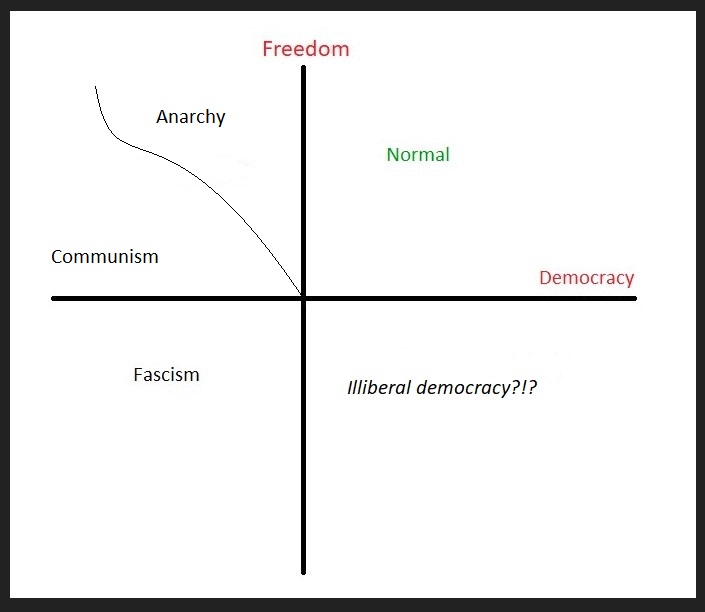
‘Most people confuse liberty and democracy. They are not the same.’

Liberty and democracy are not the same indeed.

Like my left hand is not the same with my right one.

But I need both in order to lead what I consider to be a normal life.

Most people – specially if they get help, can survive without a hand. Or without either liberty or democracy.

But without both… without both hands or without both liberty and democracy… I’d be at somebody else’s mercy!

‘What?!?
What kind of liberty is there under communist rule???’

You see, liberty has two ‘faces’. Two dimensions.
Three, actually, but I’ll be talking about only two of them in this post.

There is the ‘inner liberty’ and there is the ‘socially sanctioned liberty’.

Liberty itself is a human concept.
We have noticed something, wondered about it, named it and then attempted to understand it.
This was, and continues to be, a collective effort.

In some places ‘liberty’ had appeared ‘naturally’.
There was enough liberty naturally sloshing around, hence the circumstances were right for those who had happened to live there at the right time to notice it. Furthermore, the conditions had been right again for the entire community to be able to agree among themselves about the concept and about how to use it/put in practice their new intellectual achievement.

Other places have not been so lucky.
They had been close enough, geographically and socio-historically, to notice the ‘birth of liberty’ but their specific conditions were not ‘right enough’. Many people living there coveted liberty but the local conditions made it impossible for liberty to take hold.
In these places ‘inner liberty’ – individually assumed freedom, can be found a lo more easily than presumed by those unfamiliar with the local realities.

Yet other places had it even worse.
Initially on the path towards liberty – and democracy, they have somehow stumbled.
For whatever causes – internal and/or external, something went wrong. People became disappointed enough to give up not only democracy but also liberty. Including their own, individual inner freedom.

A somewhat intermediary situation constitutes the third abnormal quadrant.
The people involved have given up their liberty – partially, but those running the show continue to use (‘pretendingly’) democracy as a window dressing to hide their true intentions.

The last hundred years or so have been extremely relevant in this matter.
All communist regimes had fallen. Under their own weight.
Most fascist/nazi regimes are no longer with us. Had been so ‘arrogant’ – read self destructive, that their neighbors had to do something about them. Had created so much disruption around them that those whose very existence was endangered had been forced to spring into action.
‘Illiberal democracy’ is a rather new ‘development’. Would be fascist/nazi dictators don’t have all circumstances aligned to make their final move so they have to make do with what there is at their disposal. The local population is ‘despondent’ enough to pay attention to their arguments but not desperate enough to follow them into the ‘unknown’. Hence this oxymoronic abomination.

‘Illiberal democracy’…
On the other hand, the spin doctors promoting illiberal democracies hope to be able to reap the benefits of democracy – the population being ‘rather favorably disposed’ towards the government while having to pay less ‘lip service’ to individual human rights.
A balancing act, with no safety net, which is alluring to those reckless enough to attempt it but which will end up badly. Sooner rather than later.

But the most interesting ‘combination’ – for me, at least, is Anarchy.
In the sense that those who ‘swallow’ the lure are self delusional.
They have somehow convinced themselves that their, own, liberty somehow trumps the liberty of everybody else. They feel so strong, so immune to any outside influence, that they would willingly accept to live in a no rule environment. Without understanding that ‘no rule’ means ‘no holds barred’.
They actually don’t realize that unfettered liberty actually means ‘Each of us free against all others’.
This being the reason for which Anarchy, as a political arrangement, has never survived for long enough to be noticed. Except as a transitory phase.

Să fie oare întâmplător faptul că noi suntem singura țară din lume unde Libertatea, și Adevărul, se vând la tarabă? Pe sume modice?

Să depășim momentul…

Unii sunt ‘îngroziți’ de apariția noii formațiuni politice. Atât de îngroziți încât se gândesc dacă nu cumva ar fi cazul să ceară – în justiție, desființarea partidului.
Alții, din considerente politice – din diverse considerente cât se poate de ‘politice’, doar că genul ăsta de ‘politică’ nu mai are demult de a face cu ‘funcționarea cetății’, se ascund după cireș.

Tocmai ce am citit, pe FB, o analiză mai echilibrată a situației. Aveți linkul aici, chiar merită citită.
https://www.facebook.com/radu.umbres/posts/10161494904682228

“Am intalnit destul de des comparatii intre AUR si Miscarea Legionara, intre George Simion si Corneliu Zelea Codreanu. Deseori aceste legaturi sunt facute pentru a trage un semnal de alarma despre extremismul AUR (antisemitism, sovinism, ultratraditionalism, etc), adica sunt partizane si instrumentale.”

Radu Umbreș, identifică în continuare o serie de asemănări și de deosebiri. Făcând, prin aceasta, o convingătoare invitație către o discuție mai aprofundată. Dincolo de calculele ‘politice’ insăilate de diverși ‘instrumentalizatori’. N-am să mă apuc să reiau idelile lui, sunt la doar un click distanță.

Am să vă fac părtași doar la comentariul meu.
De, blogul meu, comentariul meu…

„De acod cu aproape toate asemanarile si cu mare parte dintre deosebiri.
As puncta totusi o asemanare ‘deosebita’.
Asteptarile oamenilor.
Analiza de mai sus este cat se poate de obiectiva. Doar ca noi, oamenii, suntem mai degraba rationalizatori decat rationali. Gandim, si actionam, mai degraba dupa cum credem noi ca este/ar trebui sa fie decat dupa cum este ‘in realitate’.
Adica actionam dupa cum este in realitatea fiecaruia dintre noi, nu dupa cum este in realitatea ‘obiectiva’. In cea calculata ca medie a celor ce se intampla in societate.
Discutia e lunga, si poate chiar ‘tehnica’, doar ca din anumite puncte de vedere situatia e mai groasa acum decat pe vremea mai sus mentionata. Sau nu mai ‘groasa’ cat mai complicata. Pe vrema aia, era un numar relativ mic de oameni care aveau habar de cele ce se intamplau in afara ‘bulei’ lor. Si care aveau asteptari ce nu puteau fi indeplinite in conditiile date. O parte dintre ei au devenit legionari, altii comunisti. Unii, destul de multi, chiar au trecut dintr-o parte in alta.
Acum e alta situatie. Aproape toata lumea are internet. Adica pareri. Dar prea putini mai au sperante. Iar comunismul si-a aratat deja limitele.”

Lectură suplimentară:

https://spotmedia.ro/stiri/opinii-si-analize/adevarul-nesuferit-despre-george-simion-si-aur

Attempting to value individualism over collectivism is similar to trying to establish which came first, the chicken or the egg.

Having experienced both – collectivism and individualism put in practice as political principles, I have noticed that neither extreme is capable of working in a sustainable manner.

Communist regimes had fallen one after another.
Fascist regimes did the very same thing.
Pirate republics could never resist for long.

Coming back to what is happening in the US, I’m afraid very few people are aware of how much collective thinking had been embedded in the American Psyche. The good kind of collective thinking…
Americans go to church. A place where you go to to be together, not alone.
Americans used to help each-other. Charity used to be a big thing. Slowly, it had become a dirty word.
And so on.

Individuals can not exist on their own. They need each other to survive. And to thrive.
Collectives can not last for long unless the individuals who constitute them do respect each-other. Help each-other maintain and develop their individuality.

As simple as that.