not2bdemocracy

Enter a caption

Our nation did not become great because our form of government was created as a socialist, communist, or any form of democracy; it was specifically created as a constitutional republic.

I’ve been trying for some time now to figure out the origin of this huge confusion.

Yesterday, during an exchange on this subject, a FB friend of mine used this link to prove her argument:

An Important Distinction: Democracy versus Republic


And there it was, laying in plain sight, THE explanation I was too blind to find it by myself.

It is important to keep in mind the difference between a Democracy and a Republic, as dissimilar forms of government.

Come again?!?

Since when democracy has become a “form” of government?
If you want to discuss about forms of government you have basically two: republican and monarchic. In a republic the head of state is changed from time to time, sometimes in a more or less democratic manner, while in a monarchy it is customary for that head of state to be replaced only after his death and by a person which has already been known for quite a while.

That was not what you had in mind? You meant what kind of interaction exists between the governed and the government?
‘Cause only in this realm we may speak about the difference between democracy – where the population has a say about its fate – and dictatorship – where the rulers don’t give a damn about the wishes of those who allow themselves to be ruled from above.

Don’t believe me?
Then please consider the British Empire. It is headed – nominally – by a monarch who has had no power for the last two hundred years or so and has NO – absolutely NO – constitution. Yet its democratic traditions can be traced down to the Magna Carta – a ‘compact’ signed in 1215 between the King (John of England) and his ‘free subjects’.

I used ‘ ‘ around ‘free subjects’ to highlight the fact that this is an oxymoron AND that the basic function of Magna Carta was to solve that oxymoron.
It actually doesn’t matter much what was written in that compact. The very fact that the King – erstwhile considered an almost divine person who until then had absolute power over his subjects and the land under his control – sat down at the same table with some of his erstwhile subjects and by his own signature conceded that they were “free” (‘all free men have a right to justice and a fair trial‘) signifies the dawn of a new kind of interaction between those at the no longer opposed ends of the society.

OK, things didn’t evolve smoothly. The Magna Carta wasn’t enforced in earnest until a lot later but still, the bird was out of the cage.

My point being that until we understand that the difference between ‘republic’ and ‘democracy’ is the same as the one between apples and oranges – and that we should stop comparing them – we are stuck.

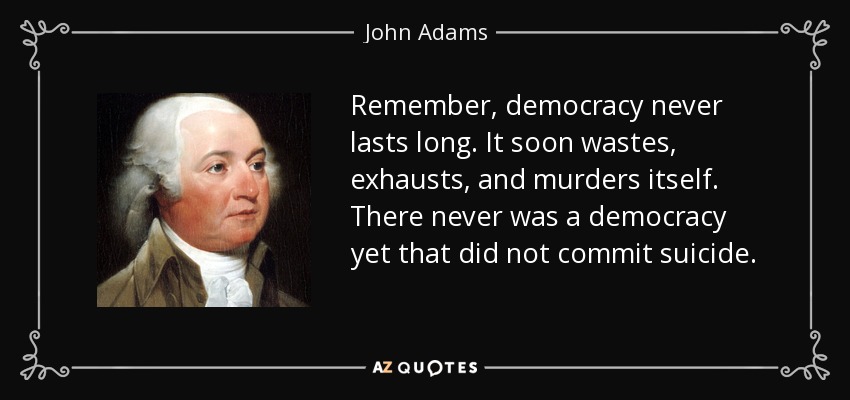
So, am I somewhat implying that John Adams was wrong?
quote-remember-democracy-never-lasts-long-it-soon-wastes-exhausts-and-murders-itself-there-john-adams-0-19-42

Not at all. All I’m saying is that he used a poetic license and that the quote is not only incomplete but also used in a misleading way.

“I do not say that democracy has been more pernicious on the whole, and in the long run, than monarchy or aristocracy. Democracy has never been and never can be so durable as aristocracy or monarchy; but while it lasts, it is more bloody than either. … Remember, democracy never lasts long. It soon wastes, exhausts, and murders itself. There never was a democracy yet that did not commit suicide. It is in vain to say that democracy is less vain, less proud, less selfish, less ambitious, or less avaricious than aristocracy or monarchy. It is not true, in fact, and nowhere appears in history. Those passions are the same in all men, under all forms of simple government, and when unchecked, produce the same effects of fraud, violence, and cruelty. When clear prospects are opened before vanity, pride, avarice, or ambition, for their easy gratification, it is hard for the most considerate philosophers and the most conscientious moralists to resist the temptation. Individuals have conquered themselves. Nations and large bodies of men, never.”

OK, he made the same confusion between ‘forms’ of government and social relationships between the people and those in power, only this is an understandable mistake. But, to his merit, he made it amply clear that it is the very “passions” of the people that “when unchecked, produce the same effects of fraud, violence, and cruelty”!

This is precisely the job that every constitution – not only the republican ones – is called to fulfill. Or a powerful enough tradition – please remember that the British ‘Empire’ has no constitution to this day.

Coming back to the notion of democracy I must add that it might not work properly, no matter how well written the constitution that presides over the process, unless the people who uses this form of collective decision making entertains the proper mental and moral attitude.
If the entire society isn’t permeated by enough mutual respect among its members then what Adams had warned us against is about to happen – regardless of any constitution. Or even under the cloak of the existing one.

You see, proper democracy works because it creates a frame where all those interested in the matter – all stake-holders – have the opportunity to express their grievances. This way the society is able to find out what doesn’t work properly and to take the appropriate measures.
But if there is not enough mutual respect going on around, things may become ugly, eventually. Just as Adams told us. When mutual respect weans out we stop caring about anything else but our own personae and ‘passions’ are no longer ‘checked’.
Society no longer acts like an organism and people become divided into smaller ‘mobs’ whose leaders fight each-other – sometimes under a democratic disguise – for followers.

That’s when democracy ceases to be a venue for a civilized debate about ideas and become an arena for the bloodiest sport of them all. Politician-ism.

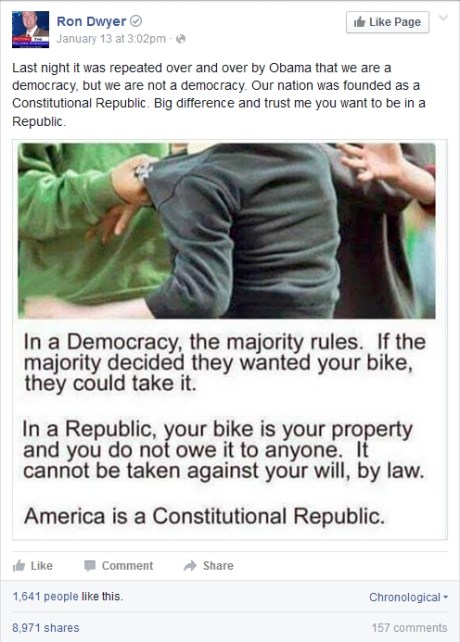
That’s when some people start thinking like this.
democracy, bikes

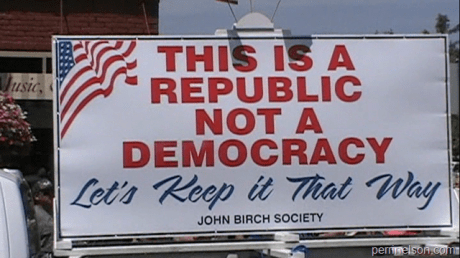
Or even like this:
jbs_3

Let me tell you something.
I’ve been living under a republican regime for all my life. Only for the first 30 years that republic was a communist one. It even had a constitution – and at the first glance it wasn’t such a bad one. But believe me, you don’t want to experience that kind of republic.

What you really want is true democracy, the one where people respect each-other. It doesn’t matter if that happens in a republic or in a kingdom. It is enough that it works, and for that to happen it is enough for the people to ‘check their passions’.

And mind you!  Whenever 51% of the voters band together to confiscate the bikes that the others have acquired through honest means, that’s no longer democracy but mob rule. Something that could very easily degenerate into communism. That’s what you want to avoid, not bona fide democracy.

future shock

Some 30 years ago Herbie Hancock published an album which proved to be uncanningly prescient. The future we have been building since is indeed shocking.

Breastfeeding in public is considered unbecoming by too many of us:

breastfeeding

“Weren’t you breastfed when you were little? – We had formula in those times!”

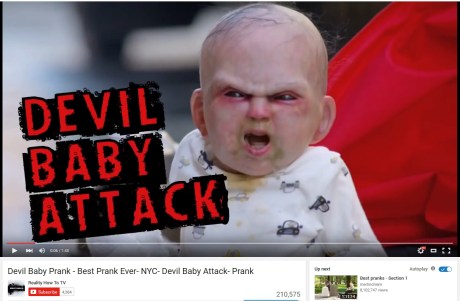
while almost none of us freaks out, for the right reasons, when seeing something like this:

devil prank

I’m afraid that if we don’t get our act together the future we are currently building for our kids will be even more gruesome than some of our pranks.

S

Somebody shared a video – where two senior citizens swing their golf clubs at some rather idiotic pranksters – on FB

golf prank

and captioned it “Don’t mess with old dudes and their balls…”

This made me wonder ‘what on Earth are we doing to ourselves?’ As a species, I mean.
OK, those kids did a rather stupid thing, indeed.
But let’s not forget that they have been raised by people not so very different from those golf players – statistically speaking, of course.
And where is the difference between what those two kids have done and the ‘practical jokes’ that are aired ad nauseam by most TV stations? Owned and run by individuals very much like those two annoyed ‘senior citizens. Who were enraged enough to swing their ‘irons’ at the pranksters, risking serious injuries…

How much lower can we get?

devil prank

PS.
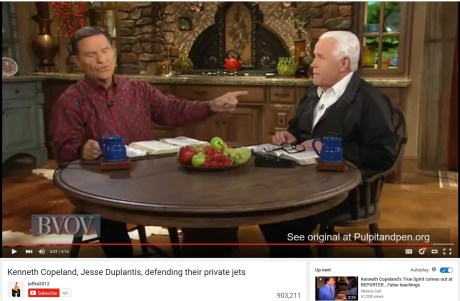
Somebody pointed me to this. You might say there is no connection between these two private-jet loving ministers and the pranksters but don’t think they all display the same level of callousness towards the rest of the people?

private jet loving ministers

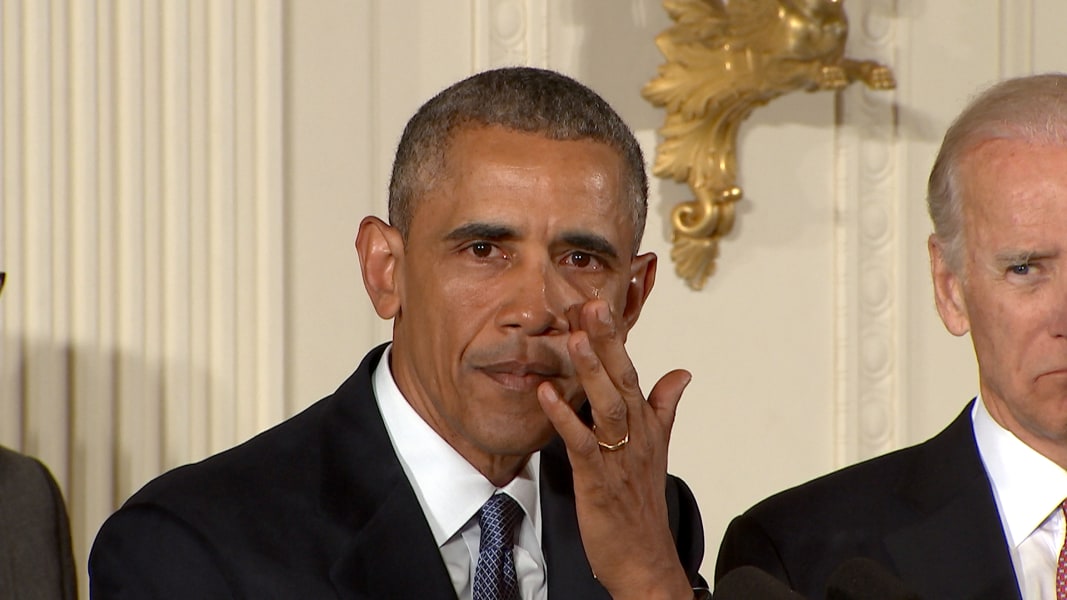
f_dc_obama_crying_160105-nbcnews-ux-1080-600


” But when you look closer at the picture, when the illusion of power gives way tot the reality of pain the world at which this woman sits, our world, that is a world which is torn by war, destroyed by hate, devastated by despair and devastated by distrust. The world on which she sits is on the very brink of destruction. Famine ravishes millions of the inhabitants of this world in one hemisphere while feasting and gluttony are enjoyed by inhabitants of another hemisphere. A time bomb ticking is the world on which she sits with apartheid in one hemisphere and apathy in the other hemisphere and enough nuclear warhead scientists tell us to wipe out all forms of life except for cockroaches and that is the world on which this woman sits. A world which cares about more bombs for the enemy than it does about bread for the hungry. A world that is still more concerned about the color of skin than it is about the content of character. A world more finicky about the texture of hair or what is on the outside of your head than it is about the quality of education or what is on the inside of one’s head. That is the world on which this woman sits. You and I think of being on top of the world as being in heaven, but when you look at the woman on Watt’s painting a little closer what you discover is that this woman is in Hell. And that artist Watt dares to entitled the painting “Hope.” 
“with her clothes in rags, her body scarred and bruised and bleeding, her harp all but destroyed and with only one string left, she had the audacity to make music and praise God … To take the one string you have left and to have the audacity to hope… that’s the real word God will have us hear from this passage and from Watt’s painting.” (Jeremiah Wright, The Audacity To Hope)


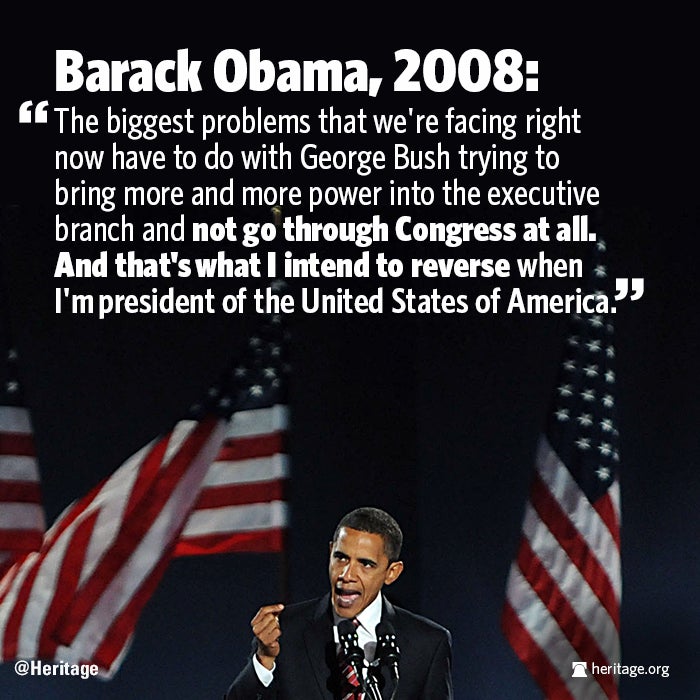
08obamaexecpwr_v1

What happened during his tenure that made him change his attitude so drastically as to resort to administrative measures in order to effect the ‘change we can believe in’?

I still remember the joy I felt when he was elected. I hardly knew anything about him, of course, but the way he talked made me hope he was going to behave differently than the one before him.
Even more important than his personality was that I had seen his election as an about-face of the American political scene. I presumed that by electing Obama to the Oval Office the American People was sending a powerful signal.
That they wanted to tell everybody, politicians included, that they had understood how much damage had been done by the constant bickering and extreme mutual distrust that was plaguing the political establishment. And that they had enough of it.

Could it be that Obama’s tears of yesterday were shed for the fact that he didn’t really deliver? That from the height of his position he had got an even clearer picture about the State of the Union than he one he had before becoming President yet he wasn’t able to do anything meaningful about it? Precisely because the Union is even more divided than before?

About almost everything?

Why have we allowed our respective ideologies separate us to the tune of making us see two different realities where there is only one?

Why do we have to get down to a ‘single string left on our harp’ before understanding that?

george-frederic-watts-hope-1340051296_b

quote-a-nation-that-is-afraid-to-let-its-people-judge-the-truth-and-falsehood-in-an-open-market-is-a-john-f-kennedy-100676

There is undeniable truth in here but there is also a considerable amount of confusion.

Whenever truth is hidden behind the words instead of being openly discussed among those who deal information pertaining to a particular situation all those involved will eventually suffer the consequences of their deceptions.
This is something that has been common knowledge for sometime now yet there still are too many individuals who think they can ‘beat the market’ on this.

This is the true part.

What makes me wonder is how come a nation may become afraid of its own people? Isn’t this an oxymoron of sorts?
Or is it that only some members of that nation have become afraid that their deceptions will become apparent to the rest of the people?

I have used a small strike in an orchard valley as the symbol of man’s eternal, bitter warfare with himself.” (John Steinbeck, in a letter to George Albee)

Why on Earth had Kennedy chosen to beat around the bush instead of speaking out in plain English? It didn’t much good for him anyway, isn’t it?

Why are so many of us still following this policy?
Why are so many nations that allow this to happen?

050c31042a04e93467298c7458c219af4cbcc6-wm

For some time now I’ve been wondering how come so many people who define themselves as being Christians – “Again I tell you, it is easier for a camel to go through the eye of a needle than for a rich person to enter the kingdom of God.“, Matt 19:24 – are so passionately defending the very concept of (private)”property”.

Could it be that Marx was right after all: “Private property is the result of alienated labor.” ?!? And so many of us have been wrong for so long?

“The right to private property is the social-political principle that adult human beings may not be prohibited or prevented by anyone from acquiring, holding and trading (with willing parties) valued items not already owned by others. Such a right is, thus, unalienable and, if in fact justified, is supposed to enjoy respect and legal protection in a just human community.”

Trying to understand the source of this dichotomy I adopted a two pronged strategy. First I looked up the word itself and then I tried to deepen my understanding of the entire concept.

It’s absolutely obvious that ‘property’ comes from ‘proper’.
‘Proper’, in its turn, has two basic meanings: ‘fit for use‘ and ‘pertaining to one individual‘. The first one has evolved into ‘propriety’, “the state or quality of being correct and proper” while the second has become ‘property’, “thing owned“.

So, do all these etymological arguments make it any easier for us to accept that respecting each others’ right to private property is what introduced a certain degree of functionality in the human society?

‘But aren’t you contradicting yourself?
At the beginning of your post you suggested that ‘property’ might not be as good as advertised and now you say that the ‘right to private property’ is ‘good for you’?
Will you make up your mind, for Christ’s sake?’

Now, that I’ve reached the conceptual stage of my analyses, I must bring to your attention the fact that a right is nothing but an opportunity while each (piece of) property is a thing – even those  which are not of a ‘substantial’ nature. ‘Intellectual property’, for instance, is a ‘measurable thing’ even if you cannot put your finger on it while the ‘right to intellectual (or any other kind of) property’ is (an infinite) something which patiently waits for (a rightful) somebody to make (proper) use of it.

Maybe this is what Christ tried to tell us in the first place. That it’s not property itself that stands between us and our salvation but our (improper) attitude towards it. That it’s not the object of our property that is the problem but how we make use of our right to private property.
After all Christ told the “young rich man” “If you would be perfect, go, sell what you possess and give to the poor, and you will have treasure in heaven; and come, follow me.” (Matt 19:21). ‘Go sell, give and THEN follow me’, not ‘come help me ABOLISH the very right to private property’, as Marx used to preach to his followers.

To understand the difference between what Christ and Marx said about this subject let’s see how these two relate to the notion of ‘Man’.

In Christ’s book God took a lump of dirt and ‘made Man in His own image’ while in Marx’s narrow materialistic vision “it is not the consciousness of men that determines their existence, but, on the contrary, their social existence that determines their consciousness.”

Basically both of them start with the same ‘materiel’ – the mundane ‘star dust’ that Mendeleev distributed throughout his table – but what a difference at the end of the ‘assembly line’!

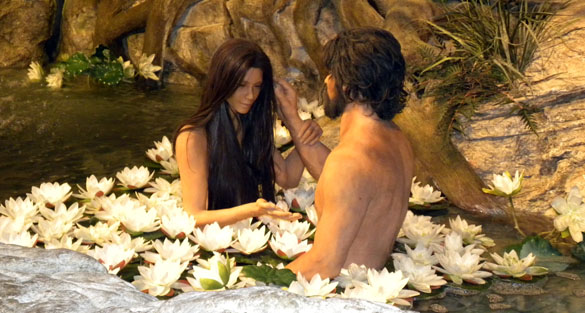
adamevebefore

Being made ‘in His Own image’ not only means that all Men (and Women) are created equal but also that each of them shares in His Divine Nature. Hence the origin of our free will, of our ability (‘right’, opportunity) to be saved. Compare this to how Marx described the human society:

“The Communists, therefore, are on the one hand, practically, the most advanced and resolute section of the working-class parties of every country, that section which pushes forward all others; on the other hand, theoretically, they have over the great mass of the proletariat the advantage of clearly understanding the line of march, the conditions, and the ultimate general results of the proletarian movement.

The immediate aim of the Communists is the same as that of all other proletarian parties: formation of the proletariat into a class, overthrow of the bourgeois supremacy, conquest of political power by the proletariat.

The theoretical conclusions of the Communists are in no way based on ideas or principles that have been invented, or discovered, by this or that would-be universal reformer.

They merely express, in general terms, actual relations springing from an existing class struggle, from a historical movement going on under our very eyes. The abolition of existing property relations is not at all a distinctive feature of communism.”

articlefiles-mv003370610000-96750_bd

As somebody who has lived for 30 years under communist rule let me translate this from ‘Newspeak‘ into plain English:
‘History suggests that those who figure out the inner workings of this world  have, from time to time, the opportunity to take over the show. Now is one of those moments. The ‘fat cats’ have been so greedy lately that the regular people are growling under the very heavy yoke that has been placed on their shoulders.  That’s why we have the opportunity to unsettle the ‘old’ from their positions and to plant our fat asses in their comfortable chairs.
And the first thing we must do in order to achieve that goal is to abolish the right to private property. People are so fed up with what was going on lately that they’ll go along. They have grown to hate so much the ‘greedy plutocrats’ that most of them won’t notice that in the (revolutionary) process they’ll lose the very last shrouds of personal autonomy they still have. Without the right to dispose of the results of their own labor they’ll be at our mercy’.

Who was right between the two?

Well… Both, unfortunately.

The communists did run the show, at least for a while. And we all know to which results.
On the other hand it seems that in the longer run miss-using the right to private property is indeed a powerful drawback. The already too long sequence of economic crises caused, ultimately, by nothing else but our own greed has indeed given birth to a generalized state of psychological malaise.

I don’t know about what’s gonna happen in the next world – or if it exists at all – but I’m sure that if we don’t learn, fast, how to use, properly, the right to private property things will become too hot for our own good in this one.

The only one we are sure about.

Further reading.
During my research for this post I found this very interesting take on the same subject:

“Zwolinksi argues that libertarians are right to support private property, but also that private property is more complicated than we sometimes think.”

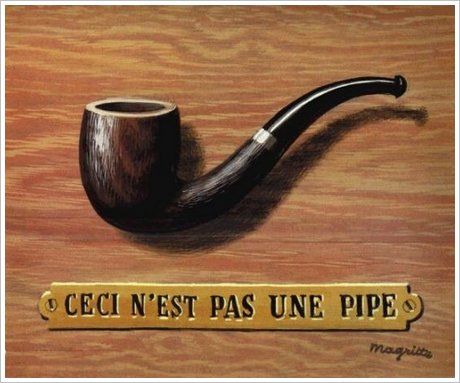
20090421-ceci-nest-pas-une-pipe-rene-magritte

As a child I was introduced to the chicken and egg paradox by my grandmother – a very wise woman, despite (because?!?) the fact that she had very little formal education.

As I grew up I found out that even the adults are passionate about it. Just Google it if you don’t believe me. Last time I checked the search engine had come up with 26 million (26 000 000 000) entries….

Then I was introduced to a slightly more interesting version of it.
Who is responsible for what is going on around us.
“Who created the World”, that is.

Apparently we have three three camps.

The theists, of various denominations – some of whom would cut each-other’s throats attempting to convince the ‘others’ that their God is the true one, believe that an outside agent is wholly responsible for the ‘Big-Bang’ and all its consequences. Or, at least, for ‘jump-starting’ the process.
The atheists, some of whom are ‘rabid’ enough to be as obnoxious as some of the theists, who blame it all on Lady Luck.
And the agnostics, like myself, who cannot make their minds one way or another.

Now, and I hope you won’t mind, I’m going to enumerate some facts.

  • We, the humans, are the ones who came up with the Big-Bang theory.
    Which is nice. It offers a generous canvas on which we might eventually thread a lot of ‘science’, but doesn’t, in any way, shape or form, offer even the slightest opportunity for the most imaginative amongst us to propose the flimsiest hypothesis about what started the whole process.
    Hence those of us who follow a far longer tradition feel free to consider that a Divine interference is the sole rational explanation. For everything that hasn’t yet a ‘scientifically proven’  one. As if science ever offered us a definitive answer to anything…
  • The Big Bang Theory was initially devised by a Catholic priest, Georges Lemaitre, as yet another attempt to understand God’s ways.
  • No matter what the various prophets and religious teachers have told us, all books – including the ‘holy’ ones – have been written by people. They might have been inspired by (a ?!?) God, there is no way of telling what happened in the minds of the writers, but all those books have been written by human hands.
  • We, the humans, are the ones who consider this problem to be a very important one.

So important, in fact, that even a newspaper otherwise busy with economic and political issues occasionally looks (up ?!?) at it.

In its Christmas Day edition the Wall Street Journal published “Science Increasingly Makes the Case for God” by Eric Metaxas.
Basically he author tells us the story of how Sagan started the hunt for ‘Extraterrestrial Intelligence’ and how the seemingly simple task ended up in a cul-de-sac.
While Good Old Carl thought “that there were two important criteria for a planet to support life: The right kind of star, and a planet the right distance from that star” in time “our knowledge of the universe increased” and “it became clear that there were far more factors necessary for life than Sagan supposed”.
So many in fact that some of us, Eric Metaxas included, now believe that “Probability said that even we shouldn’t be here”.

In this context I’d like to bring to your attention the words uttered by Lord Kelvin in 1895 – by that time already elected president of the Royal Society: “Heavier-than-air flying machines are impossible.”

“Yet here we are, not only existing, but talking about us existing here.”

Do you see the pattern?

The usual claptrap, because something can’t be explained, it must be God.” (Mark Baxter’s comment on my FB wall) Or outright impossible, I might add, following Lord Kelvin’s example.

In other words ‘if WE cannot figure it out then it either doesn’t exist or has been made by God’.

But who made ‘God’ in the first place? And why?

Are we even aware that what we call ‘God’ is nothing but an image?
I’m not going to delve far into such intricacies like reminding you that no Orthodox Jew would ever pronounce the ‘true’ name of God but this is a powerful indication that our Elders were aware of the difference between reality and our ability to figure it out.

So why do we keep making this mistake? Why do we still try to ‘invent’ an ‘outside agent’ whenever we don’t have enough information about how something came to be?

That outside agent might very well exist, of course. Someplace, ‘out there’…. Or not. For all we know some things might happen just by pure chance. However improbable that might seem. To us!

We cannot determine, as of now at least, either way.

Then why insist? Any way?

Some of you will tell me, quite appropriately,  that ‘believing’ has brought us where we are now.
That ‘faith’ has guided us through the dark nights when we would have otherwise lost our hope. That following the ‘ten commandments’ has kept us from killing each-other much more ‘passionately’  than we’ve done it.

But now that we’ve understood what religion has done good for us, what’s keeping us from behaving ‘as if’?
Without ‘God’, or whatever name you want to use for the reality that harbors us at its bosom, having to ‘strike’ us down from time to time?


BetterFailling's avatarMan as a measure of all things.

democracy_thumb

“People Aren’t Smart Enough for Democracy to Flourish, Scientists Say”

“The democratic process relies on the assumption that citizens (the majority of them, at least) can recognize the best political candidate, or best policy idea, when they see it. But a growing body of research has revealed an unfortunate aspect of the human psyche that would seem to disprove this notion, and imply instead that democratic elections produce mediocre leadership and policies.”

I’m afraid that (not only) this time “the scientists” have gotten it all wrong.

By speaking about “the best” (political candidate, policy idea) they demonstrate a completely false understanding of what democracy is.
They mistakenly define it as an optimization process (that is supposed to identify the best available opportunity) while functional democracy is nothing but a weeding out process.

Even pretending that anybody can identify ‘the best political candidate/policy idea’ is presumptuous, to say the…

View original post 309 more words

Since my main blog – Nicichiarasa.wordpress.com – has become a pell-mell of subjects connected solely by my subjectivity I decided to put things in order.
Hence the birth of my second blog, Man as a measure of all things.
Enjoy it, if you can find anything interesting in here.
And Merry Christmas to those of you who celebrate it.

BetterFailling's avatarMan as a measure of all things.

150721183714-donald-trump-large-169

This morning, while browsing through Facebook, I came across a very good question. The kind that really gets your mind spinning in overdrive.

“If you were to be a scientist, would you prefer to be:
a) super smart and moderately curious
b) moderately smart and super curious?”

First of all I don’t think being a scientist matters in any way. This question is valid for all of us.

I pondered for a few minutes – b) – and then read the entire discussion that followed. After a couple of hours it hit me. BTW, b)  means I’m aware about my limited brightness – which is why it took me so long to figure this out.

Being smart is only part of the whole equation.

Intuitively a smart mind must be very mobile, hence very curious.
Well, that would mean that all really bright people would necessarily develop encyclopedic minds, right?

View original post 535 more words

Adoptarea acestei legi a impartit România in două tabere si a determinat Banca Centrala Europeana sa ne trimita un aviz extrem de ciudat dar care lamureste multe.

Unii se bucura ca in sfarsit cineva le-a dat peste nas bancilor, bancile – sau mai bine spus bancherii si actionarii – spumega de furie iar cei de la UE nu prea stiu pe unde sa mai scoata camasa.

Treburile nu sunt totusi chiar atat de complicate.

Pe vremea cand toata lumea era plina de sperante bancile au dat o gramada de credite cu garantie imobiliara iar „consumatorii” s-au angajat voiosi sa le plateasca. Bancile isi facusera calculul ca nu pot sa piarda – doar ele insele facusera evaluarile cu privire la bunurile puse sub ipoteca. In plus exista si prevederea ca atunci cand executarea garantiei nu acopera valoarea datoriei banca se poate indrepta asupra altor bunuri ale debitorului sau chiar asupra veniturilor sale viitoare. Iar clientii nu fusesera atenti la amanunte de genul asta.

Dupa criza situatia a devenit paradoxala. Oamenii s-au trezit ca au de platit rate enorme pentru o proprietate care valoreaza jumatate din pretul platit pe ea cu doar cativa ani inainte dar bancile inca nu aveau prea mari probleme. Toti cei care mai aveau slujbe – adica majoritatea debitorilor – au continuat sa plateasca ratele pentru ca nu aveau alta alternativa. Daca s-ar fi oprit banca le-ar fi luat casa – pe care ar fi vandut-o la un pret ridicol de mic – iar ei tot ar fi trebuit sa plateasca restul datoriei. In plus fata de chiria pentru noua locuinta.

In situatia asta nenea Parlamentul European de mana cu nenea Consiliul Europei s-au gandit ca macar de acum in colo sa ii protejeze pe consumatorii europeni de credite. Asa ca au emis Directiva 2014/17/UE. 50 de pagini din care rezulta ca incepand cu data de 21 martie 2016 contractele de credit ipotecar incheiate in Europa sa semene cu cele din America. Adica datoria sa fie stinsa in intregime atunci cand imobilul care face obiectul ipotecii intra in posesia bancii.

Parlamentarii romani au facut un pas mai departe si au prevazut in noua lege posibilitatea ca si cei care au incheiat contracte de credit inainte de aceasta data sa poata iesi din ele prin aceiasi metoda.

Din momentul acesta „formalistii” au sarit in sus. Cum se poate ca statul sa intervina legislativ intr-un contract deja incheiat, de comun acord, intre doua parti?
Cum se poate ca un act legislativ sa aibe efecte in mod retroactiv?

Pai hai sa o luam altfel.
Atunci cand a fost incheiat contractul banca a fost cea care a trimis un evaluator la fata locului si tot ea a stabilit cat din valoarea stabilita de acel evaluator va fi luata in calcul la stabilirea ipotecii.
Acea valoare nu face si ea parte din contract? De ce acum, cand debitorul nu mai poate – sau nu mai vrea, pentru ca nu mai are nici un sens din punct de vedere „economic” – sa ramburseze creditul nu se mai face in nici un fel vorbire despre acea „valoare”?
Nu este si asta o forma de modificare, chiar daca implicita, a contractului?
A manifestarii de incredere reciproca dintre parti?

Adica banca are voie sa spuna „pardon, am gresit” dar clientul nu?

Sincer sa fiu, inteleg foarte bine temerile bancherilor.
Si pe cele ale Bancii Centrale Europene.
Ba chiar si pe cele ale proprietarilor de case – daca legea va intra in vigoare in forma actuala preturile vor mai scadea, cel putin pe termen scurt.

Numai ca lucrurile trebuie lamurite repede.
Daca am inteles ca principiul dupa care au functionat lucrurile pana acum nu a fost bun – si asta este foarte clar, inclusiv din directiva citata mai sus – atunci situatia trebuie remediata pentru toti, nu doar pentru viitor.

Sau poate ca la asta se refera cei care vorbesc cu atata patima despre „hazardul moral”?
La faptul ca daca situatia nu se reglementeaza repede lumea isi va pierde de tot increderea in sistemul bancar?