They were there, alright. But didn’t existed, yet.
Most dictionaries do not discriminate between ‘being’ and ‘existing’. But I still recall, vividly, those moments when – as a teenager, I tried to make myself remarked by the girl I fancied at that moment. More often than I’d like to remember, it was as if I didn’t existed at all. I was standing there, making a fool of myself, yet I didn’t existed at all.
Simply because I wasn’t noticed. By the significant one.
Everything which has a temporal dimension – movement, transformation or both, incurs costs and produces consequences.
From a rock sliding down a slope to me writing this.
The difference between these two being the simple fact that no rock has ever had any goal.
You see, the rock looses some energy and mass while sliding down. It accelerates at first but since no rock has ever slidden for ever. Only rocks never do anything on their own. Something has to happen to them first. They do bear the costs – they wear down, break, etc., yet they don’t mind. For they are not, at all, aware of what’s going on. And, anyway, completely unable to do anything about it. Hence not at all ‘responsible’ about any of the consequences produced by whatever they had been involved in. Happened to them, actually.
Fast forward to me. I’m not only alive – hence reactive to whatever happens to me, but also aware. Aware of my own awareness even. I notice the costs I have to pay. Hence I try to minimize them.
And here’s the gist of the matter. My awareness drives me to minimize the costs I incur during my life AND to be very careful about the consequences of my endeavors.
– There’s enough, and suitable, space. – There are enough, and suitable resources. In that place, of course. – Something starts it.
Trivial?
Good! What you’ve just read being trivial for you only means you’ve already figured this out. That you cannot master anything – which happens outside your consciousness, – you don’t really understand, – you haven’t set your mind on.
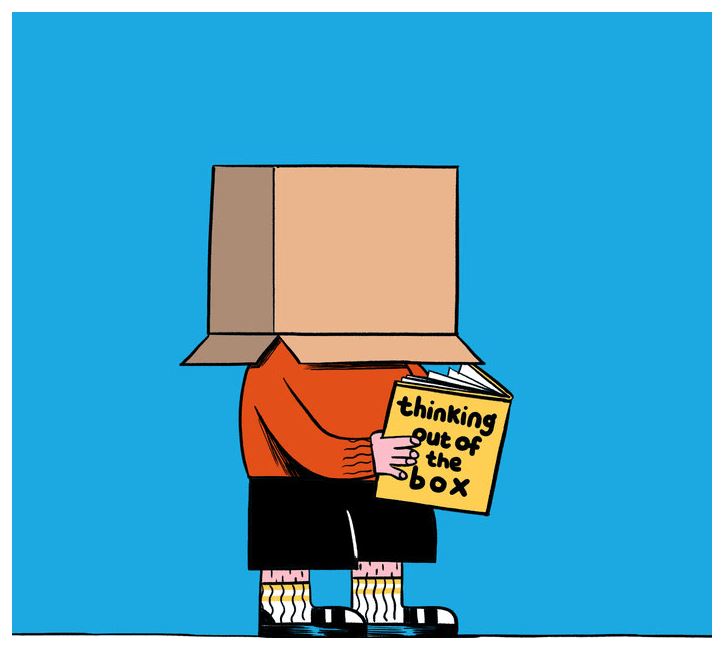
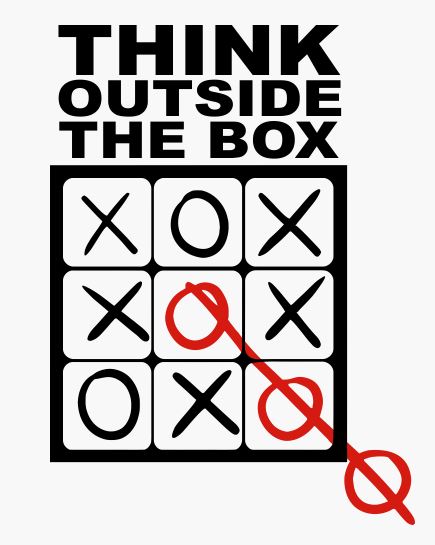
There are a lot of people who prod us to ‘think out of the box’. And a few who dare to warn us about the perils of pushing it too far…
I’m gonna invite you to the next level. Instead of sending your imagination to think outside the box – while the rest of you remains comfortably inside, let’s step outside ‘in person’.
Classic thinking outside the box does nothing but enlarges the box. Brings inside a portion of the outside. Moves the walls. Bringing in a lot of additional clutter in the process.
By stepping outside, physically, you have the opportunity to actually see the problem as an ‘independent’ box. Separated from you and separated from the environment.
How about this for a change in perspective?
This way it will be easier for you to notice, and carefully examine, the links which exist between you and the problem. Between ‘the’ problem and the rest of the problems. Between the problems and the environment. The place where you have to cope with the problems.
The place where you live.
And that, my friend, is your biggest problem. How to step out of your own life. In order to make it better.
To make ends meet? To make it easier for our needs to be met?
What do we have a banking/financial system for? To mobilize capital for the economy? To make it possible for our needs to be met easier? More efficiently?
Or, to put it the other way around, ‘what profit is?’
The well deserved ‘consequence’ – considered as such by the vast majority of the stakeholders, of a well-done job? Or a self serving benchmark to be reached at all costs? Which costs are to be ‘shouldered’ by anybody else but the profiteer himself… till reality slaps us, all of us, over our faces…
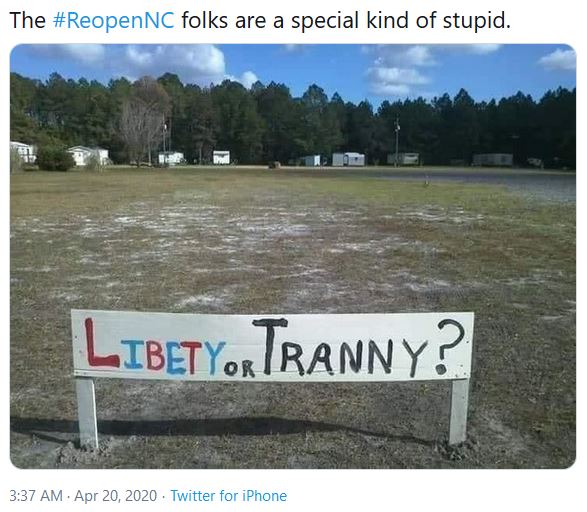
Let’s face it, in the present circumstances the picture above might mean a lot of things.
It can be a prank – somebody might have made the whole thing up just for the fun of it. It can also express the frustration of somebody who isn’t such a good speller. Or of somebody who suffers from dyslexia?
What really interests me is how we, the ‘intellectual’ public, react to things like these. Do we understand the frustration which lies at the bottom of this? Do we even try to?
Or we just dismiss it as being a manifestation of stupid?
No, I don’t consider the economy as being more important than life preservation. Some very sound arguments can be found here.
But I’m absolutely convinced that treating the ‘others’ with disdain is what brought us here in the first place.
You don’t like the manner in which the likes of Trump treat those who don’t agree with them? Then why are you doing the very same thing?
Humberto Maturana teaches us that human consciousness can be understood as our ability to ‘observe ourselves observing‘. In other words, consciousness might be reduced to self-awareness.
I’m afraid it’s not enough. While no individual can be described as conscious if not commanding a certain degree of self-awareness, being able to observe their own observations doesn’t elevate an observer to fully conscious status.
How many of us have ‘enjoyed’ messing up ants or other insects just for the fun of it? When we were teenagers, of course. OK, we continue to squish the cockroaches we happen to see and to spray our gardens against mosquitoes and other pests. Only we no longer do it for fun. We employ a ‘healthy’ rationale to justify our actions – cockroaches/mosquitoes are ‘bad for us’. And we try to do it in a reasonable manner. We don’t soak the entire garden with the most potent insecticide available. Simply because we’ve understood, the hard way, that bees are also important for us.
Otherwise put, it’s not enough for us to be able to keep tabs on what we do, we must also take responsibility for our actions.
After all, we’ve been able to notice that bison ‘engineer’ their own environment.
“Herds of bison milling through Yellowstone National Park may seem aimless to the average visitor, but a new study reveals the animals are hard at work engineering their ecosystem. By rigorously mowing and fertilizing their own patches of grassland, the big herbivores essentially delay spring until late summer.”
Maybe the time is ripe for us to understand that we, humans, have done the very same thing for quite a while now. The world we live in is, to a certain – but rapidly growing – extent, the consequence of our own decision making.
The faster we learn to accept that, the higher the chances we won’t repeat past mistakes.
When I was admitted to the Bucharest Polytechnic, I learned that engineers and dogs have a few things in common. An intelligent gaze and the inability to use words when trying to express themselves. When I started daubing in photography I discovered ‘there’s more than meets the eye’. When studying to become a mediator I learned, as if it was still necessary, that ‘truth is somewhere in the middle’.
Nowadays, we all expect Science to come forward. To find the answer. To break, once again, the barrier which separates us from of the unknown. To take us by the hand and deliver us from evil.
But wasn’t Art the one supposed to provide for our metaphysical needs?!? Even though it had been Archimedes who was the first to advertise his ‘physical’ breakthrough by shouting ‘Eureka’? While running naked up and down the streets of ancient Syracuse … It had been the artists who used to trample their boots in the sludge at the bottom of our ordinary lives in order to open our windows towards new horizons… The ones we expect to transform mud into statues. To morph suffering into hope!
But is there such a great difference between science and art?
‘The man in the street’ might indeed entertain the notion that art is based on inspiration while science is defined by discipline. Only this is nothing but yet another proof that it’s high time for us to learn how much inspiration one needs when trying to find a new cure. And how much discipline must be observed by anybody who attempts to turn their inspiration into something to be traded with another soul.
Addressing the issue from another angle, “can spring be furloughed”?
A friend of mine answered ‘yes’. ‘If there’s no one to notice it …’ Another friend said ‘no’. ‘Spring coming no matter what is the only thing which keeps my mind, and soul, whole.’ Let’s enjoy spring. Together, as it unfolds us.
Given my experience of living under communist rule, I can tell you that too much consistency is bad. Having to toe the line is dangerous. For individuals and for societies, as a whole. Communism did fall, you know.
On the other hand… some consistency is needed.
Let me give you an example.
The whole world is asking China to do ‘the right thing’ about its wet markets. In Bill Maher’s terms “eating bats is bat-shit crazy“.
Why?!?
Because of what science tells us. That bats are full of corona-viruses, which are bad for us.
That’s what we say, anyway. Those of us who side with ‘science’… And who ask the Chinese to give up their traditions.
Let’s examine the problem from the other side.
‘We’ve been eating bats for ages. And nothing happened to us. Now you say that this flu like disease is produced by viruses who live in bats. Why would we believe you – and give up eating bats, if you don’t believe your own scientists? And balk when they tell you to quit smoking. To stop piling plastic into landfills. To stop heating up the planet.








 nicichiarasa