Cel comunist. Care aplica cat se poate de frust principiul ‘afară vopsit gardul, înăuntru leopardul’. Statul comunist funcționa de parcă totul se afla în proprietatea absolută a liderilor de partid. Un sistem quasi feudal, care avea exact aceleași avantaje și dezavantaje. Centralizarea absolută a puterii favoriza ‘agilitatea’ în adoptarea deciziilor. Iar pe măsură ce persoanele cu adevărat calificate au fost epurate din sistem, aceiași centralizare a puterii a condus la osificarea sistemului. Și la prăbușirea acestuia.
Acum avem de a face cu mai multe state. Tot felul de ‘administratii’ (structuri), publice sau private, au ajuns să dețină – firesc, asumat sau chiar confiscat, controlul (quasi)absolut asupra domeniilor lor de activitate. De la administrația fiscală până la diverșii distribuitori de energie – adică cei care controlează țevile și firele, nu cei care emit facturile. Rețelele sociale. Administrația drumurilor… ISCIR-ul…Protecția Muncii și cea a Consumatorului… și aici le-am menționat doar pe cele relativ necunoscute. Sau nerecunoscute ca atare. Toate astea aflându-se sub controlul teoretic, dar din ce în ce mai vag, al statului oficial.
O fi sustenabil? Mai ales în condițiile în care nimănui nu-i mai pasă de nimic!
In the 20 odd years since Caro and Hauser have set the bar for what teaching means quite a number of species have been found to do it. To fully or at least suggestively cross all the necessary t-s. From ants to primates.
Interestingly enough, all of those species have a clear ‘collective’ behavior. All individuals belonging to a species collaborate, of sorts, towards the survival of that species. This goes without saying. But in some species this collaboration is more intense than in others. Ants and bees versus most other insects. Elephants versus cheetahs. Or leopards. Even chimpanzees versus orangutans…
OK, for some species hand to hand collaboration between generations is impossible. Most parent insects are dead when their offspring hatch. Orangutans live in forests where food is too scarce for more than 1 individual to forage. Others have found their niches. Where the individual approach is good enough for them to survive. Cheetahs, leopards. Bears, even…
Charles Darwin taught us about evolution. Merging individual lives into the survival of the species those individuals belong to.
Life, as I see it from a “functional and mechanistic perspective“, is yet another manner in which matter is organized. Yet another ‘state of matter‘. For life to be present, three conditions have to be met. – Individual organisms have to be exchanging, in a controlled manner, substances with their environment. To ingest nutrients and to excrete the by-products of their metabolism. – Individual organisms have to be exchanging information with their environment. And with their interior. Otherwise the exchange of substances would no longer be controlled by the individuals. – Individual organisms have be passing to the next generation the pertinent information needed for the species to survive. In the kind of life we are familiar with, that would be ‘the genetic information’.
Considering the above, I dare to make a difference between what Caro and Hauser consider to be teaching and what we, humans, do. Intent!
I doubt that any of the ‘animal teachers’ do it under their own volition. After all, nobody has yet identified an animal con-artist who cons the members of their own species… as we do! As far as we currently know, ‘teaching behavior’ is displayed inside species which collaborate more closely than other species. Which suggests that that kind of behavior is somehow innate to those species. A ‘habit’, not a choice. As it is with us.
What makes it possible? This difference? Our special kind of conscience and our use of language. The fact that we are the only species – as far as we know – capable of building a ‘virtual image’ of the surrounding reality. Capable to select certain aspects of what surrounds us and codify them using various forms of ‘notation’. And to do this according to our own, individual, interests! Sometimes even against the interests of the community/species to which we belong.
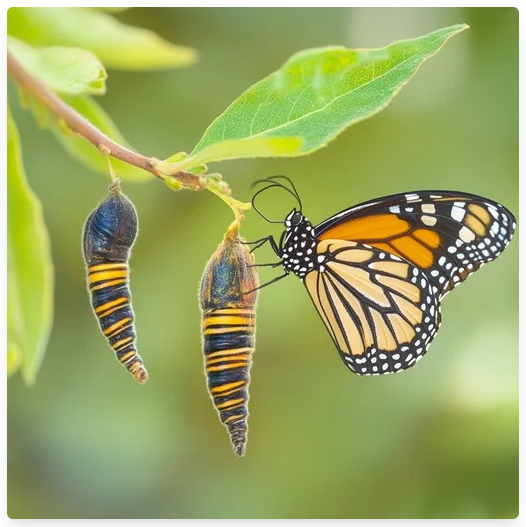
So. Metamorphosis can be interpreted as both the process of changing shape and/or nature and the result of that process. My point being that we are the ones who make the connections. Who connect the dots…
We are the ones who have noticed the link between the caterpillar and the butterfly. We are the ones who have taken the notion of division way further than its very nature.
How much (natural) sense does it make to divide something to a divisor which is smaller than 1 ?!? It is nevertheless possible… arithmetically speaking… we do it by carrying the rule into the ‘sub-unitary realm’ … without giving much thought to the ‘metaphysical’ aspects of the ‘operation’. To the fact that by dividing something to a sub-unitary divisor we actually transform division into multiplication!
We do that by applying a rule beyond, also known as ‘meta’, its natural domain.
I am, first and foremost, an engineer. ‘Down to earth’ used to be my middle name.
Until I started to notice things. And to ask questions… At first, under communist rule, I worked blue-ish collared jobs. Despite – or because?!? – holding an MSc in Mechanical Engineering. For me, ‘industry’ had a very clear meaning. And involved getting your hands dirty. After the regime change, I also changed tack. My hands were still dirty but with a difference. That was when I first got in contact with the ‘banking industry’. At the time, those two words put together didn’t make much sense to me. But I was too busy making money… Now, half a life later, things are falling into place.
‘Industry’ is the where things actually happen. Banking, hospitality, ‘heavy’, transportation, mining, garment, you name it! The point being that ‘industry’ is an actual place. A factory, an office, the open sea, a rolling meadow or a ‘dust bowl’, industry needs an actual place for the people involved to do their thing. Solving other people’s problems and meeting their needs.
Why? Why do we do it? Toil?!? Because we cannot escape ‘economy’. A virtual space we inhabit, which conditions us to be efficient. Money-wise.
Where? Inside ‘politics’!
– But you just said that ‘actual things take place inside industry’…
Yep. Actual things do take place inside industry and the interaction between industry and economy takes place inside ‘politics’.
You see, we’ve lived – for a very long time, at least three millennia – in a virtual world. Vir is a latin word. Has a lot of meanings, ‘hero’ amongst them. ‘Virtual’ means ‘made, on purpose, by a hero’. By us, actually. People who pretend to be civilized live in a world of their own doing. Knowingly and purposely. A world carved according to those people’s wishes. Maybe not exactly but at least tentatively.
How did they pull this stunt? Built their own world? As close to their wishes as humanly possible? Industriously, economically and driven by politics.
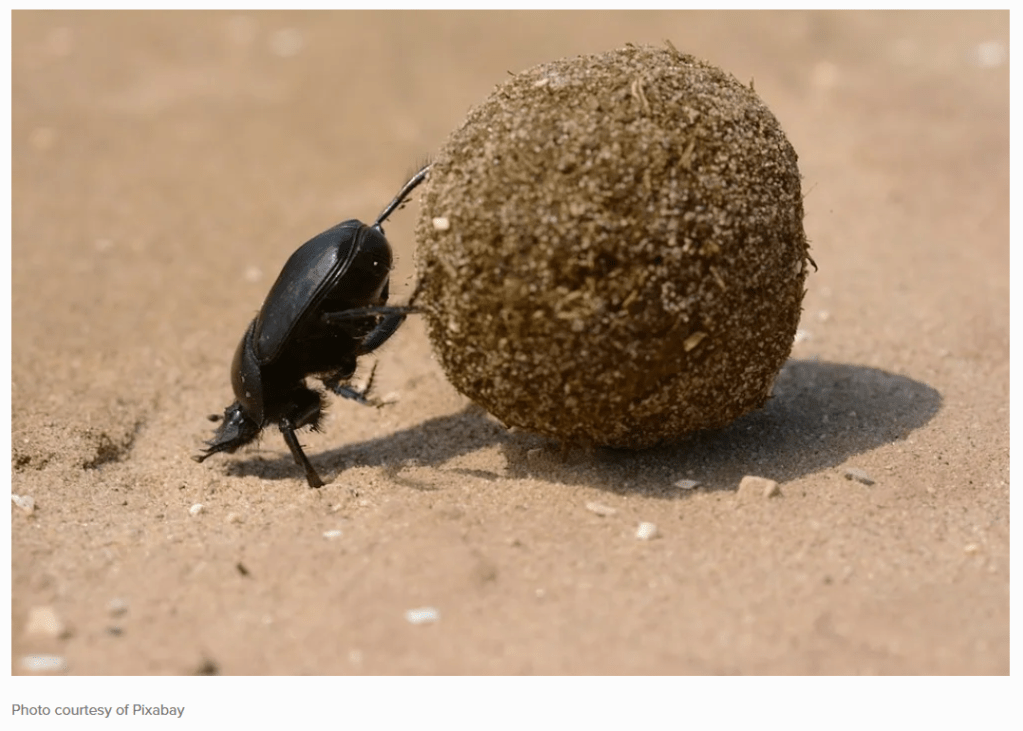
Dung beetle are very industrious. They don’t think much but are very useful.
And they have been useful for quite a while. Since long before our ancestors had started to roam the Earth…
My point being that their attempt at taking care of their next generation – their species collective effort to survive – have helped shaping the current version of Earth’s ‘environment’. The current version of the place which we, all of us, call home.
Where we, humans, do our thing. Think!
Think and make differences.
For the dung beetles, poop is both a resource and an opportunity. They need dung in order to ‘nest’ their eggs so whenever they find it they start working.
Dung beetles are very good at using poop. In doing their job they perpetuate their species and they reintegrate poop into the natural order of things. Read here what happened in Australia between man had introduced cows and the ‘same’ man had got wise enough to bring some dung beetles specialized in using that particular kind of poop. But dung beetles are not able to think. Or to speak. About anything, including their most prized resource. Dung.
We do. We are able to think. And to speak. Among ourselves. And with ourselves… How else do we do what makes us humans? How else do we think except by using words? Concepts…
And this is how we get to the gist of today’s post. The difference between a resource and an opportunity.
It was by thinking that we have identified something as being a resource. That something can be used. And it was through the same process that we have coined the concept of ‘opportunity’.
We don’t eat everything in sight, right? We understand the difference…
In fact, we are able to understand. We have the necessary resources to make the difference! But we don’t always make good of the opportunity…
‘Frate, frate, dar brânza-i pe bani.’ Corect, doar că zicala asta e valabilă cu precădere printre ciobani!
Filozofie de doi bani, trasă cu urechea printre jucătorii de șah din Cișmigiul anilor ’70. 1970!
Până la urmă, moșul ăla avea dreptate… Obsesia asta pentru bani, care ne terfelește tuturor mințile, este doar un simptom. Dovada faptului că ăsta a rămas singurul lucru pe care îl mai avem în comun. Că ne-am transformat, aproape toți, în ‘ciobani’.
Am devenit un fel de fluturi. Atrași de flacăra lămpii! Incapabili să mai vedem altceva. Incapabili să mai înțelegem că tocmai flacăra aia e pe cale să ne ardă sufletele. La propriu!
Sunt agnostic. Când spun că flacăra ne va arde sufletele, mă refer la ‘aripi’. Fluturii zboară cu ajutorul aripilor. Oamenii zboară cu ajutorul sufletelor lor! Cei care știu să și le apere. De flăcări!
Fluturii zboară din instinct. Oamenii învață unii de la alții. Cum să zboare. Și, mai ales, încotro să zboare!
Fără suflet, oamenii nu pot zbura. Fără o minte ‘trează’, zburătorul se va trezi foarte repede cu sufletul ars. Iadul, cu flăcările sale, este aici. Îl construim împreună. Fiecare dintre noi.
He has the opportunity. He feels good doing it. And he doesn’t care. About the consequences experienced by those affected. As long as those affected are not able to affect him back, of course! And if you analyze the whole thing in a dispassionate manner, this is a perfectly rational behaviour!
There is a difference. Between differences. There is a quantitative difference and a qualitative difference.
There is a quantitative difference between moral and immoral behaviours/persons. An immoral person is someone who cannot restrain themselves in certain instances. Who knows the difference between good and bad and yet cannot resist. Cannot resist doing the bad thing. And there is a qualitative difference between a moral/immoral person and an amoral one. The amoral one’s actions are not affected by morals. That person does anything they want to do as long as they is not affected by the consequences of their doings. Regardless of whatever consequences may have to be endured by others.
Which brings us to the difference between bad and evil. Also a qualitative one. Which difference has nothing to do with the amount of damage caused to the bystanders. And everything to do with the attitude of the perpetrator regarding their actions!
As an aside, I have to remark that we are all ‘bad’. In the sense that all of us commit bad things. That none of us is able to completely restrain ourselves from doing immoral things. From knowingly performing ‘bad’ things. Bad for ourselves or even bad for other people.
The difference between us, normal immoral people, and the evil amoral ones being simple.
The immoral perform things which are potentially bad. For themselves and for others. For example we smoke. Which is bad. Both for us and for all those who breathe our smoke. But the damage isn’t obvious. We might die before developing a cancer, right? And most of us have driven a car after having enjoyed one drink too many. With no intent to commit an accident, obviously. Meanwhile, the amoral may commit things which will certainly cause harm to other people. Regardless of whatever rationales the perpetrators invent to justify their actions. From Ponzi schemes to terrorism.
I’ve saved the juiciest bite for the end of my post. While immoral is necessarily bad, amoral is morally neutral. Anything in between necessarily bad and necessarily good. For instance, using weapons of mass destruction and compulsory vaccination/quarantine are amoral. Both are used with a blatant disregard towards the feelings of all those who have to endure. The first is ‘a certain killer’ while the latter has saved entire populations… go figure!
‘Ce s-ar fi întâmplar dacă Hitler s-ar fi născut în Anglia? Nimic. O vreme ar fi lucrat ca zugrav și spre sfârșitul vieții ar fi ajuns la balamuc!’
O selecție cât se poate de interesantă, și inspirată, a momentelor care jalonează drumul parcurs până acum. Suficient de detaliată pentru a scoate în evidență pașii pe care îi mai avem de făcut.
În primul rând, trebuie să părăsim suprafața. Să lăsăm în pace evidența. Faptele. Și să ne uităm puțin în oglindă. În sufletele noastre.
“Maia Sandu a câștigat președinția împotriva unei oligarhii susținute de Rusia. Cu toate acestea, cazul moldovenesc are specificitățile sale și nu oferă neapărat o rețetă generalizabilă.”
Bineînțeles că Moldova are particularitățile sale. Ca toate celelalte. Ca toate celelalte țări și națiuni. Acesta fiind motivul pentru care nu există rețete generalizabile…
În afară de particularități – care contează pentru fiecare dintre situații dar sunt irelevante atunci când încercăm să înțelegem straturile mai profunde – există și un fir roșu.
Nimeni, dar absolut nimeni, nu se apucă să rezolve problemele până când nu le ajunge cuțitul la os!
Și atunci? Dacă așa fac toți, cum mai pot fi explicate diferențele? Prin capacitatea diferită de înțelegere. Prin capacitatea de a vedea, mai repede, cât de puțin mai are cuțitul până la os.
Când eram mic, adică în urmă cu o jumătate de secol, am citit pe undeva chestia aia despre Hitler. Despre importanța locului unde te-ai născut. Despre capacitatea locului respectiv de a face față diverselor provocări. Capacitate care ar putea fi descrisă ca ‘maturitate socială’. Bine, ‘senectutea socială’ nu este infailibilă, vezi Brexit, dar are totuși ceva avantaje… Ai ‘unde să te întorci’! După ce ți-ai dat seama că ai luat-o pe arătură…. Dacă n-ai apucat însă să te obișnuiești ‘cu asfaltul’, e mai greu. Îți dai seama, la un moment dat, că nu vrei să fii unde ai ajuns, doar că dureză mai mult.
Și totuși. Ce ar mai fi de înțeles?
Noi, adică imensa majoritate a comentatorilor din presa românească – nu numai dar acum discutăm cazul României, relatăm evenimentele în cheia ‘Maia Sandu a câștigat alegerile.’ De parcă alegerile ar fi un fel de concurs de frumusețe… Ceva în genul expozițiilor canine sau a petrecerilor câmpenești care se termină cu alegerea unei miss.
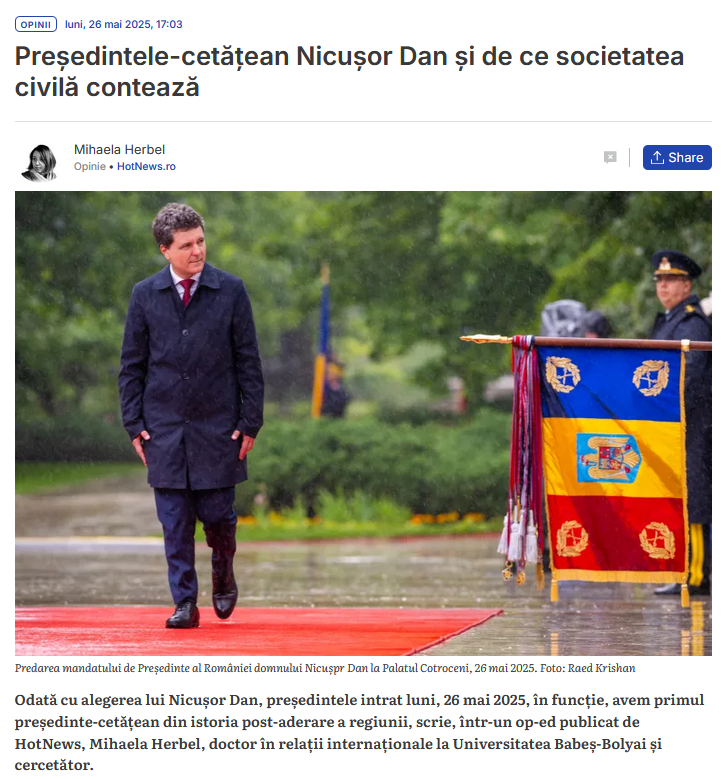
Abia după ce vom fi înțeles că Moldova este cea care a câștigat, enorm, prin alegerea Maiei Sandu dintre toți cei care se oferiseră să ocupe fotoliul de președinte, abia de atunci încolo vom avea și noi parte de un Havel. Până atunci… nici măcar n-am fi în stare să-l recunoaștem pe stradă! Chiar dacă l-am ales deja, ‘din lipsă de altceva mai bun’, ca președinte al nostru.


 nicichiarasa