lashes1-copy-300x210
If we want to understand what’s going on there we have realize that we are dealing with a absolute dictatorship which uses Islam as a crutch, exactly as the soviet style dictators in the so called ‘popular democracies’ were using ‘scientific materialism’ – their term for the communist doctrine.
The job of the Saudi ‘justices’ is to maintain ‘the order’ as they see fit – the kingdom as it is and the Saudi family in power, not at all to dispense justice as we know it.
In order to do that they use, ‘creativelly’, the most powerfull tool they have at their disposal: the faith shared by the majority of the inhabitants of the kindom.
It even doesn’t matter for them that in the process they are ruining any chance of a decent life for the majority of their conationals.
At first their only goal was to retain the graces of the ruling family – just as minions everywhere behave in the presence of a powerfull figure.
In time things have evolved in a malignant manner. I’m afraid that nowadays the House of Saud itself has become the prisoner of the erstwhile minions, just as every dictator eventually becomes the prisoner of his guards.

“The best laid schemes o’ mice an’ men / Gang aft agley”
(The best laid schemes of mice and men / Often go awry.)
Burns, To a Mouse.

Robert Burns destroyed the burrow of a mouse while plowing his piece of land and, feeling sorry for the misery he had brought to the animal, asked for forgiveness by writing a poem.

How many of those who wheel and deal in this world have ever apologised in earnest after making a mistake?

Then how come we, those who bear the brunt of their mistakes, still look up to them? As if they were Gods?

Pentru mine este de-a dreptul uluitor cum specialistii in imagine incearca, si de multe ori chiar reusesc, sa ne duca – cu dezinvoltura – de nas.

Sa luam exemplul legii ‘antifumat’.

Aproape toata lumea accepta ideea ca inhalarea de fum de tigara – de buna voie sau pentru ca nu ai aer curat pe care sa il respiri – creeaza conditii favorizante pentru aparitia unui mare numar de boli.

Si ce facem pe chestia asta?

Unii incearca sa interzica fumatul in cat mai multe locuri. Ceea ce mi se pare firesc – cu toate ca mai trag si eu cate o tigara, din cand in cand. Mai ales ca nu imi place, dar deloc, sa mananc in timp ce altcineva fumeaza langa mine.
Si ca sa-i ajute pe oameni sa se lase de fumat, sau sa nu se apuce, s-au gandit sa interzica comerciantilor sa expuna rafturile cu tigari chiar langa cele cu dulciuri si guma de mestecat exact acolo unde orice cumparator pierde mai mult timp si se plictiseste de moarte.

Altii spun ca daca interzicem total vanzarea de tutun vom ajunge ca pe vremea prohibitiei din America. Contrabanda va duce la cresterea coruptiei si, mai ales, vor scadea incasarile la buget. Argumentul forte al acestei linii de argumentatie fiind ca: “Industria tutunului este al doilea mare plătitor la bugetul de stat.”  Voi reveni.

Pana aici totul clar. Cine avea ceva de spus a facut-o pe fata, cu ce argumente i s-a parut lui ca vor avea mai mult impact.

Problema e ca in spatele acestor argumente stau lungi siruri de rationamente bazate pe cunostinte de psihologie aplicata, cunostinte care nu sunt puse prea des pe tapet. Nu sunt tinute la secret dar nici nu prea se vorbeste despre ele.

Pozitionarea marfurilor in magazine, de exemplu, este facuta dupa indelungi studii. Dulciurile – si tigarile, sunt puse langa casa de marcat tocmai pentru oamenii nu au, in mod real, nevoie de ele. Si atunci s-ar putea sa ‘uite’ sa le cumpere. Sau chiar sa nu le treaca vreodata prin cap sa o faca. Asa ca au fost pozitionate strategic, undeva unde nu poti face abstractie de ele. Copiii ii vor bate la cap pe parinti pana acestia vor ceda. Si apoi, nervosi, vor amana pe alta data mult promisa lasare de fumat.

Stiu ca povestea mea pare trasa de par dar ia ganditi-va mai bine!

Si acum, ca tot am vorbit despre lucruri care nu sunt secrete dar nu se prea vorbeste despre ele, haideti sa facem niste calcule.

Bugetul Sanatatii pe 2014:
Bugetul Ministerului Sanatatii: 7.8 miliarde lei
Bugetul Casei Nationale de Asigurari de Sanatate: 22.9 miliarde lei
Bugetul Administratiilor locale pentru Sanatate: Nu am reusit sa gasesc date centralizate la nivel national.
Total: cel putin 31.7 miliarde de lei. Adica aproximativ 7 miliarde de Euro.

Am mentionat mai sus ca cei din industria tutunului se bat cu caramida in piept ca ei sunt ‘al doilea mare platitor la bugetul de stat’. Hopa… adica aduc bani de-acasa?
Ei nu, singuri spun ca doar aduna “pur și simplu banii de la consumator”.
Pai si-atunci cum adica sunt ‘platitori’?
Nu v-am spus ca aici e multa pricepere in materie de dres busuiocul? Spui una la inceput, ca sa impresionezi, si apoi completezi ca sa nu te faci de ras. Numai ca ordinea in care este prezentata informatia este extrem de importanta. Cineva care se grabeste sau care este disponibil sa ia de bun tot ce citeste va ramane cu impresia ca industria tutunului chiar este importanta pentru constructia bugetului.

Si, cel putin la prima vedere, chiar este. Aproape 40% din bugetul sanatatii nu este putin lucru.
E foarte greu de evaluat daca acesti bani acopera cheltuielile pentru tratamentul bolilor provocate sau agravate de fumat.
Asa ca voi pune, pur si simplu o intrebare. Stie cineva vreo situatie in care doctorul v-a spus ‘poti sa fumezi linistit in continuare, la boala pe care o ai nu mai conteaza’?

S-a prins cineva ca am folosit exact aceiasi metoda a ‘iutelii de mana in conditii de nebagare de seama’ ca sa va induc un anumit sentiment?

Inseamna ca v-ati prins si ca voi sunteti adevaratii platitori de impozite.

2-capsunari

Abia ce a fost promulgata legea votului prin corespondenta ca au si inceput sa umble pe net tot felul de mesaje care exprima nemultumirea unora dintre cei ce au ramas sa manance ‘salam cu soia’ fata de posibilitatea ca si cei care ‘au fugit’ sa isi exprime optiunile in ceea ce priveste viitorul Romaniei.

O parte dintre argumente, bineinteles ca mult mai frumos ambalate decat am facut-o eu, se regasesc intr-un articol aparut nu demult in Deutsche Welle si datorat lui Horatiu Pepine: Votul de la distanta si natiunea extrateritoriala”.
Cele mai uzuale dintre ele sunt grupate in doua categorii.
Una de natura ‘tehnica’ – cica nu se poate asigura confidentialitatea votului si certitudinea ca cel care exercita votul este chiar persoana care ar avea dreptul sa o faca.
Si o alta de natura morala – ce treaba are ‘el’, de acolo, sa ne hotarasca ‘noua’ destinul. Aici.

Cu alte cuvinte ‘tehnicienii’ se opun idei de vot prin corespondenta, sau chiar electronic, pentru ca s-ar putea ca unii sa ‘vanda’ buletinele de vot. Sau sa accepte ca cineva sa li se uite peste umar atunci cand voteaza.
Teoretic au dreptate.
Practic e echivalent cu a banui ca o proportie semnificativa din electorat ar fi dispusa sa faca asa ceva. Se poate, cine stie…
Totusi nu prea imi vine a crede ca o operatiune care ar aduna un numar semnificativ de voturi in felul asta ar ramane ne-sesizata.

In ceea ce priveste argumentul moral… Aici treburile sunt putin mai complicate. “Cei care s-au exprimat într-o formă sau alta, par să ignore faptul că numai românii au pretenția de a vota masiv din țări străine. Toți ceilalți europeni fie se întorc acasă în ziua votului, fie își vor fi pierdut între timp dreptul de vot.”
Prima natiune moderna care a (re)introdus ideea de democratie in Europa a fost Anglia iar principiul care a stat la baza demersului a fost ca regele sa nu poata impune impozite fara acceptul celor care urmeaza sa le plateasca. Acest principiu continua sa functioneze si in zilele noastre. Se organizeaza alegeri locale – care determina cum vor fi cheltuite taxele stranse la nivel local, alegeri nationale – guvern si taxe la nivel national, ba chiar si alegeri pentru Parlamentul European.
Ei bine, exista o tendinta prin vestul continentului ca la nivel local sa voteze toti cei care au resedinta intr-o anumita localitate, fara sa conteze cetatenia. Locuiesti legal, adica platesti taxe, in localitatea respectiva? Votezi. Si gata.
Largind putin perspectiva nu putem sa nu observam ca marea majoritate a Romanilor care ‘au pretentia de a vota masiv din tari straine’ au o stransa legatura cu tara. Au proprietati aici – si platesc taxe pentru ele, trimit gramezi de bani rudelor ramase in tara, vin aici de doua, trei ori pe an… Foarte multi dintre ei chiar planuiesc sa se intoarca pentru a-si cheltui aici pensiile pe care  le vor primi ‘de-acolo’.
In situatia asta ‘pretentia’ lor nu mai pare chiar atat de exagerata…

Iar toata discutia cade in derizoriu in momentul in care intelegem ca tot razboiul asta se poarta pentru 2 locuri in Senat si 4 in Camera.

Sau poate ca tocmai de asta a fost starnit tot ‘scandalul’ asta? Ca sa nu se prinda oamenii ca legea este foarte frumoasa dar ca de fapt nu are mare importanta cate voturi vor fi exprimate in afara granitelor atunci cand vine vorba despre alegerile parlamentare?

I hate crowded malls and supermarkets.
As a consequence I make it so that I seldom have to buy anything during the weekend. And when I do I wake up early and I beat the crowd to it.

Not today. It so happened that I started late so I had to experience ‘weekend shopping’ at full intensity. Farmers market, a hypermarket, a discount store and a supermarket. All in under two hours – it’s a relatively small city, those places are not so far away from each other and I know exactly where each item I need is shelved in each store.

And now the reasons for my current post.

– Why on Earth would a pensioner chose to buy anything during the weekend rush except for the things that have to be absolutely fresh. For instance fish or lettuce?
OK, I can understand that some of them were shopping for the Sunday dinner but still… they could have done that on Friday morning when the shops are empty and they don’t have to wait at the cashiers desk or to navigate the heavy trolleys through a dense crowd…

– We are raising a very strange generation of kids. The shops were full of parents who were obviously quite disconnected from their children. My guess being that the kids spend the week at the kindergarten/school/after school (or with a nanny) and the parents ‘take over’ only during the weekend.
In those two short hours I witnessed innumerable interactions that suggested to me that the parents had no clue about their children and that the children practically didn’t know/trust their parents.


armed citizens
Terrorism needs three things in order to produce victims.
Some disgruntled/deranged individuals to perpetrate the actual crimes.
Some callous individuals who for various reasons organize/support the disgruntled/deranged.
A large enough section of the community which is too tired/despondent/discouraged to care about what’s going on in its close vicinity – that’s where the terrorists (hit men and the support network) hide while preparing a hit and where the support network will try to sink itself afterwards.
Since it is practically impossible to corral all the deranged and to smoke out all the schemers beforehand the only really viable strategy  remains to make it so that the general public no longer assists catatonically to whatever is happening in its close vicinity. Until it’s so late that even drawing a gun is no longer very helpful.

I don’t even think that arms are such a must.
They might come handy in certain occasions but what we really need is a much more active attitude. A calm and considerate one but firm enough to impose respect.


forgiveness

Some say that God created the world, a long time ago, and that’s why he is the only one who can forgive.
Some others remember how the elders taught them that keeping a grudge is far worse than having an ulcer. It will eat you alive, like a cancer.

I, personally, don’t know anything about God creating the world. I wasn’t there at that time so…
What I do know is that playing God is extremely dangerous. Not only for the impersonator but mostly for those around him. Exactly those who were amused at first by his performance – enough so that they encouraged him to continue, only to find out later how annoying the show will soon become AND that the exit door had been paddled shut behind their back, while they were happily clapping after the first gigs.
At the very end, after the impersonator had left the scene – by his own will or simply carried out, he will end up shouldering the whole blame – as he should, of course.
But I can’t stop wondering how much suffering could have been avoided if the crowd were just a tad more circumspect?

Not making very much sense, do I?

OK, first take a look at this:

No mercy

Then watch this:

go hard

Do you really think this is funny? Well… more than 38 000 of the almost two and a half million who watched this say they enjoyed it and only two and a half thousand became worried enough to express their feelings.

Most of you have not experienced how it is to live under dictatorship so I’ll use another metaphor.

You are probably quite familiar with this guy:

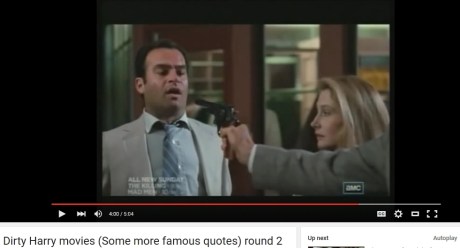
dirty harry

He was lionized during the ’70’s and the ’80’s for impersonating a no-nonsense cop who cut through the red tape and got things done.

Mostly by shooting the bad guys.

Don’t get me wrong.

They didn’t get anything else than they actually deserved.

What I find really troublesome about Dirty Harry is the casualness with which he killed people. And his over-reliance on guns. On brute force, that is. “Go ahead, make my day.”

It is true that at that time people were exasperated with the daily occurrence of violent crime and were desperate for a way out of that situation. I’m not going to offer you statistics or stuff, you can look them up yourself. I’ll just tell you that the Romanian television was having an almost daily news bulletin presenting the latest violent acts committed Stateside. It was all part of the propaganda, of course, but the facts were real. And plenty enough to make me wonder, I was a teenager at that time, what on Earth is going on there?

That wave of violence has subsided, as we all know. Some say it happened because of ‘broken windows policing’, some ‘freakin’ others ‘blame’ ‘Roe vs Wade’ for it while I suspect that all of the above had something to do with it but that the main ‘culprit’ was the economic upsurge that followed the ‘stagflation’ period.

Nowadays we find ourselves in another economic and psychological down-turn. With a twist though.
The recent economic troubles were brewed at home while then it started with the Oil Crisis. Much of the violence no longer starts as a robbery but has a psychological motivation – disgruntled and socially disconnected young people commit multiple acts of homicide, either by indiscriminately shooting their victims or by blowing themselves up, along with a huge amount of explosives, in densely populated areas.

And how do we respond to this fresh wave of violence?
By turning a blind eye to heavy policing? By digging fresh trenches that further divide our already highly polarized society? By another wave of over reliance on guns?

“I said it was only me and, hands still raised, slowly descended the stairs, focused on one officer’s eyes and on his pistol. I had never looked down the barrel of a gun or at the face of a man with a loaded weapon pointed at me. In his eyes, I saw fear and anger. I had no idea what was happening, but I saw how it would end: I would be dead in the stairwell outside my apartment, because something about me — a 5-foot-7, 125-pound black woman — frightened this man with a gun. I sat down, trying to look even less threatening, trying to de-escalate. I again asked what was going on.”

Go ahead, click on that quote and read the entire article. My post won’t go anywhere.

What’s the connection between what happened to Kyle Monk, the Dirty Harry movies and Putin?

For starters all those involved were …human individuals.
Kyle’s neighbor who called the police and who, when asked by Kyle ‘why did you do it’, chose to end up the conversation with “I’m an attorney, so you can go f— yourself.”
All of the nineteen policemen who played a role in this drama – and who treated a 125 pound, scantily clad, woman as if she were an armed and dangerous criminal were also human individuals.
The heads of the public administration, those who adopt and enforce policing policies are also human individuals.
The financial wizards who engineered the recent crisis belong to the same species as we do.

We, the guys who admired Dirty Harry for his toughness, are the parents of the hapless generation who blows itself up or mindlessly shoot their colleagues in campuses.

We are also the guys who are amused when bored magazine writers attribute to Putin such silly quotes as ‘it’s my job to send them to Him’.

And it’s us who applaud the Putins of this world. Only to find out, on our own skin but too late to be able to do anything about it, that the ‘hug of the bear’ is not that comfortable as it seemed from a distance.

you're Callahan


I happened to stumble upon this image on somebody’s FB wall.
gore2bvidal

And then it hit me.

Waging war is simple.
Even winning one is relatively simple if one has enough resources.
Winning the peace afterwards is the real challenge.
America did very good jobs at winning the peace after WWII and the Korean War but very poor ones afterwards.
Here’s Gore Vidal elaborating on the subject:
gore vidal

Let me elaborate on some concepts first.

We have religion and we also have religions.

Regardless of whether religion comes from the Latin ‘religare’ or not it is obvious for the concerned observer that inside what is commonly known as ‘culture’ there is a tightly knit set of traditions which constitutes the common ground where all members of the community that share those convictions come to meet and ‘find the time of the day’.
Emile Durkheim, one of the founding fathers of sociology, has written a whole book on this subject – The Elementary Forms of Religious Lifeand John Faithful Hamer, one of his disciples, has summed up brilliantly the whole idea: “Religion is largely a function of sociology, not theology.”

Only each community has evolved in its own distinct environment. Hence, even if for each community ‘religion’ plays the same role, there are no two religions that are similar. Simply because each of them consists, as I’ve said before, of a certain set of traditions whose main goal is to help the community make the most of the environment into which it has to make do. And since each environment is different from the next one…

And now we have arrived at the second role played by religion. To offer a certain degree of solace and certitude to the individual believer. Just as nobody can make it out by himself – regardless of whatever the anarchist libertarians might think/preach – all of us need some assurance about the world having some kind of congruence. Some of us find it in science, some others in stories which involve a God or a team of Gods and yet others in a godless narrative about how to behave in order to find, eventually, a way out of this Earthly ‘Valley of Tears’.
In order to offer that solace each individual religion has developed a certain ritual. Just as rigorous performance of calisthenics provides a certain physical well being by performing a religious ritual individuals forge a strong connection with the same minded people belonging to the same flock. That’s why some people believe that ‘religion’ comes from ‘religare’ – the Latin word for ‘binding’.

Let me now put two and two together.

We have religion as a set of guiding traditions and we also have religion as a ritual which is performed in order to bind people together so that they no longer feel alone and helpless.
Putting things this way it’s easy to observe that there are some people who are firm believers in those guiding traditions but who, for various reasons, do not feel the need to constantly reenact the ritual; others who are more or less skeptic about the traditions but who are convinced that their world would come apart if the ritual would no longer be performed and still others who are both firm believers in ‘their’ traditions and staunch performers of the ritual attached to those traditions.

From a more practical point of view the non ritualistic ‘firm believers’ will live and let live even if they are convinced the others will rot in hell while those who attach great importance to the proper performance of the ritual will try to impose it as widely as they (even im)possibly can.
So, if we need to reduce their militancy it would be easier to reduce their perceived insecurity/helplessness than to try to change their ‘religious’ convictions. Maslow taught us that it’s relatively easy to lift an individual from the base of his famous pyramid to a more comfortable level while history has taught us that it takes a lot of time to change a time-honored tradition.
Also, by helping them to overcome their perceived helplessness we’ll also help them notice the fact that each religion offers a great degree of autonomy to its followers.
BTW, that’s why many would be dictators insist on religious-like values (nationalism is also a religion), on the corresponding rituals being faithfully respected AND simultaneously do their worst in order to reduce their followers – the ordinary members of the community they intend to dominate – to a state of abject dependency. The most poignant example being Pol Pot’s Cambodia but this has happened, to various degrees, in all communist states. But not exclusively.

girls chose ISIS

mothers of ISIS

Atunci cand vine vorba despre analizat, post factum, intentiile faptuitorilor treaba este atat de complicata incat mi se pare o pierdere de vreme. Primul obstacol fiind acela ca niciodata nu poti sti daca a fost vorba despre nestiinta sau despre asumarea costurilor, mai ales atunci cand acestea urmeaza sa fie platite de altii. Iar al doilea lucru care ma determina sa fac economie de efort este ca, de fapt, nu conteaza. Consecintele sunt aceleasi, indiferent de motivatiile celor care au initiat procesul.

Iar acestea, consecintele, fiind de natura factuala, sunt mult mai usor de analizat.

Numai ca, oricat de factuale ar fi, ele trebuie analizate in cheia potrivita.

Deci.
PSD-ul a initiat un amendament, ceilalti au protestat de forma, amendamentul a trecut pana la urma aproape in unanimitate, ‘o parte a presei’ a luat foc iar cei din tabara initiatorilor tac malc asteptand sa vada ce va face Iohannis.

Trecerea in revista este foarte schematica si fara o conexiune stransa cu spatiul media este greu de sesizat ce voi spune in continuare asa ca voi solicita din partea voastra un pic de incredere ‘oarba’. Bineinteles, doar pe durata urmatoarelor cateva paragrafe.

Ei bine, masura luata in parlament este prin excelenta una politica numai ca marea majoritate a analistilor o intorc pe toate fetele doar din punct de vedere economic. Foarte rar mai spune cate unul, si doar en-passant, ca cei care au votat in favoarea ei – toti, nu doar initiatorii, au facut acest lucru luand in considerare (numai?) apropierea alegerilor. Si apoi se apuca sa planga, in cheie economica, de grija deficitului bugetar de anul viitor.

Tocmai de aceea voi incepe prin a incerca sa inteleg ce efecte va avea aceast amendament mai ales in plan politic si abia apoi in plan economic.

Aparent scorul este 1 la 1. Parlamentarii ambelor tabere au votat cot la cot asa ca, cel putin la prima vedere, s-ar parea ca nimeni nu va castiga nimic din chestia asta.
Da, numai ca efecte vor fi – chiar daca ele nu vor putea fi transformate in voturi de nici una dintre parti.

Daca impartim scena politica si sociala – locul unde se joaca aceasta piesa de teatru, pana la urma destul de absurda – in tabere, vom observa cu usurinta ce se intampla:

– Parlamentarii, aproape toti, incearca in disperare sa isi pastreze sansele de a fi realesi. ‘Pai si ce te miri?’ Nu ma mir de ce fac ei, doar ma intreb daca agitatia lor ar mai fi fost atat de mare daca ar fi fost adoptata legea pensiilor pentru parlamentari si, anticipez un pic, ce ar fi fost mai ieftin? Sa platim pensiile alea ‘nesimtite’ sau sa facem fata catastrofei economice cu care ne ameninta marea majoritate a celor care au pareri pe tema asta?
– Platitorii de taxe se simt jefuiti.
– Bugetarii se simt aratati cu degetul.
– Marii operatori economici, cei care sperau sa prinda contractele de investitii de anii viitori, se simt frustrati ca nu vor mai avea la fel de multi bani la dispozitie.

Concluzia?

Exact in momentul in care eram pe cale sa gasim un minim consens national si sa incepem ce n-am facut in ultimii 25 de ani – adica sa ne apucam cu adevarat de treaba, iar am reusit sa gasim un motiv pentru a ne uita chioras unii la ceilalti! Parlamentul, impreuna cu intreaga clasa politica, au mai pierdut ceva din bruma de credibilitatea pe care o mai aveau, populatia este din nou dezbinata, prapastia dintre angajatori si forta de munca s-a mai adancit inca un pic…
Deci nimeni nu castiga nimic, nici macar in termeni relativi, numai ca toti pierdem din greu.

Mai conteaza daca cei care au trecut aceasta masura prin parlament stiau ce urma sa se intample? Sau daca tot ce au incercat sa faca a fost sa-si maximizeze sansele la urmatoarele alegeri?
Poate pentru istorici…

In ceea ce priveste efectele economice ale acestei masuri, daca or mai avea vreo relevanta…
Cresterea deficitului nu este de loc certa. O executie bugetara corecta, atat pe partea de colectare cat si pe partea de verificare cu atentie a costurilor, s-ar putea sa aduca mari surprize…
Cu atat mai mult cu cat toate cresterile astea salariale se vor duce imediat in consum. Chiar daca o parte din acest consum se refera la marfuri importate in conditiile unei colectari (mai) eficiente a taxelor bugetul va avea destul de mult de castigat.

Si inca o chestie foarte interesanta. Acu’ vreo doua zile am auzit pe cineva la televizor – imi pare rau dar nu am fost atent sa vad cine era si nici macar la ce emisiune – care intreba foarte inspirat: ‘oare de ce finantatorii internationali (FMI, BM, UE) protesteaza doar atunci cand vine vorba despre majorari de salarii sau scaderi de taxe si niciodata cu privire la faptul ca in Romania un kilometru de autostrada costa de 2-3 ori mai mult decat oriunde in alta parte?’ Bine, nu doar finantatorii internationali se comporta in felul acesta…

In incheiere as vrea sa va atrag atentia, doar aparent fara legatura, asupra unui articol publicat de DCNews.
“A treia sau a patra oară, după tragedia din Apuseni, văd că, în timp ce muncim ore în șir ca să rezolvăm totul, începe, cum se spune în afară, asasinarea caracterelor. Mai precis, pe cine vrem să terminăm. Vrem să-l terminăm pe Arafat. Și începe o linie de articole cu atacarea lui Arafat pe toate liniile. Ce nu se înțelege, în acest moment, este faptul că acest tip de atac continuu, nu întotdeauna fondat, pe bază de informații credibile (mai precis cu ‘aparenta de credibilitate’, completarea mea), va face ca, în viitor, multor colegi să le fie teamă să ia decizii, să coordoneze o intervenție și să avem o situație mult mai gravă în situații urgente”, a mai zis Raed Arafat.”

Vorbeam mai sus despre faliile care exista in societatea romaneasca, si care o impiedica sa functioneze cat de cat multumitor. Ei bine, iata unul dintre mecanismele prin care apar si sunt adancite aceste falii.
Pana la revolutie ‘presa centrala’ ne batea la cap ad nauseam cu ‘unitatea de nezdruncinat a intregului popor in jurul conducatorului iubit’ iar acum fiecare tabara are cate un ‘organ de presa’ cu ajutorul caruia isi ataca ‘dusmanii’, inclusiv sub centura daca nu se gaseste un motiv real.

Pe termen scurt s-ar putea ca ‘divide et impera’ sa dea rezultatele scontate numai ca pe termen lung aceasta tactica duce intotdeauna la pierderi strategice.