Archives for category: Psychology

Cineva tocmai a făcut un inventar. Chestii care umblă ‘folcloric’ – adică din gură-n gură, pe internet.
Omul acela, destul de destupat la minte de felul lui, a ajuns să se îndoiască de propria sa capacitate analitică.

Există câteva narațiuni pe care nu le pricep sub nici un chip…

N-am citez inventarul cu pricina. Până citiți voi postarea asta, oricum va fi caduc.
Dacă vă interesează, sau dacă vreți să vedeți cât de bine le demontează „omul acela”, click pe citatul de mai sus și gata. Sunteți în pâine.

Dar o explicație mică…

Propaganda lui Putin funcționează mult mai bine decât armata pe care a trimis-o să-i învețe minte pe Ucraineni!
Pentru că e mult mai ușor să stai la calculator, la căldurică, și să vii cu metode cât se poate de creative prin care să zăpăcești de cap oameni care au un interes secundar cu privire la problemă. Oameni pe care nu-i aleargă nimeni dar care au deja un bagaj de sentimente și prejudecăți. Sentimente și prejudecăți numai bune de exploatat!
Pe ‘câmp’, în schimb, când și ceilalți trag în tine… iar tu știi, în adâncul sufletului tău, că ei sunt cei care au, de fapt, dreptate…

Și, poate chiar mai important, pe internet ajunge o măciucă la un car de oale!
E destul ca cineva priceput la băgat limba-n ureche să vină cu o chestie suficient de credibilă… că Gică Contra care să răspândească jumătățile de minciună… se găsesc gârlă!

Uite-așa, o jumătate de minciună ici… o jumătate colea… te trezești cu cozi la benzină și cu o frumusețe de criză de ulei.

Chiar mai important, te trezești cu o masă captivă de oameni dispuși să creadă aproape orice.

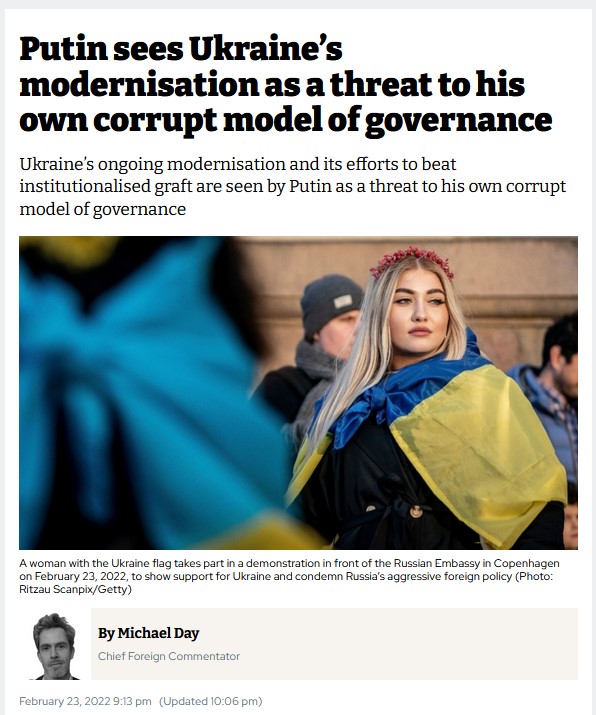
‘Rusia nu a atacat Ucraina, doar vrea să protejeze niște Ruși nevinovați de abuzurile săvârșite de Ucraineni’.
Spitalul era dezafectat iar cei din poze erau actori…

“After the bombing of the hospital, Twitter removed two posts by the Russian embassy in London which claimed the attack had been faked.
The embassy’s tweets made unfounded claims that the hospital was not operational at the time and that injured women pictured at the scene were actors.”

Și, ca să nu rămâneți cu impresia că am explicații pentru toate cele, hop și eu cu o nedumerire proprie.

Ăia care se pricep la băgat limba-n ureche, cei care vin cu toate ‘trăsnăile’ astea, cum pot să doarmă noaptea? Să-și sărute copiii pe frunte? Să facă dragoste?
Oameni inteligenții fiind – mult peste medie, nu-și dau seama unde duc eforturile lor?

Lasă că mor oameni… poate că stau prost cu empatia!
Dar nici măcar la pielea lor nu se gândesc?
Cât o să mai stea ‘Putin’ la putere?

Pe veci?!?
Iar ei, cei care sunt acum în grațiile lui ‘Putin’, vor rămâne tot acolo… Pe întreaga durată a domniei lui!
Păi da, dictatorii sunt cei mai fideli oameni din lume…
Se duc la următorul?
Și cât o să mai țină povestea asta?

Sper să nu mă luați acuma cu libertatea cuvântului!!!
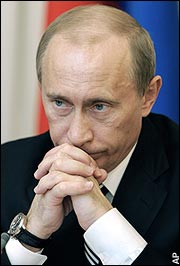
The internet is full of articles attempting to understand Putin’s motives starting from what he had said about the subject.

Here’s but the last I’ve read.
Why has Russia invaded Ukraine and what does Putin want?

Nothing special inside but it illustrates well enough the point I’m trying to make.

At first, Putin’s words are summarized and then proven ‘wrong’. Misleading. Or plain false.
In the next section of the article, the author – Paul Kirby, like many more before him, attempts to divine what Putin will do. Starting from the same words which have just been proven false and/or misleading.

?!?

No, the author is not ‘dense’.
He simply does what he was trained to do.

We, here in the land of democracy, understand language as a medium for negotiation.
And negotiation as an exchange where we let our needs be known, in earnest. As an exchange where we ‘trade’ information with the goal of finding the best mutually acceptable solution for whatever problem we attempt to solve.
In this sense, a negotiation is a form of cooperation. And compromise is something which both sides find beneficial.

For people conversant in ‘dictatorian’, ‘compromise’ is something to be shoved down the throat of the weaker side. The bigger the power differential, the harder to swallow becomes the ‘compromise’.

Doesn’t make much sense?
To us, democrats?
Because we know that shoving things down the throat of now weaker people doesn’t work on the longer time frame?

‘Assuming’ is the worst thing a negotiator may make.

We keep assuming that dictators are rational. Even worse, that they follow the same ‘ratio’ as we do.
That we – as in we and them, see the same world and have ‘slightly’ different goals.
And express those different goals in the same manner. Using the same kind of language.

We are wrong.

We, the democratically minded, are trained – conditioned is a truer word, to consider ‘the other’ as being equivalent to us.
At least some of the others, but that’s another discussion.
We actually ‘know’, in our bones, that we cannot ‘do’ anything by ourselves. That we exist only in cooperation with those around us. That everything we have ever accomplished was the result of a common effort.

People conditioned in dictatorial regimes see things rather differently.
They don’t cooperate, they just obey.
Their existence does not stem from the common effort but from following orders.
Language is not at all a medium where information is being passed between equivalent agents but a two way conduit. Orders are flowing from top to bottom and acknowledgments crawl from bottom to the top.

‘And what about ‘information’?!?
How does it travel among those people?’

Piecemeal.
Exclusively on a ‘need to know’ basis.
Nobody ‘volunteers’ any information unless expressly asked about it by a superior.

This is why dictatorships end up crumbling under their own weight.

That’s why we don’t understand, for real, what Putin attempts to communicate.
That’s why he is extremely annoyed right know.

Putin no longer understands what’s going on.
Let aside the fact that nobody around him dares to volunteer any information – which would be contrary to what Putin wants to hear.
My point being that Putin had been accustomed to having his way.

I’m not going to enumerate all the things he had done. Things we should have reacted against…
As in ‘reacted’, not meowed meekly.
As a consequence, he had grown accustomed to shoving things down our throats…

Suddenly, we have stopped swallowing!
Without giving him a ‘reasonable’ reason…
A reason he could understand!

Do you remember what I’ve told you?
A few moments ago? That dictators don’t care about those who are weaker? Nor about the long term consequences of their decisions?
That dictators are concerned exclusively with their own survival?

Savvy?

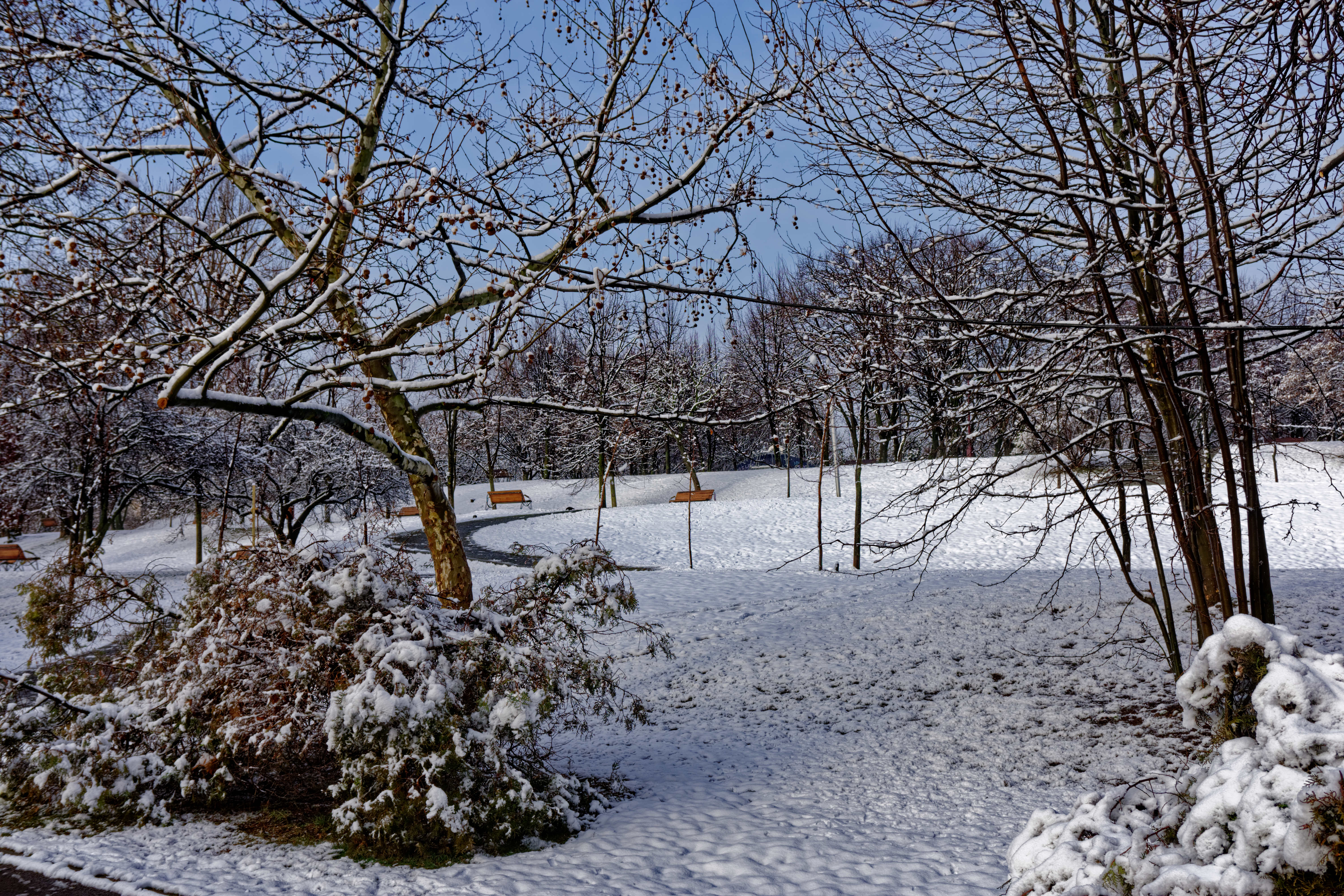
This beautiful – but almost empty, park is in Bucharest.
In Bucharest, Romania.

By the look of it, by how empty it is, it could have been anywhere in Ukraine.

Which reminds me of Churchill’s words.

Never in the field of human conflict was so much owed by so many to so few.

Currently, the Ukrainian people defend not only their freedom but that of the entire Europe.
And that of the Russian people!

Who now have the opportunity to conquer theirs!

Ever since Putin had ordered his army to invade Ukraine, I keep hearing about what drove Putin to do it.
About his dreams of rebuilding the old Russian Glory. About his drive to become the most important Russian personality. About NATO ‘pushing itself’ closer and closer to Russia’s borders. About…

The map above is the last argument I came by. And the last straw…
The person who posted the map doesn’t agree with Putin. Not at all.
But cannot ‘forget’ the fact that at one time Kiev did belong to Russia.

Well… I’ll be blunt about it!

This person, along with many others, tries to explain what is going on in a rational manner. They attempt to find an objective reason for a subjective decision.

Putin is flattening out Ukraine because he is afraid.

The Soviet Union had survived 1956 Hungary, 1968 Prague, and 1980 Solidarnosc. All of these ‘movements’ had been, somehow, quashed. Dealt with.

The Soviet Union had, finally, crumbled under its own weight after Afghanistan. After a people didn’t cave in. After a people, an entire people, found it in themselves how to resist. How to say no!

Putin had successfully quashed Yeltsin’s oligarchs, the Chechen rebellion, the first Orange revolution, dealt with Saakashvili, helped Lukashenko save his throne and put a lid upon the recent Kazahstani attempt at making a small step towards democracy.
And was contemplating the Western Europe planing to give up burning gas and oil.

‘His’ gas and oil…

He had to do something. Otherwise ‘his’ people were going to throw him out.

If Ukraine was allowed to continue on the self determination path, who was going to stop the Russians from following suit?

So yes, the circumstances described by that map are valid.
But it is Putin who bears the entire responsibility for what’s going on.
And for creating the circumstances in which ‘next’ is going to happen.

Can you imagine what’s going on in these children’s souls?

My late mother used to quote a co-worker:

After you get used to it, being hanged becomes bearable.

Let me give you some context.

I live in Romania. You know, that country which shot its dictator, Nicolae Ceausescu, on the Christmas Day 1989.

I was drafted to the army in October 1980. When I left home, you could still find food to buy. Soap, chocolate, washing powder, toilet paper… you name it. Nothing fancy but life was ‘normal’.
Nine months later, in July 1981, food was already scarce.

In 1985, things were already bad. You had to queue up for anything you needed. For all of the above mentioned items.

By 1988, things had become even worse. On top of what I had already mentioned, rolling blackouts were common. Those of us who lived in apartments connected to central heating were ‘enjoying’ running hot water for only a few hours a day/a few days a week. And shivered during the entire winter.

I’m telling you all these because in December 1989 most of us were hugely surprised when communism had fallen. With a bang.

We’d become so accustomed with what was happening to us that we were convinced our lives were ‘normal’.

Compare that to what you see below.
Oh, I forgot to tell you that we had only 1 (one) TV channel. Which was on for 2 hours each working day from Monday to Saturday and 12 hours on Sunday. And 80% of what was churned out was pure propaganda.

1. Sow doubt.
2. Drop a loud fact. Or two… This will simultaneously ‘water’ the previously planted seed and act as a ‘foot in the door’ for your next move.
3. ‘Miss-interpret’ another fact.
4. Mention an universal human emotion, inviting your audience to identify itself with the ‘victim’.
5. Squarely state what you want your audience to believe.

1. ‘The Soviet Union didn’t crumple under its own weight. It was dissolved by Yeltsin so that Gorbachev’s position would disappear.
Leaving Yeltsin as the top dog of the day. Even if at the helm of a little smaller empire…’

2. ‘After the Cold War had ended, the West should have treated the ‘defeated’ as Germany, Italy and Japan had been treated after WWII. The West should have helped the Soviet Union to overcome the transition hurdles by extending to it an equivalent of the Marshall Plan.
Instead of that, the Americans had come up with the Wolfowitz – later Bush, Doctrine.’

3. ‘Gorbatchev was told by James Baker that NATO will not move an inch eastward’

4. “…1998, Yeltsin, late Yeltsin: ‘you promised not to do this! So, how do we trust you, if you make a promise?’ “

5.1. Vladimir Putin has been created by the United States.
5.2. The so called free media in general – and New York Times in particular, cannot be trusted to provide honest information.

Pozner’s discourse is far more ‘byzantine’ than the ‘stream-lined’ version I used to illustrate what skillful propaganda looks like. Skillful maskirovka, more likely?

This post has become long enough. Let me wrap it up.

The main question here being ‘did he actually say it? Did Baker actually promised Gorbachev that “NATO will not move an inch eastward” ‘?

Having met with Genscher on his way into discussions with the Soviets, Baker repeated exactly the Genscher formulation in his meeting with Foreign Minister Eduard Shevardnadze on February 9, 1990, (see Document 4); and even more importantly, face to face with Gorbachev.
Not once, but three times, Baker tried out the “not one inch eastward” formula with Gorbachev in the February 9, 1990, meeting. He agreed with Gorbachev’s statement in response to the assurances that “NATO expansion is unacceptable.” Baker assured Gorbachev that “neither the President nor I intend to extract any unilateral advantages from the processes that are taking place,” and that the Americans understood that “not only for the Soviet Union but for other European countries as well it is important to have guarantees that if the United States keeps its presence in Germany within the framework of NATO, not an inch of NATO’s present military jurisdiction will spread in an eastern direction.”

‘So he actually said it!’…

the Americans understood that “not only for the Soviet Union but for other European countries as well it is important to have guarantees that if the United States keeps its presence in Germany within the framework of NATO, not an inch of NATO’s present military jurisdiction will spread in an eastern direction.”

The Soviet Union is long gone, all the states which have been admitted into NATO are ‘in’ because they had asked themselves to join – and are now extremely glad to be protected by the famous 5th article – … while the only (frustrated) ‘agent’ who ever cried foul was Putin.
Not only cried foul but eventualy acted out his frustrations!

But Putin is not exactly alone…

Putin’s Munich speech was the first explicit warning of serious trouble if the West did not abandon its increasingly aggressive posture toward Russia; the Kremlin’s latest demands for security guarantees and a NATO military pullback from Russia’s borders may be the last warning. The United States and its allies are backing Russia into a corner, and that is profoundly unwise if the goal is to avoid war with a heavily armed great power.

Ted Galen Carpenter, Senior Fellow, Cato.org January 24, 2022

Trump: “How smart is that?”
Pompeo: “I have an enormous respect for him!”

Pozner seems to be somewhat right, after all.
His arguments don’t stand – as he had framed them – but he does have an inkling…

And yes, you can – and actually should, analyze my post following the steps I already mentioned.
Then please read this:

Manipulation: useful tool, mortal sin or what?!? April 27, 2015
‘Causing’ Circumstances March 1, 2022

There’s chess and there’s bridge.

There’s managing your resources – on your own, while trying to outsmart – out, in the open, your opponent.

And there’s team-work. An attempt to make the most of what lady-luck had put on the table by exchanging information. With your partner and in the presence of the competing team. This time only the conversation is out in the open, the resources themselves remain hidden. During the initial phase of the competition and, partially, during the end game.

Until WWI, war was more like chess than anything else. Resources were, more or less, out in the open. The soldiers had no other role but to do and die. The whole responsibility belonged to the guys who called the shots. One for each side…

WWI had ended indecisively. Hence WWII.

Each of the winning parties – there had been two victors, had learned something different from the experience.
The Western allies had learned the value of cooperation while the Eastern ‘block’ had reached the conclusion that brute force trumps everything.

The Americans had started playing bridge with the Brits and taught the game to the rest of the world.
The Russians had honed their skills at playing chess. Something they were already very good at.
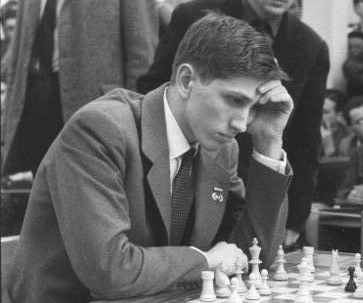
For a while, the Americans have tried to compete with the Russians. Remember a guy named Fischer? Bobby Fischer?

Soon, too soon, the Americans had given up.
After building a computer smart enough to outsmart all human chess players…

The even worse part was that the Americans had given up bridge too!
And forgot the most important lesson of WWI and WWII. That the victor needs to take care of the vanquished if they want to enjoy peace. To actually win the peace process after they had already won the war.

Which brings us to the end of the Cold War.

Communism – and practically all communist states, had crumpled under its own weight.
The westerners assumed it was something they had done themselves. Declared victory.
And the end of history

Having already given up bridge, they forgot to take care of the vanquished… and allowed Russia – the party who had taken most of the blame over their shoulders, for reasons to be discussed some other time, to slide down the slope inaugurated by post WWI Germany.
Did I mention that Russia was still fond of chess? Very much in love with brute force? And not very fond of respectful cooperation?

Now, that we all try to peek into the future – attempting to figure out how the current aggression ordered by Putin will end up, we need some people to learn about bridge.

Putin cannot launch by himself the nuclear missiles he had been brandishing lately.

Now, can those around him reset the chess board on which they are but pawns into a bridge table?
And invite the rest of the world into the game?

Will the rest of us understand the invitation?
If, and when, it will come?

Whether it’s in day to day conversation or in the media, a common response to disclosures or mentions of sexual assault is a phenomenon called victim blaming. The term might be unfamiliar, but what it looks like in practice is all too familiar. It’s questioning people who experience violence — especially sexual violence — about their actions, and what they could have done to prevent it, or worse, invite it. It’s pointing out supposed weaknesses or differences in a person that could have made them a target. In general, it’s the common tendency for people to look for the cause of violence as something the person who experienced harm did or didn’t do to prevent it.”

Victim blaming is a fact.
As in ‘exists even if it doesn’t make much sense’. As in ‘still exists despite our intense efforts to make it disappear.’

Shouldn’t we try to understand it? Before blaming those who blame the victims?

What’s going on is that our minds are biased.
And one of the two most powerful biases is our need to make sense of the word. We actually need to perceive the world as being rational. We need to have causes, to identify causes, for everything which happens around us.
The other one being our need for relevance. We not only need to make sense of the world, we also need to control it. Hence we do our best to understand the world as controllable. Controllable by us! By us, the purveyors of the explanations. By us, those who understand it as a rational succession of causes and effects.

Let involve ourselves in a small thought experiment.

We’ve just had a few drinks. Not enough to get stoned but each of us is a little ‘merrier’ than usual. A tad dis-inhibited.
In this condition, one of us has sex with an under-age person and the other has a car accident.

In which of these two cases, ‘being under influence’ would be seen as a mitigating circumstance?
Why?

See what I mean?

Socially, it is unacceptable to DUI. Because you are far more likely to cause an accident.
Socially, it is more than acceptable to have a couple of drinks at a party. Because you are going to be a far more ‘pleasant’ person that way. Well, most of us are…

It’s actually reasonable to expect a driver to be sober and a party-goer to be ‘tipsy’-ish.
Simply because it’s a lot more unnatural to drive than to have social intercourse. Hence we need a lot more ‘self-control’ when driving than when talking to someone. Even if that person is very attractive.
We, statistically speaking, have a gut feeling which tells us it’s harder to drive than to behave. Hence the biases.

‘OK, but has any of this anything to do with victim blaming?!?’

Victim blaming is the ‘easy way out’ for both would-be victims and would-be aggressors.

Remember what I said about our need to make sense of the world as a controllable environment?
As a place where we, each of us, is in charge? With the known – and already agreed upon, limitations…

For those who see themselves as potential victims, doing the ‘right thing’ – or not doing the wrong one, is something which puts us in a safe place. We’ve done everything (in our power) so we’re safe. Or as safe as we could be… If we become a victim even after we’ve done everything in our power to avoid it, then it’s exclusively the fault of the aggressor. There was nothing more we could have done to avoid it. Hence there’s no self-guilt falling on our own shoulders.
And if we have reached ‘this’ conclusion – that ‘this’ is the right behavior, then each of the ‘trespassers’ do nothing but ‘contradict’ our ‘good judgement’. Hence our ‘need’ to ‘educate’ them.

For those of us who conceivably might become or had ever been – directly or indirectly, as in ‘one of our relatives had done it and we didn’t see it coming’, – an aggressor, the logic follows the same path. The victim should have taken every precaution, we are naturally ‘limited’ individuals who cannot ‘resist’ when ‘pushed over certain limits’.

‘OK, and your point is?
That it’s OK to blame the victim?!?’

Let me bring your attention back to the title.

‘Causing’ circumstances.

Who transforms a certain set of circumstances into a cause?
Who sees a certain set of circumstances as an opportunity to do something or as an opportunity to do the very opposite? Or to simply stay put?
To directly cave in to something which ‘might’ be seen as a provocation or to ask for permission first? And to accept ‘no’ for an answer, in no matter what circumstances …

Who bears the responsibility for choosing one way or another?

This is a stub.

Basically, this post will reinterpret the arguments used in the previous one.

This is a stub.

‘This time is different’. https://www.economist.com/media/pdf/this-time-is-different-reinhart-e.pdf

History teaches us that each and every empire has collapsed. Usually under it’s own weight. Pareto has given us a valid explanation – each structure which doesn’t have to ‘refresh’ itself tends to become clogged with self serving individuals, near-sighted enough to ‘forget’ that none of them (none of us, actually) is able to survive ‘outside’. Yet each ’emperor’ allows themselves to believe that this time is different. I’m better than all my predecessors. And their followers allow this to happen, just as Pareto had taught us.

‘They is a rational operator hence they must have a reasonable objective’.
That’s how people raised/educated in a reasonable environment think/interpret the actions of other people.
This being the reason for democratically groomed leaders having such a hard time when they need to understand how dictators operate. This being the reason for democratically groomed political operators having such a hard time when it comes to identify skillful would be dictators.

https://www.journalofdemocracy.org/articles/russias-road-to-autocracy/