It’s not unusual for a Christian ‘zealot’ to accuse an atheist of ‘cherry picking’. When the latter uses a quote from the Bible to argue something which ‘displeases’ the former, of course.
Well, if I remember correctly – more than three decades have passed since I had read The Brothers Karamazov, which didn’t impress me much, the book is an intricate, but very compelling, demonstration of the exact contrary.
Some people consider individual liberty to be supreme. Nothing else comes even near, except for private property. Which is seen as the practical embodiment of freedom.
‘Me and my property, free from any outside intervention’.
Sounds good, doesn’t it?
I agree.
Some others consider ‘community’ to be the most important thing. Or various alternatives. ‘Traditions”, “elders” and so on.
I also agree!
And here comes the tricky part. While ‘traditionalists’ have dominated for most of human history the ‘individualists’ have gradually gotten the upper hand during the last 2 to 3 centuries. For example, Confucianist China – traditionalist by definition, had been the first civilized nation. It had a very productive economy when Europe’s was primitive and a sophisticated culture when Europe was yet learning to read and write. Yet it had been the Europeans who had invented ‘science’ and who eventually dominated China. For a while, at least…
So. In the end, it seems that individualism trumps traditionalism… or that it had been able to do it at least once…
But there’s a catch. Ever since individualism got the upper hand, humankind had experienced her worst crises. Not only more intense but also more often ones. And almost always starting in the Euro-Atlantic area. WWars, most economic crises, ‘erosion of values’… Only this hasn’t always been the case. Historically, China also had her share of wars – both ‘civil’ and with her neighbors, the Spaniards had been able to conquer Central and South America simply because those living there had been at each-others throat when the Spaniards had landed… and so on. Not to forget the huge number of wars fought inside Europe, between European ‘factions’. Then what if European individualism wasn’t the whole explanation for what had happened? What if Europe had been able to basically impose her Weltanschauung over the rest of the world simply because she had kept, at least for a while, her trade-mark individualism under control? At least when ‘domestic’ matters where at stake…
When Europeans dealt with other Europeans… Remember the rules governing King Arthur’s Round Table. What chivalry used to mean. The Geneva Convention, so often invoked and less and less observed as conflict took place further and further away from Geneva.
My point being that freedom – and private property, don’t make much sense unless accompanied by at least some mutual respect. While mutual respect won’t take you very far unless exercised amongst free agents.
Freedom understood as ‘ending where my nose starts’ is nothing but a continuous bout of fisticuffing. Preserving your ‘private property’ against all others is hopeless while preserving it in a collaborative way – as we currently do, is a breeze. As long as enough of us consider theft to be unacceptable, of course.
I was speaking a little earlier about ‘mutual respect among free agents’. In a sense, the phrase is an overkill. Respect cannot be mutual unless it is extended among free agents. And if those who show respect are not free, that respect is neither genuine nor mutual. This being the reason for which whenever respect ceases to be expressed among free agents it becomes nothing more than ‘window dressing’.
Hence useless when push comes to shove. When people need to gather together. To cooperate towards their common good. Towards their common survival.
In that context, it made sense. ‘How close to my house – a teetotaler, should you be allowed to open a bar and why should I be able to tell you what to drink/serve in your house.’
In a wider setting – individual rights, for instance … not so much!
‘Your right to swing your arm leaves off where my right not to have my nose struck begins’ only if at least one of the following is true: – My arms are as long as yours AND I’m willing/able to defend my nose. – You are a civilized person. – We, the entire community, have reached the conclusion that we are better off, together, if we observe – and enforce, this rule.
The first sentence describes a situation of generalized conflict. Not necessarily ‘hot’ but, nevertheless, always ‘waiting to happen’. In the second situation, ‘one side’ depends, decisively, on the ‘other side’ behaving ‘properly’. Nice and commendable but what happens when one of them goes berserk? The third describes the de facto functioning of any civilized nation. Which nation, any nation, is composed of individual people. ‘Endowed’ with ‘free will’ and not always ‘well behaved’.
Hence the danger of narrowly defining freedom as a collection of individual spaces where each of us might do as they please – as long as the consequences of their actions remain inside that space. Which spaces would have to be constantly defended. Or could be extended, whenever any of the neighbors wasn’t on the lookout.
How about ‘our mutually respected individual liberty is the well deserved consequence of our collective effort to enlarge OUR freedom’?
Classical economy sees the market as the place where demand meets supply and prices are born.
‘Relative’ economics, which hasn’t been written yet, sees the market as the place where people meet to offer their wares and to fulfill their needs. In order to meet this goal, people negotiate prices and adapt their behavior/attitude.
Classical economics sees the market as being either free or ‘non market’ – a.k.a. ” “planned” economy“: the one which “is heavily regulated or controlled by the government, most notably in socialist or communist countries.” As an aside, while I fully agree with the notion that communist countries – ‘popular democracies’, as their rulers used to describe them, had organized their economies around strictly centralized decision mechanisms, I cannot but wonder how would a classical economist describe Hitler’s economy? Or ‘crony capitalism’?
‘Relative’ economics, which – I repeat, hasn’t been written yet, sees the market as being either ‘free’, ‘un-free’ – a.k.a. ‘captured’ or ‘cornered’, or ‘obsessed’. Of course, there never was such a thing as a completely free market, only functionally free ones. And I’m sure most of you fully understand what I mean. Also, it is clear what ‘un-free’ means. Any situation where a small number of people call all the shots for an entire market. It doesn’t matter a bit whether those few people are directly involved in the market – over which they ‘enjoy’ monopolistic power, or they are involved with – read ‘control the’, government. The determining factor here is the scarcity of decision makers and the chock-hold they have over the entire decision making process. The ‘obsessed’ market is the most interesting of all. For me, at least.
Remember “Tulip Mania”?
As with many interesting stories, there are at least two sides attached to this one also. One version describes the whole thing as a generalized folly which had ended only after the government stepped in while the other paints a considerably duller picture. Only nobody denies the fact.
That for whatever reasons, tulip bulbs had been – admittedly for a relatively short while, on a par with houses. Value-wise.
Did it make any sense? Then? For those involved, yes! Otherwise… Could they afford it? Had they been affected when the bubble burst? That depends on whom you ask… and whom you believe…
Does it make any sense now? Can we make anything out of it?
We can certainly explain what had happened. Holland’s was the most affluent economy of the continent and the wealth was sort of spread around. A lot of money was ‘sloshing’, a lot of people were looking for a way to ‘show of’ and tulips were the ‘thing of the day’. Does it make any sense now? Retrospectively, no. Not for me, anyway. Do we have an explanation for what had happened? You’ve just read a very condensed one. If you need a more elaborate version, try Veblen’s ‘The Theory of the Leisure Class‘.
Anyway, that’s the perfect example of an ‘obsessed’ market. Where the agents are free to do what they please but are obsessed enough to act in sync. As opposed to ‘in concert’.
‘Obsessed’ means that all present look in the same direction and react in the same way. Which might be a good thing – when a group tries to escape a fire. Or a bad one, when the same group is trying to gather food from a forest. If all of them are looking, exclusively, for a single type of mushroom, many other sources of food are neglected.
In a really – as in ‘functional’, free market, people display a variety of behaviors. Some suppliers are greedier than others, some are diligent, some are sloppy and others are dedicated craftsmen. Some buyers are more ‘relaxed’, others ‘stingier’. Some know their way around the market, others are ignorant. On the whole, a dynamic equilibrium is constantly negotiated among all these ‘free’ agents. Simply because there is a variety of opinion. When the market is ‘un-free’, the whole notion of negotiation and equilibrium disappears. The parameters are set by the ‘rulers’. And things go on only as long as the ‘rulers’ manage to maintain a modicum of normality. When the market is ‘obsessed’, things become really interesting. The agents maintain their apparent liberty – at least for a while. Only they don’t actually use it. All of them act as if pre-programmed.
And somebody sooner or later notices what’s going on. And turns the whole thing to fit their own goal. Which is, almost always, not so different from the ‘general’ one.
Tulip Mania was relatively benign. Nothing really bad had happened.
We’ve somehow managed to weather the recent financial melt down. Which had been the consequence with our obsession with money as the ultimate goal. Which obsession continues unabated.
In these terms, science must be deterministic. No systematic study of anything might ever be made if not starting from the conviction that a given set of causes will produce the same results, over and over again. No laws attempting to describe any facts in general terms might be formulated unless starting from the same premises.
On the other hand, it was science itself which had taught us that:
And there are countless other examples of ‘in-determination’ which have been documented by scientists during their search for the ultimate truth.
Any chance of reconciliation?
Well… To start, I’ll note first that ‘determinism’ is a concept which had started its career in philosophy while ‘science’ has a more ‘complex’ origin. It might have been initiated by Christian theologians trying to ‘guess’ God’s will only they were attempting to fulfill that task by closely watching Nature – which was seen as the very embodiment of God’s intentions. In this sense, scientific determinism can be understood as the conviction that Nature must make perfect sense – must be completely explainable, simply because God’s creation – which includes Nature, must be perfect. OK, and since all theologians agree that no human will ever be able/should ever pretend to know God, what’s the problem in accepting that Man – collectively speaking now, will never learn enough to find a complete explanation for everything?
‘And what about the atheists?’
What about them? Oh, you mean the people who are sure that God doesn’t exist? Who are just as sure that God doesn’t exist as the staunch believers who are perfectly confident that God not only exists but also micro-manages everything? Under the Sun and beyond? I’ll just leave it there…
On a deeper level, there is no contradiction between ‘determinism’ – philosophically speaking, and scientific thinking. As long as we keep these two ‘apart’, of course…
‘So you are going to accept that science will never ‘know’ everything AND that ‘everything is a consequence of the previous state of affairs’ ‘ ?
Specially since entertaining a truly ‘scientific attitude’ means, above all, to be prepared, at all moment and without any notice, for all your previously held convictions to be contradicted by new evidence…
‘What are you trying to say here? That everything revolves around the manner in which each of us relates to the meaning of his own interpretation of each concept? That truth itself is relative?’
‘That man is the measure for everything?’
Yep! AND that man is also responsible for the consequences his own actions! In front of his own children, before everything else. For no other reason than it will be his own children who will bear the brunt of his own decisions.
I’ve been asked this – who wasn’t?, for so many times that I’ve lost count… Only the last instance was different.
The context was a lot more serious than usual. We were discussing ideas! Individual, social, freedom… and we were doing it in English – my ‘second’ language. Hence I was a tad more alert than when chatting away in Romanian.
Have you noticed that in English ‘you’ has three meanings? A singular ‘you’, a plural ‘you’ and a formal ‘You’ which covers both singular and plural. In French we have ‘tu’ for singular and ‘vous’/’Vous’ for both plural and formal. In German ‘du’, ‘inhen’ and ‘Sie’. Only ‘sie’ – starting with small s, as opposed to capital S, means ‘they’… In Romanian, ‘tu’, ‘voi’ and ‘Dumneavoastra’/’Domniile Voastre’. Literally, ‘Your Lordship’/’Your Lordships’.
I’m not going to delve into Humboldt’s linguistic relativity hypothesis at this point. It would be very interesting but I have something else in my mind. I’m going to answer the question ‘personally’. Influenced, indeed, by Maturana’s opinion that human consciousness (self awareness) has blossomed at the intersection between our brain power, our ability to communicate verbally with each other and our emotionally driven memory.
So, who am I? Just one of you…
Neither of us could have existed independently. None of us could have given birth to themselves… obviously. But also none of us would have been what we are today without having been raised by and educated in our respective communities. By the ‘you’-s to which each of us belong.
On the other hand, none of these communities would have ever existed without the individuals who compose them AND without those individuals being self aware enough to notice their existence. ‘Their existence’ meaning both the existence of the individual personalities which compose the communities and that of the communities themselves.
To simplify matters a little bit, we – as individuals, depend on the well being of the communities to which we belong while we – as communities, depend on the self-awareness of the individuals who animate each of the communities.
If we add the piled up consequences of all the decisions we – as a species, have ever made we end up with ‘culture’ and the present state of the environment which surrounds us – also known as ‘civilization’. I’ll leave these for another time.
Only there are a few hurdles which will have to be negotiated first.
Which ‘truth’?
Mine? Which will set me free? Theirs? Which will set them free? Or ours? Which will set us free?
What is Truth in the first place?
What I believe in? What we believe in? Something which is out there and we learn about incrementally? In a collective manner but individually driven?
How can we find it? If ever, of course….
Agree to something which has worked until now? Listen to what those around us have to say about the/any matter? Do your ‘own homework’? All of the above, in a respectful manner?
Freedom is too bothersome?!? Have you considered the alternatives?
Nowadays, too many individuals are afraid of freedom. Specially of other people’s freedom, since other people’s freedom might bring in ‘unwelcome’ change. Other people’s freedom might challenge our established way of life. And why risk it?
Still interested? History strongly suggests that societies which had considered the stability of their ‘established way of life’ to be more important than the freedom of any individual member to respectfully question everything have eventually failed to preserve that over-cherished way of life. Simply because those societies had not allowed their individual members to adapt their mores to the changes which inevitably alter the ‘environment’.
Conclusion? Liberty is of utmost importance. For both individuals and societies, equally. And, as a matter of historical fact, real – as in ‘truly functional’, freedom can be achieved only together. By the individual members of a society, acting in concert. Through a robust mechanism of checks and balances – a.k.a. real justice, based on mutual respect between the members of the society attempting to maintain this arrangement.
Warning! Since we currently experience a growing distrust among the members of many societies – America and Western Europe included, no wonder that actual individual liberty is sliding down a dangerous slope. Simply because nobody is going to defend the liberty of somebody they do not trust/respect.
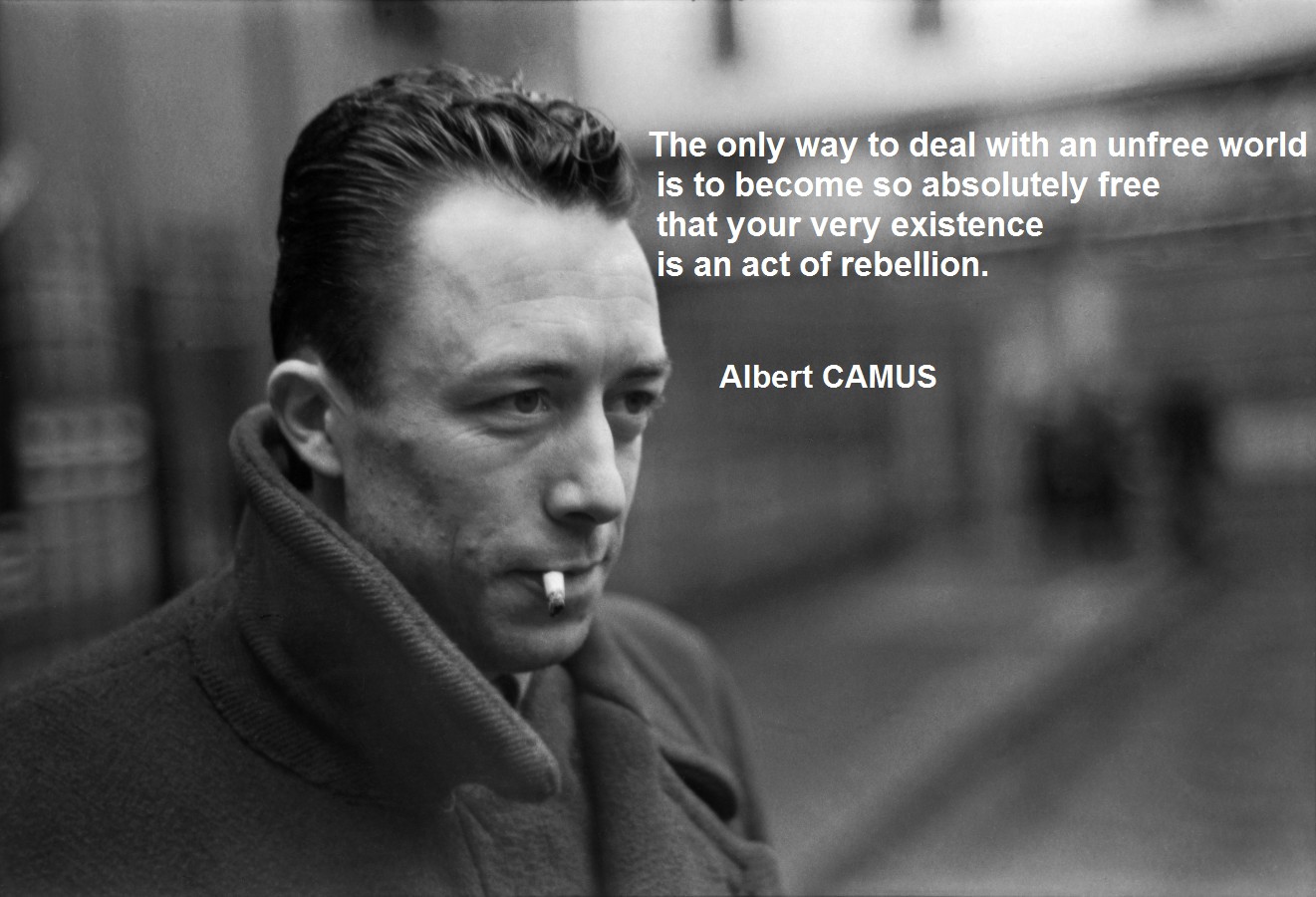
Last time I checked, for a rebellion to make sense, it had to be against some precise thing. Otherwise…
On the other hand, there are only two kinds of freedom. ‘Against all others’ – which starts as anarchy and very soon becomes atrocious dictatorship. Where the dictator is free to rule and the oppressed are free do obey. Or to attempt to climb into the dictator’s shoes… Or ‘with all others’. Also known as ‘democracy’. The real thing, of course, not the ‘mob rule’ variety which is currently creeping upon us.
Hence the only sensible rebellion would be the one against any form of dictatorship and ‘executed’ in concert with the rest of the oppressed.
Literally.
The electron in a Hydrogen atom ‘dawdles’
around the proton because its negative electrical charge ‘recognizes’
the positive one and is attracted to it. Furthermore, the Moon revolves
around the Earth because their masses ‘recognize’ each-other as such
and, ‘hence’, are subjected to a mutual attraction.
Factually.
Things are a little more complicated at this level.
For something which exists to become a ‘fact’, that something must be
first noticed by somebody. Until then it exists in ‘total darkness’. We
cannot even say it doesn’t exist, simply because we are not aware of the
possibility of its existence.
In this sense, the Moon had started to revolve around the Earth only ‘after’ we had recognized the pattern of its movement.
Teleologically.
Otherwise said, for as long as it fits our purposes AND/OR our understanding of the world.
The Sun and the Earth had pulled at each other since the start of time.
For only as long as we had been believing in Newton’s theory about
gravitation, of course…
And, at first, we had been convinced that it was the Sun who was speeding around the (flat?!?) Earth!
Despite the many proto-scientists who did their best to open our eyes.


 nicichiarasa