Archives for category: cooperation

Relative to what?
For whom?
By whom?

‘We’ – as in we, conscious human beings, live in the two tiered environment called – by us, ‘reality’.
I consider it to be ‘two tiered’ simply because it consists of a ‘natural’ layer and a man made one.

The ‘natural’, at least the part we inhabit – a relatively thin ‘skin’ surrounding the Earth, is the consequence of natural evolution. The elements have eroded the mountains, microorganisms have transformed sand into soil and ‘reconfigured’ the atmosphere, lions make sure that antelopes don’t graze the savannas back into deserts… and so on.
On top of that we’ve build a second, man made, layer. Roads, cities, churches… And, a lot more important, many strata of ‘understanding’. Collectively known as ‘culture’.

We live in a Nature which had been ‘civilized’ by ‘culture’.
Well, in fact it was us who have civilized Nature according to our culturally accrued understanding of things.

Freedom is a human concept.
Which belongs to culture, hence to one of the man-made layers which constitute the surrounding reality. The environment which hosts our lives.
Freedom, like many other components of the man made layer of reality, has two dimensions. One of a physical nature and one of a virtual nature.
Both dimensions exist only in our heads. Or, better said, exist only inasmuch as we’re aware of them. Inasmuch as we understand the concept.

For example, one aspect of the ‘physical’ liberty is our ability to move around.
Which liberty is ‘relative’ to gravity, for all those who are fit enough to exercise it and is made possible by the hardness of the Earth’s surface.
To make the example clearer, just imagine what happens to somebody caught in a pool of quicksand. Or in a pit full of molten tar.

The ‘cultural’ side of freedom has to do with the social relations which exist in a given extended community.
Hence its ‘virtual’ nature, since there is nothing ‘physical’ to determine its extent or ‘intensity’/quality. Prisons and shackles do not qualify here since they are used by some people to restrict the freedom of other people, they do not occur in nature.

Cultural freedom of one individual is relative to what the rest of the society has to say about it.
Is for whom the society considers fit to extend it to them.
And is by the same set of rules and customs which keeps that extended community together.

Like all things cultural, freedom has history. What we, collectively remember about its development in time.

At first glance, it would seem impossible to gouge what individual liberty meant 100 000 years ago, right?
Indeed, only some people still live, today, according to rules and customs which might have been valid then. The Saan and Hadza peoples in Africa, some of the indigenous tribes still living ‘traditionally’ in the Amazonian forest...
And these people have a very interesting behavior regarding ‘individual freedom’.
One is free to do as they please, for as long as their behavior do not jeopardize, in any way shape or form, the survival of the group. By not sharing, by intentionally hurting another member of the community…
The punishment for trespassers being banishment.
Temporary or even permanent. The offender is sent out into the wild, to fend it off on their own. Temporary – under the assumption that the individual will be able to learn their lesson, or – for unpardonable transgressions, for ever.

The next step, as human consciousness had become sophisticated enough to make the difference between ‘us’ and ‘them’ – one level higher than the difference between ‘me’ and ‘them’, we’ve invented slavery.
For who are the slaves?
People so different from us that we are no longer able to picture ourselves ‘in their shoes’. Just as we cannot picture ourselves as beasts of burden or as egg laying hens.
And, just as in the previous step, individual liberty was something reserved for those members of the society deemed fit for enjoying it. As individuals who are welcome at the communal fire or as individuals who are not dependent on anybody else – but the ruler/government which dispenses/embodies freedom in a given ‘formal’ society, of course.

Some extended communities have managed to go even further.
And noticed – to their amazement, perhaps, that slave-less societies fare a lot better, as a whole, than those where some of the population enjoy less freedom than the others.
Since these societies had already learned to write and to rely quite heavily on formal laws, this particular piece of information had been enshrined as the most fundamental ‘human right’.

OK, if things are so straightforward as you pretend, then why are we still having this discussion? Why ‘pockets’ of slavery – and indentured servitude, can still be found on our planet? Why, in a growing number of places, people are increasingly putting ‘personal safety’ ahead of ‘individual – and collective, liberty’?

Lack of Trust.

As I mentioned before, freedom is something which may occur in certain circumstances and which is, its social tier, a collective endeavor of the entire extended community. ‘Endeavor’ because liberty is never ‘achieved’. It has to be nurtured constantly, … or else!
The most important circumstance being mutual respect between the members of that particular extended community. Mutual respect which includes trusting your peers.
As I mentioned before, individual liberty is for ‘selected’ members of the community – under aged children continue to be excluded to this day, for example, and ‘by’ the rest of the members who constitute a community.
As mutual trust between the members decreases – for whatever reason, people are no longer willing to ‘extend’ liberty to their fellow … fellow what?!? Since they no longer perceive each-other as being fellow trustworthy citizens…

This being the reason for which deeply divided societies fall prey to totalitarian propaganda.

Whenever too many members of a society arrive to the conclusion that they will never ‘make it’ – because of ‘the wealthy’, or the king, emperor, you name it, will never ‘let them’, those people are ‘ripe’ for socialist propaganda.
On the other hand, if too many people who had once belonged to the middle class are somehow ‘demoted’ – because of various causes, and arrive at the conclusion that the current government isn’t doing ‘enough’, those people are rife for nazi/fascist style propaganda.
Tsarist Russia and WWI defeated Germany are the first examples which come to my mind.
Not much difference between those two regimes, anyway.
Both pretend to put the collective above the individual but, in fact, all what they achieve is to rise an individual dictator above all others.

Apparently, in this situation, the dictator/absolute monarch garners much of the ‘available’ liberty, thus reducing that of the rest.
In practice, things are not that simple.
The dictator becomes ‘freer’ than his subjects only in the ‘virtual’ manner.
He is free only from being interpellated by those around him. But not from the consequences of his decisions.
This being the reason for which all totalitarian regimes crumbling down. Sooner or later.
Nobody, how ever well intended and capable, was ever wise enough to pull through a dictatorship. From Alexander the Great to whomever you want to pick up from the current gallery.

So, is there anything to be done about this?
Or should we just prepare ourselves for the worst?

There are some tools which might come handy. ‘Checks and balances’, the ‘rule of law’…
But tools are only as useful as the mind which tells them what to do.
For ‘checks and balances’ to work, all parties involved need to respect each-other. ‘Checks and balances’ have been devised to weed out ‘honest’ mistakes, not to contain a raging – and conniving, bull.
Same thing with ‘the rule of law’. Laws are enforced, and written, by humans. If those who enforce, or write, them to not respect the others – and these others do not trust them back, the whole thing becomes a farce.

There is one thing which may convince us to clean up our act.
A healthy dose of history.
The understanding that we have just one planet at our disposal. For only this long.

Do we care?
Do we really care?

Let’s pretend, for the sake of argument, that we still do.

Perceived utility.

There are at least three examples of ‘mutual respect’, and its corollary, functional democracy, having developed naturally.
In the Ancient City of Athens, in Medieval Scandinavia and the entire history of the Jewish People.

The Ancient Athenians had evolved in a particular set of circumstances. They had some – but not much, fertile land, a natural port and a lot of trading opportunities in their vicinity. Hence they had experimented, very early in their development as a nation, something which was later to be described as ‘division of labour’. This very ‘division of labor’ induces trust among the members of the society. The trader has to trust that the farmer will continue to produce while the farmer has to trust the trader to come back with the money. And/or other merchandise. Further more, people involved in oversea trading, and in commercial – versus subsistence, farming, tend to develop a more independent mind-frame. And a healthy dose of self-esteem.

The same evolutionary process had happened in Medieval Scandinavia. The erstwhile subsistence farmers and fishers have expanded their ‘scope’ and became traders cum pirates. Those who ‘manned the fort’ had to trust those who went away would come back to share the spoils and those who rode the waves had to trust each-other ‘in battle’ and the ‘home-makers’ to keep the hearth warm.

Finally, the Jews had been the firsts – that I am aware of, to come with the notion that ‘God had created Man in His own image’.
Hence all men – or, at least, all those who believed in said God, were considered to be ‘equals’. ‘Equal’ sons of the same Father. Add to that the fact that each of those sons were bearing the mark of their Father – His likeliness. How not to trust/respect your ‘brother’?!?

Are we able to recreate this Weltanschauung?!?
To notice, and appreciate, the role played by each of us in the social clockwork?
To teach our children to become useful members of the society?

Let’s remember Darwin’s The Origin of the Species. Evolution is about species, not individuals.
We, individuals, are the ones who had come up with the concept of ‘freedom’. Are we wise enough to use it properly?
For the good – read survival, of our extended communities?
As we somehow managed to do until recently?

Or lazy enough to allow it to be used as a wedge to pry us apart? To smithereens?
By people who have no inkling about what they’re doing?

https://www.snopes.com/fact-check/hepatitis-c-drug-prices/

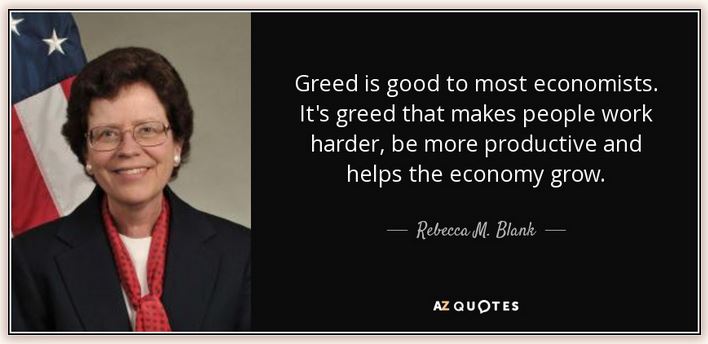
https://www.azquotes.com/quote/1133913

Then, if ‘greed is THAT good’, why blame Big Pharma for ‘buying’ politicians in order to extract as much profit as possible from their work?

Specially when it does work as advertised?

We priced the product at exactly the same as the existing standard of care, which worked about 50% of the time, and are providing a benefit that, based on real world experience, works about 98% of the time. From our perspective, it was a very good value.

I think our failure, if I have to take a step backwards, we were unable to have a good enough conversation with the payers. Perhaps we were a little conservative about what we could have or should have said to them to allow them to prepare for the number of patients that came forward. Honestly, it was far more than we thought. We did not think the system could or would try to handle as many patients as it did. We essentially quadrupled the number of patients treated in a year. That surge really created a lot of pain.

Ooops… so it’s the ‘payers’ who are hurting, not the patients themselves…

Gilead’s CEO Admits To ‘Failures’ In Setting Price of $1,000-A-Pill Breakthrough

Hepatitis C Treatment Highlights Disparity in Worldwide Drug Prices

“Tolerance without reasonable limits is like walking around with a “KICK ME” sign that you put on your own back.”

John Faithful Hamer

Well…

‘Tolerance’ is a two dimensional thing.
‘Intensity’ and ‘wideness’.
What I tolerate and how far I allow things to go before I react to them.

Indiscriminate and limitless tolerance is, indeed, incompatible with life as we know it.

Actually.
It would mean total surrender to the first ‘bidder’.

(Absolute) intolerance would mean ‘constant warfare’.
A.k.a. beating the crap out of anybody who even dares to look up.
…. Being (feeling) compelled to attempt to …

Your choice.

Our choice?

– History is the story of what we remember of what had happened, right? Based on our shared individual recollections, the ‘written sources’ we have at our disposal and our interpretation of any other material traces we might have found… and properly preserved…

– Yep!

– Then no history, no matter how diligent and well intended the historian, will ever be the actual representation of what had really happened, back then!

– Well, you seem to be quite familiar with Heidegger’s work.

– I can’t say that. Popper’s injunction that science is more about being prepared to acknowledge your ignorance than about really knowing is enough for me.

– Then we might be soon delivered from History, after all.
When enough people will share your attitude/paradigm – that no matter how hard we’ll ever try we’ll never know anything for sure… it will be impossible for any would be dictator to pretend they have the ‘right’ answer for any problem we might encounter.

The worst thing about your parents passing away is the fact that from that moment on, every time you’ll turn to anybody for help that somebody will first pass judgement on you.

And why are we still trying to solve this riddle?

‘Cause this is indeed a riddle…

Remember those metaphorical stories whose heroes end up having to find the answer to one in order to save themselves/the day?
Like Sophocles’ “What walks on four feet in the morning, two in the afternoon and three at night?”

A riddle, of course, being a question which cannot be answered until the individuals attempting to solve it stick their heads out of the box into which the riddle had been framed.

So. Individualism? Collectivism?

Having grown up under communist rule – supposedly the most collectivist social arrangement to date, I can testify that there is no such thing as collectivism without individualism nor individualism without collectivism.

Libertarians’ mantra is that socialism/communism – and even liberalism, as Americans understand it, is a form of collectivism. And, of course, that collectivism is bad for you.
Socialists, on the other hand, maintain that the current situation – which is seen as being bad, is the consequence of the growingly extreme individualism which plagues modern societies.

Interestingly enough, both sides are simultaneously right.
Communism is indeed bad for you and the bad aspects of today’s society are a consequence of callous selfishness.

On the other hand, all communist societies are composed of a huge mass of obedient subjects AND a small number of individual, and very individualistic, leaders.
Similarly, all developed capitalist societies – including those sporting huge discrepancies between the shrinking number of haves and the growing number of utterly destitutes, have reached the current level of sophistication because most of their members continue to share the belief that ‘all men have been created equal and that all of them have certain, nonnegotiable, rights: Life, Liberty and the Pursuit of Happiness’.

“Share the belief…”
But wasn’t this the very definition of collectivism?
A social arrangement where the most important possession belongs to THE public?
Was there anything more consequential for what is currently known as the ‘Euro-Atlantic’ civilization than this shared belief? Other peoples have been in possession of way more abundant natural resources. Had reached ‘astronomical’ levels of civilization way before we were even able to wipe our noses… And yet…

Haven’t we, individual thinkers, figured out yet that unless we agree on ‘the basics’, we’ll be easy prey for the callous ‘snake oil merchantmen’ who have no qualms to use collectivist slogans to pitch some of us against the others?

Haven’t we figured out, yet, that there is no ‘political collectivism’ without fear? All collectivist social arrangements, both socialist and fascist/nazist, have been built using fear/contempt (of the other) to cement ‘the people’ into believing the lies proffered by false prophets. Lenin, Mussolini, Stalin, Hitler, Mao… Lies proffered by callously individualistic political agents… bent on satisfying their own domineering instincts and making ‘good use’ of pre-existing conditions.

Haven’t we figured out yet that individualism, the tame version developed along with the good aspects of the Western Civilization, is, by nature, the very beneficial consequence of the mutual respect which (still) exists among the members of our societies?

So, to answer the riddle, we need to understand that there is no real conflict between bona fide individualism and bona fide collectivism.
Just as there is no conflict between two perpendicular lines.

Since, by trade, I’m a mechanical engineer, I’ll use a very practical metaphor to illustrate this idea.
Consider a pressurized Oxygen tank. The more pressure inside, the more Oxygen you can store in it. The more useful the tank. Only if you ramp up the pressure too much, you end up with an explosion.
In this situation, you might consider ‘pressure’ to be in conflict with the ‘walls of the tank’, right?
Wrong. The conflict is only in your mind. Pressure is simply perpendicular to those walls. The more pressure those walls can withstand, the more useful that tank is for you.

But it’s your responsibility to determine the thickness and resilience of those walls. It’s your responsibility to choose how much to ramp up the pressure.
For the very simple reason that that tank is yours.
It is you who will suffer the consequences.


An old Romanian saying posits that when God wants to punish someone, He starts by dulling their wits.

What if ‘fake news’ are a symptom of (some of the) journalists having earned the wrath of God?
Or is it the whole countries whom God wants to teach a lesson? Or two?


https://www.independent.co.uk/news/world/europe/vladimir-putin-says-he-has-never-made-a-mistake-because-god-wanted-him-to-be-perfect-10309628.html

What we currently call ‘science’ is both an activity and an attitude. Something some of us do and the way in which some of us see the world.

In current lingo, those who ‘do science’ are involved in ‘technology’ while those who see the world ‘scientifically’ partake in a certain philosophical tradition.
If we look at things in this way, it becomes obvious that doing science and thinking scientifically might not be the same thing.

Science, as an attitude, had sprung up in Ancient Greece, been kept alive by the early Islamic scholars, rekindled by the Medieval Catholic theologians, come of age during the Renaissance and ‘exploded’ after the Enlightenment.
Technology, on the other hand, is way older. And had been developed mainly elsewhere than the scientific attitude. China and India had been technological powerhouses and thriving civilizations in times when Europe was still learning to wash its hands before dinner.

‘Modern’ science – what we have now, appeared only after technological prowess had been married to the right attitude. 

OK.
It is easy to accept that technology, the more widely distributed part of ‘science’, had appeared as a consequence of mere necessity. People needed things in order to survive, then wanted things in order to increase their comfort… things which had to be produced… as efficiently as possible… hence people had put their minds to it and … voila!
But what had driven some of those around the Mediterranean Sea to develop the scientific attitude?

The same thing which drives us?
The attempt to find out the future, one second earlier than it really happens?
Because they thought, like we do, that reality is unique and that man is meant to master it?

Man, the guy who was made by God in His own image and who was told to rule the world?

Roger Bacon, Duns Scotus, Occam,  Galileo, Newton, Darwin, Georges Lemaitre… some of them might have been persecuted by the church – personally or had their their ideas ‘challenged’, but they all had been raised in the Christian tradition and had been active members of their religious communities. Even Galileo, the only one among these who had been ‘physically’ affected by the way in which his ideas had been received by his contemporaries, had a more or less ‘functional’ relationship with the heads of the Church… he had died in his own bed, arrested in his own villa, not at the stake …


Christians call it fate while Buddhists call it karma.
Christians’ main goal is called salvation while Buddhists’ is called nirvana.

And no, these are not exactly the same thing.
Not different enough to separate them easily, not similar enough to consider them the same thing.

Fate depends on what God has in mind for you while karma depends exclusively on what you have decided all along your life.

Salvation is even more complicated.
Catholics believe that each individual can obtain it, regardless of what they had done until that moment, by simply acknowledging ones sins and by repenting before God/priest. Protestants, on the other hand, believe that individual salvation is entirely at God’s mercy. Mortal individuals can do nothing more than putting their faith in God’s all encompassing love and waiting for it.
Meanwhile, since Buddhists don’t have a God, they believe that accomplishing nirvana is the responsibility of each individual… All somebody has to do in order to achieve this goal is to transform their inner self. There is no outside, objective (?!?) benchmark to be reached here… no other arbiter to please…

Yet fate and karma are not that different either… Life experience in Asia may be different from that in Europe but the differences aren’t huge enough to consider them two different things. Not to mention the growing number of Buddhists living in the Euro-Atlantic region and the burgeoning number of Christian converts in Asia….

As for salvation versus nirvana… the man made Catholic one is almost similar – even if a lot easier to obtain, to the Buddhist nirvana while the Protestant one is just as dis-similar from it’s Catholic equivalent as it is from the Buddhist nirvana.
Yet, again, is it really possible for peace of mind to be that different on the opposing ends of EurAsia? Peace of mind experienced by very similar human individuals…. The only difference between them being the culture they have grown into….

Which brings us to chance.

Rationally minded people – scientists, economists, etc., are convinced that any decision can be perfect… If  only people were diligent enough to educate themselves properly, to think with their brains instead of allowing their hearts to take over…

‘Rationally minded people…’
But how rational is to expect a human being – an animal, first and foremost, to behave in a perfectly rational manner?
How rational is to expect a human being to overcome all emotion AND all biases? Known and unknown….
How rational is even to expect a human being to ‘diligently’ research all available data before making a decision? How much time would that take? When should someone be satisfied enough with the information gathered about a particular subject?

How much is each of us indebted to Lady Luck about the place we’ve born into?
Christian Europe or Buddhist Asia?
About the time of our birth? Before any of Christ/Buddha had preached or after?
How much is each of us indebted to Lady Luck about the amount of opportunity each of us have had to decide about during our lives?

My last question was a tricky one, indeed.
OK, Lady Luck is responsible for many things. For the place and time of our birth. For the fortunes of the families we’ve been born into and for the mental and physical each of us enjoys. Or lacks…

Only we do share in the final responsibility for our fate/salvation/karma/nirvana!

Our decisions are equally shaped by the circumstances in which we’ve reached those decisions AND by our diligence in making them.
Each of our decisions opens up some new doors and shuts down others. Or, at least, turns our heads towards new openings and away from others.

‘And your point is?’

Don’t blame others for your bad decisions and don’t praise yourself too much for your good ones.
Don’t blame others for their bad decisions. Are you sure they had a real alternative for the situations you found them in? Mind you, not whether there was a real alternative! Did THEY had access to that alternative?
Extend a helping hand. You’re not responsible for saving everybody else but to see somebody in need and not offer your help sets the stage for you needing help and everybody else passing by without noticing you.
Don’t overdo it. When you see someone drowning, get them out to safety. That’s enough. Don’t lecture them about the dangers of getting into water. Firstly, you don’t know how they got in and, secondly, if they are not able to figure this out by themselves you’re wasting your time.
Don’t prevent everybody else from getting in simply because somebody had (nearly) drowned. You’re not God. You don’t know everything. You just happened to be there when somebody was drowning and you was strong and brave enough enough to save them. That’s all there is to it.


And no, this is no joke! Alas…

Populism is scientific because its ‘adepts’ have a very rational behavior and use scientific tools to increase the appeal of their public messages.
And, on the other hand, populism is scientific because its advent is perfectly explainable given what we currently know. About our society, about our brains, about our psychology….

Let me start from the beginning.
In Thomas Kuhn’s terms, the last 60 or so years have witnessed a tremendous paradigm shift.
Science has replaced religion as the main paradigm and ‘religion’ has been demoted to  ‘religions’.

Science becoming the main paradigm means that we have grown confident about our knowledge. We might be aware that we don’t know everything yet but we continue to believe that we’re able to learn everything. That if we are diligent enough we’ll sometimes be able to look under every rock that is.
This attitude has led us to search for ‘perfection’. ‘Efficiency’ has displaced ‘redemption’. We have ceased our quest for salvation and are now obsessed with ‘buy low, sell high’. In other words, ‘make the most of it but strain yourself as little as possible’.

Which makes a lot of sense, doesn’t it?

A lot of sense… mainly when you no longer perceive the guy next to you as being a full-fledged member of your community. Your religious community, that is. Of your church.

You see, ever since Emil Durkheim, the sociologists have been aware that religion was not so much a story about the making of the world as a ‘common ground’. The ‘common core’ shared by the members of a given community. Which ‘common core’ makes it possible for those who share it to have respect. For themselves and for the other faithful members of the community. By sharing that common core, the individuals find their bearings in the ‘wide, wide world’ and, thus, know how to behave relative to their ‘neighbors’. With enough mutual respect among the individual members that the community is able to function. To survive, that is.

We no longer have that kind of community.
Our primary allegiance is no longer towards ‘church’. Most of us consider themselves primarily as members of a nation – something governed more by formal laws than by public sentiment, and only secondarily – if at all, as members of a ‘religious’ community.

Now, putting two and two together, it’s very simple to understand that in the given circumstances ‘populism’ was inevitable, right?

Too many of the would be leaders have no qualms about how they get what they want.
Power.
‘Buy low, sell high’ is the current mantra, remember? Accepted by all of us. Buyers, sellers, by-standards…
Too many members of the general public are willing to accept promises which are in line with their own expectations, even if those promises being put in practice means a lot of misery for OTHERS. Who cares about those others, anyway? They are not members of OUR ‘church’!

I’ll let you decide how sustainable is such a situation. I was going to use ‘community’ instead of ‘situation’ but it would have been horribly wrong. We no longer live in communities. We only happen to live in the same place.

For how long?