Archives for category: 1989

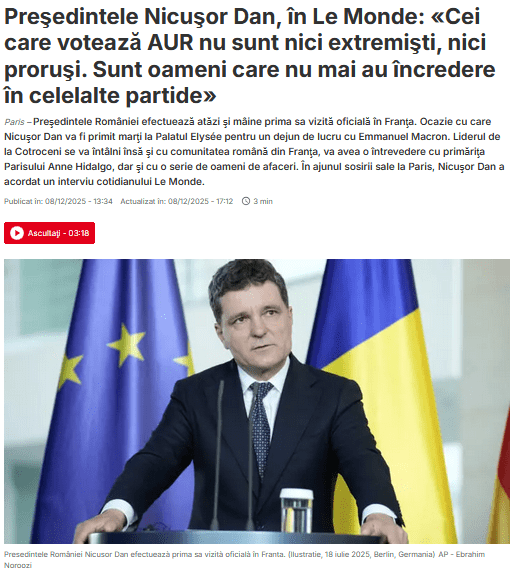
Un corespondent de limba romana al unui prestigios post de radio francez urmareste vizita președintelui român în Franța. Citește interviul acordat de acesta către Le Monde. Își informează ascultătorii…
A doua zi, prezent fiind la conferința de presă, același corespondent:

„În fine, cum cvasitotalitatea întrebărilor puse de confraţii noştri veniţi din Bucureşti au fost legate de subiecte de actualitate internă, românească, ne-am molipsit şi noi şi ne-am legat de un răspuns dat de Nicuşor Dan unei întrebări puse de aceeaşi ziarişti de la Le Monde. Preşedintele României a negat răspunsul dat confraţilor noştri francezi. «Am spus că (alegătorii AUR) nu sunt toți (extremişti sau proruşi). Am spus că motivația celor mai mulți dintre ei este o revoltă față de modul în care s-a făcut politică și administrație în România și că, în acest moment, oamenii aceștia care sunt nemulțumiți de modul în care merg lucrurile în România, spun orice e mai bine decât cei care guvernează acum. Asta este realitatea. Și atunci ei găsind un singur vehicul electoral, către care în momentul acesta se pot îndrepta, se îndreaptă către un partid care are în program elemente care sunt antieuropene, ba chiar proruse.

„Am spus că nu sunt toți!” a fost auzit ca negând „Cei care votează AUR nu sunt nici extremiști, nici proruși”.

După care anumiți ‘analiști’ descoperă că mare parte dintre politicieni, în nici un caz TOȚI, au reticențe în relațiile lor cu presa.
Genul ăsta de maniheism, de împarțire strictă în alb și negru, este cât se poate de distructiv. Distruge încrederea între părți. Și, pe cale de consecință, capacitatea de conlucrare.

Știu. Controversa produce rating.
Ăsta fiind și motivul pentru care este folosit ‘dar’ în loc de ‘precum’. „Dar și” în loc de „precum și cu o serie de oameni de afaceri”.
Uite-așa, de dragul ‘inflamării’, orice nuanțare ajunge să fie intepretată ca negare a mesajului care a fost clarificat.
Doar că funcția socială a jurnalistului este să disipeze informație. Dacă doar încearcă să producă rating, obținând în final neîncredere, atunci n-am făcut nimic. Nici ei, jurnaliștii, nici noi.
Noi toți! Și nici măcar ei.

Dacă fiecare auzim ce vrem, ce ne-am propus – de la început – să auzim… atunci n-o să ne mai înțelegem niciodată!

Cui prodest?!?

Evolution is not as much about the survival of the fittest
as it is about the demise of the unfit‘.
Ernst Mayr, What Evolution Is

As an engineer, I’m more concerned about consequences than fascinated by explanation.
OK, explanation – as in understanding the process – is necessary when trying to improve things. To fine tune. To ‘increase efficiency’…
But ‘survival wise’… sometimes it’s enough to bring things back to square 1. To repair. Specifically when the thing which no longer works used to make wonders.

Passeist? Anti-progressive?!?
No, as I already mentioned, I’m just a ‘don’t fix it if it’s not broken’ engineer. And currently … IT is broken.

Democracy doesn’t work anymore. Not like it used to, anyway!
If we want to fix it, we don’t necessarily need to understand what happened. Only to return democracy back to where it was.
For that, we need to understand what democracy is, not what had happened to it.

Looking back, we notice that all authoritarian regimes had failed. Crumbled under their own weight, usually, and failed abysmally when attacked from outside. Usually, again.
While no democratic regime had ever failed as long as it had managed to conserve its democratic nature.

‘But the Pharaohs have run Ancient Egypt for three millennia, give or take. In a very authoritarian manner…. they were absolute monarchs, you know!’
Not so fast. During those three millennia, The Ancient Egypt had been run by 33 dynasties. By 33 different authoritarian regimes… When each of those dynasties were no longer able to run the country – when each regime fell under the weight of its own mistakes, with or without ‘outside’ contribution – another dynasty, the next one, took over. ‘Usually’ not in a nice manner…
Same goes for all other authoritarian regimes!

While under a democratic regime, whenever those at the helm of the government start behaving badly, or commit too many mistakes, they are changed in a peaceful manner.

So, basically, democracy is a social arrangement which is able to change itself. To adapt! To what happens inside or outside it.
While the authoritarian rulers do their best – or worse? – to conserve their own power/position at the helm, the democratic regimes contribute to the survival of the entire society.
For as long as they manage to conserve their true democratic nature. Their openness. Their ability to depose those who overcome their welcome at the helm of the government.

I argued in my previous post that corruption is akin to decay.
Going forward, evolutionary speaking, we need to figure out what’s driving it. It’s ‘raison d’etre’.

Decay, also known as decomposition, re-allocates resources. Frees resources. Resources previously used in an currently ‘dead process’. Building blocks currently stuck in a corpse. Waiting to be freed, in order to participate in the next living process.
Corruption does more or less the same thing. Only less naturally. Way less naturally, sometimes bordering malignancy…

I mentioned corruption taking place in two environments. In a closed, abandoned, fridge – in an authoritarian environment, or in an open forest. A free society. In the fridge, corruption begets ‘hairy’, aberrant, ‘things’ while in an open society corruption plays a more nuanced role.

‘Intensity’ wise, at the individual level, there is ‘grass-roots’ corruption – like tipping your restaurant server or your hairdresser – and white-collar corruption. Which culminates in ‘pork-barrel’ politics.

‘Consequence’ wise, at the social level, grass-roots corruption sets the stage for the white-collar variety. ‘Educates’ people. Accustoms individuals exposed to it with the phenomenon. White-collar corruption weakens the entire society. Prepares it for take-over. Softens it for ‘revolution’. Not very different from an insidious rot weakening a seemingly strong tree before it is knocked over by wind.

Historically speaking – as in looking back in time – it’s easy to notice that corruption weakens both kind of societies. Open as well as the authoritarian ones.
The difference being that it works in opposite ways!

Corruption frees, eventually, those living in authoritarian societies.
The same process weakens the open, democratic, societies which allow it to grow malignantly.

Let’s remember.
Hitler’s Germany was defeated not only by the valor of those resisting its aggression but also by its inability to adapt. By its absolute corruption.
USSR collapsed, under it’s own weight, like all other empires. The British one included.
No authoritarian regime had ever survived for the long run. Each change of dynasty was, in reality, the advent of a new authoritarian regime. People had no alternative in those times.
On the other hand, no democratic regime had ever collapsed as long as it had managed to preserve its democratic character. What had happened in Eastern Europe after communism had caved in is ample proof for my thesis.

Corruption kills.
Sometimes literally.

Some ten years ago – 2015, October 30 – a fire broke out in a Bucharest night-club.
64 people died on the spot, including 4 members of the band. “The day we give is the day we die” was one of the tunes Goodbye to Gravity played that night.

The inquiry had determined that corruption was the main cause for what had happened. Safety certificates issued outside any norms, dysfunctional health care, unresponsive authorities… Massive popular protest forced the prime-minister to resign.
Things are better now, in Romania, but only slightly. Too slightly…

The point being that we’ve been warned.
Lord Acton: “Power tends to corrupt and absolute power corrupts absolutely.
Frank Herbert: “It is not that power corrupts but that it is magnetic to the corruptible.

Both were right.
Power both corrupts and is a magnet for the corruptible!
Hence we need to keep it in check…

Nothing moves without power. We need it. To make things happen.
We also need to survive. To remain alive after things will have happened!

In order to do that, we need to understand something.
About the thing which may derail the whole thing.
About corruption!

Current events – Andriy Yermak resigning his post in Ukraine and Federica Mogherini being detained – are hailed as being ‘flaws’. As highlighting the weakness of Ukraine and the EU, respectively. Their ‘unworthiness’.

I forcefully disagree.
Corruption, like decay, is a natural thing.

Let me put it in a different perspective.
Decay may happen in an abandoned fridge. A closed space in which all kind of ‘unnatural things’ will happen if left unattended.
Decay naturally takes place in a forest. Where ‘no longer living’ organisms ‘turn back to dust’.

A fridge – which is a dead thing, specially when abandoned – is incapable of managing anything. Including a process of decaying.
A forest – which is a meta-living organism, if you’ll allow this expression – thrives as long as natural processes can take place. Decaying being one of the most important ones.

Same thing goes for societies.
Open societies – the ones known as democracies – are no more and no less ‘corrupt’ than the closed ones. The ones usually known as autocracies. In the sense that those in powerful positions are equally tempted by corruption. Equally tempted to misuse their power…
The difference being that the open societies deal with corruption in an open manner. Above the board. In public. In a court of law.
While autocracies deal with the corrupt people only when the autocrat allows it. Only when the autocrat feels that a particular act of corruption is detrimental for his own well being…

So.
Every time an open society exposes an act of corruption, that society becomes stronger.
While autocratic regimes are corrupt from top to bottom. By definition. Very much similar to an abandoned fridge brimming with ‘hairy’ things.

l-am intrebat cine ar putea sa il convingă si pe Drula sa faca la fel ca sa nu iasă nebuna?
A zis ca publicul e singurul dar că orgoliu lui prea mare nu o sa fie mișcat.

Atâta vreme cât candidații mai ies din urnă doar în măsura în care îi votăm noi…

Aud tot felul de ‘invitații.’ Către candidați. Să se retragă. Ca să nu se întâmple… nefăcutul.

De parcă alegătorii ar fi tâmpiți! Incapabili să aleagă de unii singuri…
Pe baza promisiunilor făcute de către candidați și pe baza a ceea ce candidații au făcut deja în spațiul public!

În context, vă atrag atenția că Drulă este singurul care a promis să pună în practică referendumul cu privire la bugetul Bucureștiului. Referendum aprobat deja de către cei chemați să voteze din nou…

N-ar fi mai bine să ne împingem la vot unul pe celălalt – între noi, alegătorii – în loc să invităm pe unul sau pe celălalt dintre candidați să se retragă?

Până la urmă… E soarta noastră în joc, nu a lor!
Nouă trebuie să ne vină mintea la cap.
Altfel cum să știm ce să le pretindem lor să facă?!?

Winning the war is not enough.


At the end of WWI, the vanquished was left to her own devices. After having been saddled with huge war reparations. The US – whose President, Woodrow Wilson, had been the brain behind the League of Nations – went back into its ‘splendid isolation’.
Adolf Hitler rose to power. Conquered the western part of Europe and then attacked the Soviet Union, convinced that the US would not intervene into the conflict. Convinced that ‘Western Civilization’ had become weak. That the good life enjoyed by those living there had ‘mellowed’ the people. Read ‘castrated’.
Japan was convinced that attacking the US was a good idea. For more or less the same reasons used by Hitler to convince himself that America wasn’t going to fight back.

America had to fight on two fronts. For otherwise all her partners would have been conquered. For otherwise America would have been left alone…

Any resemblance with the current situation, when America seems to be extracting herself from the European front and when Russia has been left to her own devices after loosing the Cold War, is purely coincidental. And since there’s no such thing as a coincidence…

Doing business is not enough.
America and Nazi Germany did a lot of business.
Nazi Germany and the Soviet Union did a lot of business.
The EU and the US did a lot of business with Russia.

WWII is ample proof.
Winning a war is useless unless followed by a workable peace. Which comprises the integration between the victor and the vanquished.

Yet winning the war comes first.
Any attempt to integrate an unrepentant aggressor is doomed to fail.
1938 Munich Agreement and 2014 Crimea should be enough.

‘Revolution’ might be sexy and hype but our lives are shaped by counter-revolution.
Ilie Badescu, PhD

Marx, Karl Marx, is considered the quintessential revolutionary philosopher.

Ilie Badescu – a Romanian Professor of Sociology, proud of his reactionary convictions – makes a very poignant argument. ‘We live in counter-revolutionary times. Almost always. After each revolution, whatever was changed during the upheaval has been mitigated by the survivors to fit with the existing circumstances.’

The Communists are distinguished from the other working-class parties by this only:
1. In the national struggles of the proletarians of the different countries, they point out and bring to the front the common interests of the entire proletariat, independently of all nationality.

2. In the various stages of development which the struggle of the working class against the bourgeoisie has to pass through, they always and everywhere represent the interests of the movement as a whole. The Communists, therefore, are on the one hand, practically, the most advanced and resolute section of the working-class parties of every country, that section which pushes forward all others; on the other hand, theoretically, they have over the great mass of the proletariat the advantage of clearly understanding the line of march, the conditions, and the ultimate general results of the proletarian movement.
The immediate aim of the Communists is the same as that of all other proletarian parties: formation of the proletariat into a class, overthrow of the bourgeois supremacy, conquest of political power by the proletariat.
The theoretical conclusions of the Communists are in no way based on ideas or principles that have been invented, or discovered, by this or that would-be universal reformer.
They merely express, in general terms, actual relations springing from an existing class struggle, from a historical movement going on under our very eyes. The abolition of existing property relations is not at all a distinctive feature of communism.

The Communist Manifesto

Karl Marx and Friedrich Engels wrote this in the first half of the XIX-th century. During quite revolutionary times… Or rather?!?

‘The communist ideas have not been invented or discovered by this or that would-be universal reformer’…

Those familiar with the history of communism know – or should – that both Marx and Engels had been born and raised in Prussia. At that time, until 1848, Prussia was run as an absolute monarchy.
Engels came from a wealthy merchant family who owned textile factories in both Barmen, Prussia, and Salford, England.
Marx was born into a well off family. His father, Heinrich, owned a number of vineyards and was an attorney. Eventually, after an engagement spanning 7 years, Marx married the educated daughter of a liberal aristocrat, but not before befriending his future father-in-law.

Neither had any blue-collar experience. Yet they co-authored the Communist Manifesto…

Consequences.
We are the consequences of the decisions we take.
Of the choices we make.

As biological organisms, our fate, both individually and as a species, depends on whether circumstances remain habitable. Whether we can continue to live.

As rational humans, our individual destinies depend on luck, genes and on our ability to make good decisions.

‘Good’ decisions!
The tricky part being that nobody knows in advance the consequences of our decisions… whether a decision we consider to be good – when we take it – will remain so after its consequences will have been evaluated. After enough time will have passed for the full gamut of consequences to unfold…

To make things easier, humanity has developed ‘culture’.
Layered information which has morphed into ‘Weltanshauung’. Experience distilled into knowledge and accrued in time. Advice we no longer need to ask, only to remember.
When in a hurry, we do as we always used to. Back to the tried and tested.

But there’s a small problem here.
The cultural norms might have been ‘tried and tested’, hence ‘right’, but are we applying the appropriate norm in the given circumstances? Have we interpreted whatever information we have in the right way?

Ukraine is at war. Resisting aggression against all odds. Despite some of those in power attempting to access ‘undeserved rewards’. Unfortunately, war profiteering and corruption are as old as civilization…

Earlier this week, NABU (National Anti-Corruption Bureau of Ukraine) and SAPO (Specialized Anti-Corruption Prosecutor’s Office) said top company officials demanded illicit commissions of 10-15% from contractors.
The corruption allegations center on contracts linked to Energoatom, which provides most of Ukraine’s electricity.
According to investigators, an organized criminal group laundered the funds through an office in central Kyiv linked to the family of former lawmaker and suspected traitor Andriy Derkach. Among those named in the case was then-Energy Minister and later Justice Minister Herman Halushchenko.

https://www.kyivpost.com/post/64185

How do we choose to evaluate the current development?

As yet another step in the right direction? A country at war cleaning up its act?

Or…

Further more, what will we choose to DO?… after we will have chosen an interpretation to fit our ‘general disposition’… ’cause, unfortunately again, this is how we tend to evaluate things! Specially when we’re not diligent enough. Allow our ‘general disposition’ to take over and permit our reason to cowardly back off …

Help Ukraine to defend itself? And the rest of Europe? Freedom in general!
Or give up? On Ukraine, on cultural norms which seemed set in stone until not so long ago…

“How is capitalism better than socialism and communism?”

First of all, capitalism, socialism and communism are four different things.
Socialism, per se, is two things.
Funny, right?

There is the democratic socialism. A social arrangement where ‘nobody is left behind’ and where the economy is run according to capitalist principles.
And there is the ‘stepping stone’ socialism. The ‘prep class’ a Marxist society was supposed to graduate from before acceding to communism. In fact, the former USSR – as well as all the other former ‘communist’ countries had never reached that stage. Stepping stone socialism is something nobody has yet been able to graduate from.

‘Stepping stone’ socialism and communism are bad. For the simple reason that both are authoritarian regimes. Run by a small group of people according to their own whims. Pretending to mind the best interests of the entire people but, in reality and like all other dictatorships, minding exclusively their own businesses.

Capitalism? Nazi Germany was capitalist. Not good. Because it was Nazi…

‘Capitalism’, the entire gamut covered by the blanket term, is neither good nor bad. People collaborating using capitalist principles can reach for the stars – literally – while people obsessed with amassing money will, eventually, end up in a cul de sac. Remember what happened in 2008?
Free market capitalism, run by a democratic society, makes wonders. The USA until 2008, Canada, Australia, New Zealand, Japan and South Korea after they had regained their freedom, W. Europe. Great Britain.
The problem with free-market capitalism being the freedom of the market. In order to make wonders, the market must remain functionally free. Free from obsessions, free from monopolies, free from political heavy handed interventions. And equipped with a sturdy social safety net. The US used to have one. W. Germany also. Unfortunately, that kind of capitalism is very hard to find nowadays… Too many oligopolies have cornered too much of the former free market and too many safety nets have been transformed into pampering devices for dependent people. Some of whom are already rich!

We’re currently experiencing a tug-of-war.
Frustrated people have been harnessed to pull in diametrically opposed directions.
Some have somehow been convinced that the free market should be allowed to become a MMA cage. A no holds barred free for all fighting place. And what if the whole thing will eventually be dominated by your local bully? We’ll deal with that if/when it will happen.
Others have been duped to believe that capitalism is bad. That usury is not an abuse but the defining characteristic of capitalism. Hence a compelling reason for capitalism to be rejected lot, stock and barrel!

OK, for the sake of the argument, let’s look for a replacement. A replacement for Adam Smith’s capitalism.

Let me remind you that bona fide socialism relies on redistributing wealth created using capitalist principles.
That stepping stone socialism is a mockery. An undercover capitalism where all significant property is owned by the state. Where all decisions are made by the government. By the revolutionary government which pretends to know better, as advertised by Marx. Karl, not Groucho.
And that ‘real communism’ is nothing more than a thought experiment! Wouldn’t it be nice if? Yes, it might have been nice if the practical aspects of the whole thing didn’t prevent those who have tried it from reaching their goals.

Nu te lupta cu porcul în noroi.
Tu obosești iar lui îi place
.

Cele două zicători de mai sus sunt adevărate dar incomplete.
Trebuie interpretate.
Iar interpretările, precum toate celelalte ‘prelucrări mentale’, depind de dispoziția generală a interpretului precum și de implicarea sa emoțională în subiectul supus ‘prelucrării’.

Un om tracasat de frecușurile zilnice și fără prea multă dispoziție de a se mai gândi la altceva decât la ziua de mâine le va lua ca pe un îndemn să stea în banca lui. Că e prea greu să schimbi ceva și, oricum, doar unui nebun i-ar păsa de chestia asta. Nebunul fiind floarea care răsare ‘peste rând’.
Cineva puțin mai curajos și care, pe indiferent ce cale, a priceput că ‘așa nu se mai poate’, vede aspectele practice ale situației.

‘Dacă chiar vrei să te iei la trântă cu porcul, ia un furtun cu apă. Dă noroiul jos de pe el. Împinge-l undeva unde e curat. Și mai cheamă câțiva oameni să te ajute!’

Corupția, căci despre ea e vorba în propoziție, e de două feluri.
‘Inițială’ și ‘de etapă’.

Regimul comunist a fost corupt de la început.
Prin definiție.
Orice revoluție este o ‘rupere’ a ceea ce a fost până atunci. Violentă prin natura ei, are ca rezultat punerea în practică a dorințelor revoluționarilor. Urmată, mai devreme sau mai târziu de o contrarevoluție. Manifestă sau aproape nevăzută, contrarevoluția echilibrează, măcar într-o oarecare măsură, dorințele revoluționarilor cu realitatea practică.
Cu alte cuvinte, orice proces revoluționar – duetul revoluție, contrarevoluție – constă în două straturi de corupție. În prima fază este coruptă, violent, realitatea pre-existentă iar în a doua etapă sunt corupte, în foarte mare parte, intențiile revoluționarilor. A două fază poate fi la fel de violentă ca prima sau atât de molcomă încât trece neobservată. Vezi contra-revoluția ce a urmat Revoluția Franceză și procesul lent care a dus la prăbușirea tuturor regimurilor comuniste.

Există și o corupție de etapă.
Chiar și în regimurile care funcționează cu adevărat, în cele democratice, apar perioade de criză. Crize economice, crize produse de agresiuni externe, crize apărute ca urmare a auto-suficienței… Fiecare dintre aceste crize sunt ferestre de oportunitate pentru cei cu porniri corupte. Societatea, în ansamblul ei, este prea ocupată să facă față crizei și neglijează, pentru o vreme, fenomenul corupției. Până când consecințele corupției încep să pună în pericol însăși supraviețuirea societății. Care societate – vorbesc aici despre modul în care funcționează organismul social, nu despre supraviețuirea fizică a locuitorilor – va continua doar în măsura în care sistemul ei imunitar – adică justiția sprijinită, măcar moral, de suficient de mulți dintre locuitori – reușeste să readucă corupția la un nivel supraviețuibil.

În paranteză fiind spus, ‘eradicarea corupției’ este o lozincă goală. E ca și cum ți-ai propune să interzici strănutul în public… Poți doar să le ceri oamenilor ca atunci când le vine să strănute să o facă în plica cotului sau în batistă. Și să se abțină când le vine să fie corupți. Sau să corupă pe alții. Iar pe cei care nu se abțin să-i bagi la pușcărie…

Corupția din România actuală are trei mari surse.
Corupția inițială. Am fost singura țară din estul Europei unde prăbușirea comunismului a avut un caracter revoluționar. Corupția din timpul regimului comunist nu a fost suficient de puternică încât să ducă la disoluția completă a regimului. A fost nevoie de un grup de revoluționari care să rupă gura târgului. Care să servească de catalizator al nemulțumirii populare. Care grup de revoluționari a reușit, în mare măsură, să-și pună pecetea asupra destinului post-comunist al României. Urmată, în mod firesc, de o corupere contra-revoluționară a intențiilor originale.
O corupție de origine ‘externă’. Adică din afara aparatului de stat. Corupția inițială fiind, de la început, adăpostită în chiar trupul statului. Și aici am să citez un specialist. „„Să ieşim din ipocrizie. Dacă există corupţie, singur statul nu poate fi corupt, are un partener. Statul nu poate fi singur neperformant. Are un partener şi acesta este economia privată”, a susţinut preşedintele Băsescu”. Decembrie 2011.
Și o corupție de etapă. Care vine, de fapt, încă de pe vremea fanarioților. Cei care aveau de unde îi mituiau pe cei aflați la putere pentru a fi lăsați în pace. Obicei care s-a perpetuat până în zilele noastre. Omul de rând care dă bacșis medicului care nu-i cere face acest lucru. Preotul care face o mare donație pentru episcopie înainte de a primi parohie. Angajatul – la stat – care ‘se simte’… toate astea fac parte din obișnuință. Că acest obicei a fost întărit de cei care obișnuit să primească… e tot o consecință culturală. Un obicei care vine din istorie.

Ce vreau să spun cu chestia asta?

Mai țineți minte promisiunile care i-au convins pe cetățeni să voteze Convenția Democratică în 1996?

„Presedintele Emil Constantinescu a declarat (în Decembrie 1997) ca cei 15.000 de specialisti pe care CDR ii anunta in campania electorala exista, dar ca au refuzat, dintr-un motiv sau altul, sa-si asume responsabilitati. Constantinescu a participat la primul Congres National al membrilor seniori ai Ligii Studentilor, purtind un dialog direct, timp de trei ore, cu liderii de dupa 1989 ai studentilor. El i-a indrumat pe cei prezenti sa “penetreze” in administratia locala si sa sprijine procesul de inlaturare a structurilor birocratice si greoaie.”

Ar fi păcat să repetăm experiența.
Oana Gheorghiu a spus prezent!