What are electron spins:
Electrons are able to spin on an axis, like how the earth rotates on an axis, but much faster. Electrons can spin in either a clock-wise or counter-clock-wise direction. The spin on an electron is described by the spin quantum number (ms). The value of ms can be either +12 or -12. The +12 is called spin-up and denoted by a ↑, where the -12 is called spin-down and represented by ↓. Sometimes the spin of electrons will be described as angular momentum.
Each orbital of an atom can be occupied by up to two electrons. The two electrons will have opposite spins. This phenomenon was first described in the Pauli exclusion principle which states that each electron in an atom is described by a unique set of quantum numbers, including ms.”

Political spin, in politics, the attempt to control or influence communication in order to deliver one’s preferred message.
Spin is a pejorative term often used in the context of public relations practitioners and political communicators. It is used to refer to the sophisticated selling of a specific message that is heavily biased in favour of one’s own position and that employs maximum management of the media with the intention of maintaining or exerting control over the situation, often implying deception or manipulation.

Electrons ‘work’ in certain ways. Science has recently figured out some of those ways.
The point being that electrons keep to themselves. One spins in its direction, the other spins in the opposite direction and no more than two electrons fit in the same ‘orbital’.

People’s minds also work in ‘certain’ ways.
Not as ‘rigidly’ as the electrons but still ‘useful’ for those who know how to exploit this phenomenon.

By constantly pestering people with certain messages, you get to convince at least some of them.
You get to divide them into (political) camps.
You get them to fight among themselves instead of cooperating.
You get to lead them into battle.
And after the battle has been won, by no matter which side, you get to lead the winning party. At least for a while, but that is another subject.

And all lies, aka as ‘half truths’/alternative facts, start from something real.
Capitalism, for as long as the people remain awake, works. As advertised.
Socialism, on the other hand, doesn’t. It had failed, abysmally, whenever and wherever it had been experimented.

But there’s a caveat.

‘Capitalism’ is a rather clear-cut concept. Property belongs mainly to the individuals and individuals trust each-other enough to do business among themselves. Usually – but not always – capitalism is associated with ‘free market’ and democracy. With freedom to act – inside the confines of the law – and freedom to speak up.
I’ll say this again! For as long as the people remain awake, the market continues to be free and democracy still functions, capitalism works. Sustainably. But only for as long as the people remain awake…

‘Socialism’ is rather vague. From ‘public’ (instead of private) property associated with central planning of the entire society to softer versions which sometimes pay lip service to democracy. The central idea of ‘socialism’ being that society comes first and the individual is only a cog.
Who wants to be a cog? Those who see no alternative… Those who, once in a certain set of circumstances and exposed to a certain propaganda, succumb to the Sirens’ song.

The point being that in order to impose ‘socialism’ to a society you need to lure (enough of) the people into an ‘altered state of consciousness’. To make them believe a certain set of rules. To make them behave according to that set of rules.

The interesting part, as usual, comes at the end.
There is a ‘social arrangement’ where property remains private but where the people behave in a ‘certain’ manner. As if they have been made to believe a ‘certain’ – as in ‘forcefully unified’ – set of rules.

That social arrangement is just as fragile as ‘socialism’.
Again like socialism, it has already been experimented.
Both had failed. Abysmally. History is our witness.

The ‘other’ always failing social arrangement is usually called ‘fascism’.
In Germany, it has been known under the name of ‘NAZIonal socialismus’.
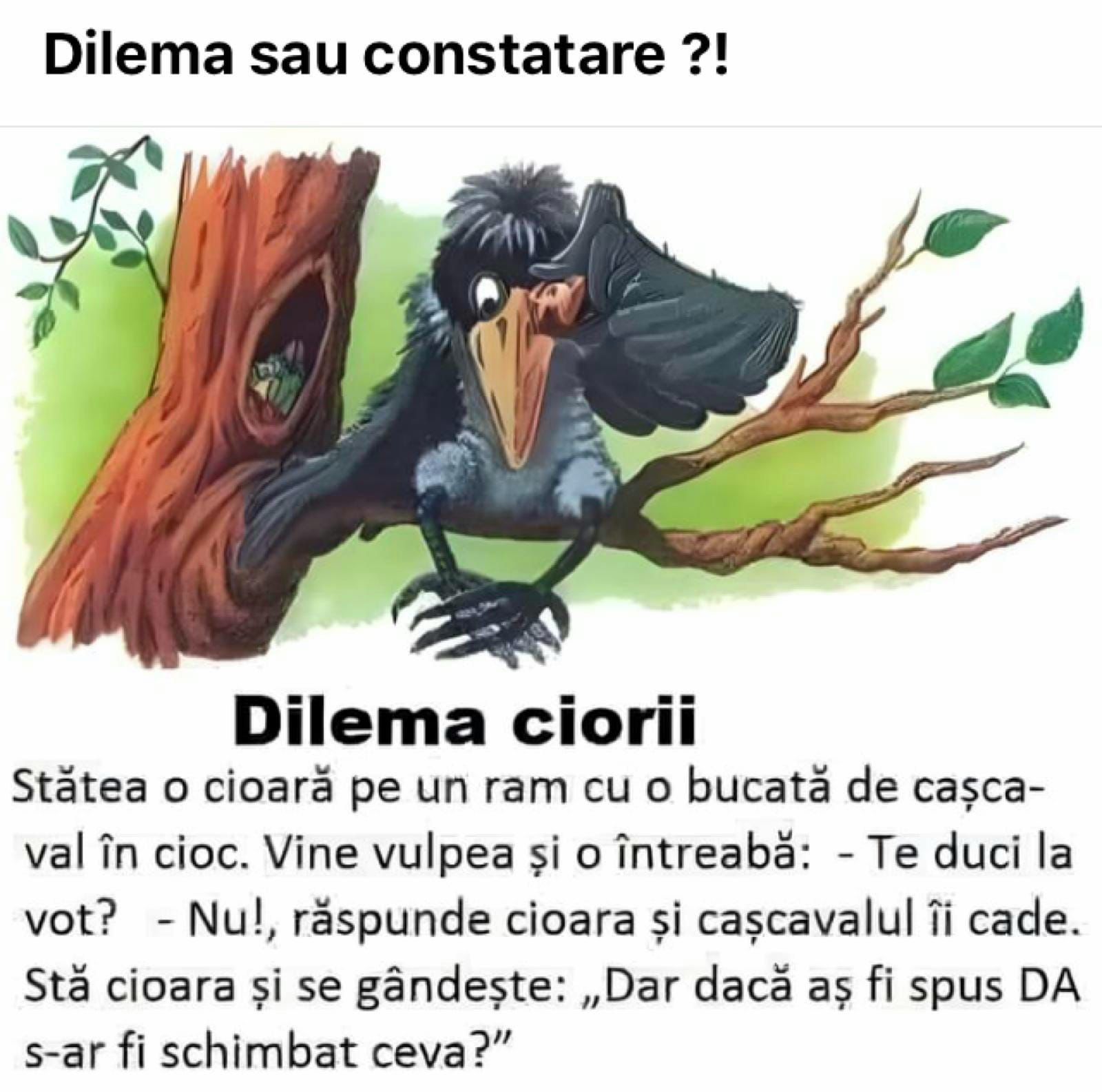
Țeapă!

Dacă se gândea puțin, victima – doar întâmplător cioară, realiza că întrebarea era ‘manipulatorie’.

Treaba votantului este să voteze și abia apoi să comenteze!

Doar așa se poate schimba ceva…

Aveți nevoie de argumente?
Tocmai v-ați uitat la unul foarte convingător!
Exact glumele astea îndoielnice – care vor să ne încurajeze să stăm acasă și să-i lăsăm pe ‘ei’ să-și vadă de ‘treabă’ – sunt cele mai bune argumente pentru necesitatea unei prezențe covârșitoare la vot.

Ce face un cetățean atunci când votează?
Alege?
‘Alegerea’ este doar o ‘porțiune’ din actul de a vota.
Principala semnificație a votului este participarea. Participarea la viața cetății!
Votul este, în primul rând, obiectivarea interesului pentru soarta colaborării dintre membrii societății în care trăim.

Sună pompos?
Am să formulez altfel.
Votul exprimat – adică pus în urnă – este un avertisment.
Un avertisment cât se poate de puternic transmis celor aflați ‘la butoane’. Un mesaj care strigă cât se poate de explicit „NE PASĂ”.

„Suntem cu ochii pe voi așa că aveți grijă ce faceți!”

Bullshit!

Back in time, some people had written a book.
And started living by it.
Things went on rather good so more and more people joined the new tradition.

After a while, after things had become so good that some of the people had enough spare time to think, some of these thinkers had noticed that some of the facts contradicted what was written in the book.
Hence some of the people had reached the conclusion that the book was not entirely right.

That even if following ‘the book’ had brought them that far, they no longer had to follow it to the t.
And they had learned to be suspicious of every written word… of all previously held convictions…
They called this new habit ‘science’.

Things went on. From good to even better.
Now many more people had enough time to spare. To think, to play… to read…

Trying to fulfill this new ‘need’, some enterprising people have transformed news gathering and publishing into a show.
Until then, news had to be exact. Hence they were published only after a close scrutiny.
After the ‘transformation’, speed and entertaining value took precedence over trustworthiness.

Furthermore, people less than passionate about knowledge had started to invade the scientific realm.

A study linking autism and vaccines had been published in a prestigious scientific magazine.
And then retracted.

With two consequences.
Some parents decided to ‘risk it’ and a lot of people were left with the impression that science had become unreliable.
That science was no longer above fraud.

““Science is at once the most questioning and . . . sceptical of activities and also the most trusting,” said Arnold Relman, former editor of the New England Journal of Medicine, in 1989. “It is intensely sceptical about the possibility of error, but totally trusting about the possibility of fraud.”Never has this been truer than of the 1998 Lancet paper that implied a link between the measles, mumps, and rubella (MMR) vaccine and a “new syndrome” of autism and bowel disease.

Fast forward to the present day.
When an editor had put together a title pretending that a “herd of 170 bison could help store CO2 equivalent to almost 2m cars, researchers say”.

Really?!?

Let me look closer.
“2m” stands for 2 million, right?
And since a conventional car spews a little over a ton of CO2 each year, that title meant that each of those 170 bison was supposed to bury 11765 tons of CO2 each year. Give or take…
But there’s a second problem.
‘Climate warriors’ are ‘mad’ about cows. We are constantly bombarded with news stating ‘the cows are belching so much methane that the polar ice caps are going to melt during our lifetime’.
What about bison? Which are, for all practical purposes, wild cows… Don’t they also belch methane?
Try reading the article and see if you understand the difference between cows and bison…

Did your homework?
No?

OK, here’s my version.
Bison grazing in the wild are a close system.
The vegetation they feed on ‘sequester’ CO2 from the atmosphere and transform it into cellulose, using energy from the Sun. Through grazing, the bison encourage the vegetation to transform more CO2 into cellulose versus the situation where the bison were not doing their thing.
Some of the extra cellulose gets eaten by the bison and ends up being transformed into the best natural fertilizer known to nature. Which further encourages the vegetation to sequester even more CO2 from the atmosphere.
A cow living on a pasture – and allowed to roam as freely as a bison herd – does more or less the same thing.
But a cow living in a stable is an ‘open system’. It is fed a lot of corn and soy. Transported from afar and which totally changes the chemistry going on inside the cow. Corn and soy accelerate the rate of growth – the reason for feeding them to the cows – but result in the cows producing a lot more methane than when naturally feeding themselves on grass. Further more, the manure thus produced is never returned where the corn and soy had been produced.

The consequences?
While in a close system the result of photosynthesis – sequestered carbon – slowly accumulates in the soil, in an open system the metabolic results of the plants and animals involved are spread around the globe. Add to that the huge amount of (fossil) energy implied in growing the plants and transporting the goods around the planet and you’ll start to understand the difference between bison/cows grazing on a pasture and cows being fed in a barn corn and soy imported from Brazil.

Why didn’t you read this in the article above?
Where did the aberration regarding each bison being able to sequester almost 12 000 tons of CO2 came from?
Why people don’t care anymore about science?

I’m sorry, you’ll have to figure these out by yourself.

“This headline and article were amended on 16 May 2024. Due to an error in the original research, a previous version stated that Carpathian ecosystems browsed by (170) bison could store 2m tonnes of carbon, equivalent to the emissions of 1.88m average US cars petrol a year. The research authors have since retracted these figures, which were due to a coding error. The correct figure is that bison could store 54,000 tonnes of carbon, equivalent to the emissions of 43,000 average US petrol cars.”

Așa ceva există doar în capetele noastre.

În Natură există doar ‘orbite’ și coliziuni.
‘Intersecții’, adică locurile alea unde se întâlnesc drumurile și unde oamenii ‘se petrec’ după niște reguli pe care le respectă toți cei care vor să treacă pe acolo ‘nevătămați’, există – și știu că mă repet – doar în capetele noastre.

‘Există peste tot, aiuritule!
Sunt pline orașele de intersecții. Și peste tot prin țară, prin locurile unde n-au ajuns încă autostrăzile…
Te dai tu deștept!’

Normal că sunt deștept!
Ce, tu poți să tastezi în somn?!? Sau habar n-ai de unde vine „Deșteaptă-te Române”?
Trezește-te, mă!”…

Să revenim.
Orașele sunt pline de între-tăieri de drumuri!
Care devin ‘intersecții’ doar atunci când cei care încearcă să treacă pe acolo respectă regulile de circulație.
Atunci când doi șoferi își reped mașinile una-ntr-alta, posibila intersecție devine brusc ‘locul accidentului’!
Înțelegi acum ce vreau să spun?

Individul – adică fiecare dintre noi – este o intersecție.
Locul aflat la confluența dintre ‘afecte’, ‘instinctul de supraviețuire’ și ‘încercarea de a înțelege’.
Societatea, adică indivizii conștienți care încearcă, împreună, să ‘treacă prin viață’, este și ea tot o intersecție.
Intersecția dintre omenire și lume.
‘Lumea’, adică Universul, este – deja v-ați obișnuit, nu? – cea mai mare intersecție posibilă. Locul în care viața încearcă să se strecoare prin timp.

Iar toate aceste considerente se bat cap în cap în cea mai importantă intersecție din lume!
În conștiința mea.
‘Cea mai importantă din lume’ pentru mine, evident!
Exact așa cum fiecare dintre conștiințe este cea mai importantă din lume pentru sine însăși.

E clar că am loc aici doar pentru enumerare.
Dar voi strecura și cel mai interesant aspect din toată tărășenia asta.

Preocuparea intrinsecă a oricărei conștiințe este supraviețuirea.

Similar faptului că masa are inerție, mișcarea are frecare și viața are ‘instinct de supraviețuire’… tot așa conștiința este preocupată de propria ei congruență.

‘Stai că nu mai înțeleg nimic!
Ai spus că viața are instinct de supraviețuire.
Ce nevoie mai are conștiința de încă o formă de autoprotecție?’

Foarte bună întrebarea.
Habar n-am!
Eu doar am constatat existența acestui fenomen.
Conștiința mea a învățat la un moment dat că ‘fumatul face rău’!
Atât teoretic cât și practic.
M-am lăsat de fumat? L-a convins conștiința mea cea înțeleaptă pe individul Sarchis Dolmanian să lase dracului țigările?
Nu!
Ce înțeleg eu de aici?
Pare evident faptul că a mea conștiință este preocupată mai degrabă de propria ei congruență decât de bună-starea animalului pe care îl locuiește. Bună-stare altfel esențială pentru respectiva conștiință…
Care conștiință se comportă, cel puțin deocamdată, ca fiind incapabilă să rezolve disonanța cognitivă dintre ‘animalul gâfâie și tușește’ și ‘cum dracu’ să recunosc, întâi în sinea mea, cât de proastă am fost atunci când l-am lăsat să se apuce de fumat?!?’
Care recunoaștere implică o falie. O discontinuitate. O ruptura între mine – conștiința de până acum, cea care am asistat pasivă la afumarea plămânilor care oxigenează creierul în interiorul căruia sunt ocrotită eu – și conștiința cea nouă. Care nu doar înțelege o anumită necesitate ci care e dispusă să-și recunoască greșeala.
Și nu doar ‘greșeala’ ci evidența că poate greși! Și că va rămâne, cât va mai rămâne, incompletă.
Care conștiință acceptă că a fi conștient este doar o oportunitate și nicidecum un dat. Ceva similar cu faptul că a fi capabil să citești nu te va pune niciodata la curent cu tot ce a fost scris până acum.

Conștiința care înțelege că se află la intersecția dintre individul pe care îl animă și tot ceea ce este în exteriorul acestuia!

And the LORD God said,
Behold, the man is become as one of Us,
to know good and evil.

Genesis, 3:22

The point of this post is simple.
The difference between ‘bad’ and ‘evil’.

‘Good’ is straightforward.
It doesn’t matter – evolution wise – whether the ‘good’ has happened ‘naturally’ or ‘intentionally’.
But it makes all the difference in the world whether the ‘bad’ only happened or it was the consequence of somebody planning it to happen.

Even if that difference is visible only to us.
Conscious humans beings who use language to communicate and to consider.

Visible as well as ‘accessible’.
How many among you consider that anybody else but us, human people, is capable of ‘evil’?

And what about the perpetrators?
How many of them consider themselves to be ‘evil’? To have become evil, as they had intentionally hurt somebody?

And how come this simple ability was enough to elevate us to “one of Us” status?

The world is nothing but change.
Our life is nothing but perception.

Marcus Aurelius.

Killing is the most definitive thing available to man.
To humans in general and to men in particular.

We cannot create life!
We can make love, our wives can give birth but other than that…

Yet we can kill!

You see, most animals feed on other living organisms.
We describe the process as ‘the law of the jungle’ but for them it’s only natural. That’s how they feed. That’s how they get their sustenance.
None of them gives much thought about it. When hungry, they do what they have to do. And then they stop.

We are the ones who get to choose. To kill or not to kill…
We are the ones who, once aware, have introduced thinking into all these.
We are the ones who, through our awareness, have transformed sensation into perception.
We are the ones who, in our attempt to create/maintain congruence – to keep things together, have attached meaning to sensation.

We are the ones who, once we have learned the difference between good and bad, have invented the notion of evil.

We are the ones who, once we have learned the difference between good and bad, have tried to separate them.
To separate what we have perceived as good from what we have perceived as bad. And called it evil…

And now, that we’ve reached the stage where we currently are, we’ve set our minds to determine which had come first.
The egg or the chicken…
The Good or the Bad?!?
Matter or Spirit?

When we’ll grow up, when we will have caught up with Marcus Aurelius, we’ll remember that there’s no clapping with one hand.
That while it may be natural to feed on other animals, there’s no escaping the consequences of our killings.

I’m acquainted with a relatively large number of people. From all walks of life. My experience suggests that it’s not the ignorance which is the problem but our (collective) unwillingness to accept/assume it. After all, we are ignorant. All of us, albeit in various degrees. Even the smartest amongst us ‘controls’ more ignorance than knowledge.

The real problem stems from us being cock-sure about things. Across the board!

Some of the smart ones are fully aware about the fact that they don’t know everything. But only some.

Some of the ‘ignorant’ are aware of their ignorance. Not all of them, but way many more than the smart ones. Simply because it’s easier to notice how much more you have to learn when you are at the start of the process.

And the problem is compounded by the fact that some of the smart ones who have chosen to ignore their ignorance team up – or more exactly organize – the ignorant who refuse to learn. This being the reason for so many actual human beings behaving as if they were some faintly intelligent ‘bots’.

A process, a space and some consequences.

The process through which individual agents transmit and receive information.

The space inside which the above mentioned individuals do what ever they set their minds to do.
The stage used by each of us, according to our own goals and abilities, to perform our self assigned roles. Inside and/or outside the roles bestowed upon us by ‘fate’.

Consequences?
The shapes and content of our individual consciences.
Consciousnesses.
Culture, as the historically accrued trove of knowledge more or less accessible – through language and subjected to interpretation – to each of us.
Civilization, as the result of our cooperative effort to ‘make good’ the knowledge we have inherited and/or gleaned ourselves.

On the other hand… letting go, emotionally speaking, may not be as beneficial as advertised.
We might lose some bitterness but we might become more liable to ‘repeat the experience’

As in …

Forgive but don’t forget is a lot easier to be said than done, you know…

Which brings us to:

Do we really need ‘a purpose’?
As in ‘an ideologically determined goal’?
Remember Marx’s “The philosophers have hitherto only interpreted the world in various ways. The point, however, is to change it.”. Then the consequences produced by those who had followed Marx’s teachings…
But not only Marx’s!

All set goals which go ‘against the grain’ incur costly consequences.
Which are detrimental to survival! Of the leading trespasser, of those in the following or of those hapless enough to be too close to that particular goal being pursued.
Remember Marx? Nothing unpleasant had happened to him. Not as a consequence of his attempts to change the world! But to others…
Which is equally valid for all other ‘world changers’. Along with all ‘world preservers’ who run along ideologically drawn paths.

Then what should we strive for?
Simply ‘follow the heart’ to achieve ‘peace of mind’?!?
Would that be enough?

Enough for what?!?

https://www.goodreads.com/book/show/56083.In_Dubious_Battle

„Mă consider un fel de jurnalist, în măsura în care ceea ce mă interesează este actualitatea, ce se petrece în jurul nostru, ce suntem, ce se întâmplă în lume. Filosofia, până la Nietzsche, avea ca rațiune de a fi eternitatea.
Primul filosof-jurnalist a fost Nietzsche. L-a introdus pe „azi” în câmpul filosofiei. Înainte de el, filosofia cunoștea timpul şi eternitatea. Nietzsche, însă, avea obsesia actualităţii.
Consider că viitorul noi îl facem. Viitorul este felul în care noi reacţionăm la ceea ce se petrece, este modul în care noi transformăm în adevăr o mişcare, o îndoială.
Dacă vrem să fim stăpâni peste viitorul nostru, trebuie să ne punem în mod fundamental problema zilei de azi. Iată de ce, pentru mine, filosofia este un fel de jurnalism radical.”

Michel Foucault

„Stăpâni peste viitorul nostru”…
Dacă nu definim bine termenul – și care o fi „binele” ăsta?!? – s-ar putea să nu ne placă viitorul ăla odată ajunși acolo!

„Stăpâni” adică ‘prin noi înșine’? Fără inputuri venetice?
„Stăpâni” adică unii dintre noi la butoane iar ceilalți ‘după marea mila noastră’? Și ce ne facem dacă ajung ceilalți la butoanele alea?!?
„Stăpâni” adică având atâta încredere în noi înșine încât facem ce ne taie pe noi capul? Doar ce ne taie pe noi capul? Fără să ne mai uităm în jur?
Stăpâni în primul rând peste pulsiunile noastre? Capabili să ne ascultăm între noi înainte de a purcede spre un viitor asumat ca fiind incert? Și cu toate astea încă încrezători că împreună putem răzbi mai ușor decât separați?

Pentru cei cu amintiri încă proaspete de la lecțiile de materialism științific și dialectic – ăsta era numele de cod pentru marxism pe vremea când mă duceam eu la școală – și pentru cei cu nostalgii comuniste am să mai adaug câteva considerații.

Poate că cel mai atrăgător aspect al marxismului a fost, și continuă să fie, ‘certitudinea’. Atât pentru ‘gânditori’ cât și pentru oamenii de rând.
Oamenii de rând au nevoie de siguranță. De siguranța zilei de mâine și de măcar impresia/aparența că îi pasă cuiva de ei.
Gânditorii – fie ei oameni de știință sau filozofi – au nevoie să-și ostoiască disonanța cognitivă. Toți oamenii cu o educație rațională știu foarte bine că realitatea nu poate fi cunoscută. Că toți agenții cunoscători pot dezvolta, chiar și împreună, doar o înțelegere limitată a celor ce se întamplă. Sunt multe explicații cu privire la chestia asta dar putem accepta acest lucru, pe moment, ca pe o axiomă.
Pentru a-și ostoi această disonanță, gânditorii raționali – adică atei sau agnostici – au nevoie – și ei, similar cu teiștii – să se agațe de o ancoră exterioară lor.

Ecce materia!
Materia cu legile ei imuabile… Determinismul de toate nuanțele… Aproape cu nimic diferit de determinarea cu care Zeul își apleacă atenția asupra creației sale.
Aspectul delicat introdus de determinisme – indiferent de natura și originile acestora – este că acestea reduc prea tare disonanța cognitivă. Disponibilitatea omului de a-și păstra mintea liberă. De a mai fi dispus să analizeze variante… după ce a ajuns la o ‘concluzie rațională’!
Indiferent dacă premiza pentru raționamentul dus până la capăt a fost de natură științifică sau de natură divină, raționamentul însuși devine literă de lege. Acesta fiind, de fapt, procesul prin care comportamentul rațional se transformă în comportament raționalizator.
Neajunsul fundamental al oricărui proces rationalizator fiind acela, ați ghicit, că induce cecitate. Adică ‘orbește’. ‘Ia mințile’. Îl face pe om incapabil să se mai adapteze. Individual și în grup.
Devine incapabil să mai genereze variante. Alternative care să-i faciliteze evoluția. Merge înainte indiferent de consecințele faptelor sale. Care fapte/acțiuni au avut la bază niște concluzii raționale, nu? Așa trebuia acționat în momentul ăla! Și ăsta este drumul pe care trebuie mers în continuare.
Ei bine, asta este una dintre semnificațiile conceptului de ‘stăpân’.
Și explicația pentru faptul că orice dictatură, orice ‘stăpânire’ – inclusiv cea comunistă, se termină, inexorabil, în prăpastie.
În disperare.

Mai puțin ‘stăpânirea de sine.’
Disponibilitatea de a ‘întoarce și celălalt obraz’. De a asculta, cu respect și atenție, alte păreri în afară de cea proprie. În afară de părerea deja proprie…