Archives for category: teleology

I need you to pretend a few things.

That you don’t know what a cart is. Or a horse.
That you are a logical machine.
That you are told a cart is something laden with merchandise, that the horse is what moves the cart and that the purpose of the whole endeavor is to transport the merchandise from A to B.
Then you will be asked to stack the three elements according to their importance.

How likely are you to arrange them in this order:
Merchandise, cart, horse?

It would be perfectly logical, right?

Remember that you don’t know anything else but what you’ve just been instructed.
That the ‘action’ is ‘transport merchandise M, laden in cart C – moved by the horse H, from A to B’.

Mere logic convinces you that the most important thing here is M. Simply because the whole brouhaha revolves around M. Followed by C – closest to M, and only then by H. Right?

Only mere logic is seldom enough… Each of those three has its own merits and their relative importance depends on many things.

On what the owner thinks about each of them. If all three belong to the same person.
On the relationship between the person asked to determine their relative importance and each of those elements.
The owner of the merchandise will certainly consider his property to be more important than either horse or carriage. But will consider the horse more important than the cart if the merchandise has to arrive sooner rather than whenever. Or the carriage more important than the horse if the merchandise is fragile…
The owner of a single horse will try to protect the animal. Simply because he will also need it tomorrow.
The owner of the trucking company will ask the drivers to drive the horses to their limits. Simply because he has so many of them.
And so on.

My point being that logic is almost never enough.
We must also understand what’s going on there before passing judgement on something.

Otherwise we’ll end up scratching our heads.
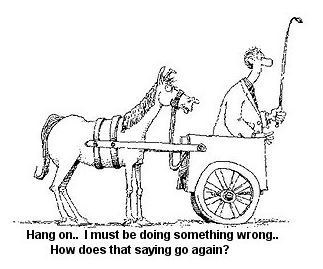

Click the drawing above and read what tborash has to say about the whole thing. He’s right too, you know.

What do we have an economy for?

To make ends meet? To make it easier for our needs to be met?

What do we have a banking/financial system for? To mobilize capital for the economy? To make it possible for our needs to be met easier? More efficiently?

Or just for profit to be made?

“It really is possible to do two good things at once: address the abuse of the working poor by payday-loan and check-cashing outfits while expanding the range of services provided by the USPS. Media outlets have called Warren’s proposal “radical.” That’s ludicrous. She’s simply using her position and prominence to highlight the findings of a new study by the Postal Service’s Office of the Inspector General, which notes that roughly 68 million Americans are underserved by the private banking system. “With post offices and postal workers already on the ground,” says Warren, “USPS could partner with banks to make a critical difference for millions of Americans who don’t have basic banking services because there are almost no banks or bank branches in their neighborhoods.”

This is not a new idea. From 1911 to 1967, the Postal Service maintained its own banking system, allowing citizens to open small savings accounts at local post offices—actually a better approach than “partnering” with banks. The system was so successful that after World War II, it had a balance of $3 billion, roughly $30 billion in today’s dollars. Congress did away with postal banking in the 1960s, but post offices in other countries—including Japan, Germany, China and South Korea—provide banking services. Japan Post Bank is consistently ranked as one of the world’s largest financial institutions based on assets.”

Or, to put it the other way around,
‘what profit is?’

The well deserved ‘consequence’ – considered as such by the vast majority of the stakeholders, of a well-done job?
Or a self serving benchmark to be reached at all costs? Which costs are to be ‘shouldered’ by anybody else but the profiteer himself… till reality slaps us, all of us, over our faces…

Well, you don’t.

You just don’t do such a thing.

For the very simple reason that by attempting it you validate the concept.

Let me start it anew.

Both the communists and the nazis had attempted to ‘bring about’ people’s minds. To create a ‘new’ man. One who was meant to behave as their creators saw fit.

We all know the consequences.

“Do unto others as you would have them do unto you”.

Isn’t this a better way than ‘making’ somebody do as you think they should?

‘But won’t we end up like Bishop Myriel? Doing good deeds and hoping that all villains will ‘turn around’ like Jean Valjean did? After all, how many Jean Valjean-s have you met in your life?’

First of all, Myriel was a fictional character. Victor Hugo might had been inspired by a real bishop when he had created Myriel but this doesn’t alter its fictional nature.
Secondly, wouldn’t this world be a far better place if those who have the chance to encounter the likes of Jean Valjean would be wise enough to act like Bishop Myriel?

‘You still don’t make much sense. And what if the guy I meet isn’t Jean Valjean? Or if I’m not wise enough to recognize his Jean Valjean-ness, whatever that might be… What should I do then? Treat him like I’d like to be treated if I was in his place? Allow him to rob me?!?’

I guess you just answered your own question. No thief would allow another to steal from him, would he? Why would you?

But all people appreciate when treated respectfully!
So why don’t we do it, on a regular basis?

Why are so many of us who consider they know better how others should behave? What others should do?
And who consider themselves above the fray…
Remember the doctor who told you to quit smoking? While having a pack of cigarettes in the breast pocket of his white coat?
The journalist who writes for ratings rather than to inform you?
The politician who…

The voter who allows himself to be fooled? Knowing very well he had voted a conman? Only because he had made all the right noises?

Când am intrat la Politehnică, am aflat că inginerii și câinii au câteva lucruri în comun. Privirea inteligentă și incapacitatea de a se exprima în cuvinte.
Când m-am apucat de fotografie am aflat că întotdeauna ‘there’s more than meets the eye’.
La școala de mediatori am aflat, dacă mai era nevoie, că ‘adevărul este undeva la mijloc’.

Așteptăm acum, cu toții, ca știința să-și spună cuvântul.
Să găsească răspunsul.
Să spargă, încă o dată, bariera necunoscutului. Să ne ia de mână și să ne ducă, din nou, la lumină.

Dar parcă treaba asta cu ‘străfulgerarea’ ținea de domeniul artei!
Chiar dacă savantul Arhimede a fost primul care a strigat ‘Evrika’. În timp ce alerga, gol pușcă, pe străzile Siracuzei…
Artiștii erau cei care intrau cu bocancii în banalul vieții de zi cu zi ca să ne deschidă ferestrele unor noi orizonturi.
Cei pe care îi așteptam să topească noroiul în opere de artă.
Suferința în speranță.

Și, oare, este chiar atât de mare diferența dintre știință și artă?

E adevarat că ‘omul de pe strada’ este convins că arta se bazează pe inspirație în timp ce știința e definită de rigoare.
Poate că trebuie să ne spună cineva de câtă inspirație ai nevoie atunci încerci să descoperi un tratament.
Și de câtă rigoare este nevoie atunci când încerci să-ți transformi inspirația în ceva pe care să-l poți propune unui alt suflet.

Abordând problema dintr-un alt unghi, „poate fi anulată primavara”?

Un prieten mi-a spus ca da. Dacă nu e nimeni care să se bucure de ea…
O prietenă mi-a spus ca nu. Și că ăsta e singurul lucru care îi ține mintea, și sufletul, laolaltă.
Să ne bucurăm împreună de primavara care ne înconjoară.

Să n-o lăsăm să înflorească degeaba.

Given my experience of living under communist rule, I can tell you that too much consistency is bad. Having to toe the line is dangerous. For individuals and for societies, as a whole. Communism did fall, you know.

On the other hand… some consistency is needed.

Let me give you an example.

The whole world is asking China to do ‘the right thing’ about its wet markets. In Bill Maher’s terms “eating bats is bat-shit crazy“.

Why?!?

Because of what science tells us. That bats are full of corona-viruses, which are bad for us.

That’s what we say, anyway. Those of us who side with ‘science’… And who ask the Chinese to give up their traditions.

Let’s examine the problem from the other side.

‘We’ve been eating bats for ages. And nothing happened to us. Now you say that this flu like disease is produced by viruses who live in bats. Why would we believe you – and give up eating bats, if you don’t believe your own scientists? And balk when they tell you to quit smoking. To stop piling plastic into landfills. To stop heating up the planet.

To vaccinate your children, for God’s sake…’

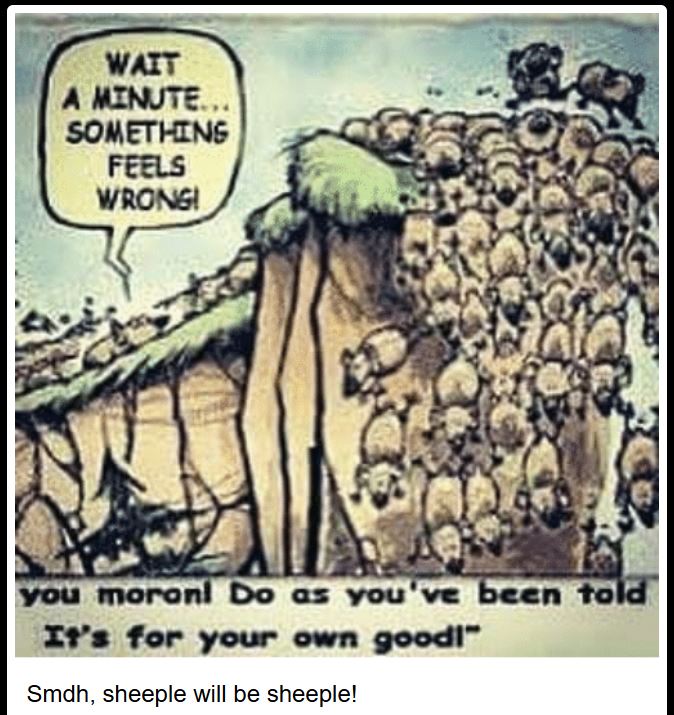
Some see here a herd of sheeple being led to disaster by:

The Democrats
The Republicans
The Government, in general
Any other con artists of their choice.

I see at least one guy who just figured out what was happening.
And who tries to share what they’ve learned!

Maybe it’s to early… I’ll take my chances though.

Germany has weathered this crises a lot better than most of her neighbors.

There are no toll- booths on the German highways. Not that I know of, anyway.

And what has this to do with anything?!?

Well, does your heart bill you for its services?
Your lungs? Your gut? Brain?
The immune system?
Even if each of them works at a cost… for the whole organism!

The health care system is the social equivalent of the immune system.

We, each cultural community around the world, might treat it as an industry. Fine tuned to maximize profit.
Or as a social service. Meant to protect the society from the consequence of disease. And run as efficiently as possible, of course. But sized to be able to cope with reasonably estimated ‘loads’.

There is a fine balance to be held here, of course. A multi-dimensional equilibrium, actually.

It depends on us, as individual members of the brain, to fine tune that equilibrium.

Or else…

All outcome depends on inputs.
When humans are involved, ‘intent’ can be found among inputs.

What do we want, in the present situation?

Basically, to survive! Right?

For as long as possible… as individuals…

The fact that the sum of our individual survivals results in the survival of our species/cultures is a truism. And, maybe, not so important for some of those struggling to survive as individuals.

The point I’m trying to make here being that how we attempt to survive will decisively influence the general outcome.

We might try to survive against the others.
Or we might try to survive with the others. In close – even if ‘distant’, cooperation with the other members of our community/culture/species.

And while surviving we might try to amass whatever we want. Of whatever we’ve always wanted. Doesn’t matter what ‘that’ is. Money, power, prestige… you name it.

Or we might learn something. We might turn Maslow’s Pyramid on its head.
We might use this crises as an opportunity to understand that we’re stronger together.
That cooperation among autonomous individuals generates a lot more chances of survival than attempting to pass through as individuals.
As a lonely individual or as an individual hiding in the middle of a crowd, doesn’t matter.

And we should bear in mind that surviving the crises will be only the first step.
How we do it will shape the stepping stone for how we’ll rebuild our livelihoods.

Any attempt to learn something, to increase your knowledge about a certain subject, is nothing more and nothing less than an attempt to become intimate with it.

Students have two open roads ahead of them.

One which implies a lot of wooing, patience and a certain degree of self appeasement.
The other asks for a direct, almost blunt, approach.
While the first is more like the student dancing around the subject, the second is akin to a hands on combat.

The results are, obviously, different.
Not exactly different. Only fundamentally.

The difference is very much like the difference between courtship and rape.
The end result might be a child. But…

Same thing with art and science.

It is true that in order to have sex, both partners need to be, at least somewhat, naked.
But there is all the difference in the world between having sex and making love!

The end result is only apparently the same!

Let me make something clear.
Crystal clear!

Money, and its ‘derivatives’ – from ‘capital’ to ‘financial market’ and ‘stock exchange’, are the tools we used to get where we are now.
Without them we would be still foraging in the woods.

Only something rather insidious has started to eat the whole scaffolding from inside.
Same process has been happening with weapons. We invented them for hunting. Then used them for self protection. Against large beasts and fellow humans.
Finally, after using them to conquer and defend our liberty, we used them to subjugate others. To impose our will upon some other people.

In other words, we used guns to shoot ourselves in the foot.
Unwittingly.
Both as hapless individuals and as a cultural species.

Money – and its derivatives, have suffered the same degradation.
We used it, at first, to coordinate our efforts.
The Stock Exchange had been an excellent way to coordinate otherwise disparate means. Very few of the corporations who have changed the world into what it is now – for good and for bad, wouldn’t have come to life without the money which fuel them.
Nowadays, too many of those who trade on the Stock Market do it in a ‘barren’ manner.

They do not contribute anything but extract value.
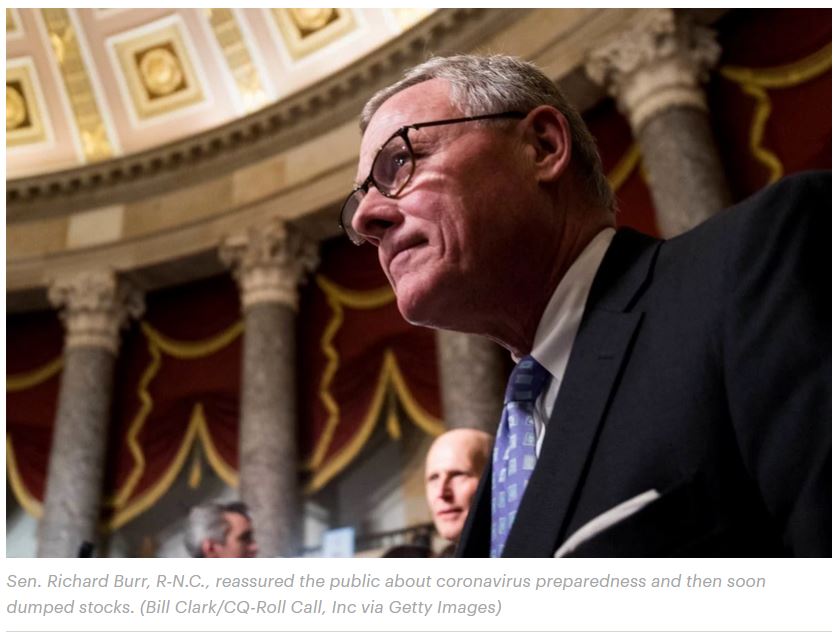
The inside traders being only the visible part of the iceberg.
Which iceberg might tank the whole contemporary ‘arrangement’.

If we keep sleeping during our watch.
And there’s no one else on deck…