Archives for category: skin in the game

Monotheists insist there’s only one.

I am the Lord, and there is none else, there is no God beside me: I girded thee, though thou hast not known me.”

– And why would this be of any interest?
– All current civilizations are off-springs of an Weltanschauung built on ‘monotheism’, aren’t they?
– Really?!? How about India? China? The Buddhist countries?
– Have you noticed the scare quotes? In my book, Hinduism, Confucianism and Buddhism are all forms of monotheism. Atheism also qualifies as such.
– ?!?
– I’ll make that point a little later.

Then, if monotheists insist there’s only one God, which one of them is the ‘real McCoy’?

“The real McCoy” was the inventor Elijah McCoy, born in Canada in 1844. He had many different inventions including an ironing board and a lawn sprinkler. Other companies copied his devices, but these never worked as well as Elijah’s so people would say, “I want a… , and make sure it’s a real McCoy.”

When humans had first became conscious, as in aware of their own frailty, they needed a way to assuage their new acquired scares:
‘What would happen if the Sun will not come up tomorrow morning? If spring will never come back? If Mother Deer will not allow me to hunt another of her children?’
So they started to raise prayers towards the Sun God. And towards other various agents held responsible for various aspects of human existence. Nowadays known as ‘totemic figures’.
Please note that each totemic figure was simultaneously responsible for one aspect of the human existence and the ‘founding father’ of a certain group of people.

After the advent of agriculture had transformed everything – including human social arrangements, things dully changed.
Agriculture gave birth to private property. Individuals needed to know which was their land and who owned the harvest. Otherwise, why bother?
Private property needs to be protected. Which demands a certain social structure. A hierarchy of social roles.

Around the Mediterranean Sea – due to geographic conditions, the ‘top brass’ were never that far removed from the ‘bottom’ as to make them ‘impervious’ to the social reality. Hence the hierarchy of Gods. Belonging to successive generations. Very similar to the succession of the dynasties which ruled the ‘land under the sky’.
At the opposite end of the Euro-Asian continent, were the emperor was further removed from the vulgus, things took a different path. Since no communication was any longer possible – between the ordinary people and the rulers/gods, gods and rulers were melted into one. Confucianism mandated that people cherish their ‘elders’.
Meanwhile Buddhism made away altogether with gods. And rulers.
The most interesting situation had evolved in India. Due to the high density of population – coupled with the diversity of languages/subcultures, the local leaders continued to be in touch with the general population while the highers up were equally insulated as their Chinese equivalents. Hence the survival of the plethora of Indian gods coupled with the advent of karma. The concept of individual responsibility for ones own fate.

The individuals’ responsibility for their own fates…
This being the common place between all ‘monotheistic’ religions. The way I see it, anyway. All three ‘sisters’ relying on the Holy Book, Hinduism, Confucianism, Buddhism… Atheism…

So, then again, how many Gods are out there?

Or, more likely, how many images of the same God – a.k.a. ‘reality’, have we, humans, carved out? Out of the before mentioned reality?
How many faces of the single reality available have we been able to identify? According to the prevalent local circumstances?

And how much more time do we need? To understand that we live under the same umbrella? According to the same set of broad rules?
Which makes us all members of the same family?
Children of the same God?

Smart enough to brag about it when attempting to become the next President of the United States…. at least according to Donald Trump… and to those who had voted for him – numerous enough for him to achieve his goal.

Smart enough or smart, period?

Let me put it differently.
You have no car. Yet you need to go to work and to shop for groceries. Hence you use public transport. Do you pay for it?
What would happen if a sizeable portion of those who use it would find a way to stop paying while still using the service? Those who continue to pay would have to pay more to keep the service going? Or the community at large would have to subsidize it?

You don’t care for my example because you do have a car… Then you need roads to drive on… hence you have to pay local taxes. And federal ones for the interstate highways…
You’d like them all to be privatized? Then you’ll pay gladly?
And how much will that be?
At this point I must remind you of Ma Bell. The telephone company which had to be dismantled, by the government, to make room for the present ‘data revolution’. If prices to move information from one place to another would have remained in the same range as in Ma Bell’s time you wouldn’t have had access to internet today. Unless you were a millionaire…

Taxes, local and federal, are ‘access fees’. If you want to operate – as a corporation or as an individual, out of a civilized place – safe and all, then you incorporate your business/set up residence in a civilized country. And pay the taxes collected by the administrators – read governments, to run those places.

Taxes are too high and or ill spent?!?
That’s a completely different subject!

Most civilized places are run as democracies.
You don’t like the way your money is spent? Or how much of it is collected to run the place?
Then what’s keeping you from voicing your concern? From holding accountable those who misspend your taxes? From doing whatever you see fit? After you pay your taxes, of course…

You feel ‘crushed’ by the majority? Whom you despise, by the way?
Then you don’t live in an actually democracy.
That’s either a ‘mob rule’ – a.k.a. populist regime, or the population is so divided that no real conversation is taking place between the various social segments. And democracy without honest conversation is nothing more than make believe.
I had chosen very carefully the word ‘population’. When something like this occurs, ‘nation’ is no longer appropriate.

Still unwilling to pay your dues?
Still convinced it’s a good thing to turn your back to what’s going on in your front yard?

Still convinced that remaining ‘sane’ is more important than finding out what’s really going on?

Further reading:

“Why arrogance is dangerously contagious”.

Division of work was the first milestone we had passed in our quest to reach humanhood.

If not convinced, compare the effectiveness – in any situation, of a team composed of identically educated and similarly skilled people versus one comprising individuals with various skills and diverse exposure to the world – a.k.a. education.
In other words, compare a bunch of ‘robots’ to a gang of people who complement each-other.

Historically, societies – when and where enough resources had been present, have become increasingly complex. While those composing them have become more and more specialized. And more and more dependent on the rest of the society. On the smooth functioning of said society.
In Adam Smith’s words: the baker, the butcher and the brewer depend on each-other to feed their respective families.

In fact, all of us depend on the smooth functioning of the market. Those of us who had experienced communism had learned this on our own skin.
Same thing is valid for all totalitarian societies. Any attempt to run complex systems from above – in a centralized manner, will – sooner rather than later, end up in failure.
For no other reason than the fact that nobody – individually or in a small team, is above error. No matter how smart or well intended, all of us make mistakes. If the system allows for those present to point out errors – and to demand those errors to be fixed, things may continue.

But, by definition, a totalitarian – a.k.a. centrally planned, system has no feed-back loop. The planners have ‘no’ information about the consequences of their decision making. Well, my experience suggests a combination. Those at ‘the bottom’ gradually loose their appetite for sending information topside – because those at the top had the habit of ‘killing’ the bearers of bad news, while those at the ‘top’ gradually loose any interest in what goes on at the bottom.

Working democracies are organized around the principle of ‘separation of powers’. Another form of ‘division of work’. Each ‘power’ does what it’s supposed to do and, together, balance the whole system.

Nothing ‘fancy’.
For as long as those involved pay due respect to the principle instead of lip service to the form…

Nassim Taleb had coined an interesting concept.
Intellectual yet Idiot.
Any individual conceited enough to believe he’s always right and arrogant enough to try to impose his worldview on those around him.

Or, in Karl Marx’s terms, an individual who has convinced himself that the world needs to be changed according to his own precepts.

‘What?!?
Are you implying that Marx was the first ‘intellectual yet idiot’?’

No, only the second…
Remember Plato’s ‘king priests’?
What’s the difference between those who, according to Plato’s advice, were to be groomed to govern and those who had been conditioned by various totalitarian parties and sent out to ‘spread the word’?
What’s the difference between Plato, Marx and, say, Alfred Beumler and Alfred Rosenberg?

Plato had been inspired by what Pericles – a dictator, had managed to achieve and his most prominent ‘product’ had been Aristotle. Who, in his turn, had educated Alexander the Great. Supposedly one of the greatest generals and statesmen in human history. According to European historiography, anyway…
If you ask to those of his contemporaries who had happened to be in Alexander’s path to glory… you might get a different opinion!
And what’s so glorious in being the immediate cause of death for so many people across three continents only to die of alcoholic poisoning?

Marx had come up with a brilliant explanation for what went wrong in early capitalism and with an abysmal solution for the problems he had identified.
The worst thing being that he didn’t stop at proposing aberrant solutions.
He was actually instrumental in several attempts to put them in practice.

Alfred Beumler and Alfred Rosenberg. Is there any need for me to comment on them? On their absolute arrogance?
How else to call their willingness to declare that some people are to go on living while others should be disposed off?

This being the moment I’ll be pointing the finger to what Plato, Marx and Beumler/Rosenberg have in common.
All of them share the willingness to divide people into ‘deserving’ and ‘undeserving’. The arrogance to put forward criteria which are to be followed by the rest of us.
The arrogance to consider the world should follow their teachings.

Division of work had done it’s job.
Invented by nobody in particular, used by most of us – and many of our ancestors, it had brought us to where we are now. When so many of us have time to think.
Technology – maybe the most evident consequence of ‘division of work’, is proficient enough to feed us all. If we use it right.
Or to kill us all. If we use it wrong.

What will it be?
Are we going to remember what, time and time again, our forefathers have figured out? That ‘together’ we can ‘move mountains’? That diversity is the key to survival? To finding new paths into the future?
Or are we going to fall pray – not for the first but, certainly, for the last time, to those who teach us to despise our neighbor? To stay separate? To consider some people – mainly ‘us’, as being above the rest?

A new pandemic is gripping us.
By our egos!
One which is a hell of a lot more dangerous than Covid….

In fact, narrow mindedness is a disease which occurs naturally. It probably affects some 10 percent of the population in ‘normal’ times.
When things are no longer normal – and people become nervous because uncertainty does all kind of ‘funny’ things to our minds, narrow mindedness becomes an opportunity.
A golden opportunity for those who ‘professionally’ fish in troubled waters.

“The Petersons weren’t wearing pro-police T-shirts,” notes Churchill. “They weren’t carrying a banner, holding a sign or waving a black-and-blue flag. They appear to just be listening. But merely listening to an opinion that some Skidmore students find objectionable is apparently enough to get a professor in hot water.”
Professor Greg Patton at the University of Southern California (USC) was telling students in a communications lecture last month about filler, or pause words, such as ‘err’, ‘umm’ or ‘you know’ in English.
Footage of his lecture, which has now gone viral, shows Prof Patton saying: “In China, the common pause word is ‘that, that, that’. So in China, it might be na-ge, na-ge, na-ge.”
Enunciated, na-ge sounds like the N-word, which led several of the professor’s students to complain to the university. Responding to the complaint, the dean of the university, Geoffrey Garrett, told students that Prof Patton would no longer be teaching the course.
“It is simply unacceptable for the faculty to use words in class that can marginalize, hurt and harm the psychological safety of our students,” he said.

As a mediator, I was trained to differentiate between needs and wishes.
Between something which will actually make your life easier and something you just fancy.
And to understand the fact that everything we do has consequences.

A father has asked me the other day:
‘What had I done wrong? My only son hardly ever speaks to me…’

‘When did the rift became apparent? How early?’

‘Things went fine until he had become an young adult. OK, we had some ‘misunderstandings’ when he was a teenager but he seemed to had overgrown them… Until sometimes in his early 20-ies when he really rebelled. And told me everything he couldn’t tell me – his words, about how he felt while growing up.”

‘And what exactly were his grievances?’

‘He was cross at the manner in which I was telling him things. At the manner in which I was trying to stimulate him. He’s very bright, you know, only didn’t do much in his life. Not by a long shot! And I kept telling him that. I still do, as a matter of fact.’

‘You see, no matter whether you go to the church or to a brothel, the soles of your shoes will get thinner. This doesn’t depend on where you go. It only depends on the road you chose and the manner in which you shuffle your feet.
Same with words. What you’re trying to say is, indeed, very important. But even more important is the manner in which you try to get the message across. Whenever your ‘target’ becomes angry at you … the message will be truncated in the process… Even more importantly, the ‘target’ will retain a ‘bad’ memory of the whole incident. And if more and more ‘bad’ memories keep piling one on top of the other…
But not everything is lost! The very fact that he took the trouble to talk out the matter with you means he was not ready for a ‘divorce’. Not then, anyway…’

“For a proposition to be true, it is not enough for it to be logically correct. It also needs to make epistemological sense.” Oscar Hoffman

Ricky Gervais is right, right?
There’s no logical connection between being offended and being right…
There’s no doubt about this!

Only Gervais is wrong.
Wrong in saying it, not in what he said.

Yes, there are people who declare themselves to be offended in an attempt to get something. Sympathy, some slack… or even the others to accept their version of things. That ‘they’ are ‘right’.

But this is not always the case!
Some (other) people are so offended by the manner in which things are unfolding that they actually need to express their feelings.
To send the warning ‘don’t continue in this manner or you’ll loose my attention/will to cooperate’.

In this sense, Gervais is actually wrong.
His saying had been used by numerous meme builders to create a bubble inside which callousness is actively encouraged.
‘Go on disregarding other people’s sentiments. They’re nothing but pussies.
It’s just words, not sticks nor stones.’

Here’s a more detailed analysis:

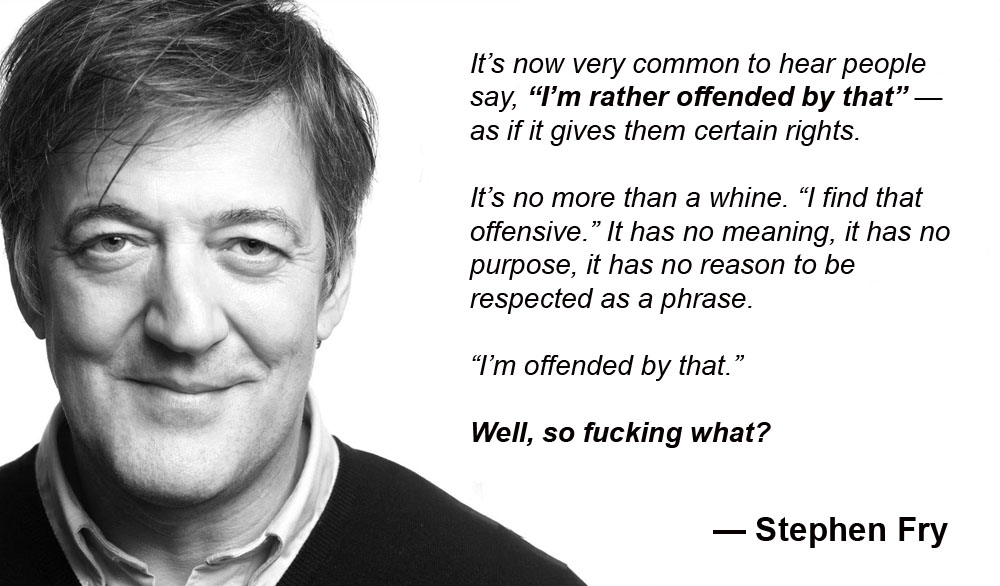
So fucking what?!?
Somebody just told you they are not going to stop paying any real attention to what you are trying to say to them and you don’t care?
Why did you start communicating in the first place? Or ‘performing’ the ‘offensive’ thing in public?
Was the ‘offense’ premeditated? For a reason or just for fun? Then it’s not ‘so fucking what’ anymore…
Or you just hadn’t thought about it beforehand? And you’re looking for an easy way out?

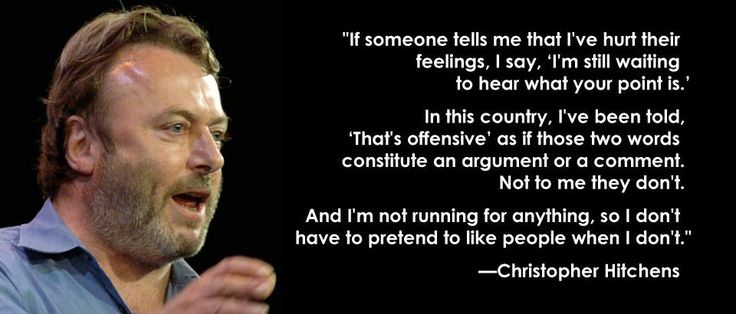
No, you don’t have to pretend to like people when you don’t.
But, in the longer time frame, it pays to honestly respect those you get in contact with. All of them.

Your life will get a lot better!

‘For things to work as intended, there must be a rule’.

Errr…

‘For things to work, there must be at least some consistency involved’.

This is a far better starting point!

An example would be fine?

Then imagine an Earth where the gravitational field was haphazard. In space and time. Where two lumps of dirt, a k a mountains, sometimes pulled at each other while some other times pushed. With no rules involved whatsoever.
Or where sometimes wood needed oxygen to burn while some other times – or in some other places, the presence of nitrogen was enough for wood to burst into flames.
Need some more? Then how about a place where dogs breed with cows. And also with butterflies. Only not always. And not in a constant manner.

Have you stopped laughing?
Well, this was how our ancestors imagined the Earth.
Sometimes after a mutation had provided them with the most powerful brain ever, our forefathers had learned to speak. To ‘trade’ information. Soon after they has started to develop something Humberto Maturana called ‘the ability of an observer to observe themselves while making observations’. ‘Self awareness’ for short. Or ‘conscience’ in everyday parlance.

Imagine a self-aware observer watching the sun go down. A rather smart one. One with a vivid enough imagination to ask ‘what if the sun will not come up tomorrow morning’…
Stonehenge has suddenly acquired a new meaning, right?

That was why God had so much traction. Simply because it gave sense to everything. It lend meaning to everything under the sun. And beyond!

In time, under God’s protection, we invented science. And, slowly but surely, we’ve started apportioning meaning ourselves.
Meaning we’ve started to take for granted.
Meaning which no longer depended on any third party!

Only we’ve gradually forgotten what science is really about.

Why we had developed it in the first place.

We had forgotten that science is wrong by definition.
That, by following this path, we’ll be forever able to find new meaning but that we’ll never be able to find ‘the’ meaning.

And now, that we’ve ‘killed’ God – as no longer necessary, we rely solely on the meaning we’ve already affixed to the things we already know.
To the things we consider to know… conveniently forgetting what science taught us….

Faced with unforeseen crises – unforeseen, not unforeseeable, we are left powerless.
Having taken so much for granted – our knowledge about the world and our ability to overcome everything the nature throws at us, above all, we find ourselves bereaved of our erstwhile powers.

Are we going to rediscover intellectual humility? And the ability to take advice? From the most unlikely teacher?

Or else?

Existence takes place ‘inside’ while things happen in-between.

Survival is a matter of preserving, ‘as is’, what already exists while evolution is about change and might involve ‘dismissal’.

Everything may survive while only ‘living’ things are capable of evolving on their own.

At some point, evolving organisms became complex enough to ‘feel’.
Not only complicated enough to react in an orderly – a.k.a. pre-programmed, manner but also to generate emotional reactions – which can be remembered, when certain things happen in their vicinity. Things which are important for the survival of the feeling organisms. As a consequence of the ‘feeling’ process, data regarding the happened occurrences are stored by the feeling organisms as information. Which information may help the organism in its struggle to survive. Using that information, that organism might become a ‘better version’ of itself.

At a further point in the evolution of ‘things’, organisms have added another layer of complexity.
They have become complex enough to ‘think’. As in complex enough to attempt to maximize the effects of the information they have at their disposal.

That was when ‘facts’ had been identified as being ‘things’ which had had consequences, when data had been identified as being information and when the thinkers had discovered that thinking was driven by sentiment.

Which sentiment is nothing but an evolution of the ‘survival instinct’.
Present in any living organism.
Which survival instinct is nothing but the living equivalent of something the physicists have identified as inertia.

Go figure….

One way to interpret Maslow’s pyramid of needs is to consider that an individual might become a full fledged human only after having climbed to the ‘fifth floor’.

The key word here being “might”!

Because nothing mandates that all those who have overcome the material constraints of this world and have successfully integrated themselves in the social milieu will ever become a ‘better version of themselves’.

Need examples? Have you ever heard about people like Bernie Madoff, Martin Shkreli or Myron Scholes?

‘But the last guy, Myron Scholes, was recognized by the Nobel committee as a world class economist!’
Exactly! What more could a person want? Money, fame, worldwide recognition… he was on the fast track to becoming whoever he wanted…
Yet he had chosen to associate himself with one of the deepest financial black-hole ever… Knowingly, unknowingly… doesn’t matter!

‘But what does it mean to become a full fledged human?’

To be free. To consider them-self a free person and to be recognized as such by their peers.

‘Scholes wasn’t a free person?!? Shkreli?!? Madoff?!?’

Nope. Neither was free from greed!
Greed for money, power, public recognition… or any combination thereof.

‘But “greed is good”!!! Isn’t this the current mantra? Aren’t we all driven by this sentiment?!?’

First of all, greed is not good. Read Adam Smith’s Theory of Moral Sentiment.
But yes, we are bombarded from all sides with this notion. That ‘greed is good. That greed is the engine of capitalism, which capitalism has brought us here. Where it is good.’

Yes, here it is indeed good. Only for fewer and fewer of us. It used to be better but since ‘greed has become good’ every ‘bump’ we encounter along the ‘free market’ road has proven to be quite a challenge. An insurmountable challenge for more and more of us.
An unsustainable arrangement. For us, as a community.
And yes, capitalism is the best economic paradigm to date. Only, as all paradigms, it has to be put in practice. By us, the people. In the right way. In the free market way.
Only we are no longer free! Those who cannot escape their sentiment may not consider themselves free. And too many of us have been enslaved by their greed!

‘But greed is written in our DNA!’

Indeed! So is the urge to have sex!
Only we’ve managed to teach ourselves, community wise, that while sex is good, rape is bad!
Not so long ago, rape was more or less condoned. ‘She must have enticed him’. ‘What was she doing there at that hour?’ And so on…
Nowadays, rape is shunned. By most of us.

Only we still live surrounded by rape culture. Seeped in greed.

Will we ever learn?
Will we, as a community, ‘actualize’ ourselves?

While everything mentioned above is absolutely true, we must also remember that it was the whites – who had first reached the ‘proper stage of development’, who had given up slavery and invented ‘human rights’.
On the other side, it is also true that the whites did reach the ‘proper stage of development’ by exploiting the rest of the world.
Only ‘this’ wasn’t invented by them! I don’t want to go into the finer details. All of you know, very well, what had really happened ‘on the ground’.

So.
What are we going to do next?

‘Delete’ everything the white people have contributed only because they have been the last to exploit the rest of the mankind?

Or accept the fact that evolution works in an oblique manner?