Things – every’thing’, actually – are/is relative. Relative to the agent evaluating each of those things. Accordin’ to Einstein, that is. He was the one who taught us to use whatever reference frame suits our needs.
Do you reckon anybody wasted any time or energy thinking about freedom before the advent of slavery? Me neither. Forget about the fact that, in those times, people didn’t have much time left for abstract thinking. Finding food and enjoying it with friends kind of drains your energy when you have to do it yourself… The point being that, in those times, everybody was free. Hence ‘had’ nothing to compare freedom with… No lack of freedom, no reason to speak/think about it. No reason to notice the thing and no reason to coin the concept…
Hunter-gatherers have no use for ‘property’. Personal objects are just that and everything else either belongs to Mother Nature or to the entire group. And this goes without saying. Or thinking about it. People share everything as a matter of fact and common sense discourages the others to use anybody’s personal objects unless in an emergency. Agriculture – either herding animals or growing crops – changed everything. Property, both as a concept and as an everyday manner of dealing with ‘things’, was invented and introduced in daily use. Productivity increased dramatically. Which made it possible for people to have ‘spare time’. For thinking. And for planning…
‘The neighbors have better crops. Let’s go take some for us. And while we’re at it, let’s take some of their women too’. The first slave was probably the first person to long for freedom…
‘Cheap’ slave work coupled with the increased social productivity induced by a markedly improved technology for obtaining food meant that some individuals could afford the luxury of thinking. The Ancient Athenians had both slaves and philosophers. The slaves did whatever was needed to be done while some of the ‘beneficiaries’ had enough time, and energy, to let their minds ‘free’. To roam free in search for meaning. To coin the concept and to explore freedom…
Relative “To whom”? To us! We’re responsible for freedom and freedom is relative to us. We have invented it. We’re the ones using it. In the sense that we’re the ones who need to notice that freer communities fare a lot better than the less free.
So freedom is relative both to those thinking about it and to each particular community. To each particular community which puts freedom into practice!
According to the English lore, “there’s more than one way to skin a cat”. According to the cat, ‘who cares about how I lose my coat? I’ll end up dead anyway!’ According to the fur tanners, ‘the manner of skinning the pelt is of utmost importance for the end-result of the operation’.
Whom to believe? Specially since all of them seem to be right…
Well, truth has a marked tendency for being complicated. Hard to comprehend in its entirety and even harder to express in a concise manner. Meanwhile we, conscious human beings, have a marked tendency to notice only what we’re interested in. To notice only what we care about…
In fact, the manner in which we notice things speaks volumes about who we are. About how we relate to what we call ‘reality’.
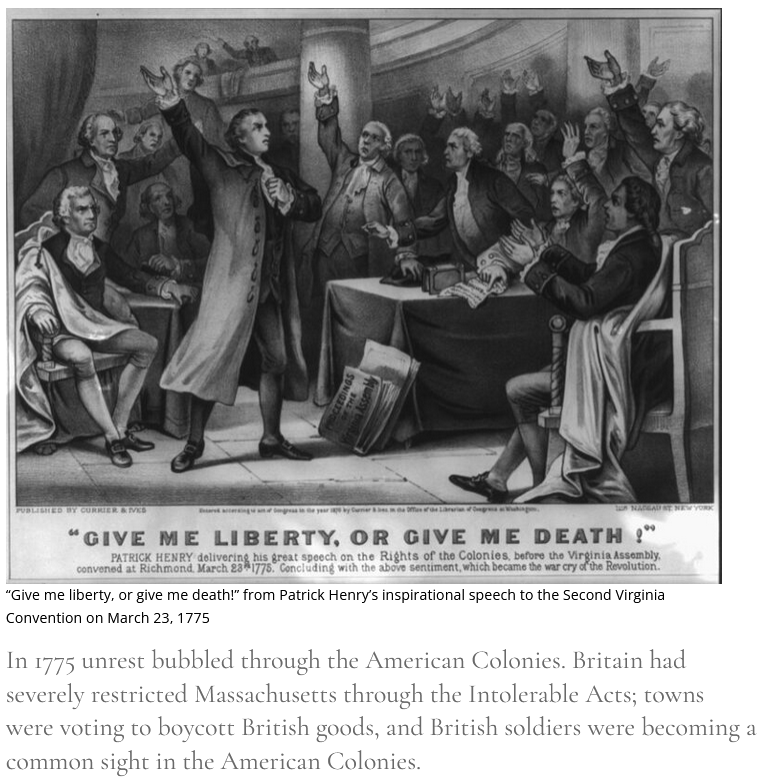
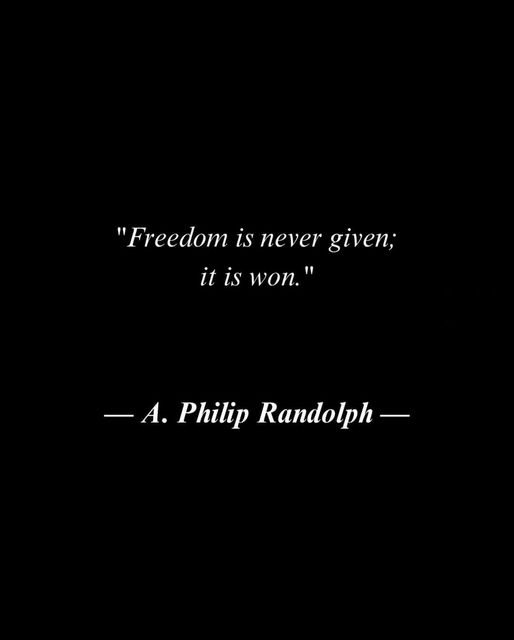
The white colonists inhabiting a certain area in Northern America had become ‘Free Americans’ after fighting the British. Only after they had freed themselves through battle! A. Philip Randoph had fought for his freedom. And for human rights.
All this fighting leads to a bout of pondering. Are we free together? As in ‘all of us’ and ‘once and for all’? Or our freedom is defined against other people? Who might try to steal our liberty from us?
What is freedom, after all? A zero sum game? Where liberty is up for grabs but in limited supply? Or a ‘grace’ we impart with and upon our fellow human beings? Something to be jealously guarded or something to be collectively and cooperatively maintained and enhanced?
And one final question. Why would anyone attempt to steal other people’s freedom? When history gives us plenty of evidence that whenever freedom was out to be shared people were happy while whenever freedom was in short supply the entire society eventually crumbled under it’s own weight…
‘Most people confuse liberty and democracy. They are not the same.’
Liberty and democracy are not the same indeed.
Like my left hand is not the same with my right one.
But I need both in order to lead what I consider to be a normal life.
Most people – specially if they get help, can survive without a hand. Or without either liberty or democracy.
But without both… without both hands or without both liberty and democracy… I’d be at somebody else’s mercy!
‘What?!? What kind of liberty is there under communist rule???’
You see, liberty has two ‘faces’. Two dimensions. Three, actually, but I’ll be talking about only two of them in this post.
There is the ‘inner liberty’ and there is the ‘socially sanctioned liberty’.
Liberty itself is a human concept. We have noticed something, wondered about it, named it and then attempted to understand it. This was, and continues to be, a collective effort.
In some places ‘liberty’ had appeared ‘naturally’. There was enough liberty naturally sloshing around, hence the circumstances were right for those who had happened to live there at the right time to notice it. Furthermore, the conditions had been right again for the entire community to be able to agree among themselves about the concept and about how to use it/put in practice their new intellectual achievement.
Other places have not been so lucky. They had been close enough, geographically and socio-historically, to notice the ‘birth of liberty’ but their specific conditions were not ‘right enough’. Many people living there coveted liberty but the local conditions made it impossible for liberty to take hold. In these places ‘inner liberty’ – individually assumed freedom, can be found a lo more easily than presumed by those unfamiliar with the local realities.
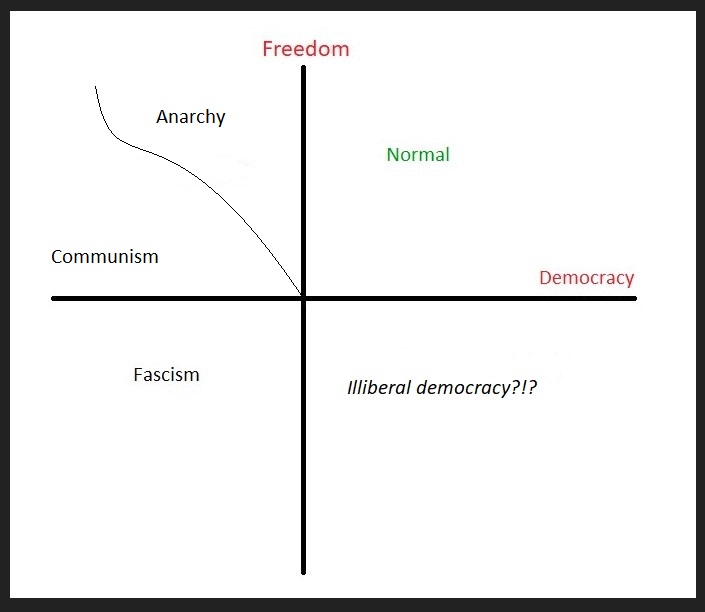
Yet other places had it even worse. Initially on the path towards liberty – and democracy, they have somehow stumbled. For whatever causes – internal and/or external, something went wrong. People became disappointed enough to give up not only democracy but also liberty. Including their own, individual inner freedom.
A somewhat intermediary situation constitutes the third abnormal quadrant. The people involved have given up their liberty – partially, but those running the show continue to use (‘pretendingly’) democracy as a window dressing to hide their true intentions.
The last hundred years or so have been extremely relevant in this matter. All communist regimes had fallen. Under their own weight. Most fascist/nazi regimes are no longer with us. Had been so ‘arrogant’ – read self destructive, that their neighbors had to do something about them. Had created so much disruption around them that those whose very existence was endangered had been forced to spring into action. ‘Illiberal democracy’ is a rather new ‘development’. Would be fascist/nazi dictators don’t have all circumstances aligned to make their final move so they have to make do with what there is at their disposal. The local population is ‘despondent’ enough to pay attention to their arguments but not desperate enough to follow them into the ‘unknown’. Hence this oxymoronic abomination.
‘Illiberal democracy’… On the other hand, the spin doctors promoting illiberal democracies hope to be able to reap the benefits of democracy – the population being ‘rather favorably disposed’ towards the government while having to pay less ‘lip service’ to individual human rights. A balancing act, with no safety net, which is alluring to those reckless enough to attempt it but which will end up badly. Sooner rather than later.
But the most interesting ‘combination’ – for me, at least, is Anarchy. In the sense that those who ‘swallow’ the lure are self delusional. They have somehow convinced themselves that their, own, liberty somehow trumps the liberty of everybody else. They feel so strong, so immune to any outside influence, that they would willingly accept to live in a no rule environment. Without understanding that ‘no rule’ means ‘no holds barred’. They actually don’t realize that unfettered liberty actually means ‘Each of us free against all others’. This being the reason for which Anarchy, as a political arrangement, has never survived for long enough to be noticed. Except as a transitory phase.
Many people interpret Darwin’s Evolution as ‘the survival of the fittest’. Ernst Mayr, What Evolution Is, made is crystal clear that ‘evolution is not as much about the survival of the fittest as it’s about the demise of the unfit. Read the book, it’s well worth the time. https://www.scribd.com/document/358382958/Ernst-Mayr-What-Evolution-is-PDF
The fact that we have so many, and so conflicting, views on such a simple natural law as the law of evolution means that… we don’t know shit!
Hence Samuel Adams was right. Since we know basically nothing, none of us should have ‘authority’ over others. Each of us should be free. To do as they please. To follow exclusively the ‘laws of nature’.
Which one of them? Darwin’s – as some of us have chosen to interpret, or Mayr’s?
‘Survival of the fittest’ or ‘The demise of the unfit’? ‘I’m stronger than you so move over’ or ‘If you don’t agree with our commonly shared values, please find another place to live?’ ‘Free against all else’ or ‘free together with everybody else’?
I’ll start by stating that nothing becomes fact before somebody calling it so!
Doesn’t make any sense? It’s not enough? OK…
So ‘blue’ had become a fact only after people had invented a word for it… It had existed before hand but we hadn’t noticed it – hadn’t spoken about it, more exactly, until we had a word for it. Until we had learned how to ‘measure’ it…
But what is a ‘fact’? Something which is ‘real’? And how do you determine if something is ‘real’ or not? It either has ‘measurable consequences’ or your experience about it has been confirmed by somebody else. A coffee table becomes a fact in the dark after you hit it with your shin and a meteorite ceases being a illusion the moment your hubby confirms he has also seen it. No so complicated, was it?
‘But what about a propaganda movie? It that real? Can you consider it to be a fact?’
Excellent question, Watson!
The movie itself is real alright! A fact, indeed. The fact that not everything it pretends to be real is true… is also a fact! Savvy?
In fact, there are more facts waiting to be discovered than actual ‘happenings’.
Take the propaganda movie. It has consequences. Some people believe in its message. And act accordingly. Each of those actions becoming facts on their own. Other people smell the rat hiding behind the screen. And act accordingly. Each of those actions being facts on their own. The fact that those exposed to the same message more often than not chose to respond differently is a strong suggestion that facts – and reality itself, are not so straightforward as we’d like them to be. As straightforward as most spin doctors pretend them to be…
‘You’ve been jabbering for sometime now but you haven’t yet come forward. What was the meaning of that ‘elusive’ title of yours?’
Liberty. What is it? A fact? A natural fact? Something which was given to us? Our natural status? Something others want to steal from us? Something we’ve built/discovered together? Or an ideal we’ll never be able to fulfill?
How about all three at the same time?
‘Are you nuts?’
A ball – a foot-ball, for example, has a certain degree of freedom. Put it on a table and it may roll in any direction it may choose. But will ‘never’ be able to fall through the table nor start to fly. ‘On it’s own’… A helium balloon has another kind of freedom. If it’s tied down with a string it has the freedom to oscillate. If it’s ‘free’ it has the freedom to go up. For as long as it manages to hold on on enough helium, but that’s another thing. Another fact, if you will…
A society is free only if its members respect and defend, collectively, their freedoms. Their individual freedom and their collective freedom. For instance, Russia is a free country but its citizens are not as free as their neighbors, the Fins. The moment Hong Kong went back to China, the city was no longer as free as it used to be as a British dominion. Yet its citizens have continued to be far freer than the rest of the Chinese citizens. For a while…..
Somethings – freedom, for instance, cannot be anything more than people think about them.
Others can. Until people had invented X-rays, nobody could know how big were the roots of any given tooth. Until Robert K. Merton had put together a more detailed analysis of it, the law of the unintended consequences was something people intuitively knew it was ‘real’ but nobody was fully aware of its real depth. Now, most of us agree that that depth is unfathomable. Yet some people still behave as if things were under control… Under their control…
Freedom, and all other rights we have enjoyed for sometime now, is only as wide – and only as deep, as we make it to be. As we agree among ourselves to make it. For all of us!
Collective freedom as a fact. In the sense that the freer communities have had a consistently bigger survivability rate than the more authoritarian regimes. Ancient Athens had been able to navigate through more ‘dire straights’ than its arch-enemy, Sparta. The Roman Empire has been established as a democracy, thrived as one for a while then failed abysmally as an autocracy. Yes, the Egyptian empire did survive for millennia… only it had been ruled, succeedingly, by 33 dynasties. Practically, there had been 33 regimes, not one… And since there had been some 3100 years between its unification and it being incorporated into the Roman Empire… an average of 100 years per political regime cannot be branded as a real success… Specially in the early years, when the competition was…
A quick jump to the XX-th century will suggest the very same thing. All major wars – WWI, WWII and the Cold one, had been won by the freer societies.
So collective freedom, or lack thereof, has consequences. Is a fact.
On the other hand, freedom – the real version, the one that works, cannot be had/enjoyed but in a social context. Nobody can be free on their own. The emperors of yore – and the dictators of today, have been under the impression – illusion, more likely, that they could do whatever they pleased. That they were free. So free that they never hesitated to trample the freedom of their subjects. Only that freedom never lasted for long… it was soon replaced by the liberty of somebody else… And all these successive liberties have been exerted at the expense of those of everybody else.
Hence liberty, individual as well as collective, is not only a fact. It’s also a social construct.
Oops! The only reasonable way to read this is ‘if you want to be free, you need to think straight’. To find out what’s keeping you down and how to free yourself in a sustainable way. How to free yourself in a manner which will add to the freedom of all others!
Cause if your increased freedom means the debasement of your erstwhile peers… things don’t look right…
One-Time
Monthly
Yearly
Make a one-time donation
Make a monthly donation
Make a yearly donation
Choose an amount
$5.00
$15.00
$100.00
$5.00
$15.00
$100.00
$5.00
$15.00
$100.00
Or enter a custom amount
$
As much as I love writing, I do have to eat. And to provide for my family. Earning money takes time. If you’d like me to write more, and on a more regular basis, hit the button. Your contribution will be appreciated! Another very efficient way to help would be to share my posts.
As much as I love writing, I do have to eat. And to provide for my family. Earning money takes time. If you’d like me to write more, and on a more regular basis, hit the button. Your contribution will be appreciated!
While everything mentioned above is absolutely true, we must also remember that it was the whites – who had first reached the ‘proper stage of development’, who had given up slavery and invented ‘human rights’. On the other side, it is also true that the whites did reach the ‘proper stage of development’ by exploiting the rest of the world. Only ‘this’ wasn’t invented by them! I don’t want to go into the finer details. All of you know, very well, what had really happened ‘on the ground’.
So. What are we going to do next?
‘Delete’ everything the white people have contributed only because they have been the last to exploit the rest of the mankind?
Or accept the fact that evolution works in an oblique manner?
Liberty is freedom from being constricted, in any way, shape or form. Period.
Liberty is more of an adjective rather than a verb. A situation more than an action.
Liberty can be attached to a space, to an agent or to both.
A free space would be a space where no constriction may occur, whatsoever. A free agent would be an individual entity outside any constriction, whatsoever.
Mathematically, both definitions are possible. Philosophically, both definitions are imaginable. By philosophers, of course.
Oscar Hoffman, a Teacher, kept telling us, his students, “For a proposition to be true it is not enough for it to be logically correct. It also has to make ontological sense. For those of you who don’t remember what ontological means, a true proposition must describe something which has to be at least possible”
In the real world, where there is no such thing as absolute freedom, liberty has to be first noticed/invented. And then constantly negotiated.
‘No such thing as absolute freedom?!? But liberty is a (God given) (human) right!!!’
Do you remember what Hoffman had (just) said about things which can exist in practice and things which can exist only in our minds? Liberty might be a right – for those who enjoy it, but that doesn’t mean that everybody has it. And, even more important, that there is – or ever will be, something even close to absolute liberty. If you don’t believe me, try to fly off a balcony without any ‘mechanical’ help. Or stop eating for a day or two. The Earth will surely ‘constrict’ you back towards its center and your stomach will certainly constrict itself for lack of food. And both Earth and stomach will constrict you back to reality.
‘OK, so no absolute freedom for individuals. How about ‘free spaces’?’ ‘As in spaces where no constriction, whatsoever, may be exercised?’ ‘Yes.’ ‘Well, that would be possible. If a space is completely empty… no constriction might be exercised in there, right? On the other hand, as soon as something, anything, populates that space, constrictions start to appear. For instance, since no two things can simultaneously exist in the very same place, the mere existence of a speck of dust in a whole stadium induces the restriction that no other speck of dust may exist in the very same spot. Sounds trivial, true, but this is it… No absolute freedom. Not for individual agents and nor for spaces.’
‘Then why are writing a post about ‘Free market’? Doesn’t make much sense, isn’t it?’
Let me finish with liberty before going any further. I mentioned earlier that liberty must be first noticed and then negotiated. You see, right or no right, liberty is, above all, a concept. We’d first observed that a flying bird is freer that a crawling worm and bam!!! We realized that some of us were freer than the others. Then that freer groups/societies fared better than the more ‘stifled’ ones. But only where liberty was more or less spread around, not concentrated in one hand. Dictatorships – where all liberty is concentrated at the top, are way more fragile than any democracy. I’ll come back to this. Now, for the negotiation part. ‘Your freedom to swing your fist ends where my nose begins’. And vice-versa. Only this is rather incomplete. Let me examine the situation where you are a person who likes to swing your fist. In the air, not with any aggressive intent, of course. So you were swinging your fist, after you had determined, in good faith, that there was no nose close enough to hurt. But what if I am a ‘nosy’ guy? ‘Nosy’ enough to bring my actual nose inside your reach? You having to restrict your swings – or to go somewhere else, isn’t a limitation of your freedom? An absolutely unnatural limitation of your freedom? Has it become a little clearer? What I mean by negotiation when it comes to individual freedom?
OK, time has come for me to go to market. To the free market!
A market is a place. Obviously, right? A place where people trade their wares. Because they have noticed that it is easier for each of them to do what each of them do better and then trade the results of their work instead of each of them providing everything for themselves. As in everything each of them needs. Or fancy.
Initially, markets were far from being free. First of all, supply was sorely limited. Transportation means were practically nonexistent so supply varied seasonally and was severely influenced by weather, soil and other similar factors. And, maybe even more importantly, supply was influenced by the sheer will of the most powerful ‘free agent’ who happened to be around. Or, more exactly, supply was heavily influenced by the whims of the most powerful free-agent who happened to be around. Don’t believe me? Then consider the extreme famine experienced by the Bengalis in 1943. Or by the Romanians during the last years of Ceausescu’s reign. Slowly, people have learned that freer markets tend to be a lot more stable than the less free. ‘Freer’ markets meaning freer from both exterior and interior limitations. For a market to become free(ish) the participants need to have a big enough pool of resources at their disposal and to be wise enough to organize themselves in a ‘free’ manner.
And what happens when at least one of the two conditions remains unfulfilled? Time has taught us that while markets tend to be limited in space and that some of the participants tent to impose themselves over the rest there is one dimension where the liberty of the market is very hard to be limited. ‘Liberty’ here meaning that things tend to evolve more in their own terms rather than ‘according to plan’. Or according to anybody’s wishes.
Whenever the available resources dry up, the participants to the market move someplace else. Or die of starvation. Whenever a market looses too much of its freedom – as in some agent controls too much of what is going on there, the market itself no longer functions properly. Whenever too many of the participants loose their ability to determine their fate/future they slowly become ‘sitting ducks’. Not as much easy to hunt down but actually unable to feed themselves. And since hunger is the best teacher, they either learn to fight for their freedom or… die of starvation. Pol Pot’s Cambodia would be a good example, even if somewhat extreme. The fall of most communist regimes also makes a compelling case for what I have in mind. Even more interesting, though, is what had happened to the American Automobile Industry. General Motors and Chrysler Corporation, once the dominant stars of the market – along with Ford, had to be rescued by the government. Quasi monopolistic positions tend to be bad for the monopolists also, not only for the rest of the market. Given enough time, true enough…
Nowadays, too many individuals are afraid of freedom. Specially of other people’s freedom, since other people’s freedom might bring in ‘unwelcome’ change. Other people’s freedom might challenge our established way of life. And why risk it?
Still interested? History strongly suggests that societies which had considered the stability of their ‘established way of life’ to be more important than the freedom of any individual member to respectfully question everything have eventually failed to preserve that over-cherished way of life. Simply because those societies had not allowed their individual members to adapt their mores to the changes which inevitably alter the ‘environment’.
Conclusion? Liberty is of utmost importance. For both individuals and societies, equally. And, as a matter of historical fact, real – as in ‘truly functional’, freedom can be achieved only together. By the individual members of a society, acting in concert. Through a robust mechanism of checks and balances – a.k.a. real justice, based on mutual respect between the members of the society attempting to maintain this arrangement.
Warning! Since we currently experience a growing distrust among the members of many societies – America and Western Europe included, no wonder that actual individual liberty is sliding down a dangerous slope. Simply because nobody is going to defend the liberty of somebody they do not trust/respect.