Collectively, species-wise, we’ve done OK. We’ve become the dominant species on Earth. For good and/or for worse…
Individually, on the other hand…
Doubts! Self-awareness comes with plenty of them: Will I be able to find enough food tomorrow? For me and for my family? When will it start to rain? Will the sun rise again?
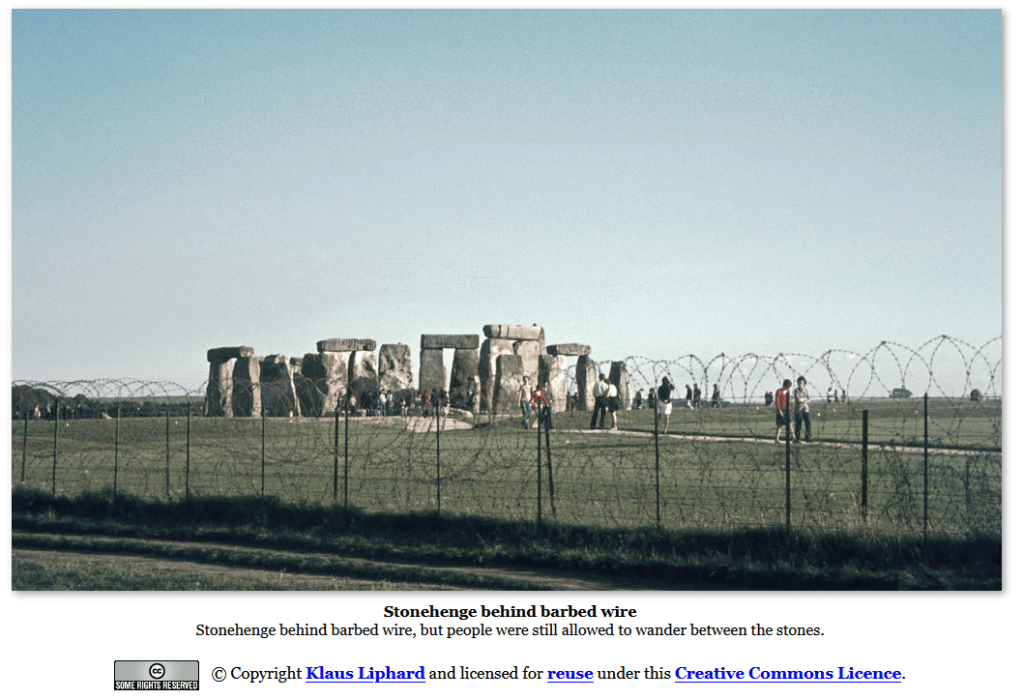
The way I see it, ‘The Stonehenge’ has been built for one thing only. To assuage fear.
‘OK, tomorrow will come. The sun will rise. We’ll be able to sow our crops for the next year. But is there an order in all this? How can we be sure?’ ‘Let’s build something which will prove “order”. If we could demonstrate that year after year the summer solstice ‘falls’ under the same ‘parameters’ then there’s indeed an ‘order’. Things don’t just happen, they follow a ‘script’ ‘.
And they did exactly that. Built the first scientific instrument. Proved that the sun not only rises each day but also follows a precise path.
Quite a management feat. And no, I don’t mean the stone stacking part. However remarkable that was… Their real success was to convince themselves to keep toiling into the future!
When do you stop cleaning something? How do you determine it is clean enough?
When do you stop cleaning the living room? When there’s no more visible dirt, right? When do you stop cleaning an operating room? You follow the procedure and you check using the appropriate methods and apparati, right? When do you stop cleaning the operating room where your child will have their life-saving surgery? I’m afraid the surgeon will have to drive you out of the room. You’ll never declare it clean enough….
My point being that we’re rational only as far as there’s nothing personal involved in the choice we have to make.
And as soon as we’re personally invested in the whole thing, we suddenly start to rationalize. To find rational arguments which favor the position we’ve already adopted. The decision we’ve already made.
My child deserves the best!
Which is true, of course. For as long as we really know what’s good for them…
What capitalism has to do with any of this?!?
Well, most of the ‘hoarders’ rationalize their habit by ‘blaming it’ on their children. “I have to take care of their future”. In their attempt to control the future, the hoarders convince themselves that amassing capital will shield them, and their children, from insecurity.
Which is partially true. If the hoarded capital is sustainable…
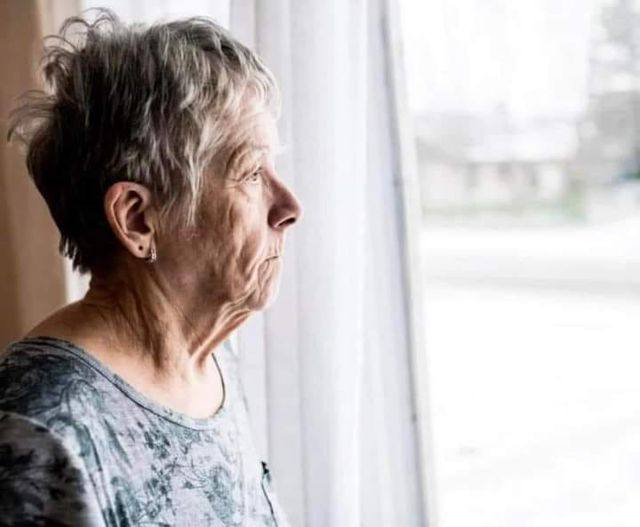
“I am 82 years old, I have 4 children, 11 grandchildren, 2 great-grandchildren and a room of 12 square meters. I no longer have a home or expensive things, but I have someone who will clean my room, prepare food and change my bedding, measure my blood pressure and weigh me. I no longer have the laughter of my grandchildren, I don’t see them growing, hugging and arguing. Some come to me every 15 days, some every three or four months, and some never. I don’t bake cakes, I don’t dig up the garden. I still have hobbies and I like to read, but my eyes quickly hurt. I don’t know how much longer, but I have to get used to this loneliness.” “Author unknown”
Every time I read something like this over the internet – more and more often – I remember that it was us. We have raised our children into what they are today.
We have amassed vast amounts of financial capital – fiat money – believing that our children will be grateful. We had not been there when they were growing up. We had not been there when they were learning things. And now we are the ones who don’t understand why there are no more bonds between us. Between us and our children. Why our children see the world differently from how we do it…
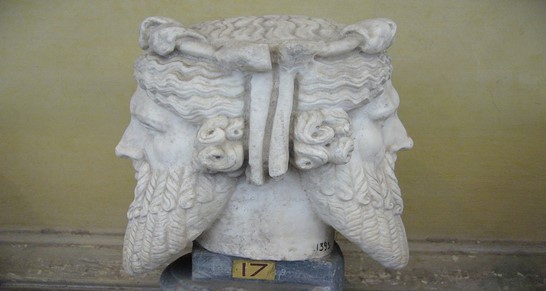
Time, like everything else human, has two sides. Like a coin.
A ‘base’ and an interpretation.
There’s no interpretation without a base – even hallucinations are based on ‘something’ – and there’s nothing which has penetrated human conscience and ever managed to evade interpretation. In fact, human conscience needs to interpret, to assign meaning to, everything it ‘sees’. Everything it perceives. Anything which is uninterpretable, which has no meaning, cannot be controlled.It is, hence, dangerous. If you don’t know what’s going to happen next, you can assume anything. And since assuming the worst – and preparing for it – is far more useful towards survival than sleeping over it, we are biased towards erring on the side of caution. And towards relentlessly searching for meaning.
Time, like everything else human, is both a phenomenon – it happens – and a concept. The difference between the ‘time’ of a star and the human time being that ours has a name – given by us – and that the star cannot do anything about it. While we do!
We can do things to and about time!
We named it, we measure it, we attempt to interpret it…. and we try to do the best of it! We try to do, while alive, what we consider to be ‘the best’.
The best (?!?) for whom?
Tao.
The ‘road’. If everything flows, it has to flow ‘somewhere’. Not only from the start/spring to the ‘end’ (?!?)/never tranquil sea. Everything flowing needs a ‘riverbed’ to flow ‘through’. A plant needs soil to sprout, grow, bear fruit and ‘return to nature’. Even a star needs an Universe in order to shine… besides enough ‘fuel’, of course! I have started this post by saying that there’s no interpretation without a ‘base’ and that we, conscious human beings, need to attach meaning (a.k.a. interpretations) to everything of which we become aware. Same thing here. For anything to happen, a venue is needed. Some wise people in our past have used ‘Tao’ as a name for THE venue. For the venue where everything takes place.
Karma.
At first, when conscience had dawned on us, we were alone in the ‘dark’. And afraid about what was going to happen to us. To assuage that fear, we have identified God. As the ‘the meaning’ of the world. At first, when both the world and time seemed to be endless – to us, consequences came from God. We had to behave. Or else… God was there to punish each and every transgression. Sometimes using one of us as his proxy. After a while, some of our ancestors have learned to write. To reliably transfer information over generations. Very soon, those ancestors of ours have learned the link between cause and effect. Between behavior and consequence. Very soon God had become an outside observer. Or was out-rightly forgotten. But Karma survived.
Future.
I keep hearing that ‘evolution has no purpose’. Like many other human utterances, this one conveys far more information about the utterer than about the phenomenon described by the utterer.
‘This wooden table has 4 legs’. We learn about the table that it is in front of us, that it is made of wood and ‘has’ 4 legs. We learn about the utterer that: It was conscious when uttering those words. Only conscious agents are capable of ‘speaking like a human’. It has, at some point, learned to speak. English, and possibly other languages. It has, at some point, learned to count. At least up to four. And it had conserved that ability up the moment when it uttered those words. It was capable of identifying ‘wood’ as a material. When uttering that phrase, it was in a ‘casual’ state of mind. A ‘scientifically minded person’, a ‘grammar nazy’, for example – when in that mood, would not attribute human ‘abilities’ to a table. Which table is a mere object and objects cannot posses other objects. Tables cannot ‘have’, hence that person was speaking colloquially. Or, given the current ‘technological’ developments, those words might have very well been uttered by a statistically ‘minded’ AI application…. A man made ‘parrot’!
See what I mean?
Let’s go back to the presumably purposeless evolution.
Evolution is a phenomenon. Like a thunder. It takes a lot more time to unfold than a thunder, it’s about as hard as a thunder to predict the exact point where it will ‘strike’ but we know enough about both to be able to point out, quite reliably, a few ‘rules’ about how both phenomena take place. About where, when and how they will unfold. What’s the purpose of thunder? To ‘close the circuit’? To discharge the energy pent up in the cloud? I’m afraid that attributing purpose to thunder is akin to allowing tables to ‘have’ legs. What we have here is a ‘figure of speech’. An ‘implicit’ figure of speech… so implicit that it’s not even considered as such… Same thing when it comes to evolution.
Which evolution is paramount to survival. Just as no cloud can accumulate ad infinitum electric energy – hence thunder – no living thing ever – no species, more exactly – has yet been able to survive ‘everything’. Everything mother nature has thrown at it. Hence ‘evolution’! Which is a mere process which makes life possible. In certain conditions – in a certain Tao – after it had sprung up. And, again, attributing purpose to evolution is akin to allowing a table to own legs.
Then what about ‘future’? If God no longer decides for us – the God we have identified – and if evolution is ‘pointless’… then ‘future is blind’?!?
Not so fast!
Question: Where was God at Auschwitz? Answer: Where was man at Auschwitz?
Could any of those present at Auschwitz have done anything to fundamentally change the outcome? Probably not. Could we, as a species, have done – have behaved, actually – in such a manner as to avoid Auschwitz altogether? Specially after the Armenian Genocide had already taken place? Should we, as a species, have done differently when so many Tutsi had been killed in Rwanda? When 8000 Muslim Bosniak men and boys had been murdered in Srebrenica?
See what I mean? About the future? About our future?
What do we have here? “Eternity and endless return?” Or past mistakes haunting us through time? Until we figure out the way forward? Or else…
‘For things to work as intended, there must be a rule’.
Errr…
‘For things to work, there must be at least some consistency involved’.
This is a far better starting point!
An example would be fine?
Then imagine an Earth where the gravitational field was haphazard. In space and time. Where two lumps of dirt, a k a mountains, sometimes pulled at each other while some other times pushed. With no rules involved whatsoever. Or where sometimes wood needed oxygen to burn while some other times – or in some other places, the presence of nitrogen was enough for wood to burst into flames. Need some more? Then how about a place where dogs breed with cows. And also with butterflies. Only not always. And not in a constant manner.
Have you stopped laughing? Well, this was how our ancestors imagined the Earth. Sometimes after a mutation had provided them with the most powerful brain ever, our forefathers had learned to speak. To ‘trade’ information. Soon after they has started to develop something Humberto Maturana called ‘the ability of an observer to observe themselves while making observations’. ‘Self awareness’ for short. Or ‘conscience’ in everyday parlance.
Imagine a self-aware observer watching the sun go down. A rather smart one. One with a vivid enough imagination to ask ‘what if the sun will not come up tomorrow morning’… Stonehenge has suddenly acquired a new meaning, right?
That was why God had so much traction. Simply because it gave sense to everything. It lend meaning to everything under the sun. And beyond!
In time, under God’s protection, we invented science. And, slowly but surely, we’ve started apportioning meaning ourselves. Meaning we’ve started to take for granted. Meaning which no longer depended on any third party!
Only we’ve gradually forgotten what science is really about.
Why we had developed it in the first place.
We had forgotten that science is wrong by definition. That, by following this path, we’ll be forever able to find new meaning but that we’ll never be able to find ‘the’ meaning.
And now, that we’ve ‘killed’ God – as no longer necessary, we rely solely on the meaning we’ve already affixed to the things we already know. To the things we consider to know… conveniently forgetting what science taught us….
Faced with unforeseen crises – unforeseen, not unforeseeable, we are left powerless. Having taken so much for granted – our knowledge about the world and our ability to overcome everything the nature throws at us, above all, we find ourselves bereaved of our erstwhile powers.
Are we going to rediscover intellectual humility? And the ability to take advice? From the most unlikely teacher?
I’m not pointing fingers here. I just try to convince you how hard it is to make the right decisions. ‘Going forward’ as opposed to ‘looking back’. I just try to convince as many of you as possible to stop for a moment and think about it. As dispassionately as possible.
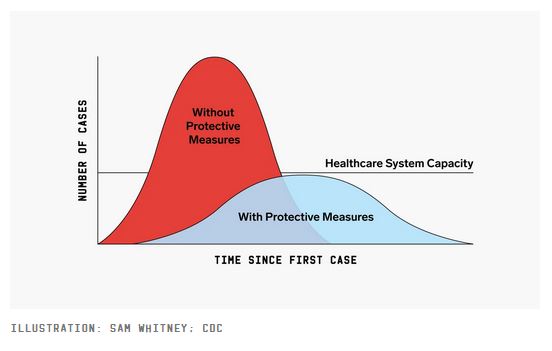
We’ve also been told that we need to flatten the curve. That our systems were not prepared enough for the onslaught that was going to happen.
Some people continued ‘as they were’ while others tried to ‘flatten the curve’.
For a while. Now, after some time, people from both categories have started to entertain second thoughts.
Trying to figure out what’s going on here, I’ve asked my self a couple of questions.
Who had chosen to go on as usual and who had chosen to distance themselves from the rest of the society?
‘Go on as usual’ first: – Those who don’t trust the government. – Those who are convinced nothing can happen to them. – Those who felt they had no alternative. Who live paycheck to paycheck or who provide essential services to the society. Like healthcare for instance. Or those who bake our daily bread. Pump the water we drink. Tend the generators who lighten our bulbs and power the computer I use to write this post.
Now those who attempt to ‘flatten the curve’: – People who tend to trust the authorities. – Those who understand they should really protect themselves. Who are older and/or already sick. – Those can work from home. – And people who are otherwise fine but afford to distance themselves from the fray. Those who have enough resources to do it.
Am I imagining things or the picture is already a lot clearer?
And the other question now. Why the second thoughts?
Because things have unfolded more or less as the government said they were going to. Because things have started to happen. If not to them, directly, at least to some of those living around them. Because there still is no alternative in sight. And because there is nothing much to convince them that their efforts are appreciated by the rest of the society.
Because the government might have been right to tell them to ‘lie down’. But because the same government has failed to do enough in the meantime. Not to mention what it had failed to do before. Because staying put allows you to start thinking. ‘What next? For how long can we go on like this?’
So. What next? What are we doing to convince those who actually keep us going to continue doing so? What are we doing to convince those who have chosen to restrict their lives to a barren minimum that their efforts are worth it?
What are we doing to convince everybody that there will be a life worth living at the end of all this?
Decision is the frontier between action and understanding.
All frontiers are, in fact, links.
Present decisions set the stage where future will be played, just as past decisions have built the theater.
While we, “the people”, are the building actors. The script writers. And the spectators who will eventually bear the brunt.
What we currently call ‘science’ is both an activity and an attitude. Something some of us do and the way in which some of us see the world.
In current lingo, those who ‘do science’ are involved in ‘technology’ while those who see the world ‘scientifically’ partake in a certain philosophical tradition. If we look at things in this way, it becomes obvious that doing science and thinking scientifically might not be the same thing.
Science, as an attitude, had sprung up in Ancient Greece, been kept alive by the early Islamic scholars, rekindled by the Medieval Catholic theologians, come of age during the Renaissance and ‘exploded’ after the Enlightenment. Technology, on the other hand, is way older. And had been developed mainly elsewhere than the scientific attitude. China and India had been technological powerhouses and thriving civilizations in times when Europe was still learning to wash its hands before dinner.
‘Modern’ science – what we have now, appeared only after technological prowess had been married to the right attitude.
OK. It is easy to accept that technology, the more widely distributed part of ‘science’, had appeared as a consequence of mere necessity. People needed things in order to survive, then wanted things in order to increase their comfort… things which had to be produced… as efficiently as possible… hence people had put their minds to it and … voila! But what had driven some of those around the Mediterranean Sea to develop the scientific attitude?
The same thing which drives us? The attempt to find out the future, one second earlier than it really happens? Because they thought, like we do, that reality is unique and that man is meant to master it?
Man, the guy who was made by God in His own image and who was told to rule the world?
Roger Bacon, Duns Scotus, Occam, Galileo, Newton, Darwin, Georges Lemaitre… some of them might have been persecuted by the church – personally or had their their ideas ‘challenged’, but they all had been raised in the Christian tradition and had been active members of their religious communities. Even Galileo, the only one among these who had been ‘physically’ affected by the way in which his ideas had been received by his contemporaries, had a more or less ‘functional’ relationship with the heads of the Church… he had died in his own bed, arrested in his own villa, not at the stake …
I’ve spent the first 30 years of my life under communist rule.
One of their many ‘mantras’ was: ‘Children are the future of mankind’.
Communist rule had brought about so much happiness in Romania that people had stopped making children.
Concerned about the future the communists had decreed that from then on abortion was to be considered a crime – after it was freely available until that time, October 1, 1966.
As a consequence more than 10 000 women died after botched abortion attempts – all other methods for birth control had been banned also.
Add to those deaths the individuals, mostly youngsters, killed while attempting to flee communism by sneaking across the borders.
But there was one good thing that communist rule had brought to the people. Not that much because the communists really cared about the fate of the individuals but because they needed skilled laborers in order to put their plans into practice.
Schooling was free.
You could learn as much as you wanted without having to pay a dime.
One had to pass some exams, positions were limited for higher education, but if you were smart enough and diligent enough you could go really high. Specially in the area that is currently known as ‘STEM’. ‘Humanities’ were somewhat off limits, because one could get ‘funny’ ideas when delving too deep in that area but STEM was OK.
Fast forward to our days.
Half of my University mates – I have a MSc in Mechanical Engineering – have emigrated right after Ceausescu was toppled while political power in Romania has fallen under the constant grip of a small coterie which doesn’t really care about what’s going on and/or has not enough intellectual flexibility to understand that we are currently running towards a dead end.
In the end the ‘good’ thing has proved to be a poisoned apple. By tuning the schooling system towards their own goals the communists had created many generations of superb engineers – who were welcomed by the ‘greedy capitalists’ – but also had completely discouraged independent thinking – the kind needed to breed honest politicians and effective public figures, if you can accept those concepts as anything more than empty words.
Gazing over the borders I became even more despondent.
Forget, for a minute, about child pornography, sweat-shops and so on. These are absolutely horrible but we might console ourselves with the thought that those who are involved in them are either mentally disturbed or blinded by greed.
But something like this?
Supposedly a feminist writer is followed by either like-minded people or opponents of her ideas only both categories belong to the wider category of ‘intellectuals’ – people concerned with ideas, human rights, philosophical thinking, etc., etc….
In this context to threat a mother that you are planning to rape her child is way above anything that was imaginable until this moment.
It’s as if being able of sophisticated thinking is no longer one of the venues towards becoming a better person – by simply being able to understand how much pain is produced by evil or careless behaviour.
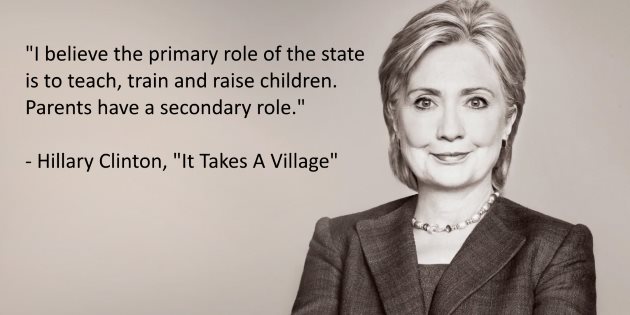
Then I came across the meme at the top of my post.
I must confess that I don’t like her. For various reasons that do not fit here. Enough to say that while watching the DNC 2016 I had the distinct impression of being transported back in time to one of the congresses organized by the Romanian Communist Party.
Because of my dislike of her I had the tendency to believe that she had actually wrote that.
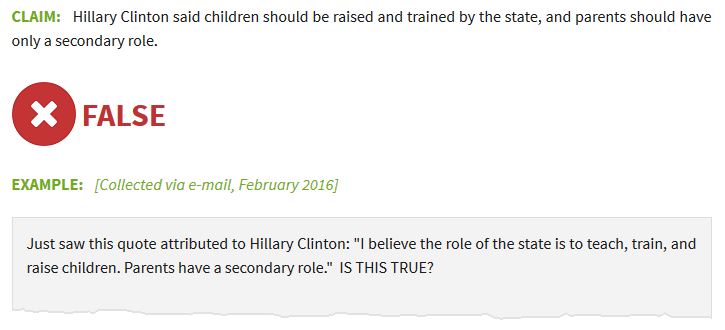
OK, some of you will tell me that Snopes is leaning towards the left and that you cannot always trust its findings.
I can agree with that. Sometimes you should not believe your own eyes, let alone what you read over the Internet.
But my argument still stands.
What has happened to us?
Why are we so willing to involve even our children in our political lies? It doesn’t matter here who lied – Snopes or those who ‘cooked’ this meme…
What are politics for if not for securing a future for our children?
What kind of future can be build on lies?
On this kind of lies and on this kind of threats…
When are we going to understand that the state which side-lines the parents is a fascist one – fascism and communism are close authoritarian cousins, that no one can survive for long outside a community and that the community, as a whole and each of its members, fare better if all its members have a real chance to develop their potential?
Education and health care should not be treated as ‘individual rights’.
It is obvious to the naked eye that societies who take good care of their members while simultaneously respect their freedom fare better than those who let their members fend for themselves without helping them train for today’s job market and without extending them any safety net.
We keep saying that we need better skilled individuals and do nothing about it. We keep saying that in a free market there are risks that have to be taken yet we step back when a risk taker who happened to have failed, honestly, asks for our help.
OK, I understand. The communists dissuaded their children from studying ‘humanities’. Simply because they might have started to ask the very same questions that I’m asking today.
But what happened to the rest of the world?
Who is thinking about the future, beyond planning for future cash-flows (extremely unreliable in the first place), anyway?
Some of us go by ‘the winner takes it all’.
For them each ‘win’ is another step that must be climbed on the ladder towards ‘success’.
Until the inevitable failure, and a single one is enough for the kind of game this people choose to play, brings them back at the foot of the ladder.
Samuel Becket suggested and then Nicholas Nassim Taleb amply demonstrated that there is an alternative to this scenario.
Next time ‘fail better’ was how Beckett taught us to deal with life’s inevitable downs while Taleb’s notion of ‘antifragility’ is the key that unlocks the door towards the understanding that the real success is to be able to survive everything that life throws at you.
In fact that’s what we’ve done, as a species, until now. We are still here, right? Even more, we managed to overcome all hurdles and became the dominant species on Earth.
There is one small thing though. We’ve apparently grown close to the limits of our planet. We’ve explored almost all of the land mass and we’ve discovered many of it’s natural resources. And now we have become aware of all this.
We have some obvious venues in front of us.
Start fighting among ourselves for the control of what ever resources still are out there. Depending on what kind of weapons we’ll use this scenario might lead to total destruction or to a long war of attrition that will be won by those who have the less to loose. Any of these two will lead to a lot of misery.
Or extend competitive cooperation – the kind that is currently known as ‘really free market’, no monopolies/bullying allowed – to cover up the entire planet. The demographic pressure will ease up considerably – what we currently describe as ‘advanced nations’ have a lot less children than the rest of the population – so we’ll be able to stretch out existing resources for longer. This way we’ll have a lot more time at our disposal to develop sustainable technologies that will enable us to survive on the really long run, potentially until the Sun will grow nasty on us.
And who knows what will happen until then.
But to find out what the future has in store for us we’ll have to survive til that moment. And in order to do that we’ll have to re-learn what it means to trust, respect and love our fellow human beings. All of them.






 nicichiarasa