Archives for posts with tag: Democracy

Some say that history repeats itself until we figure out what it meant in the first place.
Others maintain that history’s first ‘helping’ comes as a tragedy while the second becomes a farce.

Well, I’m afraid things are a little more complicated.

For starters, history doesn’t do anything.
History is nothing but a string of events. Considered noteworthy and written down by some of those who have survived the above mentioned events.
NB, ‘winning’ is not necessary. Being able to survive – and to write, of course, is!

It is us who consider some of the events we have witnessed – or read about, to be noteworthy.
It is us who attempt to draw meaning from what we ‘hear about’.
It is us who are arrogant enough to believe we have learned anything.

Which brings me to the next step.

We live in a huge reality.
But see only a small portion of it. Understand even less than that.
But consider ourselves rational human beings. We are convinced that what we do – the decisions we reach and then put in practice, are based on reason. And good will!!!

Day to day practice tells us that individuals make mistakes.
I’ll leave ‘alone’ the actual ‘criminals’, I’m going to consider – for the scope of this post, that all of us act in good faith, all of the time.
Hence we need a mechanism to cope with the ‘honest mistakes’ made by every one of us.
No matter how low or how high in the ‘pecking order’.
No matter how feeble or how powerfull each of us is.
How much decision power each of us musters at any one moment.

We need a ‘procedure’, an ‘opening’, for each of us who sees something going amiss to be able to tell the others that ‘the emperor is naked’.

That’s what ‘democracy’ is for.

But there’s a caveat here.

Like history, democracy is a human concept. A man-made ‘tool’!

Each of the individual members of the group using this tool is ‘limited’. Has a limited knowledge and a limited ‘processing power’. By definition… Otherwise, democracy wouldn’t have been necessary in the first place. If at least one of the individuals involved would have been omniscient, they would have – somehow, climbed to the pinnacle of the hierarchy.
The fact that all imperia – all ‘arrangements’ where one individual garners a lot of power over a complex system comprising of many other people, have inevitably collapsed is a very powerful empirical proof for my assertion.
Further more, the number of individuals involved in any democratic arrangement is also limited. Also by definition. There’s no place on Earth – there are no humans living someplace else, for an infinite number of people. Hence even the ‘aggregate understanding of things’ any democracy might reach is also limited. Fallible, that is.

Thus even democracies need to follow rules. They just cannot ‘vote’ whatever their members wish to happen…

The first rule, of course, being you should not vote ‘against’ the rules of nature. You cannot, for instance, abolish Newton’s gravity by voting it ‘unlawful’…
The second rule being that the individuals comprising the democratic arrangement have be convinced that each of them is equivalent. Not equal, that’s impossible, but ‘equivalent’. That each of them should be able to vote, that each of them should have only one vote and that each of them should have the opportunity to voice their concerns. In a nutshell, that all of them have equal rights and that nobody – no individual or a smaller number of people than the entire ‘congregation’, has the right to tell anybody else what to do. Or what to refrain themselves from doing.

Now, that I have reached this point, let me go back to history.

The first ‘democratic arrangement’ known to us was the Ancient Athens.
It had evolved, for while, as an increasingly democratic form of government. During this time, the city’s fortune and influence in the region had grown almost constantly until Pericles had ‘bent’ the democratic principles so that he could yield more influence. Almost two centuries of democratic ebbing on and off followed until Philip II of Macedonia had taken over entirely. As a consequence, Athens’ influence had waned and then disappeared entirely.
The second one had dawned in Scandinavia, during the Viking era.
That democratic seed had, in time, spread in Europe, America and, gradually, in many other countries.

In the US, for example, at first only the white men were involved in the democratic process. They were the ones who voted and who were elected into office. Gradually, the democratic ‘rights’ had been extended to the female portion of the society and to the ‘members of the other races’. These successive ‘extensions’ had been parts of the general improvement of the society as a whole. During this period – not necessarily due to but certainly simultaneously with, the entire population lived better and longer lives while the country as a whole had become more and more powerful. The energy and potential of the population – of an ever increasing proportion of the population, had been put to better and better uses.

Simultaneously, individuals – an ever increasing proportion of the individual members of the society, with the criteria of sex, gender and race gradually losing the previously held power of discrimination, had enjoyed more and more power. More and more autonomy to determine their own fate.

Which brings us to the current developments in the US.

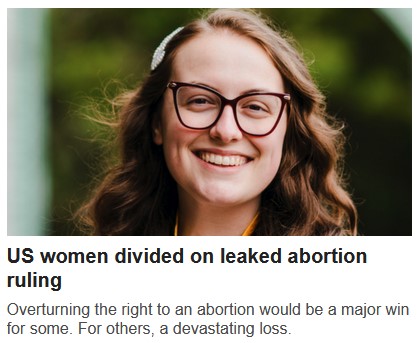
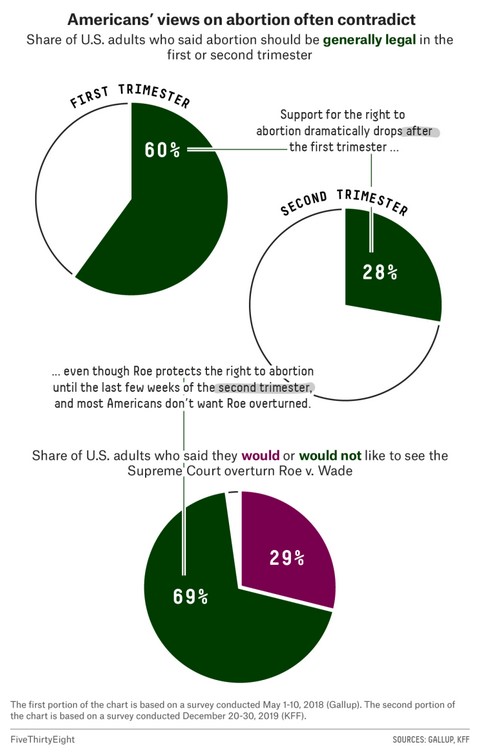
Some people, far from a majority of “The People”, would like to see the ‘other end’ of Roe v Wade.
‘These’ people seem to have somehow convinced a majority of the Justices sitting in the Supreme Court not only to hear their plea but also to ‘consider it in a favorable manner’.

In other words, a very small number of people – five out of nine, are going to restrict a previously granted right which had been enjoyed for almost 50 years by more than half of the American Population.

‘You have got it completely wrong!
Scotus isn’t going to prohibit abortion. Only the states can do that!’

Do you remember what the Civil War had been fought over?
Basically, the Confederates were claiming that individual states had the right to determine which people were to be considered ‘free’ while the ‘others’ kept maintaining that all people, regardless of their skin color, were free. That individual freedom was something which had to be determined at federal level, not by each ‘individual’ state.
Nowadays we have the very same thing. Some states claim it’s their ‘right’ to tell ‘their’ women whether, and in which circumstances, they may – or not, have an abortion.

Not a very ‘appealing’ proposition.
It opens the door for individual states claiming more and more ‘rights’ over their ‘specific subjects’.

The absolutely baffling thing about this whole development is the fact that those who want Roe v Wade to be repelled claim they do this in order to enhance individual rights (to live). I can understand that. I even sympathize with them. Ending a life, even that of an embryo, is not something to be treated easily.

But for a minority to impose their point of view – no matter how sound it might appear to some of us, to a majority… that cannot be, either, taken lightly.

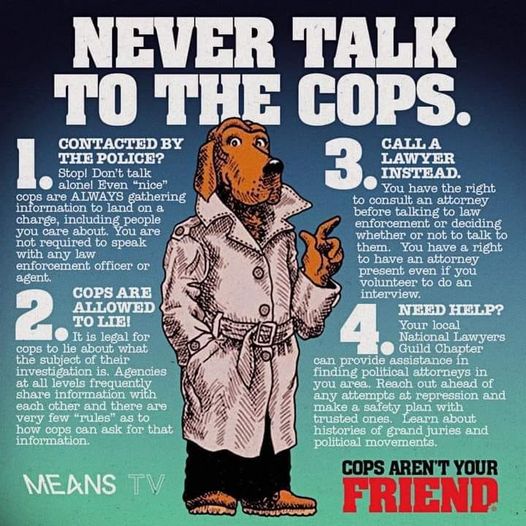
Just came across this meme.

It was shared on a FB-wall and somebody had commented that “Institutionally they are not your friends.”

My ‘jerked’ comment was:

“Institutionally, cops should be your ‘last resort’ friends.

The fact that too many of them are not, and the fact that too many of us consider them, as a category, to be unfriendly, is proof of how dysfunctional our society has become.

Cops used to be ‘unfriendly’ when I grew up. In communist Romania. When the cops were used, by the communist state, to preserve their power. The communist power over the entire society.

In the free countries of today, the cops are the sole barrier separating our persona and private property from the hands of the criminals.

Without their presence…

Or, putting it the other way around, we have but the cops we deserve. Train and motivate them properly and you’ll have good cops!”

At a second glance, I had an inkling.
Is it possible for the whole thing to be nothing more than a ‘marketing campaign’? Organized by the only people interested in increasing litigation?

Interested in altering the relative stability of our political establishment?

The police, by properly performing their duties – the world over, not only in the communist countries, contribute to the political stability of those respective countries.
For the police to properly perform their duties, there must to exist a proper trust between the general population and the police itself. The population must see the police as their friends of last resort while the police must see the general public as both their employer and their responsibility.
The population must be open in their relationship with the police while the police must treat respectfully every individual, including the suspects and the convicts.

In the communist regime I grew up, the police couldn’t fulfill its duties. Exactly between there was a ‘trust’ barrier between the general public and the police. Between the oppressed and the armed hand of the oppressor.
The communist regime I grew up under, in Romania, had eventually collapsed.
Exactly because of the malignant mistrust between the general public – The People, and the government. The police being nothing but a portion of the government itself.

Who is interested in the collapse of the democratic regimes?
Who is mostly interested in wedging apart the government from The People?

This is a stub.

‘This time is different’. https://www.economist.com/media/pdf/this-time-is-different-reinhart-e.pdf

History teaches us that each and every empire has collapsed. Usually under it’s own weight. Pareto has given us a valid explanation – each structure which doesn’t have to ‘refresh’ itself tends to become clogged with self serving individuals, near-sighted enough to ‘forget’ that none of them (none of us, actually) is able to survive ‘outside’. Yet each ’emperor’ allows themselves to believe that this time is different. I’m better than all my predecessors. And their followers allow this to happen, just as Pareto had taught us.

‘They is a rational operator hence they must have a reasonable objective’.
That’s how people raised/educated in a reasonable environment think/interpret the actions of other people.
This being the reason for democratically groomed leaders having such a hard time when they need to understand how dictators operate. This being the reason for democratically groomed political operators having such a hard time when it comes to identify skillful would be dictators.

https://www.journalofdemocracy.org/articles/russias-road-to-autocracy/

In physics, ‘temperature’ measures the intensity of the interaction between the elements which ‘inhabit’ a certain place.
The more energy exists in a certain place, the more intense the interaction. If the place is inhabited by a gas, each molecule is able to ‘travel’ a short distance before actually hitting one, or more, of its neighbors. If the place is occupied by a liquid, the molecules glide against each-other and if we speak about a solid, the components just shimmy together.
The more energy exists inside a place – the higher the temperature, the more intense the interaction between the individual components. And if, for whatever reason, ‘too much’ energy accumulates into a given space the interaction becomes intense enough for ‘change’ to happen. As temperature raises, solids melt, liquids boil and evaporate while gases become plasma.

Adding energy isn’t enough to determine change. Temperature might rise without anything noticeable to happen. Specially when we speak about liquids and solids. If enough outside pressure is applied, the liquid cannot start to boil and the solid stays in place.

Same thing when it comes to a society.
High output societies need a very intense social interaction to make things happen.
To make so many things happen at once… that being the reason for which those societies need to be democratic. Autocracies are too rigid, they cannot accommodate the continuous adjustments needed to ‘absorb’ the huge amount of ‘social change’ warranted by the amount of energy ebbing through the system.

One way to measure ‘social temperature’ – other than the ‘output’ of that society, is to gouge how vulnerable a society is when confronted with a highly infectious disease which is transmitted through direct contact. Cholera will sweep through an entire community which drinks from the same well, regardless of how much contact individual people have with each-other. Covid, and Ebola, need people to ‘touch’ each-other in order to jump from one to another.

But don’t forget to factor in ‘pressure’. And other things specific to each individual ‘place’.
Otherwise the analysis might produce less relevant results.

Until recently – historically speaking, people had two ideologies to choose from.

Conservative and liberal.

The conservatives used to posit ‘law’ as a ‘cage’ which didn’t allow any transgression while the liberals understood ‘law’ as an agreed upon environment which allowed people an individual but orderly pursuit of happiness.

The advent of Marx’s communism changed everything. His promotion of ‘class warfare’ as a legitimate political instrument had effectively muddled that which had previously been considered a clear choice.

After communism proved itself to be an abject failure, the naifs have forgotten about Marx.
Flying under the ideological radar, ‘class warfare’ has metastasized.

Nowadays, Regular Joe is confronted with three ideologies. And to make things worse, their names – attributed and/or assumed, are misleading.

We have a line of thought which uses (natural) ‘law’ as a line of defense against any kind of change. And as a means of bringing back the ‘better yesterday’.

Another line of thought which sees (man made) ‘law’ as an instrument to implement – forcefully, if needed, whatever the ‘implementer’ wants to achieve. One of the most often professed goals being ‘equality’. Close on its heels comes ‘diversity’.

And the ‘classical’ liberals who are squeezed between the previous two.

The state/government – whose job is to keep ‘the playing field’ level and functional, is paralyzed by the first two factions fighting to control it.
The ‘conservatives’ want to use the state/government as a ‘preserving agent’ for what they consider to be their (natural) ‘rights’.
The ‘progressives’ want to use the state/government as an instrument of (forceful, if needed) change towards what they consider to be ‘the common good’.

Meanwhile, the classical liberals – berated by both of the above, have a hard time explaining to a shrinking audience that the state/government is an extremely dangerous instrument if allowed to fall into the hands of ‘single-minded’ operators. That as soon as the freedom of the markets (the economic and, way more importantly, the ideatic ones) is curtailed, everything starts to go south. Fast!

Democracy and the free market have brought us so far.
The freedom of thought/expression and the freedom to act as an honest entrepreneur have been instrumental in us reaching the present state. With the goods and the bads in it.

Each instance in which the state/government had fallen prisoner in the hands of ‘men of state’ with ‘focused vision’, history started to run backwards.
No matter whether that ‘limited vision’ had been focused in the past or on “a certain” future.

Each time this subject comes about I remember about Francis Fukuyama’s The End of History.
About how concentrated he was on the future he considered to be forthcoming.
About how his ‘hard focus’ had prevented him from noticing the sunken part of the iceberg.

https://www.theguardian.com/world/2021/oct/10/texas-abortion-law-jonathan-f-mitchell-profile
https://www.marxists.org/archive/marx/works/download/pdf/Manifesto.pdf

Imagine an ‘outside observer’. From, say, Sirius.
Who had just arrived. Didn’t have enough time to become familiar with what’s going on here.

Thailand.
Ballots had been cast in November. A party had lost. And pretends, without proof, that the elections had been rigged.

“In his first public comments after the coup, Gen Hlaing sought to justify the takeover, saying the military was on the side of the people and would form a “true and disciplined democracy”.” GETTY IMAGES

When the parliament was about to be convened, and the electoral results formally confirmed, the backers of the loosing party – which had happened to be the army, declared martial law and annulled the electoral results. The leading general announced in public that the measure had been adopted in pursuit of a ‘real and disciplined democracy’.

The US.
Ballots had been cast in November. The looser pretended, without proof, that the elections had been rigged.

When the parliament was convened to certify the results, a mob had stormed the House of the Parliament, at the bidding of the loosing President. Order was finally restored and the dully elected President installed into office.

What would the ‘outside observer’ think about our planet? About us…

What if their job is to asses whether we should be allowed to roam the Galaxy?
To be entrusted with some very powerful technological ‘secrets’. Which would help us solve some of our very stringent problems. Feel free to name a few…

How do we vote?
For a candidate/party or against? Usually against the incumbent… Or against what we dislike…

What do we vote for? What do we expect?
Leadership or stewardship?
Do we expect our elected officials to take us by our collective hand and lead us through darkness or just want them to turn on the light?
To make it so that we may lead whatever lives we choose for ourselves ? For as long as we behave in a generally acceptable manner, of course…

Which brings us to ‘what democracy really is’ and ‘how can we make it work for real’?

First of all, let me point out that no democratic ‘arrangement’ had ever failed. For as long as it managed to maintain its democratic nature, of course….
Secondly, no authoritarian regime had survived for long. And most of them had fallen under their own weight rather than under outside pressure.

You see, even the ‘weakest’ democracies are way more adaptable than any authoritarian regime. The fact that anybody can voice their concerns sheds light on each problem, as it arises. The fact that all positions under the despot are filled with yes-sayers actually blinds all authoritarian regimes.
Furthermore, the fact that ‘we, the people’ has peaceful means to ‘fire’ those who do not rise to the occasion makes it possible for the society, as a whole, to survive ‘the event’. Even if the previous ‘decision maker’ could not find a way out. Faced with the same predicament, an authoritarian regime must first pass through a revolutionary transformation…

Then, if democratic regimes have such an evolutionary advantage compared to the authoritarian ones, why are we still confronted by so many dictatorships?

Because democracy demands something which is in short supply.
Mutual respect among all members of a given society!
Furthermore, democracy works only when the questions seeking answers are about the ‘how-s’ of the matter and not about the ‘what-s’.
A democratic society will remain democratic for only as long as its members continue to stick together. To have a common goal. To share a common weltanschauung.

As soon as a society allows itself to be divided into ‘parties’ promoting antagonistic interests its previously democratic arrangement will fade into ‘mob-rule’. Which is the ante-chamber of authoritarianism.

Just came across this story:

A king had 10 wild ferocious dogs.

He used them to torture and kill any minister that misguided him. A minister once gave an opinion which was wrong and which the king didn’t like at all. So he ordered that the minister to be thrown to the dogs. The minister said “I have served you loyally for 10 years and you do this?”

The king was unrelenting.

Minister pleaded “Please give me 10 days before you throw me to the dogs”.

The king agreed. In those 10 days the minister went to the keeper of the dogs and told him he wanted to serve the dogs for the next 10 days.

The guard was baffled, but he agreed. So the minister started feeding the dogs, caring for them, washing them, providing all sorts of comfort for them.

When the 10 days were up the king ordered that the minister be thrown to the dogs as sentenced. When he was thrown in, everyone was amazed at what they saw. The dogs were wagging their tails playing with the condemned minister, licking his feet.

The king was baffled at what he saw.

“What happened to the dogs?!” he growled.

The minister then said “I served the dogs for only 10 days and they didn’t forget my service. I served you for 10 years and you forgot all at the first mistake!”

The King realised his mistake and replaced the dogs with crocodiles!

As soon as I finished reading, I started to wonder…

Who, in their right minds, would accept to work for such an ’employer’?
After all, sooner rather than later, everybody makes mistakes!
And if the penalty for the slightest mistake is being thrown to a pack of wild dogs…

On the other hand, who – in their right minds, would treat their employees like that?
Given the fact that no right minded people would accept – as per my previous observation, to work under such ‘constraints’.

And, even more interesting, who – as an ‘owner’, would hire such a ‘manager’?

Two Republican senators are criticizing President Donald Trump and his team for their efforts to pressure state and local election officials to overturn President-elect Joe Biden’s victories in several closely contested states.

Sen. Mitt Romney, R-Utah, one of Trump’s most vocal GOP critics, tweeted Thursday, “It is difficult to imagine a worse, more undemocratic action by a sitting American President.”

Romney accused Trump on resorting to “overt pressure on state and local officials to subvert the will of the people and overturn the election.”

Sen. Ben Sasse, R-Neb., went after Trump lawyer Rudy Giuliani, who held a press conference Thursday presenting a list of far-fetched, thoroughly debunked claims on the 2020 election.

Sasse tweeted: “Rudy and his buddies should not pressure electors to ignore their certification obligations under the statute. We are a nation of laws, not tweets.”

Given what’s currently going on in the most powerful democracy on Earth, it becomes obvious why Putin had helped Trump’s 2016 campaign to become POTUS.
Remember Ulises’s Trojan horse?
OK, it’s impossible to know for sure whether Trump and Putin actually ‘negotiated’ anything.
The point being that for a seasoned judge of people Trump behaving like an elephant in a china shop after being sworn in office was a no-brainer.
Putin could not know exactly what Trump was going to do. But he was certain that it would not end well…. For America!

Now, that Trump is throwing democracy to the dogs simply because the process didn’t end up the way he wanted, Putin must be gloating in front of the biggest mirror in Kremlin!

Weapons are nothing but repurposed tools. Sometimes ‘enhanced’ to fit the new goal.

Clubs had started as fruit harvesting utensils, then used for hunting purposes and eventually for bashing in the heads of those who had slept with the missus when the wielders weren’t looking. And so on…

As a tool, an implement is used to ‘put things together’. As a weapon, the same (kind of) implement is used to ‘set things apart’. An axe can be used to split wood in order to build a fire or to ‘split’ furniture during a fit of rage.
Generally speaking, a tool is used towards the ultimate goal of adding to/fine tuning a structure while a weapon is used to destroy/disable something which is meant to remain so.

Our ability to communicate was ‘the’ tool which actually transformed us into what we are today. Humans.
At least according to Humberto Maturana. His theory maintains that we’ve become self-aware social individuals through what he calls languaging.
In a nut-shell, he says that we’ve become humans – self conscious apes, by continuously expressing our thoughts towards the other members of the community. Hence simultaneously building an ‘agora’ and ‘walling in’ individual private spaces.

Yet the same ability to communicate can be used also as a weapon.
Instead of being used by individuals to mutually groom themselves, and ultimately adding to the overall resilience of the community, ‘weaponized’ communication is used to ‘downgrade’ susceptible individuals.
To lower the ability of certain individuals to contribute to the community to which they belong, to lower the ability of entire communities to hold together… or both at the same time.

History suggests that, in the longer run, democracy – as a manner of decision making, increases the survivability of the communities which use it. Simply by pooling the decision making resources of the entire community instead of relying on the mental prowess – and good will, of a single authoritarian leader.
Only for democracy to be fully functional, the individual members of the community have to be able to share, in earnest, their thoughts.
This is why Freedom of Speech has been enshrined in the First Amendment.
That’s why whenever the public discourse becomes increasingly dominated by ‘fake-news’ things start to go south.

That is why whenever people allow themselves to be split into warring parties – with no real communication between the sides except for the misinformation hurled across the divide, both sides eventually end up wondering at the destruction they had allowed the ‘communication warriors’ to inflict upon them.

As a species, I mean…

We’ve ‘invented’ mutual respect.
Based on it, we created the two institutions which allowed us to get where we are now. Democracy and free market capitalism.

I’ll make a short detour for those who are not ‘convinced’.

Democracy, the functional kind, starts from the premise that it is impossible for an individual to know everything. And that together we know much more than each of us. This being the reason for any democratic process starting with an intense discussion. Whoever has something to say, takes the stand and whoever is interested in the well being of the community pays attention. To learn where to cast their votes.

Free market capitalism starts, too, from the premise that it is impossible for an individual to know everything. That nobody, be it an individual or a group of people, might be smart enough to call all the economic shots needed for entire society to ‘feed itself’ on the long run.

These two fundamental institutions operate on the basis of mutual respect between those who live within them. The people exchange ideas and goods on the principle that the transactions are done voluntarily and in good faith. That deception is just an exception.

These two institutions made it possible for us to cooperate into building the present reality. We have developed enough technology that we are able to produce enough food for everybody.
We went to the moon
We have enough weapons to destroy the entire planet.
Each of us can communicate, almost instantly, with almost anyone on the planet.

And? What do we do in these conditions?
Although there still are many of us who are starving, we throw away food. For various reasons.
Most satellites are used (and) for military purposes.
Although we could not have ‘arrived’ if we hadn’t ‘invented’ mutual respect, we currently use information technology mainly to spread fake news and ‘consume’ pornography.

Is this really okay?
How much longer is this going to last?