Archives for posts with tag: authoritarianism

Unfortunately, it was a ‘deep critical thinker’ who had come up with this idea in the first place.
That ‘if you want to control, you need to isolate the intellectual’.

A ‘plain-clothes man’ doesn’t think in these therms!

Let me rephrase the whole thing.

I am rational.
Which means that all my conclusions are valid. Simply because I have reached them in a rational manner.
Hence all other conclusions are wrong. For the simple reason that they are different from mine.
Since they are wrong, they should not reach their audience.
For they might displace my conclusions from the public mind!
Which brings me to the conclusion that if I want to conserve my position – as the official thinker – I must make it so that all other intellectuals must be isolated from the public.
Only I need to dress up this conclusion as if it was about the greater public good.

And this is why Protagoras of Abdera and Socrates had been banished from the forum.
Why Plato maintained that before being allowed to rule the philosopher-kings had to be specially trained for the mission. Taught to keep an open mind towards alternatives!
Why Marxism, Fascism and all other authoritarian lines of thinking lead those who pursue them into the same dead-end. Into abject failure…

Behold, the man has become as one of Us,
to know good and evil.
And now,
lest he put forth his hand and take also of the tree of life,
and eat and live for ever:
Therefore the Lord God sent him forth from the garden of Eden,

to till the ground from whence he was taken.

Tradition is a collection of knowledge. Which has been agglutinating in time and is used as a ‘benchmark’ by the currently living keepers of the relevant tradition.
‘Relevant’ in the sense that not everything which is still remembered continues to be useful.

Functionally speaking, tradition is both a filter we use to interpret the reality and a guide we use when shaping future action. And we use it simply because the alternative would be to start from scratch whenever we see anything or have to do something. Like a child learning to walk and speak.
Like a child who keeps saying ‘what is this and why do I have to…’
We get many of those answers from the traditions passed over by our ancestors. Without these traditions we would be like a lonely child. A collective child who keeps asking for direction but who gets no answer. Because there’s no one around to answer…

Ideology is also a collection of knowledge. Which has been put together, edited or both at the same time by an ideologue. Or group of ideologues.
Psychologically speaking, ideology and tradition work in the same way. Both as a filter used when interpreting reality and as a guide for future action.

But there are some differences.

Tradition has been vetted by evolution.
Individual traditions have evolved themselves. No modern Jew would ever consider stoning to death “a woman who had been caught in adultery”. Even if this used to be the biblical standard punishment for such a transgression…
Some traditions have disappeared altogether. Because, at some point, they had ceased to be relevant. Their teachings were no longer helpful… At some point, those who were living in those traditions had understood, one way or another, that their particular tradition was suggesting an interpretation of reality which was … wrong! So wrong/useless that the entire tradition had to be abandoned. Like the Egyptian pyramids.
Other traditions are still alive today. Because at least parts of them continue to be relevant for those who keep them. “And God said, Let us make man in our image, after our likeness: and let them have dominion over the fish of the sea, and over the fowl of the air, and over the cattle, and over all the earth, and over every creeping thing that creepeth upon the earth”.

In fact, what we call ‘modern civilization’ is based entirely upon this particular piece of tradition.
We’ve built it together, as children of the same father. We’ve been building it under the authority of the said father, who had given us dominion over everything which was moving under the sun. And the fact that we considered ourselves to be the children of the same father – siblings, hence equals – has given birth to the very notion of human rights.

Ideology, on the other hand, is still fresh. Some of it might make it, some of it might break us.

The bible itself has been nothing more but a piece of ideology. When it was written…
The fact that those who had been inspired by the bible have survived, as a flock, for so long is a strong suggestion that the biblical tradition has been useful. That, overall, the suggestions derived by the ‘keepers’ from this particular tradition have helped them in their quest.

Other ideologies have been less successful…

Communism, for instance.
On the face of it, the communist ideology is a continuation of the christian tradition. People are to be considered equals, resources are to be shared among the members of the community… what more can you wish?
Well, it didn’t work out that way. It actually failed. Abysmally. I know, I’ve been there myself.

I’m not going to delve into why some ideologies work – and live to become traditions – while others fail.
I’m not God, I don’t know everything.
What is plainly visible, for those who want to see, is that authoritarianism – under any ideological pretext – is doomed to fail. This being the reason for which God – or the wise guy who wrote that passage – had banned Man from the garden of Eden. An immortal man would stick to his convictions until it would be too late. Until the heaven would had fallen upon his shoulders….

I cannot end this before sharing with you what prompted me to write it.
The goal of Hamas – ideologically shaped and ideologically imposed upon its followers, regardless of any of the circumstances – is to destroy the state of Israel and to replace it with an islamic state. Is there a ‘promise’ about how people will live once that islamic state would be imposed? Except that they will have to obey?
The goal stated by the communist ideology was equality! Not people’s happiness or anything like that. The way to obtain that goal was a continuous revolution. A sort of jihad, if you will…
Now look at what Hamas has accomplished. At what Marx’s communists had accomplished…

Choose wisely.
‘Cause each of us is born into a tradition. Into a particular tradition…
But ideology is something that each of us chooses. And can give up!

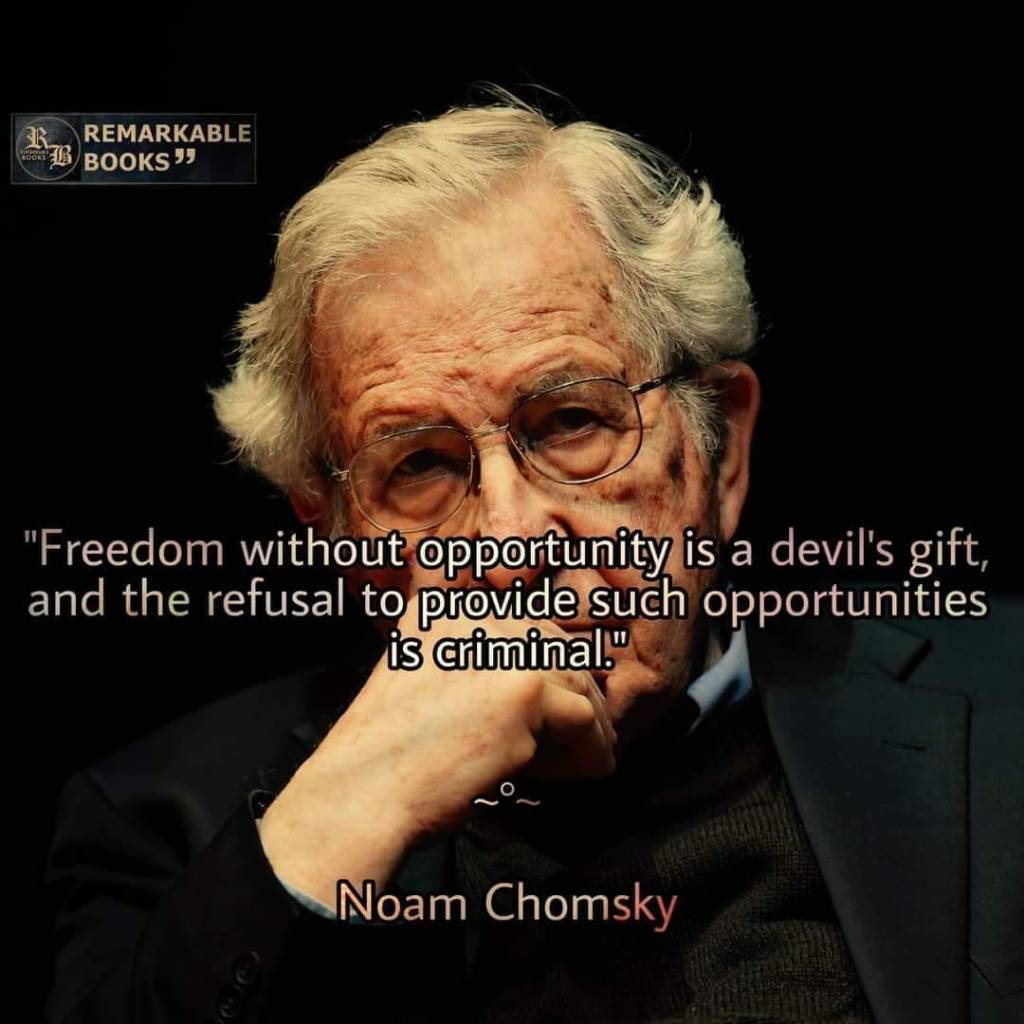
As usual, Chomsky is only half-right.
Opportunities shouldn’t be provided. Period!
In fact, nobody should be able to control/provide sizable amounts of opportunity!

On the other hand, making it so that only a small number of people enjoy all the opportunities in the world is, indeed, criminal.
Unsustainable for the longer time frame, actually!

Does it really matter?

Both fascism and communism appear when enough people are fed up. Really fed up.
So fed up that they have become gullible enough to accept the lies promised by those who want to get ‘at the top’, in the given circumstances.
The difference between fascism and communism, the only one, being the exact conditions which had caused the ire of the people.
Communism can, and will presently be, presented as the only possible alternative to those confronted by a ‘black ceiling’.
Fascism, on the other hand, can, and will presently be, presented as the only possible alternative to those confronted by a ‘glass ceiling’.
The always poor who have no chance of improving their lot will accept the lies promised by the communists. They don’t know any better so they believe those lies are possible.
The impoverished who have no chance of returning to their former situation will accept the lies professed by the fascists. They know what they have lost and need to find a culprit to blame for what had happened.

In a sense you can identify fascism with the right and communism with the left.
In reality, fascism and communism are the two ugly faces of the same fake coin.

Can we do without it?
And if not, how much of it?

– If ‘no government’, then who would pay for the army we need to defend ourselves?

Ooops… you’ve just answered the ‘why does Russia ‘encourage’ the trolls who push ludicrous libertarian ideas’ question. Which trolls attempt to achieve two things at once. Weaken the concept of free government and give libertarian-ism a bad rep. Transforming libertarian-ism into yet another form of extremism.

Let’s get serious and try to find an answer to ‘why, and how much of it, do we need government?’

The boring one would be: ‘Whenever one government falls, another one takes over. The interregnum is always bad so… let’s get used to it’.

‘Getting used to it’ works only for very short expanses of time. Left on its own, all ‘government’ becomes sloppy. So sloppy that it soon becomes such a burden that even the most ‘used to it’ lose their patience.
Government, all of them, need to be kept on a tight leash. Otherwise it will soon cease to perform as intended.

– But if you have to keep it on a tight leash, why bother with any in the first place?
Can’t we do without such a bothersome pet?
What’s the point of the whole thing, anyway?

Instinctively, we’re against ‘government’ for two reasons.
It costs us a lot and it used to represent the interests of the ruler.

Until 10 000 or so years ago, we didn’t need ‘government’.
People were living more or less like the modern day Sun People still do. In the Kalahari desert… small bands roam the place, living of the land. The bands are small – so that they might find sustenance, they don’t have any ‘private’ property to protect, hence they don’t need government. Neither did our ancestors.

As soon as people ‘invented’ agriculture – raising ‘tame’ animals at first and working the land soon after, things had changed dramatically.
The advent of agriculture brought two things. An increased productivity and private property.
Soil has not been born equal. Both pastures and arable land can be good, passable or bad. People wish to have the best. Those who already have it are willing to defend it and those who don’t are willing to steal it.
Increased productivity means that those who produce are able to hire people to protect their ‘means of production’. Their property. As a consequence of fighting for it, some people accumulate more and more of it.
More and more ‘means of productions’ – property, means an ever increasing need for ‘management’ and an ever increasing need for ‘protection’. Soon you have a very ‘wealthy’ owner – the lord of the place, call it what you like or use the name given to him by his subjects, the people who perform the day to day management of the ‘whole-sale property’ and those who protect it from ‘marauders’. Both the ‘managers’ – read ‘government’, and the ‘protectors’ – read ‘army’, used to be under the direct supervision of the local lord.
For a while – for as long as the lord kept everything in balance, everybody was happy. The ‘peasants’ were happy because thy were safe, the ‘managers’ were happy because the wise lord used to appreciate their work and ‘compensated’ them accordingly, the ‘protectors’ were happy because they were well fed and taken care of. According to this article, the great Egyptian had been built by willing people, not by slaves.
https://www.harvardmagazine.com/2003/07/who-built-the-pyramids-html
But soon enough, the lord had become estranged from his people. Government had become an instrument used to extract more and more wealth from the peasants while the army was used to protect the government against the people and, whenever possible, to increase the property of the ruling lord by stealing some from the neighboring ‘lords’. The ’empire’ was born.

But this development could take place only in certain circumstances. Where those below the ruling lord had nothing more to do than to obey. Where the best subject was the disciplined one. Where autonomous thinking and imagination were frown upon by the ruler. Where one mind was enough.
Whenever the ‘environment’ mandated the individuals to remain relatively autonomous, proto-democratic forms of self government had been experimented. From the nomadic pastoralists of the Central Asia to the sailing communities in Ancient Greece and Medieval Scandinavia. Those driving herds or sailing ships need to be a lot more independent-minded that those who just tile the earth. No offense intended here! Simple observation will notice that where the geography of the place had allowed it, somebody had ‘built’ an empire. The Nile Valley, the Middle East, the Russian plain, China, Mexico…
Where ever the geography of the place was fragmented enough by sail-able sea, proto-democratic forms of self-management had been developed. The sailing Ancient Athens versus the land-locked Sparta, Medieval Scandinavia versus Medieval France…

Fast forward to present day.
When we have two forms of government.
The more or less democratic ones. Those under whose ‘guidance’ discussions like the present one can happen.
And the more or less authoritarian ones. Which actively discourage autonomous thinking.

Mind you, there are no ‘perfect’ governments.
There’s no perfectly democratic arrangement anywhere on Earth. Because we are imperfect human beings.
And there’s no ‘perfect’ authoritarian government. Because no government can survive for long if it attempts to centralize the decision power. The closer a government gets to being perfectly authoritarian, the smaller is the crisis needed to topple it. Unless it is supported from the out-side but that’s another topic.

So. It is fairly simple to understand how authoritarian governments fail. Too much ‘stiffness’ makes it impossible for authoritarian governments to evolve. To find solutions for whatever challenges pop up constantly.

But what can go wrong with the collective forms of self-rule? With the participative forms of social self management? Otherwise known as democracies?
Lack of enough popular involvement. Due to a sense of apparent safety, initially. And to a feeling of apparent impotence, soon after.
Lack of enough fore-sight. Those who should know better become distracted, for whatever reasons.
Too much opportunism. More and more of the ‘insiders’ use ‘the power of the government’ to fulfill their own, private, goals instead of making sure that ‘government’ works properly.

And what does that mean?

A government works properly when the community which self manages itself using that particular (form of democratic) government survives in the long run.
When those momentarily working inside the government make things happen for the community at large.
When people, both inside and outside the government, follow, in spirit, Kennedy’s words.

Am I being naive?
Maybe… But wouldn’t it be a nice thing to have?
A nice thing to chase, anyway?

And what better way to chase ‘it’ than voting for people who at least pretend to be honest? Who at least make the ‘right’ noises? Whom we can hold accountable whenever they break their promises?
Instead of voting for those who promise barrels and barrels of ‘pork‘?
https://grammarist.com/idiom/pork-barrel/

Ideological pork or hands-on pork, I don’t know which is worse…

How do we vote?
For a candidate/party or against? Usually against the incumbent… Or against what we dislike…

What do we vote for? What do we expect?
Leadership or stewardship?
Do we expect our elected officials to take us by our collective hand and lead us through darkness or just want them to turn on the light?
To make it so that we may lead whatever lives we choose for ourselves ? For as long as we behave in a generally acceptable manner, of course…

Which brings us to ‘what democracy really is’ and ‘how can we make it work for real’?

First of all, let me point out that no democratic ‘arrangement’ had ever failed. For as long as it managed to maintain its democratic nature, of course….
Secondly, no authoritarian regime had survived for long. And most of them had fallen under their own weight rather than under outside pressure.

You see, even the ‘weakest’ democracies are way more adaptable than any authoritarian regime. The fact that anybody can voice their concerns sheds light on each problem, as it arises. The fact that all positions under the despot are filled with yes-sayers actually blinds all authoritarian regimes.
Furthermore, the fact that ‘we, the people’ has peaceful means to ‘fire’ those who do not rise to the occasion makes it possible for the society, as a whole, to survive ‘the event’. Even if the previous ‘decision maker’ could not find a way out. Faced with the same predicament, an authoritarian regime must first pass through a revolutionary transformation…

Then, if democratic regimes have such an evolutionary advantage compared to the authoritarian ones, why are we still confronted by so many dictatorships?

Because democracy demands something which is in short supply.
Mutual respect among all members of a given society!
Furthermore, democracy works only when the questions seeking answers are about the ‘how-s’ of the matter and not about the ‘what-s’.
A democratic society will remain democratic for only as long as its members continue to stick together. To have a common goal. To share a common weltanschauung.

As soon as a society allows itself to be divided into ‘parties’ promoting antagonistic interests its previously democratic arrangement will fade into ‘mob-rule’. Which is the ante-chamber of authoritarianism.

Liberty is freedom from being constricted, in any way, shape or form. Period.

Liberty is more of an adjective rather than a verb. A situation more than an action.

Liberty can be attached to a space, to an agent or to both.

A free space would be a space where no constriction may occur, whatsoever.
A free agent would be an individual entity outside any constriction, whatsoever.

Mathematically, both definitions are possible.
Philosophically, both definitions are imaginable. By philosophers, of course.

Oscar Hoffman, a Teacher, kept telling us, his students, “For a proposition to be true it is not enough for it to be logically correct. It also has to make ontological sense. For those of you who don’t remember what ontological means, a true proposition must describe something which has to be at least possible”

In the real world, where there is no such thing as absolute freedom, liberty has to be first noticed/invented. And then constantly negotiated.

‘No such thing as absolute freedom?!? But liberty is a (God given) (human) right!!!’

Do you remember what Hoffman had (just) said about things which can exist in practice and things which can exist only in our minds?
Liberty might be a right – for those who enjoy it, but that doesn’t mean that everybody has it. And, even more important, that there is – or ever will be, something even close to absolute liberty.
If you don’t believe me, try to fly off a balcony without any ‘mechanical’ help. Or stop eating for a day or two. The Earth will surely ‘constrict’ you back towards its center and your stomach will certainly constrict itself for lack of food. And both Earth and stomach will constrict you back to reality.

‘OK, so no absolute freedom for individuals. How about ‘free spaces’?’
‘As in spaces where no constriction, whatsoever, may be exercised?’
‘Yes.’
‘Well, that would be possible. If a space is completely empty… no constriction might be exercised in there, right? On the other hand, as soon as something, anything, populates that space, constrictions start to appear. For instance, since no two things can simultaneously exist in the very same place, the mere existence of a speck of dust in a whole stadium induces the restriction that no other speck of dust may exist in the very same spot. Sounds trivial, true, but this is it… No absolute freedom. Not for individual agents and nor for spaces.’

‘Then why are writing a post about ‘Free market’? Doesn’t make much sense, isn’t it?’

Let me finish with liberty before going any further.
I mentioned earlier that liberty must be first noticed and then negotiated.
You see, right or no right, liberty is, above all, a concept.
We’d first observed that a flying bird is freer that a crawling worm and bam!!! We realized that some of us were freer than the others. Then that freer groups/societies fared better than the more ‘stifled’ ones.
But only where liberty was more or less spread around, not concentrated in one hand. Dictatorships – where all liberty is concentrated at the top, are way more fragile than any democracy. I’ll come back to this.
Now, for the negotiation part.
‘Your freedom to swing your fist ends where my nose begins’. And vice-versa. Only this is rather incomplete.
Let me examine the situation where you are a person who likes to swing your fist. In the air, not with any aggressive intent, of course. So you were swinging your fist, after you had determined, in good faith, that there was no nose close enough to hurt. But what if I am a ‘nosy’ guy? ‘Nosy’ enough to bring my actual nose inside your reach? You having to restrict your swings – or to go somewhere else, isn’t a limitation of your freedom? An absolutely unnatural limitation of your freedom?
Has it become a little clearer? What I mean by negotiation when it comes to individual freedom?

OK, time has come for me to go to market. To the free market!

A market is a place. Obviously, right?
A place where people trade their wares. Because they have noticed that it is easier for each of them to do what each of them do better and then trade the results of their work instead of each of them providing everything for themselves. As in everything each of them needs. Or fancy.

Initially, markets were far from being free. First of all, supply was sorely limited. Transportation means were practically nonexistent so supply varied seasonally and was severely influenced by weather, soil and other similar factors. And, maybe even more importantly, supply was influenced by the sheer will of the most powerful ‘free agent’ who happened to be around. Or, more exactly, supply was heavily influenced by the whims of the most powerful free-agent who happened to be around.
Don’t believe me? Then consider the extreme famine experienced by the Bengalis in 1943. Or by the Romanians during the last years of Ceausescu’s reign.
Slowly, people have learned that freer markets tend to be a lot more stable than the less free. ‘Freer’ markets meaning freer from both exterior and interior limitations. For a market to become free(ish) the participants need to have a big enough pool of resources at their disposal and to be wise enough to organize themselves in a ‘free’ manner.

And what happens when at least one of the two conditions remains unfulfilled?
Time has taught us that while markets tend to be limited in space and that some of the participants tent to impose themselves over the rest there is one dimension where the liberty of the market is very hard to be limited. ‘Liberty’ here meaning that things tend to evolve more in their own terms rather than ‘according to plan’. Or according to anybody’s wishes.

Whenever the available resources dry up, the participants to the market move someplace else. Or die of starvation.
Whenever a market looses too much of its freedom – as in some agent controls too much of what is going on there, the market itself no longer functions properly. Whenever too many of the participants loose their ability to determine their fate/future they slowly become ‘sitting ducks’. Not as much easy to hunt down but actually unable to feed themselves.
And since hunger is the best teacher, they either learn to fight for their freedom or… die of starvation. Pol Pot’s Cambodia would be a good example, even if somewhat extreme. The fall of most communist regimes also makes a compelling case for what I have in mind.
Even more interesting, though, is what had happened to the American Automobile Industry. General Motors and Chrysler Corporation, once the dominant stars of the market – along with Ford, had to be rescued by the government. Quasi monopolistic positions tend to be bad for the monopolists also, not only for the rest of the market. Given enough time, true enough…

Reading this excellent article by James Poulter, BBC Three, I was reminded of Marx. Karl, not Groucho.

“The lower middle class, the small manufacturer, the shopkeeper, the artisan, the peasant, all these fight against the bourgeoisie, to save from extinction their existence as fractions of the middle class. They are therefore not revolutionary, but conservative. Nay more, they are reactionary, for they try to roll back the wheel of history. If by chance, they are revolutionary, they are only so in view of their impending transfer into the proletariat; they thus defend not their present, but their future interests, they desert their own standpoint to place themselves at that of the proletariat.”

 Karl Marx, Friedrich Engels, The Communist Manifesto, 1848.

The XX-th century had been torn apart by two totalitarian lines of thought. Communism and fascism/nazism.
The communists had backed their claims on Marx’s class struggle while the fascists/nazists had used a plethora of other authors as pretexts. Despite the differences, the results had been the same. Callous spin doctors had used popular discontent to get uncontested possession of the political levers. And kept playing with them until entire countries crumbled under their own weight.

But what was it that made some nations destroy themselves on the left side of the authoritarian spectrum while others have done the same thing but on the right side?

The nature of the popular discontent!

At any given point, the majority of the people living in a country might see itself as being in one of the following three situations:
– Leading a relatively comfortable life and having a decent perspective to improve its lot or at least to maintain its present status.
– Having always led a bad life and finding absolutely no perspective of improvement.
– Having led a relatively good life for a while, lost that status and finding no way to resume it.

According to Marx, the first situation would have necessarily led to the third and, eventually, to communism.
According to history, people living in the second situation had always been manipulated into communism while people struggling in the third have been led into fascism/nazism.

Meanwhile, people living in the first situation have remained there for as long as they maintained their social cohesion. But that will be the subject of another post.


Democracy works. Authoritarianism works too.

Athens, the Ancient version, had become the dominant power of the Ancient Greece as a democracy. Only the Parthenon was build under Pericle’s rule. And Pericle was, for all intents and purposes, a dictator.
Rome, the Ancient version, had build a huge empire. As a democracy. Then enlarged it some more. As a growingly authoritarian and eventually discretionary regime.

England had started as the most democratic kingdom in Europe. Building upon the democratic traditions developed by the Vikings, the barons had forced King John to sign Magna Charta Libertatum. Way back in 1215.
Meanwhile, France – England’s neighbor and long time competitor, had become the dominant power in Medieval Europe. As an increasingly absolutist monarchy.

At some point, the people living in the future United States of America had decided that they had enough. That they wanted to enjoy the same privilege as their British counterparts. “No taxation without representation”.  George III would have no such a thing so the US had been established as the first democratic modern state. And the most successful to date. By almost every measure.
Following on America’s foot steps, the French had their Revolution. After a very short – and very tumultuous, democratic stint, they had reverted to authoritarianism. And conquered almost all Europe, under the command of Napoleon Bonaparte the First. Only to be eventually defeated by a coalition led by the more democratic British empire.

On the other side of Eur-Asia, things had been more linear.

The Russian Empire was developed in fits and starts. When the dictating ruler knew what he was doing – Peter the Great, for instance, things went forward. When not…
India had been, for all but the last 70 years or so, a melting pot of feuding dictatorships. Yet had developed a fascinating culture and much of what we currently call science and technology. The numbers our computers crunch had been invented there. And the steel we use to build our cars
The Chinese Middle Kingdom had once been the most civilized country on Earth. Then had crumbled under the assault of the marauding already democratic Europeans… only to revive, like the famous Phoenix… and all these while remaining submissive to a succession of authoritarian regimes.
Japan is a story by herself. Never fully authoritarian and yet still ‘imperative’ in many ways even today, she had somehow managed to put up a relatively good show. But for the period when she had succumbed to the ‘charms’ of hard core dictatorship, of course.

Coming back to Europe, I have to note that in the last century the inevitable tension between democracy and authoritarianism has produced immense tragedy.
WWI was the consequence of the inflexibility inherent to the authoritarian regimes. The leaders of the Keiserlich und Koniglich Habsburgic Empire, the Deutches Reich and the Russian Empire were not able to solve their disputes otherwise than dragging the whole continent into a huge mess.
Which, unsolved, had given birth to a second, and more horrible, one.
To complicate things even more, the battle was not fraught between the democratic regimes and the authoritarians.

The relatively flat layout of most parliamentary chambers has induced in us the idea that society is linear. From left to right and backwards.
Also, the current almost ubiquitous existence of parliaments drove us to forget that until recently – historically speaking, of course, most societies have been punctiform. The sovereign king was the only one able/entitled to make any significant decision…

Meanwhile we are told by the political scientists that long term political stability can be achieved only through ‘checks and balances’. Meaning that the state has to be organized in such a way that nobody can get amass too much power.
Actually most modern states have an executive, a legislative body and a judiciary. Each of them performing their specific tasks while keeping a jealous eye on the other two.

The problem with long term political stability being that it is a very abstract goal while most people just want to be happy. And are willing to go at considerable lengths in order to achieve their goals….

And it’s exactly here where ideologues start to argue among themselves

Some say that the individual is sacrosanct. That individual freedom is the most important value that is and the most fundamental ‘human right’.
Others say that society is more important than any individual. That all individuals should put themselves at the service of the society and that individual liberty pales when confronted with social necessity.
And a third category consider that democracy is a waste of time and of opportunity. That the best for any society is that a capable person/group of persons to be given absolute power over it. The rationale being that ‘the capable’ will take good care of their ‘property’. A far better kind of care than any group of bickering politicians would ever be able to offer….

On the practical side, those preoccupied with ‘freedom’ consider that the main duty of the state is to preserve/protect individual liberty. That people, once free, will know how to achieve their personal happiness.
The socially minded consider that individual happiness cannot exist before/outside the well being of the entire society. Hence the ‘rational citizen’ has to postpone (read forget) any personal goals and sublimate their own persona into the society.
‘The more capable than the rest’ consider that the ‘incapable’ cannot be trusted with defining their own goals and have to be told what to do. For their own good!

It is very easy to observe that none of the three ‘ideal types’ described above doesn’t work on its own. That each have been experimented and found to be ‘unpractical’, to say the least.

Individual absolute freedom exists. The Saan living in the Kalahari desert and the  Baka in the Cameroon don’t have any formal rules, no social hierarchy and are absolutely free to do as they please. Both have been easily overcome, their habitat is being encroached/destroyed by their ‘neighbors’ and have been able to survive only by going further and further away from anything.
Socially minded people have, time and time again, congregated. Only to witness their communities dissolve or develop malignantly. From the early christian settlements to the XiX-th century phalansters.
The ‘know better’ is, apparently at least, the most successful arrangement. All kingdoms and empires have been organized according to this principle.
And all of them eventually failed. Even Plato’s idea of ‘king priests’ has led to Alexander the Great’s ultimately disastrous campaign into the Middle East. Not to mention the fact that the erstwhile mighty Athens had fallen into anonymity just after starting to be governed by specially trained rulers.

Since the pure ideal types didn’t work, let’s see what we get if we combine them.

Since I’ve been experimenting it for the first 30 years of my life, I’ll start with the result of crossing ‘social minded’ with ‘know better’. Does ‘communism’ ring any bells with you?
Let’s cross ‘liberty’ with ‘know better’. Actually this has already been done. It was about liberty for those who knew better… Nazism, and its newer variants, are the first examples which come to mind.
And the most interesting result comes from crossing freedom with social minded. This has also been experimented. In the democratic Ancient Athens and in during the truly Republican phase of the Roman Empire. The same combination was used by the vikings and somehow perpetuated to this day. Its offshoots being the western style democracy.

Which democracy – just like the Roman Empire, will survive for only as long as it will conserve both individual freedom and social mindedness while allowing, but only when needed, the ‘know better’ to take over for the short periods of time when their presence at the helm is absolutely necessary.