Cautand pe net o fotografie cu care sa ilustrez postarea de astazi am constatat – multumesc Politica Ridicola – ca acest leit-motiv este vechi de cel putin 3 ani.

Las la o parte orientarea politica a blogului de unde am imprumutat fotografia, analiza pe care o face fenomenului ramane in picioare.

Numai ca eu voiam sa ating o alta latura fata de cea tratata acolo, si pe care va invit calduros sa o cititi.

Intrebarea pe care mi-o pun eu este: ‘OK, ne-am prins! Si acum ce facem?’

Avem, ipotetic vorbind, mai multe variante.

– ‘Aruncam copilul odata cu apa din cada’ si renuntam, cu totul, la clasa politica. Lasam pe primul care pare mai de doamne-ajuta, sau care reuseste sa ne ia mintile, sa ia toata puterea si dupa aceea ne rugam de el sa ne dea si noua cate ‘un semn de mila mariei sale’. Am mai incercat chestia asta – chiar daca inconstient, pe vremea lui Iliescu? Si nu a iesit mai nasol decat a fost doar pentru ca Iliescu nu a fost chiar atat de eficient pe cat ar fi putut sa fie? Precum Alexander Lukashenko, de exemplu?
– ‘Alegem raul mai mic’? Pai nu asta am tot facut pana acum? Si uite unde am ajuns. Nu chiar atat de rau pe cat ar fi putut fi dar nici prea bine nu e.
– Sau intelegem o data ca democratia nu se rezuma doar la arunca, periodic, un petec de hartie intr-o urna si la astepta – de obicei zadarnic, ca cei alesi sa isi respecte promisiunile?

Pana nu vom pricepe ca democratia incepe de la a ne respecta in primul rand intre noi, astia de pe strada, cum sa le cerem celor de ‘sus’ sa ne respecte?
Abia dupa ce vom invata sa vorbim intre noi – adica sa ne si ascultam unul pe altul, nu doar sa strigam din ce in ce mai tare unul la celalalt, vom reusi sa ajungem la o concluzie. Adica la niste pretentii minime pe care sa cerem, politicos, ferm si pe termen foarte lung, tuturor celor care se ofera sa ne conduca.
Si daca tot am vorbit despre respect reciproc, este greu sa impunem conducatorilor nostri – care, pana la urma, sunt un fel de administratori pe care ii angajam noi sa aibe grija de casa noastra, Romania, respectarea acelui set de cerinte minime atata timp cat nu le respectam noi. Adica daca vrem ca ei sa nu mai fure atunci trebuie sa nu mai intoarcem capul cand vedem ceva dubios. Daca vrem sa nu mai ia spaga atunci, pur si simplu, trebuie sa incetam sa le-o mai oferim.

Si inca ceva. Nu vi se pare ca argumentele prezentate acum de cei care nu vor sa plece de la putere seamana ca doua picaturi de apa cu cele prezentate de cei care nu voiau sa plece acum trei ani? Ei bine, asta inseamna ca toti politicienii sunt, pana la urma, niste fiinte umane. Care actioneaza mai mult sau mai putin la fel.
Cu alte cuvinte foarte multi dintre ei vor lua spaga, daca le-o oferim.
Pe de alta parte sunt convins ca foarte multi dintre ei, probabil o majoritate covarsitoare, vor invata sa se adapteze si dupa ce vom intoarce foaia. Ba chiar, in noua situatie, vor intra in politica si foarte multi dintre cei care au stat deoparte scarbiti de ceea ce se intampla acolo.

Numai ca respectul mai inseamna ceva. Nu poti cere cuiva servicii de lux si sa-l platesti ca pe un om de duzina. Am tot respectul pentru oamenii obisnuiti dar daca vrei sa angajezi pe cineva de top trebuie sa ii oferi o remuneratie mare, chiar daca sunt unii care se vor supara pe chestia asta. Sau sa te astepti ca la un moment dat cel care accepta o leafa incredibil de mica sa isi ia singur ceea ce crede el ca i se cuvine.

Am sa vorbesc la concret. Primarul Bucurestiului – nu ma intereseaza persoane ci functii – are un venit anual, impozabil, de aproximativ 24 000 de Euro si gestioneaza un buget de un miliard. Tot de Euro. Cu alte cuvinte ii cerem cuiva sa gestioneze un buget de ‘multinationala’ pentru o leafa de lower middle management. O fi rezonabil din partea noastra? Si, avand in vedere ca lefurile subordonatilor sunt in functie de leafa sefilor, ajungem ca directorii din primaria mare sa aiba niste venituri de-a dreptul derizorii pentru raspunderile pe care le au.

Da, stiu ca pentru un om de pe strada 24 000 de mii de euro pe an este o suma enorma. Mai stiu si ca fiecare ne gandim ca lefurile astea sunt acoperite din taxele pe care le platim noi. Asa ca va propun un exercitiu de imaginatie. Ce-ar fi sa ne gandim cam ce economie am face daca in loc sa aruncam o gramada de bani pe borduri supraevaluate si schimbate din doi in doi ani – nici macar nu voi face vreo aluzie la motivele pentru care se tot schimba acesta borduri, vom oferi lefuri rezonabile celor care ocupa pozitii de raspundere in administratia locala?
Si asa mai departe in intreaga administratie de stat.

Pana nu demult teoria era ca nu are rost sa fie marite lefurile medicilor pentru ca oricum iau spaga. Sau pe cele ale profesorilor pentru ca dau meditatii.
Acum vreo 8 ani a venit unul, nu dau nume, persoana importanta aflata pe vremea aia in fruntea statului, care a spus ca este cazul ca veniturile politicienilor si ale functionarilor de stat sa fie micsorate – pentru ca era criza. Dupa aceea a inchis o gramada de spitale tot pe caz de criza. In schimb a pus sa fie construite terenuri de sport in panta si instalatii de tele-ski la care nu se poate ajunge pentru ca nu sunt drumuri pana acolo.

Acum jumatate dintre medici au plecat in tarile calde. Jumatate dintre absolventii de liceu nu iau bacul. Unii nici macar nu se duc sa il dea. Iar oamenii au ajuns sa strige in piata publica ‘toate partidele, aceiasi mizerie’.

Da, este foarte multa mizerie in jurul nostru. Ar fi cazul sa ne apucam sa facem curatenie. Cu atentie totusi. Sa nu cumva ca luati de val sa aruncam si lucrurile bune pe care le-am agonisit.

Am mentionat in postarea trecuta modul in care pozitia geografica in care s-a intamplat sa traim a constituit cadrul in care a aparut si s-a dezvoltat ceea ce Mihai Eminescu a denumit ‘selectie negativa’.

Simplul fapt ca jocul ‘geopoliticii’ a facut ca marea majoritate a conducatorilor din acest spatiu sa fie schimbati sub imperiul unor forte exterioare acestuia si fara ca ceea ce se intampla in interior sa aiba mare influenta asupra destinului suportat de locuitori a generat aparitia unei stari de spirit descrisa foarte bine de ‘capul plecat, sabia nu-l taie’ si ‘te faci frate cu dracu’ pana treci puntea’.
Conducatorii isi vedeau de treburile lor, isi angajau/numeau in posturi cheie tot felul de ciraci si rubedenii fara sa tina cont de ce erau acestia in stare sa faca cu adevarat ci doar in functie de cat de loiali erau fata de cel care i-a numit. Adica exact ce descria Eminescu atat de plastic prin ‘selectie negativa’.
In acelasi timp marea masa a dezvoltat ceva care s-ar putea numi ‘strategie de supravietuire’: “zi ca el si fa ca tine”. Adica, pe de o parte, un dispret total fata de ‘clasa superpusa’ dar, in acelasi timp, un fel de resemnare, ‘n-ai ce dracu sa le faci, trebuie cumva sa te descurci fara ca ei sa bage de seama’.

Acest sistem a functionat, de bine de rau, atata vreme cat conducatorii erau inca ‘cenzurati’ de ceva/cineva. Cand treaba se imputea prea tare se mai ducea cineva cu cate o ‘jalba in protap’ la Marea Poarta, la Viana… si ocupantul, preocupat pana la urma de stabilitatea domeniului de unde primea tribut, mai trimetea cate un basbuzuc sau macar cate o mustrare.
De cand am devenit independenti insa, sistemul a inceput sa isi arate coltii. Scandaluri de coruptie care au afectat pana si Casa Regala inainte de primul razboi mondial, dictatura regala inainte de cel de al doilea, cel mai idiot dictator comunist in afara de Stalin, Pol Pot si dinastia Kim…

Ei bine, se pare ca intrarea in UE a inceput sa produca roade.
Insistenta lor ca legile sa fie respectate si in spiritul lor, nu doar de fatada, a inceput sa produca ceva rezultate.
Numai ca si mai mari rezultate sunt cele produse de faptul ca romanii au inceput sa umble prin lume si sa vada cum merg lucrurile prin alte parti.
Foarte multi dintre cei protesteaza zilele astea au fost pe afara sau/si lucreaza pentru companii private.
Dupa ce ai vazut cum arata normalitatea nu ai cum sa nu iti doresti si pentru tine asa ceva.

Tocmai de asta spun ca pentru a rezolva problema coruptiei trebuie sa ne uitam, cu mare atentie, la numere.
Nu vom putea depasi aceasta situatie pana cand cei care inteleg fenomenul si isi doresc, cu putere, sa il schimbe nu vor constitui o majoritate confortabila.

Pentru a ajunge pana acolo mai trebuie sa examinam cateva seturi de date.
Primarul Bucurestiului – buget de un miliard de Euro anual, adica 1 000 000 000 – are leafa de 24 de mii de Euro pe an.
Ce presedinte de corporatie cu cifra de afaceri de un miliard s-ar duce la munca pentru un asemenea salariu?
Avem 500 si ceva de parlamentari pe care ii platim cu cate 5 000 de lei pe luna.
‘Pai da, dar mai au o gramada de bani pentru biroul teritorial si pentru cazare, isi mai iau si de acolo’.
Vedeti?
Exact asta spuneam si eu. Atitudinea noastra este extrem de ambivalenta. Ni se pare firesc sa ii platim prost pentru ca ei oricum fura.
N-ar fi mai bine sa ii platim rezonabil de bine si apoi sa nu-i mai lasam sa fure?

Nu de alta dar in momentul acela vor intra in competitie pentru posturile astea si oameni care pana acum au stat deoparte tocmai pentru ca n-au vrut sa se manjeasca. Suficient de capabili incat sa castige bine in economia privata – acolo unde cel mult dadeau ei spaga, din partea firmelor pentru care lucrau, dar nu aveau nevoie sa primeasca.

V-as propune sa mai facem un calcul, Nu am suficiente date ca incep de undeva dar hai sa ne imaginam cat se pierde in economie din cauza coruptiei. Ce inseamna atunci cineva plateste un kilometru de sosea de doua ori mai mult decat face? Ce inseamna atunci cand un antreprenor trebuie sa dea un ‘para-ndarat’ de 10%? Ce evaziune face pentru a putea plati? Ce alte spagi mai trebuie sa dea pentru a nu fi prins? Ce costuri taie? Ce nu face cum trebuie?
Oare de asta trebuie refacute autostrazi de abia date in folosinta? Oare de asta circula acum trenurile de doua ori mai incet decat acum 20 de ani?

Nu cumva daca am plati preturile corecte – atat pentru kilometrul de autostrada cat si pentru munca primarilor, a medicilor, profesorilor si celorlalti bugetari – ar ajunge banii pentru toata lumea?

Bineinteles cu conditia ca taxele sa fie platite in mod corect. Adica de catre noi toti.
Dar daca cei de la stat nu ar mai lua spaga atunci cum ar mai putea privatii sa evite plata impozitelor?

E un fel de cerc vicios?
Intr-adevar.
Numai ca orice cerc vicios poate fi transformat foarte usor intr-unul virtuos.
Pur si simplu ne oprim, ne intoarcem cu 180 de grade si pornim din nou.

Ca la patinoar, cand eram mici. Si daca facem suficient de multi chestia asta ii vom lua si pe ceilalti cu noi.
De asta vorbeam la inceput despre numere. Tot ce trebuie sa facem este sa ne adunam suficient de multi atunci cand facem manevra.
‘Iesiti din casa, daca va pasa!’

coruptia ucide

Every 25 years or so Romania startles the rest of the world.

In 1989 we had to pass through the bloodiest Revolution in the Eastern Block in order to get rid of the most unreasonable communist dictator in Europe, bar Stalin of course.
In 2015 we had to be awaken by a disastrous fire in a night club to oust a prime minister who is currently under investigation for alleged corruption.

What’s going on here?

Some history first.

For the last 2000 years the Carpathian mountains have been the first obstacle that had to be negotiated by the migratory peoples that came to Europe from the depth of Asia.
Since for the first 1000 years on the plains where now lie Northern Poland and Northern Germany there was nothing to be plundered while the Northern shores of the Sea of Marmara were harboring a very rich city – Byzantium – most of those tribes transformed the area between the Carpathians and the Black Sea into a sort of highway. That’s why whatever forms of political structures the local population – the proto-Romanians – were trying to set had very short lives. They usually were fleeting fiefdoms run by chieftains from the migratory tribes whose authority survived only till the next, and more powerful, tribe arrived in the region.
After the huge Russian plains have been somewhat stabilized by the establishment of the Crimean Khanate the situation became even more complicated. The area was a battle ground for Bulgarians, Turks, Tartars, Hungarians and later Austrians and Russians. Besides the constant political instability this situation included the fact that very seldom the people who were in charge with running the place had a strong connection with the people they were leading. If any at all.
This had very insidious consequences, the most important being a huge distrust of authority. The present days libertarians would argue that this is a good thing… Well, think again.

If the people do not, not at all that is, trust those who happen to be in power and those in power do not care at all about those under their patronage you have the ‘perfect’ set of circumstances for the onset of an all pervasive corruption.

During the last five centuries the Western Europe has slowly evolved from Feudalism – the rule of he who happened to be powerful enough, tamed by some traditions inspired by religion, to what is now known as ‘The Rule of Law’. Meanwhile, in the European provinces occupied by the Ottoman Empire people lived in an almost schizophrenic manner. They passionately hated their rulers – and did their best to cheat them when ever they could, while developing a very strong respect for traditions, the only thing that kept the people together.
By the way, this is also the explanation for what has happened in the former Yugoslavia, where strong ethnic and religious allegiances were played upon by callous political adventurers.

This constant distrust/disdain between the rulers/administration and the general public has only deepened during the Soviet imposed communist rule and produced a real chasm between these two social strata. And it’s exactly this divide that is the reason for which all dictatorial regimes fail abysmally, sooner or later.
A convincing explanation for this was provided, long ago, by Pareto: ‘whenever the circulation of the elites (social mobility) is hindered, the society where this is happening is in great danger’.
Another way of explaining the unfailing demise of any dictatorship is corruption. When ever the rulers do not care about anything else but their very short term interests and the ruled do their best to cheat the system the corruption becomes so pervasive as to clog the entire social mechanism.

If left to itself this cancer can lead to implosion. The Roman Empire, for instance, didn’t fell because it was mortally wounded by the barbarous migrant tribes. It had became so weak because of wide spread corruption as to allow the barbarians to provide him with the fatal blow… Just consider what Caligula used to do for fun… The Soviet Empire did almost the same thing.
Now that I’ve reached this point I’ll have to remind you that corruption does not always have to be about money but covers all instances when people misuse, intentionally, their power.

You see, people make mistakes.
There is no way of avoiding this.
And the main difference between a corrupt society and one which is more or less ‘normal’ is that in a normal society he who notices a mistake has at his disposal enough means to report that mistake to the relevant authorities while having a decent chance to survive the attempts of the ‘perpetrator’ to ‘cover his tracks’.

The fire that started the current uprising in Romania was nothing but the final straw that broke the camel’s back. People have witnessed, individually, so many instances of corruption that had become fed up with it. But each of them wasn’t quite sure about what the guy next door was going to say/do about it. Meanwhile the authorities were more a part of the problem than providing a solution.

When this tragedy struck a lot of people have finally understood that this has to stop. And took their grief to the street.

Information is like bricks while knowledge is like buildings.
One can make his own bricks from the available mud and then proceed to build his own hut.
Inevitable all bricks made by man will have something in common – after all they are made from the same material, for the same purpose, by individuals belonging to the same species, but will also vary considerably – depending, among others, on the skills of the makers and on the quality of the available mud.
Inevitably the houses will also have something in common – again, they are made for the same broad purpose by individuals belonging to the same species – but they will vary more widely than the bricks do because they have to fulfill a wider selection of purposes in a variety of climates. (All bricks are made to be used as building blocks but buildings are used for many more purposes than simply sleeping in them.)
In conclusion information is something that was gleaned by an individual from his environment while knowledge is a patchwork put together by the same individual using the pieces of information he has acquired previously.
Also please note that while all information is gleaned using one’s senses this process can be a direct one – the senses probe the reality in a direct mode, the observer watches birds in his back yard, or it can be mediated by an information source – the passionate reads, using the ‘same’ eyes as the observer, a book about the same birds.
And any consideration about the difference between information and knowledge would be incomplete if we forget to mention ‘sensations’.
Which are nothing but the raw material – the mud, if you like – from where our brain extracts what we call ‘information’ – which, in its turn, will end up being attached, by the same brain, to the patchwork commonly known as knowledge.

Somebody shared a picture on FB and I finally understood the strange relationship between the American People and their Government.

“One of the things taken out of the curriculum was civics,” Zappa went on to explain. “Civics was a class that used to be required before you could graduate from high school. You were taught what was in the U.S. Constitution. And after all the student rebellions in the Sixties, civics was banished from the student curriculum and was replaced by something called social studies. Here we live in a country that has a fabulous constitution and all these guarantees, a contract between the citizens and the government – nobody knows what’s in it…And so, if you don’t know what your rights are, how can you stand up for them? And furthermore, if you don’t know what’s in the document, how can you care if someone is shredding it?”

The quote belongs to, obviously, Frank Zappa. I found it in an article written by Kevin Courrier and published in CriticsAtLarge.com.

What grabbed my attention was not the fact that a musician is so passionate about politics but the huge confusion that sits at the bottom of his political weltanschauung.
The American Constitution, any constitution for that matter, is not at all a contract between the government and the people but a contract that binds together the citizens that inhabit a country. The government, any government, is ulterior to the signing of that contract so it cannot be a part of that contract.

OK, I can understand how that confusion came to be only I cannot understand how it could survive for so long.
For more than two centuries, that is.
As we all know the US were, at first, British colonies. For the last nine centuries or so Britain was run more or less according to Magna Charta – which is indeed a sort of contract between the Monarchy and the British people. But that is valid for Britain. It is the Great Britain that traces its ‘essence’ back to the idea of a divinely sanctioned Monarch who owned, entirelly, the whole country and who autocratically ruled over all the aspects of its life. And that at a certain point in history the Monarch agreed to sign a contract with his subjects, promising to treat them fairly.

But at an ulterior point in the history of the British Empire the American people had decided that they didn’t want anymore to be subjected to any worldly authority so they had sent the British Governor packing. From there on the essence of the American state was no longer the persona of the Monarch but ‘We, the People’.

That’s why the American Government is, by right, nothing more than an employee of the American People while the British one is a servant – or an employee – of the Monarch.

Let me put it a little differently. America is like a huge corporation while the citizens are its shareholders. The people own the country and the Government who runs it is the Board of Trustees. The people are the employers and the members of the government are the employees.
In Britain the Monarch is the ‘owner’, the people are ‘tenants’ and the government is the administrator of the whole business. The government is employed by the owner and payed by the tenants – who have a say because they are paying the rent, otherwise known as ‘taxes’.

Then how come, two hundred years after the Constitution that settles the conditions of ‘incorporation’ was adopted so many Americans still see the Government as being different from the ‘people’? Could it be that Zappa is right? That too few people have understood that “this nation, under God, shall have a new birth of freedom—and that government of the people, by the people, for the people, shall not perish from the earth.”?

I know, I know… These words are not from the American Constitution – they are widely attributed to Lincoln. But they describe perfectly its spirit, even if some people accuse Lincoln for being a dictator – because he didn’t allow the South to seccede, as if this decision was his to make… You see, the confusion is deep indeed. When people are passionate about something they tend to pick up from the entire picture only the pixels that fit their view of the world…

“We the People of the United States, in Order to form a more perfect Union, establish Justice, insure domestic Tranquility, provide for the common defense, promote the general Welfare, and secure the Blessings of Liberty to ourselves and our Posterity, do ordain and establish this Constitution for the United States of America.”

Then why so many of the ‘we the people’ still believe that the constitution is a contract between them and their Government?
Or maybe Zappa was (half) right after-all? Civics should indeed be brought back …

PS
Coming back to ‘Government of the people, by the people, for the people’ some people attribute these words to John Wycliffe and still others to Thomas Cooper.

Aceasta era concluzia la care ajunsese multimea adunata aseara in fata Palatului Victoria.

coruptia ucide

Cum am ajuns aici?

Tragedia din “Colectiv” a fost doar unul dintre simptoamele care ne-au tot tras de maneca. Unul suficient de dureros incat sa ne pese.
Cauzele sunt insa mult mai adanci. Ingropate in ceea ce se numeste constiinta colectiva.

Clipul asta a fost incarcat acum doua zile pe Youtube.
Fusese vizionat, la ora la care mi l-a aratat cineva, de 200 000 de oameni. Adica de vreo 10 ori mai multi decat cei care au manifestat aseara in Bucuresti.

Pentru cei care nu au rabdare sa il asculte dar vor sa inteleaga ce mi-a venit voi cita versurile:

“M-am apucat de rele de cand eram mic
Asta a fost solutia sa ma ridic
Viata m-a facut sa nu fiu deloc cuminte
Am facut infractiuni si-am mers inainte

Eu nu dau inapoi Nu cad pe locul doi
Pentru ca seful meu
E numai Dumnezeu
Am facut multe rele
Si-aveam pedepse grele
Dar El nu m-a lasat
Si tot m-a ajutat

Ce aveti dusmanilor ce aveti toti cu mine
Aveti invidie ca imi merge bine
Eu nu v-am facut rau nu v-am deranjat
Am ajuns mare fiindca viata mi-am riscat

Eu nu dau inapoi Nu cad pe locul doi
Pentru ca seful meu
E numai Dumnezeu
Am facut multe rele
Si-aveam pedepse grele
Dar El nu m-a lasat
Si tot m-a ajutat

Doamne ce lume rea n-am putut sa vad
Nu vrea sa ma lase in pace deloc
Se tine scai de mine si mi-ar lua viata
Are invidie pe afacerea mea

Eu nu dau inapoi Nu cad pe locul doi
Pentru ca seful meu
E numai Dumnezeu
Am facut multe rele
Si-aveam pedepse grele
Dar El nu m-a lasat
Si tot m-a ajutat.”

Cu alte cuvinte ‘fac ce vreau, indiferent de ce consecinte au infractiunile savarsite de mine asupra voastra, fraierii din jurul meu’, si asta pentru ca ‘sunt convins ca Dumnezeu tine cu mine’.
Tinand cont de faptul ca Dani Mocanu se bucura de un imens succes de public rezulta ca un numar destul de mare dintre concetatenii nostri sunt de acord cu viziunea lui asupra vietii.
Oare cate tragedii trebuie sa ni se mai intample ca sa ne dam seama ca ne dam singuri foc la valiza?
Si ca, de fapt, cu cat ne credem mai smecheri cu atat mai tare ne lasam fraieriti de cei care sunt mai priceputi in ale inselatoriei decat noi.
Solutia?
Extrem de simpla. Cand iti dai seama ca jocul este masluit singura metoda de a evita sa fii pacalit in continuare este sa iesi cu totul de acolo.
Cam asa e si cu coruptia asta. Pana la urma efectele ei distrug orice urma de incredere intre membrii unei societati. Consecintele fiind exact cele pe care le vedem in jurul nostru.Si ce poate fi mai groaznic decat sa iti arda copilul de viu intr-un club pe care l-ai renovat/controlat chiar tu?
Nu s-a intamplat inca?
Chiar vrem sa asteptam si chestia asta?
Nu e suficient ca din cauza prostiilor intamplate in ultimii 25 de ani copiii nostri nu mai au acces la un invatamant de calitate iar multi dintre medicii de care vom avea atata nevoie chiar noi, atunci cand ne vor ajunge batranetele, au plecat deja sa-i ingrijeasca pe batranii altora?
PS. Daca faceti click pe fotografia de la inceputul postarii puteti vedea mai multe imagini din seara zilei de 3 Noiembrie.

Mă uitam cu soţia mea la telejurnal.

Nu mai spune despre … ca e prost!

OK, voi spune doar ca are o capacitate redusă de a pricepe ce se întâmplă în jurul lui….

Păi da, numai că nimeni nu poate înţelege tot ce se întâmplă în jurul lui…

Tocmai aici este problema. Unii acceptă ca nu le ştiu pe toate iar alţii pretind acest lucru.
Şi atunci cine sunt proştii?

These wrinkly, hairless creatures may help scientists understand more about preventing cancer (Credit: Frans Lanting Studio/Alamy)

Just finished reading an extremelly interesting article in BBC Earth.
I learned that humans, dogs, cats and mice – among many others – do get a lot of cancers while elephants and the rodents depicted above are fairly immune to this disease.

Now, if we remember that humans and mice are the most versatile species on this Earth – we are able to live practically everywhere on the planet, something nobody else can – and that dogs and cats have been bred into a cornucopia of variations could we consider cancer as a cost for our ability to adapt to an extremelly variable environment?

“One day a blonde woman entered an auto body shop claiming that she’d suffered extensive damage to her new car. The mechanic thought he’d have some fun with her so he told her that she didn’t need him to fixed all the dents. He said she could fix them herself by blowing into the tailpipe as hard as she could and they’d all pop out. The woman went home and proceeded to get down on her hands and knees in the driveway. She was blowing into the pipe as hard as she could and her face was turning purple when another blonde woman walked by and asked what she was doing. After hearing the whole story the second blonde pauses for a moment then responds, “Hello! The windows are down”.

What am I to laugh about here? A jerk who misleads a dimwit into believing that blowing up a tailpipe will fix ‘all the dents’? A woman who rightly observes that blowing into a space which is not airtight will accomplish absolutelly nothing?

Or this one:

“A woman yells to a blonde walking along a river, “How do I get on the other side!?” The blonde says, “You are on the other side!”

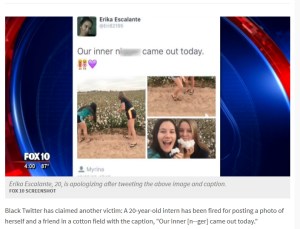
inner nigger

A twenty year old intern was “fired for posting a photo of herself and a friend in a cotton field with the caption, “Our inner [n–ger] came out today.” She later apologized invoking a “lack of my better judgment.”

Looking from the other side of the Atlantic this is rather exaggerate.
OK, I understand why calling someone a ‘nigger’ could be seen as an insult. But if you refer to yourself as such?

In fact, all what she said was that the two of them were doing work which not so long ago was done by ‘niggers’. While they seemed to be enjoying performing their duties.
I don’t think she erred there. She just doesn’t seem to understand (anymore?) the world as people our age do. Could this be a sign for us to let the old ghosts find some peace?

‘Politically correctness’ hits again, and some of us are not even aware of what’s going on.

I know, it’s easy for me to speak like this. I don’t live there. But what if my emotional detachment from this issue allows me to look deeper into the matter?
And no, we should not simply forget what had happened. Just learn the lesson – so that we’ll never have to repeat it – and move on. If we keep pestering that wound in an inappropriate way (nigger is just a word, we give it its meaning) it will stay open. For as long as we encourage it to fester. Do we really want this?

PS Politically correctness “involves changing or avoiding language that might offend anyone“. If we keep sliding down this slope we’ll soon end up unable to open our mouths. It’s damn hard not to offend ‘anyone’, sooner or later.