Archives for category: Mindset

OK, Trump did say something.
Which isn’t exactly stupid, by the way.
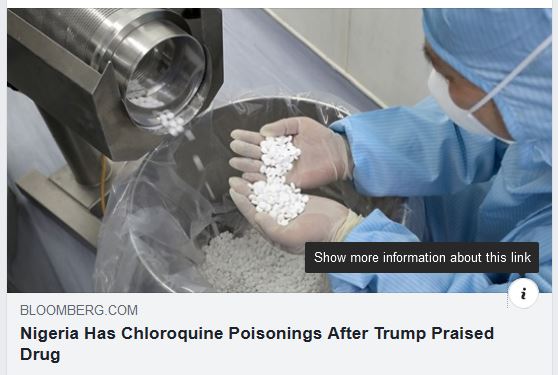
Two halfwits had self medicated themselves to death. With the very same substance Trump was peddling.
But we don’t know for sure whether those two had ever heard Trump advertising that substance. “In Nigeria, households still regularly use tablets containing chloroquine for treating malaria, even though it was banned in 2005 for first-line use because of its declining effectiveness. News of a February study in China about the use of chloroquine for the coronavirus had already sparked lively debate in Lagos, so people began stocking up.”
And there’s a lot of other people, way more knowledgeable than Trump on the matter, who advocate the same course of action.

Yet Trump is held accountable for those two ending up dead…
Are we going to get out of this state of mind?
Ever?

The sooner the better….

After all, what’s the real difference between those who see Trump as their savior and those who see Trump as their arch-enemy?

Any attempt to learn something, to increase your knowledge about a certain subject, is nothing more and nothing less than an attempt to become intimate with it.

Students have two open roads ahead of them.

One which implies a lot of wooing, patience and a certain degree of self appeasement.
The other asks for a direct, almost blunt, approach.
While the first is more like the student dancing around the subject, the second is akin to a hands on combat.

The results are, obviously, different.
Not exactly different. Only fundamentally.

The difference is very much like the difference between courtship and rape.
The end result might be a child. But…

Same thing with art and science.

It is true that in order to have sex, both partners need to be, at least somewhat, naked.
But there is all the difference in the world between having sex and making love!

The end result is only apparently the same!

Where S stands for Sociological.

So. Let me present you with a sociologically fictitious scenario.

We have an intelligent observer and and a trans-galactic vehicle.

There are no details available about the observer except for the fact that it has access to a comprehensive real time stream of data about what is going on inside – or, more exactly, on the surface, of the trans-galactic vehicle.

And here’s what the observer had recorded.

The vehicle is being continuously transformed by its passengers.
In fact, there are two manners in which the passengers change their vehicle.
By interacting directly with it.
And as unintended consequences of the interactions which take place between the passengers themselves.

The passengers are evolving.
During the observation period, some of them had become dominant.
But no matter whether they had become dominant or not, most of the passengers had disappeared. Both as individuals and as species.

The current dominant species is the most intriguing ever.

It displays a strange mix of intelligent behaviors and suicidal tendencies.

It is composed of rather autonomous individuals who are adept at finding ingenious solutions to almost intractable problems.
But, strangely enough, they haven’t yet been able to figure out two basic things:
The limited nature of the vehicle on which they live. In both time and space.
Nor how to balance their individual functional autonomy with their need to cooperate towards their natural goal. The survival of their own species.

If the whole ‘project’ were a SF movie, the text above would have been the opening.
Followed by:

Currently, the dominant passengers are being taught a lesson by the apparently most insignificant amongst those transported by the vehicle. By a virus, as the dominants refer to it.
The virus – like all of its kind, is able to hijack other organisms and somehow convince them to work for him. At a very high cost for the hijacked organisms.
In this case, the hijacked organisms belong to the dominant species.

And what have the individuals belonging to the dominant species chosen to do?
Inform each-other promptly and cooperate earnestly towards the common goal?

Not exactly. Not yet, anyway.

Homework:
What would the intelligent outside observer think about the whole situation?
Would He consider to lend a helping hand?

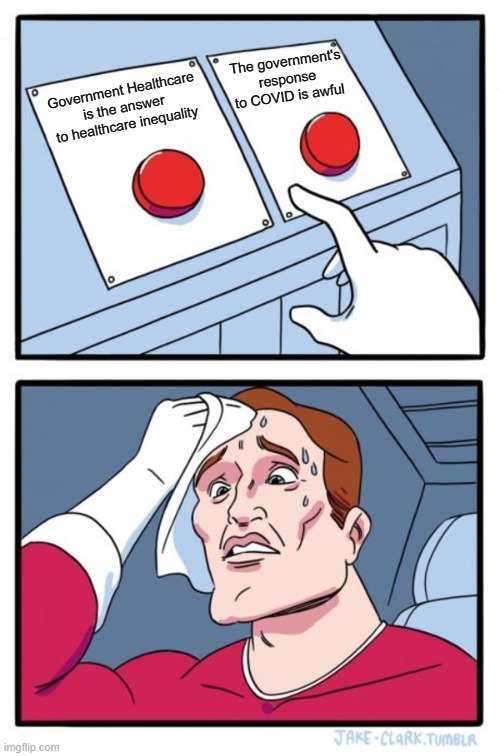
https://i.imgflip.com/3ua749.jpg

Well, we must remember that solutions came a lot easier when we refuse to think inside a box. Inside any box. No matter how large or how nice.

Every time I understand/notice that somebody tries to frame my thinking process, I go ‘ballistic’.

I try to raise my mind perpendicularly above the frame. So that I may observe the limits.

Every time when somebody is presented with an ‘either/or’ option there is a strong likelihood that the situation merits a more nuanced approach.
As in ‘yes, the government was terrible at handling COVID-19’ and ‘yes, the government – as our servant, should be mandated by us, the people, to coordinate the help we need in our hour of need’.

How can we reconcile these two?
Simple.
Hire a better government and keep a keen eye on it!

And, if I’m not mistaken, wasn’t democracy meant to do exactly this?

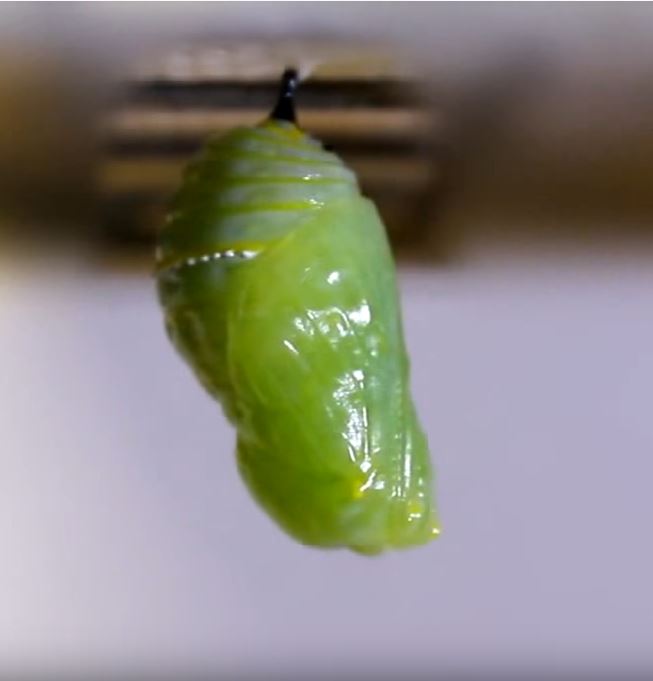
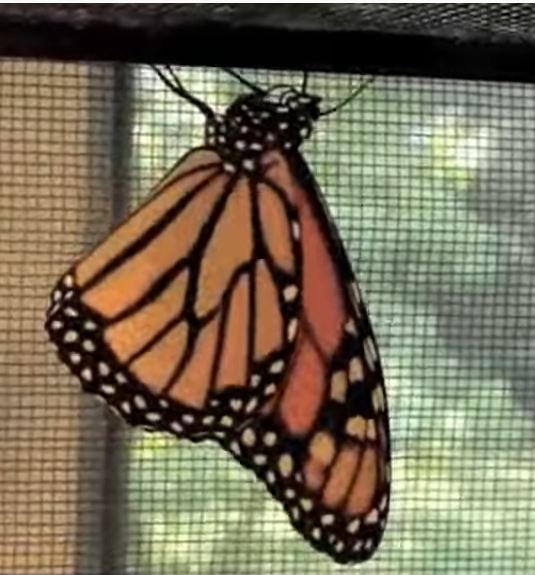
A transformation so drastic that somebody needs to have been at both ends of the process in order to accept that what came out was the same thing as what went in.

The Universe has already went through Metamorphosis 0.1 and 1.0.
The ‘Big Bang’ and the apparition of life.

We’re witnessing Metamorphosis 2.0.
Awareness’ coming of age.

Individuals becoming aware not only of their own awareness but also of their place in the order of things.
Communities becoming aware that each of their individuals are paramount. That ‘no one left behind’ is the only thing that keeps the community together.
Individuals understanding that each of them is equally important yet none of them indispensable.

Individuals and communities alike opening their minds to the fact that none of them might exist without the other.

My friend and coworker asked me the other day:
“Why do these people hate each-other so passionately?”

“Because they are rational. They have reached their present convictions as the result of a rational process. Hence they are convinced they are absolutely right. Then, when anybody expresses a different opinion, they interpret ‘dissent’ as a personal attack. My ‘truth’ having been reached in a rational manner means that all other opinions must be false. Defending them – against all ‘evidence’, means that these people are either provocative or, even, outright destructive.”

“But being rational doesn’t include being open to the possibility of being wrong?”

“I’ll have to rephrase. ‘They are convinced they are acting in a rational manner’. In fact, we, humans, are ‘rationalizing’ rather than ‘thinking rationally’. We use whatever arguments/information we have at our disposal to justify whatever conviction we already harbor. And only when reality slaps us in our faces we ‘open up’. Even science and justice work out this way.
“Innocent until proven guilty”. Only scientists and law-enforcers are already accustomed to the possibility that things may not be exactly as they previously thought they were. Politically minded people are still learning.”

“Please” is an attempt to maximize your chances to get something.
“Thank you” is an attempt to maximize your chances at ‘second helpings’.
“I’m sorry” is an attempt to ‘reconnect’ after committing a ‘blunder’.

All of them, simultaneously, serve the individual uttering them and knit the community.

But there’s something which sets one of them apart.
While “please” and “thank you’ are ‘upfront’, “I’m sorry” has a more ‘hidden’ nature. And is a lot less used…

Both “please” and “thank you” have a very clear message. “I want/am grateful for something’ and ‘I acknowledge the fact that I cannot function/exist by myself’.

“I’m sorry” is far more complex and a lot less upfront.
‘I acknowledge not only that something went wrong but also that I have anything to do with the occurrence’. And ‘please do not banish me for what I have done’!

If we dig deeper, we’ll find some more ‘intricacies’.

“Please” and “Thank you” are ‘face to face’. You know what you want/are grateful for and by uttering them you transmit that information to your audience. Those who might fulfill your wishes or have already done that.

“I’m sorry” identifies you as the ‘culprit’. Or, even worse, tells the ‘victim’ that something nasty is going to happen.

It is here that things become really interesting.
Conscience is a function. A feature which helps the individual. To survive and to thrive. In order to do that, conscience must – first and foremost, to take care of itself. To protect and cherish itself. More about how it does that in my next posts. The point of the present one being that is far easier for ‘conscience’ to ‘please’ and ‘thank’ rather than to ‘apologize’.

First of all, ‘gratification’.
1.0 versus 2.0.
Getting what you want/need versus avoiding punishment.
Which is never as direct.

The ‘buried head’ fallacy.
‘What if/maybe they never find out’?
‘Who did it’ or even that it had happened at all …

The ‘I cannot afford to appear weak’ fallacy.
Or the ‘I cannot afford to accept having been wrong’ situation.

That’s why it is far easier to say ‘I’m sorry’ after stepping on somebody’s toe than to leave a sorry note on somebody’s windshield after denting their fender in an unsupervised parking lot.
That’s why it is far easier to apologize to a a coworker than to admit guilt, as a CEO, in a shareholders meeting.
That is why it is almost inconceivable for a dictator to publicly admit an error which had been committed under their watch.

Wilhelm von Humboldt had initiated a current of thinking, linguistic relativity, which posits that the language used in a cultural space is a reflection of the ideas populating that space. And that there is a strong link between the workings of that language and the manner of reasoning favored by those who use it.

‘Dull as fuck’ is a perfect example.

Nowadays ‘conventional’ fuck is considered to be boring.

We’ve arrived to need all kinds of ‘gadgets’ and a cornucopia of titillation.

We’ve become addicts. Depending on porn.

Universal Grammar (UG) is intended to specify the most general principles of human language. It must provide an explanation for the extraordinary fact that a Japanese child raised in Paris will acquire French, but not Japanese, and a French child raised in Tokyo, Japanese, but not French. Either child may acquire both French and Japanese, of course, but neither will fail to acquire French or Japanese. Linguists and philosophers may have known this in antiquity; they did not say so with any great conviction, and they may not have said so at all. It was left to Chomsky to remark with the full force of his genius that every human language can be acquired by any human being. Universal Grammar, Chomsky concluded, must be a species-specific characteristic of the human race, biologically encoded, genetically transmitted.

The quote comes right out of an article written by David Berlinski and Juan Uriagereka. Never heard of any of them.

Reading that article, I remembered the reason for which I tend to avoid modern philosophers. Or linguists. Hard to discern which is which, anyway…

Let me return to the quote itself.
“An explanation for the extraordinary fact that a Japanese child raised in Paris will acquire French, but not Japanese, and a French child raised in Tokyo, Japanese”.
Read this to anybody who isn’t familiar with the notion of ‘Chomsky’. You’ll get a laugh and a troubled look. ‘What’s so extraordinary here?!? People will always learn whatever language is spoken around them… but only if they come in contact with the ‘exterior’ world!’

Home-school those Japanese/French children in Paris/Tokyo while preventing them from getting in touch with anybody else but their immediate family/trainers and they’ll learn only whatever language(s) their trainers/family will have chosen for them.

As an aside, what does Chomsky mean by ‘French’ and or ‘Japanese’?
‘Genetically’ French/Japanese? What if one parent is French/Japanese and the other German/Korean? What will the child be? Like the father or like the mother?
‘Culturally’ Japanese/French? According to their ‘mother’ tongue?!?
Forget it…

“Universal Grammar, Chomsky concluded, must be a species-specific characteristic of the human race, biologically encoded, genetically transmitted”.

‘Species specific characteristic of the human race’… told you these guys have a lot of humor… or, maybe, they cannot make up their minds…
What are we, humans?!? A species or a race?

OK, let me move forward.
Hidden underneath all this ado, there is a piece/gem of ‘harsh’ reality.
The simple fact that if/when we want to, we are able to understand each-other. To communicate with each-other. To exchange ideas. To trade meaning.
And there is indeed something species-specific about this ability of ours. Nobody else has it… according to our present knowledge about the world, anyway.

‘Nobody else has it’… yeah, right… as if you hadn’t watched, time and time again, two dogs ‘greeting’ each-other in the park.
OK, those dogs were interacting in highly unnatural circumstances. Walked by people, in a people infested environment …
Fact is that all animals have ‘procedures’ for interacting with other animals. Belonging to the same species or belonging to other species. Some of the procedures being inbred while others had been acquired trough learning or training.
Cats, for instance, have an inbred ‘procedure’ for chasing anything which might become a prey but need to be taught by their mothers how to finish the chase. How to kill that prey.
And yes, cats do have a species-specific, biologically encoded and genetically transmitted characteristic which allows them to kill and eat their prey. Or to play with the people who take care of them. They kill and eat using their claws and teeth while they play using their brain. OK, the brain also contributes during the chase… don’t be a nit-pick.

Let me summarize.
So cats have a specific set of tools, teeth and claws, which are ‘coordinated’ by a brain which needs to be taught in order to become fully functional.
And the overall ‘functioning’ of any given cat depends simultaneously on how well their organism works AND the quality of the learning they have been able to amass.

Then where’s the difference between humans and cats?
What is so species-specific in our ability to interact with the world?

I’m exaggerating, of course. We are able to understand each-other far deeper than the other great-apes, our cousins. There is something species-specific in all this.
But only in ‘depth’, not in ‘nature’.
We’ve been able to teach chimps to write. And cats to play with strings instead of catching mice. All three of us ‘share’ the more or less same kind of brain and surprisingly similar anatomies.

What really sets us apart is our learned ability to watch ourselves while doing something. To observe ourselves observing, as Maturana puts it.
And our ability, learned again, to formulate information in a transmittable form. To ‘build’ highly specific messages using rather ‘fungible’ building blocks and in such a manner that those messages might be transmitted from one individual to another. From one generation to another, even.
To make good use of the Universal Grammar noticed by Chomsky.

Can any of this be construed as species-specific? Of course. Without the huge brain we’ve got – or without the ability to articulate sounds, we most likely wouldn’t have been able to reach this stage of our evolution.
But to reduce everything to mere biology … I’m afraid that would be too simplistic.

Consciousness – or self-awareness, opens up huge evolutionary venues. Powered by our very ability to communicate so intensely. To use ‘Universal Grammar’, even without being aware of its existence.
But since both self-awareness and talking depends upon learning them from/with the others… biology is not enough. Necessary, indeed, but not enough.

Not by a long shot.

https://redeeminggod.com/genesis_3_1-5/

You might have figured out already that I don’t believe yet I find a lot of inspiration in the Bible.

I’d like to discuss today the subject of Eve.
Many people are adamant that she was instrumental in Adam being banished from heaven. That she was conned by the serpent into convincing Adam to commit the first – and most important, sin. Into disobeying God, his Father.
Hence Eve – and all her daughters, are the culprits for us, men, having to ‘toil for our daily food’. Outside of where we have been meant to live, the Paradise…

Really?!?

Then, if Eve was the root of all evil, why had God chosen Virgin Mary – Eve’s granddaughter, as the vessel for his beloved Son? For the instrument of our salvation?

Furthermore, if we treasure virginity – something which only man can spoil, then how come it is Eve – the entire womenfolk, who is considered the origin of sin?

Let’s move forward to the really hard questions.

Eve engaging in conversation with the serpent resulted in both Adam and Eve learning the difference between good and evil. In both Adam and Eve becoming full fledged, self aware human beings.
And what was wrong with that?!?
Becoming conscious was a bad thing? Thinking with our own heads is sinful?

I remember that, as a child, I had always experimented what was verboten. Except for the obvious things, of course.
And used the trick on my own son. Whenever I wanted him to try something, I led him to believe that that thing was dangerous or out of limits. For him, of course.