Archives for category: authoritarianism

Quite a large number of people are complaining about how hot it is nowadays.
So uncomfortably hot that they have to stay indoors until late in the evening.

And no, they are not pensioners.
They work from home, earning enough money to be able to have everything delivered to them.

Which reminds me of my first job, right out of university.
A big factory building where water almost froze in winter and temperatures rose to 41-42 degrees Celsius in August.
Inside that building were, among other ‘run of the mill’ machine-tools, 3 top of the art automated Czech-built lathes.
This story goes back to 1986 and happened in communist Romania.
The lathes were very precise but couldn’t be used all the time. In winter they stopped working altogether and in summer they faltered. No amount of fine tuning could bring them back to yielding usable parts.
It took a few years for the brass to figure-out what was going on. The lathes were designed to work in a ‘controlled environment’. The temperature was supposed to hover between 15 and 25 degrees for the lathes to function normally.
Hence the lathes were ‘sheltered’ in an auxiliary building. A shed built inside the factory. And provided with efficient enough ‘temperature control’.

We, the people, had been left on the outside. Outside the shed but still inside the factory…. freezing in winter and sweat-drenched in summer. Still working, because we were sturdier than the top of the line machinery…

This morning I came across a FB post.

This brought about another memory.

Sometime in 1990-1991 I happened to lay my hands on a Newsweek magazine. Or a the Economist… I don’t remember exactly. Anyway… the article I was going to discuss with you was about the hard life endured by the American poor people. And was illustrated with a color picture.
I’m going to make a small break here and inform you that in the 1990 Romania colored magazines – let alone glossy, were hard to get by.
That picture, taken somewhere in the Bronx, contained a color TV and three pre-teen kids. All of them clad in blue-jeans and wearing ‘sports shoes’. You know, the likes of Puma/Adidas/ you name it.
In those times, in Romania, bluejeans or ‘sports-shoes’ could be had mostly on the black market. Where you had to fork out the wage earned in a whole month if you wanted to buy a pair of each. Or you could buy them in a brand store. For twice the price….

You see, the communist regimes have crumbled because the leaders had lost contact with reality.
The brass in the factory where I had started working couldn’t figure out – nor really cared about, the reason for which those lathes didn’t work properly.
And didn’t care about the fact that the workers had a very hard life. On the factory floor and outside its premises.

The liberal-democratic and capitalist regime has created huge opportunities. People used to live incomparably better there than in the rest of the world. And continue to do so.
On the other hand, in many of the ‘affluent’ countries people have lost contact with each other. The haves have no idea about how the poor live. Nor the poor have any idea about what it means to be rich.

We live in different worlds. In different realities.

Each of us on their own ‘tin roof’.

The problem being that all of them are becoming increasingly ‘hot’.
And I’m not thinking ‘global warming’ now…
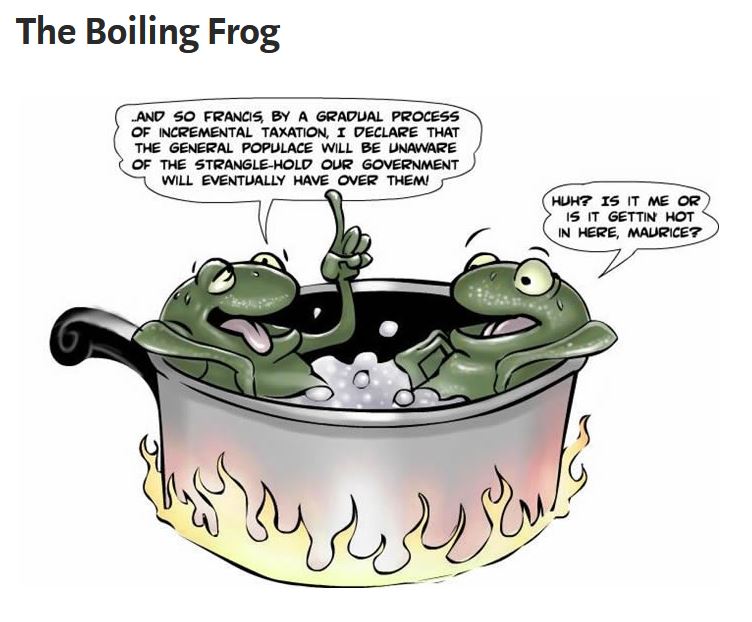
Communism had crumbled because the rulers couldn’t understand what was going on. Couldn’t react efficient enough to changes brought about by normal evolution. Because the rulers had gradually lost contact with reality. Which inevitably happens in all authoritarian settings.

We are currently living in different realities. In ‘bubbles’. For now, these bubble still have something in common. We are still able to talk to each other. Sometimes we have a hard time understanding what the other has to say – or don’t really care, but the dialog is still possible.

I’m afraid of the day when the dialog will no longer be possible.

The guys in the pan are so obsessed about the taxes they have to fork out that they actually don’t pay attention to anything else.
The guys attempting to collect those taxes are so obsessed about what they want to do with the money that they actually don’t pay attention to anything else.

Meanwhile, the world is growing apart. The bubbles lose contact with each other. And with the hard core reality…

The cats can always jump down from the roof. Whenever it grows too hot or too cold.
Where are those two frogs going to jump when things will become uncomfortable?

The common sense definition for an inflationary situation is ‘when too much money chase an inherently limited amount of goods and services’.

The ‘limited amount of goods and services’ part is easy. We live on a finite planet, we have a limited capacity to transform whatever resources we are able to identify into usable goods and services … so…
OK, we can always identify new resources and build new capacity but we cannot do any of this ‘on the spot’. We need time. And, even more importantly, we need to put ourselves to it!

Then ‘who does the chasing’?
After all, money is ‘inert’. It doesn’t do anything if let alone in a drawer. On under the mattress…
In reality, we – buyers and investors, are the true ‘inflationary agents’.
‘But it would be completely stupid to sit on a pile of money when inflation rages! You have to buy something otherwise you’ll loose a lot of value! At least, you need to invest that money…’
This is one of the best examples of a self-fulfilling prophecy!
Indeed. Buying or investing during an inflationary bout is the reasonable thing to do! Yet we need to understand that our actions will, temporarily, exacerbate the very inflation we are trying to ‘tame’.

But where does the excess money come from?!?

Until not so long ago, the sovereign was the only one person who could bring new money to the market.
And their ability to do that was severely curtailed by the amount of bullion available for this task.
In fact, the first major inflationary episode in the second millennium had been fueled by the gold brought back to Europe by the Spanish conquistadors. Which bout of inflation brought about the first major change in the European economic thinking.
“To inspect the country’s soil with the greatest care, and not to leave the agricultural possibilities of a single corner or clod of earth unconsidered… All commodities found in a country, which cannot be used in their natural state, should be worked up within the country… Attention should be given to the population, that it may be as large as the country can support… gold and silver once in the country are under no circumstances to be taken out for any purpose… The inhabitants should make every effort to get along with their domestic products… [Foreign commodities] should be obtained not for gold or silver, but in exchange for other domestic wares… and should be imported in unfinished form, and worked up within the country… Opportunities should be sought night and day for selling the country’s superfluous goods to these foreigners in manufactured form… No importation should be allowed under any circumstances of which there is a sufficient supply of suitable quality at home.” Philip von Hornigk, 1684.

After a while, economy had become ‘complicated’ enough to demand ‘paper money’.
The amount of goods and services produced had become so large – and insufficient bullion was added to the money pool, that prices would have had to shrink if the balance was to be maintained.
Unsustainable! Nobody would have bought anything and everybody would have jealously guarded their precious money while waiting for the prices to fall further. This process is known as ‘deflation’ and is considered even more malign than a decent amount of inflation.
We have to note at this point that ‘paper money’ had been made possible by the advent of the ‘nation’.
This is a rather complicated discussion, for the present purpose it’s enough for me to mention that ‘paper money’ being accepted as ‘tender’ means that the general population has enough trust in the issuer of the bills. That the individual user of the paper money trusts/believes he is part of ‘something bigger’.
In those times, it was the issuer of paper money who practically controlled the amount of money which existed on the market.

Which brings us to the present times.

I’m sure all of you are aware of how “fractional reserve banking” works.

‘Yeah, the banks create money out of nothing!’

Wrong!
For banks to be able to ‘create’ new money, they have to extent credit!
For new money to be created in this way, somebody must walk into a bank with a business proposition.
That somebody might want to buy a house, a car or whatever else. Or that somebody might want to start a business. If that somebody convinces the bank that they is solvent or that their idea is worthy enough, then and only then new money is created!
Money doesn’t appear out of the blue! It is born out of trust. That somebody not only trusts themselves but they are convincing enough to determine the banker to extend that much needed credit!

But wait!
We’ve developed yet another mechanism which churns out money.
The stock market.
After developing the business started with the loaned money, the somebody we’ve been talking about above decides to make an IPO. To sell part of his business to investors. To monetize his initial investment.
Depending on the moment chosen for the IPO – and the economic data in the prospect, the IPO can be a huge success. For ‘somebody’ and for the early buyers. You see, each time the price of the stock goes higher, new money is created. Based more on the ‘market’s expectations’ than anything else…

‘But people who put their money on the financial markets are rational agents! They are experts in their field…’

Yeah, right…
You’re talking about the experts who had put together the collateralized debt obligations debacle…
And many others. Too many others…
Also, you’re talking about the experts who had bought those papers! Who had trusted the expertise of the first batch of ‘specialists’!

Thinkers, from Freud to Kahneman and Ariely, have proven than humans are very good at rationalizing and less so at being truly rational.
That for a market to behave in a reasonable manner, it must preserve its freedom.
That it must be free from ‘bullies’ – individual agents who muster a lot of ‘clout’, and free from any mania.

The 1637 Dutch Tulip Mania is a very good example of what might happen when a market gets obsessed with something.
When too many people – not even a majority, forget about the fact that economy (oikonomia) is about making ends meet and that getting rich may be a nice consequence but is a terrible goal.

‘OK, nice try. But what about inflation?’

We have an inherently limited amount of goods and services.
A relentless mechanism which churns out money.
Meanwhile, some of us obsess about their need to conserve the money denominated portion of their stashed away fortunes.

Inflation is nothing but another mechanism.
Which re-balances the market.
Piece-meal – adjusting for daily changes, in normal times. When things evolve ‘freely’.
Suddenly when the market – the people who ‘man’ the market, find out about ‘the dark side of the moon’.

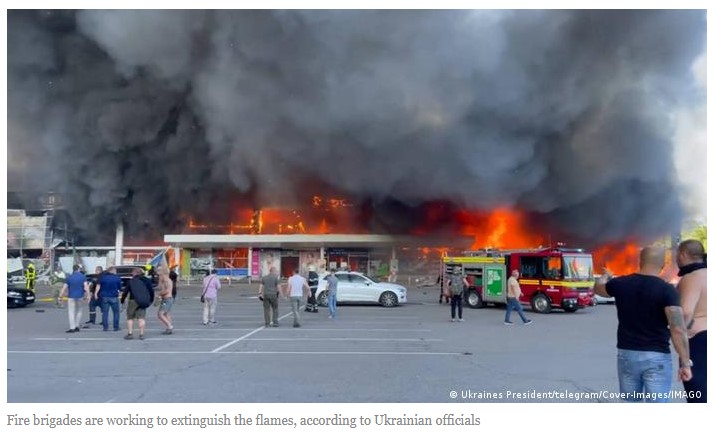
People are dying in Ukraine.

And what takes place there has consequences all over the planet.

The first two world wars had been fought by soldiers from almost every corner of the Earth.
Almost all countries have declared war on each other, even though not all of them have participated in military operations.
The third world war – the Cold One, had been fought ‘virtually’. And was the first to divide the world into three.
The ‘liberal-democratic’ camp, the ‘popular democracy’ camp and the non-aligned camp. As always, World War III had been lost by the least flexible among the combatants. By the more dictatorially run camp. By the camp, which, precisely because of the authoritarian manner in which its decisions were adopted, had failed to mobilize all the resources it had, potentially, at its disposal.

I’ll make a parenthesis.
Any act of aggression is an idiocy.
Regardless of the short-term, medium-term and long-term outcome, the aggressor has more to lose than the victim. This does not need to be demonstrated. The most perfunctory glance at history is eloquent enough.
Here I’m concerned about war as an ‘ongoing phenomenon’, I am not trying to integrate it into the narrative. Any war, any act of aggression, is initiated under certain conditions determined by the history spent until then and will be, at some point, integrated into the history written afterwards. And the way it will be integrated into history will determine the conditions under which the next war will be initiated. Or not…

Let’s go back to the present moment.
This, the fourth one, is the first mixed world war. The first ‘lukewarm’ war.
The consequences are felt around the globe, almost all states take part in it – also divided into three camps, while the act of ‘actual’ aggression is somewhat limited.
The reactions to this act of aggression – the way in which those who have to bear its consequences relate to the conflict, constitute the beginning of the way in which this episode of physical aggression will be integrated into history.
The liberal-democratic camp is helping the victim as much as it can – this could be the subject of a very long discussion.
The authoritarian-populist camp helps the aggressor. As far as it can, lest it shows its true colours…
The self declared ‘non-aligned’ camp claims it is one of the victims and urges negotiations.

Here’s the place where I need to make another parenthesis.
The aggressor is ‘Putin’. A collective character that has at its center the current Kremlin ‘gate-keeper’.
The fact that the collective character known as ‘Putin’ is currently leading Russia’s destinies is a matter of history. It has to do with Russia and the Russian people indeed, but placing all the responsibility for the atrocities which are taking place in Ukraine on Russia’s shoulders would be a mistake. A mis-diagnosis which would lead to a ‘counterproductive’ treatment.
Many of the analysts and commentators who write on this subject are ‘mesmerized’ by the ‘master of disaster’. By Putin. Some ‘highlight’ his actions and others want to distract us from what Putin is doing by trying to argue that Putin was forced to do what he had done because the ‘others’ had acted as they had done. As if the mistakes already committed could provide any justification for future atrocities…

Back to the subject.
The main idea which emerges from the ‘messages’ we are bombarded with – regardless of the motivations attributed to Putin, is that any surrender to the aggressor’s claims will be eventually ‘underwritten’ by all those involved.
For the simple reason that Putin will interpret the smallest crumble ceded by the victim of the aggression as a personal victory. Victory that will be attempted again, sooner rather than later.
Meanwhile, all the other Putins in this world, all those animated by authoritarian whims, will feel encouraged by any shred of victory which Putin will have enjoyed.

‘Are we stupid?!? He pulled it through, didn’t he?
We should try it too!’

Well, so far, so simple.
Putin is not the first dictator to be scrutinized by psychologists. Or by political scientists.
‘Nothing new under the sun’ and no original contribution.
Almost everything Putin had ever ‘accomplished’ has already been analyzed and can be explained away with the help of quotes pulled from more or less famous authors. Sun Tzu, Clausewitz, Marx, Ivan Ilyin.
Unfortunately – or fortunately? – Putin is ‘transparent’.
He becomes more than ‘obvious’ after the briefest analysis. And, in fact, dictators – all dictators, are very ‘simple’. Single minded individuals effectively enslaved by a single thought. Concentrated exclusively on how to obtain and preserve absolute power. Everything else about them is bullshit. Make belief and propaganda.

Personally, I’m interested in something else than ‘what drives Putin to…’
Putin does what he does because he has the opportunity. Because he ‘enjoys’ a set of circumstances in which he can act his ‘fantasies’. And Putin got into this situation because those around him – those who could have done something about ‘this thing’, did not understand at the time what was going on before their eyes.
I can understand that! ‘Temporary blindness’ is not an ‘exceptional’ thing. But still. From a certain point onward – after ‘the milk spilled over’ and after reality had slapped you over your face, to continue with your head buried in sand… to remain ‘temporary blind’ only because you ‘enjoy’ your current position and/or your current paycheck… without realizing that you are being led to the abyss…

‘Putin’ doesn’t take prisoners.
Even if you considered yourself his ally, or his faithful servant, and no matter how many promises he has made to you, when he no longer needs you…. you’re toast!
When he no longer needs you, you become a cost. And in their world, in the world of dictators, costs must be cut! No other arguments will ever be considered.
Aside from the fact that you have a good chance of getting sacked as Putin becomes more and more powerful/callous, associating yourself with this kind of people is dangerous by definition. No matter how strong they seem to be at any given point, all ‘things Putin’ end up badly. The more powerful the Putin becomes, and the higher they get, the worse they fall. They along with those who ‘waited’ on him!….

Does anyone know a dictator who ended up on the throne?
Lenin?Stalin? Khrushchev? Brezhnev? Andropov?
Is this what we want?!?

The conclusion drawn by some observers, “In the end the outcome has only two valences: Putin loses or Putin wins” is valid only for the short term. Very short! In the long run, Putin loses. In the longer run Putin has always lost.
And it was us who had to endure! The ‘excesses’ committed while the dictator was at the helm and the ‘vagaries’ of the ‘transition period’ which followed. The point being that the more we endure ‘it’ – for the sake of momentary comfort or out of fear for what might happen, the more we will have to pull. In the near future!

As for the five dictators enumerated above, yes, four of them did die on their throne. Khrushchev had been deposed and lived for a while under ‘close supervising’. But after each of them had ‘transitioned’, their ‘close associates’ had been thoroughly ‘epurated’.

What happened to Russia during their ‘tenure’?

Whence my question.
Do we really want to take part, any part, in anything even remotely similar?

2017

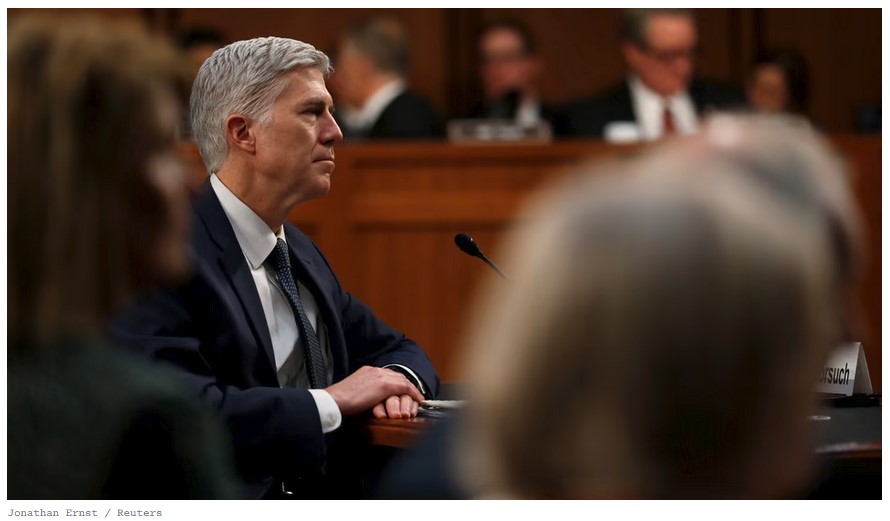
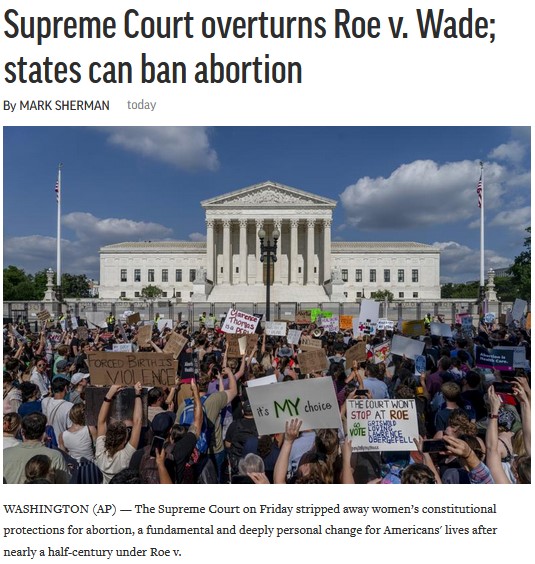
““How could you square that statement with legal abortion?” Durbin asked him. “Senator, as the book explains, the Supreme Court of the United States has held in Roe v. Wade that a fetus is not a person for purposes of the Fourteenth Amendment, and the book explains that,” Gorsuch replied.

“Do you accept that?” Durbin asked. “That’s the law of the land,” Gorsuch answered. “I accept the law of the land, senator, yes.””

2022

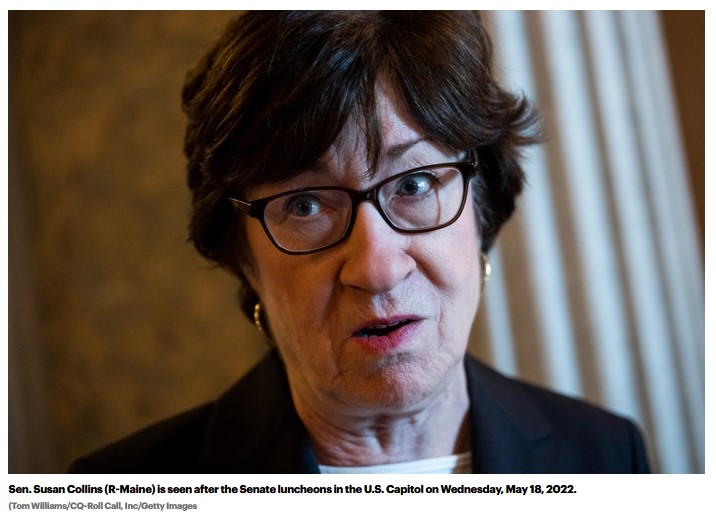
“In a statement following the Supreme Court’s decision to overturn Roe v. Wade, Sen. Collins expressed her dismay that Justices Neil Gorsuch and Brett Kavanaugh misrepresented their alleged respect for precedent and private conversations with her and in their confirmation hearings. “This decision is inconsistent with what Justices Gorsuch and Kavanaugh said in their testimony and their meetings with me, where they both were insistent on the importance of supporting long-standing precedents,” she wrote.

Rolling Stone reported last month that Collins was deliberately manipulated by Trump officials into voting for Kavanaugh despite his judicial history indicating a liability to strike down Roe. The White House correctly predicted that as long as they “let the Susan Collins-es of the world think what they needed to think and hear what they needed to hear,” as one ex-official put it, the fence-sitters would fall in line and vote to confirm Trump’s nominee.”

2016

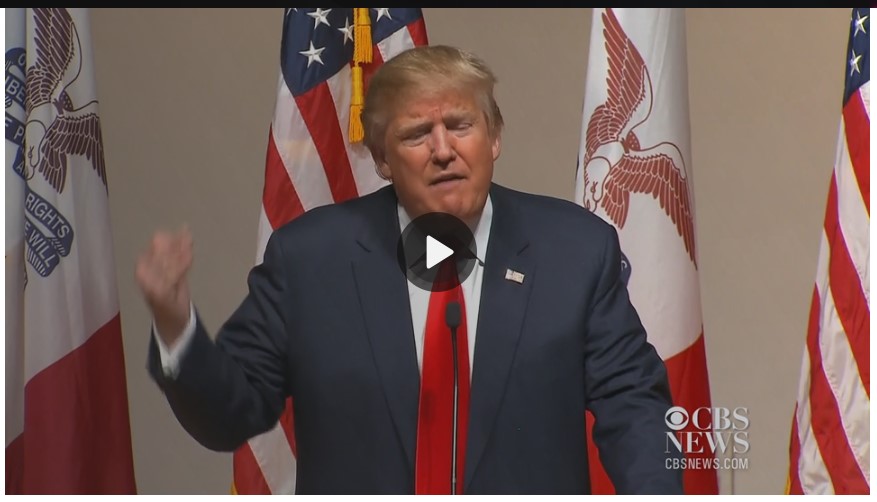
“My people are so smart — and you know what else they say about my people? The polls?” Trump asked a crowd at a Sioux Center, Iowa, rally Saturday. “I have the most loyal people — did you ever see that?”

“I could stand in the middle of Fifth Avenue and shoot somebody, and I wouldn’t lose any voters, OK?” he said, referring to the major street in New York City that cuts through Manhattan’s large commercial district. “It’s, like, incredible.”

2022

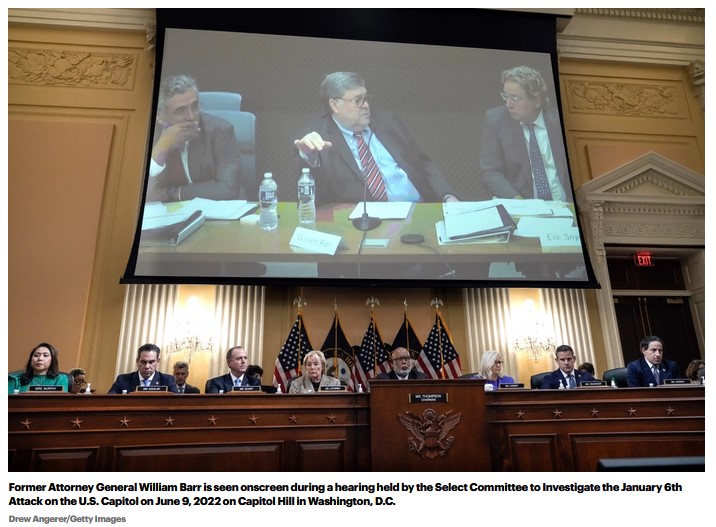
“In its first hearing, the Jan. 6 committee last week played a clip of former Attorney General Bill Barr testifying that he told former President Trump that claims the 2020 election was stolen were “bullshit.” In its second hearing, the committee on Monday played several additional minutes of Barr’s testimony, during which he described unsuccessful effort to convince Trump that the election was legitimate.”

“Barr met with Trump again on Dec. 14. “He went off on a monologue saying there was now definitive evidence of fraud through the Dominion machines,” Barr said of a Dec. 14 meeting with Trump, noting that he gave Barr a report he said proves that the election was stolen and that he would have a second term in office. Barr said the report looked “amateurish” with no real evidence to support its claims that voting machines were rigged. Barr said he was “demoralized” after looking at the report. “I thought, boy, if he really believes this stuff, he has lost contact with — he’s become detached from reality,” Barr said.”

2022-06-24

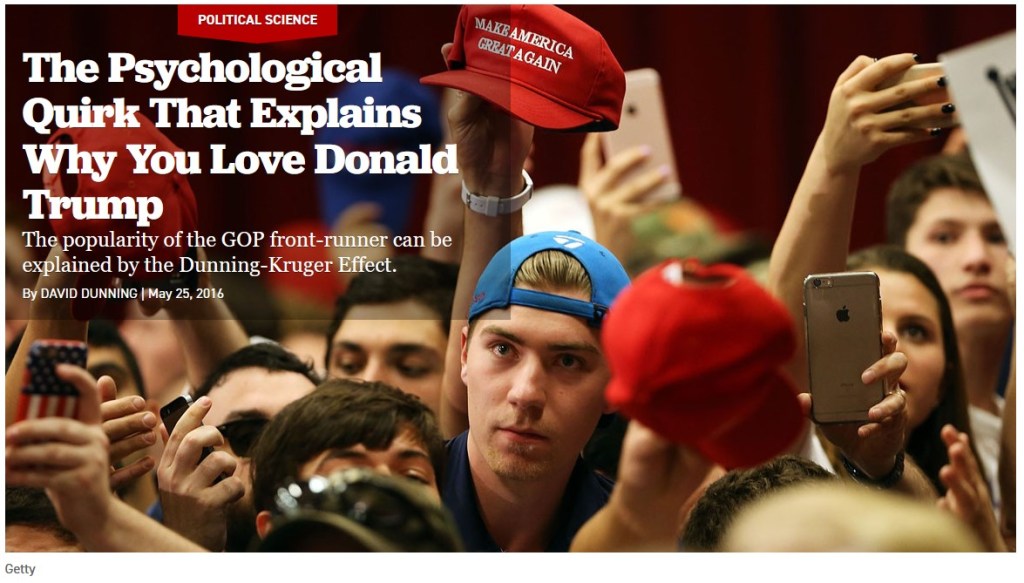
“In voters, lack of expertise would be lamentable but perhaps not so worrisome if people had some sense of how imperfect their civic knowledge is. If they did, they could repair it. But the Dunning-Kruger Effect suggests something different. It suggests that some voters, especially those facing significant distress in their life, might like some of what they hear from Trump, but they do not know enough to hold him accountable for the serious gaffes he makes. They fail to recognize those gaffes as missteps.”

“Again, the key to the Dunning-Kruger Effect is not that unknowledgeable voters are uninformed; it is that they are often misinformed—their heads filled with false data, facts and theories that can lead to misguided conclusions held with tenacious confidence and extreme partisanship, perhaps some that make them nod in agreement with Trump at his rallies.”

“….. himself also exemplifies this exact pattern, showing how the Dunning-Kruger Effect can lead to what seems an indomitable sense of certainty. All it takes is not knowing the point at which the proper application of a sensible idea turns into malpractice.”

I have no way of knowing what the creator of the meme actually wanted to convey through it.
All I know is what I make of it.

The ‘Austrian’ will eventually fall. Not only that nobody can stay in the saddle for ever but the guy uses only one hand to steer his bike. And the fact that he doesn’t use a helmet is the second proof that he doesn’t care much for safety. For his safety… At his age, he should have known better!

Hard to argue with Mises – the quintessential Austrian economist, if I remember right.
Specially since I grew up under a communist regime. Where laissez faire was absent and where the government was inept and immoral. Which regime, like all other authoritarian/totalitarian regimes in history, had crumpled under it’s own weight.

But wait!
Countries which use laissez faire had long ago invented the necessary mitigation mechanisms.
The unlucky entrepreneurs can declare bankruptcy and start all over.
The fraudulent entrepreneurs – well, many of them, go to prison.
While the inept and immoral governments get booted. Democratically!

My point being that laissez faire works better if there’s a safety net in place.
And that people should trust their government. But also keep it on a very short leash!

Wishful thinking!

Conspiracy theorists are absolutely convinced that they are the true critical thinkers…

That their critique of how things works on the face of the Earth is the only reasonable one!

Then what?
Sheeple and conspiracy theorists are nothing but the very same thing? Each of them on the other ‘side’ of the dividing mirror? The surface on which the conspiracy theory dew has been craftily etched? To blurr the vision of all those attempting to look through?

After all, what’s the difference between sheeple – those who follow the official narrative and consider the ‘alternative’ to be wrong, and the conspiracy theorists? Those who consider theirs to be the true version and the ‘official version’ a misleading lie?

Each of them exercise their right and ability to doubt. To look for alternatives. And to discard the alternatives they deem to be implausible!

Most conspiracy theories have already been proven as having been bogus?
With the current ones waiting in line?

This, I’m afraid, is the moment for me to remind you that science is wrong by definition. That all scientific theories are, by definition, falsifiable. That the scientific community is convinced that all knowledge is maybe not completely wrong but definitely incomplete!
Hence there’s a lot of room out there for conspiracy theories to thrive!

‘OK.
I can follow your arguments.
Or, more exactly, I can follow your logic….
But I still believe you’re wrong.
Conspiracy theories ARE bogus!’

Let me put it differently.
Both the official narratives and the conspiracy theories are fueled by the same human need.
By our need for consistency!
Human mind has a hard time processing cognitive dissonances. Pieces of information which contradict each-other. Hence we need a ‘script’. A meta explanation for ‘everything’. A way to discharge the tensions produced by the conflicting pieces of information which assault our attention.

‘And why some people choose to become sheeple – to buy into the official version of things, while others remain conspiracy theorists for life?’

You’ve just set aside the vast majority.
Those people who are explicitly or implicitly aware that both the official version and the conspiracy theories are at least incomplete. And sometimes promoted by people with ‘ulterior motives’.
People who have a deeper creed. Many times of a religious nature but not necessarily.
People who have too many on their heads, mostly worries, so are no longer ‘available’ for ‘petty things’.
As for conspiracy theories being bogus…
I just mentioned how science works. Whenever a theory is judged to be plausible by the peers involved, it becomes the official narrative. All other competing theories become bogus. But all those earnestly involved in the process are convinced that sooner or later the official narrative will be proven if not wrong, then at least incomplete!

‘Then what about ‘critical thinking’? Is it good or not?
And you haven’t answered my question!’

Critical thinking is a tool!
And as all other tools, it becomes good or bad only in the hands of the person who yields it!

The most important thing about critical thinking is that we must remain critical relative to our own opinions!
Open to whatever new evidence happens to cross our path!
Sometimes the evidence which comes first might be misleading. Or false. We might reach the wrong conclusion. If we cling to the already reached conclusion we might be wrong. It is absolutely understandable – admitting an error is hard, but still wrong. That’s why some people remain sheeple while others cling to their beloved conspiracy theories.

You see, the true definition for sheeple is not ‘those who believe the official version’. Far from it!
The real sheeple continue to pay lip service to the official version long after fresh evidence prove the official version has been ‘incomplete’!

This is the first time that I’ve read anything written by Daniel Kowalski. Here’s what I learned, about Kowalski, while reading his his essay about Marx.

I’m not sure that Kowalski had actually read the communist manifesto. And I’m sure that he didn’t understand much of it.

The point being that Marx described society as being composed of the ruling class – those who owned things and gave orders, the ‘doers’ – the qualified/skilled workers, those we currently describe as ‘middle class’, and the ‘underdogs’ – the lumpen-proletariat.

And if Marx hated anybody more than he hated the rulers… those people were the lumpen-proletariat! Because the lumpen-proletariat were so poor that they did everything the rulers asked them to do.

Let’s get to the ‘visionary’ part. Read carefully, the manifesto is crystal clear. Communism was not supposed to ‘dawn’ while Marx was still alive. For communism to become viable, the middle-class had to became poor. To loose their perks. To be reduced to ‘lumpen’ status. But since the middle class already had ‘conscience’ – was aware of its ‘value’, they were supposed to understand what was happening to them. And to revolt against those who were benefiting from the process.

In Marx’s vision, the impoverished middle class was supposed to become aware of its predicament, and only then to let itself be led into the new era of ‘eternal bliss’ by the “the most advanced and resolute section of the working-class parties of every country, that section which pushes forward all others; on the other hand, theoretically, they have over the great mass of the proletariat the advantage of clearly understanding the line of march, the conditions, and the ultimate general results of the proletarian movement.” Also known as ‘communists’.

I’ll end up my comment drawing your attention to the growing wave of anti-capitalist propaganda which is being ‘vented’ over the internet.

The fact that Marx’s remedy for what he saw as the scourge of capitalism – inequality, was an absolute idiocy – the “workers’ dictatorship”, doesn’t erase the fact that Marx the prophet was right after all. The middle class is being squeezed out.

The communism has failed. Because it was based on dictatorship.

The current flavor of capitalism – increasingly monopolistic, will soon follow suit. Not because its capitalist nature but because of its monopolistic – aka dictatorial, dimension.

In my book – I have experimented both communism and democratic(ish) capitalism, there’s no real difference between the communist ‘one ideology solves all problems’ and the ‘greed is good’ mantra.
In practice, all we have is a single, uni-dimensional, idea forcefully being imposed upon all the people who happen to live in a place at the given moment. ‘Money/capital is bad’, hence it has to be abolished, versus ‘money/capital is everything’, hence it has to be enshrined.
I’m not a christian but I’m fully aware that ‘you shall not make yourself an idol’ is a very wise teaching. Specially when that idol is golden.

‘Most people confuse liberty and democracy. They are not the same.’

Liberty and democracy are not the same indeed.

Like my left hand is not the same with my right one.

But I need both in order to lead what I consider to be a normal life.

Most people – specially if they get help, can survive without a hand. Or without either liberty or democracy.

But without both… without both hands or without both liberty and democracy… I’d be at somebody else’s mercy!

‘What?!?
What kind of liberty is there under communist rule???’

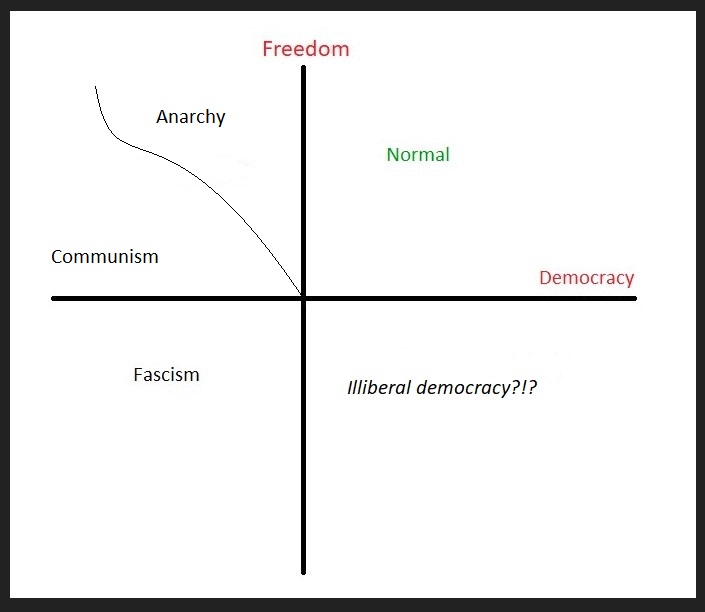
You see, liberty has two ‘faces’. Two dimensions.
Three, actually, but I’ll be talking about only two of them in this post.

There is the ‘inner liberty’ and there is the ‘socially sanctioned liberty’.

Liberty itself is a human concept.
We have noticed something, wondered about it, named it and then attempted to understand it.
This was, and continues to be, a collective effort.

In some places ‘liberty’ had appeared ‘naturally’.
There was enough liberty naturally sloshing around, hence the circumstances were right for those who had happened to live there at the right time to notice it. Furthermore, the conditions had been right again for the entire community to be able to agree among themselves about the concept and about how to use it/put in practice their new intellectual achievement.

Other places have not been so lucky.
They had been close enough, geographically and socio-historically, to notice the ‘birth of liberty’ but their specific conditions were not ‘right enough’. Many people living there coveted liberty but the local conditions made it impossible for liberty to take hold.
In these places ‘inner liberty’ – individually assumed freedom, can be found a lo more easily than presumed by those unfamiliar with the local realities.

Yet other places had it even worse.
Initially on the path towards liberty – and democracy, they have somehow stumbled.
For whatever causes – internal and/or external, something went wrong. People became disappointed enough to give up not only democracy but also liberty. Including their own, individual inner freedom.

A somewhat intermediary situation constitutes the third abnormal quadrant.
The people involved have given up their liberty – partially, but those running the show continue to use (‘pretendingly’) democracy as a window dressing to hide their true intentions.

The last hundred years or so have been extremely relevant in this matter.
All communist regimes had fallen. Under their own weight.
Most fascist/nazi regimes are no longer with us. Had been so ‘arrogant’ – read self destructive, that their neighbors had to do something about them. Had created so much disruption around them that those whose very existence was endangered had been forced to spring into action.
‘Illiberal democracy’ is a rather new ‘development’. Would be fascist/nazi dictators don’t have all circumstances aligned to make their final move so they have to make do with what there is at their disposal. The local population is ‘despondent’ enough to pay attention to their arguments but not desperate enough to follow them into the ‘unknown’. Hence this oxymoronic abomination.

‘Illiberal democracy’…
On the other hand, the spin doctors promoting illiberal democracies hope to be able to reap the benefits of democracy – the population being ‘rather favorably disposed’ towards the government while having to pay less ‘lip service’ to individual human rights.
A balancing act, with no safety net, which is alluring to those reckless enough to attempt it but which will end up badly. Sooner rather than later.

But the most interesting ‘combination’ – for me, at least, is Anarchy.
In the sense that those who ‘swallow’ the lure are self delusional.
They have somehow convinced themselves that their, own, liberty somehow trumps the liberty of everybody else. They feel so strong, so immune to any outside influence, that they would willingly accept to live in a no rule environment. Without understanding that ‘no rule’ means ‘no holds barred’.
They actually don’t realize that unfettered liberty actually means ‘Each of us free against all others’.
This being the reason for which Anarchy, as a political arrangement, has never survived for long enough to be noticed. Except as a transitory phase.

After Putin ordered the Russian army to invade Ukraine, the rest of the world ‘took sides’.

Some sided with Putin, many extended a helping hand to Ukraine – for various reasons, and others felt their lives have been ‘disturbed’.

This morning I almost blew my top.
I was listening to the radio. A usually decent station. Usually decent and, like all of us, imperfect.

The news anchor was interviewing an ‘expert’. An Ivy League Professor of International Relations and other blah-blahs. I’m not giving their names because I want them forgotten, not even more famous than they already are.

‘Is there any chance for this conflict to end in a negotiated manner?’
‘Yes, if/when both sides will find a mutually acceptable solution.
For example, if the Ukrainian side would accept a referendum in Donbass – and in Crimea, and if the Russian side would accept UN inspectors to validate the process. This would be in line with the general accepted policy of self-determination and ….’

OK, and where’s the difference between what Putin keeps saying and what I’ve just heard?!?

Two non-Ukrainians telling Ukraine what to do…

I’m going to set aside, for now, what these two – wait, three! – people are saying.
That Ukraine, the Ukrainian People, should give up a piece of their land.
My immediate interest lies in ‘who these three guys think they are’?!?

OK, only those who don’t want to see haven’t yet found out that Putin is a dictator.
But for a renowned Ivy League Professor to elaborate a scenario according to which the UN would supervise a referendum where an occupied population would have the opportunity to vote whether they want ‘their’ aggressor to maintain its control over the already occupied territory….

Would that distinguished Professor be comfortable with a referendum – equally supervised by the UN, taking place in California? Which California had already been occupied by Mexico? For which referendum, the Californians were asked where they want to live? Whether Mexico should continue its occupation or should the Mexican army retreat behind the internationally recognized border?

No, I don’t think the Professor has been paid by Putin. Or ‘compensated’ in any other way by the ‘red Satan’.
I just consider he was not paying real attention to what he was saying.
He had just opened his mouth and verbalized what his mind was churning.
The current ‘events’ have disturbed his pleasant existence to such a degree that he really needs this ‘fly in the ointment’ to ‘fly away’.

He is so ‘driven’ by his ‘need’ that he is no longer ‘patient’. He just can’t ‘stop talking’ for long enough to realize how fast Putin’s propaganda machine will make ‘good’ use of his ‘verbalizations’…

‘See, the good Professor confirms what our Beloved Leader has already done.
It’s the Ukrainians who are not reasonable!
They should first change their leadership then come back into Mother Russia’s arms.’

When are we going to understand?

Don’t tell others what to do unless you are prepared to ‘take advice’ yourself…
And, for your own good, don’t trade your future freedom for your present comfort!

Can we do without it?
And if not, how much of it?

– If ‘no government’, then who would pay for the army we need to defend ourselves?

Ooops… you’ve just answered the ‘why does Russia ‘encourage’ the trolls who push ludicrous libertarian ideas’ question. Which trolls attempt to achieve two things at once. Weaken the concept of free government and give libertarian-ism a bad rep. Transforming libertarian-ism into yet another form of extremism.

Let’s get serious and try to find an answer to ‘why, and how much of it, do we need government?’

The boring one would be: ‘Whenever one government falls, another one takes over. The interregnum is always bad so… let’s get used to it’.

‘Getting used to it’ works only for very short expanses of time. Left on its own, all ‘government’ becomes sloppy. So sloppy that it soon becomes such a burden that even the most ‘used to it’ lose their patience.
Government, all of them, need to be kept on a tight leash. Otherwise it will soon cease to perform as intended.

– But if you have to keep it on a tight leash, why bother with any in the first place?
Can’t we do without such a bothersome pet?
What’s the point of the whole thing, anyway?

Instinctively, we’re against ‘government’ for two reasons.
It costs us a lot and it used to represent the interests of the ruler.

Until 10 000 or so years ago, we didn’t need ‘government’.
People were living more or less like the modern day Sun People still do. In the Kalahari desert… small bands roam the place, living of the land. The bands are small – so that they might find sustenance, they don’t have any ‘private’ property to protect, hence they don’t need government. Neither did our ancestors.

As soon as people ‘invented’ agriculture – raising ‘tame’ animals at first and working the land soon after, things had changed dramatically.
The advent of agriculture brought two things. An increased productivity and private property.
Soil has not been born equal. Both pastures and arable land can be good, passable or bad. People wish to have the best. Those who already have it are willing to defend it and those who don’t are willing to steal it.
Increased productivity means that those who produce are able to hire people to protect their ‘means of production’. Their property. As a consequence of fighting for it, some people accumulate more and more of it.
More and more ‘means of productions’ – property, means an ever increasing need for ‘management’ and an ever increasing need for ‘protection’. Soon you have a very ‘wealthy’ owner – the lord of the place, call it what you like or use the name given to him by his subjects, the people who perform the day to day management of the ‘whole-sale property’ and those who protect it from ‘marauders’. Both the ‘managers’ – read ‘government’, and the ‘protectors’ – read ‘army’, used to be under the direct supervision of the local lord.
For a while – for as long as the lord kept everything in balance, everybody was happy. The ‘peasants’ were happy because thy were safe, the ‘managers’ were happy because the wise lord used to appreciate their work and ‘compensated’ them accordingly, the ‘protectors’ were happy because they were well fed and taken care of. According to this article, the great Egyptian had been built by willing people, not by slaves.
https://www.harvardmagazine.com/2003/07/who-built-the-pyramids-html
But soon enough, the lord had become estranged from his people. Government had become an instrument used to extract more and more wealth from the peasants while the army was used to protect the government against the people and, whenever possible, to increase the property of the ruling lord by stealing some from the neighboring ‘lords’. The ’empire’ was born.

But this development could take place only in certain circumstances. Where those below the ruling lord had nothing more to do than to obey. Where the best subject was the disciplined one. Where autonomous thinking and imagination were frown upon by the ruler. Where one mind was enough.
Whenever the ‘environment’ mandated the individuals to remain relatively autonomous, proto-democratic forms of self government had been experimented. From the nomadic pastoralists of the Central Asia to the sailing communities in Ancient Greece and Medieval Scandinavia. Those driving herds or sailing ships need to be a lot more independent-minded that those who just tile the earth. No offense intended here! Simple observation will notice that where the geography of the place had allowed it, somebody had ‘built’ an empire. The Nile Valley, the Middle East, the Russian plain, China, Mexico…
Where ever the geography of the place was fragmented enough by sail-able sea, proto-democratic forms of self-management had been developed. The sailing Ancient Athens versus the land-locked Sparta, Medieval Scandinavia versus Medieval France…

Fast forward to present day.
When we have two forms of government.
The more or less democratic ones. Those under whose ‘guidance’ discussions like the present one can happen.
And the more or less authoritarian ones. Which actively discourage autonomous thinking.

Mind you, there are no ‘perfect’ governments.
There’s no perfectly democratic arrangement anywhere on Earth. Because we are imperfect human beings.
And there’s no ‘perfect’ authoritarian government. Because no government can survive for long if it attempts to centralize the decision power. The closer a government gets to being perfectly authoritarian, the smaller is the crisis needed to topple it. Unless it is supported from the out-side but that’s another topic.

So. It is fairly simple to understand how authoritarian governments fail. Too much ‘stiffness’ makes it impossible for authoritarian governments to evolve. To find solutions for whatever challenges pop up constantly.

But what can go wrong with the collective forms of self-rule? With the participative forms of social self management? Otherwise known as democracies?
Lack of enough popular involvement. Due to a sense of apparent safety, initially. And to a feeling of apparent impotence, soon after.
Lack of enough fore-sight. Those who should know better become distracted, for whatever reasons.
Too much opportunism. More and more of the ‘insiders’ use ‘the power of the government’ to fulfill their own, private, goals instead of making sure that ‘government’ works properly.

And what does that mean?

A government works properly when the community which self manages itself using that particular (form of democratic) government survives in the long run.
When those momentarily working inside the government make things happen for the community at large.
When people, both inside and outside the government, follow, in spirit, Kennedy’s words.

Am I being naive?
Maybe… But wouldn’t it be a nice thing to have?
A nice thing to chase, anyway?

And what better way to chase ‘it’ than voting for people who at least pretend to be honest? Who at least make the ‘right’ noises? Whom we can hold accountable whenever they break their promises?
Instead of voting for those who promise barrels and barrels of ‘pork‘?
https://grammarist.com/idiom/pork-barrel/

Ideological pork or hands-on pork, I don’t know which is worse…