Archives for category: authoritarianism

‘Most people confuse liberty and democracy. They are not the same.’
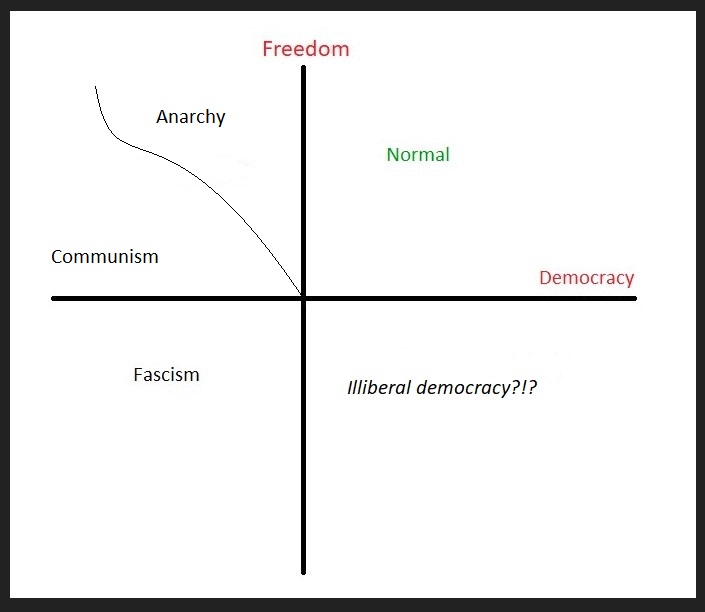
Liberty and democracy are not the same indeed.

Like my left hand is not the same with my right one.

But I need both in order to lead what I consider to be a normal life.

Most people – specially if they get help, can survive without a hand. Or without either liberty or democracy.

But without both… without both hands or without both liberty and democracy… I’d be at somebody else’s mercy!

‘What?!?
What kind of liberty is there under communist rule???’

You see, liberty has two ‘faces’. Two dimensions.
Three, actually, but I’ll be talking about only two of them in this post.

There is the ‘inner liberty’ and there is the ‘socially sanctioned liberty’.

Liberty itself is a human concept.
We have noticed something, wondered about it, named it and then attempted to understand it.
This was, and continues to be, a collective effort.

In some places ‘liberty’ had appeared ‘naturally’.
There was enough liberty naturally sloshing around, hence the circumstances were right for those who had happened to live there at the right time to notice it. Furthermore, the conditions had been right again for the entire community to be able to agree among themselves about the concept and about how to use it/put in practice their new intellectual achievement.

Other places have not been so lucky.
They had been close enough, geographically and socio-historically, to notice the ‘birth of liberty’ but their specific conditions were not ‘right enough’. Many people living there coveted liberty but the local conditions made it impossible for liberty to take hold.
In these places ‘inner liberty’ – individually assumed freedom, can be found a lo more easily than presumed by those unfamiliar with the local realities.

Yet other places had it even worse.
Initially on the path towards liberty – and democracy, they have somehow stumbled.
For whatever causes – internal and/or external, something went wrong. People became disappointed enough to give up not only democracy but also liberty. Including their own, individual inner freedom.

A somewhat intermediary situation constitutes the third abnormal quadrant.
The people involved have given up their liberty – partially, but those running the show continue to use (‘pretendingly’) democracy as a window dressing to hide their true intentions.

The last hundred years or so have been extremely relevant in this matter.
All communist regimes had fallen. Under their own weight.
Most fascist/nazi regimes are no longer with us. Had been so ‘arrogant’ – read self destructive, that their neighbors had to do something about them. Had created so much disruption around them that those whose very existence was endangered had been forced to spring into action.
‘Illiberal democracy’ is a rather new ‘development’. Would be fascist/nazi dictators don’t have all circumstances aligned to make their final move so they have to make do with what there is at their disposal. The local population is ‘despondent’ enough to pay attention to their arguments but not desperate enough to follow them into the ‘unknown’. Hence this oxymoronic abomination.

‘Illiberal democracy’…
On the other hand, the spin doctors promoting illiberal democracies hope to be able to reap the benefits of democracy – the population being ‘rather favorably disposed’ towards the government while having to pay less ‘lip service’ to individual human rights.
A balancing act, with no safety net, which is alluring to those reckless enough to attempt it but which will end up badly. Sooner rather than later.

But the most interesting ‘combination’ – for me, at least, is Anarchy.
In the sense that those who ‘swallow’ the lure are self delusional.
They have somehow convinced themselves that their, own, liberty somehow trumps the liberty of everybody else. They feel so strong, so immune to any outside influence, that they would willingly accept to live in a no rule environment. Without understanding that ‘no rule’ means ‘no holds barred’.
They actually don’t realize that unfettered liberty actually means ‘Each of us free against all others’.
This being the reason for which Anarchy, as a political arrangement, has never survived for long enough to be noticed. Except as a transitory phase.

After Putin ordered the Russian army to invade Ukraine, the rest of the world ‘took sides’.

Some sided with Putin, many extended a helping hand to Ukraine – for various reasons, and others felt their lives have been ‘disturbed’.

This morning I almost blew my top.
I was listening to the radio. A usually decent station. Usually decent and, like all of us, imperfect.

The news anchor was interviewing an ‘expert’. An Ivy League Professor of International Relations and other blah-blahs. I’m not giving their names because I want them forgotten, not even more famous than they already are.

‘Is there any chance for this conflict to end in a negotiated manner?’
‘Yes, if/when both sides will find a mutually acceptable solution.
For example, if the Ukrainian side would accept a referendum in Donbass – and in Crimea, and if the Russian side would accept UN inspectors to validate the process. This would be in line with the general accepted policy of self-determination and ….’

OK, and where’s the difference between what Putin keeps saying and what I’ve just heard?!?

Two non-Ukrainians telling Ukraine what to do…

I’m going to set aside, for now, what these two – wait, three! – people are saying.
That Ukraine, the Ukrainian People, should give up a piece of their land.
My immediate interest lies in ‘who these three guys think they are’?!?

OK, only those who don’t want to see haven’t yet found out that Putin is a dictator.
But for a renowned Ivy League Professor to elaborate a scenario according to which the UN would supervise a referendum where an occupied population would have the opportunity to vote whether they want ‘their’ aggressor to maintain its control over the already occupied territory….

Would that distinguished Professor be comfortable with a referendum – equally supervised by the UN, taking place in California? Which California had already been occupied by Mexico? For which referendum, the Californians were asked where they want to live? Whether Mexico should continue its occupation or should the Mexican army retreat behind the internationally recognized border?

No, I don’t think the Professor has been paid by Putin. Or ‘compensated’ in any other way by the ‘red Satan’.
I just consider he was not paying real attention to what he was saying.
He had just opened his mouth and verbalized what his mind was churning.
The current ‘events’ have disturbed his pleasant existence to such a degree that he really needs this ‘fly in the ointment’ to ‘fly away’.

He is so ‘driven’ by his ‘need’ that he is no longer ‘patient’. He just can’t ‘stop talking’ for long enough to realize how fast Putin’s propaganda machine will make ‘good’ use of his ‘verbalizations’…

‘See, the good Professor confirms what our Beloved Leader has already done.
It’s the Ukrainians who are not reasonable!
They should first change their leadership then come back into Mother Russia’s arms.’

When are we going to understand?

Don’t tell others what to do unless you are prepared to ‘take advice’ yourself…
And, for your own good, don’t trade your future freedom for your present comfort!

Can we do without it?
And if not, how much of it?

– If ‘no government’, then who would pay for the army we need to defend ourselves?

Ooops… you’ve just answered the ‘why does Russia ‘encourage’ the trolls who push ludicrous libertarian ideas’ question. Which trolls attempt to achieve two things at once. Weaken the concept of free government and give libertarian-ism a bad rep. Transforming libertarian-ism into yet another form of extremism.

Let’s get serious and try to find an answer to ‘why, and how much of it, do we need government?’

The boring one would be: ‘Whenever one government falls, another one takes over. The interregnum is always bad so… let’s get used to it’.

‘Getting used to it’ works only for very short expanses of time. Left on its own, all ‘government’ becomes sloppy. So sloppy that it soon becomes such a burden that even the most ‘used to it’ lose their patience.
Government, all of them, need to be kept on a tight leash. Otherwise it will soon cease to perform as intended.

– But if you have to keep it on a tight leash, why bother with any in the first place?
Can’t we do without such a bothersome pet?
What’s the point of the whole thing, anyway?

Instinctively, we’re against ‘government’ for two reasons.
It costs us a lot and it used to represent the interests of the ruler.

Until 10 000 or so years ago, we didn’t need ‘government’.
People were living more or less like the modern day Sun People still do. In the Kalahari desert… small bands roam the place, living of the land. The bands are small – so that they might find sustenance, they don’t have any ‘private’ property to protect, hence they don’t need government. Neither did our ancestors.

As soon as people ‘invented’ agriculture – raising ‘tame’ animals at first and working the land soon after, things had changed dramatically.
The advent of agriculture brought two things. An increased productivity and private property.
Soil has not been born equal. Both pastures and arable land can be good, passable or bad. People wish to have the best. Those who already have it are willing to defend it and those who don’t are willing to steal it.
Increased productivity means that those who produce are able to hire people to protect their ‘means of production’. Their property. As a consequence of fighting for it, some people accumulate more and more of it.
More and more ‘means of productions’ – property, means an ever increasing need for ‘management’ and an ever increasing need for ‘protection’. Soon you have a very ‘wealthy’ owner – the lord of the place, call it what you like or use the name given to him by his subjects, the people who perform the day to day management of the ‘whole-sale property’ and those who protect it from ‘marauders’. Both the ‘managers’ – read ‘government’, and the ‘protectors’ – read ‘army’, used to be under the direct supervision of the local lord.
For a while – for as long as the lord kept everything in balance, everybody was happy. The ‘peasants’ were happy because thy were safe, the ‘managers’ were happy because the wise lord used to appreciate their work and ‘compensated’ them accordingly, the ‘protectors’ were happy because they were well fed and taken care of. According to this article, the great Egyptian had been built by willing people, not by slaves.
https://www.harvardmagazine.com/2003/07/who-built-the-pyramids-html
But soon enough, the lord had become estranged from his people. Government had become an instrument used to extract more and more wealth from the peasants while the army was used to protect the government against the people and, whenever possible, to increase the property of the ruling lord by stealing some from the neighboring ‘lords’. The ’empire’ was born.

But this development could take place only in certain circumstances. Where those below the ruling lord had nothing more to do than to obey. Where the best subject was the disciplined one. Where autonomous thinking and imagination were frown upon by the ruler. Where one mind was enough.
Whenever the ‘environment’ mandated the individuals to remain relatively autonomous, proto-democratic forms of self government had been experimented. From the nomadic pastoralists of the Central Asia to the sailing communities in Ancient Greece and Medieval Scandinavia. Those driving herds or sailing ships need to be a lot more independent-minded that those who just tile the earth. No offense intended here! Simple observation will notice that where the geography of the place had allowed it, somebody had ‘built’ an empire. The Nile Valley, the Middle East, the Russian plain, China, Mexico…
Where ever the geography of the place was fragmented enough by sail-able sea, proto-democratic forms of self-management had been developed. The sailing Ancient Athens versus the land-locked Sparta, Medieval Scandinavia versus Medieval France…

Fast forward to present day.
When we have two forms of government.
The more or less democratic ones. Those under whose ‘guidance’ discussions like the present one can happen.
And the more or less authoritarian ones. Which actively discourage autonomous thinking.

Mind you, there are no ‘perfect’ governments.
There’s no perfectly democratic arrangement anywhere on Earth. Because we are imperfect human beings.
And there’s no ‘perfect’ authoritarian government. Because no government can survive for long if it attempts to centralize the decision power. The closer a government gets to being perfectly authoritarian, the smaller is the crisis needed to topple it. Unless it is supported from the out-side but that’s another topic.

So. It is fairly simple to understand how authoritarian governments fail. Too much ‘stiffness’ makes it impossible for authoritarian governments to evolve. To find solutions for whatever challenges pop up constantly.

But what can go wrong with the collective forms of self-rule? With the participative forms of social self management? Otherwise known as democracies?
Lack of enough popular involvement. Due to a sense of apparent safety, initially. And to a feeling of apparent impotence, soon after.
Lack of enough fore-sight. Those who should know better become distracted, for whatever reasons.
Too much opportunism. More and more of the ‘insiders’ use ‘the power of the government’ to fulfill their own, private, goals instead of making sure that ‘government’ works properly.

And what does that mean?

A government works properly when the community which self manages itself using that particular (form of democratic) government survives in the long run.
When those momentarily working inside the government make things happen for the community at large.
When people, both inside and outside the government, follow, in spirit, Kennedy’s words.

Am I being naive?
Maybe… But wouldn’t it be a nice thing to have?
A nice thing to chase, anyway?

And what better way to chase ‘it’ than voting for people who at least pretend to be honest? Who at least make the ‘right’ noises? Whom we can hold accountable whenever they break their promises?
Instead of voting for those who promise barrels and barrels of ‘pork‘?
https://grammarist.com/idiom/pork-barrel/

Ideological pork or hands-on pork, I don’t know which is worse…

After reading this interview for a second time, I asked myself: ‘Why are you paying so much attention to this guy?!? After all, he doesn’t say anything new…’

Then it hit me!

“Russia” and “we” are two different things.

Russia, the country, cannot indeed afford to “lose”. To ‘lose it’, to be more precise.
Russia will survive, no matter how many more ‘mistakes’ the morons currently running it will commit.

“We”, on the other hand, are the ones who can. And eventually will. Lose. Everything.

And the longer those “we” are allowed by Russia itself to run the Kremlin, the worse it will be.
For everybody. Us – the rest of the world, included.

‘But when will this nightmare end?’

That I don’t know.
All I know is that it will eventually do that. End.

Look at the picture above.
When have you seen anything more British than that?
OK, fake British. Make-believe British. But British nonetheless.

That was which hit me.
That during its entire history, Russia had tried to emulate Britain.
The Russian elite has for ever tried to rise itself to ‘British standards’. From Peter the Great to Putin.
All the while convincing the Russian People that the road they were trundling on was unique…

The sooner the ordinary Russians will figure out that they have been misled – and enough of the elite will understand that British-ness is good only for the Brits, they will make peace.
Among themselves.
With the their Ukrainian cousins.
And with the rest of the world!

Homo Sapiens Sapiens is a species of cultured animals simultaneously capable to place a highly sophisticated IR telescope on an orbit around their native planet, the Earth, and to reduce a country to a pile of rubble.

Interestingly enough, the technology used to accomplish both, the rocket, has been imagined a little more than a century ago.
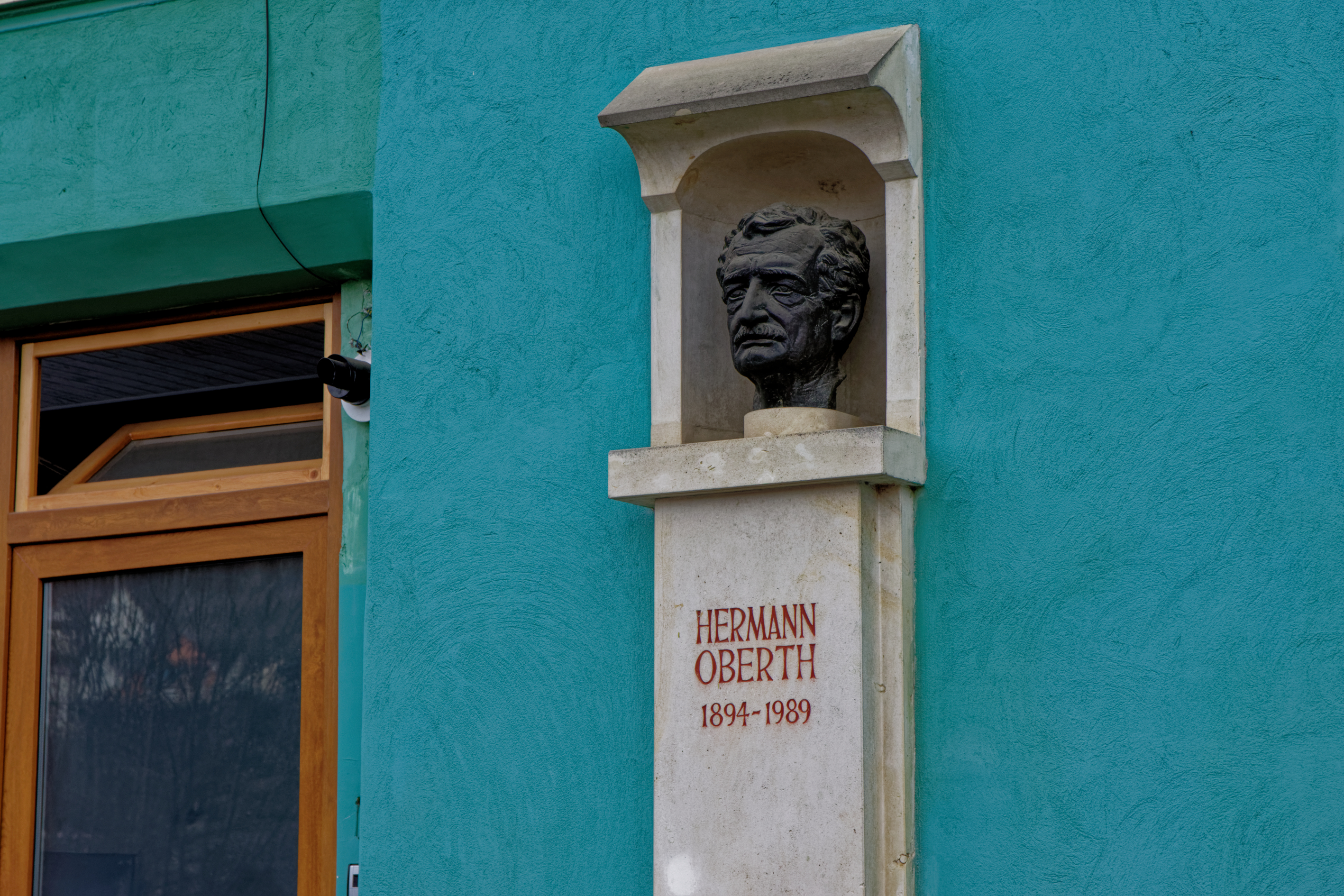
By, among others, Herman Oberth.

He had built his first rocket as a school project, when he was 14. About then he also came up with the concept of a multistaged rocket.
Lack of resources convinced him to study medicine. After only two years he was drafted into the German Imperial Army to serve during WWI. Initially as a foot soldier and then moved to a medical unit. In that period he found enough “spare time” to conduct experiments which had later enabled him to present “designs of a missile using liquid propellant with a range of 290 km to Hermann von Stein, the Prussian Minister of War.“
During WWII he had worked at Peenemunde, were he was awarded a decoration for bravery during an aerial attack, and then at the German WASAG organization developing solid fueled anti-aircraft rockets.

Between the wars he had contributed to a series of experiments in Germany. For one of which he was helped by an 18 years student. Werner von Braun.

After WWII, Oberth moved to Italy to continue, for the Italian Navy, some of the work he had started at WASAG. Then returned to Germany to publish “Mankind into Space, in which he described his ideas for space-based reflecting telescopes, space stations, electric-powered spaceships, and space suits.”

“Oberth eventually came to work for his former student, Wernher von Braun, who was developing space rockets for NASA in Huntsville, Alabama.“

He retired in 1962 and had a brief stint in far right politics (the National Democratic Party of Germany).
He was invited to the US in 1969 to witness the Apollo 11 crew being sent towards the Moon and in October 1985 to view the Space Shuttle Challenger being launched carrying the D-1 Spacelab mission – “the first with German mission management and controlled from the German Space Operations Center“
“However, his primary interest during his retirement years was to turn to more abstract philosophical questions. Most notable among his several books from this period is Primer For Those Who Would Govern.“

Humans, as a species, have harbored the same ‘amount’ of brain for the last 200 000 years. That was when the Homo Sapiens had arrived. But that brain had produced something only about 70 000 years ago. That’s why the second Sapiens was added, by us, to the name of those living since that time. To underline the fact that humans had become ‘fully’ conscious only ‘recently’. That having a big brain was not enough. That becoming fully human also implied self awareness. Wisdom…

Apparently that’s not enough.
After experiencing, first hand, the horrors of WWI such a creative mind as Herman Oberth’s was still capable of building offensive weapons for Hitler.
After experiencing, first hand, the horrors of WWII such a creative mind as Herman Oberth’s was still able of joining an extreme right political party…

After experiencing, first hand, the horrors of WWII at the hands of the nazi, the modern day, post communist, Russia is capable of inflicting the same kind of horrors to their close cousins, the Ukrainians.

When are we going to become Sapiens enough to stop this insanity?
To concentrate our creativity exclusively towards ‘elevating’ purposes?

We have a fact and two conflicting interpretations.

Barrabas is mentioned in al four gospels.
Which has to mean something.

One interpretation posits that the whole story was made up.
That Barrabas himself was not a real person and that there was no such thing as a “custom whereby the Romans would release a condemned prisoner on the occasion of a holy day“
OK, but for what reason?
“to shift the blame for Jesus’ death away from the Roman authorities and onto the shoulders of the Jews“
By the time the gospels had been written, most of the Christians were living under the Roman authority and outside Palestine. So a little benevolence curried from the Romans couldn’t hurt…
Except the Jews…
“Historically, the release of Barabbas at the crowd’s behest, and their subsequent demands to crucify Jesus, have been used to justify anti-Semitism. Many have placed blame for Christ’s death on the Jews, commonly citing Matthew 27:25, in which the crowd shouts, “His blood be on us and on our children!”“

Another interpretation takes the opposite view.
The whole episode is considered to be true as described and interprets Barrabas as “a flesh-and-blood symbol for you and for me. At this moment the Gospel story paints Barabbas as Everyone. The guilty go free, and the Holy One dies. Barabbas becomes the first one who can say, “Jesus died for me.”“

Being an agnostic, somewhat simplifies things. For me.
At the emotional level, I prefer the second interpretation.
At the rational level, I appreciate the effort made by the first interpretation towards finding a logical explanation for the whole thing. Which explanation might actually be true. In the sense that the evangelists, all four of them, might have indeed tried to lessen the Roman responsibility for Christ’s death.

What bothers me is why so many of the readers have accepted the story as plausible?
A crowd to send a bandit to freedom and an innocent to death?
How likely is this?

But what if the crowd was biased?

Well, not the crowd, since the episode was most likely invented.
The individuals who had a message to convey to their readers. To us.

Let’s start with the beginning. The Old Testament.
According to this writing, the covenants were made between God and the people of Israel. Which gave the people of Israel a special place. They were His people. The chosen ones.
The New Testament changes all this. Jesus died for all of those who accept his sacrifice.
The Jews are no longer the only chosen ones.

The way I see it, the ordinary Jews have no problem with this.
I have no knowledge of Jews discriminating against Christians. Except for the claims made by the anti-Semites…
I’m not so sure though about the likes of Caiaphas… “a member of the council when he gave his opinion that Jesus should be put to death “for the people, and that the whole nation perish not”“
After all, Caiaphas – and all those in the same position, were the only ones who had anything to lose as a consequence of Jesus’s teachings.
As a consequence of all people, not only those who followed the likes of Caiaphas, being able to consider themselves as being children of the same God.
Only the likes of Caiaphas had anything to lose from all followers of Christ considering themselves equal among themselves.

Not at all different from what had happened after Luther had nailed his famous theses to the door of the Wittenberg church.
The established hierarchy felt it’s throne was becoming wobbly and reacted forcefully…

What if the real meaning of the whole Barrabas story is for us, the readers of the Gospels, to be extra careful when we evaluate the ‘recommendations’ given to us by the ‘authorities’ of the moment?
Specially when those ‘authorities’ are about to loose their clout…

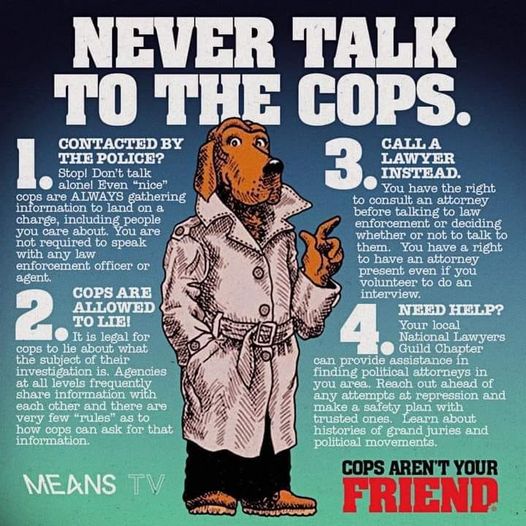
Just came across this meme.

It was shared on a FB-wall and somebody had commented that “Institutionally they are not your friends.”

My ‘jerked’ comment was:

“Institutionally, cops should be your ‘last resort’ friends.

The fact that too many of them are not, and the fact that too many of us consider them, as a category, to be unfriendly, is proof of how dysfunctional our society has become.

Cops used to be ‘unfriendly’ when I grew up. In communist Romania. When the cops were used, by the communist state, to preserve their power. The communist power over the entire society.

In the free countries of today, the cops are the sole barrier separating our persona and private property from the hands of the criminals.

Without their presence…

Or, putting it the other way around, we have but the cops we deserve. Train and motivate them properly and you’ll have good cops!”

At a second glance, I had an inkling.
Is it possible for the whole thing to be nothing more than a ‘marketing campaign’? Organized by the only people interested in increasing litigation?

Interested in altering the relative stability of our political establishment?

The police, by properly performing their duties – the world over, not only in the communist countries, contribute to the political stability of those respective countries.
For the police to properly perform their duties, there must to exist a proper trust between the general population and the police itself. The population must see the police as their friends of last resort while the police must see the general public as both their employer and their responsibility.
The population must be open in their relationship with the police while the police must treat respectfully every individual, including the suspects and the convicts.

In the communist regime I grew up, the police couldn’t fulfill its duties. Exactly between there was a ‘trust’ barrier between the general public and the police. Between the oppressed and the armed hand of the oppressor.
The communist regime I grew up under, in Romania, had eventually collapsed.
Exactly because of the malignant mistrust between the general public – The People, and the government. The police being nothing but a portion of the government itself.

Who is interested in the collapse of the democratic regimes?
Who is mostly interested in wedging apart the government from The People?

No, Putin’s henchmen executing a nuclear attack isn’t the worst case scenario.

This is.

People around the world asking themselves ‘how is it possible for an army belonging to a civilized country – one currently holding the right to veto any UN Security Council decision, might behave in such a horrible manner’?!?
How is it possible for a civilized people, the Russian people, to allow something like this to happen?

After the Cold War had been lost by the Soviet Union, the world over was under the impression that the liberal-democratic and capitalist model had ‘won’. That nobody could any longer advocate for an alternative.
Nine years later, Russia was on the verge of collapse. After following – ineptly, the capitalist mantra – greed is good, the Russian people was almost dying of hunger. That’s how the Russians had fallen under Putin’s spell. He had turned around the Russian economy and earned the gratitude of the ordinary Russian people.

  • But he had done nothing but reigning in Yeltsin’s oligarchs… and got filthy rich in the process!

Yes, but the ordinary Russians had enjoyed, for some 15 years, a life they had never thought possible. A life of relative abundance.
At a relatively low cost. At a cost they were already accustomed with.

The Russian people has been been accustomed, since always, to keep its mouth shut.
That’s so deeply ingrained into their minds that most of them never even dream of speaking up….

  • OK, OK… but what is the link between your ‘worst case scenario’ and the Russian people being unable to ‘speak up’?!?

Putin is able to do what he is currently doing because nobody is challenging his decisions.
Nobody inside Russia…

Because nobody inside Russia is challenging his decisions – and a ‘handful’ of ‘dimwits’ actually executes those decisions, the rest of the world is under the impression that the Russian people is OK with what’s going on in Ukraine.

  • And who are you to tell us that ‘regular Ivan’ would challenge Putin’s decisions if he had any opportunity?!?

I didn’t say that!
If you are under that impression, I’m afraid I haven’t made my point yet.

You see, what we really need to do is to ‘fold’ the Russian people into our ‘Weltanschauung’.
To welcome them into our social and cultural space.

The current war will end. One way or another.
Putin will die. Sooner or later.
But until the Russian people will learn that with us is far better that against us… we – all of us, will live on a ‘tight-rope’.

My impression, watching the horrors committed by the Russian army, is that those horrors have been ordered by Putin for one reason. And one reason only.

To convince us, the rest of the world, that the Russian people is nothing but a bunch of savages.
That they deserve no compassion.

That their leader – Putin, must be offered an easy way out – at the expense of the Ukrainians, and that the Russian people must be left to rot at his disposal.
That the Russian people deserves nothing. Nothing but to be left at the mercy of their ruthless and mind-twisting sheep-master.

That is the worst case scenario.
Us accepting that another people, any people, is worthless.

Putin’s followers – Le Pen and Orban being but the most obvious examples, are eagerly waiting for that to happen.

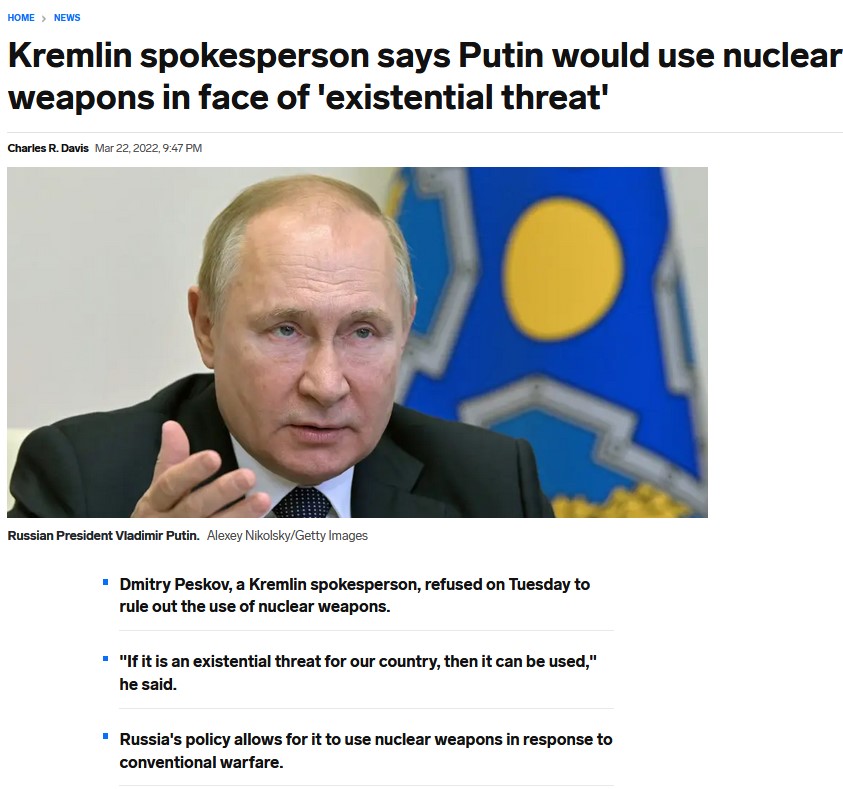
Putin advisers ‘too afraid to tell him the truth’ on Ukraine: US official
“Putin didn’t even know his military was using and losing conscripts in Ukraine, showing a clear breakdown in the flow of accurate information to the Russian president,” the official said.

There are two ‘things’ which collide here.

Dictators tend to drive away really competent people and those remaining tend to put the entire blame on the ‘guy on top’.

As many of you already know, I grew up in the communist Romania. Ruled by Nicolae Ceausescu, the dictator who ended up being shot on Christmas Day, 1989.

At 28, I was already familiar with the notion of ‘yes-people’. Decision makers who ruled our daily lives were surrounded by people who provided the ‘right’ answers, effectively isolating the decision makers from the reality.
This ‘development’ being the fundamental explanation for how all dictatorial regimes, including the communist ones, ended up in abject failure. For ‘how’, not for ‘why’ – but this is another issue.

After Ceausescu was toppled, I was absolutely flabbergasted when I first heard

‘He didn’t know what was going on. Had his close advisers kept him in touch with the real situation, he would have taken the proper decisions to rectify things’

Really?!?

Who had selected his ‘close advisers’?!?

Who prevented him from asking ‘a second opinion’? From stepping out of his office and ….

Who, step by step, had ‘created’ the ‘atmosphere’ which had driven all those unwilling to lick where ‘he’ had spat to flee, living ‘him’ surrounded by sycophants?

Sycophants attempting, after Ceausescu had been toppled, to pile all the blame on his shoulders…

I’m afraid we are witnessing a replay, with Putin as the lead character.

When I was six, my father took me to a German kinder-garden.

He was learning German, at 35, and thought I should start earlier.
In the end, I didn’t exactly learn the language but during the process I met a lot of nice German speaking people.

At 16 I read

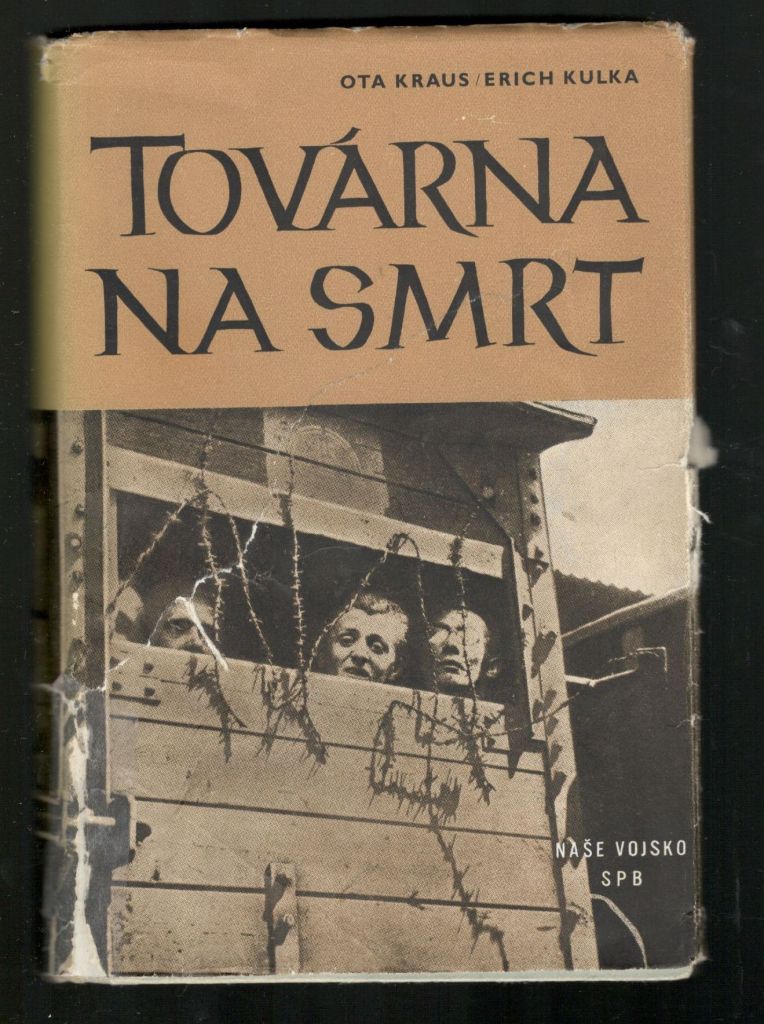
The Death Factory, a book about the Auschwitz concentration camp

Well, actually it was translated in Romanian but the original cover is far more suggestive for non-Romanians.

That was when I learned to distinguish between a people as a whole and the atrocities committed by a minority.

As I grew up, under communist rule, I noticed the ‘little compromises’ my parents had to make in order to provide a better life for me. The small bribes offered whenever ‘necessary’, not speaking up their minds in ‘official settings’, allowing stupid, but powerful, individuals to boss them around…
As a young adult, I understood how those small compromises, made by almost all of us, added up and eventually caused the entire regime to collapse. Eaten up, from inside, by institutionalized corruption.

As a no longer young adult, after the regime change, I noticed that ‘compromise’ was so entrenched in our habit that it had been carried over into the new regime. As if the new found liberty had been interpreted as the freedom to accept ‘un-earned benefits’ from whoever offered them. In exchange for things which were not ours to give…
The same was happening in other ex-communist countries. The closer to Moscow, the more intense the phenomenon.

That was when I learned to dissociate corruption from any particular political regimen.

Soon after that I learned the international dimension of the whole thing.

“BONN, Germany (AP) _ Germany is set to outlaw tax deductions for bribes paid to foreign officials, falling in line with a U.S.-led drive to fight corruption and promote fair competition.
The change is part of proposed tax reforms presented Monday by the new center-left government of Chancellor Gerhard Schroeder. Parliament is expected to approve the measure before the end of the year.
Currently, kickbacks paid by German companies abroad or at home to win contracts are tax deductible as legitimate business expenses unless the person who made the payout is found out and convicted of bribery. In practice, that rarely happens
.”

AP NEWS, November 10, 1998

Gerhard Schroeder, who had called „the Russian president a “flawless democrat””, „has been tapped to join the Gazprom supervisory board”.

That was when I realized how many of those living inside a country have no effing idea about what some of their compatriots do when ‘working’ abroad.

A few short years later, a Romanian president had the audacity to shout ‘the emperor is naked’.

“Corruption belongs to both the public and private sectors, and the president has said he does not shift responsibility to anyone, but that it must be “shared and assumed.”
An official cannot be corrupted if there is no one to pay a bribe, just as a ministry cannot pay 50% more for a contract if there is no consultant to do an expertise in this regard, Basescu explained.
“Let’s get out of the hypocrisy. If there is corruption, the state alone cannot be corrupted, it has a partner. The state cannot be alone. It has a partner and this is the private economy.”
Basescu was present yesterday at the launch of the Romanian Competitiveness Report prepared by AmCham.
“

Claudiu Medrega, Ziarul Financiar, 15/12/2011

That was when I learned that democracy alone is not enough to cure corruption. That democracy can also be eaten from the inside by this worm. If ‘the people’ do not pay enough attention!

This morning, on top of the already ‘normal’ news from the Ukrainian front, I learned that

“Last week, Boris Romanchenko, a 96-year-old Holocaust survivor, was killed when shelling hit his ordinary flat in the war-ravaged Ukrainian city of Kharkiv”
“The multi-storey apartment building where Romanchenko lived was shelled and caught on fire,” said the statement.
Kharkiv, Ukraine’s second largest city, has been under heavy fire from Russian artillery throughout the invasion, which Russian President Vladimir Putin calls a “special military operation” necessary to disarm and “denazify” its neighbour.”

Reuters, March 22, 2022

That was when I understood that ‘what goes around, comes around’ is driven by our bad choices.
By our unwillingness to make good what we have already learned from past mistakes.

Should have learned from past mistakes…

Really guys?
The Red Army had spilled its blood to free the people herded to be killed at Auschwitz and a survivor from Auschwitz is killed by a Russian bomb attempting to ‘denazify’ Ukraine?!?
Which Ukraine wanted nothing but to join the EU and NATO?
But couldn’t! Crimea was occupied while Donetsk and Luhansk have rebelled against the central government… and NATO – like all other clear headed alliances do not admit new members which are already involved in ‘border disputes’.

“Putin says Russia’s concerns expressed over three decades about NATO’s expansion were dismissed by the West, and post-Soviet Russia was humiliated after the 1991 fall of the Soviet Union.”
He says NATO, as an instrument of the United States, was building up its military on Ukraine’s territory in a way that threatened Russia.
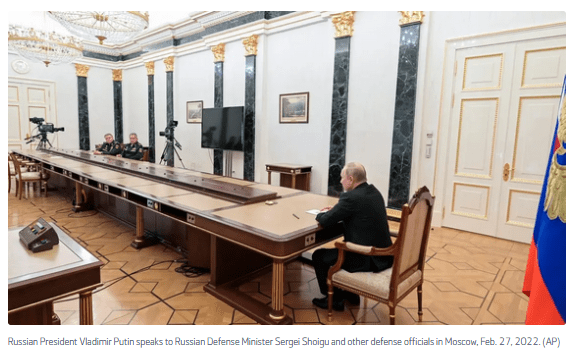
On March 11, Russia’s Defence Minister Sergei Shoigu told Putin the West was beefing up military forces close to Russia’s Western borders. Putin asked Shoigu to prepare a report on how to respond
.”

“For almost 25 years, the West believed Russia could be tamed by diplomacy and trade to maintain stability and security in Europe. In 1997, NATO and Russia signed a “founding act” that was designed to build trust and limit both sides’ force presence in eastern Europe.
The alliance also sought to build a partnership with Russia, which took part in NATO exercises in the Baltic as recently as 2012, according to retired U.S. Admiral James Foggo, who commanded U.S. and NATO fleets in Europe for almost a decade until 2020.

After Russia annexed Crimea in 2014… NATO created small, multinational combat units in Poland and the three Baltic states, which serve as a forward presence to deter Moscow. But the force numbers are designed not to violate the “founding act,” which has hindered NATO’s ability to move troops into the Baltics and Poland on a permanent basis.“

So. Putin, spooked by a NATO who doesn’t dare to violate the ‘founding act’ – not even after Russia had occupied Crimea, orders the Russian Army to demilitarize and denazify a country whose independence and integrity was guaranteed by the Budapest Memorandum.

And, caught in the middle, a man whose life had been saved – some 75 years ago, by the Red Army ends up being killed by the Russian one…

Simply because we didn’t pay attention.
And allowed what went around to come back!

Boris Romantschenko of Ukraine, along with five other former prisoners, renews the oath of Buchenwald, from April 19, 1945, at the Buchenwald Concentration Camp Memorial, in Weimar, Germany, April 12, 2015. Picture taken April 12, 2015. Michael Reichel – Buchenwald and Mittelbau-Dora Memorials Foundation/Handout via REUTERS/File Photo