We’ve arrived at a very interesting point in our evolution as a cultural species.
Having more or less solved our existential problems – food, shelter, companionship, we’re hard at work towards building ‘self esteem’.
Putting it in Abraham Maslow’s terms, a good portion of the humankind – most of those active on the internet, the netizens, have reached the ‘self-actualization’ stage.
The problem being that we’re so preoccupied with ‘expressing our true selves’ that almost nobody listens anymore. Truly listens…
The kind of listening needed when we try to learn something. To understand what’s going on.
As opposed to the listening used when educating somebody.
When attempting to learn, we listen opening our minds. We let information in and structure it afterwards. When educating people, our listening is focused. We take information in with the sole goal of detecting dissent – in order to stifle it, and openings to exploit in our quest to implant our opinion about the world in the minds of our ‘targets’.
Take a breath. And exhale carefully not to inflate another bubble. There are already a lot of them waiting to burst.
What if our self awareness, otherwise known as conscience, has evolved in order to understand, accept and mitigate randomness?
There’s no evolution – hence no life, without randomness. Yet life, anyway you look at it, is about maintaining a certain degree of order.
Whenever there’s so much randomness that life can no longer adapt to it… evolution stops. Whenever structures become so big/rigid that they find it harder and harder to evolve, they eventually succumb to an otherwise survivable amount of randomness. Dinosaurs and too big to fail corporations versus mice and flexible operators.
And to avoid the deepest pitfall we’ll encounter during this never ending journey – randomness will always be wider than our individual ability to encompass it, we must keep remembering that conscience is selfish. Untrained, it is more about protecting itself than about helping the entire ‘individual’ to survive.
‘What?!?’
Yes, it’s hard to believe! But what other explanation is there for so many of us continuing to smoke after finding out, the hard way, that this habit might actually kill us? I use this example simply because I still remember the cigarette I smoked when I last visited the grave where rests a woman I loved dearly. And who is no longer with us because of lung cancer.
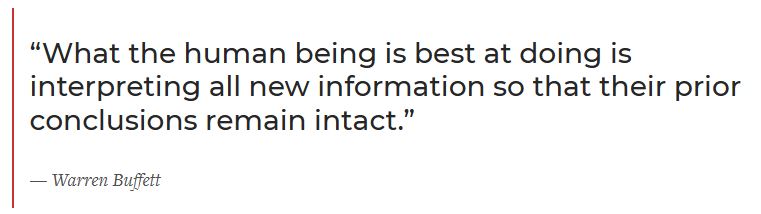
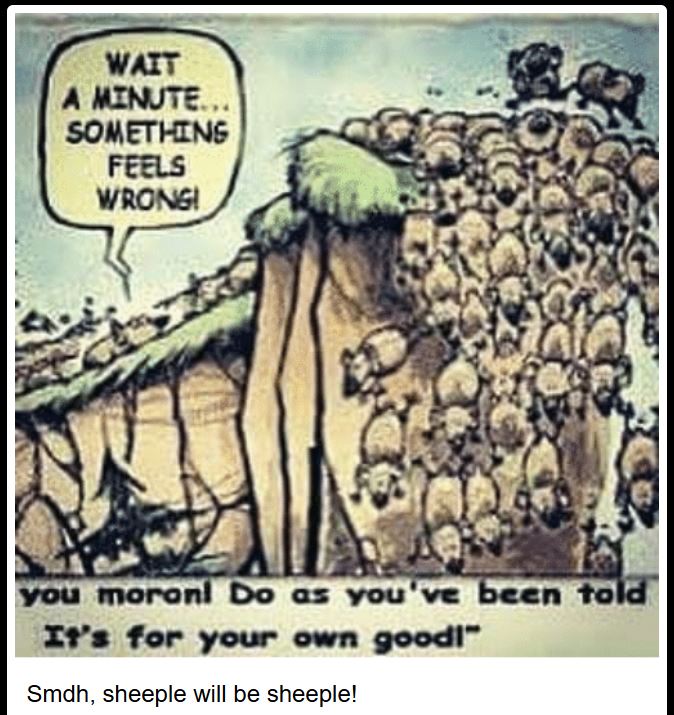
Too often our conscience will prefer to rationalize away new information than accept that past choices could have been better.
I’m certain all of you are already too familiar with ‘confirmation bias‘.
SARS-CoV 2 lock-downs have intensified the already heated discussion about ‘rights’. About “our rights”. Which have to be defended “at all costs”.
The way I see it, rights can be evaluated from two directions. As ‘gifts’. Either gifted to us by ‘higher authorities’ or conquered for us by our ancestors. Or as ‘procedures’. Elaborated in time by society and coined into law by our wise predecessors. Who had duly noticed that societies which respect certain rights work way better than those who don’t.
After all, societies are nothing but meta-organisms. Which, like all other organisms, function for only as long as the components interact according to certain, and very specific, rules. The ‘better’ the rules, the better the organism works.
In this sense, ‘rights’ are the code we use when interacting among ourselves. The rules we use when cooperating towards the well being of the society.
You don’t care about the society? Only about ‘your rights’?
OK, but if the society, as a whole, doesn’t work properly, who’s going to respect ‘your rights’? Who’s going to help you when a bully will try to snatch ‘your rights’ away from you? And bullies trying to separate you from ‘your rights’ are the most certain occurrence whenever societies cease to function properly. Whenever the individual members of a society no longer respect each-other enough to collectively uphold their rights. Their rights.
Knowledge is being constantly (re)generated by us.
Everything we know, individually and collectively, has been first felt, then interpreted and finally communicated by us.
For something which has happened inside our sensorial sphere to become a piece of information we have to first notice it, then evaluate it and, finally, deem it important enough to remember. To codify it as information.
For something to make sense – whatever that means, the information we have about that something has to fit in to the rest of information we already have.
These three premises, which I hold to be self evident, lead me to the conclusion that:
Individual human beings will always have but a limited knowledge/understanding about/of the world. A group of people are able to develop an aggregate understanding of the world which might be wider than those belonging to the individual members. In time, a community of people will cobble together an even more complex weltanschauung. But still an incomplete one. For no other reason than the fact that the sum of a finite number of finite quantities will always be finite.
Consequences.
Since our understanding of the world is finite, determinism doesn’t make sense. This being the reason for all authoritarian regimes/monopolistic arrangements caving in sooner rather than later. For the simple reason that those regimes/monopolies use but the brain power of those in power and waste the rest. Our understanding of the world being finite, there is no way to demonstrate or refute God.
Which God is, anyway, nothing but a figment of our imagination. Because of the very reasons I mentioned above. Even if God itself would appear right now in a public square and on all the TV monitors in the world, the impression/understanding of him we would be left with after the experience would be of our own making.
Incomplete and inexact. Heavily dependent on everything else we already know.
“Friedrich Engels in a thinker’s pose The four-meter-tall bronze sculpture of the other philosopher of communism, Friedrich Engels, is a bit smaller than the planned Marx statue in Trier. This Engels monument in his hometown, Wuppertal, was also made by a Chinese artist and offered by the government of China in 2014.”
I grew up under communist rule. We studied marxism in school. At some point, I was about 16, the teacher asked us about the relative merits of the different brands of materialism he had mentioned during his classes. My answer was ‘dialectic materialism is better than all others because those who apply it into practice constantly gouge the consequences of their (political) decisions and fine tune policies accordingly’. Some 15 years later the communist lager had imploded simply because those who were supposed to act in a dialectic manner had failed to put the principle in practice. Coming back to the original question, ‘was Marx a determinist’, the answer is yes. Marx’s dialectics is only a procedure. Meant to help the communists exercise the dictatorship mandated by Marx in the name of the proletariat. And dictatorships are determinist by definition. Why mandate one if you are not convinced that things can be ruled? For the long run and in a comprehensive manner?
Given my experience of living under communist rule, I can tell you that too much consistency is bad. Having to toe the line is dangerous. For individuals and for societies, as a whole. Communism did fall, you know.
On the other hand… some consistency is needed.
Let me give you an example.
The whole world is asking China to do ‘the right thing’ about its wet markets. In Bill Maher’s terms “eating bats is bat-shit crazy“.
Why?!?
Because of what science tells us. That bats are full of corona-viruses, which are bad for us.
That’s what we say, anyway. Those of us who side with ‘science’… And who ask the Chinese to give up their traditions.
Let’s examine the problem from the other side.
‘We’ve been eating bats for ages. And nothing happened to us. Now you say that this flu like disease is produced by viruses who live in bats. Why would we believe you – and give up eating bats, if you don’t believe your own scientists? And balk when they tell you to quit smoking. To stop piling plastic into landfills. To stop heating up the planet.
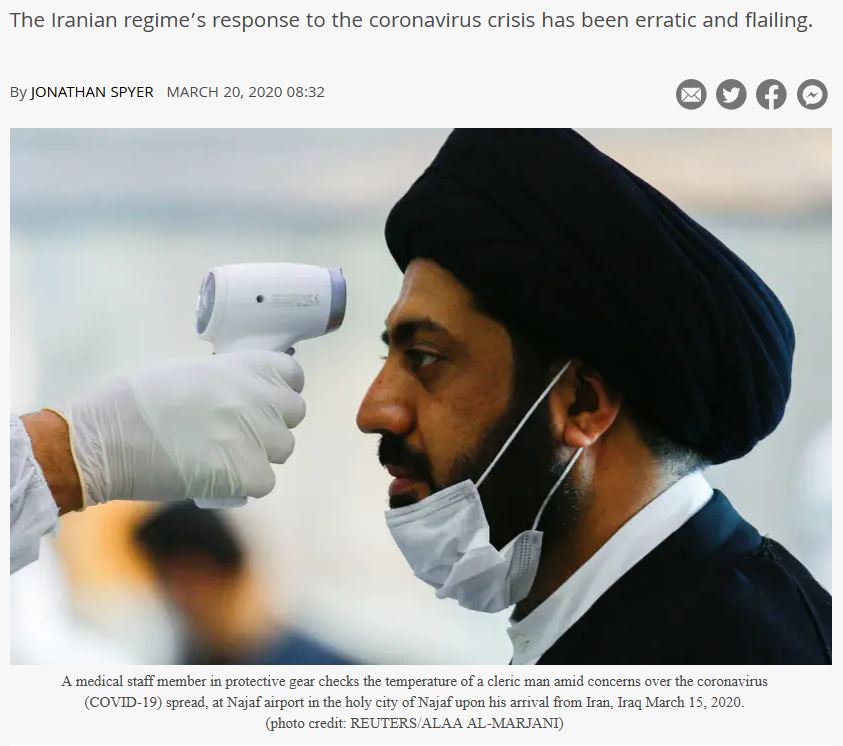
If you live on the Moon, or if enough time had passed since I’ve written this, click on the picture to read Jonathan Spyer’s excellent rendition of the facts which have driven me to post this.
Or you may proceed.
For me, there is a striking resemblance between what’s going on in Iran and what would happen in a hardcore libertarian society.
The mullahs are concerned only with spreading/enforcing their faith and consider everything else will take care of itself.
The extreme libertarians are concerned exclusively with upholding their understanding of liberty and consider that everything else would take care of itself. By itself.
And I’m convinced that everything will indeed take of itself! After all, life has continued after communism had failed. The communist leaders had been professedly concerned exclusively with enforcing their understanding of equality. And convinced that everything else would had taken care of itself. If only that equality could have been instated…
Yet I don’t think communism will be missed. By those who had experienced it hard enough to understand it…
The last proposition also makes a lot of sense. Democracy, when functional, lowers ‘political temperature’ to levels where individual members of the community/nation may focus on identifying and solving the problems which might endanger the survival of the entire social organism. Otherwise put, democracy dramatically increases the survival chances of the communities who are wise enough to maintain its true character. Who are wise enough to make it work. Properly.
What prompted me to believe such a thing? Look back in history. All authoritarian regimes – a.k.a. ’empires’, have eventually crumbled under their own weight while no democracy has ever ‘folded its hand’ before loosing first its democratic character.
Which brings us to ‘what is the gist of democracy’? Or, in ter Haar’s terms, who is responsible for maintaining it? Who ‘runs’ the “conflict management within states”?
This is where I part ways with ter Haar. For me, democracy is something natural. It has to come from within. There is no one who can, or should, manage it. Administer it – as in accurately counting the ballots and making sure that rules are followed, obviously. Actually managing the process?!?. No! That would defeat the very purpose of the democratic process. For the people to find its own way.
But there are so many who can spoil it… Willingly or unwillingly!
First among them being those who decide to stay at home. To keep mum. For whatever reason!
Because those who keep mum are those who allow the ‘pirates’ to ‘steal’ the helm. Just as keeping quiet is the worst attitude when somebody bullies you, staying at home on election day empowers those with less than fully democratic attitudes to ascend to power.
How often do you hear this expression? Are you OK with it? Because you’ve grown accustomed with it or because you are OK with the idea of politics being a contest? A game to be won?
In a certain context, I’ve been asked which game is a more ‘fitting description’ of politics. Chess or Go?
Both being, as I’m sure you already know, strategic games where all ‘tactical’ information is above the board, where the scope is to ‘control the territory through the smart use of available resources’ and where neither of the competitors have any real idea of what their opponent might have in mind. Yes, there are rules and limitations. Of course. So each of them are able to divine a ‘probable course of action’ but …
Going back to politics, I’ll just quote myself:
“Politics like Go… very interesting question. Go is a game. Something to play with. And play is very important, indeed. Through play, we hone skills used in real life. When playing, it doesn’t matter whether you win or loose. There’s something to be learned in both situations. While in real life, loosing is not an option. In playing, all that matters is to participate. In life, all that matters is to survive. When playing, we improve our skills by competing against each-other. In life, we survive by helping each-other. In this sense, politics is an exercise of cooperation more than a competition. A process through which the whole community finds its way forward rather than a beauty pageant where the next beauty queen is nominated to carry the torch through the dark. For a while… The point being that all community/nations which had allowed personal interest – lust for wealth/power, to trump the collective need to survive have eventually collapsed. From Ancient Rome to Soviet Russia. This being where Marx was hugely mistaken. While he understood history as a succession of class struggles – to be ended by the mother of all dictatorships, in reality is was a continuous evolution/honing of cooperation. From slavery to feudalism and to democratic capitalism people learned to do more and more things together. The status of the individual – of all the individual members of any given society, gradually improved while the communities have become more resilient and more productive. And all attempts to revert to more ‘centralized’ alternatives – no matter how the ‘winners’ were supposed to be determined, have failed. All political and economical dictatorships – authoritarian-isms and monopolistic situations, have crumbled. Not before incurring a lot of pain to those who allowed them to happen, helas. Contestants and spectators alike.”
Now go fight for your favorite political figure. And allow hate to alter your perceptions.




 nicichiarasa