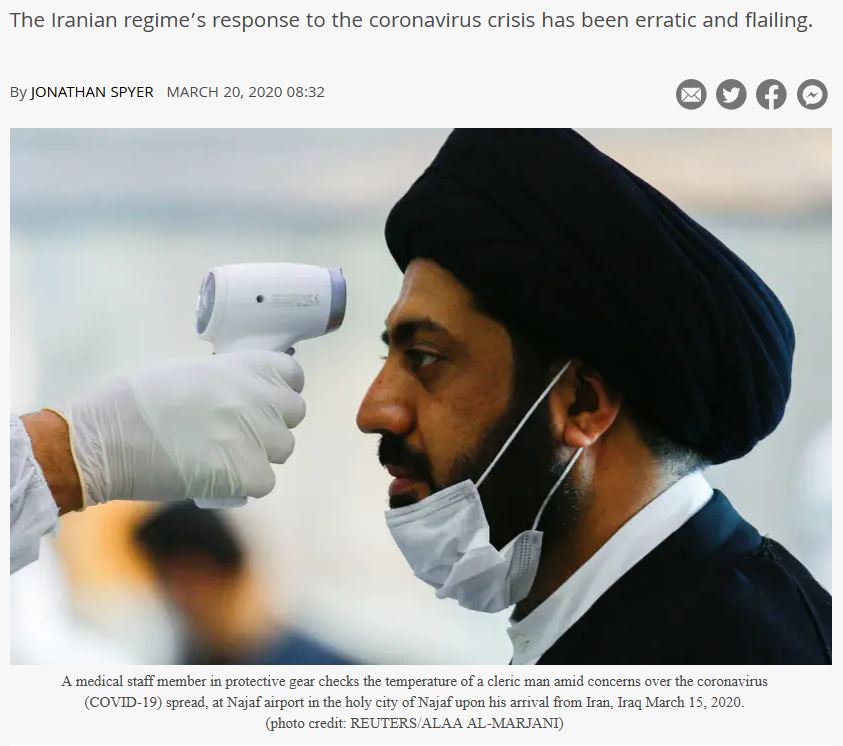
If you live on the Moon, or if enough time had passed since I’ve written this, click on the picture to read Jonathan Spyer’s excellent rendition of the facts which have driven me to post this.
Or you may proceed.
For me, there is a striking resemblance between what’s going on in Iran and what would happen in a hardcore libertarian society.
The mullahs are concerned only with spreading/enforcing their faith and consider everything else will take care of itself.
The extreme libertarians are concerned exclusively with upholding their understanding of liberty and consider that everything else would take care of itself. By itself.
And I’m convinced that everything will indeed take of itself! After all, life has continued after communism had failed. The communist leaders had been professedly concerned exclusively with enforcing their understanding of equality. And convinced that everything else would had taken care of itself. If only that equality could have been instated…
Yet I don’t think communism will be missed. By those who had experienced it hard enough to understand it…
The last proposition also makes a lot of sense. Democracy, when functional, lowers ‘political temperature’ to levels where individual members of the community/nation may focus on identifying and solving the problems which might endanger the survival of the entire social organism. Otherwise put, democracy dramatically increases the survival chances of the communities who are wise enough to maintain its true character. Who are wise enough to make it work. Properly.
What prompted me to believe such a thing? Look back in history. All authoritarian regimes – a.k.a. ’empires’, have eventually crumbled under their own weight while no democracy has ever ‘folded its hand’ before loosing first its democratic character.
Which brings us to ‘what is the gist of democracy’? Or, in ter Haar’s terms, who is responsible for maintaining it? Who ‘runs’ the “conflict management within states”?
This is where I part ways with ter Haar. For me, democracy is something natural. It has to come from within. There is no one who can, or should, manage it. Administer it – as in accurately counting the ballots and making sure that rules are followed, obviously. Actually managing the process?!?. No! That would defeat the very purpose of the democratic process. For the people to find its own way.
But there are so many who can spoil it… Willingly or unwillingly!
First among them being those who decide to stay at home. To keep mum. For whatever reason!
Because those who keep mum are those who allow the ‘pirates’ to ‘steal’ the helm. Just as keeping quiet is the worst attitude when somebody bullies you, staying at home on election day empowers those with less than fully democratic attitudes to ascend to power.
How often do you hear this expression? Are you OK with it? Because you’ve grown accustomed with it or because you are OK with the idea of politics being a contest? A game to be won?
In a certain context, I’ve been asked which game is a more ‘fitting description’ of politics. Chess or Go?
Both being, as I’m sure you already know, strategic games where all ‘tactical’ information is above the board, where the scope is to ‘control the territory through the smart use of available resources’ and where neither of the competitors have any real idea of what their opponent might have in mind. Yes, there are rules and limitations. Of course. So each of them are able to divine a ‘probable course of action’ but …
Going back to politics, I’ll just quote myself:
“Politics like Go… very interesting question. Go is a game. Something to play with. And play is very important, indeed. Through play, we hone skills used in real life. When playing, it doesn’t matter whether you win or loose. There’s something to be learned in both situations. While in real life, loosing is not an option. In playing, all that matters is to participate. In life, all that matters is to survive. When playing, we improve our skills by competing against each-other. In life, we survive by helping each-other. In this sense, politics is an exercise of cooperation more than a competition. A process through which the whole community finds its way forward rather than a beauty pageant where the next beauty queen is nominated to carry the torch through the dark. For a while… The point being that all community/nations which had allowed personal interest – lust for wealth/power, to trump the collective need to survive have eventually collapsed. From Ancient Rome to Soviet Russia. This being where Marx was hugely mistaken. While he understood history as a succession of class struggles – to be ended by the mother of all dictatorships, in reality is was a continuous evolution/honing of cooperation. From slavery to feudalism and to democratic capitalism people learned to do more and more things together. The status of the individual – of all the individual members of any given society, gradually improved while the communities have become more resilient and more productive. And all attempts to revert to more ‘centralized’ alternatives – no matter how the ‘winners’ were supposed to be determined, have failed. All political and economical dictatorships – authoritarian-isms and monopolistic situations, have crumbled. Not before incurring a lot of pain to those who allowed them to happen, helas. Contestants and spectators alike.”
Now go fight for your favorite political figure. And allow hate to alter your perceptions.
My previous post was about the parallel fate endured by those who had experienced nazism/fascism and/or communism.
My point being that nazism/fascism had been powered by the feelings of those attempting to regain their previous, higher, status while communism had been powered by the feelings of those not allowed to ‘move forward’ by the social constraints paralyzing their societies.
Currently, people are ‘confused’. Some say communism had been better than nazism – for various reasons. Others find various excuses for the way both regimes had treated the general population and, mainly, the ‘dissidents’. Or, specially for the nazi, the ‘differents’. There is, though, a convergence point. Nominally, at least. All sides declaratively abhor the violence employed by both regimes.
To add to the confusion, after the 2007 financial meltdown, more and more ‘concerned individuals’ have fingered capitalism as the main culprit for all the tragedies experienced by humankind in the last century and a half.
For me, this is the straw which will break the camel’s back.
So. Nazism/fascism – which is nothing but a ‘condensed’ form of corporatism, is bad. Communism – a similarly centralized manner of social decision making, only differently sold to differently feeling masses, is also bad. Capitalism – a decentralized manner of resource allocation, is considered to be more or less equivalent to both nazism/fascism and communism. All three of them have been declared equally criminal…
Then what? What are we to do next? Hang ourselves in despair? Reheat either fascism or communism?
Or look forward than our own noses?
Both those who had followed Hitler and Lenin/Stalin were feeling desperate. Desperation drives you to do stupid things. And there are plenty of unscrupulous people willing to profit from this kind of situations.
Do we really want to prevent ‘unpleasant’ experiences? Then we need to go beyond blaming the likes of Hitler and Lenin/Stalin. They should be dealt what’s rightfully theirs, no doubt about that. But we also need to make sure that the ‘run of the mill’, the ordinary people who make things work in this world, no longer feel desperate.
How to do that? Taking into account that contemporary capitalism seems to be faltering?
What was the common thing between nazism/fascism and communism? The fact that decision making was concentrated in a very small number of hands? Which had led to both regimes ending up in abysmal failure?
What is the apparently unstoppable trend in our contemporary societies? The apparently unstoppable wealth polarization?
Then let’s tax ourselves out … America worked fine during the ’50s and ’60, when the highest marginal tax was 91%… Yeah, only those years had been followed by stagflation. And let me remind you that communism can also be interpreted as ‘100% tax followed by a comprehensive redistribution’. And it also failed.
Then how about ‘libertarianism’? No taxes, no government…
But how about less extremism? Of any kind?
How about remembering that liberal capitalism has made possible all that we have today? Liberal as in free-market capitalism, of course.
Free market as in competition working both ways. Entrepreneurs competing among themselves for clients AND resources. The workforce being, of course, a resource. The ‘compensated’ workforce representing the bulk of the clients…
What we seem to have forgotten today is that the circle must be round. If we want the ‘show to go on’, of course.
If some of us concentrate too much control over the rest of us – either way, the circle becomes lopsided. And everybody has everything to loose.
No matter whether this happens as a consequence of nazism/fascism, communism or even capitalism.
At least, capitalism has proved to be manageable. Let’s make it work, again.
People may find themselves in three situations. ‘Coasting’, trying to climb back up to their former position or hitting a glass ceiling.
All societies – past, present and future, were, are and will forever be composed of various mixtures of ‘coasters’, ‘back climbers’ and ‘glass ceiling hitters’.
Please note that I’m dealing in self-referentials here. This is about how individual people describe themselves when speaking to themselves. The coasters enjoy the life they had designed/expected for themselves. The ‘back-climbers’ attempt to regain the position/status they believe it was rightfully theirs but had been robbed of in circumstances outside their control. The ‘glass ceiling hitters’ are… busy hitting the famous glass ceiling.
If a society is composed of a ‘healthy’ number of coasters combined with a manageable number of ‘back-climbers’/’glass ceiling hitters’ then the frustration felt by the latter – which tends to tear apart the social fabric, can be compensated by the sheer mass/inertia of the joy experienced by the former. Hence the society can be described as being ‘stable’.
Whenever the ‘back climbers’ or the ‘glass ceiling hitters’ get the upper hand, things start to unravel. Or to fall apart…
To understand what I’m driving at, please consider the pre-revolutionary Russia and the German society after WWI.
Russia was an extremely hierarchical social organism. The birth-place was ‘definitive’. And most of them led to very unpleasant lives. The vast majority of the population, from muzhiks to intelligentsia, could not break through the glass ceilings allocated to each of them, at birth.
The defeated German population had found itself in a very unpleasant situation. After having been told they had been instrumental in preserving order in Europe – as the back bone of the army who had defeated Napoleon Bonaparte and kept in check Napoleon III, they found themselves at the receiving end of history… After their fathers had witnessed the Parisians eating their zoo animals during the 1870 siege, the Germans were reduced to hunting food scraps themselves.
Hence the difference between communism and nazism. Both equally authoritarian in nature, each of them springs from completely different social circumstances. Which explains why ‘progressives’ have such a high tolerance for communism…
While the ‘back climbers’ attempt only to reinstate the order they were accustomed to – order which has already been proven dysfunctional by what had happened, the ‘glass ceiling breakers’ are always attempting to open new roads. Very enticing from the ‘progressive’ point of view…
Fact is that both communism and nazism/fascism are artificial. Figments of frustrated intellectual imagination. Both ideologies have been put together by thinkers and only followed by ordinary, desperate people.
“Please” is an attempt to maximize your chances to get something. “Thank you” is an attempt to maximize your chances at ‘second helpings’. “I’m sorry” is an attempt to ‘reconnect’ after committing a ‘blunder’.
All of them, simultaneously, serve the individual uttering them and knit the community.
But there’s something which sets one of them apart. While “please” and “thank you’ are ‘upfront’, “I’m sorry” has a more ‘hidden’ nature. And is a lot less used…
Both “please” and “thank you” have a very clear message. “I want/am grateful for something’ and ‘I acknowledge the fact that I cannot function/exist by myself’.
“I’m sorry” is far more complex and a lot less upfront. ‘I acknowledge not only that something went wrong but also that I have anything to do with the occurrence’. And ‘please do not banish me for what I have done’!
If we dig deeper, we’ll find some more ‘intricacies’.
“Please” and “Thank you” are ‘face to face’. You know what you want/are grateful for and by uttering them you transmit that information to your audience. Those who might fulfill your wishes or have already done that.
“I’m sorry” identifies you as the ‘culprit’. Or, even worse, tells the ‘victim’ that something nasty is going to happen.
It is here that things become really interesting. Conscience is a function. A feature which helps the individual. To survive and to thrive. In order to do that, conscience must – first and foremost, to take care of itself. To protect and cherish itself. More about how it does that in my next posts. The point of the present one being that is far easier for ‘conscience’ to ‘please’ and ‘thank’ rather than to ‘apologize’.
First of all, ‘gratification’. 1.0 versus 2.0. Getting what you want/need versus avoiding punishment. Which is never as direct.
The ‘buried head’ fallacy. ‘What if/maybe they never find out’? ‘Who did it’ or even that it had happened at all …
The ‘I cannot afford to appear weak’ fallacy. Or the ‘I cannot afford to accept having been wrong’ situation.
That’s why it is far easier to say ‘I’m sorry’ after stepping on somebody’s toe than to leave a sorry note on somebody’s windshield after denting their fender in an unsupervised parking lot. That’s why it is far easier to apologize to a a coworker than to admit guilt, as a CEO, in a shareholders meeting. That is why it is almost inconceivable for a dictator to publicly admit an error which had been committed under their watch.
Some people actually do something – be it ‘fighting’, producing something or being involved in government, while other just ‘speak’. OK, their ‘speech’ does have consequences. So we might say they also ‘do’ something… yes, true enough, only their deed is more than indirect. And no, teachers don’t belong here. Nor ‘actors’. Or even writers. All these people might do nothing but ‘speak’ only they produce something through their speech. Education, show, literature… ‘Commentators’ is very straightforward. Even more straightforward is ‘talking heads’. But ‘talking heads’ isn’t wide enough!
We all know the consequences of people following Marx’s advice… But what could have gone wrong? Weren’t philosophers supposed to be the brightest amongst us? Wasn’t Plato – the founder of Western philosophy, advocating the very same thing? That society should be run by specially trained philosopher kings?
Let’s go back to the original division of work. Not all people have become farmers. There still are a lot of humans who survive as hunter-gatherers. Some don’t need to bother – there’s enough food to be gathered where they live , while others couldn’t possibly farm anything. The Inuits, for instance. Among the farmers, there’s further division. Some farm plants while others farm animals. Because of the specifics of local soil, geography… Also, farmers need tools. Hence wood workers, metal workers, weavers… etc. The farmers need protection. Hence soldiers. Society, as a whole, needs organizing. Hence government.
Let me pause for a moment. These arrangements work simply because they are more efficient than each individual providing everything they need for their own survival. The soldier protects so the farmer might plow in peace. Some farmers use better plows because of the woodworkers and the metal workers who have cooperated to produce it. The farmers with the better plows produce more than those who use a rudimentary one, built by themselves. And so on. But please remember that each of these people have a first hand experience in their domain of expertise. And that their livelihood depends directly on their expertise.
Now, the next level of analysis shows us that organized societies fare better than those who lack any ‘structure’. ‘Fare better’ in no other sense than having a better chance of survival, as a social organism. Nota Bene! While an Inuit – or an Inuit family, has a far better chance to survive in the Arctic than you and me, we, together, have a better chance at surviving – and even thriving, anywhere on the planet. Including in the Arctic. But only as long as we act as an organism. Only as long as we cooperate among us.
And whose job is to organize this cooperation? The government and the ‘commentators’, who else… The government to act as a referee – to prevent the rogue among us from ruining the game, and the ‘commentators’ to convince us that behaving is a lot better than mis-behaving.
Yeah… only this is nothing more than an ideal… seldom maintained for long… Usually, the ‘government’ becomes too powerful, the ‘commentators’ convince us – both ‘government’ and general public, that this is how it should be… tensions build up… and something snaps!
And the problem becomes even more acute when the ‘commentator’ pretends to become king. Pretends to have the ultimate truth. Pretends to be obeyed. Convinces us – this being his only skill, to obey him.
This being the moment for us to remember that the commentators have only indirect knowledge about the world. While each of the doers has at least some first hand experience about something, the commentators have nothing but second hand expertise. Everything they know, they know it because somebody has told them so. Or because they have read about it somewhere. The commentators’ vision might be far wider than that of the doers but it is at least ‘once removed’ from the reality.
And this is the reason for which societies who have used Marx as their spiritual leader have failed. They have not respected the main principle which makes division of work function properly. Let those who know about it make it their job. Let the doers do and let the commentators gather and aggregate knowledge.
I had already learned that individuals needed to preserve their self esteem. The good opinion they have built about themselves during their entire lives. This being the reason for which most self made people see their own efforts as the main reason for their status. While being adamant that Lady Luck had played no role whatsoever in their advancement…
I had also observed that all imperia had eventually failed. No matter what kind of imperia… Political dictatorships, commercial monopolies, abusive families… For no other reason than dictators’/patriarchs’ tendency to drive away those who don’t kowtow to their opinions. Which attitude effectively empties the structures led by authoritarian figures of any ‘alternative’ expertise. Of any other expertise but that of the leading figure. And since no expertise was ever infinite – not even Napoleon’s, the end of all imperia had been sealed from the moment when a single will had imposed itself over the entire structure.
OK, from the outside everything made sense. The added figures matched the measured total.
But something still bothered me. As a constant rebel, I perfectly understood those who chose to leave instead of bowing to the higher authority.
But why act in a dictatorial manner in the first place? Why drive away all those who might come handy in a dire strait? Why not replace those who choose to leave with equivalent people? Instead of favoring increasingly obedient ones? Specially when speaking about very intelligent people… and very few individuals have ever arrived at the top of any complicated structures only because Lady Luck had a crush on them …
Yesterday, when discussing the subject with my father – we each support different political parties and Romania had just elected it’s president, he told me: “You had been lucky enough to never have had to make a compromise. That’s why you can afford to think like this!” We were using Romanian. I used ‘can afford’ to convey what he said to me because I’m not aware of a closer English equivalent. Maybe I could have used ‘allow yourself to think like this’… Anyway, that was the moment when it struck me.
That past ‘compromises’ tend to compromise our ability to see the forest for the trees. That whenever somebody aired an opinion which even slightly contested any of the compromises we ever had to make in our pasts we perceived it as an aggression. As if our self esteem was under assault. No matter that the ‘assailant’ had no way of knowing that we had to compromise our own beliefs at one point. The simple fact that we remember that moment is enough. We’ve found ways to soothe our souls. We’ve already have invented excuses. Otherwise we wouldn’t have been able to function… But we’ve never been able to really come to terms with ourselves. We’ve never forgiven our own weaknesses. Never assumed them in earnest.
And this is how past ‘mistakes’ continue to haunt us. Preventing us from accepting advice. Because ‘deep down’ we feel the urge to continue the path we have already chosen’. That being the easier way to preserve our psychological well being. Our mental consistency…
Well, there’s a small problem here. While I agree with Speer about the importance of ‘humanities’ I also must notice that Marx had been another example of an individual convinced that the world can be ‘tweaked’ by following a ‘blue print’. He used the term ‘ideology’ instead but… And we cannot say that Marx was stranger to ‘humanities’.
But there’s another observation made by Speer. “We were pragmatic to the extreme”. While their ‘deficient’ education might have made Hitler’s job easier, I’m afraid it was their ‘nearsightedness’ which had been the catalyst.
It was their obsession with their immediate goal – transform the reality according to their own wishes, which had made them blind towards the future consequences of their actions.
It was not ‘humanities’ they lacked but ‘religion’.
“Thou shalt not make unto thee any graven image” is not really about what you pray to as about what you convince yourself about. That the ‘image’ you have developed about your surrounding reality is good enough to be ‘graven’. For ‘future reference’ and for it to be imposed upon others. By force if necessary.
People had walked the Earth ever since they had climbed down the tree. Or had been created, whatever scenario each of us prefers. And their walking had resulted in the existence of trails. After a while, some of them had became more powerful than others. They called themselves ‘kings’, assumed the property of everything in their grasp and built roads. They actually needed them to administer their property… Their private property…. Hence all roads had started as being private. Since everything belonged to the king… In time, kings learned it was far easier to hire somebody to do their work. To administer their property. From that moment on, the roads had no longer been built by the kings but by their governments. But continued to remain private! Flash forward to modern times. People have realized – some of them, anyway, that democracies work far better than any authoritarian arrangement. Regardless of the state being organized as a republic or as a constitutional monarchy. But most roads were still being built by the government. ‘His majesty’s government’ – as they still call it in Great Britain or a government “of the people, by the people, for the people”. In the last half century or so, private roads have made fresh inroads into our lives. Some people have started to build them and others to accept them as the new normal. Are we headed back to the old normal? Where people had to defend themselves because there was no government to do it? Or didn’t care about the private citizens?