Archives for category: altruism

The state of being calm and not easily worried or excited.

Many human beings praise themselves for being able to ignore emotion when trying to make decisions. And the more important a decision is, the harder they try to ignore their own feelings about the matter.

People with antisocial personality disorder (ASPD) can be witty, charming, and fun to be around — but they also lie and exploit others. ASPD makes people uncaring. Someone with the disorder may act rashly, destructively, and unsafely without feeling guilty when their actions hurt other people.

Modern diagnostic systems consider ASPD to include two related but not identical conditions: A “psychopath” is someone whose hurtful actions toward others tend to reflect calculation, manipulation and cunning; they also tend not to feel emotion and mimic (rather than experience) empathy for others. They can be deceptively charismatic and charming. By contrast, “sociopaths” are somewhat more able to form attachments to others but still disregard social rules; they tend to be more impulsive, haphazard, and easily agitated than people with psychopathy. ASPD is uncommon, affecting just 0.6% of the population.

Am I the only one here baffled by how little free space is left between these two definitions? By how little leeway we have between the constant pressure to ‘act rationally’ and becoming a ASPD patient?

On a more practical level – now that I’ve noticed this, I’m even more baffled by our duplicity. As a species, I mean.
‘Concerned Citizens’ insist that ‘conflict of interests’ should be avoided at ‘all costs’ – lest it generates even higher ones, while some ‘thinkers’ consider that it is possible for humans to actually put aside their personal feelings.

Daniel Kahneman, among others, has done a brilliant job in describing many of the intricate ways of our thinking processes. Which are nothing but continuous tugs of war between emotional pulsions more or less kept in check by rational processes.
Basically, most of those concerned with human decision making have reached the conclusion that we’re not rational thinkers but rationalizing agents.

Hence my ‘nagging question’:

What keeps a cool-headed rationalizing agent from becoming a ASPD patient?
Specially given the constant social pressure towards ‘coolheadedness’…

OK, some people are better at rationalizing than others… but that would tend to help them at remaining undetected rather than not becoming affected…
Frans de Waals – again, among others, posits that, ‘statistically’,  altruism/empathy is an inbred feature of many animals, all primates included. Given this concept, ASPD would be rather simply explained as an ‘organic’ deficiency. Due to a ‘wiring error’, those affected by ASPD display less ‘phenotypically’ expressed altruism/empathy than the ‘average’ members of the society.

Bingo!

phenotype. (fē′nə-tīp′) n. The observable physical or biochemical characteristics of an organism, as determined by both genetic makeup and environmental influences. The expression of a specific trait, such as stature or blood type, based on genetic and environmental influences.

It seems that ‘what you get’ is not solely determined by the genetic information inherited from the parents but also by the specific environment in which the given genetic information gets to express itself.

For the rest of the living realm, things are relatively simple. Lady Luck is the sole ‘director’ in these matters. A really lucky organism gets to spend its life in a more suited environment than a less lucky one.

For humans… things are a tad more complicated.
Besides the fact that each of us enjoys a relative autonomy – some call it freedom of will, we also contribute enormously to the environment in which we get to live. And no, I don’t want to talk about pollution or man-made global heating.

The thing I have in mind right now is usually called ‘culture’.

Daniel Kahneman, Thinking Fast and Slow, 2013
Frans de Waal, The Bonobo and the Atheist, 2014


What do we want?

Money.

When do we want it?

Now.

How do we get it?

By being efficient.
‘Give as little as you possibly can while taking as much as you can possibly grab.’

And who’s going to get the job done?

Huh?!?

Capisci?

Huh?!?

thinking

We’re not the only ones able to use tools to solve problems.
We’re not the only ones capable of self-awareness. Otherwise said, to recognize ourselves in a mirror.
We’re not even the only ones able to use language to dampen our feelings for long enough so that the frontal cortex might take over from the amygdala.

So?

But what does it mean to be human?

What if being human means being able to do all those three things, simultaneously?

Well, I’m not so sure I’d be comfortable with that…

‘Dampen our feelings for long enough so that the frontal cortex might take over from the amygdala’.

A key difference between a psychopath and a sociopath is whether he has a conscience, the little voice inside that lets us know when we’re doing something wrong, says L. Michael Tompkins, EdD. He’s a psychologist at the Sacramento County Mental Health Treatment Center.

A psychopath doesn’t have a conscience. If he lies to you so he can steal your money, he won’t feel any moral qualms, though he may pretend to. He may observe others and then act the way they do so he’s not “found out,” Tompkins says.

A sociopath typically has a conscience, but it’s weak. He may know that taking your money is wrong, and he might feel some guilt or remorse, but that won’t stop his behavior.

Both lack empathy, the ability to stand in someone else’s shoes and understand how they feel. But a psychopath has less regard for others, says Aaron Kipnis, PhD, author of The Midas Complex. Someone with this personality type sees others as objects he can use for his own benefit.

Oops!

So one of the very things which make us human might also explain why some of us become psycho/sociopaths?

No, not only one. All three of them.

For a psycho/sociopath to become manifest, one has to behave like one. To act like one. To make the difference between their own persona and the rest – self-awareness, and then to use tools to defend/enhance what makes their own persona so special. Regardless of whatever consequences those actions might impose upon any second or third party.

Then how come we have survived for so long?
As a species?

According to Ernst Mayr – ‘evolution is not about ‘survival of the best’ but about the demise of the unfit’, whatever psycho/sociopathy has plagued us wasn’t enough to kill us.
What kept it in check?
We might have a natural propensity for doing the right thing but… bad things still happen… the mechanism which ‘tames’ us has to be a dynamic one… Does the job in an at least satisfactory manner – we’re still here, it has successfully adapted to whatever historical changes had fallen upon our head – again, we’re still here, but is not fail proof. From time to time, evil explodes into the world.

We’ve somehow coped with these ‘explosions’. For now, at least.

Basically, any future strategy for survival might imply one of the next two scenarios.

Put our faith in God. Who had created us. And who’ll lead us out of whatever predicament we might get in. Even if/when we do it to ourselves. Simply because he is our loving father.

Remember that when we had really pissed him off, he had preferred to cleanse the entire (known) world with water. And learn to reign in our own ability to do the wrong thing.

And, maybe, our distance nephews will consider that being human means being able to innovate AND to knowingly keep that ability in check.

As I promised you some time ago, let’s have a look at ‘property’.

As you recall, I was arguing that we, humans, are only ‘qualitatively’ different from the rest of the animals. In the sense that we do everything that they do – and nothing really new or different, only that we do it ‘better’. And more ‘evenly’.

In my previous post, I was dealing with ‘trade’. So I’ll use ‘trade’ to explain what I mean by ‘more evenly’.

All living things are made of three things.

An inside, a membrane and a set of instructions which deal with two things.
How the whole thing should be structured in order to able to live and how the inside should interact with the outside – through the membrane, in order for the organism to remain alive and replicate itself.

My previous post dealt with individual organism trading food (a.k.a. matter) and information with their outside. It also dealt with manners in which trade can be performed.
Directly – as in barter, or indirectly – using symbols.
The most simple barter is breathing. Exchanging gases with the environment. Or foraging – individual organisms ingest food and water and excrete poop and urine.
‘Trading’ information is a little more complicated. An individual organism can be endowed with genetic information by it’s parents, presented with information by some of its peers – bacteria or playmates, taught by its voluntary or involuntary teachers or it can glean information by itself through mindful observation. Also, trading information is more complicated than trading food because information can be either ‘hardware’ or ‘software’. DNA inherited from the parents (received from peers/’invaders’) being ‘hardware’ while information gleaned through observation or during training being ‘software’.

Everything described in the previous paragraph is common for all living organisms, including humans.

My point being that we’ve been trading, from the ‘beginning’, far more items than any of  the other living things – plants and/or animals.
OK, an individual whale will eat far more than an individual human being. But whales eat, basically, one or two things. While we, humans, will throw down our throats almost anything that we fancy. Including some stuff which will actually hurt us.

But the real interesting thing is the manner in which we ‘trade’ information. We not only observe keenly what happens outside our consciousness (not just outside our-bodies, simply outside the shell that harbors our ‘mind’) but also translate that information into symbols and then communicate that symbolic information with our fellow human beings.

And here’s the catch.

I mentioned earlier that every individual organism consists of an inside, a membrane which keeps it together and a package of information.
For survival purposes, each organism must consider all its three components as being its own and to defend them ‘to the bitter end’. Or else…
Which is congruent to what happens in the real world… Membranes are relatively hard to penetrate, there are some defense mechanisms which at least attempt to take of any intruders – the immune system, for example….
More over, the more ‘sophisticated’ organisms also defend ‘their’ territories and the local resources they have identified and claimed as being theirs. If you don’t believe me, just try to take a bone from any normal dog which isn’t yours.

You see, not even ‘property’ is exclusively  specific to humans…. We have created the concept, we actually define ourselves using our possessions… yet we share this trait with all other living organisms… even if they don’t know anything about it…

Remember what I just said about us being able to trade ‘symbolic’ information? To ‘formulate’ the information before trading/sharing it?
Same thing happens with ‘property’.

For a dog, a bone is its property as long as it happens to be in his snout. And most dogs have no problem in attempting to ‘steal’ a bone from another dog – as long as the other is not way bigger, a pup or some-other special cases.

Meanwhile, most humans would painstakingly respect other people’s property.
Simply because, for us, property has also meaning. Besides ‘survival value’

NB. In English, ‘property’ is not exclusively about possession. Its root, ‘proper’, means from ‘clean’ to ‘as it should be’.

thor

“Before being rescued, Thor had dragged himself around the streets of Mexico for months. A young woman named Eva pulled over to the side of the road seeing that the dog was barley alive. She took a picture and sent out a desperate cry for help. The REAL Bark (located in Los Angeles) saw it posted and immediately committed to this handsome pitt-bulldog mix. He was broken, paralyzed, and wounded, and a lot of doctors advised the rescue to put him down. Even if he lived, which was unlikely, he would need to be in a special-needs chair for the rest of his life. Jf Pryor, the founder of The REAL Bark, claimed that Thor’s eyes begged, “Let me live. Let me show you”- so instead of ending his life, The REAL Bark team began it.

His therapy, or “thorapy” as The REAL Bark team calls it, consisted of acupuncture, hydrotherapy, laser therapy, muscle building, and stretching. The most difficult part of recovery was helping end the enduring pain Thor was experiencing. Thor’s main doctor and biggest advocate was Dr. Jessica Waldman, the owner of California Animal Rehabilitation (CARE). When Thor attended CARE, the rescue team knew he needed a new set of wheels, a cart for him to pull his lifeless body along. Dr. Jessica Waldman surprised the team however with her response, “You can borrow a cart, but there is no need to purchase.” Thor’s doctor continued, “We will get him walking,” she said. “He wants to walk”. This hope kept the team going.”

eaten alive by scabies

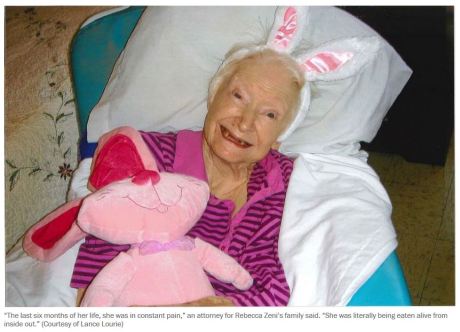
“The scabies that infected Zeni’s body had become so severe that bacteria seeped into her bloodstream. She died in 2015 at age 93.

Zeni’s death is now the subject of a lawsuit filed against PruittHealth, a for-profit company that owns dozens of nursing homes, including Shepherd Hills in LaFayette, Ga., where Zeni lived for five years until she died. Shepherd Hills, a nursing home that had multiple scabies outbreaks in recent years and a history of health violations, failed to follow policies and procedures to prevent the occurrence and spread of the highly contagious disease, documents say. Instead of providing the care that Zeni desperately needed, the lawsuit alleges that the nursing home allowed her to die an agonizing death.

“The last six months of her life, she was in constant pain,” Prieto said. “She was literally being eaten alive from inside out.””

We need to breathe.
We absolutely need to breathe. Just as we absolutely need to drink and to eat, only not so often.

Yet we seldom think about breathing, we remember to think about drinking only when we’ve forgotten to take along a bottle of water for that two hour drive and we somewhat constantly keep warm in the back of our heads the nagging ‘what’s in for dinner?’.

What makes us so indifferent to breathing – as long as our lungs remain OK, anyway, and so choosy when it comes to our ‘daily bread’? After-all, both are equally important…
And how come we almost never think about the air we breathe but equally almost never forget to dream about our precious car? The future one, of course, not the present! Or about a beach holiday, a diamond ring, Jimmy Choo shoes …

So.
There are some things that we actually need, some we actively want and things which belong to both categories.

Then why don’t we actively keep tabs on all the things we actually need and why do we bother so much with those which are more or less superfluous?

Maybe because we are not machines? And because life is neither simple nor forthright?

Let me start from the beginning.

We belong to the realm of the living things.
The difference between living things and inanimate matter being that all individual organisms eventually die while inanimate matter might, theoretically at least, remain unchanged for ever.

Otherwise put, inanimate matter has only ‘inertia’ and living things have both inertia and an innate ‘will to survive’.
Another difference between the two being that all kinds of inanimate matter are ‘isotropic’ while ‘life’ is almost synonymous with ‘individual organisms.’
It’s just as impossible to differentiate between two water molecules as it is to find two identical organisms – even if they belong to the same species. N.B., not even clones are identical to each other.

As an aside, sometimes it is possible to differentiate between two water molecules. For instance, heavy water is slightly different from regular water. Also, there are some differences between the water molecules which have in their composition different Oxygen isotopes. But if you know what an isotope is… you get my drift.

Coming back to the difference between inanimate and living, the inanimate does not change in time.
A molecule of water remains the same until something happens to it and water, as a substance, has never changed since….
On the other hand, each individual living organism changes, however minutely, with ‘every breath it takes’ while species are undergoing a constant evolutionary process.

Furthermore, we can draw a parallel between inanimate substances and animate species. Both of them, substances and species,  are ‘organized’ along some common ‘information’.
‘Water’ has a certain ‘blue print’, ‘vinegar’ has it’s own – different from that of ‘water’, and ‘wolves’ have yet another one – which is different from that of ‘poplar’.
Only the parallel can be drawn only so far.
All molecules ‘belonging’ to the same substance share the same ‘constitutive information’.
All individuals belonging to the same species do have a lot of ‘constitutive information’ in common yet each of them is different from all of the rest.

Hey, wait a minute!
– You promised us something about needs and wants and now you’re lecturing us about the difference between life and death? What next?
– Bear with me. I’m getting there!

One last difference and we’re almost done.

I told you a little earlier that life is about change while inanimate is… boringly stable!
Actually life is also about exchange, not only about change.
No inanimate molecule ever exchanges anything material with anybody, lest it becomes something else.
No individual living organism can survive for any sizeable amount of time without exchanging substance and information, in an ‘organized’ manner, with it’s surrounding medium.

In my ‘original terms’, each individual living organism has needs while individual molecules have none – except for the ‘need’ to be ‘left alone’ in order to ‘survive’.

I’m not going to enter into details. For now, all I’m going to say is that the above mentioned ‘organized exchange’ is regulated by a ‘membrane’ according to information passed along from generation to generation.
Each individual living organism has it’s own set of information, coded in its DNA (RNA for the more ‘primitive’ ones). Which set of information has a lot in common with but is slightly different from that which has belonged to the previous generation.

For instance, each E.coli bacteria has a membrane – which separates the interior of the ‘organism’ from it’s surrounding medium, a nucleus which contains its ‘constitutive information’ and some other things which are of no importance for this discussion.
For as long as that individual bacteria is alive, the membrane plays two roles. It keeps the bacteria together and mediates the exchanges between the individual organism and its medium. It lets food and oxygen in. It makes it so that ‘excrement’ and CO2 are purged out.
And all these are happening according to the information contained in the genetic material passed over from the previous generation.

In a sense, exactly because each individual organism somehow manages to remain – for a while, at least – in one piece while constantly exchanging substance with the surrounding medium, one may say that each individual bacteria has a form of (proto?) conscience. Remember that it does ‘survive’ on its own, ‘guided’ exclusively by information contained in it’s own DNA. As long as its surrounding medium remains in certain parameters, of course, but this is another issue.

Let’s jump now directly to us, human beings.

OK, we are multi-cellular organisms hence we are provided with a second ‘membrane’ – which is usually referred to as  ‘skin’.
The rest is basically the same. The ‘skin’ keeps us together, breathes in, breathes out, excretes the by products of our metabolism…
Well, not exactly the same! We have yet another layer of ‘membrane’. Using a very modern word, I’ll describe this third layer as being “virtual”.

I’m speaking about our infinitely more complex conscience.

The proto-conscience of the E.coli is  similar to a ‘mechanical’ function.
‘Mechanical’ in the sense that the information contained in the nucleus is more or less directly expressed. The bacteria is not able to asses the results of its actions, to watch itself ‘doing things’ or to learn anything from what’s happening to it.

Time for another aside. Recent scientific research strongly suggests that even unicellular organisms are capable of learning. Something. This is very important, and very helpful towards increasing the ability of any given organism to survive, but doesn’t change much of what I have to say here.

Our conscience is anything but mechanical.
OK, it very much depends on our brains. Hence on our DNA.
It also depends on everything that has happened to us from the moment each of us has been conceived till the very present moment. A single minute spent without being able to breathe during birth can wreak havoc with out brains. Hence with our ability to develop a full fledged conscience.
Furthermore, being born into a relatively well off family during a peaceful era leads to being exposed to a completely different set of stimuli than if born into a poor family during a war.

Coming back to my initial example – very few of us really think about breathing, simply because most of us are accustomed to air being freely available, people exposed to those two different sets of ‘initial inputs’ will have a different attitude towards ‘normal daily needs’.
The first kid will grow with an innate sentiment that having enough to eat is comme il faut and nothing to worry about while the second…
Also, the first kid will grow accustomed to people around him ‘parading’ a host of satisfied ‘wants’ almost incomprehensible for the other kid.

Don’t tell me these two kids will develop the same kind of conscience.
Equivalent? Maybe.
Geared towards the same goal? Survival of the individual AND that of the social norms into which the individual has been socialized? Certainly! Only the social norms I’ve just mentioned will never be exactly the same in those two cases… regardless of those two children belonging to the same broad culture.

As a consequence of their different fortunes, each of them will maintain a different balance between needs and wants. Even if their fortunes will change in time.

The ‘conscious membrane’ can change, and it usually will, following the changes in the surrounding medium. But those changes cannot fundamentally alter the ‘initial orientation’ – that forged during the early childhood.

Vatican scrambles after pope appears to deny existence of hell.

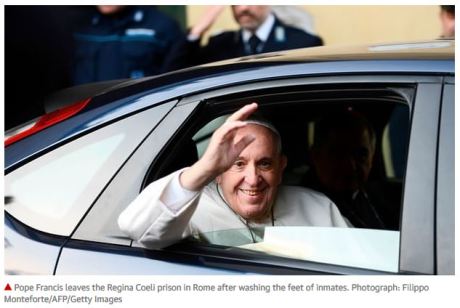
Francis washing feet of inmates

“The controversy came as Pope Francis washed the feet of 12 prisoners at Rome’s Regina Coeli prison on Holy Thursday. Among the inmates were two Muslims, an Orthodox Christian and a Buddhist. He told them: “Everyone has the opportunity to change life and one cannot judge.”
It was the fourth time since becoming pope that he held mass in an Italian prison. “I am a sinner like you but today I represent Jesus … God never abandons us, never tires of forgiving us,” he added.”

“The Holy See issued a terse statement saying a lengthy article published in La Repubblica on Wednesday by Eugenio Scalfari, 93, the newspaper’s founder, was “the fruit of his reconstruction” and not “a faithful transcription of the Holy Father’s words”.

While the Vatican conceded that Scalfari, an atheist who struck up a friendship with Francis in 2013, had held a private meeting with the pontiff before the Easter weekend, it said an interview had not been granted.

During the meeting Scalfari asked the pope where “bad souls” go, to which he was quoted as responding: “They are not punished. Those who repent obtain God’s forgiveness and take their place among the ranks of those who contemplate him, but those who do not repent and cannot be forgiven disappear. A hell doesn’t exist, the disappearance of sinning souls exists.””

OK, and where’s the problem?

“… in 1999 Pope John Paul II announced that hell was “the ultimate consequence of sin itself … rather than a place, hell indicates the state of those who freely and definitively separate themselves from God, the source of all life and joy”.”

Since ‘nihil sine Deo’, where’s the difference between ‘disappearing’ and ‘becoming definitively separated from God’?!?

“The Catholic church’s teachings affirm the existence of hell and its eternity, saying “the chief punishment of hell is eternal separation of God”.”

If I’m not mistaken – and I’m not, many people belonging to the same Catholic church once behaved as if sinners were able to buy ‘respite tickets from hell’, for themselves or for their friends and family…
The Council of Trent instituted severe reforms in the practice of granting indulgences, and, because of prior abuses, “in 1567 Pope Pius V canceled all grants of indulgences involving any fees or other financial transactions” (Catholic Encyclopedia). This act proved the Church’s seriousness about removing abuses from indulgences.

Humans are biased. We tend to interpret what we are told and to bend everything we learn towards what we want to believe.

How about going back to basics.

God loves us.
Simply because He had made us in His own image.
And, just like any other reasonable parent, He knows that His children are far from being perfect. Hence He must have had perfected a method to correct our transgressions.

On the other hand, eternal damnation doesn’t make much sense, does it?

What loving Father could envision any number of his children suffering till the end of time, whenever that might come?

What about a simpler alternative than trying to out-guess God?

For who knows a person’s thoughts except their own spirit within them? In the same way no one knows the thoughts of God except the Spirit of God.

1 Corinthians 2:11

Pope Francis’s words make a lot of sense. To me!
There’s also very little difference between his interpretation of hell and that expressed by Pope John Paul II.
How can anything continue to exist when separated from the all encompassing God?
What loving Father would give up, for good, any number of his children? Regardless of their transgressions…

Who has done this and carried it through, calling forth the generations from the beginning?

I, the Lord—with the first of them and with the last—I am he.”

Isaiah 41:4

You see, adding the fact that we’re all sinners to the possibility of an eternal hell would lead us to the conclusion that we’re all doomed. For the eternity.
If God would allow it, of course.

Doesn’t make much sense, does it?
Then how about us striving to minimize our sins here, while we still have this opportunity, and leave the rest to somebody who knows better?

I keep hearing about this issue and I can’t stop wondering about how parallel to each other are those defending this idea with those denying its merits.

Pro:

-Robots are eating more and more jobs so more and more people will end up hungry.
-AI will make robots so productive that it will be far more efficient to use robots than human workers.
-A decent income is a human right.

Con:

-This is a socialist move, hence it will end up in failure – no other reason offered.

As it is obvious to all, both sides score big.

Yes, including ‘a decent income is a human right’ and ‘all socialist ideas end up in failure’.

Then what are they fighting each-other about?!?

Let me rephrase that.
WHY are they fighting, in the first place?

Because neither listen to what the other has to say… as simple as that…

Let me discuss some of the practicalities involved.

Robots eating up jobs and AI being able to continually increase financial efficiency are so evident that they do not deserve much consideration.

‘All socialist moves ended up in failure’.
We need to define socialism in order to make sense of this sentence.
Mainly because ‘socialism’ is one of the most abused words nowadays, on a par with liberalism. Sometimes they are even considered synonyms…
Well, ‘liberalism’ comes from liberty and  bona fide liberalism is concerned with individual freedom.
Socialism, on the other hand, comes from social. And is concerned with the the workings of the entire society.
The point being that there are two types of socialism. One which is ‘somewhat’ synonym with liberalism – the ‘reverse’ side of liberalism, actually, while the latter is the exact opposite.

I’m not making any sense?

Let me start from the other side.
All forms of socialism which have failed have been excessively centralized forms of government. And it was because of that excessive centralism that they had failed, not because of being ‘socialist’. The evident proof being that the same thing has happened with all right-wing dictatorships, which had used the very same excessively centralized decision making mechanism – the totalitarian government …

Which brings us back to the problem at hand.

For Universal Basic Income to work – or Guaranteed Basic Income, as some insist on calling it, it has to be financed.
Through taxes, right? Which means that those owning the robots would have to be somehow convinced to give up a huge proportion of their profits… Then why bother in the first place…? Why start any businesses, at all?
We’ll have the government run the whole show? Remember what history teaches us about centralized decision making?

So?!?

Well, not all is lost while there’s still hope!

Let me rearrange the arguments.

We not only live in an inherently limited space, with inherently limited resources, but we’ve also finally started to understand our predicament. Which calls for as much efficiency as possible.
Only for a different kind of efficiency than that we’ve accustomed ourselves to.

Until recently, we’ve been trying to get as much money under our belts as possible. Without much regard for anything else.
That’s why we’ve been cutting down secular forests, feeding almost all the fish we’ve been pulling from the oceans to the domestic animals we were raising for their meat, polluting our breathing air, selling our fellow humans which happened to had a different skin color than ours into slavery… As if there was no tomorrow…

Slowly, we’ve started to realize that this won’t work for very much longer.

That no matter whether we’re responsible for the global warming – or if it’s real at all, sooner or later we’ll exhaust the planet.
OK, it is highly plausible that we’ll discover/learn to use new classes of resources.
But this eventuality doesn’t constitute, in any way, a valid reason for us to continue squandering the meager resources we have at our disposal.

Hence the need for increased efficiency.

Only this has to be a different kind of efficiency. The kind that focuses on minimizing waste instead of maximizing profits. The kind that recycles because it makes obvious sense, not because it is cheaper.

Along the same path we’ll discover that it would make a lot of sense to help the less developed nations to catch up with the most advanced ones.
For starters, because the ‘advanced economies’ no longer need cheap workers. They use robots instead.
Secondly, because better living people tend to have less children than those struggling to survive. And we’ve already agreed about the planet being rather limited…

Nothing too fancy… until now, right?

Well, the next item will be trickier..

Remember that Ford had raised dramatically the wages he paid to his workers?
With tremendous results?

OK, his reasons were not the ones, generally but erroneously, attributed to him.
He didn’t do it to ‘encourage’ his workers to buy cars from him… or because of philanthropy…

Actually, it was the turnover of his staff.

At the time, workers could count on about $2.25 per day, for which they worked nine-hour shifts. It was pretty good money in those days, but the toll was too much for many to bear. Ford’s turnover rate was very high. In 1913, Ford hired more than 52,000 men to keep a workforce of only 14,000. New workers required a costly break-in period, making matters worse for the company. Also, some men simply walked away from the line to quit and look for a job elsewhere. Then the line stopped and production of cars halted. The increased cost and delayed production kept Ford from selling his cars at the low price he wanted. Drastic measures were necessary if he was to keep up this production.”

But, whatever Ford’s reasons were, the long term results have been abundantly clear.
Nowadays people who build cars are being paid well enough to afford buying the same kind of cars they are building. At least in the advanced economies…

What happened was that Ford, in order to keep the assembly line going, paid his workers as much as he afforded to. With spectacular results.
While nowadays most employers tend to ‘compensate’ their employees with as little as possible. Which makes perfect economic sense… doesn’t it?

The same economic sense which used to drive us into “cutting down secular forests, feeding almost all the fish we’ve been able to pull from the oceans to the domestic animals we were raising for their meat, polluting our breathing air, selling our fellow humans which happened to had a different skin color than ours into slavery… As if there was no tomorrow…”

See what I mean?
Instead of attempting to mandate a ‘Guaranteed Basic Income’, calculated by the central government and financed through forcefully levied taxes, how about hiring as many people as it would make sense, let them work as little days per week as they want and pay them as much as we can afford to instead of programmatically replacing as many of them with robots and paying the remaining ones as little as we possibly can?

OK, some of us won’t get as rich, as fast, as our grand-fathers did… So what? None of us can eat even close to what our grand-fathers used to… and food is a lot cheaper, anyway…

This is would be a considerably shorter way to get more people out of poverty than any scheme concocted by any government and it would have the same snow-ball effect as Ford’s wage increase had.

Economists describe this as Rostow’s ‘take off effect’.


For attaining adequate finance for take off it is necessary that:

(a) The community’s surplus over consumption does not flow into the hands of those who will utilize it by hoarding, luxury consumption or low productivity investment out-lays;

(b) Institution for providing cheap and adequate working capital be developed;

(c) One or more sectors of the economy must grow rapidly and the entrepreneurs in these sectors must plough back a substantial portion of their profits to productive investment; and

(d) Foreign capital can profitably be utilized for building up social and economic overheads.”


Obviously, any attempt to instate a guaranteed basic income, (except for those too young, too old or otherwise un-able to pull their weight, of course) would grind any ‘take-off’ to a stand-still.

And no, getting people out of poverty is not a valid goal, per se.
Poverty is a relative thing, which relies more  on feelings than on hard reality.
The real problem with poverty is that it reduces the ability of poor individuals to lead meaningful lives. Poor people are a lot less autonomous than self sufficient ones, meaning that decision making ability is impaired by the fact that they need to focus their attention on the short term time span.

This whole thing has long term consequences on societal level.

Remember what I said about centrally planned socialist countries constantly failing.
About all dictatorships eventually crumbling under their own weight, because of too much decision power being concentrated in too few hands?

Excessive wealth polarization produces the same results. Economic decision becomes too concentrated, political decision follows through and…

What next?
The world has already experimented with communism. Didn’t work.
It also experienced two economic meltdowns, exactly when wealth polarization was at relative peaks.
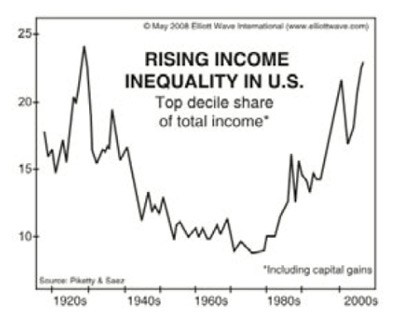
income-inequality-08

When are we going to learn anything from what happens to us?
Why do we continue to waste the accumulated lessons collectively known as ‘history‘?


Pentru foarte multi dintre noi, 23 August are o valoare cel putin ambigua.

In orasele mari erau organizate manifestatii, la care oamenii muncii erau dusi cu forta si obligati sa ia parte la tot felul de ‘coregrafii’. Cu placute, cu steaguri…iar cei care se bucurau de increderea partidului primeau sarcini cu adevarat importante! Li se incredinta cate un portret al preaiubitului fiu al intregului popor…. Deh, slugarnicia se plateste…

Apropo de ‘prea-iubitul fiu…’ ‘Elementele dusmanoase’ pretindeau ca mama sa ar fi avut o moralitate cel putin indoielnica… altfel cum ar fi fost Ceasca ‘fiu al intregului popor’? Sa trecem peste… Gura lumii, sloboda… Sloboda, sloboda… sa fi spus eu bancul asta intr-o companie nepotrivita pe vremea ‘cealalta’… as fi avut mari sanse sa capat ceva ‘domiciliu obligatoriu’… si nu la Slobozia…

Pe de alta parte, eu nu prea sunt calificat sa vorbesc despre manifestatii din astea.
Am purtat barba de cum am terminat armata – aveam ‘botul imblanit’ chiar si pe livretul militar, nu ma ‘solicitau’ la ‘actiuni’… ‘tovarasul’ nu agreea ‘pilozitatile faciale’… asa ca barbosii erau sfatuiti insistent sa se barbiereasca. Iar daca nu pricepeau erau tinuti la fereala.

Sa recapitulam. Teoretic, era o sarbatoare populara. Clasa muncitoare primea o zi libera.
Practic, multi dintre ei o petreceau marsaluind sub un soare arzator… purtand in carca niste pancarte mincinoase… si fiind obligati sa strige niste  lozinci in care nu mai credea nimeni… Iar asta nu doar in ziua respectiva. Faceau si cateva repetitii pregatitoare… Ca de, totul trebuia sa fie perfect!

Si, de fapt, aproape nimeni nu mai stia cu adevarat ce se intamplase in 1944.
Nu ca le-ar mai fi pasat prea multora dintre ei …

Lipsa de inter5es nu provenea neaparat din defetism sau din descurajare. Aveau si astea contributia lor, nimic de spus, numai ca sursa nepasarii era in alta parte.

Propaganda oficiala se batea cap in cap cu memoria colectiva iar acest conflict producea confuzie.

Termenul tehnic este ‘disonanta cognitiva’.
Fenomen cu consecinte dramatice, mai ales la nivel social.
Un individ pus intr-o astfel de situatie are trei variante. Pur si simplu nascoceste o naratiune care sa rezolve conflictul in favoarea sa, se mentine intr-un echilibru precar dar pe care nu vrea sa-l paraseasca pentru asta ar insemna sa se scufunde cu totul in pacat sau, pur si simplu, innebuneste.

Nu pricepeti mare lucru?
La vreo cativa ani dupa ce comunismul fusese instaurat in urma unei operatiuni care a imbinat forta bruta cu inselatoria abjecta, liderii momentului au dorit sa anihileze orice potentiala dizidenta. Cu alte cuvinte, ‘opozantii’ – adica cei care nu pricepusera de buna voie, urmau sa fie ‘reeducati’.

“Împreună cu alţi câţiva deţinuţi dispuşi la compromisuri pentru eliberarea înainte de termen, manevraţi de înalţi oficiali din Securitate cu complicitatea administraţiei penitenciarului, Ţurcanu a condus ceea ce a rămas cunoscut sub numele de „experimentul” ori „fenomenul” Piteşti, în fapt torturarea continuă şi fără limite a altor deţinuţi politici pentru un dublu scop: smulgerea unor informaţii suplimentare despre activitatea împotriva regimului înainte de arestarea lor şi anihilarea fizică şi morală a victimelor, odată cu compromiterea lor.

Cum se proceda? După o perioadă de câteva luni de înfometare şi restricţii severe (de cele mai multe ori, inclusiv vorbitul era interzis, în timp ce insultarea şi lovirea de către gardieni erau locuri comune), un grup de deţinuţi era transferat într-o celulă în care găsea alţi condamnaţi. Noii sosiţi erau primiţi cu căldură şi prietenie, uneori transferurile fiind astfel realizate încât în cameră se reuneau membri ai aceluiaşi lot, foşti colegi de facultate ori prieteni. Plăcut surprinşi de atmosfera de relaxare din noua celulă, studenţii începeau să discute între ei despre studii, familie, prieteni sau despre activitatea anticomunistă care i-a adus în închisoare. Fraternitatea dura până când şeful camerei (Ţurcanu de cele mai multe ori) dădea un semnal scurt, fizic ori verbal: „Pe ei!”

Deodată, vechii ocupanţi ai celulei scoteau din locuri ascunse bâte, scânduri şi alte obiecte contondente şi se aruncau cu o violenţă greu de imaginat asupra celor cu care discutaseră amical până cu câteva momente înainte. Deşi şocul pentru victime era paralizant, bătaia colectivă putea dura câteva ore bune, fără să mai conteze cu ce şi unde se lovea: la cap, pe spate, în ceafă, în organe, nicio zonă nu era scutită, până când victimele zăceau într-o baltă de sânge. Violenţa acestei prime agresiuni neaşteptate era atât de mare, încât agresorii înşişi erau şocaţi, după cum a mărturisit Maximilian Sobolevschi: „s-a desfăşurat într-un mod îngrozitor, fiind bătuţi de la orele 7 dim[ineaţa] până la 15 în continuu cu pari, ciomege, curele, până la epuizare. În urma aceste bătăi au căzut 3 deţinuţi în nesimţire stând mai multe zile iar restul învineţiţi pe tot corpul. Pot spune că de o astfel de bătaie nici nu am auzit în viaţa mea, ea petrecându-se într-un mod bestial”.

În acest moment victimelor li se explica motivul pentru care au fost supuse violenţelor, şeful de cameră ţinând un mic discurs cu privire la necesitatea „reeducării” în spirit comunist, ceea ce presupunea denunţarea tuturor acţiunilor întreprinse împotriva regimului şi renunţarea la vechea lor mentalitate, responsabilă pentru situaţia lor de condamnaţi politic, în opinia agresorilor. Dacă acest discurs era încă destul de vag, următoarele solicitări din partea agresorilor aveau să lămurească pe toată lumea că nu era vorba nicidecum de o schimbare de mentalitate, de o adaptare benevolă la regulile noii societăţi, ci de lucruri mult mai abjecte: turnătorie, tortură continuă, blasfemie şi compromitere.

Primul lucru care li se cerea victimelor pentru a demonstra că nu mai sunt ostile regimului era să ofere declaraţii verbale şi scrise cu privire la întreaga lor activitate politică de până la arestare, insistând pe acţiunile anticomuniste şi pe cei cu care au activat. În fapt, li se cerea un supliment de anchetă, întrucât regimul ştia foarte bine că mulţi dintre cei deja condamnaţi tăinuiseră în cercetări multe persoane şi fapte. Cei mai mulţi refuzau să vorbească, conştienţii fiind că orice nume declarat putea conduce la arestarea respectivului, astfel că urmau alte reprize de torturi, atât individuale, cât şi colective. Erau schingiuiţi şi cei care denunţau doar parte din informaţiile deţinute, neconcordanţele fiind sesizate prin confruntarea cu declaraţiile celorlalţi sau prin cunoştinţele pe care agresorii le aveau despre cei torturaţi din perioada de relaxare de dinaintea începerii violenţelor. Victimele realizau astfel că prietenia şi căldura cu care fuseseră întâmpinaţi erau simulate, având doar rolul de a îi face să vorbească despre activitatea lor din libertate.
Dincolo de torturile fizice (bătăi la tălpi, la fese, călcatul în picioare, lovituri în stomac ori organe, statul în diferite poziţii fixe zile întregi, fără posibilitatea de se mişca etc.), şi celelalte episoade ale zilei constituiau prilej de chinuire a victimelor. Astfel, mesele erau servite fie prin turnarea mâncării fierbinţi pe gât, fie obligând victimele să se aşeze în patru labe, cu mâinile la spate, şi să se folosească doar de gură, ba uneori să şi guiţe ca porcii. Scoaterea „la program” (adică la toaletă) se făcea în grabă maximă o dată pe zi, iar cine nu apuca să îşi facă nevoile, era nevoit să şi le facă mai târziu în celulă, în gamelele din care mâncau, fără să aibă dreptul să le arunce ori să spele gamela, astfel că unii deţinuţi îşi îngurgitau fecalele de bună voie, pentru a putea primi mâncare. Dormitul era şi el un chin, victimele fiind obligate să stea în pat întinse pe spate, cu pătura până la piept şi mâinile deasupra păturii, ca să nu poată să se sinucidă. Dacă vreunul adormea şi se mişca în somn, plantoanele care stăteau de gardă peste noapte îi loveau violent cu ciomagul, ceea ce, coroborat cu tensiunea strânsă în timpul zilei în urma bătăilor, făcea somnul imposibil pentru mulţi dintre deţinuţi. Alţii nu au fost lăsaţi să doarmă în mod intenţionat timp de câteva zile, ajungându-se până la zece, cincisprezece în cazurile extreme, pentru a-i doborî fizic. La un moment dat a fost introdusă o nouă metodă de tortură – statul în poziţie fixă, care presupunea aşezarea în fund, cu mâinile pe genunchi şi privirea aţintită la vârful picioarelor timp de săptămâni întregi. La orice tresărire, deţinuţii erau loviţi cu bâta, însă după zile întregi de stat în aceeaşi poziţie fixă, mulţi dintre ei preferau (şi chiar căutau) să fie loviţi, pentru că astfel aveau posibilitatea de a se mişca măcar câţiva centimetri. 

Schingiuirile durau între câteva zile şi câteva luni, în funcţie de celulele în care erau aplicate (unele fiind mai mici, erau mai puţine victime), dar şi de momentul în care aveau loc, întrucât au existat momente de apogeu a violenţelor, după cum au existat şi perioade uşor mai liniştite. Bătăile continuau până când deţinuţii acceptau să ofere informaţiile cerute, la început verbal şefului de cameră, apoi în scris, într-o cameră special amenajată în acest scop (de notat că hârtia şi instrumentele de scris erau strict interzise în închisoare, însă agresorii nu sufereau de pe urma acestei restricţii). Ca o umilinţă în plus, din motive bine calculate, victimele erau obligate să aşterne informaţiile sub forma unor denunţuri benevole, pentru a da impresia colaborării cu regimul. Formula standard era „Subsemnatul… deţinut, în urma unui proces de gândire pe care mi l-am făcut singur, am ajuns la concluzia că am fost necinstit în declaraţiile mele date la anchetă în faţa Securităţii şi ţin din proprie iniţiativă să aduc la cunoştinţă următoarele”.”

Cred ca ati inteles mecanismul. Pentru a putea supravietui trebuia sa te ‘dai cu ei’, calcandu-ti in picioare insasi demnitatea ta de om. Sau iti asumai niste riscuri enorme. Ei bine, foarte multi dintre cei care alegeau supravietuirea – iar pentru asta trebuiau sa treaca de partea tortionarilor, isi modificau ‘setul de valori’. Ajungeau sa creada ca victimele, adica si ei insisi, erau cei vinovati pentru ce li se intampla. Foarte putini au reusit sa-si mentina o farama de luciditate in interior – in timp ce exteriorul lor se comporta dupa cum li se ordona, iar foarte multi au inebunit pur si simplu.

Trebuie sa fac o paranteza aici si sa ma intreb daca nu cumva adevaratii nebuni au fost cei care au reusit sa-si pastreze luciditatea atunci cand asistau la ororile pe care le savarseau ei insisi… dar asta e alta problema…

Ce vreau sa spun este ca trecerea printr-o astfel de experienta – atunci cand stii ca ce esti obligat sa executi/crezi nu este bine dar, in acelasi timp, sa nu poti face nimic pentru a aduce lucrurile pe fagasul normal, transforma pe cei mai multi dintre noi in niste umbre ale celor care am fost. Sau am fi putut sa fim…

E adevarat ca lucrurile mai depind si de intensitatea trairilor. Precum si de forta fiecaruia dintre cei in cauza.

Textul citat este o parte din descrierea facuta “experimentului Pitesti”, gasita pe site-ul cu acelasi nume. Ororile, pana la urma repudiate chiar de conducerea PCR, au fost comise intre 1948 si 1952.
Ei bine, fenomenul de disociere cognitiva – cel pe care se bazeaza de fapt ‘reeducarea’ de tip ‘Pitesti’ a fost descris abia in 1957 de Leon Festinger.

Si atunci, de unde au stiut tortionarii de la Pitesti – si cei care le-au dat mana libera, cum sa organizeze intregul ‘experiment’?

Bon, acum ca ne-am lamurit care e treaba cu disonanta cognitiva la nivel individual, sa vedem ce legatura este intre toata tarasenia asta si 23 August.

In scoala generala am facut istoria cu Bucataru. Asa il chema, de meserie era chiar profesor. Unul foarte bun!
Nu mai tin minte ce scria in manualul de atunci dar stiu ca profesorul Bucataru ne-a explicat, foarte exact si fara nici o urma de dizidenta sau de provocare, cum s-au desfasurat lucrurile. Pana la urma chiar asistase in direct la intreaga desfasurare. Avea vreo 20 de ani pe vremea aia… Chiar daca nu statuse ‘in primul rand’, nu avea cum sa nu tina minte lucrurile importante.

Dupa aceea, in cursul diversele sesiuni de invatamant politic la care am fost obligat sa iau parte, am fost ‘victima’ constantului  proces de intoxicare la care era supusa intreaga societate. Pe deasupra, in fiecare an – pe toate canalele media, ni se sublinia ‘rolul hotarator indeplinit de eroicul partid in momentele de apriga cumpana’…

Ei bine, memoria colectiva era depozitara unei versiuni cu totul si cu totul diferita fata ce cea care ne era prezentata ad nauseam.
Poporul tinea minte, de la radio, discursul tinut de Regele Mihai.
Stia ca acesta, la doar 23 de ani, avusese curajul sa-l destuie, privindu-l direct in ochi, pe  autointitulatul “conducator al statului” – un maresal de 62 de ani.
Acelasi popor fusese de fata atunci cand comunistii au falsificat alegerile din ’46, l-au alungat pe rege in ’47 si pe proprietari din casele lor in ’48. Si cand au fost manati, cu mitralierele, sa se inscrie in CAP-uri.

Tot aceluiasi popor i s-a povestit apoi o cu totul si cu totul alta versiune a lucrurilor. Despre cum comunistii au condus lupta anti nazista, despre cum acestia ar fi eliberat Romania, despre cat de bine era sub ‘inteleapta conducere a eroicului partid, in frunte cu…’

Sa nu te strici de cap?
In mod colectiv?
Si asta cu atat mai mult cu cat o serie intreaga de ‘personalitati’ trecusera, cu arme si bagaje, de partea noilor ciocoi? N-am sa ma apuc acum sa trec in revista… cititi si voi Capcanele Istoriei a lui Lucian Boia.

Revin cu intrebarea de mai sus. De unde au stiut comunistii sa confiste ziua de 23 August inca din ’45, ’46 daca Festinger a descris disocierea cognitiva abia in ’57?
Cum de au uitat aproape toti intelectualii evocati in cartea lui Boia de rolul atribuit ‘paturii superpuse’ de catre inaintasul lor, Mihai Eminescu? O fi zbarcit-o el cand vorbea despre ‘bulgaroii cu ceafa groasa’ si despre ‘venituri’ numai ca pe asta cu ‘patura superpusa’ a nimerit-o foarte bine!
Si exact asta era menirea intelectualilor – inclusiv a celor cu preocupari politice.
Sa rezolve disonantele cognitive, nu sa le adanceasca.

Sa ne conduca pe noi spre ‘lumina’, nu sa ne abandoneze prada celui ‘viclean’.

Da, stiu, aberatiile comise de legionari in numele aceluiasi ideal de perfectiune nu aveau cum sa ajute.
Da, numai ca si aberatiile legionarilor au purtat girul unor intelectuali…

Si atunci? Ne mai miram ca poporul nu mai stie ‘cu cine sa voteze’?

Ne revenim si noi odata?
Cica toamna se numara bobocii… din punctul asta de vedere 23 August e bine pus in calendar!

I’ve reached the conclusion that thinking and digesting have very much in common.

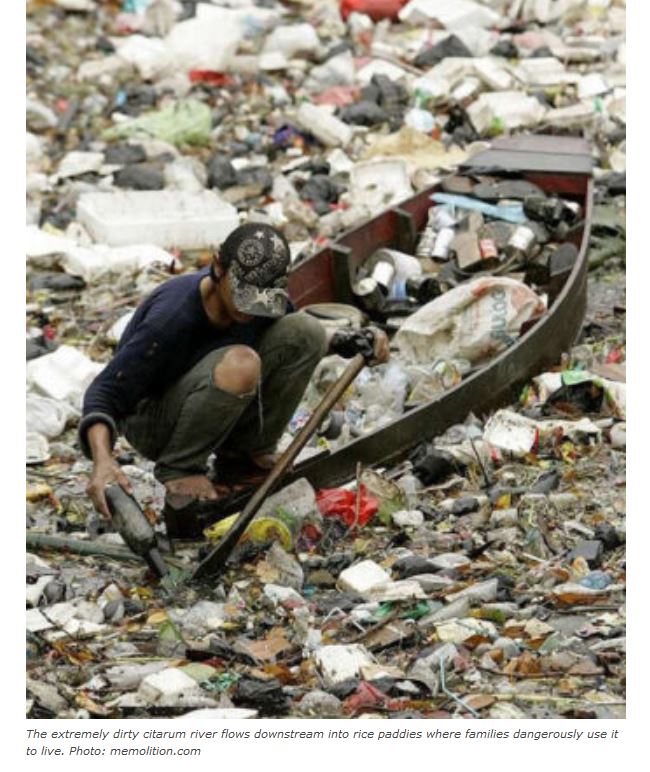
Citarum 2

We can’t do it by our own. Those of us who don’t cooperate/speak with those around them, don’t have what to eat or what to think about.

Both processes imply three stages. Identification, absorption, use.
We use cultural models to identify both our food and the important issues.
Absorption – through our gut/conscience, is both highly specific to each individual and governed by our common DNA/shared cultural traditions.
The ‘products’ of the digesting/thinking process are, again, used both in public as well as in private. Part of the energy we get from our food is consumed ‘cooperatively’ with our ‘coworkers’ while most of our thoughts end up either verbally expressed or put in practice.

Both processes, digesting as well as thinking, increasingly change the environment where we, and others, live.

Citarum 1