Matthew Tontonoz's avatarMatthew Tontonoz

The recent decision by the U.S. Centers for Disease Control and Prevention (CDC) to endorse circumcision as a prophylactic measure against disease has once again drawn media attention to America’s most controversial surgery. In draft guidelines issued in December, the CDC emphasized that the most up-to-date medical science indicates clear health benefits of circumcision—including a 50%-60% reduced risk of female-to-male HIV transmission, a 30% reduced risk of transmission of the human papilloma virus (HPV), and lower risk of urinary tract infections during infancy. On the basis of these data, the CDC is recommending that health care workers counsel uncircumcised adolescent boys and men, as well as the parents of newborn males, on the potential benefits and risks of circumcision. The guidelines are currently undergoing a 45-day review period, during which the CDC is actively soliciting feedback.

According to the CDC, 80% of American males are circumcised. According to the CDC, roughly 80% of American men are circumcised.
The CDC guidelines follow similar…

View original post 3,137 more words

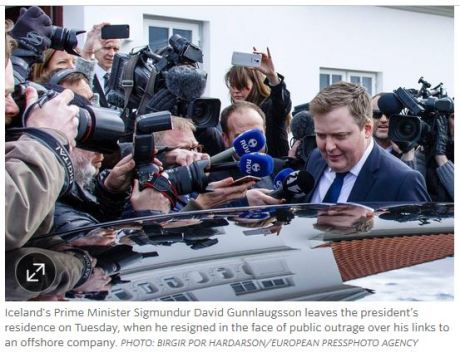
The ‘Panama Papers’ rekindled the public interest in the subject of ‘what legitimate goal could anyone have in setting up a company in a fiscal paradise?’.

Taxes, stupid!

Actually it’s quite simple.

Let’s pretend you are an alien from the outer space who has a business idea backed up by enough capital and you want to put it in practice somewhere on Earth. Aren’t you going to shop around for the best environment you might find? So that your business would have optimal conditions to grow? And when the business ripens wouldn’t you want to be able to cash on it – and end up with as much money as possible?

Rather conflicting demands, isn’t it?

First you want an ‘operational base’ with relatively low costs but secure and full of whatever amenities your business might need in order to thrive. Next you’ll need fast access to a market where to sell your wares. Last but not least it would be important for you to incorporate your business in such a way/place that you’ll end up pay the least amount of tax, both while operating the business and after the cash out moment.

While all these are legitimate demands there are a right and a wrong way to meet them.

I’ll refrain myself to discussing exclusively about the tax part, the rest being relatively easy to balance.

In this respect you can choose to incorporate the business in the same place you have selected for your operational base and pay whatever taxes are due in that place, under the rationale that those taxes cover the cost of doing business there and are nothing but a compensation for benefiting from the conditions present there at the time. After all, when you have chosen a particular place as the home of your business you have entered into an informal arrangement with that place. It lets you make good use of whatever is there to be used – exactly the things that convinced you to select that particular place, and expects you to fulfill your side of the bargain. Provide enough compensation so that that place can continue to be a good place to conduct business and, if possible, improve itself. Pay the local taxes.

Or, equally legitimate, use two different places for each thing. Organize your operational base where it would work best and incorporate your business in a place where you’ll be able to pay as little tax as possible.

And here’s the catch. No matter where you incorporate your business you’ll still have to pay some taxes in the place you have chosen as your operational base.

Then why bother?!? you might legitimately ask.
Since this is not an accounting dissertation I’ll just tell you that there might be serious financial advantages in making this choice, not the least of them having to do with the cash out moment.

And this is the very point where some people get greedy. They try to avoid altogether the taxes tied to the ‘operational base’ – by employing various semi, or even completely i-legal stratagems, and by doing so completely transform the very nature of the entire operation.

From one of fiscal optimization to one of money laundering.

There are a lot of rationalizations for this course of action. From ‘the state is a thief that uses force in order to part me from the fruit of my efforts!’ to ‘why give it to the state since the money will be squandered by the inefficient government?’.

Now let’s please remember where we started from.
OK, you are not an ‘alien from the outer space’ but what’s stopping you from conducting your business where ever you want on the face of this Earth? (My bad, this question is not valid for exactly everybody, there still are countries that don’t allow for people, or capital, to exit freely, but I’m sure you get my drift)
Oh, you like it where you are but you hate paying taxes and/or you’re disgusted by the way the government handles its finances!

Then let me remind you of two things.

First, you probably live in a democracy. Speak up. Make your concerns known. Loudly. Make sure you are listened to. Vote wisely.

Secondly, you are probably fed up not only by the fact that in your country taxes are really high but also by how little you get back in return.
Well… that’s because there are so many people who do not pay their fair share and that your government has to take more from those who do pay in order to make the ends meet.

Savvy?

iceland prime minister resigns over Panama papers

Recentul sondaj cu privire la legea ‘darii in plata’, si mai ales modul in care este comentat de presa, releva faptul ca majoritatea ‘consumatorilor’ nu prea inteleg care e treaba cu bancile si ca prea multi dintre cei care stiu se fac ca ploua.

“Majoritatea respondenților s-a pronunțat împotrivă ca beneficiarii legii să fie cei care și-au cumpărat mai multe case/terenuri și au dificultăți, fiind indicați ca beneficiari ai legii numai cei care au o singură casă (81%). De altfel, 89% dintre români consideră că este bine să existe o lege care să ajute persoanele fizice care au luat un credit și se află în dificultate financiară”, se menționează într-un comunicat al ARB.

Comunitatea bancară din România reiterează că se impune devansarea termenului de intrare în vigoare a Legii 151/2015 privind procedura insolvenței persoanelor fizice.”

Teoria spune ca rolul bancilor este relativ simplu.
Ca orice intreprindere comerciala, acestea supravietuiesc doar in masura in care reusesc sa se faca folositoare clientilor lor.
In cazul bancilor moderne serviciile ‘vandute’ acestora pot fi impartite in doua categorii: fundamentale si accesorii.
Cele accesorii fiind facilitarea transferului de fonduri si tot ceea ce are de a face cu chestia asta.
Pe vremuri mai era vorba si de asigurarea protectiei banilor numai ca acest aspect a cazut in desuetudine. Avand in vedere comisioanele de retragere si dobanzile pasive extrem de mici este mai ieftin sa inchiriezi o caseta de valori decat sa tii banii in banca, cel putin pe termene relativ scurte.

Si iata ca am ajuns la rolul fundamental al bancilor.
Sa ia cu imprumut bani de la cei care nu au ce face, momentan, cu ei si sa-i dea, tot cu imprumut, celor care au, acum, nevoie SI reusesc sa-i convinga pe oficialii bancii ca vor fi in stare sa returneze, la termen, respectivele fonduri.
Remarcati ca nu am facut nicaieri vorbire despre ce fel de clienti este vorba – persoane fizice sau juridice.

Ei bine, in momentul actual bancile fac aceasta diferenta.

In afara de faptul ca persoanele fizice platesc alte comisioane si primesc alte dobanzi pasive fata de persoanele juridice.

In realitate persoanele fizice sunt discriminate de banci in mod groaznic.

Sa luam cazul cuiva care se hotaraste sa intreprinda ceva si ia credit ca persoana juridica. Incepe operatiunea si, la un moment dat, totul se duce dracului. Ei bine, firma da faliment, investitorul pierde ce bani a bagat acolo – de obicei toti, iar banca mai recupereaza ceva, daca mai poate. Iar investitorul ramane fara nici un fel de datorii si chiar cu obrazul curat.
Bine, vorbim aici de ‘cazul banal’ in care nimeni dintre cei implicati nu a savarsit vreo ilegalitate – atunci cazul se schimba fundamental.

Daca acelasi investitor are proasta inspiratie sa incerce aceiasi operatiune pe persoana fizica – din diverse motive, le discutam mai tarziu, atunci s-ar putea ca acesta sa-si blesteme zilele. Daca operatiunea nu-i iese, chiar daca el nu are nici o culpa in chestia asta, acesta va trebui totusi sa returneze bancii toata suma.

Chiar si in conditiile in care ar functiona legea falimentului individual – ceea ce inca nu este cazul, situatiile ar fi complet diferite. Dupa declararea falimentului firmei investitorul este ‘spalat’ de orice in timp ce dupa declararea falimentului personal individul mai are multe de tras.

In anumite situatii diferenta asta este pe deplin justificata. De exemplu in cazul unui imprumut de nevoi personale sau a datoriilor facute pe cardul de credit.

Dar nu este in nici un fel justificata in situatia unui credit ipotecar. Care este similar pana la identificare cu un credit acordat unei persoane juridice.
Persoana juridica garanteaza cu capitalul social si cu celelalte active ale sale in timp ce persoana fizica garanteaza cu bunul supus ipotecii. Iar banca, inainte de a vira banii, analizeaza cu atentie atat valoarea, si perspectiva acesteia, bunului ipotecat precum si posibilitatile viitoare ale creditatului – atat persoana fizica cat si juridica, de a restitui creditul.

Diferenta de abordare se vede cu ochiul liber.
Unde mai este raspunderea bancii pentru due-dilligence inainte de acordarea creditului unuei persoane fizice? In ce fel mai putem spune ca cei doi sunt parteneri egali in contract?

In situatia in care creditul este acordat unei persoane juridice banca isi preia, in mod efectiv, partea ei de risc. Daca nu a apreciat bine valoarea gajurilor sau perspectivele planului de afaceri banca are mari sanse sa ‘o ia in barba’ – chiar daca cei implicati se comporta perfect onest.
In cazul unui credit ipotecar acordat unei persoane fizice, cel putin deocamdata, banca nu isi asuma nici un fel de raspundere. Indiferent de orice, acesta va fi urmarit pana in panzele albe. Dispare total egalitatea care ar trebui sa existe intre parti.
Atat egalitatea dintre partile aflate in contract cat si egalitatea dintre clientii persoane fizice si clientii persoane juridice.

Iar faptul ca ‘oamenii de rand’ sunt intrebati ‘ce opinie au despre chestia asta’ este o actiune interesanta din punct de vedere sociologic dar irelevanta din punct de vedere rational, economic.

Da, intr-adevar, nu este ‘frumos’ sa fie iertati de datorii cei care s-au gandit sa faca ‘dezvoltari imobiliare’ pe persoana fizica cu scopul de a scapa de impozite.
Numai ca treaba asta nu are logica. Nici economica si nici legala.
Fenomenul trebuie controlat cu ajutorul legislatiei despre ‘faptele de comert’, nu pe baza vre unor considerente de ordin moral.
Ca sa nu mai vorbesc despre imposibilitatea de a face diferenta intre cei care ‘nu pot plati’ si cei care ‘pot plati dar nu vor’!

Us electoral sinopsis, re-edited

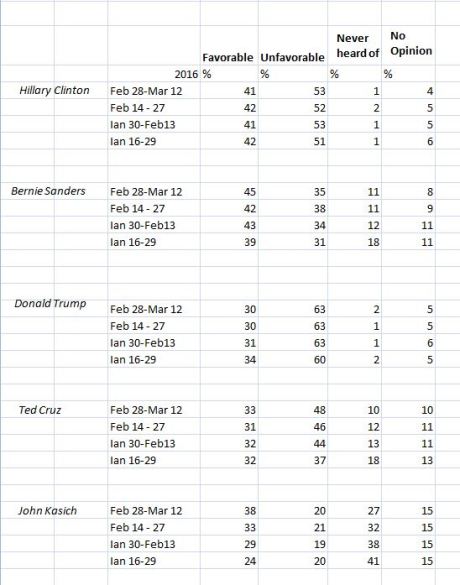
Favorability: People in the News, Gallup, April 2, 2016

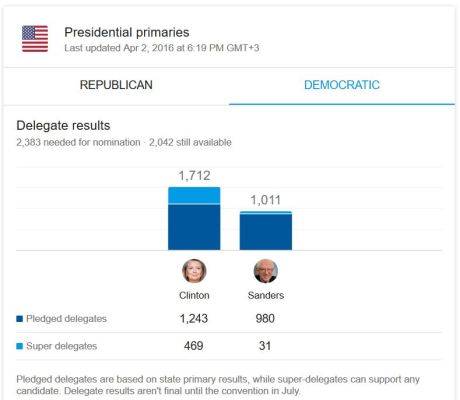
Clinton vs Sanders, April 2, 2016

Source: AP

So, it looks like that the concerned Democrats – those who bothered to show up for the preliminaries, and specially the ‘super delegates’, are going to send Hilary Clinton to compete on the national stage, despite her constant ‘negative favorability’ and despite the fact that Sanders is constantly improving his chances – both favorability and ‘never heard of’ scores are slightly better now than they were at the start of the year. Furthermore, Sanders is the one who can ‘grow naturally’ – simply by making himself known – while Clinton needs to convince the voters that their erstwhile opinion about her was mistaken. An almost impossible feat, given the length of her public career…

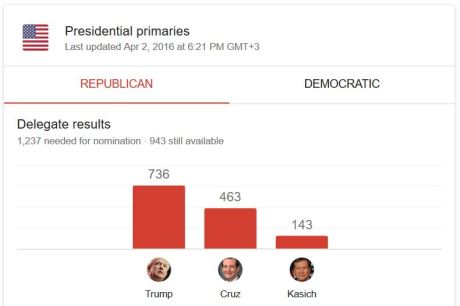
republican pack, April 2, 2016

Source: AP

On the Republican side things are even stranger.
Trump gathers more and more delegates while his ‘negative favorability score’ becomes slightly even ‘more negative’, Cruz gets a second lease on life despite his ‘unfavorable’ score increasing dramatically while Kasich, the least favored by the hard core Republicans, climbs nationally from +4% to + 18% in 4 short months. And if you look closely almost all new opinions on him, those that have been developed during the last 4 months, have been in his favor.

One of my Republican friends said “I can’t speak for the other candidates, but people support Cruz because they believe in what he believes, and feel that sometimes it’s more important to stand up for what’s right, rather than what’s popular.“.
OK, I can understand that. The despondent and/or exasperated use Trump as a banner for their state of mind while the hard core, value toting, Republicans hope that by backing Cruz they will somehow bolster those values.

But let’s see what some ‘significant Republicans’ have to say about the matter.

Scott Walker, Governor for Wisconsin and ex candidate, being interviewed on WTMJ’s Charlie Sykes Show:
““If you’re someone who is uneasy with the frontrunner, right now there’s really only one candidate—I think if you’re just looking at the numbers objectively, Ted Cruz, Sen. Cruz, is the only one who’s got a chance other than Donald Trump to win the nomination,” Walker said in the Wednesday interview on WTMJ’s Charlie Sykes Show. “Statistically, my friend Gov. Kasich can not.””

Then there is Lindsay Graham, Republican Senator for South Carolina and ex candidate who endorsed Jeb Bush when dropping from the race:
“Graham said there are other candidates he likes better, but he doesn’t think they can win. “I prefer John Kasich; Cruz is not my first pick by any choice,” the South Carolina senator explained. “But I don’t see how John Kasich can mount the opposition that Ted Cruz can to stop Donald Trump from getting 1,237” (the number of delegates needed to secure the nomination).
Graham has made it abundantly clear that he really doesn’t like Cruz at all. In January, he said Cruz has “exhibited behavior in his time in the Senate that make it impossible for me to believe that he could bring this country together,” adding that choosing between him and Trump is “like being shot or poisoned — what does it really matter?” Last month, he joked about Cruz’s general unpopularity among his colleagues, saying, “If you killed Ted Cruz on the floor of the Senate, and the trial was in the Senate, nobody would convict you.””

The way I see it, these guys, the Republican ‘apparatchiks’, are more concerned about derailing Trump than with promoting the more suited candidate among the trio. Suited for Presidency, that is.

sansele candidatilor

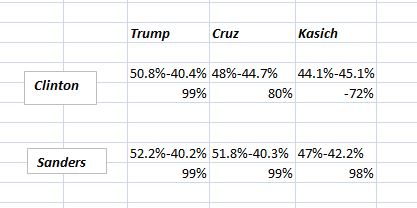
source: Huffpost Pollster

So, according to the polls compiled by Huffington Post, Sanders would lick the entire Republican field – if allowed to compete, while the Republican candidates are stacked, at least for now, according to the ‘who has the least chances on the national front’ criterion.

?!?

Does any of this make any sense? Any at all?

Here’s my Republican friend again: “In the case of Clinton, despite her unfavorability in the polls, there’s a sense in the Democratic Party that it’s her “turn.”
Some others think she is ‘in cahoots’ with the ‘big business’… “Family charities collected donations from companies she promoted as secretary of state“… Coming from Wall Street Journal this is a powerful allegation indeed…

But at least in this camp things are unfolding, lets say, ‘naturally’. The guys with vested interests (the super delegates, for example) are acting according to those interests while the rank and file Democrats are slowly (too slowly, maybe?) finding out what’s going on.

What really baffles me is what’s happening on the Republican side.

Some of the rank and file have adopted ‘the Donald’ as their mascot despite the obvious fact that he doesn’t belong, at all, in politics. He might have been a successful business man – read chock full of money, but the way he made that money disqualifies him from holding office. Does ‘eminent domain‘ ring any bells with you? Not to mention his antics on the public stage: “Excuse me”, ‘I’m the best thing that could happen to America!’
Are all these people delusional or are they so fed up with what’s currently going on in America that they can’t see the trees because of the forest (is on fire)?

Some others have gone ‘back to basics’ and try to revive what they consider to be the ‘sound Republican values’ – I’m speaking now about those who support Ted Cruz, if you didn’t figure that out by yourselves.
But what are these ‘hard core Republican values’?
How come some of Cruz’s followers are blaming Lincoln for being the first ‘statist’ in American history – not for abolishing slavery but for imposing that measure by force to the unwilling Southern States.
And how come those values have come to be embodied in someone so ‘popular’ among his Senatorial colleagues that “If you killed Ted Cruz on the floor of the Senate, and the trial was in the Senate, nobody would convict you.” ?

And isn’t it strange that so many Republicans are so mesmerized that they are willing to give up almost any chance of electing a Republican President?
OK, I can understand that way of thinking being used by ‘lay people’. But what is the real meaning of ‘pundits’ rallying behind the ‘value laden’ Cruz when it is obvious that Kasich is in a way better position on the national front?

Could it be that these pundits are more concerned about their own careers than with the fate of the Republican party? And even about the Republican values?
Farfetched?
Are you sure? Don’t you see that by energizing their constituencies into a frenzy they are simply building Republican (local) fortresses for their own use, leaving the rest of the (national) Republicans out to dry?

more stuff

Well, I was under the impression that Conservatism was about maintaining a common way of life, not about conserving privileges.

I still believe that.

ouroboros

Ever since people have become aware of their own awareness philosophers have entertained opposing views as to what is more important: matter or soul.

The materialists point out that everything, including us, is made of matter and, hence, nothing would be possible without it while the idealists maintain that everything that exists is nothing but a projection of our own thoughts.

As an engineer who had designed (material) objects before actually building them I find it strangely rewarding that both these fiercely opposing sides are, simultaneously, right.

Just as we are simultaneously made of flesh and animated by souls.

If you disagree, just pinch yourself.
Now tell me, ‘did it hurt?’.
Who felt it? Your flesh or your soul?
And who’s able to meditate about the whole experience? How come are we not only able to feel things but also to think about them? Then to communicate, efficiently, among ourselves about our relatively different experiences?
Surely, there must be something shared amongst us, something that constitutes not only a medium for our communication but also a common base for our experiences.

I’m going to use ‘reality’ to designate that commonality, irrespective of the fact that reality is a two tiered thing.

A material reality, something that exists per se – according to its own, natural, set of laws, and a social reality, something that we, the people, have agreed upon – either willingly or by omission to protest, efficiently, against it.

These two tiers of reality are no longer independent.

In fact they have never been. The social reality has grown, as a bud, ‘on top’ of the material reality. And this has happened according to an opportunity enshrined in the natural laws that govern the very existence of the material reality.

Now, after its birth, social reality has started to alter the material one.
In two ways.
By developing an ever more sophisticated understanding of the inner workings we gradually discover inside the material realm and, subsequently, by using various aspects of that (inherently limited) understanding in order to effect voluntary change.

I’m going to make a brief pause here.
Social reality is a human construct, one that came to life fueled by our own volition and shaped by the sum of the choices we’ve made during our entire history.
The mere fact that we are also ‘animals’ – and have changed the world around us by our mere, and long time unwitting, existence, is something else. Related to our social existence but nevertheless different from it.

What I’m trying to say is that by coming of age – by becoming aware of our own awareness, we are currently adding a third dimension to that Ouroboros thing.
The ‘serpent’ has been ‘eating its tail’ from the very beginning of the world. New stars have been born from the dust left after the older ones have exploded and decaying organic matter is what used to feed our crops until a few short years ago – and still does for the organic farmers.
But now, that we’ve become aware of the entire process – and of our contribution to it, we are in a position to influence its direction.

We can turn it into a vicious or a virtuous circle.

Which will it be?

who needs what

And please, please, don’t make this confusion.
People do, as for now at least, need ‘nature’ in order to lead what we call/feel to be a normal life.
But nature also somehow needs us. Otherwise it wouldn’t have allowed us to become what we are today.

Until now, during our development, we haven’t broken, not significantly at least, any natural laws. Otherwise we wouldn’t have reached this stage – according to Ernst Mayr’s interpretation of  Darwin’s teachings, anyway.
Evolution is not about the survival of the fittest but about the demise of the unfit.
We’re not dead yet, are we?

Let’s keep it that way, lest we’re gonna be replaced.

Fast.


st_2015-12-09_middle-class-03


Middle income or middle class?

The terms “middle income” and “middle class” are often used interchangeably. This is especially true among economists who typically define the middle class in terms of income or consumption. But being middle class can connote more than income, be it a college education, white-collar work, economic security, owning a home, or having certain social and political values. Class could also be a state of mind, that is, it could be a matter of self-identification (Pew Research Center, 2008, 2012).”

OK, so even those who rely heavily on money as an indicator for who belongs to the middle class concede that there are other connotations to the concept.

Let’s consider the situation from a functionalist point of view. As in how the members of  various social strata react to the day to day challenges of the normal life.

‘Day to day’ meaning not only ‘normal’ things – waking up and brushing your teeth – but also things that we wish will never happen, although all of us know they are ‘normal’ occurences. A car accident, a broken leg or even having three children in one go when you were praying for one.

Usually the wealthy take them in one stride, those belonging to the middle class manage to cope – sometimes welcoming some help from their friends, relatives or even insurance company, while the really poor almost certainly sink under the burden. But not always.
Sometimes even the wealthiests loose it when faced with adversities they were not accustomed with while some of the poorest find it in themselves to rise from the ashes.

Then how about setting a slightly different system of ‘classes’: the extremely resilient, the ‘middle class’ and the very fragile?

As a rule of thumb it’s true that a certain amount of wealth does miracles when some resilience is needed so, roughly,  these two classifications look more or less the same, but, on a qualitative rather than quantitative level, we are speaking of two different things here.
When we are speaking of ‘money’ we are dealing mainly in ‘resources’ while when we’re speaking about resilience we have to take into account the attitude of the concerned individuals. It is true that the above mentioned attitude is, more often than not, heavily influenced by the affluence of the respective individuals but the function is hardly a direct one.

Based on these considerations – and on my personal experience of dealing with people, I’m going to propose the following synopsis.

The ‘resilient’ are those convinced they are able to cope, more or less on their own, with almost everything life can throw at them. Unfortunately some of them grow ‘spiritual callouses’, simply because they have never experienced any real hardships.
Or because they have over-compensated after dealing with those hardships, sometimes after succeeding to do so without receiving significant outside help.

The ‘fragile’ are those who, by lack of material resources, spiritual stamina or both,  behave more like leafs driven by the wind than like masters of their own fate – as every human being should.

By now you’ve probably figured out that  ‘my middle class’ is composed of individuals who have a certain degree of resilience but who, on the other hand, are perfectly aware that there are things on this world that they wouldn’t be able to face on their own.

In a sense, possession of money – or other resources, ‘encourages’ an individual to reveal his true nature.
If a person is naturally inclined to grow ‘callouses’ then being ‘insulated’ from the outside world by a thick wad of money will provide him with enough space to let those callouses grow but if his skin is ‘in the game’ then those callouses will be constantly shaven while interacting with his peers.
But if the stakes of the game are very meager – and the insulation provided to the players by their respective possessions is practically nonexistent,  then instead of growing callouses most of the players will be rubbed raw during the intercourse. Mind you, neither  the ‘stakes of the game’ nor the ‘individual possessions’ need to necessarily be of a strictly material nature.

In conclusion, the ‘callously resilient’ will tend to mind to their own – simply because their sensitivity towards the outside world is dampened by their callouses, the ‘fragile’ will tend to mind to their own raw wounds while those belonging to the ‘middle class’ will be the only ones really interested in maintaining the well being of the social organism. The one to which they ‘knowingly’ belong.
Because they are the only ones with enough time/energy/resources on their hands to consider the matter, the real interest to do so and the willingness to put some effort into this endeavour.

pent up anger

As you can very easily infer from the title, I define myself as being an agnostic.
I’m reasonably satisfied with the scientific explanation about how the world came to be but I cannot rule out any intervention from an out-side agent during the process.

Hence my unwillingness to commit myself to any of the extreme positions.

And hence my conundrum.

A significant portion of the theist believers are convinced that God, their God, is behind everything that takes place on the surface of the Earth. And beyond.

All scientific materialists are convinced that everything takes place according to some immutable and implacable ‘natural laws’.

Then how come any of them has enough gumption to contradict any of the others?

How come a religious believer can say to another ‘your God is false’ if he is convinced that nothing in this World can happen without the knowledge and approval of his own one? Isn’t this a form of censorship towards his own God?
How come a religious believer can say to an atheist ‘you are going to rot in Hell’?
Last time I checked all Gods were very jealous, all religious teachings I know are clear about this: ‘You do your job and let Me do the judging.’ Then how come so many zealots feel free to usurp the place of their Gods and pass judgement on their peers?

How come so many of the atheists feel free to poke fun at the believers?
According to their own creed, religion is a natural thing. It does exist, isn’t it?
And by its mere existence it necessarily observes the very natural laws the atheists so staunchly defend. As if any of them needs any defense, let alone to be imposed upon the others…

When are we going to accept that religion, any of them, is nothing but an environment, not a yoke?
Just a place with some rules, not some kind of a prison?
That the final responsibility for our acts belongs to us, regardless of any God watching or not over our fates?

Here on Earth, anyway.

661211-_uy447_ss447_


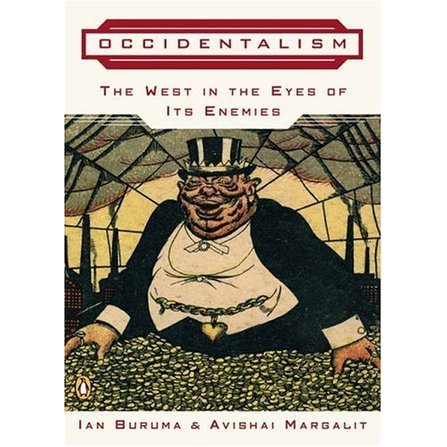
Just finished reading about the West as an object of hate.

Next in line is a book about the Orient as an object of study.

51k6n6ma-nl

Bearing in mind the fact that the Occident is still very much hated by a significant number of people residing in the Eastern part of the World it seems that we, the Westerners, have  been rather poor students of the Orient.

Or that some of us don’t give a damn about the long term consequences of their actions?

“To understand is not to excuse, just as to forgive is not to forget, but without understanding those who hate the West, we cannot hope to stop them from destroying humanity.”

I’d say these are very wise words which constitute an excellent starting point.
Towards the end of their book Ian Buruma and Avishai Margalit argue that “despite Christian fundamentalists speaking of a crusade, the West is not at war with Islam. In fact the fiercest battles will be fought inside the Islamic World.” (translation belongs to me, I have a Romanian version of the book)
How about us, in the West, helping the ‘right’ side in an innovative way?
By giving them an example.
By mending our own ways, before telling others to mend theirs!

God thanks

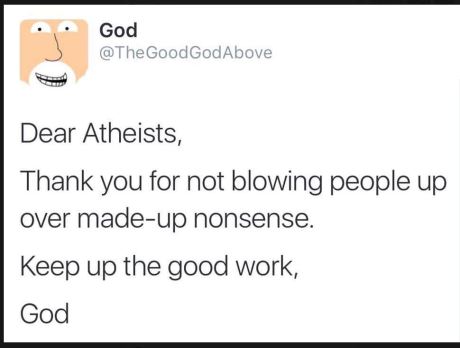
I recently shared this meme, originally posted on FB by Black Atheists.

The broad spectrum of the commentaries made on this subject enticed me to elaborate on it.

There are people who blow people up under religious pretenses and people who blow people up under their own ‘rationale’.

This meme can be interpreted as God praising those who do not use his name when committing heinous crimes.

Who do not misinterpret religious teachings to fit their callously narrow goals.
Who do not make up self-serving nonsense simply because they have enough sleigh of mind and an audience who, for various reasons, is willing to believe anything that might provide some psychological comfort.
Who do not use religious pretexts when horribly mistreating others.

And don’t get me wrong. God doesn’t praise them for what they’re doing – there is nothing to be praised there.

He praises them for what they are not doing.

Using false pretenses, that is.

It depends on the meanings we attach to these two concepts.

Yanis Varoufakis, Greece’s ex finance minister, is convinced that ‘Capitalism will eat democracy – unless we speak up.

Since he has some experience in this matter I’ll follow his line of thinking – for a while.

His point being that you can have successful capitalism in undemocratic societies – like Singapore and China – and that effective power has slowly shifted from the political sphere of the society to the economic one – which is undemocratic by definition.

Can’t say he’s entirely wrong, can we?

But we can say he’s somewhat confused…
So, he mentions Lee Kuan Yew’s Singapore and China as capitalistic success stories and then says that  the political sphere is gradually falling  under the yoke of the economic one… Well, last time I looked, in China the state was still in full control of everything that moved and the state was firmly in the hands of the politicians. Same thing was happenning during Yew’s tenure as Singapore’s good willed dictator.

Unfortunately there is some truth in his words when we look at what’s going on on the both sides of the Atlantic and that’s why I’m going to examine whether we have the same kind of capitalism in both situations.

By Google-ing the word I got two definitions for the concept.

The first definition that was offered by the search engine came from Oxford Dictionaries, “An economic and political system in which a country’s trade and industry are controlled by private owners for profit, rather than by the state” and the second one came from Merriam Webster: capitalism is “an economic system characterized by private or corporate ownership of capital goods, by investments that are determined by private decision, and by prices, production, and the distribution of goods that are determined mainly by competition in a free market“.

Putting them together we have private ownership, private decision, free market and profit as a goal.

Are these enough to describe a reasonably well functioning economic system?
I’m afraid not.

Let me give you some examples.
The French state has a controlling interest in Renault and the land of Bavaria quite a sizeable one in VW. Renault is in good shape and VW was too, until very recently. So private ownership is not an absolute necessity.
In the US we had quite an interesting situation. Two out of the three big car manufacturers  had to be bailed out by the state. All three were privately owned so we must look somewhere else: the Ford family still has a powerful word in the management of the single one which didn’t had to be bailed out. In Europe the best run auto company seems to be BMW – again controlled by a single family, the Quandt’s. It seems that it helps a lot if those who call the shots have a long time interest in the well being of the company versus the situation in which the top management has (short time) profit as the single/obsessive target.
Coming back to Renault and VW, they can be compared to Singapore, China and, maybe, Spain. Singapore was able to develop a ‘capitalistic’ economy despite it being an authoritarian society simply because Lee Kuan Yew was a very special kind of ‘dictator’ – one that not only cared sincerely for the greater good of his people but also didn’t loose his head during his long stage at the helm. A similar thing happened in Spain – Franco was the sole dictator who had made preparations for a democratic evolution after his demise, while China had to wait for another good-willed dictator to grab the power – Deng Xiao Ping – before it could steer towards the present course. No other authoritarian regimes but these two have ever managed to replicate this feat – we still have to wait a little before pronouncing Vietnam as the third, and very few other publicly owned companies fare so good as Renault does.

So, we have rather strong evidence suggesting that ‘skin in the game‘ trumps blind insistence on short time profit and that a free, democratic, society offers greater chances for economic development than a authoritarian one. In fact the politicians that need periodic confirmation from the people they govern do have some skin in the game while the authoritarians are in a position that is somehow equivalent to that of the CEO’s of the huge corporations whose stock owners are so disspersed that practically don’t count much – the members of the board practically slap each-other on the back and are able to do practically what they want with the companies. Look what happened at GM, Chrysler and, for example, ENRON.

But how free should be that society in order for capitalism to thrive?

Could it be so free that a guy could come from the street and claim your house as being his own? No?

So we need a free but orderly society. One where private property changes hands only when its owner says so – or has previously entered into a contract which stipulates that in certain conditions that transfer has to take place.

Meaning that in order to have a functioning capitalist society we need not only private ownership but also private owners who have enough trust in each other to start making business together.

You see, the feudal lords of the Dark Ages did have a lot of private property but capitalism couldn’t take hold in earnest as long as the (absolute) monarch could strip a man of his property and give it to somebody else. They couldn’t enter into (longish time) contracts because the era was dominated by huge uncertainties regarding various aspects of the social and economic life.

In fact it is exactly this well tempered freedom that is the crux of functional capitalism. Enough freedom so that everybody could feel confident that he is his own master but tempered by rules enforced in a pwerfully enough manner to give everybody sufficient trust that most contracts will be executed faithfully.

In this sense for capitalism to work properly we need to have a market that is free in more dimensions that one.

It has to be free from political intrusion in the sense that the government should leave it alone as a rule of thumb but also that the same government should keep it free from becoming cornered by a single group of interests.
In fact there is no difference from a market that is run by a governmental agency or by a monopolistic corporation – no matter if the latter is private. As soon as decision making becomes concentrated in too few hands mistakes starts happening. And their effect accumulate until the system finally collapse. Or is dismantled by some ‘exasperated’ more powerful agency – as Standard Oil and  ‘Ma Bell’ were dismantled by the US government. Which, by doing so, created the premises for  the huge development of those two respective markets – oil and communications.

Only this freedom of the markets can seldom be preserved by an authoritarian regime. Yew’s Singapore and contemporary China are exceptions, not the rule. Most authoritarian regimes cannot resist temptation and start meddling in the economic life of their countries. By doing so, they introduce a lot of ‘noise’ into the system. Eventually, this noise drowns the useful signals and ‘blinds’ the decision makers.

Same thing happens – and here Varoufakis has a valid point – when economic agents become so powerful that they can dominate the policy makers. The politicians can no longer preserve a balanced stance towards the economy and give in to ‘special interests’. This way the markets loose their freedom, with all the malign consequences that come with this situation. Among them, the lack of trust that slowly creeps in the souls of those who have to do business in the no longer free markets. Which lack of trust is very bad for all those involved.

And another thing about which Varoufakis is absolutely right. A lot of money are not being moved through the ‘front doors’. Not that they are not invested at all but because they are kept somewhat hidden they do not contribute as much to the well being of the world economy as they could/should.

2.1 $ trillion have been accumulated, as of  October 2015, in off shore accounts by the top 500 American companies in order to avoid taxes and
Between $21 an $32 trillion have been hiding in 2012 in various offshore jurisdictions.

Why is that? Simply because those who are called to decide about these money do not ‘trust’ that by bringing these money home and by investing them there, after paying the taxes, will be able to generate profits equivalent to those produced by leaving them off shore?

So what should we do? Tell them ‘democratically’, by electing somebody who is crazy enough to implement such a measure, to bring them home? Or even  confiscate them, one way or another?

I’m afraid that here I part again ways with Mr. Varoufakis. And with Aristotle: the way I see it democracy is not ‘the constitution in which the free and the poor, being in majority, control government‘. That would be ‘mob rule’.
A truly democratic process starts before the vote. When every stakeholder can make its point known to those who are going to cast a ballot so they’ll be able to do that having a reasonably clear understanding about what’s going on.

Frankly I’d rather rephrase Varoufakis’ message. ‘Corporatism has a tendency to disembowel democracy and transform it into ‘mob rule’ – the situation where the poor are no longer that free simply because they are convinced through ‘unholy’ methods to vote one way or another.

What can be done? Explain, loud and clear, that if jobs disappear the same thing will happen with the aggregate demand?
Explain that by giving their workers as little money as they can in reality the results are way worse than if the wages were as high as the companies could afford?
Ford didn’t give his workers more money because he loved them but simply because he had understood that in the long run he would be better off himself by doing this, you know!