
Logos continuously chiseling
new Reality
out of whatever Opportunity is at hand….
At the beginning there was nothing but Chaos.
Then Gods were born. One way or another.
The birth of Gods sowed order into Chaos.
Thus Cosmos was born.
Logos continuously chiseling
new Reality
out of whatever Opportunity is at hand….
At the beginning there was nothing but Chaos.
Then Gods were born. One way or another.
The birth of Gods sowed order into Chaos.
Thus Cosmos was born.
„Fiule, tu întotdeauna eşti cu mine şi tot ce este al meu este şi al tău.
Dar trebuia să ne veselim şi să ne bucurăm,
pentru că acest frate al tău era mort
şi acum trăieşte,
era pierdut şi a fost găsit!“
Cum, necum, Guvernoiu – noua versiune – s-a apucat de treabă.
Reforme, alea… alea…, după cât îi taie capul.
Sunt și ei atât de pricepuți pe cât de bine i-am ales noi!
Și noi?
Noi ce facem?
Care noi?!?
Noi, presa!
Pentru că doar gura presei se aude. După cum e și normal…
Presa și influencerii ce influențează, de bună voie sau în servicu comandat, pe toate canalele. Pe toate canalele media apărute ca o consecință a dezvoltărilor ‘tehnologice’…
Și ‘noi’?
Noi… ăștia… ăștia care am votat! Ăștia care am tot votat în ultimii 35 de ani…
Și care am reușit să supraviețuim, cu bune și cu rele!
Care am supraviețuit experimentului comunist. Așa aberant cum a fost el.
După care am supraviețuit tranziției. Și procesului de democratizare. De integrare în UE….
Că integrarea în NATO a cam fost pe șestache… Nici nu ne-am dat seama că s-a întîmplat!
Noi, adică ‘noi ăștia’, am ajuns într-un punct de inflexiune.
Când să ne bucurăm și noi de roadele muncii din ultimii 35 de ani – de integrarea în UE, în Schengen și de protecția oferită de NATO – tocmai am descoperit că ‘împăratul e gol’.
Că vistiernicii în care am tot avut încredere – adică pe care i-am tot votat – au lăsat bugetul în pielea goală.
Cum, necum… vistieria e goală!
Deocamdată a ajuns la butoane o (semi)nouă garnitură. Tot ca urmare a votului nostru.
Care garnitură, repet, s-a apucat de treabă. Pe cât îi duce mintea…
Și noi? Reacția noastră? Exprimată prin presă și prin gura influencerilor?
Bolojan ar fi trebuit mai întâi să…!
Nu e normal ca poporul să sufere ca urmare a deciziilor proaste luate de (o parte dintre)foștii/actuali guvernanți!
Dragos Anastasiu și toți ceilalți care au dat vreodată mită și au recunoscut acest lucru denunțîndu-i pe cei care au primit-o n-au ce căuta în aparatul de stat!
Înțelepciunea populară pretinde că ‘hoțul neprins, negustor cinstit’.
Isus, că tot o ardem cu cât de creștin-ortodocși suntem, și-a învățat ucenicii că doar cei cei care n-au păcătuit vreodată au dreptul să ‘arunce cu piatra’….
‘Bine, bă! Da’, până la urmă, tu ce vrei să spui cu toată polologhia asta?!?’
Vreau să aduc aminte că toți am dat șpagă.
Unii mai mult, alții mai puțin… Unii recunoaștem, măcar în sinea noastră, alții nu…
Și că noi trăim astăzi consecințele deciziilor noastre. Deciziilor pe care le-am luat împreună!
Nu știu ce trebuia să fi făcut Bolojan.
Nici măcar nu știu dacă Anastasiu – și ceilalți ca el – ar trebui/putea să facă parte din aparatul de stat. Au experiență, știu care sunt urmările șpăgii, dar nu se pot bucura de încrederea publicului.
Dar știu că dacă ne mai coim mult în loc să ne uităm adânc în oglindă… o să ne ia mama dracului!
Și e păcat.
Abia ce se luminase de ziuă!
„Să nu confundăm poporul cu statul”
„Statul”, cuvântul „statul”, are mai multe sensuri. Cel puțin două…
Statul ‘degeaba’.
Și statul ca instituție.
Adică să stai degeaba la stat…
„A confunda” are tot doua sensuri. Cel puțin două…
A confunda la nivel perceptiv și a confunda la nivel agentic.
A încurca lucruri între ele atunci când le examinezi și a ‘amesteca’, eventual în cunoștință de cauză, un ‘ceva’ cu un altceva.
Ludovic al paișpelea, dacă nu mă înșeală memoria, este pomenit pentru afirmația „L’etat c’est moi”.
El pretindea că …
Iar cei din jurul lui acceptau această pretenție! Așa era pe vremea aia…
Între timp, adică de la Revoluția Americană încoace, poporul a revendicat – prin reprezentanții săi, discuție lungă – locul de onoare.
Fenomenul a fost imitat foarte repede pe vechiul continent. Atunci cînd foștii supuși ai lui Ludovic catorz l-au descăpățânat pe Ludovic XVI. Pentru „înaltă trădare și crime împotriva statului”…
Nu pot să nu observ ironia faptului… Ludovic XIV, pe vremea aia monarh absolut, a ajutat poporul American să se „confunde” cu statul American. Ce mai contează motivele pentru care…
Ludovic XIV și-a făcut-o cu mâna lui… Pe vremea când conducea Franța.
Chiar dacă, în mare parte, ‘nominal’. Prin interpuși…
Mai apoi nici măcar n-a fost în stare să fugă la timp!
Cam așa și cu popoarele. Mai ales cu cele care, cândva în istoria lor, au acces – adică ‘s-au urcat’, la democrație.
Care au ceva de spus atunci când vine vorba despre viitorul lor!
Care au devenit una, care se confundă, cu statele în care trăiesc.
Acele popoare, mai ales acele popoare, sunt responsabile pentru soarta lor!
Pentru un singur motiv.
Pentru motivul că ele sunt cele care își trăiesc soarta!
For a proposition to be ‘true’
it is not enough for it to be logically valid.
It also has to make sense. Epistemologically speaking.
Oscar Hoffman
“This house belongs to me”.
“I own this house”.
Logically, these two propositions are equivalent. Both state the same thing.
But which one makes real sense?
Where do you belong?
Where do you feel at home?
What can your house do for you?
What have you done to your house?
Self awareness doesn’t come cheap…
Collectively, species-wise, we’ve done OK. We’ve become the dominant species on Earth.
For good and/or for worse…
Individually, on the other hand…
Doubts!
Self-awareness comes with plenty of them:
Will I be able to find enough food tomorrow? For me and for my family?
When will it start to rain?
Will the sun rise again?
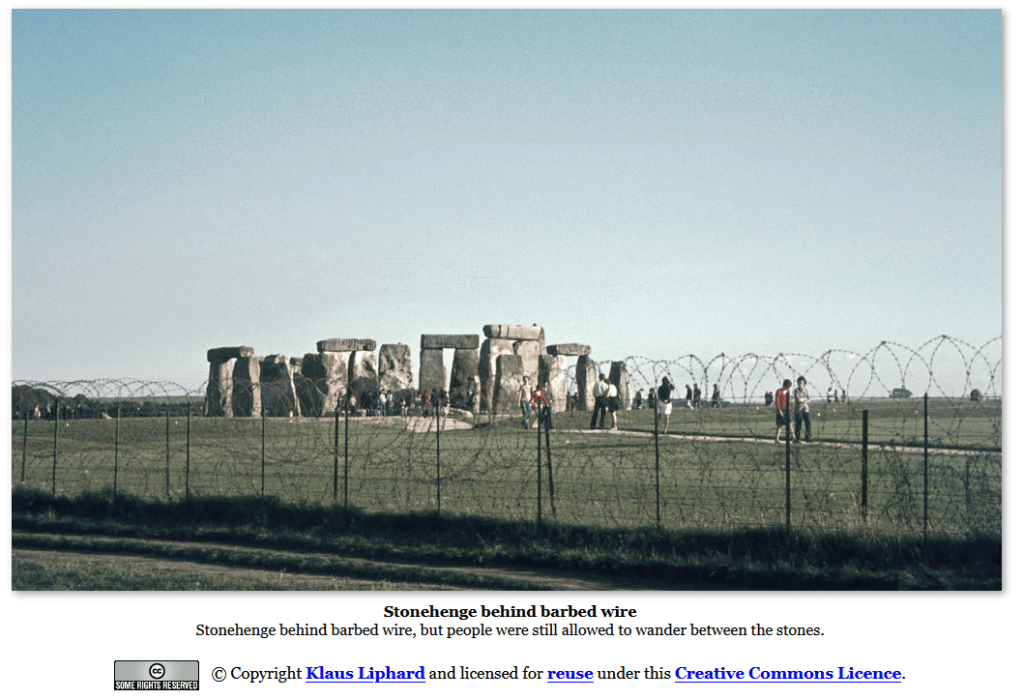
The way I see it, ‘The Stonehenge’ has been built for one thing only.
To assuage fear.
According to scientists researching the phenomenon, ‘The Stonehenge’ had been built by the immigrants who brought agriculture into Britain.
Solving the food problem wasn’t enough. Enough to bring peace of mind…
Now, that full bellied people had enough time on their hands, they started to think about ‘the future’:
‘OK, tomorrow will come. The sun will rise. We’ll be able to sow our crops for the next year. But is there an order in all this? How can we be sure?’
‘Let’s build something which will prove “order”. If we could demonstrate that year after year the summer solstice ‘falls’ under the same ‘parameters’ then there’s indeed an ‘order’. Things don’t just happen, they follow a ‘script’ ‘.
And they did exactly that. Built the first scientific instrument. Proved that the sun not only rises each day but also follows a precise path.
Quite a management feat.
And no, I don’t mean the stone stacking part. However remarkable that was…
Their real success was to convince themselves to keep toiling into the future!
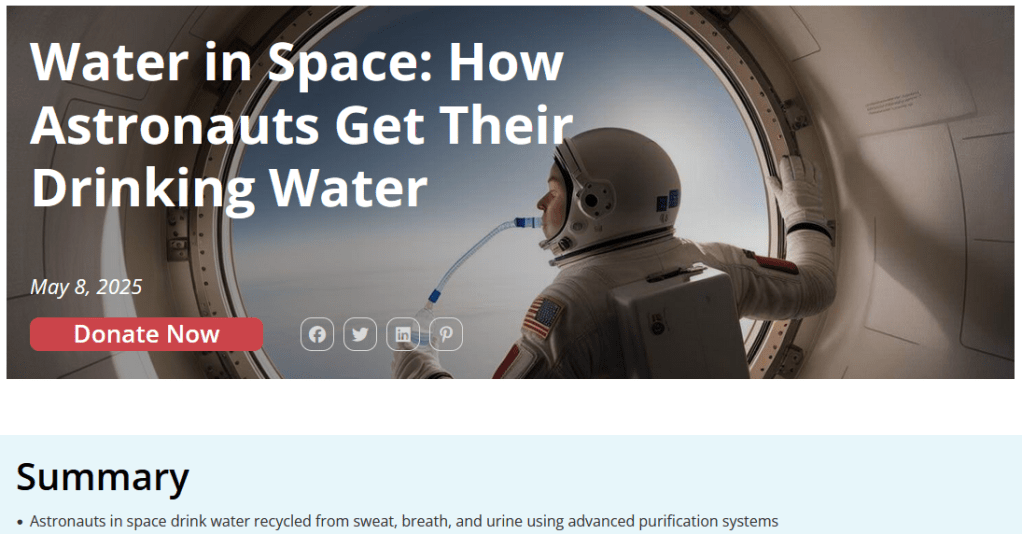
Astronauts don’t bring all their drinking water from Earth.
Instead, they rely on closed-loop water recycling systems
that recover and purify nearly every drop of moisture produced onboard.
That includes urine, sweat, breath vapor, shower water, and humidity from the air.
In space, nothing is wasted.

A space station circling the watery pebble we call home…
Cooperation brought us so far.
A majority of us have enough to eat and some of us – albeit very few – get to see the world from above.
Some of us might wonder:
What’s the point of ISS?!?
Wouldn’t that money be better spent feeding the hungry?
The short answer is:
‘We don’t need the ISS money. Feeding the hungry is well within our current possibilities. We just haven’t yet figured out how important this is!’
And here’s the explanation.
We’re no longer able to feed ourselves. Individually…
In order to enjoy our current standard of life, we need to cooperate.
In order to cooperate, we need to trust each-other.
Nobody has asked to be born.
Yet here we are.
La Legion Etrangere goes by “Marche ou Creve”. Keep walking or ‘make way’.
Now that we’ve been born, how about we make the best of it?
Those who get to see the world from above did have a say about the whole thing.
Nobody gets there against their wishes.
And they know what they’re signing for. Not everything – some of them don’t get to get there – but they have a fair image of what’s gonna happen to them. Including the facts about the water they’ll be drinking while enjoying the view.
Maybe it’s time for the rest of us to understand the limited nature of the Earth itself.
Not as limited as the ISS but I’m sure you understand my drift.
The astronauts trust each-other.
And they trust the rest of us.
Those who have made it possible for them to go there.
We, the rest, need to learn the trick.
How to actively, agentically, build trust 2.0.
“Give us today our daily bread”

We’ve been around for a while.
300 millennia, according to some. 70 millennia, according to others. Who use a more stringent set of criteria.
Anyway. Homo Sapiens is considered to be 300 000 years old while his nephew, Homo Sapiens Sapiens, is a little younger. Only 70 000 years…
Regardless of age, for most of this time we have been foragers.
OK, even our ancestors had tools. We’ve been around for 300ky while tools have predated us by more than 1my. Yes, our hominin predecessors were the ones to invent tools…
Then what is our contribution? Why are we the ones who are still around?
According to Ernst Mayr – if I interpret correctly – we’ve simply been lucky!
Nothing happened.
No catastrophic event bad enough to extinguish us. And no freshly minted ‘superman’ to take our place.
That question, regarding our contribution, speaks volumes about our infatuation with ourselves.
Hence the paradox.
Very recently, we’ve done something. Used agriculture on a large enough scale to change our way of life.
As foragers, we used to live in a certain way.
As homo economicus, who actively, agentically, produces food – and everything else we need, we’ve crossed yet another barrier. Benchmark? Anyway, we live completely different lives from those experienced by our foraging (fore)fathers. Despite the fact that there’s no biological or psychological difference between us.
Don’t believe me? Take a small child from the African or South American bush, lovingly raise them in a functional family and tell me if you find any difference. Between any of those children and their ‘already civilized’ school-mates. The key concepts here being ‘lovingly raise them in a functional family’ and ‘school mates’. If you understand what I mean…
‘Completely different lives’.
‘OK, I get it. They, the lives, are different. But are they better? Or worse?!?’
Your question, your very pertinent question, is extremely eloquent.
It fully expresses the paradox haunting us.
As foragers, we’ve learned to speak. To carve. To make beautiful tools. To paint…
As foragers, we’ve become human.
As agriculturalists, we live way longer lives. And accomplish way many more things.
Yes, ‘things’.
We speak the same. We paint the same. We carve the same. We even eat more or less the same things. Less of them but there’s nothing really new in our diet. Less diverse, heavily processed in too many instances, but no really new ingredients…
The only two differences between us and our fore-fathers is the length of our lives and the amount of things we end up owning.
So. Are our lives better?
Longer, for certain!
Less painful? Probably. Considering the physical pain…
Happier?
Then what? Give up agriculture? Go back to bare-back foraging?
How about learning from agriculture?
Digesting the concept, not only the produce…
As foragers, we were ‘expandable’. Each of us could do everything. Statistically, speaking… Gathering, hunting, fetching water and wood, you name it. We depended on each other, of course, but none of us was irreplaceable.
As homo economicus we also depend on each other. But differently!
Just remember what happened last week. When nobody knows how/why, yet, the fuel lines of an airplane taking off somewhere in India were switched off.
Or think about what happens when one of your colleagues calls in sick.
Smith, Adam ‘Free Market’ Smith, taught us about ‘the baker, the butcher and the brewer’.
We still have to digest his teachings.
Our daily bread demands a lot of cooperation.
We’re no longer capable to accomplish much individually.
Our longer and way more bountiful lives depend on our ability, and willingness, to cooperate.
Respectfully….
Where there’s a way
There will be a will!
An open wound will be ‘colonized’ by various organisms.
A mixture of water and flour will develop a ‘froth’.
A naive person will be swindled.
A healthy immune system will, eventually, take care of the infection. Successfully or not…
If in the hands of an experienced baker, the mixture of water and flour will – eventually – become the starting point for a delicious sour-bread loaf.
The previously naive person, once swindled, might learn something from the experience.
Life is nothing but an added layer of opportunity.
The pre-animated world is about strict rules. No variation, except for that brought about by happenstance.
Life is also about rules. But way laxer than those governing the pre-animated world.
While the pre-animated world is about nothing more than mere existence, life is about surviving in the given conditions. About evolution. About change.
And here’s the catch.
Pre-conscious change is also mainly about happenstance.
Darwin’s evolution is driven by minute changes at the DNA level. Those which are helpful are perpetuated while those which are harmful either kill out-rightly the organism where they have appeared or restrict its ability to ‘give birth’.
Nota bene. Darwin’s evolution was about “On the Origin of Species by Means of Natural Selection“
In his understanding, and in the real world, evolving – biology wise – is done by the species. Not by individual organisms!
Conscious change, on the other hand… is driven by individuals!
Happenstance continues to be involved, heavily, but the main drive comes from ‘want’. From individuals willing/wishing to ‘make a difference’.
Is this a good or a bad thing?!?
It is a fact. Neither necessarily good or bad. Just a fact.
The outcome, evolution wise, depends on how the social organism – the cultural species – digests the experience.
For a while, I was convinced we were living in a virtual reality.
In a reality of our own making. As I mentioned earlier, ‘vir‘ is a Latin word. “Man”. “Hero”.
Hence ‘virtual’ literally means ‘man-made’. ‘Manufactured’.
Now I’ve realized we live inside an experiment.
We are both the objects and the agents of the intersecting experiments currently active.
We call them ‘lives’. Our lives…
We all know about it.
To the tune that none of us cares
anymore about what the rest of us think about it.
We’ve conditioned ourself to use a single perspective.
To measure with a single yard-stick.
To have but a single goal…
We have not yet been able to replace the founding illusion
The naturally born idol.
Our image of God…
Our hunting-gathering ancestors have become conscious, learned to speak, invented crafts. And painted numerous caves.
Life was nice in those days. A few hours spend foraging then you could do whatever you fancied. No point in gathering more food – it would have spoiled – and no point in making more tools than you could carry with you. So… lay back and enjoy.
The only problem with this was the fact that those people lived in a state of an extreme precarity. No provision could be made for tomorrow. Nobody ever knew what they were going to eat, if anything, the next day!
Hence they jumped at the first chance of agriculture. A far safer approach.
The problem with agriculture was that it had brought three things with it.
People were divided in three. Rulers, free people – men, usually and slaves.
It was far cheaper, and way more efficient, to use slaves instead of hiring free-people. They were spared for trading, fighting and other occupations which needed self esteem and a lot more personal autonomy than tilling.
Agriculture also brought about the need for protection. For an army.
Stashed produce, saved to be used during the entire year and sometimes beyond that, was liable to tempt some of the neighbors. Those who preferred to steal something rather than work for it.
The ‘protection force’ also came in handy when the slaves tried to leave their posts.
The third ‘thing’ was philosophy.
The society had enough spare resources to allow a few of its members to spend their time thinking. Instead of performing ‘menial’ tasks.
These thinkers have started to notice.
And continue to do so.
For as long as the thinkers concentrated their efforts towards the well being of the community and the community paid attention, things went well. Each generation fared better, on average and statistically speaking, than the previous ones.
Whenever things went astray – the thinkers started to ‘hallucinate’, the ‘public’ no long cared and/or both, things went the other way.
Until some 50 years ago, things were going in the right direction.
People were increasingly freer and fared increasingly better.
Since some 15 years before the communism had collapsed, things has started to sputter.
Stay tuned.
 nicichiarasa