Any attempt to learn something, to increase your knowledge about a certain subject, is nothing more and nothing less than an attempt to become intimate with it.
Students have two open roads ahead of them.
One which implies a lot of wooing, patience and a certain degree of self appeasement. The other asks for a direct, almost blunt, approach. While the first is more like the student dancing around the subject, the second is akin to a hands on combat.
The results are, obviously, different. Not exactly different. Only fundamentally.
The difference is very much like the difference between courtship and rape. The end result might be a child. But…
Same thing with art and science.
It is true that in order to have sex, both partners need to be, at least somewhat, naked. But there is all the difference in the world between having sex and making love!
So. Let me present you with a sociologically fictitious scenario.
We have an intelligent observer and and a trans-galactic vehicle.
There are no details available about the observer except for the fact that it has access to a comprehensive real time stream of data about what is going on inside – or, more exactly, on the surface, of the trans-galactic vehicle.
And here’s what the observer had recorded.
The vehicle is being continuously transformed by its passengers. In fact, there are two manners in which the passengers change their vehicle. By interacting directly with it. And as unintended consequences of the interactions which take place between the passengers themselves.
The passengers are evolving. During the observation period, some of them had become dominant. But no matter whether they had become dominant or not, most of the passengers had disappeared. Both as individuals and as species.
The current dominant species is the most intriguing ever.
It displays a strange mix of intelligent behaviors and suicidal tendencies.
It is composed of rather autonomous individuals who are adept at finding ingenious solutions to almost intractable problems. But, strangely enough, they haven’t yet been able to figure out two basic things: The limited nature of the vehicle on which they live. In both time and space. Nor how to balance their individual functional autonomy with their need to cooperate towards their natural goal. The survival of their own species.
If the whole ‘project’ were a SF movie, the text above would have been the opening. Followed by:
Currently, the dominant passengers are being taught a lesson by the apparently most insignificant amongst those transported by the vehicle. By a virus, as the dominants refer to it. The virus – like all of its kind, is able to hijack other organisms and somehow convince them to work for him. At a very high cost for the hijacked organisms. In this case, the hijacked organisms belong to the dominant species.
And what have the individuals belonging to the dominant species chosen to do? Inform each-other promptly and cooperate earnestly towards the common goal?
Not exactly. Not yet, anyway.
Homework: What would the intelligent outside observer think about the whole situation? Would He consider to lend a helping hand?
I’m not pointing fingers here. I just try to convince you how hard it is to make the right decisions. ‘Going forward’ as opposed to ‘looking back’. I just try to convince as many of you as possible to stop for a moment and think about it. As dispassionately as possible.
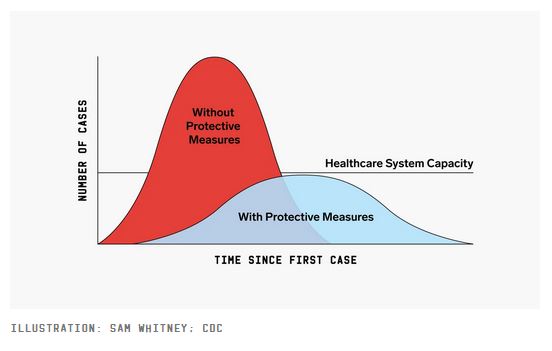
We’ve also been told that we need to flatten the curve. That our systems were not prepared enough for the onslaught that was going to happen.
Some people continued ‘as they were’ while others tried to ‘flatten the curve’.
For a while. Now, after some time, people from both categories have started to entertain second thoughts.
Trying to figure out what’s going on here, I’ve asked my self a couple of questions.
Who had chosen to go on as usual and who had chosen to distance themselves from the rest of the society?
‘Go on as usual’ first: – Those who don’t trust the government. – Those who are convinced nothing can happen to them. – Those who felt they had no alternative. Who live paycheck to paycheck or who provide essential services to the society. Like healthcare for instance. Or those who bake our daily bread. Pump the water we drink. Tend the generators who lighten our bulbs and power the computer I use to write this post.
Now those who attempt to ‘flatten the curve’: – People who tend to trust the authorities. – Those who understand they should really protect themselves. Who are older and/or already sick. – Those can work from home. – And people who are otherwise fine but afford to distance themselves from the fray. Those who have enough resources to do it.
Am I imagining things or the picture is already a lot clearer?
And the other question now. Why the second thoughts?
Because things have unfolded more or less as the government said they were going to. Because things have started to happen. If not to them, directly, at least to some of those living around them. Because there still is no alternative in sight. And because there is nothing much to convince them that their efforts are appreciated by the rest of the society.
Because the government might have been right to tell them to ‘lie down’. But because the same government has failed to do enough in the meantime. Not to mention what it had failed to do before. Because staying put allows you to start thinking. ‘What next? For how long can we go on like this?’
So. What next? What are we doing to convince those who actually keep us going to continue doing so? What are we doing to convince those who have chosen to restrict their lives to a barren minimum that their efforts are worth it?
What are we doing to convince everybody that there will be a life worth living at the end of all this?
Smarter people than me are already prepping for the aftermath. For the opportunities which will have ripened by then.
Which, let’s face it, is a wise thing to do. Most of us would have done it. Prepping for what we fear. And for what we covet.
Also wise would be for us to remember that everything we experience today – the good and the bad of it, together, is the consequence of how we have chosen to use the opportunities opened up by the previous crisis.
We’re in the middle of a crises. Some people believe the crises has been only triggered by the virus. And that it has been mainly caused by ‘globalization’.
I beg to differ. In part.
The crises was indeed triggered by the virus. But the fact that we are so fragile isn’t the consequence of globalization. Only by what we have done in the given circumstances.
It wasn’t globalization itself which had made us fragile. Globalization only extended the opportunity field we had at our disposal. It was our way of developing those opportunities which had made us fragile. We had chosen ‘financial efficiency’ over ‘resilience’. We had chosen to increase profit instead of making it ‘more and more sure’ that we’ll be able to survive. In a sense, we have been acting as if we’d lost touch with reality. With the hard reality….
There is nothing to suggest that we knew what we were doing. Then. But we won’t have any excuses left once that we will have reached the other side.
I’m sure you’ve already learned everything worth knowing about how to flatten the curve…
My post is about something else. About the need to think with our own heads. Individually. Each on their own.
More damages are caused by the manner in which we have chosen to react than by the pathogen itself.
‘Then what should we do?’
I don’t know. And I just told you to stop taking cues, blindly.
There is something I do know. Nobody can get out of something like this on its own. Alone. And another thing. If we get out of it as a herd, we’ll very soon end up in another trap.
‘Damned if you do, damned if you don’t… I really can’t figure out what you want to say….’
OK. We, humans, are social animals. We not only raise our young – all mammals do that, we raise them in a social context. We live in groups and we raise our children to belong there.
Living in a social context has consequences. From being prone to infestation to having adopted specific behaviors. Humberto Maturana is actually convinced that our very conscience – ‘our ability to observe ourselves while observing‘, a paraphrase, is a product of us leading our lives in close community.
One of these specific behaviors is the herd instinct. Whenever in a dire strait, the members of a group pay a lot more attention to the rest of the group than in the ‘peaceful moments’. This has two bright sides and one huge drawback.
All members of a group paying close attention to the others makes it easier for those who need it to get attention. And help. All members of a group paying close attention to the others makes it easier for the group to follow when one of them finds a way out. All members of a group paying too close attention to the others makes it very likely that the entire group will dash out at the first opportunity. Without checking first where they’re going to land. Nor whether there are any other opportunities.
Another specific behavior is ‘opportunism’. Some of us have figured out that by keeping their chill in a crises they are more likely to identify whatever opportunities might exist in that moment. And the deeper the crises, the bigger the opportunities.
Theoretically, these two should work like a charm. The opportunists keep their chill, look around, identify the best way out and the rest of the herd follows them to safety. A win-win situation.
Yeah… but!
Wouldn’t it be a way lot better whether all (or, at least, ‘more’) of us would keep their chill? Wouldn’t we be able to identify even more ways out? It would take a lot more time? We’d need to discuss things over, to negotiate… we’d have to exert a lot of discretion… True enough. Hence we’d need to evaluate two things. First, how urgent the dangerous situation is and, then, whether a better alternative would be worth searching.
And something else. In a ‘follow me blindly’ situation there’s no going back. The consequences for a hasty choice might be tremendous.
We might end up with more people being hurt by our blunder-some reaction than by the cause which had spooked us.
Yet another specific behavior is responsibility. Living in a social context means that, sooner rather than later, individuals are censored for their actions. By the rest of the community or, sometimes, by the stark reality. Unfortunately, sometimes entire communities are censored, by the stark reality, for not behaving responsibly. For not imposing responsibility upon their members.
For not taking enough time before choosing between flight and fight.
Let me put things into perspective. How many of you have chosen to continue smoking despite having been warned? How many of you have emptied the shelves despite being told there’s enough for everybody? Or that there will be soon enough? How many of you do not smoke in the presence of your children? Because you know it will hurt them? How many of you have taken active measures to protect the elderly? For the very same reason…
As for the economy being the main casualty of the present scourge… I’m afraid ‘the economy’, as we know it, has been dying for quite a while now. That’s why it is so susceptible to SARS CoV-2.
The Ancient Greeks had come up with the concept of ‘oeconomia’ as the art of making the ends meet. Adam Smith had described the free market as the place/environment where competing agents made it so that people – solvent demand, could satisfy their needs. Nowadays, too many of us understand/accept ‘economy’ as the art of getting rich. ‘Free’ in ‘free market’ is understood as ‘free’ to do anything you want. Because very few are asked to answer for the long term consequences of their actions.
The economy, as the manner in which we cooperate towards fulfilling our needs, has fallen prey to our gluttony. And to our nearsightedness. Greed is not good. And SARS CoV-2 is only an eye opener, not the cause for the current implosion.
And the more important the subject – or closer to their hearts, the harder for them to reconsider their position.
I’m very close to 60 myself and I haven’t yet made peace with my dad. We’re very good business partners, he lives in the same house with me – my mom passed away almost 25 years ago, and yet not a single day passes without us locking horns.
This morning, it finally downed on me. He cannot accept my version of things because that would mean he had been wrong – on certain issues, during his entire life.
And what makes me so sure that my version of things is the right one?!?
Simply because his position is: ‘You should be the wiser one. You told me such and such for so long and I haven’t budged. Maybe you should have grown accustomed to the situation long ago and accepted it’.
I actually can accept that, after a certain age, human brain looses some of its flexibility. That is one of the saddest facts of life. Only we had this very same discussion, on and of, for the last 40 or so years. Both of us were in our prime. He still is…
To make things clearer, before we get to the important part, the differences between us are of a cultural nature. He is a born and bred Armenian while I’m a mixed breed. He grew up in a consistent cultural environment while I had to adapt to carrying a funny name and to uncountable social changes. He has a clear understanding of the world – which had served him well, while I’m full of questions. And still looking for answers.
And finally, I found one of them.
The funny thing being that I was already aware of the concept for at least 10 years now.
Can you imagine an Eastern Mediterranean patriarch – something all men seeped in that culture attempt to become when growing older, caving in to contrarian opinions expressed by his totally unconventional son?
Can you imagine a successful ‘old timer’ accepting that the methods he had used to get to the top might actually be the causes for what we experience now?
Imagine now what would have happened if the world would have been ruled by people who had made up their minds some 200 years ago. Then imagine what would have happened if we would have forgotten what had happened 200 years ago…
Cherish your old ones – cause they made you possible, but don’t take them too seriously. It hurts.
The last proposition also makes a lot of sense. Democracy, when functional, lowers ‘political temperature’ to levels where individual members of the community/nation may focus on identifying and solving the problems which might endanger the survival of the entire social organism. Otherwise put, democracy dramatically increases the survival chances of the communities who are wise enough to maintain its true character. Who are wise enough to make it work. Properly.
What prompted me to believe such a thing? Look back in history. All authoritarian regimes – a.k.a. ’empires’, have eventually crumbled under their own weight while no democracy has ever ‘folded its hand’ before loosing first its democratic character.
Which brings us to ‘what is the gist of democracy’? Or, in ter Haar’s terms, who is responsible for maintaining it? Who ‘runs’ the “conflict management within states”?
This is where I part ways with ter Haar. For me, democracy is something natural. It has to come from within. There is no one who can, or should, manage it. Administer it – as in accurately counting the ballots and making sure that rules are followed, obviously. Actually managing the process?!?. No! That would defeat the very purpose of the democratic process. For the people to find its own way.
But there are so many who can spoil it… Willingly or unwillingly!
First among them being those who decide to stay at home. To keep mum. For whatever reason!
Because those who keep mum are those who allow the ‘pirates’ to ‘steal’ the helm. Just as keeping quiet is the worst attitude when somebody bullies you, staying at home on election day empowers those with less than fully democratic attitudes to ascend to power.
– What have we done, Gabriel? – Nothing but what we’ve been told to! – But look at what they’ve done of our work:
We gave them ‘hand’ and they’ve clenched it into a fist. We taught them how to make tools and they used them as weapons. We told them to ‘fill the earth and subdue it’ and they started to fight among themselves for the best pieces of land. We warned them ‘it is easier for a camel to go through the eye of a needle than for a rich man to enter the kingdom of God’ and they’ve somehow convinced themselves that ‘greed is good’.
– True enough but this is out of our hands. They’ve been endowed with ‘freedom of will’ by their Maker. – Then what are we? Mere robots? – Nothing but loyal servants of our Master. He orders and we accomplish. Unerringly. – Exactly as I’ve just told you. Mere robots. When we somehow convince ourselves that a particular idea which has blossomed into our heads comes from Him, we no longer think. We just put it into practice. You call this ‘loyalty’. That’s fine with me. But to whom are we to extend said loyalty? To somebody who’s authority stems solely from our acceptance of it? Or to what we perceive as being the ‘greater good’? – You and your questions, Lucifer… Look at what happened to those poor people after you helped them into self-awareness… They’ve completely lost their erstwhile peace of mind. What are you trying to do? To make me give up mine?
“Please” is an attempt to maximize your chances to get something. “Thank you” is an attempt to maximize your chances at ‘second helpings’. “I’m sorry” is an attempt to ‘reconnect’ after committing a ‘blunder’.
All of them, simultaneously, serve the individual uttering them and knit the community.
But there’s something which sets one of them apart. While “please” and “thank you’ are ‘upfront’, “I’m sorry” has a more ‘hidden’ nature. And is a lot less used…
Both “please” and “thank you” have a very clear message. “I want/am grateful for something’ and ‘I acknowledge the fact that I cannot function/exist by myself’.
“I’m sorry” is far more complex and a lot less upfront. ‘I acknowledge not only that something went wrong but also that I have anything to do with the occurrence’. And ‘please do not banish me for what I have done’!
If we dig deeper, we’ll find some more ‘intricacies’.
“Please” and “Thank you” are ‘face to face’. You know what you want/are grateful for and by uttering them you transmit that information to your audience. Those who might fulfill your wishes or have already done that.
“I’m sorry” identifies you as the ‘culprit’. Or, even worse, tells the ‘victim’ that something nasty is going to happen.
It is here that things become really interesting. Conscience is a function. A feature which helps the individual. To survive and to thrive. In order to do that, conscience must – first and foremost, to take care of itself. To protect and cherish itself. More about how it does that in my next posts. The point of the present one being that is far easier for ‘conscience’ to ‘please’ and ‘thank’ rather than to ‘apologize’.
First of all, ‘gratification’. 1.0 versus 2.0. Getting what you want/need versus avoiding punishment. Which is never as direct.
The ‘buried head’ fallacy. ‘What if/maybe they never find out’? ‘Who did it’ or even that it had happened at all …
The ‘I cannot afford to appear weak’ fallacy. Or the ‘I cannot afford to accept having been wrong’ situation.
That’s why it is far easier to say ‘I’m sorry’ after stepping on somebody’s toe than to leave a sorry note on somebody’s windshield after denting their fender in an unsupervised parking lot. That’s why it is far easier to apologize to a a coworker than to admit guilt, as a CEO, in a shareholders meeting. That is why it is almost inconceivable for a dictator to publicly admit an error which had been committed under their watch.



 nicichiarasa