Archives for category: Mutual Respect

Things – every’thing’, actually – are/is relative.
Relative to the agent evaluating each of those things
.
Accordin’ to Einstein, that is.
He was the one who taught us to use whatever reference frame suits our needs.

Do you reckon anybody wasted any time or energy thinking about freedom before the advent of slavery?
Me neither.
Forget about the fact that, in those times, people didn’t have much time left for abstract thinking. Finding food and enjoying it with friends kind of drains your energy when you have to do it yourself… The point being that, in those times, everybody was free. Hence ‘had’ nothing to compare freedom with… No lack of freedom, no reason to speak/think about it.
No reason to notice the thing and no reason to coin the concept…

Hunter-gatherers have no use for ‘property’. Personal objects are just that and everything else either belongs to Mother Nature or to the entire group. And this goes without saying. Or thinking about it. People share everything as a matter of fact and common sense discourages the others to use anybody’s personal objects unless in an emergency.
Agriculture – either herding animals or growing crops – changed everything. Property, both as a concept and as an everyday manner of dealing with ‘things’, was invented and introduced in daily use. Productivity increased dramatically. Which made it possible for people to have ‘spare time’. For thinking.
And for planning…

‘The neighbors have better crops. Let’s go take some for us. And while we’re at it, let’s take some of their women too’.
The first slave was probably the first person to long for freedom…

‘Cheap’ slave work coupled with the increased social productivity induced by a markedly improved technology for obtaining food meant that some individuals could afford the luxury of thinking.
The Ancient Athenians had both slaves and philosophers. The slaves did whatever was needed to be done while some of the ‘beneficiaries’ had enough time, and energy, to let their minds ‘free’. To roam free in search for meaning.
To coin the concept and to explore freedom…

Relative “To whom”? To us!
We’re responsible for freedom and freedom is relative to us.
We have invented it. We’re the ones using it. In the sense that we’re the ones who need to notice that freer communities fare a lot better than the less free.

So freedom is relative both to those thinking about it and to each particular community.
To each particular community which puts freedom into practice!

“How is capitalism better than socialism and communism?”

First of all, capitalism, socialism and communism are four different things.
Socialism, per se, is two things.
Funny, right?

There is the democratic socialism. A social arrangement where ‘nobody is left behind’ and where the economy is run according to capitalist principles.
And there is the ‘stepping stone’ socialism. The ‘prep class’ a Marxist society was supposed to graduate from before acceding to communism. In fact, the former USSR – as well as all the other former ‘communist’ countries had never reached that stage. Stepping stone socialism is something nobody has yet been able to graduate from.

‘Stepping stone’ socialism and communism are bad. For the simple reason that both are authoritarian regimes. Run by a small group of people according to their own whims. Pretending to mind the best interests of the entire people but, in reality and like all other dictatorships, minding exclusively their own businesses.

Capitalism? Nazi Germany was capitalist. Not good. Because it was Nazi…

‘Capitalism’, the entire gamut covered by the blanket term, is neither good nor bad. People collaborating using capitalist principles can reach for the stars – literally – while people obsessed with amassing money will, eventually, end up in a cul de sac. Remember what happened in 2008?
Free market capitalism, run by a democratic society, makes wonders. The USA until 2008, Canada, Australia, New Zealand, Japan and South Korea after they had regained their freedom, W. Europe. Great Britain.
The problem with free-market capitalism being the freedom of the market. In order to make wonders, the market must remain functionally free. Free from obsessions, free from monopolies, free from political heavy handed interventions. And equipped with a sturdy social safety net. The US used to have one. W. Germany also. Unfortunately, that kind of capitalism is very hard to find nowadays… Too many oligopolies have cornered too much of the former free market and too many safety nets have been transformed into pampering devices for dependent people. Some of whom are already rich!

We’re currently experiencing a tug-of-war.
Frustrated people have been harnessed to pull in diametrically opposed directions.
Some have somehow been convinced that the free market should be allowed to become a MMA cage. A no holds barred free for all fighting place. And what if the whole thing will eventually be dominated by your local bully? We’ll deal with that if/when it will happen.
Others have been duped to believe that capitalism is bad. That usury is not an abuse but the defining characteristic of capitalism. Hence a compelling reason for capitalism to be rejected lot, stock and barrel!

OK, for the sake of the argument, let’s look for a replacement. A replacement for Adam Smith’s capitalism.

Let me remind you that bona fide socialism relies on redistributing wealth created using capitalist principles.
That stepping stone socialism is a mockery. An undercover capitalism where all significant property is owned by the state. Where all decisions are made by the government. By the revolutionary government which pretends to know better, as advertised by Marx. Karl, not Groucho.
And that ‘real communism’ is nothing more than a thought experiment! Wouldn’t it be nice if? Yes, it might have been nice if the practical aspects of the whole thing didn’t prevent those who have tried it from reaching their goals.

Do your own thinking!

How many times did you came across this message? ‘Do your own thinking!’. ‘Do your own research!’. ‘Don’t believe everything you are told!’

Sounds reasonable, doesn’t it? What’s wrong in googling up a subject before making up your mind? What’s wrong in storming your brain before calling something one way or another?

Let’s examine something else first.
There are ways in which we relate to ‘reality’. ‘Conservatively’ or ‘open-mindedly’.
And no, this has very little to do with our intelligence or with our level of education.

It depends on how important the subject at hand is to our well being and whether we have already made up our mind about it!

How open minded are you when it comes to spending the last money you have in your pocket? With no prospect of getting any in the near future?
How open minded do you remain after you have already declared, publicly, one way or another?

Most of those lavishly spraying their audience with ‘use your own heads’ – in my FB feed – also told their followers to avoid vaccines, at all cost. The one against Covid in particular – ‘it will eventually kill you’, but also those against measles. ‘It might cause autism’.

How this thing works?

Survival bias.
We not only want to survive, physically, but also to ‘feel good’. To preserve the good opinion we have constructed about ourselves.

This being the reason for which those of us who struggle to find their next meal will not take time to consider any philosophical subject. Will gladly accept the more ‘convincingly’ stated opinion and get back to the more important task of ‘foraging’.
And this being the reason for which those of us already entertaining a strong opinion about a subject see the world ‘differently’. Effectively associate different meaning to the same words!

“Do your own thinking” actually means different things to different people.
For those who have already made up their minds it means “feel free to stick to your own opinion”.
While for those who, for whatever reason, are open-minded about the subject at hand it means “please hear me out”.

Take your pick.

Commodities are things produced for exchange, with a market value,
rather than for their intrinsic use or benefit.
Commodification prioritizes exchange value over use value,
meaning things are valued primarily for their potential to be sold and generate profit,
not for their inherent purpose or usefulness. 
AI Overview

US soldiers kneeling for Putin? Viral red carpet photo triggers backlash…” The Times of India

We’ll never know how many people have watched, mesmerized, the ‘breaking news’ detailing what had happened yesterday in Anchorage.

Otherwise put, we’ll never know how many people have watched exactly nothing.

On the other hand, there are some who know. How many people have already watched and how many continue to watch. The countless interpretations offered by the talking-heads regarding what had happened. Regarding the nothing which had been breaking the news all day yesterday…

What’s going on?

Until not so long ago – until Robert Murdoch has launched the first 24-hours news channel, Sky News, UK 1989 – ‘fresh information’ was provided to the general public mixed up with other ‘things’. TV channels used to air, some of them still do, a carefully choreographed mix of entertainment, sports, movies and news. And news…
TV watchers used to be treated as people. As individual human beings. With various tastes, indeed, but also with a common interest. A common interest in the well being of the place where they happened to live…
The common denominator uniting the audience was, even if never stated in plain language, the understanding that all of them cared for the important things. Country, values, tomorrow…society…

Not any longer.
Nowadays the audience is considered/treated as a herd of consumers.
How many times have you heard “welcome to the show” at the start of a news bulletin?
News bulletin which is meant to keep you riveted to the TV set for long enough so that you’ll be exposed to the commercial messages being ‘trafficked’ by the TV stations…

I argued in the previous post that democracy is a weeding out mechanism.
That in a functional democracy the informed citizen will, eventually, weed out inefficient politicians. Those who had allowed themselves to become ‘corrupted’. Not necessarily in the direct sense, as in taking bribes and all that. Political corruption takes many forms, all of them drastically diminishing the efficiency of government.

The informed citizen…
But what kind of information is currently available?
And, furthermore, who initiates the ordinary TV watcher in the fine art of watching the news?
Remember, in this context, that the ‘ordinary TV watcher’ is considered to be a ‘consumer’, no longer a ‘concerned citizen’.

And who are the people who know exactly how many viewers have watched yesterday’s news bulletins? And today’s interpretations of what had happened yesterday?
The ‘media watchers’, of course. Those who measure the audience for the sole purpose of extracting as much money from selling commercials as possible…


Kiss an ass for long enough, its owner will become god.
And start behaving accordingly…

We all know that no communist regime has ever worked. For long…
Some of us have noticed that all empires, all imperial regimes, eventually collapsed. Under their own weight. Under the weight of accumulated errors…

The mechanism is simple.
Lord Acton was convinced that “Power corrupts and absolute power corrupts absolutely”.
Frank Herbert, looking from the other direction, argued: “It is not that power corrupts but that it is magnetic to the corruptible”.
My experience suggests that both were right. Power is magnetic to the corruptible and when enjoying it those in power are subjected to innumerable ‘temptations’. Already corruptible, most of them indulge themselves…

Democracy is nothing but a weeding mechanism. “The People”, realizing that (some of) those in power have become too corrupted, have the necessary tools to weed them out. To replace those corrupted politicians peacefully.
With other politicians, not – as yet, anyway – as corrupted as those sent away.

Imperial regimes, the communist ones included, do not have such mechanisms.
The already corruptible, once in power, sink deeper and deeper into corruption. Become more and more impervious to any advice. More and more confident in their own infallibility. More and more prone to making bigger and bigger errors.
The consequences of which errors keep pilling one on top of the other.
Until nothing works anymore…

Which is why all reasonable political regimes have limits.
Elections are organized on a timely manner.
And no more than two presidential mandates, for example.

Given all of the above, I’m afraid. Petrified, actually.
Two people are going to meet, in a short time, pretending to solve…
The entire planet seems mesmerized!
Two people are going to determine the fate of billions!?!

Are we nuts?


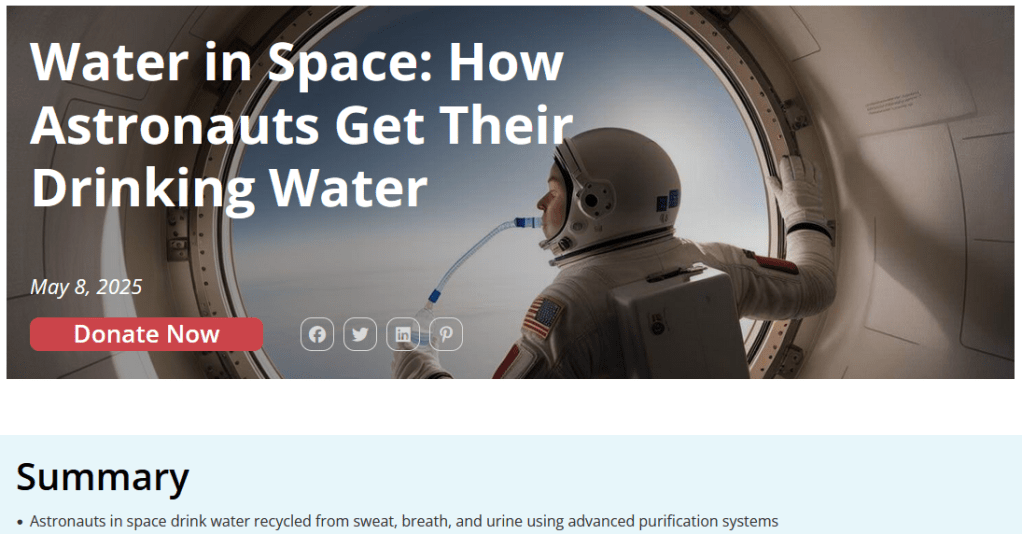
Astronauts don’t bring all their drinking water from Earth.
Instead, they rely on closed-loop water recycling systems
that recover and purify nearly every drop of moisture produced onboard.
That includes urine, sweat, breath vapor, shower water, and humidity from the air.

In space, nothing is wasted.

NASA 1132 77.0F

A space station circling the watery pebble we call home…

Cooperation brought us so far.
A majority of us have enough to eat and some of us – albeit very few – get to see the world from above.

Some of us might wonder:
What’s the point of ISS?!?
Wouldn’t that money be better spent feeding the hungry?

The short answer is:
‘We don’t need the ISS money. Feeding the hungry is well within our current possibilities. We just haven’t yet figured out how important this is!’

And here’s the explanation.
We’re no longer able to feed ourselves. Individually…
In order to enjoy our current standard of life, we need to cooperate.
In order to cooperate, we need to trust each-other.

Nobody has asked to be born.
Yet here we are.
La Legion Etrangere goes by “Marche ou Creve”. Keep walking or ‘make way’.
Now that we’ve been born, how about we make the best of it?

Those who get to see the world from above did have a say about the whole thing.
Nobody gets there against their wishes.
And they know what they’re signing for. Not everything – some of them don’t get to get there – but they have a fair image of what’s gonna happen to them. Including the facts about the water they’ll be drinking while enjoying the view.

Maybe it’s time for the rest of us to understand the limited nature of the Earth itself.
Not as limited as the ISS but I’m sure you understand my drift.

The astronauts trust each-other.

And they trust the rest of us.
Those who have made it possible for them to go there.


We, the rest, need to learn the trick.
How to actively, agentically, build trust 2.0.

He has the opportunity.
He feels good doing it.
And he doesn’t care. About the consequences experienced by those affected.
As long as those affected are not able to affect him back, of course!
And if you analyze the whole thing in a dispassionate manner,
this is a perfectly rational behaviour!

There is a difference. Between differences.
There is a quantitative difference and a qualitative difference.

There is a quantitative difference between moral and immoral behaviours/persons. An immoral person is someone who cannot restrain themselves in certain instances. Who knows the difference between good and bad and yet cannot resist. Cannot resist doing the bad thing.
And there is a qualitative difference between a moral/immoral person and an amoral one. The amoral one’s actions are not affected by morals. That person does anything they want to do as long as they is not affected by the consequences of their doings. Regardless of whatever consequences may have to be endured by others.

Which brings us to the difference between bad and evil. Also a qualitative one.
Which difference has nothing to do with the amount of damage caused to the bystanders. And everything to do with the attitude of the perpetrator regarding their actions!

As an aside, I have to remark that we are all ‘bad’.
In the sense that all of us commit bad things. That none of us is able to completely restrain ourselves from doing immoral things. From knowingly performing ‘bad’ things. Bad for ourselves or even bad for other people.

The difference between us, normal immoral people, and the evil amoral ones being simple.

The immoral perform things which are potentially bad. For themselves and for others.
For example we smoke. Which is bad. Both for us and for all those who breathe our smoke. But the damage isn’t obvious. We might die before developing a cancer, right?
And most of us have driven a car after having enjoyed one drink too many. With no intent to commit an accident, obviously.
Meanwhile, the amoral may commit things which will certainly cause harm to other people. Regardless of whatever rationales the perpetrators invent to justify their actions. From Ponzi schemes to terrorism.

I’ve saved the juiciest bite for the end of my post.
While immoral is necessarily bad, amoral is morally neutral. Anything in between necessarily bad and necessarily good.
For instance, using weapons of mass destruction and compulsory vaccination/quarantine are amoral. Both are used with a blatant disregard towards the feelings of all those who have to endure.
The first is ‘a certain killer’ while the latter has saved entire populations… go figure!

Schimbarea stăpânilor,
bucuria nebunilor.

Vorbă din bătrâni

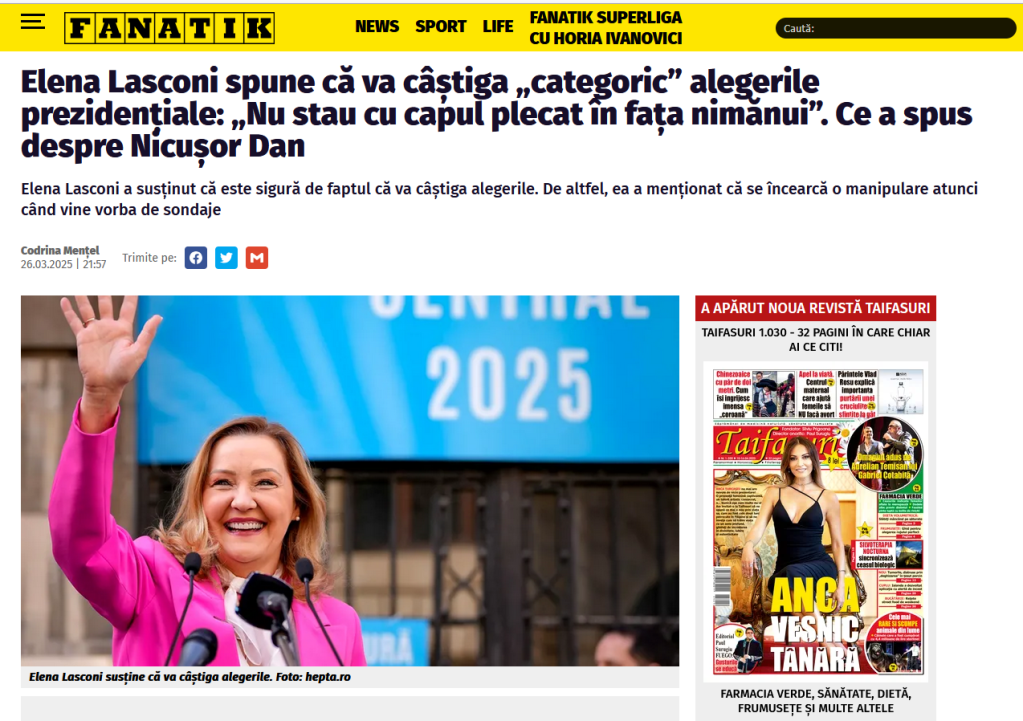
Puteți pune în locul Elenei Lasconi orice alt candidat. Orice alt candidat care a pretins că el va „câștiga alegerile”.
Apoi întrebați-l care este scopul unor alegeri. Democratice…

Avem de a face cu vre-un concurs? E un premiu pe undeva?
Sau suntem în situația în care un grup de oameni, o națiune, încearcă să determine care dintre candidații care s-au oferit este cel mai potrivit pentru postul devenit vacant?

Pentru a mă face mai bine înțeles voi sublinia cuvintele cheie:

postul care a devenit vacant


„Schimbarea stăpânilor, bucuria nebunilor” este o vorbă foarte înțeleaptă.
Vine din bătrâni și descrie perfect realitatea. Realitatea de atunci!
Realitatea de pe vremea când lumea era condusă de ‘stăpâni’.

De ‘stăpâni’ care se băteau între ei pentru putere. Care stăpâneau pentru o vreme.
Până când greșelile făcute se adunau atât de multe încât domnia lor, a fiecăruia dintre ei, se prăbușea. Foarte rar de la sine, cel mai des sub loviturile unui pretendent.
Pretendent care pretindea că el se va purta mai bine cu poporul. Care popor, exasperat de greșelile precedentului, cădea pradă promisiunilor noului pretendent.
Care popor, în foarte scurtă vreme, constata că și noul stăpân – odată ajuns la putere – se comporta cam la fel ca precedentul. De unde și vorba din bătrâni…

De la o vreme încoace, din ce în ce mai multe națiuni au învățat să folosească altă metodă de a scăpa de conducătorii nepricepuți.
Democrația.
Dacă pe vremea ‘stăpânilor’ oamenii așteptau până le ajungea cuțitul la os înainte de a pune de o revoluție – sau măcar de o schimbare de natură dinastică – în democrație treaba e mai simplă.
Din când în când, cei de la putere se dau jos de pe scaune – singuri – iar poporul își alege din nou conducătorii.
Mult mai simplu decât să pui de o răzmeriță…

Poporul e mai liniștit. Știe că, măcar din când în când, are și el ceva de spus.
Conducătorii sunt și ei liniștiți. Știu că, la un moment dat, pot ieși la pensie. Că nu li se va tăia capul imediat ce vor fi pierdut puterea…

Cu alte cuvinte, alegerile – repet, cele democratice – sunt despre cum să meargă lucrurile mai bine.
Despre cum un popor poate să schimbe pe cei care s-au dovedit a fi nu fi fost atât de pricepuți precum au pretins la un moment dat. Sau cărora li s-a urcat între timp puterea la cap…

Alegerile democratice sunt un proces în urma căruia trebuie să câștige poporul.
Candidatul ales va avea de muncit, nu va primi vre-un premiu.
Va primi ceva abia la sfârșitul mandatului.
Și asta doar dacă va face față provocărilor.
Va primi respectul oamenilor pe care i-a condus.

If it walks like a duck…
James Whitcomb Riley

By 1917 it seemed to Lenin that the war would never end and that the prospect of revolution was rapidly receding. But in the week of March 8–15, the starving, freezing, war-weary workers and soldiers of Petrograd (until 1914, St. Petersburg) succeeded in deposing the Tsar. Lenin and his closest lieutenants hastened home after the German authorities agreed to permit their passage through Germany to neutral Sweden. Berlin hoped that the return of anti-war Socialists to Russia would undermine the Russian war effort.

Do you remember the story about the early American Colonists “gifting of blankets and linens contaminated with smallpox” to the native inhabitants of the place?
It worked, to a degree, because the natives had no prior experience with the disease. Their immune systems had no prior experience with this pathogen. Which had been construed as an opportunity by those who had cooked up the plan, even though – in those times – nobody had any idea about ‘immunity’.

Lenin was also effective towards pulling the Czarist Empire out of WWI. Do we really care whether he was aware of the fact that he had been used as a 5-th column by Kaiser Wilhelm II’s strategists?

Do we learn anything?

You are permitted in time of great danger
to walk with the devil until you have crossed the bridge

Bulgarian Proverb

““The man has now become like one of us, knowing good and evil. He must not be allowed to reach out his hand and take also from the tree of life and eat, and live forever.” So the Lord God banished him from the Garden of Eden to work the ground from which he had been taken.”

Bulgaria is a Balcanic country. Having evolved more or less together, the Balcanic countries share many cultural traits. Nevertheless, individual countries do have their own characteristics. Bulgaria does have a particular one.
The name, Bulgaria, comes from a Turkic tribe. Who had conquered the area in the VII-th century and established the first Bulgarian Empire. Yet the Bulgarian people is mainly Slavic. Speaks a Slavic language and has remained Christian Orthodox despite having been ruled directly by the Islamic Ottoman Empire from 1396 to 1878. Hence it is safe to consider that the Bulgarians do know a thing or two about keeping their shit together, don’t you think?

On the other hand, who, in their right mind, would want to find themselves on the other side of the bridge? Alone with the devil?!?

Maybe ‘devil’ has different meanings for different people…

We, in our cozy world, where everything is just about fine, consider the devil to be the absolute evil.
We are taught to believe that.

Yet things were not so clearly cut in the good old days.

The Bulgarian experience suggests that when the shit hits the fan, maybe it is wiser to put aside some of the things which made you consider your neighbour was ‘untouchable’ and join forces with them. Until the real danger is gone…

An even older experience, the one shared in the Bible, suggests that the Devil had a defining contribution in us becoming ‘like one of them (Gods)’. After all, it was ‘he’ who had taught Eve to eat the fruit which empowered her to “know good and evil”. It was ‘he’ who prodded Eve, who prodded Adam, to become conscious human beings…

Let me continue this post by sharing a story. Not a funny one but which fits in this context.

Once upon a time, there was a nonconforming sparrow who decided not to fly south for the winter. However, soon the weather turned so cold that he reluctantly started southward. In a short time, ice began to form on his wings and he fell to earth in a barnyard, almost frozen. A cow passed by and crapped on the little sparrow. The sparrow thought it was the end. But then the manure warmed him and defrosted his wings. Warm and happy, able to breathe, he started to sing. Just then a large cat came by and hearing the chirping, investigated the sounds. The cat cleared away the manure, found the chirping sparrow and promptly ate him.
Now, it may seem that there are no lessons here, but there are. In fact, there are three:
1. Everyone who shits on you is not necessarily your enemy.
2. Everyone who gets you out of shit is not necessarily your friend.
3. If you’re warm and happy in a pile of shit, keep your mouth shut.

Allen Klein

I’m not sure about 3. though. Keeping your mouth shut is not always the best option. Not in the longer run…
Use your better judgement instead of letting others tell you what to do.

Having just told you to use your own better judgement instead of letting others tell you what to do, I now suggest that you click on the following link. And read Niemoller’s life story:
https://hmd.org.uk/resource/pastor-martin-niemoller-hmd-2021/