Archives for category: Mutual Respect

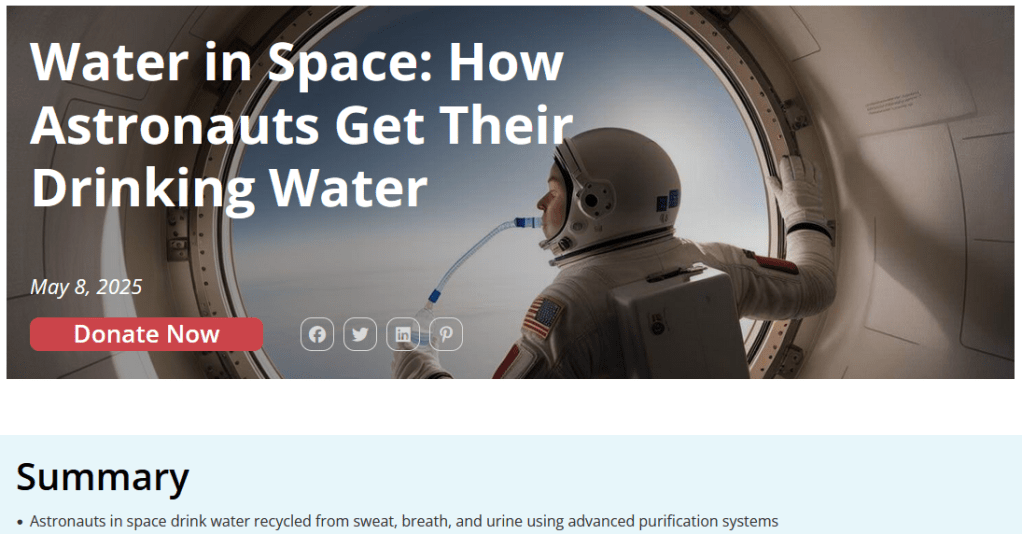
Astronauts don’t bring all their drinking water from Earth.
Instead, they rely on closed-loop water recycling systems
that recover and purify nearly every drop of moisture produced onboard.
That includes urine, sweat, breath vapor, shower water, and humidity from the air.

In space, nothing is wasted.

NASA 1132 77.0F

A space station circling the watery pebble we call home…

Cooperation brought us so far.
A majority of us have enough to eat and some of us – albeit very few – get to see the world from above.

Some of us might wonder:
What’s the point of ISS?!?
Wouldn’t that money be better spent feeding the hungry?

The short answer is:
‘We don’t need the ISS money. Feeding the hungry is well within our current possibilities. We just haven’t yet figured out how important this is!’

And here’s the explanation.
We’re no longer able to feed ourselves. Individually…
In order to enjoy our current standard of life, we need to cooperate.
In order to cooperate, we need to trust each-other.

Nobody has asked to be born.
Yet here we are.
La Legion Etrangere goes by “Marche ou Creve”. Keep walking or ‘make way’.
Now that we’ve been born, how about we make the best of it?

Those who get to see the world from above did have a say about the whole thing.
Nobody gets there against their wishes.
And they know what they’re signing for. Not everything – some of them don’t get to get there – but they have a fair image of what’s gonna happen to them. Including the facts about the water they’ll be drinking while enjoying the view.

Maybe it’s time for the rest of us to understand the limited nature of the Earth itself.
Not as limited as the ISS but I’m sure you understand my drift.

The astronauts trust each-other.

And they trust the rest of us.
Those who have made it possible for them to go there.


We, the rest, need to learn the trick.
How to actively, agentically, build trust 2.0.

He has the opportunity.
He feels good doing it.
And he doesn’t care. About the consequences experienced by those affected.
As long as those affected are not able to affect him back, of course!
And if you analyze the whole thing in a dispassionate manner,
this is a perfectly rational behaviour!

There is a difference. Between differences.
There is a quantitative difference and a qualitative difference.

There is a quantitative difference between moral and immoral behaviours/persons. An immoral person is someone who cannot restrain themselves in certain instances. Who knows the difference between good and bad and yet cannot resist. Cannot resist doing the bad thing.
And there is a qualitative difference between a moral/immoral person and an amoral one. The amoral one’s actions are not affected by morals. That person does anything they want to do as long as they is not affected by the consequences of their doings. Regardless of whatever consequences may have to be endured by others.

Which brings us to the difference between bad and evil. Also a qualitative one.
Which difference has nothing to do with the amount of damage caused to the bystanders. And everything to do with the attitude of the perpetrator regarding their actions!

As an aside, I have to remark that we are all ‘bad’.
In the sense that all of us commit bad things. That none of us is able to completely restrain ourselves from doing immoral things. From knowingly performing ‘bad’ things. Bad for ourselves or even bad for other people.

The difference between us, normal immoral people, and the evil amoral ones being simple.

The immoral perform things which are potentially bad. For themselves and for others.
For example we smoke. Which is bad. Both for us and for all those who breathe our smoke. But the damage isn’t obvious. We might die before developing a cancer, right?
And most of us have driven a car after having enjoyed one drink too many. With no intent to commit an accident, obviously.
Meanwhile, the amoral may commit things which will certainly cause harm to other people. Regardless of whatever rationales the perpetrators invent to justify their actions. From Ponzi schemes to terrorism.

I’ve saved the juiciest bite for the end of my post.
While immoral is necessarily bad, amoral is morally neutral. Anything in between necessarily bad and necessarily good.
For instance, using weapons of mass destruction and compulsory vaccination/quarantine are amoral. Both are used with a blatant disregard towards the feelings of all those who have to endure.
The first is ‘a certain killer’ while the latter has saved entire populations… go figure!

Schimbarea stăpânilor,
bucuria nebunilor.

Vorbă din bătrâni

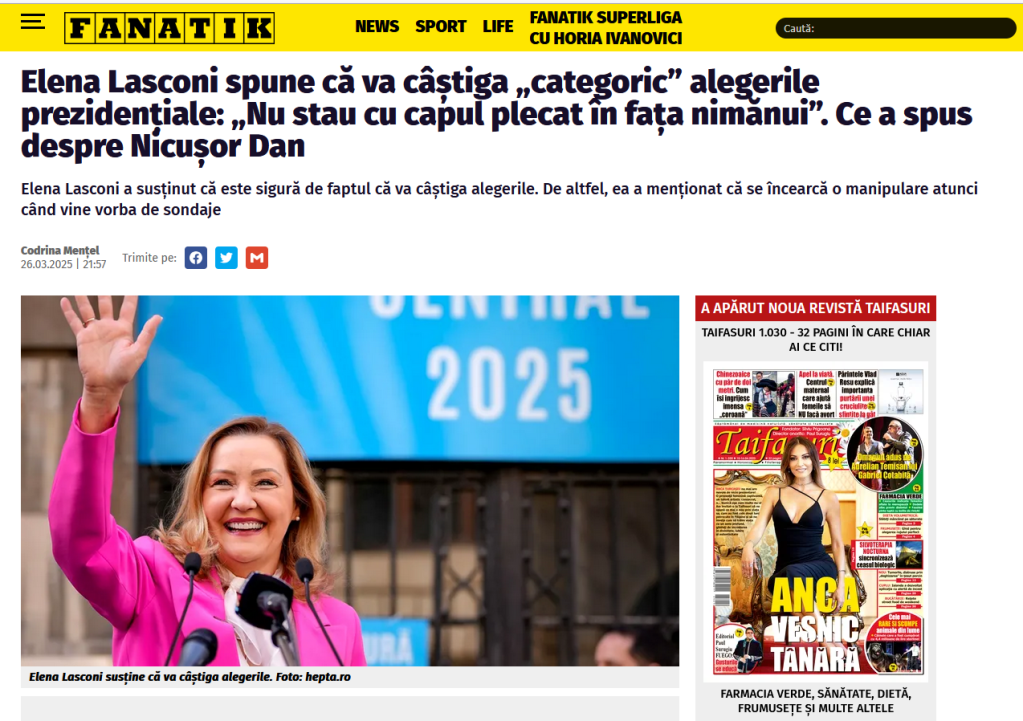
Puteți pune în locul Elenei Lasconi orice alt candidat. Orice alt candidat care a pretins că el va „câștiga alegerile”.
Apoi întrebați-l care este scopul unor alegeri. Democratice…

Avem de a face cu vre-un concurs? E un premiu pe undeva?
Sau suntem în situația în care un grup de oameni, o națiune, încearcă să determine care dintre candidații care s-au oferit este cel mai potrivit pentru postul devenit vacant?

Pentru a mă face mai bine înțeles voi sublinia cuvintele cheie:

postul care a devenit vacant


„Schimbarea stăpânilor, bucuria nebunilor” este o vorbă foarte înțeleaptă.
Vine din bătrâni și descrie perfect realitatea. Realitatea de atunci!
Realitatea de pe vremea când lumea era condusă de ‘stăpâni’.

De ‘stăpâni’ care se băteau între ei pentru putere. Care stăpâneau pentru o vreme.
Până când greșelile făcute se adunau atât de multe încât domnia lor, a fiecăruia dintre ei, se prăbușea. Foarte rar de la sine, cel mai des sub loviturile unui pretendent.
Pretendent care pretindea că el se va purta mai bine cu poporul. Care popor, exasperat de greșelile precedentului, cădea pradă promisiunilor noului pretendent.
Care popor, în foarte scurtă vreme, constata că și noul stăpân – odată ajuns la putere – se comporta cam la fel ca precedentul. De unde și vorba din bătrâni…

De la o vreme încoace, din ce în ce mai multe națiuni au învățat să folosească altă metodă de a scăpa de conducătorii nepricepuți.
Democrația.
Dacă pe vremea ‘stăpânilor’ oamenii așteptau până le ajungea cuțitul la os înainte de a pune de o revoluție – sau măcar de o schimbare de natură dinastică – în democrație treaba e mai simplă.
Din când în când, cei de la putere se dau jos de pe scaune – singuri – iar poporul își alege din nou conducătorii.
Mult mai simplu decât să pui de o răzmeriță…

Poporul e mai liniștit. Știe că, măcar din când în când, are și el ceva de spus.
Conducătorii sunt și ei liniștiți. Știu că, la un moment dat, pot ieși la pensie. Că nu li se va tăia capul imediat ce vor fi pierdut puterea…

Cu alte cuvinte, alegerile – repet, cele democratice – sunt despre cum să meargă lucrurile mai bine.
Despre cum un popor poate să schimbe pe cei care s-au dovedit a fi nu fi fost atât de pricepuți precum au pretins la un moment dat. Sau cărora li s-a urcat între timp puterea la cap…

Alegerile democratice sunt un proces în urma căruia trebuie să câștige poporul.
Candidatul ales va avea de muncit, nu va primi vre-un premiu.
Va primi ceva abia la sfârșitul mandatului.
Și asta doar dacă va face față provocărilor.
Va primi respectul oamenilor pe care i-a condus.

If it walks like a duck…
James Whitcomb Riley

By 1917 it seemed to Lenin that the war would never end and that the prospect of revolution was rapidly receding. But in the week of March 8–15, the starving, freezing, war-weary workers and soldiers of Petrograd (until 1914, St. Petersburg) succeeded in deposing the Tsar. Lenin and his closest lieutenants hastened home after the German authorities agreed to permit their passage through Germany to neutral Sweden. Berlin hoped that the return of anti-war Socialists to Russia would undermine the Russian war effort.

Do you remember the story about the early American Colonists “gifting of blankets and linens contaminated with smallpox” to the native inhabitants of the place?
It worked, to a degree, because the natives had no prior experience with the disease. Their immune systems had no prior experience with this pathogen. Which had been construed as an opportunity by those who had cooked up the plan, even though – in those times – nobody had any idea about ‘immunity’.

Lenin was also effective towards pulling the Czarist Empire out of WWI. Do we really care whether he was aware of the fact that he had been used as a 5-th column by Kaiser Wilhelm II’s strategists?

Do we learn anything?

You are permitted in time of great danger
to walk with the devil until you have crossed the bridge

Bulgarian Proverb

““The man has now become like one of us, knowing good and evil. He must not be allowed to reach out his hand and take also from the tree of life and eat, and live forever.” So the Lord God banished him from the Garden of Eden to work the ground from which he had been taken.”

Bulgaria is a Balcanic country. Having evolved more or less together, the Balcanic countries share many cultural traits. Nevertheless, individual countries do have their own characteristics. Bulgaria does have a particular one.
The name, Bulgaria, comes from a Turkic tribe. Who had conquered the area in the VII-th century and established the first Bulgarian Empire. Yet the Bulgarian people is mainly Slavic. Speaks a Slavic language and has remained Christian Orthodox despite having been ruled directly by the Islamic Ottoman Empire from 1396 to 1878. Hence it is safe to consider that the Bulgarians do know a thing or two about keeping their shit together, don’t you think?

On the other hand, who, in their right mind, would want to find themselves on the other side of the bridge? Alone with the devil?!?

Maybe ‘devil’ has different meanings for different people…

We, in our cozy world, where everything is just about fine, consider the devil to be the absolute evil.
We are taught to believe that.

Yet things were not so clearly cut in the good old days.

The Bulgarian experience suggests that when the shit hits the fan, maybe it is wiser to put aside some of the things which made you consider your neighbour was ‘untouchable’ and join forces with them. Until the real danger is gone…

An even older experience, the one shared in the Bible, suggests that the Devil had a defining contribution in us becoming ‘like one of them (Gods)’. After all, it was ‘he’ who had taught Eve to eat the fruit which empowered her to “know good and evil”. It was ‘he’ who prodded Eve, who prodded Adam, to become conscious human beings…

Let me continue this post by sharing a story. Not a funny one but which fits in this context.

Once upon a time, there was a nonconforming sparrow who decided not to fly south for the winter. However, soon the weather turned so cold that he reluctantly started southward. In a short time, ice began to form on his wings and he fell to earth in a barnyard, almost frozen. A cow passed by and crapped on the little sparrow. The sparrow thought it was the end. But then the manure warmed him and defrosted his wings. Warm and happy, able to breathe, he started to sing. Just then a large cat came by and hearing the chirping, investigated the sounds. The cat cleared away the manure, found the chirping sparrow and promptly ate him.
Now, it may seem that there are no lessons here, but there are. In fact, there are three:
1. Everyone who shits on you is not necessarily your enemy.
2. Everyone who gets you out of shit is not necessarily your friend.
3. If you’re warm and happy in a pile of shit, keep your mouth shut.

Allen Klein

I’m not sure about 3. though. Keeping your mouth shut is not always the best option. Not in the longer run…
Use your better judgement instead of letting others tell you what to do.

Having just told you to use your own better judgement instead of letting others tell you what to do, I now suggest that you click on the following link. And read Niemoller’s life story:
https://hmd.org.uk/resource/pastor-martin-niemoller-hmd-2021/

History never repeats itself.
Only keeps teaching a lesson until we actually understand it.

‘In 1936, Hitler boldly marched 22,000 German troops into the Rhineland, in a direct contravention of the Treaty of Versailles. Hitler offered France and Britain a 25 year non-aggression pact and claimed: “Germany had no territorial demands to make in Europe” ‘.

“In the summer of 1938 Hitler demanded the annexation of the Sudetenland into Germany. At this point Hitler was aware that the Allies were desperate to avoid war, and thought it likely that they would appease his demands.
Hitler threatened war over the issue of the Sudetenland. On 29 – 30 September 1938 the British, Italian, French and German leaders met in Munich to discuss the issue.
The Allies agreed to concede the Sudetenland to Germany in exchange for a pledge of peace. This agreement was known as the Munich Pact.”

On May 3, 1939, Soviet leader Joseph Stalin fired Foreign Minister Maksim Litvinov, who was Jewish and an advocate of collective security, and replaced him with Vyacheslav Molotov, who soon began negotiations with the Nazi foreign minister, Joachim von Ribbentrop. The Soviets also kept negotiating with Britain and France, but in the end Stalin chose to reach an agreement with Germany. By doing so he hoped to keep the Soviet Union at peace with Germany and to gain time to build up the Soviet military establishment, which had been badly weakened by the purge of the Red Army officer corps in 1937. The Western democracies’ hesitance in opposing Adolf Hitler, along with Stalin’s own inexplicable personal preference for the Nazis, also played a part in Stalin’s final choice. For his part, Hitler wanted a nonaggression pact with the Soviet Union so that his armies could invade Poland virtually unopposed by a major power, after which Germany could deal with the forces of France and Britain in the west without having to simultaneously fight the Soviet Union on a second front in the east.

What is the lesson here?
That each tyrant believes they can outwit all other tyrants.
That tyrants are convinced they can outwit democratic alliances.
That, in the end, all authoritarian regimes fail. Abysmally. For the simple reason that inability to accept their own faillings makes all authoritarian leaders incapable of coping with change. Unable to adapt. Unable to evolve. Hence all authoritarian regimes are inherently fragile.

And who suffers the consequences?
We do. All of us. “World Wide Wars”, remember?

“Insanity is doing the same thing
over and over again
and expecting different results”

Rita Mae Brown

“Knowledge is limited. Imagination encircles the world.”

First celebrated as a brilliant physicist, Einstein had later been recognized as an ‘all rounder’.
So much so that he was found ‘guilty’ for other people’s words.

Rita Mae Brown?!?
Why bother mention her? If you want ‘to back’ up such an important saying, you’d better come up with a really famous ‘promoter’. Preferably a dead one…

‘And your point is…?’

On January 27, the day when Auschwitz was liberated 80 years ago, I shared this on FB:

Some people took exception. Interpreting this as an allusion to what’s currently going on in the US, they asked me to ‘be specific’.

“I don’t protest the protesters but their particular way of doing it. Without any consideration for the ‘collateral damage’ and turning a blind eye towards the already experienced facts.”

My point being that Hitler didn’t invent antisemitism. Germany wasn’t the first country where large scale pogroms were organized.
Pogrom is a Russian word. “To wreak havoc, to demolish violently”.
The way I see it, ‘pogrom’ is not only a tragedy – for both victims and perpetrators – but also a symptom.
A symptom that something is amiss in the society which allows it to happen.

To protest something is fully justified.
If unhappy about something, one is fully entitled to try to prevent that something from happening. Again…
But it would be ‘unreasonably’ to ‘prevent’ it in a way that will be even costlier than the ‘feared development’. Particularly ‘unreasonably’ if the method had already been experimented!

Those supporting Hitler were ‘protesting’ the Versailles Treaty.
Just as Lenin’s Bolsheviks were protesting what had happened during the czarist Russia.
Hitler and Lenin protested by perpetrating crimes even more heinous than those they were protesting.

They should have known better.
Those who supported them, of course… for it was the supporters who had ultimately experienced the consequences!
After all, one doesn’t have to be a rocket scientist to understand that the simple fact that this time it is the others who are at the receiving end of what’s going on doesn’t make it right. In no way better than what we have experienced. And continue to… The misery experienced by the others does not annihilate ours!

Celebratory meme posted by ecstatic Trump 47 supporter a few days after the inauguration.

True enough.

Only living in a world where everybody is scared… isn’t that much fun!

Not even for those who have managed to amass all the money in the market.

As somebody who has lived under both communism and not yet free market capitalism I must stress that there’s little difference between communism and monopolistic capitalism presented under the guise of democracy.
Between a social order where all power – political, economic, social, you name it – is concentrated in the hands of a few self selected people pretending to protect the interests of the people. A social order described by those calling the shots as being a ‘popular democracy'(?!?).
And a social order where all power – …. – is concentrated in the hands of the few people who have amassed all the riches in that particular society. And who, behind manipulated -and no longer liberal – democratic mechanisms pretend to protect the interests of the people.

The problem with both situations being the fact that a few people – no matter how capable and/or well intended, if that is the case – cannot manage, over a sizeable amount of time, such a complex thing as a society. Period.

“Intelligence is the ability to think, reason, and understand
instead of doing things automatically or by instinct.

Nerve cells, after all, do not have intelligence of their own.

Theoretically, we do have a certain understanding regarding the thing we call ‘intelligence’. After all, there are some dictionary entries discussing the matter.
But when it comes to measuring the said intelligence… nothing is straightforward anymore. So we still have a lot to learn about the thing. About our ability to understand, after all… About our ability to understand, period, including our own intelligence.

Click the picture above and read the article. It is interesting. The most interesting part being what it misses.

The first really intelligent computer application put together by man was the one who defeated Garry Kasparov.
Has anyone been invited to play chess by an application?
Is anybody aware of any chess or go application who had any initiative? Meaningful initiative? Other than making this or that move only AFTER a human had initiated the game?

What are we discussing here?
The intelligence level of any of the many, present or future, artificial intelligence applications or their ability to become aware? Aware of anything…

Furthermore, when we discuss whether AI, ANI, AGI or even ASI would erase humankind from the face of the Earth… nobody has yet mentioned us. After all, we are the ones building the applications. The computers on which we run the applications…
Instead of worrying whether any of the AI versions would do anything to us, we should worry about what some of us will do after they will have laid their hands on a really powerful AI application!

“There’s going to be things we do and the superintelligences just get fed up with the fact that we’re so incompetent and just replace us.”
Nearly 10 years ago, Elon Musk, founder of SpaceX and CEO of Tesla Motors, told American astrophysicist Neil deGrasse Tyson that he believes AI will domesticate humans like pets.
Hinton ventures that we’ll be kept in the same way we keep tigers around.
“I don’t see why they wouldn’t. But we’re not going to control things anymore,” he said.
 “


Total BS. ISS distance from Earth is 408 km.
So, the Moon should be…
I don’t know. You do the math.
In this picture, it looks like ISS is orbiting the Moon, not the Earth.”
Somebody on the Internet

“I don’t know. You do the math!”
But you do have the right to express your opinion, right?

Me

„I disapprove of what you say,
but I will defend to the death your right to say it

Voltaire

Oui maître, mais…
‘I will defend to the death your right to make a fool of yourself. To demonstrate your ignorance…’
OK, I get it. Only your attitude stems from your conviction that everybody who is able to read is also able to understand the meaning of what they read…
Which is no longer valid!

What do we need to do?
Educate? The readers…
Censor? The aberrant? And who will ‘put the stamp’?!? Who will be the trusted arbiter playing God?
Wait till the consequences of our laisez-faire will rattle their skulls against our crossed bones?

Or simply wake up?
Remember that mutual respect is paramount for our collective survival.
And that asking before sentencing is the smart thing to do….