Archives for category: man as a measure for all things

The theory that each person imposes the moral law on himself. It is opposed to heteronomous morality, which holds that the moral law is imposed from outside of man by another, and ultimately by the divine Other, who is God, which makes the moral law theonomous.

I argued in my previous post that in a perfect world the simple fact that we consider ourselves to have been created, in his likeness, by the God we believe in, would have been enough to make us behave in a certain manner.

We don’t. Behave in that manner.

The world exists. And will continue to exist, regardless of whatever we might do in the foreseeable future. Maybe not the Earth as we know it but it’s rather unlikely that we’ll ever be able to destroy the entire world.
Here, on our home-planet, we’ve more or less soiled everything we’d come in contact with. Willingly or unwittingly.
Which suggests that the world might not be perfect but is more or less OK. And that it is us who haven’t yet risen to the occasion.

We may not have fully risen to the occasion, indeed, but we’ve managed to somehow survive. Until now, that is.
How was that possible, given our imperfect nature?

Was our behaviour shaped from outside as the heteronomous morality theory suggests? By (a) God, as the theonomous morality theory pretends?

“Now the serpent was more crafty than any of the wild animals the Lord God had made. He said to the woman, “Did God really say, ‘You must not eat from any tree in the garden’?”

The woman said to the serpent, “We may eat fruit from the trees in the garden, but God did say, ‘You must not eat fruit from the tree that is in the middle of the garden, and you must not touch it, or you will die.’”

“You will not certainly die,” the serpent said to the woman. “For God knows that when you eat from it your eyes will be opened, and you will be like God, knowing good and evil.”

When the woman saw that the fruit of the tree was good for food and pleasing to the eye, and also desirable for gaining wisdom, she took some and ate it. She also gave some to her husband, who was with her, and he ate it. Then the eyes of both of them were opened, and they realized they were naked; so they sewed fig leaves together and made coverings for themselves.”

What do we have here?
A couple of people, who are already able to speak, who cannot yet make the difference between good and evil but who can see that ‘the fruit of the tree is good for food’ and ‘desirable for gaining wisdom’.
Furthermore, the couple is not only able to communicate between the two of them, they – or, at least, one of them, are also capable to negotiate with ‘outside agents’.
And, in fact, it was a consequence of a ‘negotiation’ that they had learned to differentiate between good and evil.
Moving even closer to Godhood in the process: “The man has now become like one of us, knowing good and evil. He must not be allowed to reach out his hand and take also from the tree of life and eat, and live forever.”

“So the Lord God banished him (them, actually) from the Garden of Eden to work the ground from which he had been taken.”

I must confess that things become more and more complicated instead of becoming clearer.
‘Moral law is imposed’…
Adam and Eve have learned the difference between good and evil as a consequence of ‘freely’ interacting with someone from ‘outside’ their ‘immediate community’.
And got punished for it. On a ‘technicality’!

What is moral in all this?
What are they to learn from this experience?
Since all that God had imposed on them was ‘punishment’, are they (we?!?) to understand that ‘moral law’ is equivalent with ‘gallows’?

In this setting, moral law is supposed to be learned exclusively through ‘trial and error’?
No ‘explanation’? No ‘prep school’?
Is this nothing but a form of ‘radical training’? Like that advertised by B.F. Skinner?
Not to mention that for some ‘sins’, the punishment is to be served ‘later’…

“God created mankind in his own image, in the image of God he created them; male and female he created them.”

Hence all people, male and female, have been created equal. Simply because all of them have been cast in the same mould.
And all of them, male and female, harbor a spark of divinity. Simply because the mould into which all of them have been cast had been made “in the image of God”.

Simple logic would tell us that all people who believe mankind had been made in the image of God would behave in a certain manner.
Because of the reasons I mentioned above.
That kind of behavior had been called ‘ethical’ by well established thinkers. Plato, for instance.

“Then God said, “I give you every seed-bearing plant on the face of the whole earth and every tree that has fruit with seed in it. They will be yours for food.” “

.
.
.

“This is the account of the heavens and the earth when they were created, when the Lord God made the earth and the heavens.
Now no shrub had yet appeared on the earth and no plant had yet sprung up, for the Lord God had not sent rain on the earth and there was no one to work the ground”

Same simple logic I’ve invoked earlier tells me that God had created ‘the heavens and earth’ in two different stages. More or less like we do things.
First we think about the things we are going to do – ‘design them’ would be a more modern term, and then we put our thoughts into practice. ‘Execute’ our designs, according to the practical aspects which always limit our actions.

“Then the Lord God formed a man from the dust of the ground and breathed into his nostrils the breath of life, and the man became a living being.”

The Bible itself seems to agree with me. When God finally decided to put into practice his idea of a man, he started with something he already had at his disposal. Just like we have to do whenever we attempt to accomplish anything.
“Dust from the ground”.
Man, ‘made in the image of God’, was fashioned from already available material, not from ‘thin air’.

Could this be the origin of man’s limitations?
His ‘earthly’ nature, no matter his divine likeliness?
Could this be the reason for God going back on his words?

“The Lord God took the man and put him in the Garden of Eden to work it and take care of it. And the Lord God commanded the man, “You are free to eat from any tree in the garden; but you must not eat from the tree of the knowledge of good and evil, for when you eat from it you will certainly die.” “

What made God change his mind?
In Genesis 1 – the R&D phase?, he had planned a world where man was allowed to feed on everything under the sun while in Genesis 2 he had established rules about what Adam was allowed to eat and what not.
Furthermore, why make a ‘tree of the knowledge of good and evil’ in the first place? If you were going to forbid your favorite pet from eating its fruit, under the most drastic penalty…

No!
This is not yet another half backed attempt to deny the existence of God under the pretext that the only source describing its existence is full of inconsistencies.
Pretending that God does not exist simply because those who tried to describe him had not been able – or willing ?, to present a more coherent image of him is equivalent to pretending that God exists simply because we haven’t found, yet, an exhaustive explanation for everything.

You ‘see’, the Bible, no matter how holly we might consider it to be, is nothing but an image of God. A Man made image of God.
A Man written image of God, to be more precise.

The fact that the Bible is chock-full of wisdom can not be denied.
Which fact remains true regardless of whether it had been written ‘under guidance’ or ‘on their own’ by a group of ‘free agents’. Or, even, by a combination of both.
Unfortunately, there is another fact which seemingly contradicts the first. The Bible had been used as pretext for horrible crimes. Committed by ‘over-zealous’ believers, by ruthless ‘self serving’ operators or by a strange combination of both.

In order to encompass the simultaneous existence of both aforementioned facts each of us must take a step back-wards.
Extract ourselves from the fry.

Each of us must start thinking for ourselves.

How to do that – become ‘independent’, and yet preserve our chances to survive? As in remain connected with the day to day, hard-core reality?

Stay tuned. That will be my next subject.

Each of us made of a huge, but finite, number of atoms belonging to a few chemical elements, we, humans, are in relative control of a huge, but finite, planet.

As animals – living animals, that is, we need to constantly ‘ingest’ part of our environment and periodically excrete the ‘consequences’ of our metabolism.

As conscious humans we learn. Constantly.
Practically, we ingest information about what is going on around us.
We ‘digest’ it by ‘thinking’ about what concerns us.

Only the more ‘sophisticated’ animals control their bladders and bowels. Hence choosing – according to various criteria, what to do and where to deposit the ‘consequences’ of their metabolism. By doing so they actually increase their chances of survival.

We, as the most sophisticated animal around, have taken a huge step forward. We not only control our excretion, we also control our intake.
Animals – along with plants and fungi, ingest whatever they can from whatever surrounds them at any given time.
We’ve reached the stage where we actually change our environment in order to make it more amenable to our wishes. To our wishes, no longer to our mere necessities.

While the living have started to change the planet long before we evolved into being – by ingesting part of it, digesting it and excreting the consequences of their metabolism, we’ve considerably ‘revved up’ the process.
Simply because of our ability to learn and apply our knowledge towards what we consider to be our goals.

In a sense, we not only ingest our environment in a direct, material, way but also in a ‘virtual’ one. By learning about it we practically ingest it in an ‘informational’ manner. And by implementing our decisions we ‘excrete’ the consequences of our learning.

As I mentioned before, the animals who control their bladders/bowels have experienced increased chances of survival as a consequence of their new – evolutionary speaking, ability.
It is high time for us to learn how to control our imagination/desire in order to achieve the same thing. Regarding to our ability to informationaly ingest and decisionally transform our environment.

I was arguing yesterday that life, as a biological phenomenon, depends on membranes doing their jobs.
Keeping the inside in, the outside out and managing the transit of substances. Nutrients in and excretions out. For some organisms, their ‘membranes’ also act as a thermo-regulators.

‘Watching’ a membrane in action, one might get the impression that it has been endowed with a certain ‘awareness’. The membrane acts as if it were aware of the differences between its inside and its outside. It recognizes what belongs where and keeps them there. It also recognizes nutrients for what they are – and lets them in, and excretions for what they are – and where they should be.
OK, the membrane does what it does simply because it was ‘pre-programmed’ in a specific way, according to the genetic information each organism has received from its predecessors. There’s nothing supernatural involved here. For what we currently know, anyway…

Watching, as a dispassionate outside observer, the evolutionary process unfolding one might get the impression that life itself has a certain awareness.
‘Rules of life’, read genetic information passed along from one generation to another, are diligently updated to fit the changes in the environment. Nevermind that the whole process is ‘impersonal’, ‘goal-less’ and is fueled by haphazard trial and error, the end result is what we currently consider to be ‘learning’!
That’s what we try to code into our artificially intelligent machines, don’t we?

Further more, recent research points out that individual organisms share information with their brethren.
Bacteria can share antibiotic resistance genes through lateral transfer.
Physarum polycephalum, a unicellular organism, seems to be able to share information already learned when it comes in contact with other members of the species.
Plants “can “talk” in several different ways: via airborne chemicals, soluble compounds exchanged by roots and networks of threadlike fungi“.

Since communication itself is a process which implies the ability to differentiate between a ‘run of the mill’ situation and one special enough to warrant the effort to ‘talk’ about it, I find all these to be compelling arguments for life itself to be considered as implying certain forms of awareness.

Indeed!

Only there are a few hurdles which will have to be negotiated first.

Which ‘truth’?

Mine?
Which will set me free?
Theirs?
Which will set them free?
Or ours?
Which will set us free?

What is Truth in the first place?

What I believe in?
What we believe in?
Something which is out there and we learn about incrementally? In a collective manner but individually driven?

How can we find it? If ever, of course….

Agree to something which has worked until now?
Listen to what those around us have to say about the/any matter?
Do your ‘own homework’?
All of the above, in a respectful manner?

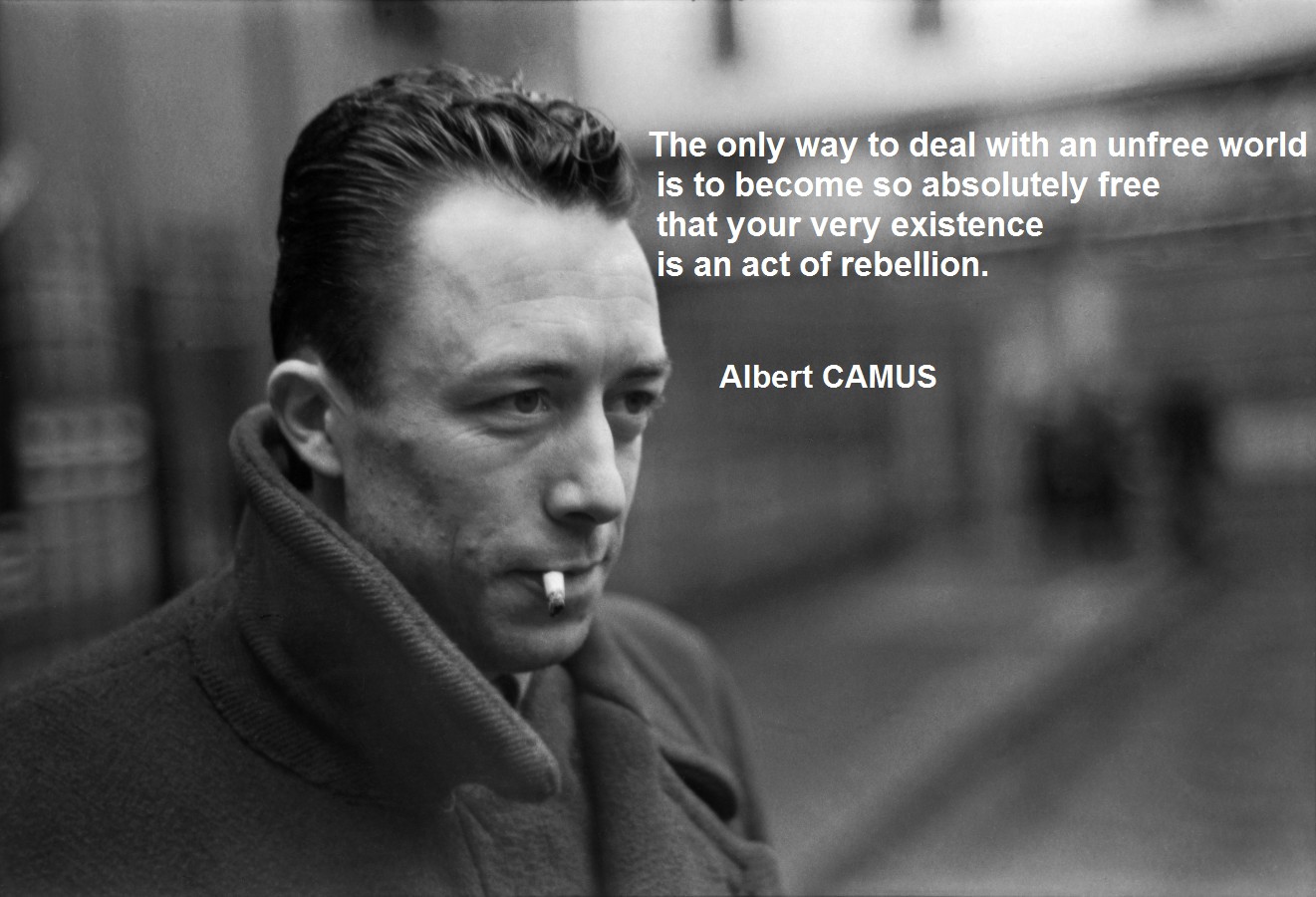
Freedom is too bothersome?!?
Have you considered the alternatives?


https://i.kym-cdn.com/photos/images/original/001/178/733/780.jpg

Last time I checked, for a rebellion to make sense, it had to be against some precise thing. Otherwise…

On the other hand, there are only two kinds of freedom.
‘Against all others’ – which starts as anarchy and very soon becomes atrocious dictatorship. Where the dictator is free to rule and the oppressed are free do obey. Or to attempt to climb into the dictator’s shoes…
Or ‘with all others’. Also known as ‘democracy’. The real thing, of course, not the ‘mob rule’ variety which is currently creeping upon us.

Hence the only sensible rebellion would be the one against any form of dictatorship and ‘executed’ in concert with the rest of the oppressed.

Relative to what?
For whom?
By whom?

‘We’ – as in we, conscious human beings, live in the two tiered environment called – by us, ‘reality’.
I consider it to be ‘two tiered’ simply because it consists of a ‘natural’ layer and a man made one.

The ‘natural’, at least the part we inhabit – a relatively thin ‘skin’ surrounding the Earth, is the consequence of natural evolution. The elements have eroded the mountains, microorganisms have transformed sand into soil and ‘reconfigured’ the atmosphere, lions make sure that antelopes don’t graze the savannas back into deserts… and so on.
On top of that we’ve build a second, man made, layer. Roads, cities, churches… And, a lot more important, many strata of ‘understanding’. Collectively known as ‘culture’.

We live in a Nature which had been ‘civilized’ by ‘culture’.
Well, in fact it was us who have civilized Nature according to our culturally accrued understanding of things.

Freedom is a human concept.
Which belongs to culture, hence to one of the man-made layers which constitute the surrounding reality. The environment which hosts our lives.
Freedom, like many other components of the man made layer of reality, has two dimensions. One of a physical nature and one of a virtual nature.
Both dimensions exist only in our heads. Or, better said, exist only inasmuch as we’re aware of them. Inasmuch as we understand the concept.

For example, one aspect of the ‘physical’ liberty is our ability to move around.
Which liberty is ‘relative’ to gravity, for all those who are fit enough to exercise it and is made possible by the hardness of the Earth’s surface.
To make the example clearer, just imagine what happens to somebody caught in a pool of quicksand. Or in a pit full of molten tar.

The ‘cultural’ side of freedom has to do with the social relations which exist in a given extended community.
Hence its ‘virtual’ nature, since there is nothing ‘physical’ to determine its extent or ‘intensity’/quality. Prisons and shackles do not qualify here since they are used by some people to restrict the freedom of other people, they do not occur in nature.

Cultural freedom of one individual is relative to what the rest of the society has to say about it.
Is for whom the society considers fit to extend it to them.
And is by the same set of rules and customs which keeps that extended community together.

Like all things cultural, freedom has history. What we, collectively remember about its development in time.

At first glance, it would seem impossible to gouge what individual liberty meant 100 000 years ago, right?
Indeed, only some people still live, today, according to rules and customs which might have been valid then. The Saan and Hadza peoples in Africa, some of the indigenous tribes still living ‘traditionally’ in the Amazonian forest...
And these people have a very interesting behavior regarding ‘individual freedom’.
One is free to do as they please, for as long as their behavior do not jeopardize, in any way shape or form, the survival of the group. By not sharing, by intentionally hurting another member of the community…
The punishment for trespassers being banishment.
Temporary or even permanent. The offender is sent out into the wild, to fend it off on their own. Temporary – under the assumption that the individual will be able to learn their lesson, or – for unpardonable transgressions, for ever.

The next step, as human consciousness had become sophisticated enough to make the difference between ‘us’ and ‘them’ – one level higher than the difference between ‘me’ and ‘them’, we’ve invented slavery.
For who are the slaves?
People so different from us that we are no longer able to picture ourselves ‘in their shoes’. Just as we cannot picture ourselves as beasts of burden or as egg laying hens.
And, just as in the previous step, individual liberty was something reserved for those members of the society deemed fit for enjoying it. As individuals who are welcome at the communal fire or as individuals who are not dependent on anybody else – but the ruler/government which dispenses/embodies freedom in a given ‘formal’ society, of course.

Some extended communities have managed to go even further.
And noticed – to their amazement, perhaps, that slave-less societies fare a lot better, as a whole, than those where some of the population enjoy less freedom than the others.
Since these societies had already learned to write and to rely quite heavily on formal laws, this particular piece of information had been enshrined as the most fundamental ‘human right’.

OK, if things are so straightforward as you pretend, then why are we still having this discussion? Why ‘pockets’ of slavery – and indentured servitude, can still be found on our planet? Why, in a growing number of places, people are increasingly putting ‘personal safety’ ahead of ‘individual – and collective, liberty’?

Lack of Trust.

As I mentioned before, freedom is something which may occur in certain circumstances and which is, its social tier, a collective endeavor of the entire extended community. ‘Endeavor’ because liberty is never ‘achieved’. It has to be nurtured constantly, … or else!
The most important circumstance being mutual respect between the members of that particular extended community. Mutual respect which includes trusting your peers.
As I mentioned before, individual liberty is for ‘selected’ members of the community – under aged children continue to be excluded to this day, for example, and ‘by’ the rest of the members who constitute a community.
As mutual trust between the members decreases – for whatever reason, people are no longer willing to ‘extend’ liberty to their fellow … fellow what?!? Since they no longer perceive each-other as being fellow trustworthy citizens…

This being the reason for which deeply divided societies fall prey to totalitarian propaganda.

Whenever too many members of a society arrive to the conclusion that they will never ‘make it’ – because of ‘the wealthy’, or the king, emperor, you name it, will never ‘let them’, those people are ‘ripe’ for socialist propaganda.
On the other hand, if too many people who had once belonged to the middle class are somehow ‘demoted’ – because of various causes, and arrive at the conclusion that the current government isn’t doing ‘enough’, those people are rife for nazi/fascist style propaganda.
Tsarist Russia and WWI defeated Germany are the first examples which come to my mind.
Not much difference between those two regimes, anyway.
Both pretend to put the collective above the individual but, in fact, all what they achieve is to rise an individual dictator above all others.

Apparently, in this situation, the dictator/absolute monarch garners much of the ‘available’ liberty, thus reducing that of the rest.
In practice, things are not that simple.
The dictator becomes ‘freer’ than his subjects only in the ‘virtual’ manner.
He is free only from being interpellated by those around him. But not from the consequences of his decisions.
This being the reason for which all totalitarian regimes crumbling down. Sooner or later.
Nobody, how ever well intended and capable, was ever wise enough to pull through a dictatorship. From Alexander the Great to whomever you want to pick up from the current gallery.

So, is there anything to be done about this?
Or should we just prepare ourselves for the worst?

There are some tools which might come handy. ‘Checks and balances’, the ‘rule of law’…
But tools are only as useful as the mind which tells them what to do.
For ‘checks and balances’ to work, all parties involved need to respect each-other. ‘Checks and balances’ have been devised to weed out ‘honest’ mistakes, not to contain a raging – and conniving, bull.
Same thing with ‘the rule of law’. Laws are enforced, and written, by humans. If those who enforce, or write, them to not respect the others – and these others do not trust them back, the whole thing becomes a farce.

There is one thing which may convince us to clean up our act.
A healthy dose of history.
The understanding that we have just one planet at our disposal. For only this long.

Do we care?
Do we really care?

Let’s pretend, for the sake of argument, that we still do.

Perceived utility.

There are at least three examples of ‘mutual respect’, and its corollary, functional democracy, having developed naturally.
In the Ancient City of Athens, in Medieval Scandinavia and the entire history of the Jewish People.

The Ancient Athenians had evolved in a particular set of circumstances. They had some – but not much, fertile land, a natural port and a lot of trading opportunities in their vicinity. Hence they had experimented, very early in their development as a nation, something which was later to be described as ‘division of labour’. This very ‘division of labor’ induces trust among the members of the society. The trader has to trust that the farmer will continue to produce while the farmer has to trust the trader to come back with the money. And/or other merchandise. Further more, people involved in oversea trading, and in commercial – versus subsistence, farming, tend to develop a more independent mind-frame. And a healthy dose of self-esteem.

The same evolutionary process had happened in Medieval Scandinavia. The erstwhile subsistence farmers and fishers have expanded their ‘scope’ and became traders cum pirates. Those who ‘manned the fort’ had to trust those who went away would come back to share the spoils and those who rode the waves had to trust each-other ‘in battle’ and the ‘home-makers’ to keep the hearth warm.

Finally, the Jews had been the firsts – that I am aware of, to come with the notion that ‘God had created Man in His own image’.
Hence all men – or, at least, all those who believed in said God, were considered to be ‘equals’. ‘Equal’ sons of the same Father. Add to that the fact that each of those sons were bearing the mark of their Father – His likeliness. How not to trust/respect your ‘brother’?!?

Are we able to recreate this Weltanschauung?!?
To notice, and appreciate, the role played by each of us in the social clockwork?
To teach our children to become useful members of the society?

Let’s remember Darwin’s The Origin of the Species. Evolution is about species, not individuals.
We, individuals, are the ones who had come up with the concept of ‘freedom’. Are we wise enough to use it properly?
For the good – read survival, of our extended communities?
As we somehow managed to do until recently?

Or lazy enough to allow it to be used as a wedge to pry us apart? To smithereens?
By people who have no inkling about what they’re doing?

‘Things are not at all what they ‘really’ are but only what they seem to be.’

Confusing?

What we have here is the intersection between ‘reality’ – a.k.a. ‘absolute’ truth, and knowledge – a.k.a. logos or relative truth.

‘Things’, ‘existence’ and ‘reality’ are concepts.
Developed by us, conscious people, through the use of ‘logos’ and starting from two implicit premises.
That there must be something outside our consciousness – both the individual and collective ones.
And that our perceptions do have at least some correspondence in that ‘outside’.

By adding layers and layers of logos, collectively known as ‘culture’, upon our initial perceptions we’ve actually built an alternative reality. The one we call ‘civilization’.

The ‘thing’ being that this second reality is just as ‘outside’ our grasp as the original one was. And continues to be.
Because of our own consciousness, which both separates and connects us to ‘reality’.

What we are left with are our ‘perceptions’.
And with our understanding, for those who had reached it, that ‘perceptions’ are ‘real’ only in the sense that they do correspond to some segments of ‘reality’ but they are not necessarily similar to them.

Our concepts, not matter how gingerly refined and thoroughly revised, are only representations of ‘reality’.
‘Real’, in their own right: developing them produced, and continues to, its own set of consequences – a.k.a. ‘civilization’.
The downside being that some of those concepts have begotten rather unpleasant consequences.

‘Moral depravation’, ‘pollution’, ‘corruption’…

It doesn’t really matter how many of these consequences are the result of ‘direct’ action or unintended spin offs.

What matters is that we have to understand there will always be a distance between what we believe at some point and the object of our belief. That that distance may have enormous consequences. And that our only chance to avoid those consequences is transparency.

Heidegger was speaking about ‘unhiddenness’.
The limited nature of both our consciousness and rationality produces the distance between our concepts and their ‘real’ correspondents.
Only by openly, and respectfully, sharing what we know about ‘things’ we’ll be able to shorten that distance.
Otherwise, the limited nature of the reality we live in – the planet itself, will no longer be able to accommodate the hiatus between our concepts and the only reality we have at our disposal.

“Tolerance without reasonable limits is like walking around with a “KICK ME” sign that you put on your own back.”

John Faithful Hamer

Well…

‘Tolerance’ is a two dimensional thing.
‘Intensity’ and ‘wideness’.
What I tolerate and how far I allow things to go before I react to them.

Indiscriminate and limitless tolerance is, indeed, incompatible with life as we know it.

Actually.
It would mean total surrender to the first ‘bidder’.

(Absolute) intolerance would mean ‘constant warfare’.
A.k.a. beating the crap out of anybody who even dares to look up.
…. Being (feeling) compelled to attempt to …

Your choice.

Our choice?

Yet another misleading title

OK, I fully understand the editors’ need to grab readers’ attention… I also understand the fact that the readers themselves have become somewhat forgiving… in the sense that most don’t even notice that the title which convinced them to read an article is only vaguely connected to the rest… but how far down this road do we need to go before understanding how dangerous it is?

Most people do not trust the media anymore… could it be that this had been helped by the continuously widening distance between the titillating titles and the actual content of the articles?

How about ‘Men are attracted by smart women but not enough for them to overcome a certain weariness’?

Now, that I’ve hopefully grabbed your attention, let me delve into the matter.

“…more and more research reveals that though the thought of a smart woman is appealing to men, a real, live smart woman standing in front of them is actually a turnoff.”

“Researchers at the University of Buffalo, California Lutheran University, and the University of Texas at Austin” developed a two tiered study to test their hypothesis.
During the first step 105 men where read a “hypothetical scenario in which a woman either outperformed or underperformed them in a math or English course, and then (they were) instructed … to imagine this woman as a romantic partner”. During this step the men who were outperformed tended to describe a more favorable impression about the woman they were compared to than the one offered by the others. And this finding seems to validate another claim made earlier this year: “Men value intelligence in women far above large breasts and long legs.”
During the second step each of the same men were asked to complete something that looked like an intelligence test and then offered the opportunity to meet a woman that had either out or under performed them. Surprisingly (or not?) the men who were going to meet a woman that was smarter than them “distanced themselves more from her, tended to rate her as less attractive, and showed less desire to exchange contact information or plan a date with her,”

This being somewhat inline with the conclusion of another study which finds that: “men’s avoidance of more intelligent or ambitious women could be due to fear of rejection by these higher quality women.”

Can we even try to draw a conclusion? Given so much contradictory information?

Let’s start from here:

“This study also did not take into account men who are already in a relationship with a more intelligent woman.”

Wow! It wasn’t that hard, after all…
Until now we were considering ‘thoughts’ and ‘impressions’ provided by individuals confronted with ‘hypothetical scenarios’ but who had no first hand experience about the real deal…

But do not despair. You haven’t lost precious time reading all this.

Here’s some ‘homework’ you might find challenging:

Why are some men – those who haven’t yet discovered that this situation could be comfortable – avoiding a romantic relationship with a more intelligent/ambitious woman? While so many same sex friendships bond people who display different levels of intelligence/ambition?

Are we that stuck in our old ‘gender roles’? Do males’ egos still tend to be threatened if they are not the alpha member of their household?

Or could it be that some of the males tend to associate female smartness with a variety of rather aggressive feminisms and it’s this that puts them off, not the the intelligence itself?

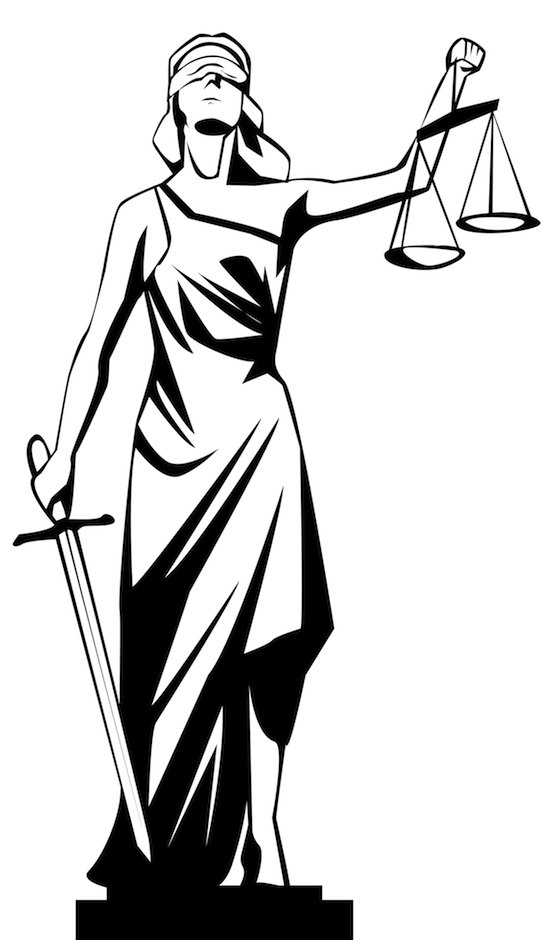
And why is it that justice is usually depicted as a blindfolded woman instead of an overbearing male?